 by Tom Gurney
Tom Gurney BSc (Hons) is an art history expert with over 20 years experience
Published on June 19, 2020 / Updated on November 19, 2026
Email: tomgurney1@gmail.com / Phone: +44 7429 011000
Introduction
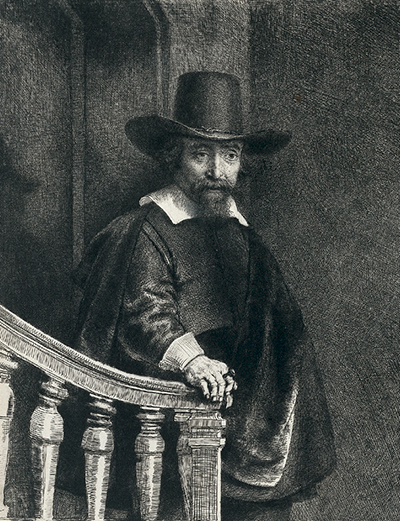
Light catches the stair rail before it reaches the face of Ephraim Bueno. The Amsterdam physician, also known as Ephraim Bonus, has paused with one hand on the newel post. His white cuff and collar pick him out against the wall, while the broad brim of his hat leaves his face in shadow. Look into that shadow and the grey separates into a fine mesh of lines. Across the sleeve, short strokes follow the rounded cloth. On the staircase, brighter spaces between the marks give the wood its polish. Rembrandt made the portrait in 1647. One impression in the Rijksmuseum, RP-P-1961-1154, is catalogued as the second of two states and combines etching, drypoint and engraving. [1]
Those three techniques could leave very different marks, even though all three printed in the same ink. Rembrandt could also change the image after he had seen a trial impression, or wipe the plate differently the next time he printed it. The surface receiving the ink might be a sheet of European laid paper, a smooth paper imported from East Asia or, on occasion, vellum. A second impression might show the same figure on the same staircase and give a different sense of how much light reaches him. Much of the pleasure of looking at Rembrandt’s etchings comes from learning to see where those differences originate.
At a Glance
- TechniquesEtching, drypoint and engraving
- Working surfaceCopper plate
- ExamplesThe Three Trees and The Hundred Guilder Print
From a line on copper to a line on paper
To make an etching, a printmaker covers a polished metal plate with an acid-resistant coating called a ground. The etching needle opens a path through the ground, exposing the copper underneath. Its point can travel with something of the freedom of a pen because it is moving through the coating. Acid then bites into the exposed metal. The resulting grooves hold ink, and their depth can be varied by exposing some passages to the acid longer than others. A printmaker can protect part of the design and let the rest bite further, or apply a fresh ground and return to the plate with new lines. A single impression may therefore contain marks made at several stages of work. [2]
Once the ground has been removed, ink is worked into the grooves and the surface is wiped. The plate and a dampened sheet pass through a roller press, which pushes the paper into the recesses so it can take up the ink. This is intaglio printing. The pressure can leave a rectangular indentation where the paper has been pressed around the edge of the copper. Within that plate mark, the lightest passages may be areas where very little ink reached the sheet. A patch of light can be made by interrupting strokes, spacing them farther apart or leaving a passage of copper smooth enough to wipe clean. The paper itself supplies much of the light we see. [2]
A small Portrait of a Boy, in Profile from 1641 shows how much depends on the condition of the ground. In the second-state impression at the Fondation Custodia in Paris, the point of the boy’s nose projects from a face that seems almost transparent. The darkest accents gather under his jaw, near the eye and beneath his hair. A delicate grain runs across the image. The Fondation traces this texture to a porous, cracked ground through which acid reached parts of the copper that Rembrandt had intended to protect. A unique first-state impression records the damage before he tried to smooth the plate. In the Paris sheet, the background has been burnished and the tip of the nose has lost a little of its definition. There is a visible cost to the repair. [3]
The boy’s name poses a different kind of problem. A seventeenth-century inventory of copperplates lists a portrait of a skipper’s son that has been associated with this print. The possibility depends on interpreting a brief description in an estate record. The marks in the surviving impressions offer much firmer evidence for the sequence of biting and burnishing. Both the plate’s history and the sitter’s identity can be investigated, with different degrees of confidence. [3]
Self-portraits and the reversed image
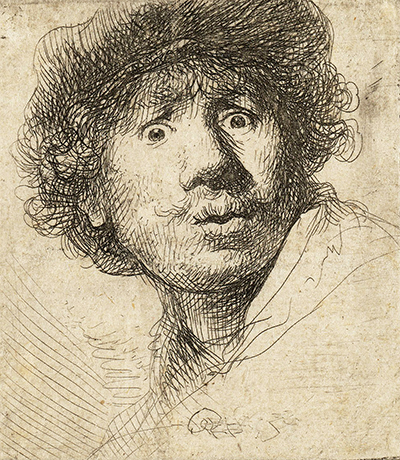
In the Rijksmuseum’s Self-portrait in a Cap, Wide-eyed and Open-mouthed of 1630, a few square centimetres of copper have to carry an entire expression. The eyes widen under the cap, the mouth pulls into a small opening, and the head appears to draw back. The low viewpoint helps. So does the way the shoulders dissolve at the edges, leaving the action concentrated around the eyes and lips. The face is recognisable as Rembrandt’s, and one can also imagine him holding the pose just long enough to discover which creases and shadows make surprise legible. There is little need for a room or for an elaborately described costume. [4]
The Self-portrait, Etching at a Window of 1648 gives the gaze a different purpose. The mature artist sits at a table by the window, his hand poised above the work in front of him. He has looked up. The title suggests an etching needle, though the Metropolitan Museum allows for a pen, and the image leaves the implement small enough to sustain either reading. In the Rijksmuseum’s impression RP-P-1962-9, the shadow under the hat belongs to a continuous range of half-dark tones that extends down the face and into the clothes. The mullions and the edge of the table give the seated figure a framework. The museum records etching, drypoint and burin on Japanese paper and identifies the sheet as the second state in New Hollstein. [5] [6]
Any artist drawing directly on a copperplate has to reckon with the reversal that takes place at the press. A window placed on one side of the copper appears on the other side of the impression. Lettering must be worked in reverse for the print to read normally. For a self-portrait made with the aid of a mirror, there is a reversal in the reflection as well. A viewer trying to deduce which hand Rembrandt worked with from a printed likeness would first need to know how he arrived at the design. In the 1648 portrait, the hand is most revealing for the pause it describes. The head has lifted while the fingers still hold their place over the work. [2] [5]
Paper descriptions also belong to individual sheets. In its 2026 exhibition Rembrandt, the Printmaker, the National Museum of Western Art in Tokyo identified a loan from the Rembrandt House Museum of this self-portrait as printed on Chinese paper. The Rijksmuseum identifies its own sheet as Japanese paper. The two records concern separate impressions of a single design, and the wording preserves an important distinction. The papers on which the image survives are part of its history, down to the way a dark sleeve or the sidelight at a window reads on a particular sheet. [6] [7]
A counterproof offers another way to see the reversal. A freshly printed impression, still carrying transferable ink, can be pressed against a second sheet. The transfer reverses the design again, recovering the orientation of the plate. The Rijksmuseum catalogues a counterproof of The Triumph of Mordecai, made around 1641, as well as an impression of the print. Compare the direction of the horse and the position of the onlookers in the two sheets. They exchange sides, although the relationships of riders, pedestrians and architecture remain the same. A counterproof usually transfers less ink and can be especially useful to a printmaker who wants to examine the composition in the orientation in which the copper will be worked. Its reversed design has a physical explanation quite different from that of a copy made on another plate. [8] [9]
Drypoint, engraving and the life of a burr
An etching needle opens the ground. A drypoint needle, used on bare metal, scratches the plate itself. As it travels, it pushes up a small ridge of copper along the incision. That ridge, called a burr, catches ink at its edges. In a good impression, the resulting line can have a dark core and a softness that spreads into the surrounding paper. The mark is particularly effective in the deep shadows of The Triumph of Mordecai. The bright horse and the splendidly dressed rider emerge from a crowd whose faces and garments are partly swallowed by the dark. The Rijksmuseum identifies the print as an unusually extensive use of drypoint for this point in Rembrandt’s career. [9]
Engraving also works directly on the metal. The engraver guides a burin, a tool with a shaped cutting point that removes a sliver of copper and leaves a groove capable of printing a firm, controlled stroke. Rembrandt could reinforce an etched passage with the burin, then use drypoint where he wanted ink to gather softly at the edges. The distinction is easier to see across a passage than in a single stroke in a photograph. Adjacent marks can overlap, and the effect of each depends on the depth of the groove, the ink, the wiping and the paper. A clean, dark line can have more than one technical explanation. [1] [2] [9]
In the 1647 portrait of Jan Six, a standing reader holding an open book is silhouetted against the window. Looking from the bright pages into the room takes a moment. The surrounding darkness gradually yields the wall, the furnishings and receding folds of cloth. At close range it resolves into intersecting strokes whose direction and density keep one object distinct from the next. The original copperplate survives in the Six family, as does Rembrandt’s painted portrait of Jan, made several years later. The copper preserves the toolwork from which the printed portrait could be multiplied. In an impression, the same marks are seen through the ink they released and the paper that received it. [10]
Burr is vulnerable to the repeated passage of a plate through the press and to the handling involved in inking and wiping it. As the ridge wears or flattens, the same groove can print with less of its earlier softness and depth. The plate may still be in the same state. Rembrandt could sharpen a passage by working the copper again, which would leave a new, repeatable change in the image. Comparing impressions is particularly revealing when both processes can be tracked, as they can in The Three Crosses. [11] [12]
The changing darkness of The Three Crosses
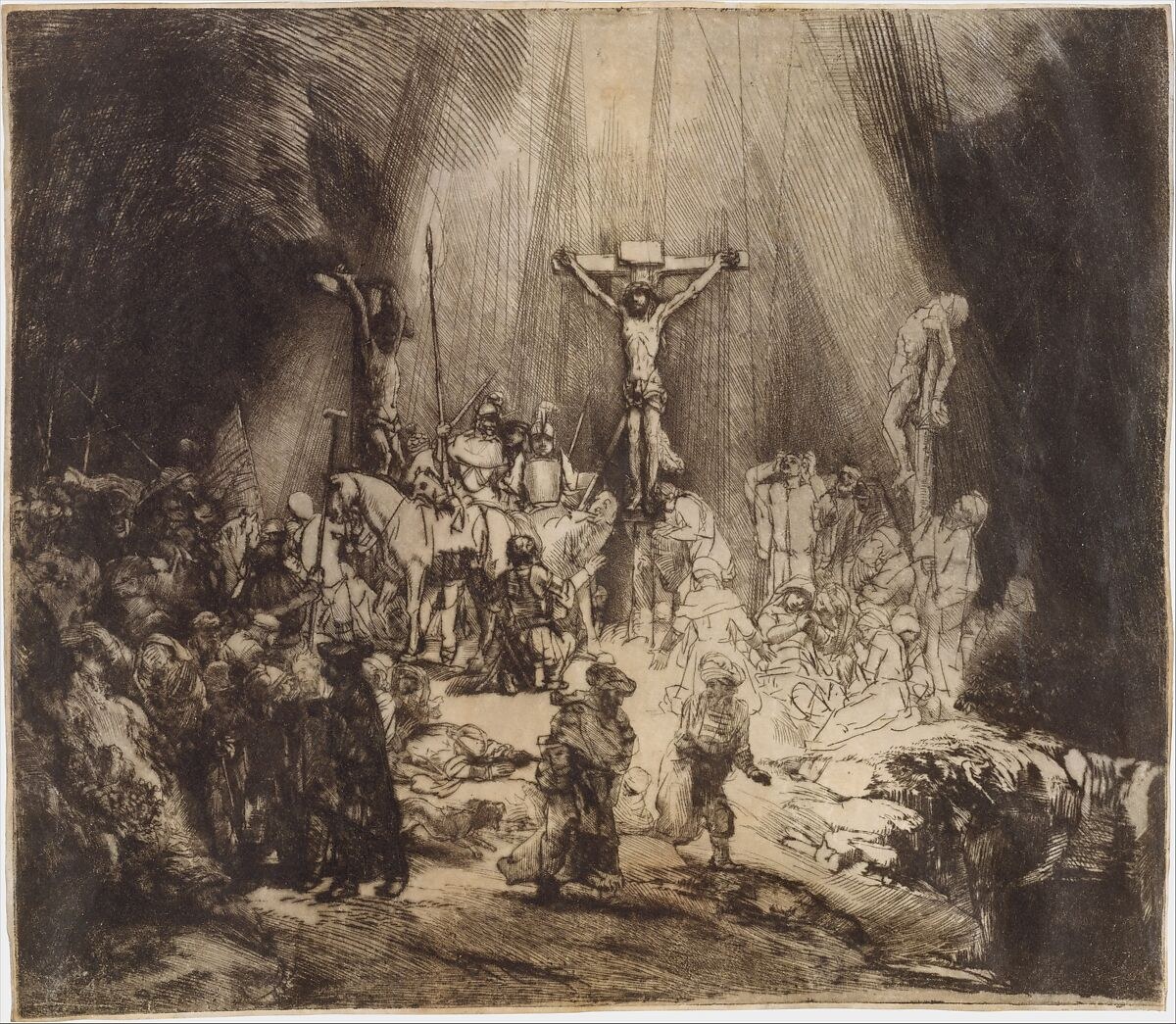
The Metropolitan Museum’s second-state Three Crosses, 41.1.31, was printed on vellum in 1653. Christ and the two thieves rise above a foreground in which mourners, soldiers and onlookers are still distinguishable. A shaft of light descends through the centre. Move towards the right edge and the scene fades into a veil of ink, deepest over the bushes at the side. The museum identifies some of this darkness as ink deliberately left on the plate at printing. The vellum, a prepared animal skin, contributes a warm ground and holds the ink close to the surface. The softness is the cumulative effect of the support, the wiping and the rich ink caught in the burr. [11]
The Rijksmuseum’s RP-P-OB-617 comes from the third state, the third of five in New Hollstein. The easiest detail to look for is under the dog in the foreground. Rembrandt reinforced the shadow there with additional strokes. Their placement matters. The animal is small enough to escape attention in the general scene, yet the shadow gives it contact with the same ground where the human figures stand and kneel. It is also a detail with a clear relation to the condition of the plate. As the drypoint lost some of its richness, a local addition could restore weight to a passage that printed too lightly. Those added lines would recur in subsequent impressions from that stage of the copper. [12]
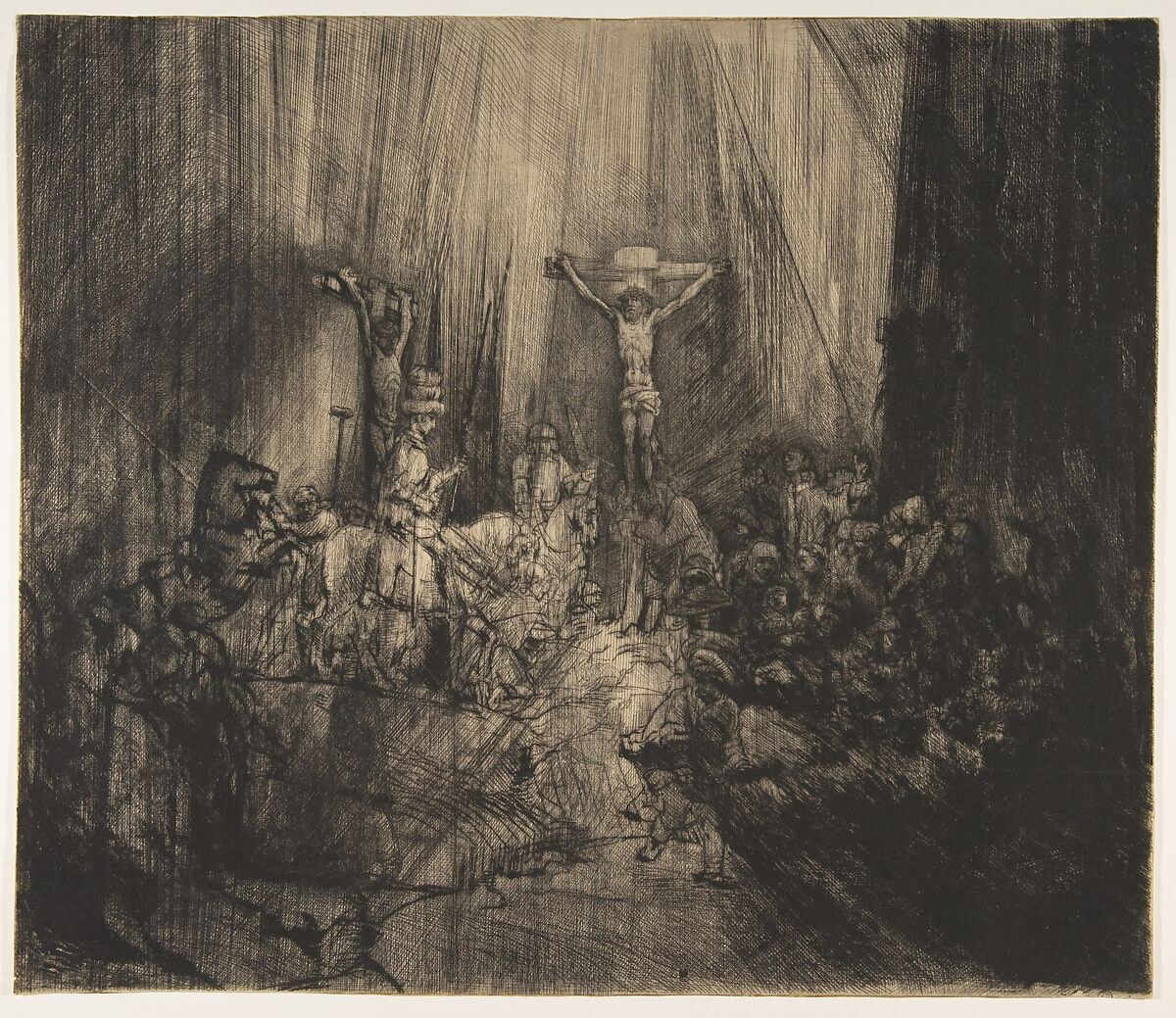
The Met’s fourth-state impression, 41.1.33, shows a more extensive return to the plate. Rembrandt scraped away substantial areas of the earlier composition and laid emphatic diagonal strokes across the sky and the figures at the sides. Some of the older work is still discernible beneath the new hatching. At the centre, Christ’s mouth opens and his eyes are nearly closed. The Met reads the revision as a shift from the centurion’s recognition after Christ’s death to the final moments of Christ’s life. The altered face helps sustain that reading. So does the diminished visibility of the surrounding witnesses, whose actions had given the earlier image much of its incident. [13]
Across these three sheets there are three kinds of darkness to follow. On the vellum impression, ink lies in a thin film over parts of the image. Beneath the dog in the Rijksmuseum sheet, discrete strokes supplement a weakening shadow. In the fourth state, broad sweeps of hatching change the distribution of light across the whole plate. A reproduction of any one of these impressions might carry the title The Three Crosses. The title gives the subject, while the state and the particulars of the sheet explain which moment in the making of the image is in front of us. [11] [12] [13]
What the printer leaves on the surface
Plate tone is the film of ink allowed to remain on the surface of a plate after wiping. It transfers to the paper under pressure, reaching across areas between incised lines. A little tone can join discrete shadows or make the palest parts of the image seem to stand out. A heavier veil can lower the visibility of an entire corner. The printer can wipe selected areas more cleanly, so that light appears to drift across a wall or pick out a face. The marks cut or bitten into the copper remain available for the next impression, when the distribution of surface ink can be altered. [2] [11]
Two impressions of Christ and the Samaritan Woman at the Bibliothèque nationale de France help isolate this kind of variation. The Département des Estampes et de la photographie catalogues both under the second state of the 1657 plate. It describes one impression, IFN-10522102, as printed on Japanese paper with a strong printing tone. In the other, IFN-10522103, the tone is lighter. The figures at Jacob’s well come from the same stage of the incised design. The relative prominence of the pale areas changes because the ink on the surface modulates the space between the lines. It is possible to see why a print room would keep both sheets. [14]
The Paris record gives a separate change to the copper itself. By the second state the plate, which had measured about 20.5 by 16 centimetres in its first state, had been reduced. That change determines the boundary within which either impression can be printed. Comparing the two second-state sheets records a decision at the press. Comparing an intact first-state image with those second-state sheets records an alteration to the dimensions of the matrix. This is one reason to include the edges when looking at a print. A photograph cropped tightly around the figures can hide the very evidence that distinguishes one printing history from another. [14]
Some tonal differences become harder to isolate. Close hatching can read as a continuous grey at ordinary viewing distance. An old sheet may also have darkened, and photographs can change the apparent warmth of the paper or the depth of the ink. On a well-photographed sheet, it helps to compare a suspected patch of plate tone with the margin just outside the plate mark, then look for individual strokes within the patch. On the object itself, the edge of a faint veil and the surface of a drypoint line can be examined under magnification. The French catalogue’s record of lighter and heavier printing tone is valuable precisely because it describes the sheets in the collection, where such differences can be studied directly. [11] [14]
Watch: Rembrandt’s life and work
Explore Rembrandt’s early career, etchings and paintings, and see his work alongside that of other Baroque artists.
Rembrandt | A Life of Art
Curators introduce Rembrandt’s early career and trace how he developed his handling of light and shade.
Watch on YouTubeLaid paper, imported papers and watermarks
European laid paper carries a record of the mould on which it was formed. Hold a suitable sheet to transmitted light and it may show closely spaced parallel laid lines crossed at wider intervals by chain lines. A wire design attached to the mould leaves a watermark where the layer of pulp is thinner. The pattern can include a letter, a coat of arms or a familiar device such as a foolscap. Since a papermaker produced sheets much larger than many of Rembrandt’s prints, an impression may occupy a portion of a sheet that contains part of the mark or misses it altogether. The dimensions of the print tell only part of the story of the paper. [15] [16]
Papers imported from East Asia presented Rembrandt with a range of surfaces. Some allowed exceptionally fine lines to remain distinct in shadow. Others contributed a warm colour or a particular softness to a passage of ink. The label “Japanese paper” is most informative when attached to a particular museum impression and read alongside any physical research on that sheet. In a study of seven prints at the National Gallery of Victoria, the conservator looked at the structure of the papers with beta radiography and drew on microscopic analysis by Akinori Okawa at the Kochi Prefectural Paper Technology Centre. The fibres were sampled in very small quantities from the backs of the prints. Katsuhiko Masuda of the Tokyo National Research Institute of Cultural Properties helped arrange the analysis. [15]
The results showed diversity even among papers for which gampi was the dominant fibre. The internal structure of a sheet, including indications that layers had been brought together, supplied evidence alongside the fibre identification. For one sample, the investigators found features that suggested a Chinese origin and also identified a close parallel with Japanese paper made in the manner of Chinese calligraphy paper. Those conclusions depend on how the sheet was formed as well as on the plants that supplied its fibres. A warm colour in a digital photograph is a poor basis for assigning a paper to a country, much less to a particular mill or papermaking district. [15]
Watermarks in European papers can open a different line of inquiry. A general resemblance between two foolscaps is a starting point. Researchers can then compare the curves of the wire design and its position relative to the laid and chain lines. An exact fit can tie sheets to a single mould. A pair of moulds used in the same shop could carry closely related marks, so small divergences are important. A precise overlay can make them easier to judge. The Watermark Identification in Rembrandt’s Etchings project and related research have made it possible to pursue these comparisons between prints and seventeenth-century documents preserved in archives. [16]
One comparison concerns The Flute Player. The date 1642 was added to the plate in its second state. An impression of the fourth state in the Herzog Anton Ulrich Museum in Braunschweig has a foolscap watermark that researchers matched to the mark in a document dated 1653 in the Zeeland Archives. The match supports reconsidering when that particular sheet was printed, bringing it closer to 1653 than the dates previously proposed for known impressions. The date in the copper still records a stage in the life of the plate. The date on the archival document belongs to the use of another sheet made on the same mould. Paper could be stored and used at different times, which leaves a range of possibilities for the day or year the impression was pulled. [16]
The crowd and the light in The Hundred Guilder Print
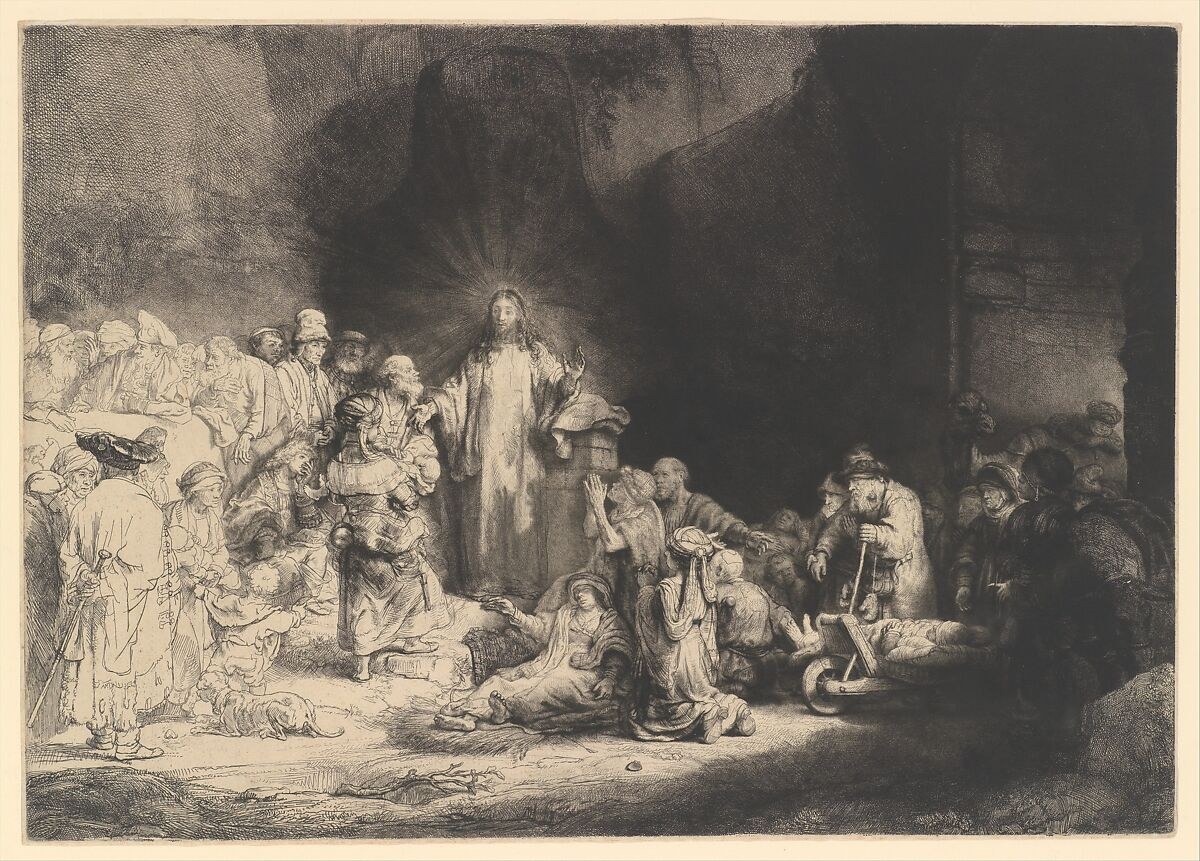
In the National Museum of Western Art’s second-state impression of the Hundred Guilder Print, G.1981-0001, Christ stands amid figures who seem to come from several directions at once. On his right, at the left of the sheet, men talk and a child is brought forward. On the other side, people press into the scene from a dark opening, bringing the sick with them. A woman low in the composition stretches out her hand. Tokyo catalogues its impression as etching, drypoint and engraving on Japanese paper. Its pale ground is visible in the air around the loosely drawn figures at the left and in the spaces that allow Christ’s outline to emerge. [17]
Rembrandt brought together episodes from chapter 19 of Matthew. The arguments and questions, the welcome given to children and the arrival of the sick can be read as separate encounters within one field of light. In the Metropolitan Museum’s second-state impression, 29.107.35, the lightly etched figures at the left have enough space between their lines for the paper to show through their clothes. At the right, crossings and reinforcements accumulate around the people entering from the dark. The outline of a head or a sleeve can catch light against that density. Near the centre, traces of earlier positions survive around Christ’s eyes, hands and feet. A viewer can follow the large design and still find evidence of its making within a few millimetres of a gesture. [18]
The Rijksmuseum’s double-sided drawing of the sick woman records a related search on paper. Rembrandt tested how she could raise herself and reach up while still appearing physically weak. Related studies survive in Berlin and in the Clement C. Moore collection. In the sequence discussed by the museum, the lowered hand and fingers in the Berlin study suggest the effort needed to sustain the gesture. In the print, that effort is legible partly because the woman occupies a low position amid upright figures. The separate studies follow her body at close quarters, and the print gives that body a precise relationship to Christ and to the people around her. [19]
The long-standing nickname has a history of its own. The Rijksmuseum cites complaints from an Antwerp print dealer as early as 1654 about a price of one hundred guilders. The Met records the story that Rembrandt paid that sum to buy back an impression and treats the tale with caution. The two accounts take us to the early valuation of an unusually ambitious print and to the growth of a story around it. The date of the scene’s development likewise calls for several kinds of evidence. The copper records successive decisions, the drawings preserve experiments with particular figures, and watermarks on early impressions provide a basis for placing the work around 1648. The very different treatment of the two sides of the composition can be seen on the sheet. Assigning each side to a separate period of work would require further evidence. [18] [19]
Weather held in the lines of The Three Trees
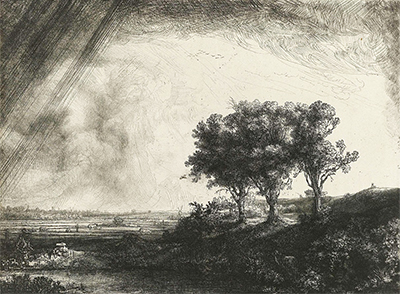
The three trees stand on a rise at the right of the sheet. Their foliage forms a dark mass, broken along the margins by small openings. Below the bank, the foreground is thick with vegetation. Beyond it the fields flatten, light opens across the land and the low settlements become a band of small marks on the horizon. Across the upper left, long slanting strokes carry a shower through the sky. In the Rijksmuseum’s impression of The Three Trees, RP-P-OB-444, the plate measures roughly 21 by 28 centimetres. Rembrandt used etching, drypoint and burin, and the impression carries a light plate tone. [20]
The differing scales of mark give the weather movement. The rain is built from emphatic diagonals, long enough to cut across several changes of tone. Along the horizon, short horizontal strokes and small interruptions let the eye settle and judge distance. The trees have weight partly because their upright trunks hold their positions against the falling lines. The Bibliothèque nationale de France, in its study of Rembrandt’s use of shadow, draws attention to the way all three techniques give this landscape successive planes of light and darkness. In the Metropolitan Museum’s impression, a speckled tone helps connect the cloud and the land, while the varying depths of etched line keep the passing rain and the remoter landscape distinct. [21] [22]
Some cloud shapes to the left of centre have prompted a more specific proposal. The Met notes that Rembrandt may have worked the landscape on copper that already carried an abandoned sketch for The Death of the Virgin, the subject of a larger plate dated 1639. Marks that sit oddly within the weather can be compared with that earlier treatment. The reuse remains a possibility, and the cloud forms can still be understood within the 1643 landscape as it was printed. An earlier design, if present, would have supplied marks that Rembrandt allowed to survive or absorbed into the new sky. [21]
The National Museum of Western Art’s impression, G.2000-1754, adds evidence of a different sort. Its paper bears a Foolscap with Five-Pointed Collar watermark, recorded as Ash and Fletcher 19A.a. The Rijksmuseum describes its own sheet as the only recorded state of the plate, New Hollstein 214-1(1). A single known state is entirely compatible with variation from sheet to sheet. The watermark identifies a feature in Tokyo’s paper, while the light plate tone describes the printing of the Amsterdam impression. The two observations can be read together without transferring either characteristic to every surviving example. [20] [23]
There are small human incidents to find after the sweep of the weather. People fishing are sunk into the foreground, close to the water, and a much smaller figure is visible on the rise towards the right. The scale of their activities gives a measure of the open ground and of the height at which the trees meet the sky. One reads the shower across most of the sheet before discovering how little space these people occupy. The spaciousness comes from the relation between strokes of many sizes and the stretches of pale paper between them. [20] [21]
The crowd disappears from Christ Presented to the People
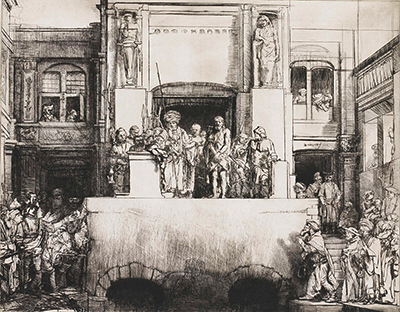
In Christ Presented to the People, a large drypoint of 1655, the figures on the raised platform occupy surprisingly little of the composition. Pilate, with his long staff, presents Christ to the people below. In the Met’s second-state impression, 41.1.34, printed on Japanese paper, the foreground is full of spectators. Some are turned towards the dais, others towards their neighbours. Their backs, lifted heads and overlapping shoulders provide several points from which to imagine watching what happens. The Rijksmuseum’s third-state impression, RP-P-1975-1, also on Japanese paper and printed with plate tone, retains the crowd. Its documentation identifies the stage of the copper separately from the material and tone of that sheet. [24] [25]
The fourth state changed the plate’s size. The Met’s 41.1.35 shows a version shortened at the top. According to the museum, the reduction allowed Rembrandt to print on the shorter sheets of Japanese paper without adding a strip. He also added detail and shadow to the wall on the right. The museum’s comparison with its second-state impression reveals that the drypoint was losing some of its dark, soft edges. The plate’s dimensions, the newly worked wall and the diminishing burr tell three related stories. One concerns fitting an image to a sheet, another the distribution of shadow in the design, and the third the condition of the copper after printing. [24] [26]
In the sixth state, Rembrandt removed much of the crowd immediately below the platform and opened up two dark brick arches. He added a sculpted male figure between them and lightly covered it in the eighth state, visible in the Met’s 41.1.36. The meaning of the arches and the figure remains uncertain. Their compositional effect is easier to describe. Earlier spectators had given the foreground a horizontal band of movement and drawn attention to the social mechanics of the judgment. The arches break up that band. Open space below the platform gives the viewer a more direct approach to Christ and Pilate, while the dark apertures interrupt any straightforward passage into the scene. [27]
The surviving impressions also show how much a word like “finished” depends on the object under discussion. The second state had a crowd worked out in detail and enough fresh burr to give the foreground considerable depth. Rembrandt went on to remove figures whose gestures and profiles he had already taken the trouble to describe. The later state has a different distance between the viewer and the event. Each stage offers a coherent way of experiencing the judgment, and the earlier sheets preserve an arrangement of bodies that the altered copper could no longer reproduce. [24] [26] [27]
Reading catalogue numbers, dates and later impressions
A catalogue number identifies the work within a particular system. New Hollstein, compiled by Erik Hinterding and Jaco Rutgers and published in 2013, orders 314 prints chronologically and distinguishes their states, with additional volumes devoted to copies. Earlier references, including Bartsch and White and Boon, are still found in museum descriptions. They may order the same works differently or divide a plate’s history into a different number of states. At the Rijksmuseum, the 1648 self-portrait at the window is New Hollstein 240-2(9) and Hollstein 22-2(5). Both entries describe the same museum impression, placed second within two accounts of the plate’s history. [6] [28]
The goldsmith Jan Lutma’s portrait, made in 1656, shows how cataloguers arrive at such distinctions. In the first state he sits with his work and tools beside a relatively open wall. A window appears behind him in the second state. On its sill is a delicately drawn bottle, and Rembrandt’s signature and date appear in an upper pane. The window gives the light a source within the room and creates a series of additional edges and small reflections behind the sitter. The change is substantial enough that impressions have long been described as Lutma “with” or “without” the window. Te Papa records its impression with the address of Lutma’s son François as the fourth of five states in New Hollstein, and as the third of three under Hollstein. It treats Rembrandt’s responsibility for later alterations with caution. [29]
A date engraved in the copper can remain there long after an artist has stopped working on the plate. Subsequent owners may print it again, strengthen worn passages or add lettering. The Hundred Guilder Print supplies a particularly tangible example. William Baillie acquired the plate in 1775 and reworked it. It was subsequently cut into separate sections and printed in pieces. The Cleveland Museum of Art’s central section, 1942.116, preserves Christ and neighbouring figures within a much smaller image. It carries part of Rembrandt’s original matrix through a later history of intervention and printing, with a composition whose boundaries differ fundamentally from those of the complete impressions in Tokyo and New York. [17] [18] [30]
When comparing two impressions, begin with a fixed detail. Find the window behind Lutma, the shadow beneath the dog or the openings below Pilate. These identify changes that belong to the copper. Then give the apparently empty parts of the sheet the same attention. The grey between two lines, a trace of ink at the edge of the image or a passage where the paper shines clear can help explain how the plate was printed. The watermark, where present, has its own evidence to offer, and the margin may preserve a collector’s stamp or an inscription added much later. Each feature answers a different question about the object. [12] [14] [16] [27] [29]
Return to Ephraim Bueno’s hand on the staircase. The light on the knuckles needs the fine divisions between the marks, the darker cloth behind the cuff and the long bright sweep of the rail. His face depends on a much narrower range of tones. One can move between those passages in seconds, following the route of the light up the print. Spend longer with them and the copper becomes imaginable through the paper. Closely spaced marks hold the wall back in shadow, the open strokes give the hand room to turn, and a man who has paused on a stair seems about to move again. [1]
Rembrandt Etchings with Images
 Rembrandt.jpg)
 Rembrandt.jpg)
Rembrandt artworks
Different impressions of the same print can appear as separate records.
| Name | Date | Medium |
|---|---|---|
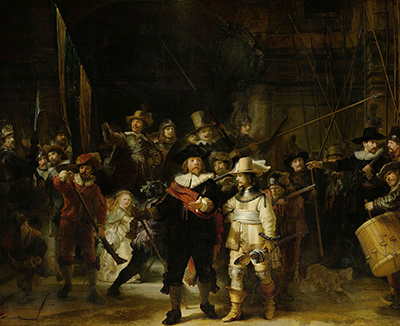
| The Night Watch | 1642 | Painting |
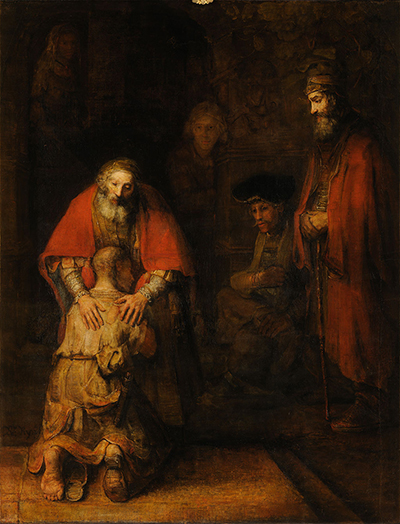
| The Return of the Prodigal Son | 1660s | Painting |
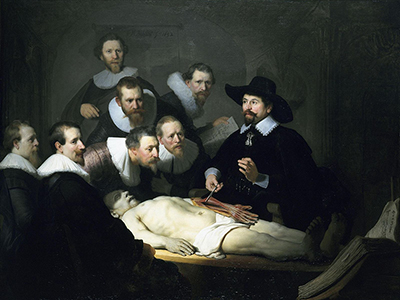
| The Anatomy Lesson of Dr Nicolaes Tulp | 1632 | Painting |
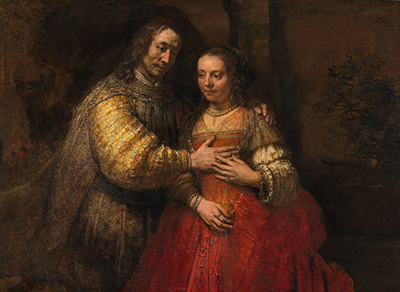
| The Jewish Bride | c. 1665–69 | Painting |
| Self-Portrait with Two Circles | c. 1665 | Painting |
| Christ in the Storm on the Sea of Galilee | 1633 | Painting |
| Bathsheba at Her Bath | 1654 | Painting |
| The Hundred Guilder Print | c. 1648–49 | |
| The Three Trees | 1643 | |
| Aristotle with a Bust of Homer | 1653 | Painting |
| The Abduction of Ganymede | 1635 | Painting |
| Ahasuerus and Haman at the Feast of Esther | 1660 | Painting |
| The Anatomy Lesson of Dr Jan Deijman | 1656 | Painting |
| Judith at the Banquet of Holofernes | 1634 | Painting |
| Artist in His Studio | c. 1628 | Painting |
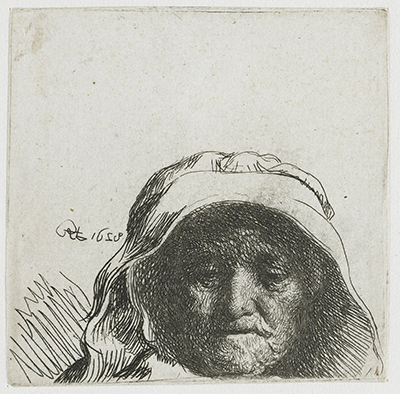
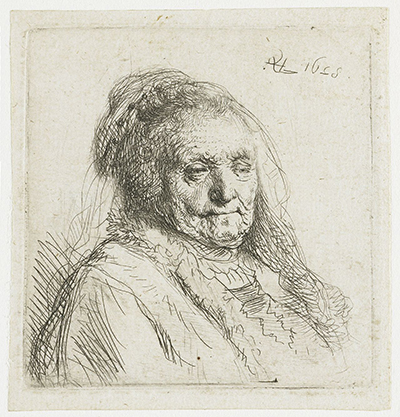
| The Artist’s Mother, Head and Bust, Three-Quarters Right | 1628 | |
| The Artist’s Mother, Head Only, Full Face | 1628 | |
| Balaam and the Ass | 1626 | Painting |
| The Baptism of the Eunuch | 1626 | Painting |
| Beggar in a High Cap, Standing and Leaning on a Stick | c. 1629 | |
| Beggar with a Clenched Hand, Leaning on a Stick | c. 1629 | |
| Belshazzar’s Feast | c. 1636–38 | Painting |
| The Blinding of Samson | 1636 | Painting |
| Bust of a Bearded Young Man with a Skullcap | 1663 | Painting |
| Christ Presented to the People | 1655 | |
| The Circumcision | c. 1625 | |
| The Conspiracy of Claudius Civilis | c. 1661–62 | Painting |
| Danaë | Begun 1636 and later revised | Painting |
| The Descent from the Cross | 1632–33 | Painting |
| Descent from the Cross by Torchlight | 1654 | |
| The Descent from the Cross, Second Plate | 1633 | |
| Diana Bathing with Her Nymphs, with Actaeon and Callisto | 1634 | Painting |
| Ephraim Bueno, Jewish Physician | 1647 | |
| Portrait of Frederick Rihel on Horseback | c. 1663 | Painting |
| Flora | 1634 | Painting |
| The Goldweigher’s Field | 1651 | |
| Head of Christ | 1645–50 | Painting |
| The Holy Family with Angels | 1645 | Painting |
| Homer Dictating His Verses | 1663 | Painting |
| Jacob Blessing the Sons of Joseph | 1656 | Painting |
| Jacob Wrestling with the Angel | 1659–60 | Painting |
| Joseph and Potiphar’s Wife | 1655 | Painting |
| Juno | c. 1662–65 | Painting |
| Landscape with a Stone Bridge | c. 1638 | Painting |
| Head of an Old Man with Curly Hair | 1659 | Painting |
| A Man in Armour | Possibly 1655 | Painting |
| Minerva in Her Study | 1635 | Painting |
| Moses with the Tablets of the Law | 1659 | Painting |
| Old Man with a Gold Chain | c. 1631 | Painting |
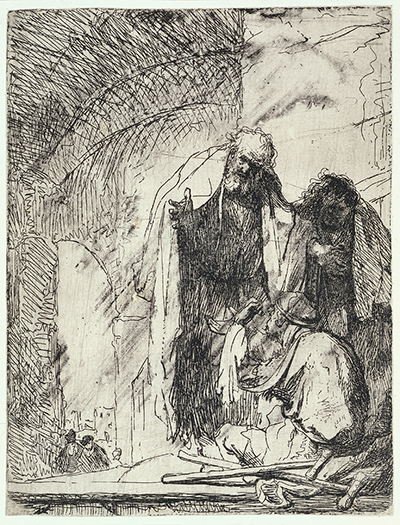
| Peter and John at the Gate of the Temple | c. 1629 | |
| Philosopher in Meditation | 1632 | Painting |
| The Polish Rider | c. 1655 | Painting |
| Portrait of a Woman with a Lapdog | c. 1665 | Painting |
| Portrait of Gerard de Lairesse | 1665–67 | Painting |
| Portrait of Jan Six | c. 1654 | Painting |
| Portrait of Maerten Soolmans | 1634 | Painting |
| Portrait of a Woman, Probably Maria Trip | 1639 | Painting |
| Portrait of Oopjen Coppit | 1634 | Painting |
| Portrait of Titus | c. 1662 | Painting |
| Rembrandt and Saskia in the Parable of the Prodigal Son | c. 1635 | Painting |
| The Raising of Lazarus | c. 1630–32 | Painting |
| The Rest on the Flight into Egypt | c. 1626 | |
| Self-Portrait as the Apostle Paul | 1661 | Painting |
| Self-Portrait (Cologne) | c. 1668 | Painting |
| Rembrandt’s Self-Portrait, Frowning | 1630 | |
| Self-Portrait in a Cap, Wide-Eyed and Open-Mouthed | 1630 | |
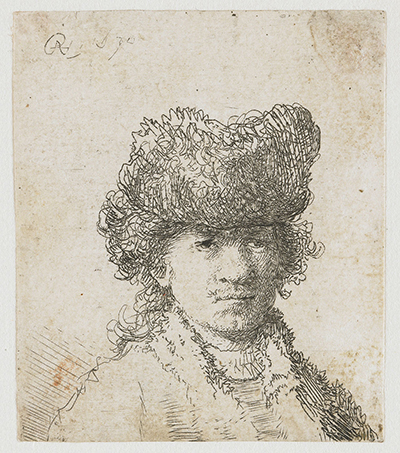
| Self-Portrait in a Fur Cap | 1630 | |
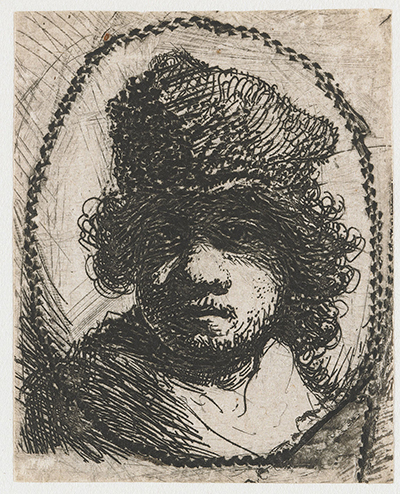
| Self-Portrait in a Fur Cap, in an Oval Border | c. 1629 | |
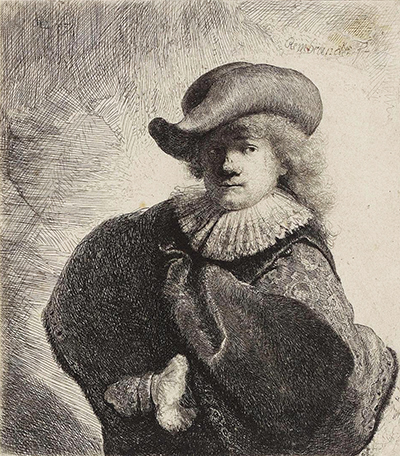
| Self-Portrait in a Soft Hat and Embroidered Cloak | 1631 | |
| Self-Portrait, Bending Forward | c. 1628 | |
| Self-Portrait with a Broad Nose | c. 1628 | |
| Self-Portrait with Beret and Turned-Up Collar | 1659 | Painting |
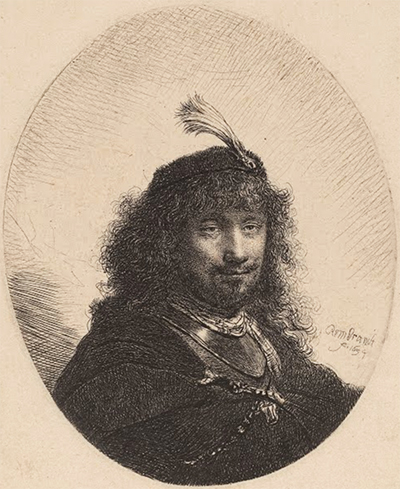
| Self-Portrait with Plumed Cap and Lowered Sabre | 1634 | |
| The Shipbuilder and His Wife | 1633 | Painting |
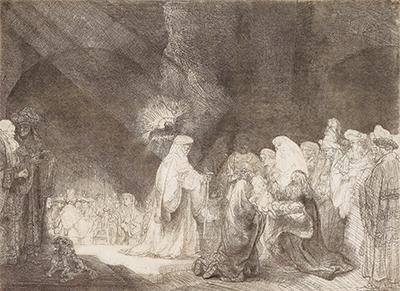
| Simeon’s Hymn of Praise | c. 1640 | |
| Simeon in the Temple | c. 1669 | Painting |
| St Jerome Kneeling | c. 1628–29 | |
| Saint Matthew and the Angel | 1661 | Painting |
| The Stoning of Saint Stephen | 1625 | Painting |
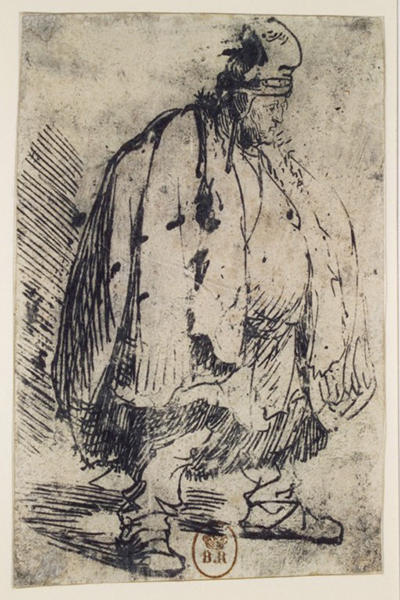
| A Stout Man in a Large Cloak | c. 1629 | |
| The Supper at Emmaus | 1648 | Painting |
| Susanna and the Elders | 1647 | Painting |
| The Syndics of the Drapers’ Guild | 1662 | Painting |
| The Mill | 1645/1648 | Painting |
| The Woman Taken in Adultery | 1644 | Painting |
| Lucretia (1664) | 1664 | Painting |
| Lucretia (1666) | 1666 | Painting |
| Anatomische les van Dr. Jan Deijman (fragment) | 1656 | Painting |
| Isaac and Rebecca, Known as ‘The Jewish Bride’ | c. 1665 - c. 1669 | Painting |
| Johannes Wtenbogaert | 1633 | Painting |
| Man in Oriental Dress | 1635 | Painting |
| Musical Company | 1626 | Painting |
| Portrait of Ephraim Bueno | 1645 - 1647 | Painting |
| Portrait of Haesje Jacobsdr van Cleyburg | 1634 | Painting |
| Portrait of Oopjen Coppit | 1634 | Painting |
| Self-portrait | c. 1628 | Painting |
| Still Life with Peacocks | c. 1639 | Painting |
| Tobit and Anna with the Kid | 1626 | Painting |
| Young Woman in Fantasy Costume | 1633 | Painting |
| A Polish Nobleman | 1637 | Painting |
| A Woman Holding a Pink | 1656 | Painting |
| A Young Man Seated at a Table (possibly Govaert Flinck) | c. 1660 | Painting |
| Man with a Sheet of Music | 1633 | Painting |
| Philemon and Baucis | 1658 | Painting |
| Portrait of a Gentleman with a Tall Hat and Gloves | c. 1656/1658 | Painting |
| Portrait of a Lady with an Ostrich-Feather Fan | c. 1656/1658 | Painting |
| Portrait of a Man in a Tall Hat | c. 1663 | Painting |
| Saskia van Uylenburgh, the Wife of the Artist | probably begun 1634/1635 and completed 1638/1640 | Painting |
| The Circumcision | 1661 | Painting |
| Bellona | 1633 | Painting |
| Flora | ca. 1654 | Painting |
| Hendrickje Stoffels (1626–1663) | mid-1650s | Painting |
| Herman Doomer (ca. 1595–1650) | 1640 | Painting |
| Man in a Turban | 1632 | Painting |
| Man with a Magnifying Glass | early 1660s | Painting |
| Portrait of a Man | 1632 | Painting |
| Portrait of a Man Holding Gloves | 1648 | Painting |
| Portrait of a Man, probably a Member of the Van Beresteyn Family | 1632 | Painting |
| Portrait of a Woman | 1633 | Painting |
| Portrait of a Woman, probably a Member of the Van Beresteyn Family | 1632 | Painting |
| Portrait of a Young Woman with a Fan | 1633 | Painting |
| The Standard Bearer (probably Floris Soop, 1604–1657) | 1654 | Painting |
| The Toilet of Bathsheba | 1643 | Painting |
| Woman with a Pink | early 1660s | Painting |
| Lieven Willemsz van Coppenol (born about 1599, died 1671 or later) | Painting | |
| Portrait of a Man | ca. 1655–60 | Painting |
| Self-Portrait | 1660 | Painting |
| A Cap | c. 1629 - c. 1630 | Drawing |
| A Cow in a Shed | c. 1640 | Drawing |
| A Syndic of the Drapers’ Guild, Jacob van Loon, Seated | c. 1661 - c. 1662 | Drawing |
| Abraham Casting Out Hagar and Ishmael | c. 1650 | Drawing |
| Actor in the Role of Pantalone Engaged in Conservation | c. 1634 - c. 1636 | Drawing |
| Bedroom with Saskia in a Canopy Bed | c. 1638 | Drawing |
| Beheading of John the Baptist | c. 1640 - c. 1641 | Drawing |
| Boaz and Ruth | c. 1645 | Drawing |
| Boy Walking with a Stick | c. 1635 - c. 1640 | Drawing |
| Christ Appearing to Mary Magdalene as a Gardener (Noli me tangere) | c. 1645 | Drawing |
| Christ Healing a Leper | c. 1650 - c. 1655 | Drawing |
| Christ Washing the Disciples’ Feet | c. 1640 - c. 1650 | Drawing |
| Cottage with White Paling among Trees | c. 1648 | Drawing |
| Daniel in the Lions’ Den | c. 1650 | Drawing |
| David Hearing the News of Uriah’s Death | c. 1650 | Drawing |
| Five Studies of Haman’s Head | c. 1655 - c. 1660 | Drawing |
| Four Men Standing, Wearing Hats | c. 1650 | Drawing |
| Indian Archer | c. 1656 - c. 1658 | Drawing |
| Inn on the Amstelveenseweg | c. 1652 | Drawing |
| Jacob and his Sons | c. 1641 | Drawing |
| Jael Killing Sisera | c. 1658 - c. 1659 | Drawing |
| Jahangir | c. 1656 - c. 1658 | Drawing |
| Joseph in Prison Interpreting the Dreams of the Butler and the Baker | c. 1650 - c. 1655 | Drawing |
| Longhouse Farmstead with a Haystack in a Polder Landscape | c. 1652 | Drawing |
| Man Helping a Rider to Mount a Horse | c. 1640 - c. 1641 | Drawing |
| Nude Woman Lying on a Pillow | c. 1661 - c. 1662 | Drawing |
| Nude Woman Seated by a Stove | c. 1661 - c. 1662 | Drawing |
| One of the Three Kings Adoring the Virgin and Child | c. 1635 - c. 1640 | Drawing |
| Recumbent Lion | c. 1660 | Drawing |
| Saskia in Bed | c. 1635 | Drawing |
| Seated Actor in the Role of Capitano | c. 1634 - c. 1636 | Drawing |
| Self-portrait with Tousled Hair | c. 1628 - c. 1629 | Drawing |
| Shah Jahan | c. 1656 - c. 1658 | Drawing |
| Shah Jahan and his Son | c. 1656 - c. 1658 | Drawing |
| Small Study of the Head of the Sick Woman | c. 1647 - c. 1648 | Drawing |
| Standing Man with a Pouch | c. 1629 - c. 1630 | Drawing |
| Standing Man with a Stick, Facing Left | c. 1629 - c. 1630 | Drawing |
| Standing Man with a Stick, Facing Right | c. 1629 - c. 1630 | Drawing |
| Standing Man with Outstretched Arm | c. 1636 - c. 1641 | Drawing |
| Studies for the Sick Woman in the ‘Hundred Guilder Print’ | c. 1648 | Drawing |
| Studies of the Mourning Magdalen and the Virgin | c. 1635 - c. 1636 | Drawing |
| Study of a Man, Seen from Behind | c. 1629 - c. 1630 | Drawing |
| Study of a Woman’s Legs | c. 1628 - c. 1629 | Drawing |
| Susanna and the Elders | c. 1650 - c. 1655 | Drawing |
| The Actor Willem Bartholsz Ruyter as a Peasant | c. 1638 | Drawing |
| The Actor Willem Bartholsz Ruyter as King Ahasuerus on his Throne | c. 1635 - c. 1640 | Drawing |
| The Angel Appearing to Joseph in his Dream | c. 1650 | Drawing |
| The Annunciation to the Shepherds | c. 1650 | Drawing |
| The Entombment, over a Sketch of an Executioner | c. 1640 - c. 1641 | Drawing |
| The Pancake Woman | c. 1635 | Drawing |
| The Swijgh Utrecht Tower in Amsterdam | c. 1650 - c. 1655 | Drawing |
| Three Orientals Conversing | c. 1645 | Drawing |
| Three Scribes | c. 1628 - c. 1629 | Drawing |
| Three Women and a Child by a Door | c. 1645 | Drawing |
| Tobias and the Angel Taking Leave of Raguel | c. 1650 - c. 1655 | Drawing |
| Two Horses at a Halting-place | c. 1637 | Drawing |
| View of the Amstel from the Blauwbrug | c. 1645 - c. 1650 | Drawing |
| View of the Amstelveenseweg outside Amsterdam | c. 1660 - c. 1662 | Drawing |
| View of the Nieuwezijds Voorburgwal | c. 1647 | Drawing |
| Walking Man with a High Cap | c. 1655 - c. 1660 | Drawing |
| Winter View with a Waterway, Cottages and Two Boats | c. 1650 | Drawing |
| Woman with a Urinating Child | c. 1658 - c. 1660 | Drawing |
| Young Woman Seated by a Window (Saskia?) | c. 1638 | Drawing |
| A Landscape with Farm Buildings among Trees | c. 1650/1655 | Drawing |
| Beggar Man and Woman | c. 1630/1631 | Drawing |
| Beggar Woman Leaning on a Stick | 1628/1630 | Drawing |
| Bust of an Elderly Man in a Flat Cap | 1635/1637 | Drawing |
| Cottages and Barn beside a Road | c. 1650 | Drawing |
| Esther before Ahasuerus | 1655/1660 | Drawing |
| Figures on the Anthoniesdijk Entering Houtewael [verso] | c. 1650 | Drawing |
| God the Father Supported by Angels | 1655/1660 | Drawing |
| Head of an Old Man (recto) | c. 1631 | Drawing |
| Jan Cornelisz Sylvius, the Preacher | 1644/1645 | Drawing |
| Joseph Recounting His Dreams | early 1640s | Drawing |
| Seated Old Man | 1630 | Drawing |
| Self-Portrait | c. 1637 | Drawing |
| View of Diemen | c. 1655 | Drawing |
| View of Houtewael near the Sint Anthoniespoort [recto] | c. 1650 | Drawing |
| View over the Amstel from the Rampart | c. 1646/1650 | Drawing |
| Woman Seated on the Ground with Two Children | 1635/1640 | Drawing |
| Cottage among Trees | ca. 1650 | Drawing |
| Cottage near the Entrance to a Wood | 1644 | Drawing |
| Elsje Christiaens Hanging on a Gibbet | 1664 | Drawing |
| Group of Farm Buildings | ca. 1648–52 | Drawing |
| Houses by the Water | ca. 1652 | Drawing |
| Nathan Admonishing David | 1650–55 | Drawing |
| Old Man in Profile | 1620–69 | Drawing |
| Old Man Leaning on a Stick | 1632–35 | Drawing |
| Potiphar's Wife Accusing Joseph Before her Husband | 1620–69 | Drawing |
| Satire on Art Criticism | 1644 | Drawing |
| Seated Man Wearing a Flat Cap | 1635–40 | Drawing |
| St. Peter and St John Healing the Paralytic | 1606–69 | Drawing |
| Study Sheet with Three Women and a Boy | ca. 1638–39 | Drawing |
| The Last Supper, after Leonardo da Vinci | 1634–35 | Drawing |
| The Wedding Night of Tobias and Sarah | 1640–49 | Drawing |
| Two Cottages | ca. 1636 | Drawing |
| Two Studies of a Woman Reading | 1635–40 | Drawing |
| Woman Reading | 1606–69 | Drawing |
| The Annunciation to the Shepherds | c. 1655 | Drawing |
| Elsje Christiaens Hanging on a Gibbet | 1664 | Drawing |
| A blind hurdy-gurdy player and family receiving alms | 1648 | Print impression |
| A cavalry fight | 1629 | Print impression |
| A Polander with a Stick | c. 1631 | Print impression |
| A scholar in his study | c. 1652 | Print impression |
| A Scholar in his Study (‘Faust’) | c. 1652 | Print impression |
| A standing hurdy-gurdy player | c. 1631 | Print impression |
| Aanbidding der herders: nachtstuk | 1650 - 1654 | Print impression |
| Abraham Francen | c. 1657 | Print impression |
| Abraham Francen, apothecary | c. 1657 | Print impression |
| Arnout Tholinx | c. 1656 | Print impression |
| Bald headed man in profile right: the artist's father (?) | 1630 | Print impression |
| Bald man with open mouth, looking down: bust | c. 1631 | Print impression |
| Bald Old Man with a Short Beard | c. 1635 | Print impression |
| Bearded man with short wavy hair: bust | c. 1631 | Print impression |
| Bearded Old Man with High Forehead | c. 1629 | Print impression |
| Bedelaar met een houten been | 1628 - 1632 | Print impression |
| Bedelaar met een stok | 1631 | Print impression |
| Beggar in a high cap, standing and leaning on a stick | c. 1629 | Print impression |
| Beggar in a High Hat, Leaning on a Stick | c. 1629 | Print impression |
| Beggar leaning on a stick, facing left | c. 1630 | Print impression |
| Beggar Man and Woman | c. 1629 | Print impression |
| Beggar Man and Woman behind a Bank | c. 1630 | Print impression |
| Beggar seated warming his hands at a chafing dish | c. 1630 | Print impression |
| Beggar Warming his Hands | c. 1630 | Print impression |
| Beggar with a clenched hand, leaning on a stick | c. 1629 | Print impression |
| Beggar with a Cottage and Two Figures in the Background | c. 1629 | Print impression |
| Beggar with a Crippled Hand, Leaning on a Stick | c. 1629 | Print impression |
| Beggar with a Wooden Leg | c. 1630 | Print impression |
| Beggar Woman with a Gourd | c. 1629 | Print impression |
| Beggar, Seated in an Armchair | c. 1629 | Print impression |
| Bust of an old man with a fur cap and flowing beard, nearly full face | c. 1631 | Print impression |
| Bust of an old man with flowing beard and white sleeve | c. 1630 | Print impression |
| Christ and the woman of Samaria among ruins | 1634 | Print impression |
| Christ before Pilate: large plate | 1635 | Print impression |
| Christ Crucified between the Two Thieves | c. 1641 | Print impression |
| Christ Crucified between the two Thieves: 'The Three Crosses' | 1653 | Print impression |
| Christ crucified between the two thieves: an oval plate | c. 1641 | Print impression |
| Christ Disputing with the Doctors | 1630 | Print impression |
| Christ disputing with the Doctors: small plate | 1630 | Print impression |
| Christ Healing the Sick (‘Hundred Guilder Print’) | c. 1648 | Print impression |
| Christ Preaching | c. 1657 | Print impression |
| Christ preaching ('La Petite Tombe') | c. 1657 | Print impression |
| Christ Preaching, known as La petite tombe | c. 1657 | Print impression |
| Christ Presented to the People (Ecce Homo) | 1655 | Print impression |
| Christ presented to the people: oblong plate | 1655 | Print impression |
| Christus en de schriftgeleerden: kleine plaat | 1630 | Print impression |
| Clump of trees with a vista | 1652 | Print impression |
| Cottage and Boundary Post on the Spaarndammerdijk | c. 1650 | Print impression |
| Cottage and boundary post on the Spaarndammerdijk ('L'Obelisque') | c. 1650 | Print impression |
| Cottage and Farm Buildings with a Man Sketching | c. 1641 | Print impression |
| Cottage beside a canal with a view of Ouderkerk | c. 1641 | Print impression |
| Cottages beside a Canal: View of Ouderkerk aan de Amstel | c. 1641 | Print impression |
| David in gebed | 1652 | Print impression |
| Diana at the bath | c. 1631 | Print impression |
| Driekoningen: een nachtstuk | 1649 - 1653 | Print impression |
| Een student aan tafel bij kaarslicht | c. 1642 | Print impression |
| Farmhouse among Trees | 1652 | Print impression |
| Geleerde in zijn werkkamer (Faust) | 1650 - 1807 | Print impression |
| Girl with a basket | c. 1642 | Print impression |
| Goudsmid | 1655 | Print impression |
| Grotesque profile: man in a high cap | c. 1629 | Print impression |
| Head of a Man in a Fur Cap, Crying Out | c. 1629 | Print impression |
| Head of a man in a high cap | c. 1629 | Print impression |
| Head of a Man in a High Hat | c. 1629 | Print impression |
| Head of an Old Man in a High Fur Hat | c. 1629 | Print impression |
| Hieronymus geknield in gebed, de blik naar beneden gericht | 1635 | Print impression |
| Honderd Gulden prent | 1753 - 1810 | Print impression |
| Jacob's ladder | 1655 | Print impression |
| Jan Antonides van der Linden | 1665 | Print impression |
| Jan Asselijn, painter | 1645 - 1649 | Print impression |
| Jan Lutma, goldsmith | 1656 | Print impression |
| Jan Six | 1647 | Print impression |
| Johannes Lutma | 1656 | Print impression |
| Johannes Wtenbogaert | 1635 | Print impression |
| Jongeman, zittend en staand | 1644 - 1648 | Print impression |
| Jozef vertelt zijn dromen | 1638 | Print impression |
| Kruisiging: kleine plaat | 1633 - 1637 | Print impression |
| Landscape with a cow drinking | c. 1650 | Print impression |
| Landscape with a farm building and the 'house with the tower' | c. 1650 | Print impression |
| Landscape with a farmhouse along a road beside a canal | c. 1652 | Print impression |
| Landscape with a Fisherman (‘The Milkman’) | c. 1650 | Print impression |
| Landscape with sportsman and dogs | c. 1648 | Print impression |
| Landscape with Sportsman and Dogs (‘Het jagertje’) | c. 1648 | Print impression |
| Landschap met drinkende koe | 1648 - 1652 | Print impression |
| Lieven Willemsz van Coppenol | c. 1658 | Print impression |
| Lieven Willemsz. van Coppenol, writing master: the larger plate | c. 1658 | Print impression |
| Lieven Willemsz. van Coppenol, writing master: the smaller plate | c. 1658 | Print impression |
| Loflied van Simeon | 1637 - 1641 | Print impression |
| Male nude, seated and standing | c. 1646 | Print impression |
| Man Crying Out | c. 1629 | Print impression |
| Man drawing from a cast | c. 1641 | Print impression |
| Man Drawing from a Plaster Cast | c. 1641 | Print impression |
| Man in a Close Cap | 1630 | Print impression |
| Man in a Square Cap, in Profile to the Right | c. 1629 | Print impression |
| Man in cap bound around his chin | c. 1631 | Print impression |
| Man with square beard and curly hair: bust | c. 1631 | Print impression |
| Man, tekenend naar een gipsmodel | 1639 - 1643 | Print impression |
| Medea: or the marriage of Jason and Creusa | 1648 | Print impression |
| Naked woman on a mound | c. 1631 | Print impression |
| Old Bearded Man, with Mouth Half Open | c. 1629 | Print impression |
| Old beggar woman with a gourd | c. 1629 | Print impression |
| Old Man in a Fur Coat and Tall Hat | c. 1629 | Print impression |
| Old man in meditation, leaning on a book | c. 1645 | Print impression |
| Old Man Lost in Meditation, Leaning on a Book | c. 1645 | Print impression |
| Old Man Shading his Eyes with his Hand | c. 1639 | Print impression |
| Old Man with a Flowing Beard and White Sleeve | c. 1630 | Print impression |
| Old Man with a Fur Cap and Flowing Beard | c. 1631 | Print impression |
| Old Man, Seen from Behind | c. 1629 | Print impression |
| Old Woman Seated in a Cottage, with a String of Onions | c. 1629 | Print impression |
| Old woman seated in a cottage, with a string of onions on the wall | c. 1629 | Print impression |
| Old Woman Sleeping | c. 1636 | Print impression |
| Oude bedelares met kalebas | 1628 - 1632 | Print impression |
| Peasant family on the tramp | c. 1652 | Print impression |
| Pieter Haaringh: hands and hat | 1655 | Print impression |
| Polander leaning on a stick | c. 1631 | Print impression |
| Portrait of Abraham Francen | c. 1657 | Print impression |
| Portrait of Lieven Willemsz van Coppenol, known as ‘The Smaller Plate’ | c. 1658 | Print impression |
| Portret van de apotheker Abraham Francen | 1655 - 1807 | Print impression |
| Portret van de schrijfmeester Lieven Willemsz. van Coppenol: grote plaat | 1658 | Print impression |
| Portret van predikant Cornelis Claesz. Anslo | 1641 | Print impression |
| Portret van Rembrandt | 1638 | Print impression |
| Profile of a Man in a High Hat | c. 1629 | Print impression |
| Ragged Peasant with his Hands behind him | c. 1630 | Print impression |
| Ragged peasant with his hands behind him, holding a stick | c. 1630 | Print impression |
| Rembrandt’s Mother | 1628 | Print impression |
| Rest on the Flight into Egypt at Night | 1642 - 1646 | Print impression |
| Rest on the flight into Egypt: a night piece | c. 1644 | Print impression |
| Rondtrekkende boerenfamilie | 1650 - 1654 | Print impression |
| Saint Jerome Reading in an Italianate Landscape | c. 1653 | Print impression |
| Schatpenning | 1633 - 1637 | Print impression |
| Self-portrait Bare-headed | c. 1629 | Print impression |
| Self-portrait etching at a window | 1648 | Print impression |
| Self-portrait in a cap and dark cloak: bust | c. 1631 | Print impression |
| Self-portrait in a cap and scarf with the face dark: bust | 1633 | Print impression |
| Self-portrait in a Fur Cap | c. 1629 | Print impression |
| Self-portrait in a Soft Cap | c. 1634 | Print impression |
| Self-portrait in a soft hat and a patterned cloak | 1631 | Print impression |
| Self-portrait in a Soft Hat and Patterned Cloak | 1631 | Print impression |
| Self-portrait in a velvet cap with plume | 1638 | Print impression |
| Self-portrait leaning forward: bust | c. 1629 | Print impression |
| Self-portrait wearing a soft cap: full face, head only | c. 1634 | Print impression |
| Self-portrait with a Broad Nose | c. 1628 | Print impression |
| Self-portrait with bushy hair: bust | c. 1631 | Print impression |
| Self-portrait with cap pulled forward | c. 1630 | Print impression |
| Self-portrait with long bushy hair: head only | c. 1631 | Print impression |
| Self-portrait with Long, Bushy Hair | c. 1631 | Print impression |
| Self-portrait, Bending Forward | c. 1628 | Print impression |
| Self-portrait, frowning: bust | 1630 | Print impression |
| Self-portrait, Leaning Forward | c. 1629 | Print impression |
| Sheet of Slight Studies, One of Two Peasants | c. 1651 | Print impression |
| Sheet of studies of men's head: old man in fur coat and high cap | c. 1629 | Print impression |
| Sheet of studies of men's heads: man crying out, three quarters left: bust | c. 1629 | Print impression |
| Sheet of studies of men's heads: old bearded man nearly in profile to right: mouth half open | c. 1629 | Print impression |
| Sheet of studies of men's heads: old man seen from behind, profile right: half-figure | c. 1629 | Print impression |
| Sheet of Studies with a Tree and the Upper Part of Rembrandt’s Head in a Velvet Cap | c. 1644 | Print impression |
| Sheet of Studies, with a Self-portrait, a Beggar Couple, and Heads of an Old Man and Old Woman | 1632 | Print impression |
| Sheet of Studies, with a Woman Lying Ill in Bed | c. 1639 | Print impression |
| Sheet of studies, with a woman lying ill in bed: busts of two male figures | c. 1639 | Print impression |
| Sheet of studies: head of the artist | 1632 | Print impression |
| Sheet of studies: head of the artist, a beggar couple, heads of an old man and old woman, etc. | 1632 | Print impression |
| Sick woman with a large white headdress (Saskia) | c. 1645 | Print impression |
| Sick Woman with a White Headdress (Saskia) | c. 1645 | Print impression |
| Sleeping Puppy | c. 1640 | Print impression |
| Small Grey Landscape | c. 1640 | Print impression |
| St Jerome beside a pollard willow | 1648 | Print impression |
| St Jerome Kneeling | c. 1628 | Print impression |
| St Jerome kneeling in prayer, looking down | 1635 | Print impression |
| St Jerome reading in an Italian landscape | c. 1653 | Print impression |
| St Peter and St John at the gate of the temple: roughly etched | c. 1629 | Print impression |
| Star of the Kings | c. 1651 | Print impression |
| Straatmuzikanten | 1632 - 1637 | Print impression |
| Strolling Musicians | c. 1635 | Print impression |
| Study of the Head of a Woman | c. 1635 | Print impression |
| The Adoration of the Shepherds | c. 1657 | Print impression |
| The adoration of the shepherds: a night piece | c. 1657 | Print impression |
| The Adoration of the Shepherds: Nocturne | c. 1657 | Print impression |
| The Artist Drawing from a Model | c. 1639 | Print impression |
| The artist drawing from the model | c. 1639 | Print impression |
| The artist's mother seated at a table, looking right: three quarter length | c. 1631 | Print impression |
| The Baby Walker | c. 1646 | Print impression |
| The beheading of St John the Baptist | c. 1631 | Print impression |
| The Blindness of Tobit | c. 1629 | Print impression |
| The blindness of Tobit: a sketch | c. 1629 | Print impression |
| The circumcision | c. 1625 | Print impression |
| The circumcision: small plate | c. 1630 | Print impression |
| The Entombment | c. 1654 | Print impression |
| The Flight into Egypt | c. 1628 | Print impression |
| The Flight into Egypt, on a Plate by Segers | c. 1653 | Print impression |
| The flight into Egypt: a sketch: St Joseph | c. 1628 | Print impression |
| The flight into Egypt: altered plate from Seghers | c. 1653 | Print impression |
| The good Samaritan | 1633 | Print impression |
| The great Jewish bride | 1635 | Print impression |
| The Hundred Guilder Print | c. 1648 | Print impression |
| The Hundred Guilder Print: the ass, the camel and the wheelbarrow | c. 1648 | Print impression |
| The Hundred Guilder Print: the central piece with Christ preaching | c. 1648 | Print impression |
| The Hundred Guilder Print: the central piece with Christ preaching, the plate arched | c. 1648 | Print impression |
| The Hundred Guilder Print: the figures leaning on the wall in the centre left | c. 1648 | Print impression |
| The Hundred Guilder Print: the man seen on the back in the lower left corner | c. 1648 | Print impression |
| The Hurdy-gurdy Player | c. 1631 | Print impression |
| The monk in the cornfield | c. 1646 | Print impression |
| The Presentation in the Temple | c. 1654 | Print impression |
| The presentation in the temple in the dark manner | c. 1654 | Print impression |
| The presentation in the temple: oblong print | c. 1640 | Print impression |
| The Rest on the Flight into Egypt | c. 1644 | Print impression |
| The Skater | c. 1639 | Print impression |
| The sleeping herdsman | c. 1644 | Print impression |
| The small lion hunt (with two lions) | c. 1629 | Print impression |
| The Small Lion Hunt, with One Lion | c. 1629 | Print impression |
| The Spanish gypsy 'Preciosa' | c. 1642 | Print impression |
| The Star of the Kings: a night piece | c. 1651 | Print impression |
| The Three Crosses | 1653 | Print impression |
| The Tribute Money | c. 1634 | Print impression |
| The Triumph of Mordecai | c. 1641 | Print impression |
| The Virgin with the Instruments of the Passion | c. 1642 | Print impression |
| Thomas Haaringh | c. 1655 | Print impression |
| Thomas Haringh (‘Old Haring’) | c. 1655 | Print impression |
| Three heads of women, one lightly etched | c. 1637 | Print impression |
| Three oriental figures (Jacob and Laban?) | 1641 | Print impression |
| Three Studies of Old Men’s Heads | c. 1630 | Print impression |
| Titus | c. 1656 | Print impression |
| Two Beggars | c. 1629 | Print impression |
| Two tramps, a man and a woman | c. 1634 | Print impression |
| View of Amsterdam from the Kadijk | c. 1641 | Print impression |
| View of the Diemerdijk with a milkman and cottages | c. 1650 | Print impression |
| View of the Huis Te Vraag Inn on the Sloterweg | c. 1652 | Print impression |
| Vlucht naar Egypte: nachtstuk | 1651 | Print impression |
| Vrouw in een deuropening, pratend met een man met kinderen | 1641 | Print impression |
| Woman bathing her feet at a brook | 1658 | Print impression |
| Woman in a Fur-trimmed Cloak | 1631 | Print impression |
| Woman with a High Headdress | c. 1630 | Print impression |
| Woman with a high headdress wrapped around the chin: bust | c. 1630 | Print impression |
| Zelfportret met gepluimde fluwelen baret | 1638 | Print impression |
| A Bald Man in Profile (The Artist's Father?) | 1630 | Print impression |
| A Peasant Calling Out: "tis vinnich kout" (It's biting cold) | 1634 | Print impression |
| A Peasant in a High Cap, Standing Leaning on a Stick | 1639 | Print impression |
| A Peasant Replying: "Dats niet" (That's nothing) | 1634 | Print impression |
| Abraham and Isaac | 1645 | Print impression |
| Abraham Caressing Isaac | c. 1637 | Print impression |
| Abraham Casting Out Hagar and Ishmael | 1637 | Print impression |
| Abraham Entertaining the Angels | 1656 | Print impression |
| Abraham's Sacrifice | 1655 | Print impression |
| Adam and Eve | 1638 | Print impression |
| Bald Old Man with a Short Beard in Profile | c. 1635 | Print impression |
| Bearded Man in a Velvet Cap with a Jewel Clasp | 1637 | Print impression |
| Bearded Man, in a Furred Oriental Cap and Robe: the Artist's Father | 1631 | Print impression |
| Beggar Man and Beggar Woman Conversing | 1630 | Print impression |
| Beggar Seated on a Bank | 1630 | Print impression |
| Beggar with His Left Hand Extended | 1631 | Print impression |
| Beggar Woman Leaning on a Stick | 1646 | Print impression |
| Beggars Receiving Alms at the Door of a House | 1648 | Print impression |
| Bust of a Man Wearing a High Cap, Three-Quarters Right (The Artist's Father?) | 1630 | Print impression |
| Bust of an African Woman | c. 1630 | Print impression |
| Bust of an Old Bearded Man, Looking Down, Three Quarters Right | 1631 | Print impression |
| Canal with a Large Boat and Bridge | 1650 | Print impression |
| Canal with an Angler and Two Swans | 1650 | Print impression |
| Christ and the Woman of Samaria: an Arched Print | 1658 | Print impression |
| Christ Appearing to the Apostles | 1656 | Print impression |
| Christ at Emmaus: the Larger Plate | 1654 | Print impression |
| Christ at Emmaus: the Smaller Plate | 1634 | Print impression |
| Christ Carried to the Tomb | c. 1645 | Print impression |
| Christ Disputing with the Doctors: a Sketch | 1652 | Print impression |
| Christ Driving the Money Changers from the Temple | 1635 | Print impression |
| Christ Preaching (The Hundred Guilder Print) | c. 1649 | Print impression |
| Christ Returning from the Temple with His Parents | 1654 | Print impression |
| Christ Seated Disputing with the Doctors | 1654 | Print impression |
| Clement de Jonghe | 1651 | Print impression |
| Cornelis Claesz Anslo | 1641 | Print impression |
| Cottage beside a Canal | c. 1645 | Print impression |
| Cottage with a White Paling | 1648 | Print impression |
| Cottages and Farm Buildings with a Man Sketching | c. 1645 | Print impression |
| David and Goliath | 1655 | Print impression |
| David in Prayer | 1652 | Print impression |
| Death Appearing to a Wedded Couple from an Open Grave | 1639 | Print impression |
| Ephraim Bonus | 1647 | Print impression |
| Faust | c. 1652 | Print impression |
| Jacob Haaringh ('Young Haaringh') (Pieter Haaringh) | 1655 | Print impression |
| Jan Asselijn | c. 1647 | Print impression |
| Jan Cornelisz. Sylvius | 1633 | Print impression |
| Jan Lutma | 1656 | Print impression |
| Jan Uytenbogaert | 1635 | Print impression |
| Jews in the Synagogue | 1648 | Print impression |
| Joseph Telling His Dreams | 1638 | Print impression |
| Joseph's Coat Brought to Jacob | c. 1633 | Print impression |
| Landscape with a Cottage and a Large Tree | 1641 | Print impression |
| Landscape with a Cottage and Hay Barn: Oblong | 1641 | Print impression |
| Landscape with a Cow | c. 1650 | Print impression |
| Landscape with a Hay Barn and a Flock of Sheep | 1652 | Print impression |
| Landscape with a Milkman | c. 1650 | Print impression |
| Landscape with a Road beside a Canal | c. 1652 | Print impression |
| Landscape with a Square Tower | 1650 | Print impression |
| Landscape with a View toward Haarlem (The Goldweigher's Field) | 1651 | Print impression |
| Landscape with an Obelisk | c. 1650 | Print impression |
| Landscape with Sportsman and Dog | c. 1653 | Print impression |
| Landscape with Three Gabled Cottages beside a Road | 1650 | Print impression |
| Landscape with Trees, Farm Buildings and a Tower | c. 1651 | Print impression |
| Lieven Willemsz van Coppenol: the Larger Plate | 1658 | Print impression |
| Lieven Willemsz van Coppenol: the Smaller Plate | c. 1658 | Print impression |
| Man at a Desk Wearing a Cross and Chain | 1641 | Print impression |
| Man Crying Out, Three-Quarters Left | c. 1630/1631 | Print impression |
| Man in a Broad-Brimmed Hat | possibly 1638 | Print impression |
| Man in a Coat and Fur Cap Leaning against a Bank | c. 1630 | Print impression |
| Man in an Arbor | 1642 | Print impression |
| Nude Man Seated and Nude Man Standing, with a Woman and Baby in the Background | c. 1646 | Print impression |
| Nude Man Seated before a Curtain | 1646 | Print impression |
| Nude Man Seated on the Ground with One Leg Extended | 1646 | Print impression |
| Nude Seated on a Bench with a Pillow (Woman Bathing Her Feet at a Brook) | 1658 | Print impression |
| Old Bearded Man in a High Fur Cap, with Eyes Closed | c. 1635 | Print impression |
| Old Man Seen from Behind, Profile to Right | c. 1631 | Print impression |
| Old Man with a Divided Fur Cap | 1640 | Print impression |
| Old Man with Beard, Fur Cap, and Velvet Cloak | c. 1632 | Print impression |
| Peasant with His Hands behind His Back | 1631 | Print impression |
| Peter and John Healing the Cripple at the Gate of the Temple | 1659 | Print impression |
| Portrait of a Boy in Profile | 1641 | Print impression |
| Reclining Female Nude | 1658 | Print impression |
| Return of the Prodigal Son | 1636 | Print impression |
| Saint Francis beneath a Tree Praying | 1657 | Print impression |
| Saint Jerome beside a Pollard Willow | 1648 | Print impression |
| Saint Jerome in a Dark Chamber | 1642 | Print impression |
| Saint Jerome Reading in an Italian Landscape | c. 1653 | Print impression |
| Saint Peter in Penitence | 1645 | Print impression |
| Samuel Menasseh ben Israel | 1636 | Print impression |
| Saskia with Pearls in Her Hair | 1634 | Print impression |
| Self-Portrait (?) with Plumed Cap and Lowered Sabre | 1634 | Print impression |
| Self-Portrait in a Cap and Scarf with the Face Dark | 1633 | Print impression |
| Self-Portrait in a Cap, Open-Mouthed | 1630 | Print impression |
| Self-Portrait in a Cap: Laughing | 1630 | Print impression |
| Self-Portrait in a Flat Cap and Embroidered Dress | c. 1642 | Print impression |
| Self-Portrait in a Heavy Fur Cap | 1631 | Print impression |
| Self-Portrait Leaning on a Stone Sill | 1639 | Print impression |
| Self-Portrait with Raised Sabre | 1634 | Print impression |
| Self-Portrait with Saskia | 1636 | Print impression |
| Self-Portrait, Frowning | 1630 | Print impression |
| Sheet of Studies including a Woman Lying Ill in Bed | c. 1641/1642 | Print impression |
| Sheet of Studies including Head of the Artist, a Beggar Couple, Heads of an Old Man and Old Woman | c. 1632 | Print impression |
| Sheet of Studies with the Head of the Artist, a Beggar Man, and Woman and Child | 1651 | Print impression |
| Sheet with Two Studies: a Tree, and the Upper Part of a Head of the Artist Wearing a Velvet Cap | c. 1642 | Print impression |
| Six's Bridge | 1645 | Print impression |
| Small Gray Landscape: a House and Trees beside a Pool | c. 1640 | Print impression |
| Student at a Table by Candlelight | c. 1642 | Print impression |
| Studies of the Head of Saskia and Others | 1636 | Print impression |
| The Adoration of the Shepherds: with the Lamp | c. 1654 | Print impression |
| The Agony in the Garden | c. 1657 | Print impression |
| The Angel Appearing to the Shepherds | 1634 | Print impression |
| The Angel Departing from the Family of Tobias | 1641 | Print impression |
| The Artist's Mother in a Cloth Headdress, Looking Down | 1633 | Print impression |
| The Artist's Mother Seated at a Table, Looking Right | c. 1631 | Print impression |
| The Artist's Mother Seated, in an Oriental Headdress | 1631 | Print impression |
| The Artist's Mother with Her Hand on Her Chest | 1631 | Print impression |
| The Artist's Mother, Head and Bust | 1628 | Print impression |
| The Baptism of the Eunuch | 1641 | Print impression |
| The Bathers | 1651 | Print impression |
| The Blind Fiddler | 1631 | Print impression |
| The Blindness of Tobit: the Larger Plate | 1651 | Print impression |
| The Card Player | 1641 | Print impression |
| The Circumcision in the Stable | 1654 | Print impression |
| The Crucifixion: Small Plate | c. 1635 | Print impression |
| The Death of the Virgin | 1639 | Print impression |
| The Descent from the Cross by Torchlight | 1654 | Print impression |
| The Descent from the Cross: a Sketch | 1642 | Print impression |
| The Flight into Egypt: a Night Piece | 1651 | Print impression |
| The Flight into Egypt: Altered from Seghers | c. 1653 | Print impression |
| The Flight into Egypt: Crossing a Brook | 1654 | Print impression |
| The Flight into Egypt: Small | 1633 | Print impression |
| The Goldsmith | 1655 | Print impression |
| The Golf Player | 1654 | Print impression |
| The Hog | 1643 | Print impression |
| The Holy Family | c. 1632 | Print impression |
| The Image Seen by Nebuchadnezzar | 1655 | Print impression |
| The Large Lion Hunt | 1641 | Print impression |
| The Little Jewish Bride (Saskia as Saint Catherine) | 1638 | Print impression |
| The Omval | 1645 | Print impression |
| The Pancake Woman | 1635 | Print impression |
| The Persian | 1632 | Print impression |
| The Phoenix or the Statue Overthrown | 1658 | Print impression |
| The Presentation in the Temple with the Angel: Small Plate | 1630 | Print impression |
| The Quacksalver | 1635 | Print impression |
| The Raising of Lazarus: Small Plate | 1642 | Print impression |
| The Rest on the Flight: Lightly Etched | 1645 | Print impression |
| The Shepherd and His Family | 1644 | Print impression |
| The Ship of Fortune | 1633 | Print impression |
| The Stoning of Saint Stephen | 1635 | Print impression |
| The Three Trees | 1643 | Print impression |
| The Virgin and Child with the Cat and Snake | 1654 | Print impression |
| The Windmill | 1641 | Print impression |
| Thomas Haaringh (Old Haaringh) | c. 1655 | Print impression |
| Three Heads of Women, One Asleep | 1637 | Print impression |
| Turbaned Soldier on Horseback | c. 1632 | Print impression |
| View of Amsterdam from the Northwest | c. 1640 | Print impression |
| Virgin and Child in the Clouds | 1641 | Print impression |
| Woman at a Door Hatch Talking to a Man and Children (The Schoolmaster) | 1641 | Print impression |
| Woman at the Bath with a Hat beside Her | 1658 | Print impression |
| Woman Reading | 1634 | Print impression |
| Woman Sitting Half Dressed beside a Stove | 1658 | Print impression |
| Woman with the Arrow | 1661 | Print impression |
| Young Man in a Velvet Cap (Petrus Sylvius?) | 1637 | Print impression |
| Jan Uytenbogaert, "The Goldweigher" | Print impression | |
| A Man Making Water | 1630 | Print impression |
| A Peasant Calling Out: "T is vinnich kout" | 1634 | Print impression |
| A Peasant Replying: "Dats niet" | 1634 | Print impression |
| Bust of an Old Man with a Flowing Beard: the Head Bowed Forward: Left Shoulder Unshaded | 1630 | Print impression |
| Bust of an Old Man with Flowing Beard: the Head Inclined Three-Quarters Right | 1630 | Print impression |
| Canal with a Large Boat and a Bridge | 1650 | Print impression |
| Christ Before Pilate: the large plate | 1636 | Print impression |
| Christ between his Parents, Returning from the Temple | 1654 | Print impression |
| Christ Crucified Between Two Thieves; oval plate | ca. 1641 | Print impression |
| Christ Preaching, called La Petite Tombe | ca. 1657 | Print impression |
| Christ Presented to the People | 1655 | Print impression |
| Clement de Jonghe, Printseller | 1651 | Print impression |
| Cornelis Claesz Anslo, Mennonite Preacher | 1641 | Print impression |
| Cottage Beside a Canal with a View of Ouderkerk (counterproof) | ca. 1641 | Print impression |
| Cottages and a Hay Barn on the Diemerdijk with a Flock of Sheep | 1652 | Print impression |
| Descent from the Cross | 1633 | Print impression |
| Ephraim Bueno, Jewish Physician | 1647 | Print impression |
| Flight into Egypt: Altered from Tobias and the Angel by Hercules Segers | ca. 1653 | Print impression |
| Jan Asselijn, Painter (Krabbetje) | ca. 1647 | Print impression |
| Jan Cornelis Sylvius | 1633 | Print impression |
| Jan Cornelisz. Sylvius, preacher | 1646 | Print impression |
| Jews in a Synagogue | 1648 | Print impression |
| Landscape with a Cottage and a Haybarn | 1641 | Print impression |
| Landscape with a shepherd and a dog | ca. 1653 | Print impression |
| Lieven Willemsz van Coppenol with his Grandson | ca. 1658 | Print impression |
| Man at Desk, Wearing Cross and Chain | 1641 | Print impression |
| Man Crying Out, Three-Quarters Left: Bust | ca. 1629 | Print impression |
| Man in a Cloak and Fur Cap, Leaning against a Bank | ca. 1630 | Print impression |
| Nude Man Seated and Another Standing, with a Woman and a Baby Lightly Etched in Background | ca. 1646 | Print impression |
| Old Man with Divided Fur Cap | 1640 | Print impression |
| Panorama near Bloemendael Showing the Saxenburg Estate | 1651 | Print impression |
| Pieter Haaringh ('Young Haaringh') | 1655 | Print impression |
| Polander Standing with Arms Folded | 1630–40 | Print impression |
| Portrait of Lieven Willemsz van Coppenol, Writing Master (the larger plate) | 1658 | Print impression |
| Rembrandt with Raised Sabre | 1634 | Print impression |
| Rembrandt's Wife and Five Other Heads | 1636 | Print impression |
| Ruth and Naomi, or a scene from Cervantes's "La Gitanilla" | ca. 1642 | Print impression |
| Self-Portrait, Leaning on a Stone Wall | 1639 | Print impression |
| Sheet of Studies with a Woman Lying Ill in Bed, etc. | ca. 1641/42 | Print impression |
| Sheet with Two Studies: A Tree and the Upper Part of a Head of Rembrandt Wearing a Velvet Cap | ca. 1642 | Print impression |
| St. Jerome in a Dark Chamber | 1642 | Print impression |
| St. Jerome in Prayer | 1635 | Print impression |
| St. Jerome Reading | 1634 | Print impression |
| Studies of the Heads of Saskia and Others | 1636 | Print impression |
| Study from the Nude: Man Seated on Ground, with One Leg Extended | 1646 | Print impression |
| The Artist's Mother: Head and Bust Three Quarters Right | 1628 | Print impression |
| The Flute Player | 1642 | Print impression |
| The Fourth Oriental Head | ca. 1635 | Print impression |
| The Raising of Lazarus: The Larger Plate | ca. 1632 | Print impression |
| The Remonstrant Preacher Johannes Uytenbogaert | 1635 | Print impression |
| The Rest on the Flight into Egypt; lightly etched | 1645 | Print impression |
| The Star of Kings: A Night Piece | ca. 1651 | Print impression |
| The Stoning of St. Stephen | 1635 | Print impression |
| The Supper at Emmaus | 1654 | Print impression |
| The Synagogue | 1648 | Print impression |
| View of the Diemerdijk with a Milkman and Cottages ('Het Melkboertje') | ca. 1650 | Print impression |
| Young Man in a Velvet Cap (Ferdinand Bol) | 1637 | Print impression |
| Cornelis Claesz Anslo, Preacher | Print impression | |
| Ephraim Bonus, Jewish Physician | Print impression | |
| The Beheading of John the Baptist | Print impression | |
| The Presentation in the Temple: Oblong Plate | Print impression | |
| A Cavalry Fight | 1629 | Print impression |
| A scholar in his study | c. 1652 | Print impression |
| A standing hurdy-gurdy player | c. 1631 | Print impression |
| Abraham Francen, apothecary | c. 1657 | Print impression |
| Bald man with open mouth, looking down: bust | c. 1631 | Print impression |
| Bedelaar met een houten been | c. 1630 | Print impression |
| Bedelaar met een stok | 1631 | Print impression |
| Beggar in a high cap, standing and leaning on a stick | c. 1629 | Print impression |
| Beggar seated warming his hands at a chafing dish | c. 1630 | Print impression |
| Beggar with a clenched hand, leaning on a stick | c. 1629 | Print impression |
| Christ before Pilate: large plate | 1635 | Print impression |
| Christ crucified between the two thieves: an oval plate | c. 1641 | Print impression |
| Christ disputing with the doctors: small plate | 1819 | Print impression |
| Christ Healing the Sick (‘Hundred Guilder Print’) | c. 1648 | Print impression |
| Christ preaching ('La Petite Tombe') | c. 1657 | Print impression |
| Christ Presented to the People (Ecce Homo) | 1655 | Print impression |
| Christ presented to the people: oblong plate | 1655 | Print impression |
| Girl with a Basket | c. 1642 | Print impression |
| Grotesque profile: man in a high cap | c. 1629 | Print impression |
| Head of a man in a fur cap, crying out | c. 1629 | Print impression |
| Head of a man in a high cap | c. 1629 | Print impression |
| Jan Antonides van der Linden | 1665 | Print impression |
| Johannes Lutma | 1656 | Print impression |
| Landscape with a cow drinking | c. 1650 | Print impression |
| Landscape with a farm building and the 'house with the tower' | c. 1650 | Print impression |
| Landscape with sportsman and dogs | c. 1648 | Print impression |
| Lieven Willemsz van Coppenol | c. 1658 | Print impression |
| Lieven Willemsz. van Coppenol, writing master: the larger plate | c. 1658 | Print impression |
| Lieven Willemsz. van Coppenol, writing master: the smaller plate | c. 1658 | Print impression |
| Male nude, seated and standing | c. 1646 | Print impression |
| Man drawing from a cast | c. 1641 | Print impression |
| Medea: or the marriage of Jason and Creusa | 1648 | Print impression |
| Naked woman on a mound | c. 1631 | Print impression |
| Old man shading his eyes with his hand | c. 1639 | Print impression |
| Old woman sleeping | c. 1636 | Print impression |
| Peasant family on the tramp | c. 1652 | Print impression |
| Polander leaning on a stick | c. 1631 | Print impression |
| Ragged peasant with his hands behind him, holding a stick | c. 1630 | Print impression |
| Self-portrait in a cap and dark cloak: bust | c. 1631 | Print impression |
| Self-portrait in a soft hat and a patterned cloak | 1631 | Print impression |
| Self-portrait leaning forward: bust | c. 1629 | Print impression |
| Self-portrait wearing a soft cap: full face, head only | c. 1634 | Print impression |
| Self-portrait with cap pulled forward | c. 1630 | Print impression |
| Self-portrait with long bushy hair: head only | c. 1631 | Print impression |
| Self-portrait, frowning: bust | 1630 | Print impression |
| Sheet of studies of men's head: old man in fur coat and high cap | c. 1629 | Print impression |
| Sheet of studies of men's heads: man crying out, three quarters left: bust | c. 1629 | Print impression |
| Sheet of studies of men's heads: old man seen from behind, profile right: half-figure | c. 1629 | Print impression |
| Sheet of studies, with a woman lying ill in bed | c. 1639 | Print impression |
| Sick woman with a large white headdress (Saskia) | c. 1645 | Print impression |
| St Jerome Reading in an Italian Landscape | c. 1653 | Print impression |
| The Adoration of the Shepherds | c. 1657 | Print impression |
| The adoration of the shepherds: a night piece | c. 1657 | Print impression |
| The Adoration of the Shepherds: Nocturne | c. 1657 | Print impression |
| The artist drawing from the model | c. 1639 | Print impression |
| The beheading of St John the Baptist | c. 1631 | Print impression |
| The blindness of Tobit: a sketch | c. 1629 | Print impression |
| The circumcision: small plate | c. 1630 | Print impression |
| The Entombment | c. 1654 | Print impression |
| The flight into Egypt: a sketch: St Joseph | c. 1628 | Print impression |
| The flight into Egypt: altered plate from Seghers | c. 1653 | Print impression |
| The good Samaritan | 1633 | Print impression |
| The Hundred Guilder Print | c. 1648 | Print impression |
| The Hundred Guilder Print: the central piece with Christ preaching, the plate arched | c. 1648 | Print impression |
| The Hundred Guilder Print: the figures leaning on the wall in the centre left | 1753 - 1810 | Print impression |
| The Hundred Guilder Print: the man seen on the back in the lower left corner | 1753 - 1810 | Print impression |
| The Monk in the Cornfield | c. 1646 | Print impression |
| The presentation in the temple in the dark manner | c. 1654 | Print impression |
| The presentation in the temple: oblong print | c. 1640 | Print impression |
| The Rest on the Flight into Egypt | c. 1626 | Print impression |
| The rest on the flight into Egypt: a night piece | c. 1644 | Print impression |
| The sleeping herdsman | c. 1644 | Print impression |
| The Small Lion Hunt, with Two Lions | c. 1629 | Print impression |
| The Spanish Gypsy Preciosa | c. 1642 | Print impression |
| The Star of the Kings: a night piece | c. 1651 | Print impression |
| The strolling musicians | c. 1635 | Print impression |
| The Three Crosses | 1653 | Print impression |
| The tribute money | c. 1634 | Print impression |
| The triumph of Mordecai | c. 1641 | Print impression |
| Thomas Haaringh | c. 1655 | Print impression |
| Two Tramps, a Man and a Woman | c. 1634 | Print impression |
| View of Amsterdam from the Kadijk | c. 1641 | Print impression |
| View of the Diemerdijk with a milkman and cottages | c. 1650 | Print impression |
| Woman with a high headdress wrapped around the chin: bust | c. 1630 | Print impression |
| Zelfportret met gepluimde fluwelen baret | 1638 | Print impression |
| Abraham Entertaining the Angels | 1656 | Print impression |
| Abraham Francen | c. 1657 | Print impression |
| Bald Old Man with a Short Beard in Profile | c. 1635 | Print impression |
| Beggar Leaning on a Stick, Facing Left | c. 1630 | Print impression |
| Beggar Man and Woman behind a Bank | c. 1630 | Print impression |
| Beggar with a Wooden Leg | c. 1630 | Print impression |
| Beggars Receiving Alms at the Door of a House | 1648 | Print impression |
| Bust of a Man Wearing a High Cap, Three-Quarters Right (The Artist's Father?) | 1630 | Print impression |
| Bust of an Old Man with Flowing Beard and White Sleeve | c. 1630 | Print impression |
| Christ and the Woman of Samaria Among Ruins | 1634 | Print impression |
| Christ at Emmaus: the Larger Plate | 1654 | Print impression |
| Christ Crucified between the Two Thieves (The Three Crosses) | 1653 | Print impression |
| Christ Disputing with the Doctors: a Sketch | 1652 | Print impression |
| Christ Driving the Money Changers from the Temple | 1635 | Print impression |
| Christ Preaching (The Hundred Guilder Print) | c. 1643/1649 | Print impression |
| Clement de Jonghe | 1651 | Print impression |
| Clump of Trees with a Vista | 1652 | Print impression |
| Cornelis Claesz Anslo | 1641 | Print impression |
| Cottage with a White Paling | 1648 | Print impression |
| Diana at the Bath | c. 1631 | Print impression |
| Ephraim Bonus | 1647 | Print impression |
| Faust | c. 1652 | Print impression |
| Jacob Haaringh (Young Haaringh) (Pieter Haaringh) | 1655 | Print impression |
| Jacob's Ladder | 1655 | Print impression |
| Jan Asselijn | c. 1647 | Print impression |
| Jan Cornelisz. Sylvius | 1646 | Print impression |
| Jan Lutma | 1656 | Print impression |
| Jan Six | 1647 | Print impression |
| Jews in the Synagogue | 1648 | Print impression |
| Landscape with a Cottage and a Large Tree | 1641 | Print impression |
| Landscape with a Cottage and Hay Barn: Oblong | 1641 | Print impression |
| Landscape with a Hay Barn and a Flock of Sheep | 1652 | Print impression |
| Landscape with a Milkman | c. 1650 | Print impression |
| Landscape with a View toward Haarlem (The Goldweigher's Field) | 1651 | Print impression |
| Landscape with Trees, Farm Buildings and a Tower | c. 1651 | Print impression |
| Lieven Willemsz van Coppenol: the Larger Plate | 1658 | Print impression |
| Lieven Willemsz van Coppenol: the Smaller Plate | c. 1658 | Print impression |
| Nude Seated on a Bench with a Pillow (Woman Bathing Her Feet at a Brook) | 1658 | Print impression |
| Old Beggar Woman with a Gourd | c. 1630 | Print impression |
| Old Man in Meditation, Leaning on a Book | c. 1645 | Print impression |
| Old Man with Beard, Fur Cap, and Velvet Cloak | c. 1632 | Print impression |
| Peter and John Healing the Cripple at the Gate of the Temple | 1659 | Print impression |
| Reclining Female Nude | 1658 | Print impression |
| Return of the Prodigal Son | 1636 | Print impression |
| Saint Jerome in a Dark Chamber | 1642 | Print impression |
| Self-Portrait (?) with Plumed Cap and Lowered Sabre | 1634 | Print impression |
| Self-Portrait Etching at a Window | 1648 | Print impression |
| Self-Portrait in a Fur Cap | 1630 | Print impression |
| Self-Portrait in a Velvet Cap with Plume | 1638 | Print impression |
| Self-Portrait Leaning on a Stone Sill | 1639 | Print impression |
| Self-Portrait, Frowning | 1630 | Print impression |
| Sleeping Puppy | c. 1640 | Print impression |
| The Adoration of the Shepherds: with the Lamp | c. 1654 | Print impression |
| The Artist's Mother Seated at a Table, Looking Right | c. 1631 | Print impression |
| The Artist's Mother Seated, in an Oriental Headdress | 1631 | Print impression |
| The Artist's Mother with Her Hand on Her Chest | 1631 | Print impression |
| The Blind Fiddler | 1631 | Print impression |
| The Circumcision in the Stable | 1654 | Print impression |
| The Descent from the Cross: a Sketch | 1642 | Print impression |
| The Flight into Egypt | 1651 | Print impression |
| The Flight into Egypt: a Night Piece | 1651 | Print impression |
| The Great Jewish Bride | 1635 | Print impression |
| The Holy Family | c. 1632 | Print impression |
| The Raising of Lazarus: Small Plate | 1642 | Print impression |
| The Ship of Fortune | 1633 | Print impression |
| The Skater | c. 1639 | Print impression |
| The Small Lion Hunt (with One Lion) | c. 1629 | Print impression |
| The Stoning of Saint Stephen | 1635 | Print impression |
| The Three Trees | 1643 | Print impression |
| The Virgin and Child with the Cat and Snake | 1654 | Print impression |
| The Windmill | 1641 | Print impression |
| Three Heads of Women, One Lightly Etched | c. 1637 | Print impression |
| Three Oriental Figures (Jacob and Laban?) | 1641 | Print impression |
| Virgin and Child in the Clouds | 1641 | Print impression |
| Young Man in a Velvet Cap (Petrus Sylvius?) | 1637 | Print impression |
| A Peasant in a High Cap, Standing Leaning on a Stick | 1639 | Print impression |
| A Scholar in His Study ('Faust') | ca. 1652 | Print impression |
| Abraham and Isaac | 1645 | Print impression |
| Abraham Casting out Hagar and Ishmael | 1637 | Print impression |
| Abraham's Sacrifice | 1655 | Print impression |
| Bearded Man in a Velvet Cap with a Jewel Clasp | 1637 | Print impression |
| Beggar Man and Beggar Woman Conversing | 1630 | Print impression |
| Bust of an Old Bearded Man Looking Down, Three-Quarters Right | 1631 | Print impression |
| Canal with an Angler and Two Swans | 1650 | Print impression |
| Christ and the Woman of Samaria: an Arched Print | 1658 | Print impression |
| Christ Appearing to the Apostles | 1656 | Print impression |
| Christ at Emmaus: The Smaller Plate | 1634 | Print impression |
| Christ Carried to the Tomb | ca. 1645 | Print impression |
| Christ Presented to the People | 1655 | Print impression |
| Christ Returning from the Temple with His Parents | 1654 | Print impression |
| Christ Seated Disputing with the Doctors | 1654 | Print impression |
| Clement de Jonghe, printseller | 1651 | Print impression |
| Cottage and Boundary Post on the Spaarndammerdijk ('L'Obelisque') | ca. 1650 | Print impression |
| Cottage beside a Canal with a View of Ouderkerk | ca. 1641 | Print impression |
| Cottages and Farm Buildings with a Man Sketching | ca. 1645 | Print impression |
| David and Goliath | 1655 | Print impression |
| David in Prayer | 1652 | Print impression |
| Death Appearing to a Wedded Couple from an Open Grave | 1639 | Print impression |
| Descent from the Cross by Torchlight | 1654 | Print impression |
| Ephraim Bueno, Jewish Physician | 1647 | Print impression |
| Jan Asselijn, Painter (Krabbetje) | ca. 1646 | Print impression |
| Jan Lutma, goldsmith | 1656 | Print impression |
| Jan Uytenbogaert (The Gold Weigher) | 1639 | Print impression |
| Joseph Telling His Dreams | 1638 | Print impression |
| Joseph's Coat Brought to Jacob | ca. 1633 | Print impression |
| Landscape with a Farmhouse Along a Road Beside a Canal | ca. 1652 | Print impression |
| Landscape with a Square Tower | 1650 | Print impression |
| Landscape with Three Gabled Cottages Beside a Road | 1650 | Print impression |
| Man at a Desk Wearing a Cross and Chain | 1641 | Print impression |
| Man in a Coat and Fur Cap Leaning against a Bank | ca. 1630 | Print impression |
| Nude Man Seated before a Curtain | 1646 | Print impression |
| Old Man with a Divided Fur Cap | 1640 | Print impression |
| Portrait of a Boy, in Profile | 1641 | Print impression |
| Saint Francis beneath a Tree, Praying | 1657 | Print impression |
| Saskia with Pearls in Her Hair | 1634 | Print impression |
| Self-Portrait in a Flat Cap and Embroidered Dress | ca. 1642 | Print impression |
| Self-Portrait with Saskia | 1636 | Print impression |
| St. Jerome beside a Pollard Willow | 1648 | Print impression |
| Student at a Table by Candlelight | ca. 1642 | Print impression |
| Studies of the Head of Saskia and Others | 1636 | Print impression |
| The Agony in the Garden | ca. 1652 | Print impression |
| The Angel Appearing to the Shepherds | 1634 | Print impression |
| The Artist's Mother Seated at a Table Looking Right: Three-Quarter Length | ca. 1631 | Print impression |
| The Artist's Mother: Head and Bust, Three-Quarters Right | 1628 | Print impression |
| The Baptism of The Eunuch | 1641 | Print impression |
| The Blindness of Tobit | 1651 | Print impression |
| The Blindness of Tobit: The Larger Plate | 1651 | Print impression |
| The Circumcision | ca. 1625 | Print impression |
| The Crucifixion: Small Plate | ca. 1635 | Print impression |
| The Death of the Virgin | 1639 | Print impression |
| The Flight into Egypt: Crossing a Brook | 1654 | Print impression |
| The Goldsmith | 1655 | Print impression |
| The Golf-Player | 1654 | Print impression |
| The Image Seen by Nebuchadnezzar | 1655 | Print impression |
| The Old Bearded Man in a High Fur Cap, with Eyes Closed | ca. 1635 | Print impression |
| The Omval | 1645 | Print impression |
| The Pancake Woman | 1635 | Print impression |
| The Persian | 1632 | Print impression |
| The Raising of Lazarus: The Larger Plate | ca. 1632 | Print impression |
| The Stoning of St. Stephen | 1635 | Print impression |
| Thomas Haaringh (Old Haaringh) | ca. 1655 | Print impression |
| Turbaned Soldier on Horseback | ca. 1629 | Print impression |
| View of Amsterdam from the Northwest | ca. 1640 | Print impression |
| Woman at the Bath with a Hat beside Her | 1658 | Print impression |
| Woman Bathing Her Feet at a Brook | 1658 | Print impression |
| Woman Sitting Half-Dressed beside a Stove | 1658 | Print impression |
| Young Man in a Velvet Cap (Ferdinand Bol) | 1637 | Print impression |
| Jan Uytenbogaert | Print impression | |
| A cavalry fight | 1629 | Print impression |
| A scholar in his study | c. 1652 | Print impression |
| Abraham Francen, apothecary | c. 1657 | Print impression |
| Bald man with open mouth, looking down: bust | c. 1631 | Print impression |
| Bedelaar met een stok | 1631 | Print impression |
| Christ before Pilate: large plate | 1635 | Print impression |
| Christ preaching ('La Petite Tombe') | c. 1657 | Print impression |
| Christ presented to the people: oblong plate | 1655 | Print impression |
| Girl with a basket | c. 1642 | Print impression |
| Head of a man in a fur cap, crying out | c. 1629 | Print impression |
| Jan Antonides van der Linden | 1665 | Print impression |
| Landscape with a Cow Drinking | c. 1650 | Print impression |
| Landscape with a farm building and the 'house with the tower' | c. 1650 | Print impression |
| Landscape with sportsman and dogs | c. 1648 | Print impression |
| Lieven Willemsz. van Coppenol, writing master: the larger plate | c. 1658 | Print impression |
| Lieven Willemsz. van Coppenol, writing master: the smaller plate | c. 1658 | Print impression |
| Male nude, seated and standing | c. 1646 | Print impression |
| Man drawing from a cast | c. 1641 | Print impression |
| Medea: or the marriage of Jason and Creusa | 1648 | Print impression |
| Naked Woman on a Mound | c. 1631 | Print impression |
| Old man shading his eyes with his hand | c. 1639 | Print impression |
| Peasant family on the tramp | c. 1652 | Print impression |
| Polander leaning on a stick | c. 1631 | Print impression |
| Ragged peasant with his hands behind him, holding a stick | c. 1630 | Print impression |
| Self-portrait in a cap and dark cloak: bust | c. 1631 | Print impression |
| Self-portrait in a soft hat and a patterned cloak | 1631 | Print impression |
| Self-portrait with cap pulled forward | c. 1630 | Print impression |
| Self-portrait with long bushy hair: head only | c. 1631 | Print impression |
| Sheet of studies of men's heads: man crying out, three quarters left: bust | c. 1629 | Print impression |
| The Adoration of the Shepherds | c. 1657 | Print impression |
| The adoration of the shepherds: a night piece | c. 1657 | Print impression |
| The Adoration of the Shepherds: Nocturne | c. 1657 | Print impression |
| The artist drawing from the model | c. 1639 | Print impression |
| The beheading of St John the Baptist | c. 1631 | Print impression |
| The circumcision: small plate | c. 1630 | Print impression |
| The Entombment | c. 1654 | Print impression |
| The flight into Egypt: a sketch: St Joseph | c. 1628 | Print impression |
| The flight into Egypt: altered plate from Seghers | c. 1653 | Print impression |
| The good Samaritan | 1633 | Print impression |
| The Hundred Guilder Print | c. 1648 | Print impression |
| The presentation in the temple: oblong print | c. 1640 | Print impression |
| The rest on the flight into Egypt: a night piece | c. 1644 | Print impression |
| The Sleeping Herdsman | c. 1644 | Print impression |
| The Star of the Kings: a night piece | c. 1651 | Print impression |
| The strolling musicians | c. 1635 | Print impression |
| The Three Crosses | 1653 | Print impression |
| The tribute money | c. 1634 | Print impression |
| The triumph of Mordecai | c. 1641 | Print impression |
| View of Amsterdam from the Kadijk | c. 1641 | Print impression |
| View of the Diemerdijk with a milkman and cottages | c. 1650 | Print impression |
| Woman with a high headdress wrapped around the chin: bust | c. 1630 | Print impression |
| Abraham Francen | c. 1657 | Print impression |
| Beggar in a High Cap, Standing and Leaning on a Stick | c. 1630 | Print impression |
| Beggar Seated Warming His Hands at a Chafing Dish | c. 1630 | Print impression |
| Christ and the Woman of Samaria Among Ruins | 1634 | Print impression |
| Christ at Emmaus: the Larger Plate | 1654 | Print impression |
| Christ Crucified between the Two Thieves (The Three Crosses) | 1653 | Print impression |
| Christ Driving the Money Changers from the Temple | 1635 | Print impression |
| Clement de Jonghe | 1651 | Print impression |
| Diana at the Bath | c. 1631 | Print impression |
| Faust | c. 1652 | Print impression |
| Jacob Haaringh (Young Haaringh) (Pieter Haaringh) | 1655 | Print impression |
| Jacob's Ladder | 1655 | Print impression |
| Jan Asselijn | c. 1647 | Print impression |
| Jan Lutma | 1656 | Print impression |
| Jan Six | 1647 | Print impression |
| Landscape with a Cottage and a Large Tree | 1641 | Print impression |
| Landscape with a View toward Haarlem (The Goldweigher's Field) | 1651 | Print impression |
| Landscape with Trees, Farm Buildings and a Tower | c. 1651 | Print impression |
| Nude Seated on a Bench with a Pillow (Woman Bathing Her Feet at a Brook) | 1658 | Print impression |
| Old Woman Sleeping | c. 1635/1637 | Print impression |
| Self-Portrait (?) with Plumed Cap and Lowered Sabre | 1634 | Print impression |
| Self-Portrait Etching at a Window | 1648 | Print impression |
| Self-Portrait Wearing a Soft Cap: Full Face, Head Only | c. 1634 | Print impression |
| Sick Woman with a Large White Headdress (Saskia) | c. 1641/1642 | Print impression |
| The Adoration of the Shepherds: with the Lamp | c. 1654 | Print impression |
| The Blindness of Tobit: a Sketch | c. 1629 | Print impression |
| The Great Jewish Bride | 1635 | Print impression |
| The Presentation in the Temple in the Dark Manner | c. 1654 | Print impression |
| The Return of the Prodigal Son | 1636 | Print impression |
| The Small Lion Hunt (with Two Lions) | c. 1632 | Print impression |
| The Spanish Gypsy "Preciosa" | c. 1642 | Print impression |
| The Three Trees | 1643 | Print impression |
Frequently Asked Questions
The artist scratches a design through a resistant ground on a metal plate. Acid bites the exposed lines, which take ink for printing onto paper. [2]
A drypoint needle cuts directly into the metal and pushes up a burr. That rough ridge catches ink and can give the printed line a soft fringe. [9]
It is the film of ink that a printer leaves on the surface of the plate after wiping. It transfers to the sheet between the bitten or scratched lines. [2]
The lines made by a paper mould and any watermark can help identify a sheet’s construction and connect it with other sheets. [15]
Yes. On Christ Presented to the People he revised the area below the platform, eventually removing the foreground crowd. [24]
Different catalogues use their own numbering systems. A New Hollstein number identifies a work within that catalogue, while a separate state designation identifies the version of the plate. [6]
Discussion
Compare what stays in the copper with what changes from one impression to the next.
Reader Insights
How does the paper affect what you see?
What evidence would show that the artist returned to the plate?
Join the Conversation
Share a detail, comparison or question about Rembrandt’s Etchings below.
References
- Rijksmuseum, Ephraim Bonus, Jewish Physician, RP-P-1961-1154. View source.
- The Metropolitan Museum of Art, “Etching,” Department of Drawings and Prints. View source.
- Fondation Custodia, Portrait of a Boy, in Profile, Frits Lugt Collection. View source.
- Rijksmuseum, Self-portrait in a Cap, Wide-eyed and Open-mouthed. View source.
- The Metropolitan Museum of Art, Self-Portrait Etching at a Window. View source.
- Rijksmuseum, Self-portrait, Etching at a Window, RP-P-1962-9. View source.
- National Museum of Western Art, Tokyo, 版画家レンブラント 挑戦、継承、インパクト (Rembrandt, the Printmaker: Challenge, Inheritance, and Impact), 2026 exhibition. View source.
- Rijksmuseum, The Triumph of Mordecai, counterproof. View source.
- Rijksmuseum, The Triumph of Mordecai, impression. View source.
- Rembrandt House Museum, “Jan Six and Rembrandt: The Etching and the Friendship.”. View source.
- The Metropolitan Museum of Art, Christ Crucified between the Two Thieves: The Three Crosses, second state on vellum, 41.1.31. View source.
- Rijksmuseum, The Three Crosses, third state, RP-P-OB-617. View source.
- The Metropolitan Museum of Art, Christ Crucified between the Two Thieves: The Three Crosses, fourth state, 41.1.33. View source.
- Bibliothèque nationale de France, La Samaritaine, second-state impressions IFN-10522102 and IFN-10522103. View source.
- National Gallery of Victoria, “Rembrandt Etchings on Oriental Papers: Papers in the Collection of the National Gallery of Victoria.”. View source.
- Journal of Historians of Netherlandish Art, “Assisting Creation Dating of Rembrandt Prints using Exact Watermark Matches Between the Prints and Seventeenth-Century Dutch Documents.”. View source.
- National Museum of Western Art, Tokyo, Christ with the Sick around Him, Receiving Little Children (The ‘Hundred Guilder Print’), G.1981-0001. View source.
- The Metropolitan Museum of Art, The Hundred Guilder Print, second state, 29.107.35. View source.
- Rijksmuseum, Studies for the Sick Woman in the ‘Hundred Guilder Print’, collection catalogue entry. View source.
- Rijksmuseum, The Three Trees, RP-P-OB-444. View source.
- The Metropolitan Museum of Art, The Three Trees. View source.
- Bibliothèque nationale de France, Rembrandt, la lumière de l’ombre, exhibition study. View source.
- National Museum of Western Art, Tokyo, The Three Trees, G.2000-1754. View source.
- The Metropolitan Museum of Art, Christ Presented to the People, second state, 41.1.34. View source.
- Rijksmuseum, Christ Presented to the People (Ecce Homo), third state, RP-P-1975-1. View source.
- The Metropolitan Museum of Art, Christ Presented to the People, fourth state, 41.1.35. View source.
- The Metropolitan Museum of Art, Christ Presented to the People, eighth state, 41.1.36. View source.
- Erik Hinterding and Jaco Rutgers, The New Hollstein Dutch & Flemish Etchings, Engravings and Woodcuts, 1450–1700: Rembrandt, edited by Ger Luijten, 2013. View source.
- Museum of New Zealand Te Papa Tongarewa, Jan Lutma, Goldsmith, catalogue commentary by Mark Stocker. View source.
- Cleveland Museum of Art, The Hundred Guilder Print, Central Section, 1942.116. View source.