


 by Tom Gurney
Tom Gurney BSc (Hons) is an art history expert with over 20 years experience
Published on June 19, 2020 / Updated on August 9, 2026
Email: tomgurney1@gmail.com / Phone: +44 7429 011000
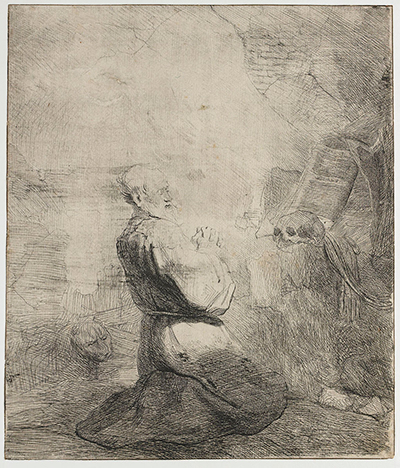
Rembrandt produced a number of different interpretations of St Jerome Kneeling, many of which were etchings such as this one. This particular piece is dated at 1630.
The date of this work would place it at a point where Rembrandt had been working with the etching medium for a few years and was now starting to become more confident and ambitious in his techniques. One effect of this was to use a greater variety of tone, meaning he would incorporate very dark areas for the most important parts of the composition and then later use subtle changes in greys throughout the rest of the piece. In the case of this design, St Jerome Kneeling, the figure's back is shadowed darkest, with much more detail found to his right in a lighter fashion. There is also a good contrast between the bright light which cover the top half of the work and the shadowed area below. Rembrandt expands on this room a little, with elements of brick work and several of this man's possessions also included here.
Rembrandt would develop his drawing and etching methods over time, taking in ideas from other local artists with whom he spent time before then appending his own creative methods on top. He would eventually become somewhat secretive about some of his techniques, keen to protect the successful career that he was now forging. It was also his etchings that provided him fame and fortune during his own lifetime, and enabled him to finance a large collection of other artists' work for a number of years, prior to experiencing financial problems in later life. He had essentially built a brand using the prints from these etchings and they could be sold far and wide, spreading his signature into new markets for the first time.
The prints produced from Rembrandt's etchings have been dispersed far and wide but within the last century or so there have been efforts by the major art galleries and museums to acquire as many of these as they can, with most available at fairly nominal prices. The end result of this is that several galleries will have prints from the same series of work, just different iterations of them. The artist would normally write on the back of each print which edition of print it was, and how many of each were produced. This helps art historians massively in documenting this part of his career, which would otherwise be almost impossible. Several extensive catalogue raisonnes of the artist's work have been produced in recent years, and the overall artworks run into the thousands, when counting all of the different mediums in which Rembrandt was involved.
Object Notes and Research Context
Rijksmuseum records St Jerome Kneeling in Prayer as a 1635 etching and notes that Rembrandt etched Jerome no fewer than seven times. That repeated attention should anchor the page: Jerome was not merely a Catholic saint in a Protestant environment, but also a model of scholarship, translation, penitence and inward study.
The attributes are easy to miss: Jerome can be shown with book, crucifix, skull, cardinal's hat, lion or stone. In this kneeling version Rembrandt concentrates on prayer and humility rather than learned display. Those attributes connect the print to Rembrandt's etchings, scholar imagery, old-man figures and iconography.
Jerome was attractive to Rembrandt because he could be shown as both scholar and penitent. A kneeling version reduces the emphasis on books and learned furniture, but the saint's identity still carries the memory of translation, study and withdrawal. That helps explain why Rembrandt returned to Jerome repeatedly.
The lion and cardinal's hat may not dominate every Jerome image, but they are useful attributes to mention when explaining the iconography. A compact attribute note would also fit the future glossary plan: saintly attributes, iconography and penitence are all terms that can help users who are not already familiar with Christian art.
Further Rembrandt Context
This shorter legacy page remains part of the Rembrandt archive. For fuller context, use the refreshed Rembrandt pages below, which explain the artist's biography, media, technique, attribution issues and major works in greater depth.
For secure object data, attribution and collection history, compare St Jerome Kneeling with the relevant museum or catalogue record before treating older page text as final.
 Rembrandt.jpg)
Discussion
What feels most useful when looking at St Jerome Kneeling: the subject, the handling of light, the medium, the attribution history, or its place within Rembrandt's wider etching or print output?
Reader Insights
Set this page beside the refreshed Rembrandt hubs before relying on older summaries alone.
Rembrandt pages often need museum records, catalogue history and attribution caution, especially where older sources use broader labels.
Which detail would you most want clarified next: date, medium, collection, attribution, subject, condition or comparison with another Rembrandt work?
Join the Conversation
Have a thought or observation about St Jerome Kneeling? Share it below. Thoughtful responses may be added as the Rembrandt archive continues to be reviewed.