


 by Tom Gurney
Tom Gurney BSc (Hons) is an art history expert with over 20 years experience
Published on June 19, 2020 / Updated on August 9, 2026
Email: tomgurney1@gmail.com / Phone: +44 7429 011000
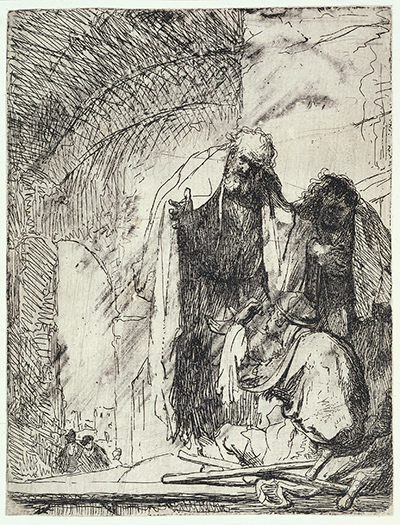
This particular pen drawing was completed by Rembrandt in around 1629 and now resides in the collection of the Albertina in Vienna, Austria. They host an impressive selection of drawings and prints from the old masters within their overall display.
You will be able to see several different techniques used within this artwork, where Rembrandt varied the intensity and direction of his tool strokes. He produced several different interpretations of this content during his career, with another being an etching which was printed many times. The version in front of us here captures an honest scene where Peter and John are standing beside a cripple in front of the gate of the temple. This was an artist who gained more inspiration from religious scripture than from anywhere else, though this was much the case for most famous artists during this period. The men look tired and wear thick, warm clothes which hard wearing rather than fashionable. This look over this helpless man and consider what they can do to help.
Such was the artist's appreciation for this drawing, he would actually turn it into an etching for printing purposes several decades later. In a religious society such as that, one can imagine this proving popular with the masses, who were now finally able to be able to afford something from this artist's career. He also was best known as an etcher during his own lifetime, because of the way in which the prints could be sold on to a wide audience, even though today he is much more famous as a highly skilled oil painter. The setting of this famous scene is Jerusalem, where the cripple asks for alms. He is then cured of his problems and follows them into the temple, dancing and jumping as he goes. This type of miraculous occurrence is entirely typical of stories from the Bible and have provided inspiration to many artists, dating back centuries.
The Albertina hosts 60,000 works by 5,000 artists within its collection, though clearly these are not all going to be on display at the same time. They have also recently opened a new building which focuses more on the modern elements of their collection. This institution has a particularly formidable number of drawings from the old masters, as many as pretty much anyone else in the world and some of the highlights to be found here include a Study for the Last Supper by Leonardo da Vinci from around 1495, the well known Young Hare by Albrecht Dürer and also The Painter and The Buyer by Pieter Bruegel the Elder.
Object Notes and Research Context
Rijksmuseum records date St Peter and St John at the Gate of the Temple to around 1629 and describe it as an extremely rare early etching. The subject is Acts 3: Peter and John encounter a disabled beggar at the temple gate; Peter offers not silver or gold, but healing in the name of Christ.
The museum's note that the sheet is rough and sketchy should guide the article. Its value is not polish but evidence of Rembrandt's early search for narrative, gesture and line. It belongs beside the beggar studies and the earliest religious etchings, when he was still learning how far a bitten line could carry action and emotion.
The Acts 3 story gives the print a clear narrative hook. A man unable to walk asks for alms at the temple gate; Peter responds with healing rather than money. Rembrandt's early etching is rough, but that roughness helps show his attempt to translate encounter, gesture and miracle into a small plate.
This is also a bridge between beggar imagery and religious narrative. The disabled figure is not simply a street type, because the biblical story transforms him through healing. That double role makes the page stronger than a short caption and gives it links to beggar prints, early etching and New Testament subjects.
Further Rembrandt Context
This shorter legacy page remains part of the Rembrandt archive. For fuller context, use the refreshed Rembrandt pages below, which explain the artist's biography, media, technique, attribution issues and major works in greater depth.
For secure object data, attribution and collection history, compare Peter and John at the Gate of the Temple with the relevant museum or catalogue record before treating older page text as final.
 Rembrandt.jpg)
Discussion
What feels most useful when looking at Peter and John at the Gate of the Temple: the subject, the handling of light, the medium, the attribution history, or its place within Rembrandt's wider etching or print output?
Reader Insights
Set this page beside the refreshed Rembrandt hubs before relying on older summaries alone.
Rembrandt pages often need museum records, catalogue history and attribution caution, especially where older sources use broader labels.
Which detail would you most want clarified next: date, medium, collection, attribution, subject, condition or comparison with another Rembrandt work?
Join the Conversation
Have a thought or observation about Peter and John at the Gate of the Temple? Share it below. Thoughtful responses may be added as the Rembrandt archive continues to be reviewed.