


 by Tom Gurney
Tom Gurney BSc (Hons) is an art history expert with over 20 years experience
Published on June 19, 2020 / Updated on August 9, 2026
Email: tomgurney1@gmail.com / Phone: +44 7429 011000
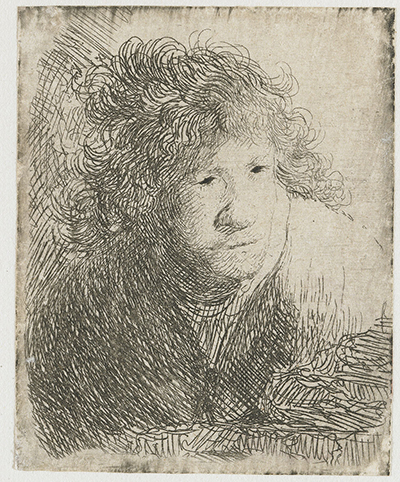
This self portrait was produced in 1628, when the artist would have been in his early twenties. The wavy hair is loosely created by Rembrandt within this etching which was later printed several times.
We see several etching techniques used here, with cross hatching for the shoulders, and then straight, lighter lines for the facial features. Light comes in from our right, leaving dark shadows onto the left hand side. This use of lighting helps to increase contrast within the piece, making each feature stand out a little more, when etching already lacks the variety of palette that you might find within Rembrandt's paintings. You will find a number of related etchings from his career, where he produced self portraits at a relatively young age - see Self Portrait in a Cap, Wide-Eyed and Open-Mouthed and Self Portrait with a Broad Nose for example. Rembrandt took advice from a number of etchers early in his career in order to best understand this new medium that he had not used before. Even by this stage, he was already shows signs of mastery.
Research, even just by us, was needed in order to find any great information on this artwork, as it is not amongst his most famous self portraits. The original Dutch title of Zelfportret, Luisterend, naar Voren geleund beared more success, and we immediately discovered that the piece can be found at the Rijksprentenkabinet, which is the Rijksmuseum's prints and drawings department, that was officially created in 1799. This is hardly surprising, of course, because their collection features a great number of prints and etchings from this artist's career but it is important to be sure about its location before you are able to learn anything more. Typically, we can then likely find more information on the etching and its prints from articles and books published by this institution since the department there was set up, more than two centuries ago.
Peter Paul Rubens was an artist that Rembrandt greatily admired and he would look to this master for inspiration around his own self portraits. You will actually find a good amount of similarity within their careers, at least from the perspective of content and themes. They were, of course, stylistically and technically both very unique and it would be wrong to say that Rembrandt was anything other than a true genius who took inspiration but incorporated it into his own world. Rubens himself actually liked to put himself into group artworks, almost as something of a surprise to the viewer, in a similar way to how Diego Velazquez would appear in Las Meninas, for example. Rubens himself can be seen in Self Portrait in a Circle of Friends from Mantua and Self Portrait with Brother Philipp Justus Lipsius and another Scholar.
Object Notes and Research Context
Rijksmuseum records this c.1628 print under Self-portrait, Bending Forward, with the older title Self-portrait, leaning forward, listening. The title variation is useful because the pose does feel auditory: Rembrandt tips forward, as if catching a sound or reacting to someone just outside the plate.
As with the broad-nose and fur-cap prints, the small scale should not be mistaken for minor ambition. Rembrandt is testing angle, shadow and expression while using his own head as a readily available model. The print connects to Rembrandt's self-portraits and early Leiden experimentation.
The pose is the page's main interpretive asset. Leaning forward changes the usual self-portrait relationship: the head seems to react rather than simply present itself. That gives the tiny etching a sense of immediacy, as if the viewer has caught Rembrandt in the middle of looking or listening.
Like the broad-nose and frowning prints, this sheet belongs to the practical side of Rembrandt's self-portrait project. It tests angle, expression and shadow before any grand claim about identity. The print is best described modestly, as evidence of repeated experiment within Rembrandt's early self-portrait practice.
Further Rembrandt Context
This shorter legacy page remains part of the Rembrandt archive. For fuller context, use the refreshed Rembrandt pages below, which explain the artist's biography, media, technique, attribution issues and major works in greater depth.
For secure object data, attribution and collection history, compare Self Portrait, Leaning Forward, Listening with the relevant museum or catalogue record before treating older page text as final.
 Rembrandt.jpg)
Discussion
What feels most useful when looking at Self Portrait, Leaning Forward, Listening: the subject, the handling of light, the medium, the attribution history, or its place within Rembrandt's wider etching or print output?
Reader Insights
Set this page beside the refreshed Rembrandt hubs before relying on older summaries alone.
Rembrandt pages often need museum records, catalogue history and attribution caution, especially where older sources use broader labels.
Which detail would you most want clarified next: date, medium, collection, attribution, subject, condition or comparison with another Rembrandt work?
Join the Conversation
Have a thought or observation about Self Portrait, Leaning Forward, Listening? Share it below. Thoughtful responses may be added as the Rembrandt archive continues to be reviewed.