by Tom Gurney
Tom Gurney BSc (Hons) is an art history expert with over 20 years experience
Published on June 19, 2020 / Updated on October 14, 2026
Email: tomgurney1@gmail.com / Phone: +44 7429 011000
Four men around a table
Rubens stands at the left of a group gathered around books, paper and pens. His brother Philippe sits beside him. Justus Lipsius occupies the centre in a fur-trimmed garment, and Jan Woverius sits at the right. Above them, a stone bust looks out from a niche; four tulips rise nearby. A landscape opens behind the group. The painting turns friendship, study and remembrance into a shared portrait.
The Italian national cultural catalogue[1] names all four human sitters and identifies Rubens as the painter. It records I quattro filosofi, or The Four Philosophers, as oil on panel, 164 × 139 centimetres, in the Gallerie degli Uffizi, with Palatina inventory 85. Its scholarly note gives the generally accepted date as about 1611–12. A Uffizi conservation notice[2] uses the fuller Palatina 1912 no. 85 inventory wording. The inherited route's mention of “another scholar” should therefore be expanded: that scholar is Jan Woverius in the holding catalogue.
The four figures were not necessarily together when Rubens painted the panel. Lipsius had died in 1606, and Philippe in 1611, according to the national catalogue. The work is usually placed soon after Philippe's death. It can depict relationships that endured in memory rather than a literal meeting in 1612. The table and shared activity give the gathering a living form, while the dates give it a commemorative weight.
At a Glance
- ArtistPeter Paul Rubens [1]
- SittersRubens, Philippe Rubens, Justus Lipsius, Jan Woverius [1]
- DateAbout 1611–12 (national catalogue) [1]
- MediumOil on panel [1]
- Dimensions164 × 139 cm [1]
- CollectionGallerie degli Uffizi, Palatina 85 [1]
Where this work sits in Rubens's career
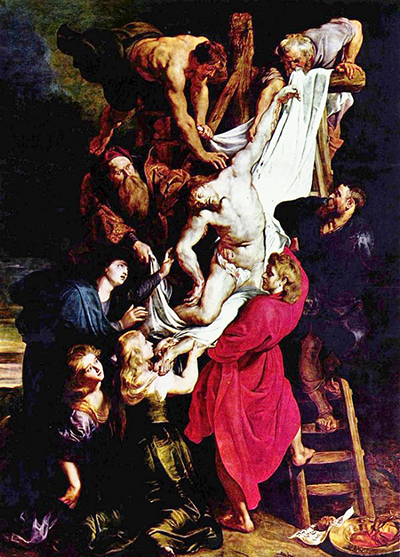
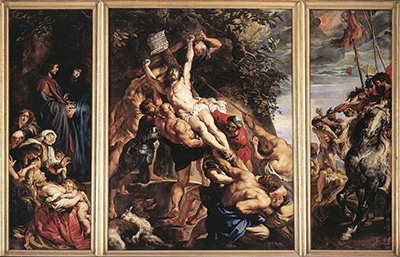
The Elevation of the Cross
1609–10The Descent from the Cross
1611–14The Four Philosophers
c. 1611–12The Garden of Love
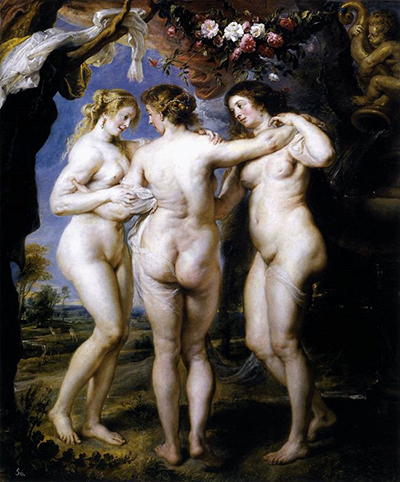
1630–35The Three Graces
1630–35Contents
- Who are the four philosophers?
- Why do the books, pens and carpet matter?
- What is the bust above them?
- Why are there four tulips?
- Is the view behind them Rome?
- Was the group painted from life in 1611–12?
- How does it differ from the Mantuan friends portrait?
- What happened to the panel later?
- How should the panel be read today?
Who are the four philosophers?
Peter Paul Rubens is the standing figure at the left. He watches the scene and also faces a little towards the viewer. His dark clothes connect him visually to the group, but his upright position distinguishes him from the three seated men. As both artist and sitter, he can place himself within a learned circle while remaining the maker of its image.
Philippe Rubens, his brother, sits next to him. The Italian catalogue identifies Philippe as one of the men who had died before the picture's generally accepted date. His presence is therefore not only a family likeness. It makes the painting a way to keep a lost companion among the living figures. The relationship between the brothers helps explain why Rubens would give a group scene such care.
Justus Lipsius sits centrally in fur. The national catalogue describes him as the teacher of the younger men and connects the portrait with his work on the ancient philosopher Seneca. Lipsius's position gives him visual authority: hands, books and the others' attention gather around him. Rubens does not need a label within the painting to make the figure a focal point, although the museum record supplies his name.
Jan Woverius, at the right, completes the human group. His identification is explicit in the national catalogue and in the Uffizi's later conservation notice. The older English route title leaves him unnamed, which could make readers think the fourth figure is anonymous. Naming Woverius restores the painting's social shape: this is not simply Rubens posing with his brother and a famous philosopher, but a portrait of a wider circle of pupils and friends.
The title Four Philosophers is conventional rather than a claim that every sitter held the same profession. The group unites artist, brother, teacher and associate around learned pursuits. It invites the viewer to think of conversation and books. Their different roles remain important, because the painting's meaning comes from relationships among named people, not from four interchangeable heads.
Why do the books, pens and carpet matter?
The tabletop is crowded with the materials of study. Books lie stacked and open; a pen and papers suggest reading, writing or discussion. These objects do not tell us exactly which page any man was examining at one historical moment. They create a credible environment for learned exchange. The viewer reads the figures as people whose relationships pass through texts and ideas.
The patterned carpet under the objects adds colour and richness. It also slows the eye at the centre of the composition, where hands and books meet. Without the table, the group might look like four separate bust portraits placed side by side. The shared surface lets their bodies and attention connect. It becomes the physical stage on which friendship and scholarship are made visible.
Rubens uses the surrounding dark clothing to make hands and faces prominent. A gesture over the books matters because the rest of the figure is restrained. Lipsius's central position, Philippe's proximity and Woverius's turn all become more legible against the relatively dark garments. The image is full of people, but its action is concentrated in a small space.
The objects are also evidence of what the painting chooses not to show. There is no battlefield, court ceremony or miracle. Rubens gives intellectual company a pictorial gravity usually reserved for more public subjects. The antique bust and Roman view expand that company beyond the present room, linking the men to older texts and examples.
What is the bust above them?
The Italian catalogue calls it the bust traditionally known as Seneca. Lipsius wrote extensively about Seneca, so the bust had long helped viewers understand the group's scholarly allegiance. Yet a historical label for an ancient-looking head is not the same as secure ancient identification. Calling it the so-called Seneca bust preserves the tradition without claiming that the original sculpture certainly represented Seneca himself.
The bust occupies a niche at the upper right, above Woverius and near the tulips. It is a fifth “face” in the composition, but not a fifth human sitter. Its stony presence differs from the warm, active men below. The contrast invites a comparison between inherited ancient learning and the living scholars who discussed it. The catalogue links the bust with Rubens's and Lipsius's antiquarian interests.
The national record gives a long account of historical copies and identifications of the bust. That scholarship explains why the object was meaningful to the group, but a reader does not need to accept every chain of attribution to see its pictorial role. It presides over the table, making the activity beneath it appear part of a larger tradition of reading and interpretation.
The bust should not be moved into the Mantuan friends portrait in Cologne merely because Rubens painted both groups. This stone head belongs to the arrangement of the Uffizi panel. Object-specific details are the best guard against blending two works with overlapping sitters.
Why are there four tulips?
The flowers stand in a vase near the bust. The Italian catalogue notes four tulips, two open and two still in bud, and reports a memorial interpretation: the two surviving men honour two friends who have died. Because Lipsius and Philippe were dead by the accepted date, the flowers can be read as a quiet sign of the group's division between present and remembered companions.
That is a scholarly reading of a visual detail, not a surviving written instruction from Rubens. The tulips do not literally spell out the men's names. Their number and different stages of opening make the interpretation plausible within a group of four, while the historical death dates give it weight. The page can share the reading without claiming it is the only possible meaning of the flowers.
The vase also softens the severe setting. Books and a sculpted head might make the room feel entirely intellectual. Flowers introduce growth and transience beside stone and paper. That contrast is especially apt for a portrait made in the wake of loss. A small object can change the emotional temperature of a large panel without dominating it.
Look, too, at where the flowers are placed: high enough to be seen against the wall, close to the bust, yet not between the faces at the table. Rubens lets them carry a possible symbolic charge while keeping the human relationships central. The panel rewards moving back and forth between its principal figures and these quieter details.
Is the view behind them Rome?
The national catalogue identifies a Roman background with ruins of the Palatine and the church of San Teodoro. The opening lies between the figures and the hanging drapery, giving the enclosed gathering a view into another place. Rome was a source of ancient monuments and texts that mattered to Rubens and the humanists he portrays.
The catalogue interprets the landscape as an homage to classical culture. It also compares the motif with other Rubens works. That contextual information should not become a claim that all four men posed together before this exact view. Landscape in a constructed portrait can function as an intellectual setting, not a record of where the sitters were assembled.
The glimpse of ruins gives depth and colour between dark indoor forms. It creates a passage from the table's books to the wider ancient world they studied. The viewer can read the view without having to recognise each building: it tells us that the group's conversation is connected to history beyond the room.
This Roman setting differs from the Mantuan association of Rubens's earlier friendship portrait in Cologne. The two backgrounds belong to different works and different claims about the people pictured. Distinguishing them prevents the title of one painting from rewriting the setting of the other.
Was the group painted from life in 1611–12?
No single sitting could include both men who had already died. The national catalogue dates Lipsius's death to 1606 and Philippe's to 1611 and places the painting around 1611–12. Rubens could use earlier likenesses, memory and invention to bring them into a common space. The record points to earlier portraits as sources for some faces. The result is a coherent image, but coherence should not be mistaken for a dated eyewitness account.
That constructed quality makes the work more poignant. The living and the dead share a table as if a conversation could continue. The panel may help preserve friendship, kinship and learning after loss. The Italian catalogue frames it as an homage, and the flowers support that reading. This does not require us to invent a specific commission or the exact words Rubens intended a viewer to think.
Rubens gives the figures enough bodily presence for the scene to feel alive. Hands hover near books; faces turn towards one another; the table holds everyday working objects. Painting makes an impossible reunion appear physically plausible. Its emotional force comes from that combination of ordinary scholarly activity and historical absence.
The precise date is also qualified. The catalogue's main database range 1600–1699 is simply a broad period classification. Its historical note gives the narrower scholarly placement about 1611–12. Reading the right field matters: the broad database range should not be copied as if historians thought the panel could have been made at any moment across the century.
How does it differ from the Mantuan friends portrait?
The earlier Self-Portrait in a Circle of Friends from Mantua is a 77.5 × 101 cm canvas shown in Cologne as a German federal loan, dated about 1602–05 by the Wallraf. The Uffizi Four Philosophers is a much larger 164 × 139 cm panel dated about 1611–12. The change in material, size, date and collection is enough to identify separate objects.
Both works place Rubens in learned company, and both can include Philippe and Lipsius in museum interpretations. But the Uffizi panel explicitly names Woverius and uses books, tulips and the so-called Seneca bust in a memorial arrangement. The Mantuan picture has a different crowd and different uncertainties about some sitters, including a proposed Galileo identification. Transferring one work's details to the other would flatten the development of Rubens's self-presentation.
The comparison is useful because it shows a persistent interest. Rubens did not paint himself only as an isolated maker of pictures. He could present his face within circles of friendship and thought. In the Uffizi work, the deaths of Philippe and Lipsius make that presentation an act of remembrance as well as of intellectual affiliation.
The inherited route names Rubens, Philippe and Lipsius but leaves the last man anonymous. The correct public title The Four Philosophers and the opening identification of Woverius repair that omission while preserving the existing address. A reader can then understand why the painting has its familiar name.
What happened to the panel later?
The Italian catalogue says the painting's original provenance is unknown. It was at Palazzo Pitti by the end of the seventeenth century, and an eighteenth-century depiction of the Uffizi Tribuna also includes it. French commissioners removed it in 1799 and took it to Paris, where it appeared in Louvre-era listings. It was recovered in 1815. These are documented later stages, not a complete account of its first owners.
The national catalogue now lists the work at the Gallerie degli Uffizi and gives Palatina 85. A recent Uffizi conservation notice names Palatina 1912 no. 85 and the four sitters. A Museum Plantin-Moretus record says the original has been in the Uffizi portrait galleries since 2023. Those current records matter because older books may still locate the picture at the Palatine Gallery in Palazzo Pitti. The historic inventory name and current location can coexist.
The 2025 conservation notice is evidence of museum attention to the work; it should not be turned into unsupported claims about treatment results. Its useful facts here are the object title, named sitters and inventory number. A release-ready page should be checked again if the museum updates display or conservation status.
The painting's later movements show how an image made around private friendship became part of major public collections. Its present setting invites viewers to study it as a work of art and a historical document. The panel itself, however, still resists being treated as a simple document of one meeting because its central relationships cross the boundary between life and memory.
How should the panel be read today?
Begin with the four men and their positions around the table: Rubens standing left, Philippe seated near him, Lipsius central in fur and Woverius at right. Then look at their hands, books and pens. The arrangement creates an active community of study. The objects above and behind them expand that community into antiquity and remembrance.
Return to the four tulips and so-called Seneca bust. The museum's memorial reading links the flowers to two living and two deceased companions. The bust gives the ancient philosopher's name a place in the room, even though the historic identification of the sculpted head is not certain. These symbols work because the people below remain vivid, not because the picture has become an abstract allegory.
Finally, keep the object's identity precise: Rubens, The Four Philosophers, about 1611–12, oil on panel, 164 × 139 cm, Uffizi Palatina 85. The original commission is unknown. The familiar title and the named Woverius distinguish it from the earlier Mantuan friends canvas. The painting is a constructed gathering that lets Rubens keep family, teacher and friend in one shared intellectual space.
Rubens artworks directory
Frequently Asked Questions
The Italian national catalogue names him Jan Woverius, seated at the right. The other sitters are Rubens, his brother Philippe and Justus Lipsius.
The catalogue's historical note gives the generally accepted date as about 1611–12, after Philippe Rubens died in 1611. Its database's broader 1600–1699 label is a period classification.
It is traditionally called Seneca because of the group's connection to Lipsius's Seneca scholarship. The ancient identity of the sculpted head should remain qualified.
The catalogue reports a memorial reading in which two open and two budding tulips honour the group's two living and two deceased men. This is an interpretation of the painted detail.
The current national catalogue lists it at the Gallerie degli Uffizi, Florence, inventory Palatina 85. It is distinct from the Mantuan friends canvas in Cologne.
Discussion
Follow the four faces around the table, from Rubens to Woverius.
Share a close observation or a reliable source for Uffizi Palatina 85.
Reader Insights
How do the tulips and so-called Seneca bust shape the memorial reading?
What makes this gathering different from a literal 1612 sitting?
How does this panel differ from the earlier Mantuan friends canvas?
Join the Conversation
Add your reading below, keeping the four named sitters and this object's history distinct.
References
- Italian national cultural catalogue, I quattro filosofi , record 0900129505. View source
- Gallerie degli Uffizi, conservation notice naming the sitters and Palatina 1912 no. 85. View source
- Fondazione Federico Zeri, catalogue record for the Uffizi panel. View source
- Museum Plantin-Moretus, later print record noting the original's Uffizi display since 2023. View source
- Wallraf-Richartz-Museum, separate early Mantuan friends canvas. View source