 by Tom Gurney
Tom Gurney BSc (Hons) is an art history expert with over 20 years experience
Published on June 19, 2020 / Updated on October 14, 2026
Email: tomgurney1@gmail.com / Phone: +44 7429 011000
A face that meets the draughtsman
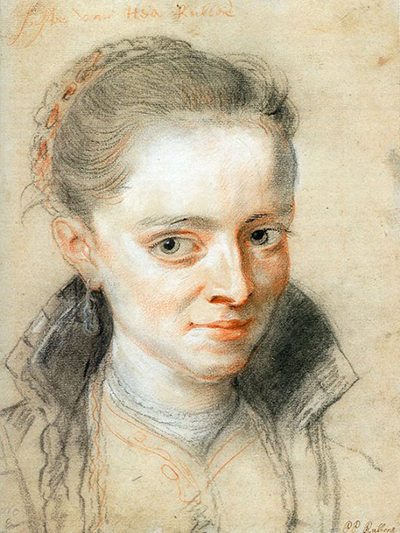
Susanna Fourment looks out with an alert, level gaze. Her hair is drawn back from a high forehead, and the corners of her mouth turn very slightly. A dark collar surrounds the lighter face; the lower clothing is left comparatively open. Rubens gives the viewer enough detail to recognize an individual presence without finishing every part of the costume. The portrait's immediacy comes from that balance between precise attention to the eyes and freedom elsewhere on the sheet.
The ALBERTINA in Vienna[1] catalogues the drawing as Susanna Fourment by Peter Paul Rubens, about 1620. It is black and red chalk heightened with white chalk, 34.5 × 26 centimetres, inventory 17651. The museum identifies Susanna as the sister of Hélène Fourment, whom Rubens married in 1630. At the approximate date it now gives this drawing, Susanna was a future sister-in-law, not yet a relative through that marriage.
The image is a portrait drawing, not an oil painting. Its materials are central to the effect: black shapes the hair and clothing, red warms the face, and white creates light across the skin. The sitter's look and small smile can invite an imaginative story about her thoughts, but the drawing does not disclose what she was thinking. The ALBERTINA itself presents a sensitive interpretation of a brief expression; that should be read as a response to the image, not as a verbatim report of Susanna's private feelings.
At a Glance
- ArtistPeter Paul Rubens [1]
- SitterSusanna Fourment (1599–1628) [1]
- DateAbout 1620; older datings differ [1]
- MediumBlack and red chalk heightened with white chalk [1]
- Dimensions34.5 × 26 cm [1]
- CollectionALBERTINA, Vienna, 17651 [1]
- InscriptionLower-right P P Rubbens added by another hand [1]
Where this work sits in Rubens's career
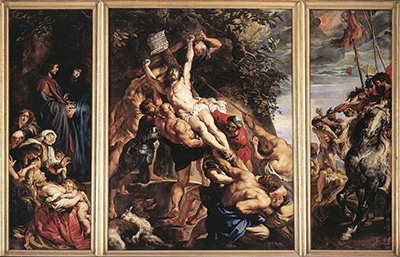
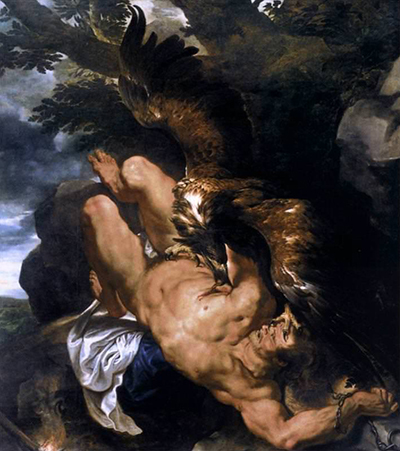
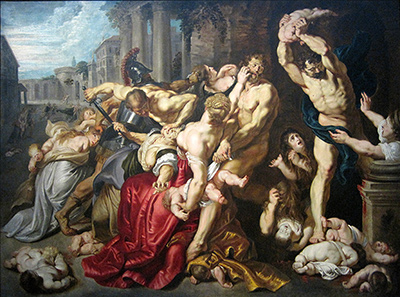
The Elevation of the Cross
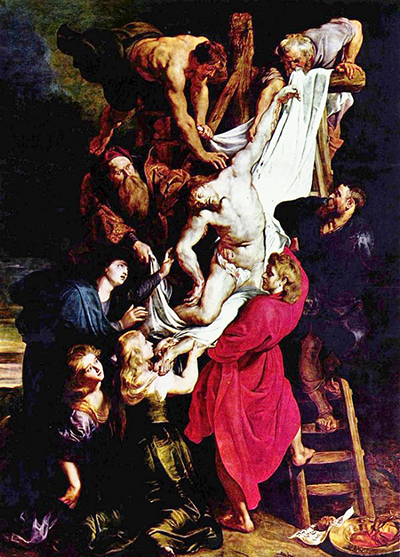
1609–10The Descent from the Cross
1611–14Susanna Fourment
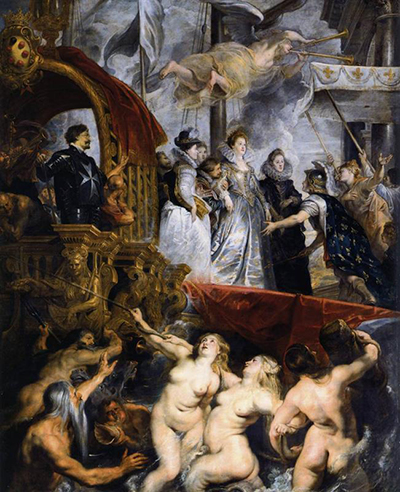
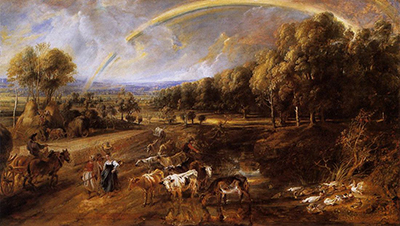
c. 1620The Garden of Love
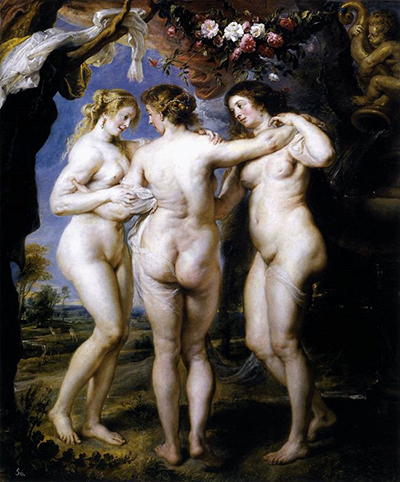
1630–35The Three Graces
1630–35Contents
- Who was Susanna Fourment?
- How does Rubens make the face feel immediate?
- What can the chalks do together?
- Is the drawing a finished portrait?
- When was the portrait made?
- What do the inscriptions mean?
- What should a viewer notice first?
Who was Susanna Fourment?
The holding museum identifies the sitter as Susanna Fourment (1599–1628). She belonged to the Fourment family and was the sister of Hélène, Rubens's later second wife. The ALBERTINA states that Rubens knew the family through close connections among the Rubens, Brant and Fourment circles before his marriage to Hélène. Those relationships explain how the sitter could have been known to him; they do not turn this sheet into a portrait made for a wedding in 1630.
Chronology matters here. The museum's current catalogue dates the drawing about 1620. Rubens's first wife Isabella Brant was then still alive, and Hélène would become his wife a decade later. Referring to Susanna as “Rubens's sister-in-law” without the word future makes the family link sound contemporary with the sitting. The more precise formulation is that this was a woman in a connected family whom Rubens would later become related to by marriage.
The ALBERTINA's 1599–1628 dates also mean that Susanna died before the 1630 marriage. That fact sharpens the need to keep the sequence straight. The sheet's interest is not that it documents a later marital relationship; it gives a distinct face and presence to a woman from Rubens's social world. The portrait can be appreciated without using Hélène's later fame to define Susanna entirely.
The name is supported by the museum's catalogue. A top-left inscription visible in the retained reproduction reads “Suster van Heer Rubbens” according to the ALBERTINA transcription. The museum lists it among inscriptions but does not, in the short field, explicitly call that wording autograph. It is therefore sensible to report the inscription and the current sitter identification without treating every handwritten label on the sheet as a note made during the portrait sitting.
How does Rubens make the face feel immediate?
The eyes are unusually direct. Their dark centres sit beneath finely judged lids, and each eye is set within a slightly different pattern of light and shadow. Because Susanna looks outward, the viewer's attention returns repeatedly to them. Rubens does not need an elaborate setting to create the feeling of a person pausing and looking back.
Her lips are almost closed. The slight rise at the corners can be read as a smile, but it is small enough to resist a single emotional label. The ALBERTINA suggests that she watches the artist at work and smiles as though courteously uncertain about the result. That is the museum's expressive reading of the image. The visible marks support the observation of a poised glance and a restrained smile; they cannot prove doubt, approval or amusement as historical facts.
The face is built with soft transitions. Across the forehead and cheeks, pale areas come forward while red chalk gives the skin warmth. Stronger darks collect around the eyes, under the nose and at the collar. The white heightening brightens selected parts without turning the drawing into an evenly coloured miniature. This selective finish allows the head to seem fully present while the clothing remains more provisional.
The portrait is also slightly asymmetrical. The hairline, ears and collar do not form a perfectly balanced decorative frame. This asymmetry matters: the head feels turned and alive rather than fixed as an emblem. The cheeks and eyes are closely observed enough to suggest an individual, but no single feature is exaggerated into a caricature. Rubens's control lies in keeping the marks varied and the expression open.
What can the chalks do together?
The ALBERTINA specifies black chalk, red chalk and white chalk. Black supplies structure and depth, especially in the swept-back hair and the dark garment near the neck. Red offers a different tonal temperature for the skin and some hair or clothing lines. White makes the forehead, cheeks and other lit passages rise from the paper. The combined effect is often called a three-chalk manner, but the important point for this sheet is what the colours do for Susanna's face.
In the retained image, the red marks are visible around the cheeks, eyes, lips and fine clothing lines. The black and grey passages carry the hair and collar. White areas are concentrated where the face catches light. The colours are not applied as flat zones to fill in an outline. They work through the drawing's marks, leaving the paper active between them.
Some of the strongest lines appear in the collar, whose edges bend sharply around the neck. They stop the head from floating against a blank ground. Yet the lower garment is only lightly indicated. The portrait's emphasis is therefore not a complete record of fashion or fabric. It is the encounter between the sitter's face and Rubens's observation.
The sheet measures a little more than thirty-four centimetres high. At that scale, the sitter's eyes and mouth can be studied closely. A web image may enlarge them dramatically, but the original remains a work on paper with faint passages that reward near viewing. The museum's material description is needed alongside the reproduction because a screen cannot fully show the chalk's texture or distinguish every white mark from the paper's own light tone.
Is the drawing a finished portrait?
The word portrait does not require uniform finish. Susanna's features are carefully developed, while the costume and lower edges remain freer. The drawing seems complete in its purpose of making the face and expression present, even though it leaves some details unresolved. A viewer can ask whether Rubens intended it as a self-contained portrait or as part of a wider practice of keeping likenesses; the short ALBERTINA entry does not specify a commission or a finished painting derived from this exact sheet.
Its selectivity is part of its strength. The hair gathers the head into a coherent shape. The collar frames the chin and cheeks. The lighter, less detailed clothing stops the eye from wandering away from the face. Rubens could make the personality of a sitter seem vivid by deciding what to describe fully and what to leave open.
The ALBERTINA places the work among its well-known Rubens portrait drawings. Its essay contrasts Rubens's lively, observed portraits with a more schematic mannerist portrait tradition. That is the museum's art-historical framing. This sheet offers a concrete instance: a face with a particular glance, a barely resolved smile and changes of pressure in the chalk that keep the features from hardening into a rigid mask.
Nothing in the record establishes that Susanna sat only once or how long the session lasted. The image can feel like a short, spontaneous encounter, but apparent speed is not a documented clock. Rubens could work rapidly while revising; a drawing can preserve a fleeting expression after sustained attention. The secure claim is that the museum reads the portrait as catching a momentary change of expression.
When was the portrait made?
The ALBERTINA's current date field says about 1620. Its long bibliography, however, records earlier scholarly proposals around 1625–27 and 1625. The present page follows the museum's current public dating while acknowledging that scholars have not always placed the sheet in the same years. The approximation sign matters; it is not a signed date written by Rubens on the paper.
The alternative dates alter how the portrait sits within Susanna's short life, but none of them supports a connection to the 1630 marriage, which occurred after her death. They also do not change the identification of the drawing's medium, size or holding collection. A cautious caption can say “about 1620, according to the current ALBERTINA catalogue” without pretending that the date has never been debated.
The museum essay also discusses Rubens's portrait practice at European courts. That larger career provides context for his skill in observing faces, but it should not make this particular drawing into a royal commission. Susanna was a named woman in a family circle, not a ruler posed for diplomacy in this sheet. The paper's intimate scale and spare setting are enough to keep its distinct purpose visible.
What do the inscriptions mean?
The ALBERTINA records “Suster van Heer Rubbens” at the upper left, “P P Rubbens” at the lower right and “No / 8” at the lower left. It specifically states that the lower-right “P P Rubbens” was written by another hand. That name should not be called Rubens's autograph signature. A collector or later keeper could add a name to help classify the drawing; the museum's attribution to Rubens as artist does not require him to have written the label.
The upper-left wording and lower-left number deserve mention because they are visible traces of how the sheet was handled and identified. The present object record does not, in those brief inscription fields, explain the date or author of every mark. A label can support the history of an identification while still needing cautious interpretation. The sitter's present catalogue name rests on the museum's assessment, not on an unquestioned assumption that all inscriptions arose in the same moment as the chalk portrait.
The sheet also bears the mark of Duke Albert of Saxony-Teschen at the lower right, identified by the museum as Lugt 174. The ALBERTINA lists him in the provenance. This mark belongs to later collecting history, not to Susanna's sitting and not to Rubens's original artistic act. The drawing carries both a seventeenth-century likeness and later signs of ownership and classification.
The distinction is especially useful when the image is viewed online. Handwritten marks can look like part of the artist's composition or a confirming signature. The museum record separates artist, inscriptions and collector's mark into different fields. Doing the same in prose keeps readers from mistaking a later label for direct testimony from Rubens.
What should a viewer notice first?
Start at the eyes. They give the feeling that Susanna has noticed the artist's attention and returns it. Then look at the mouth, where a small shift is enough to keep the expression unsettled and alive. Finally, notice the strong collar against the light face and the finer, unfinished lines below it. Rubens's priorities become clear as the gaze moves from feature to fabric.
The drawing's family context is helpful, but it should not overwhelm the person depicted. The ALBERTINA identifies her as Susanna Fourment, sister of Hélène; the portrait itself offers a much more immediate encounter than a family label. It preserves the look of a named woman who died young, using black, red and white chalk in a way that makes a small expression feel durable.
The page's reliable anchors are simple: the ALBERTINA object number 17651, current date about 1620, three chalk colours, dimensions 34.5 × 26 centimetres, the sitter's museum identification, and the later nature of the lower-right “P P Rubbens” inscription. From them, a reader can look closely without turning a slight smile into an invented anecdote.
Rubens artworks directory
Frequently Asked Questions
Not if the current about 1620 date is used. Susanna was Hélène Fourment's sister; Rubens married Hélène in 1630, after Susanna's death.
No. It is a drawing in black and red chalk heightened with white chalk, 34.5 × 26 centimetres, in the ALBERTINA, Vienna.
The ALBERTINA says the lower-right inscription was made by another hand. It still credits the drawing itself to Rubens.
The museum's current date is about 1620. Its bibliography records older scholarly suggestions nearer 1625–27.
Her glance and slight smile are visible, but her private thoughts are not documented. The museum offers a sensitive interpretation of the moment; it is not a recorded statement from the sitter.
Discussion
Begin with Susanna's eyes and slight smile.
Share a close observation or a reliable source about ALBERTINA 17651.
Reader Insights
How do black, red and white chalk shape the face?
Why does the sitter's family relationship need careful chronology?
What can the later inscriptions tell us about the sheet's history?
Join the Conversation
Add your reading below, keeping observation and speculation distinct.
References
- ALBERTINA, Susanna Fourment , inventory 17651. View source
- Rubenshuis, biography of Peter Paul Rubens. View source