by Tom Gurney
Tom Gurney BSc (Hons) is an art history expert with over 20 years experience
Published on June 19, 2020 / Updated on October 14, 2026
Email: tomgurney1@gmail.com / Phone: +44 7429 011000
A young king dressed for command
Louis XIII stands before us in polished armour, a wide white ruff and a blue cloak worked with the signs of French kingship. His right hand holds a baton. On the table beside him lie a plumed helmet and the metal-covered hand of his armour. A red curtain lifts above one shoulder, while an opening to a pale sky gives his figure more room. The portrait presents someone ready to command, even though it shows no army, battle or court ceremony. The power is carried by costume, objects and pose.
This is the Norton Simon Museum portrait of Louis XIII in Pasadena, accession F.1965.1.060.P. The museum's current object record[1] dates it about 1622, identifies oil on canvas, and measures it 118.1 × 96.5 centimetres. Crucially, its attribution is “Workshop of Peter Paul Rubens.” That means the painting belongs to the production of Rubens's studio as catalogued today; the record does not claim that Rubens personally painted every part of this canvas. Keeping that distinction clear does justice to the object as well as to the painter whose workshop made royal images circulate.
The image on this page matches the Pasadena composition: the king in armour, baton at the lower left of the picture, blue and ermine drapery, helmet to the right, and dark red curtain above. Other portraits of Louis XIII exist, including a smaller, rapidly painted study in Melbourne. Sharing a sitter does not make them the same picture. Their materials, scale and current museum attributions differ.
At a Glance
- AttributionWorkshop of Peter Paul Rubens [1]
- DateAbout 1622 [1]
- MediumOil on canvas [1]
- Dimensions118.1 × 96.5 cm [1]
- CollectionThe Norton Simon Foundation, F.1965.1.060.P [1]
- CompanionPortrait of Anne of Austria, F.1965.1.059.P [2]
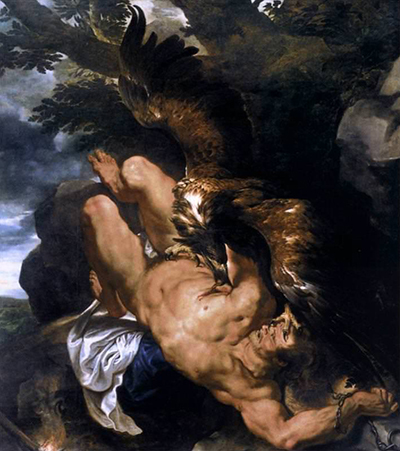
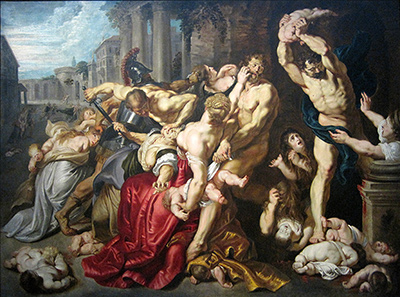
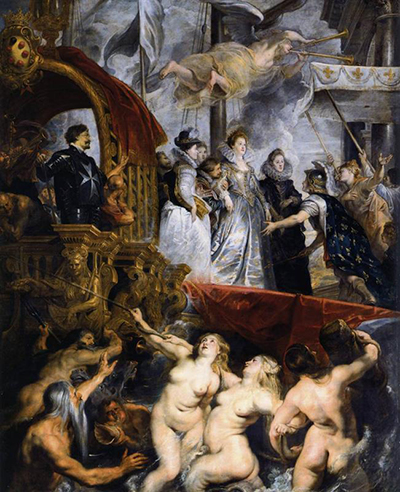
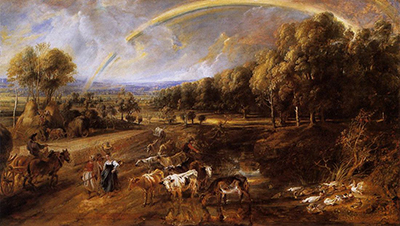
Where this work sits in Rubens's career
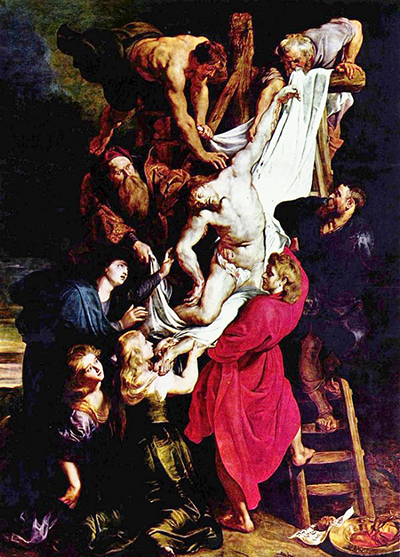
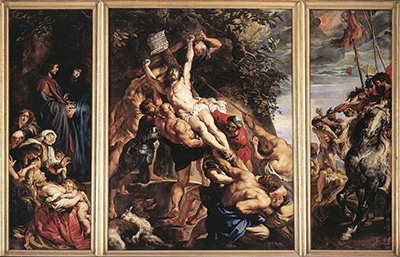
The Elevation of the Cross
1609–10The Descent from the Cross
1611–14Louis XIII
c. 1622The Garden of Love
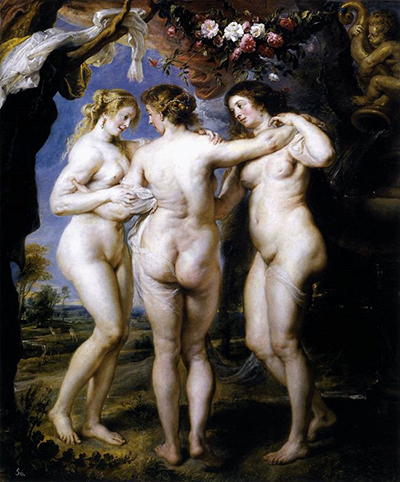
1630–35The Three Graces
1630–35Contents
- Armour, baton and the Order of the Holy Spirit
- The face within the state image
- A studio image and a different Melbourne study
- The companion portrait of Anne of Austria
- Paris, the Luxembourg commission and royal likenesses
- From princely collection to Pasadena
Armour, baton and the Order of the Holy Spirit
The Norton Simon account points to the most deliberate signs of authority. Louis's armour is polished and edged with gold. His left gauntlet rests beside the feathered helmet; his right hand grasps a marshal's baton. At his side is the cross of the Order of the Saint-Esprit, or Order of the Holy Spirit, attached to a ribbon. These are not random accessories placed around a portrait. Together they present the king as a ruler with a military role, a courtly rank and a visible place within a royal order.
The armour encloses much of Louis's body while leaving the face fully visible. Light plays across the metal plates, drawing the eye downward from his ruff to his chest and arms. The dark blue mantle brings the royal colour into the picture and softens the edge between the steel and the surrounding space. White fur and feathers add further contrasts of texture. Where the armour suggests protection and readiness, the ruff and cloak declare the setting of a formal image. This is a staged presentation of power, not a record that the king wore these exact pieces on a named day.
The baton is a compact object with a large pictorial effect. Held low in the king's right hand, it extends the line of the arm and signals command without requiring a raised sword. The helmet placed beside him makes the armour more complete, but it also reveals his hair and face to the viewer. If he had worn the helmet, the painting would have hidden much of the likeness that a royal portrait was expected to transmit. The portrait therefore balances a recognizable person with symbols of an office.
The Order cross has a different function from the weapons. It associates Louis with an institution of royal distinction. The museum identifies it, but the online record does not turn this portrait into evidence that he received the order in a particular ceremony shown here. Its position on the figure is enough to tell a viewer that the image is more than a study of facial features. Rank and authority are made visible through small, legible objects.
The face within the state image
The contrast between Louis's relatively youthful face and heavy official costume is one of the picture's main effects. He looks toward the viewer with a composed expression, framed by curling hair and the bright lace ruff. The background and armour place him in a carefully arranged world; the face offers the point of encounter. A viewer meets an individual who is also being made to stand for the French crown.
The museum's short interpretation calls attention to that difference between the young man's life and the attributes of strength shown in paint. It makes a broad judgement about Louis's political effectiveness that need not be adopted as a fact from this portrait. The image itself cannot tell us whether he governed well, how much influence his mother held in a particular year, or whether he personally directed a campaign. It can tell us how this royal likeness was meant to appear. A baton and armour make a claim about command; they do not document a battle.
This distinction is important because the portrait was produced at a time when images of Louis and his family carried political weight. His mother, Marie de' Medici, commissioned Rubens to make a large cycle about her life for the Luxembourg Palace in Paris. The Louvre's account of the Galerie Médicis[6] describes a difficult relationship between mother and son and the political purpose of the cycle. Those broad circumstances help explain why portraits of the royal family mattered to Rubens's work in France. They do not prove that Marie commissioned this specific Pasadena canvas, or that it hung in the Luxembourg gallery.
A studio image and a different Melbourne study
The National Gallery of Victoria in Melbourne[3] owns a distinct 1622 study of Louis XIII by Rubens, accession 315-5. It is only 42.8 × 32.5 centimetres and is oil on paper mounted on wood. The NGV says Rubens painted it during his Paris visit, probably from life, and that such a swiftly made likeness could serve as a model for other studio portraits of the king. It is a close view of the sitter, rather than a large official presentation with armour, baton and helmet.
That comparison provides a practical way to understand a workshop attribution. An artist with access to a royal sitter could record a face, then make that likeness available for larger, repeatable formats. Assistants could help realise versions designed to carry the king's image to different viewers and collections. The Musée du Luxembourg's 2017 exhibition guide[4] describes Rubens's general practice of creating royal portrait prototypes from drawings and small studies, then using his studio for replicas and high-quality prints. This is context for how a workshop could operate. Neither the guide nor the NGV record states that the Melbourne panel is the direct, documented model for Pasadena F.1965.1.060.P, so that exact link remains a possibility rather than a proven chain.
The difference in handling is also a difference in purpose. The Melbourne study is concentrated on the head, with quick paint helping to capture a living appearance. The Pasadena canvas expands the king into a formal presence surrounded by signs of office. One asks us to study an observed face; the other asks us to recognize a ruler. Both can belong to the history of Rubens's royal portrait enterprise without requiring the same attribution to the painter's hand.
“Workshop of Rubens” is not a synonym for a modern fake. The Norton Simon Museum uses it as its present authorship designation for a historical painting connected with Rubens's studio. The title of the inherited route is simply Louis XIII, but the byline, caption and text should make the attribution visible. Nor should a past exhibition title such as “Rubens: A Royal Portrait Artist” override the museum's current catalogue field. Exhibitions can group related works under an artist's name while an individual object still carries a more qualified credit.
The companion portrait of Anne of Austria
The Pasadena Louis has a companion in the same collection: Portrait of Anne of Austria, Queen of France[2], accession F.1965.1.059.P. The Norton Simon Museum also currently credits that canvas to the workshop of Peter Paul Rubens, dates it about 1622, and records oil on canvas. It is close in size to Louis's painting: 119.7 × 96.8 centimetres, compared with his 118.1 × 96.5. The similar scale makes sense for a royal pair intended to be encountered together, though the museum's online records do not supply a documented original room or hanging arrangement.
Anne is dressed differently. Where Louis's armour and baton speak of martial command, she appears in a gown and courtly insignia. The museum describes satin embroidered with fleurs-de-lis, jewels, a crown, ermine and a pleated lace ruffle. The paired portraits thus use related materials—lace, rich cloth, dynastic symbols—while assigning different roles to the king and queen. Reading the two together makes the Pasadena Louis less like an isolated likeness and more like one half of a statement about a royal marriage and its public image.
The pair's relation is an object fact: the museum calls Anne's picture the companion to Louis's. It should not be inflated into an undocumented story about where they first hung or who specifically ordered them. The Norton Simon digital exhibition on women's portraiture[5] describes Anne's portrait as a pendant to the king's and places the royal marriage in the politics of alliance. Its exhibition label calls Anne's painting “Peter Paul Rubens” and dates it about 1622–25, whereas the current object entry uses “Workshop of” and about 1622. For this page's catalogue facts, the individual object records are the clearest current authority. The exhibition is valuable for interpreting the pair, with that label difference kept in mind.
Paris, the Luxembourg commission and royal likenesses
Rubens's work for Marie de' Medici brought him into contact with the French court. The Musée du Luxembourg exhibition guide[4] says he travelled to Paris in 1622 to sign and discuss the Luxembourg commission and used the opportunity to study the appearances of Marie, Louis and Anne. The NGV's Melbourne portrait record[3] likewise places its small Louis study on that visit. This chronology gives a grounded setting for the making of royal likenesses around 1622.
It does not fix the Pasadena picture to a single Paris sitting. The Norton Simon Anne entry says the pair were probably painted during one of Rubens's Paris visits while he directed the Luxembourg project. “Probably” is an important limit: the records support a plausible context, but they do not give a signed commission for the Louis canvas or say exactly where each stage of its painting happened. The studio could work with a prototype even when a sitter was far away.
The political context also needs care. The Marie de' Medici cycle tells the queen mother's story through monumental allegory and history. It is a different kind of project from these two portrait canvases. The Bavarian collection's record for a sketch of The Coming of Age of Louis XIII[7] shows how the king entered that cycle as a historical and symbolic actor. The Pasadena portrait makes no comparable narrative claim. Louis simply stands before us, with the props of command. Bringing the projects into conversation can reveal Rubens's range at the French court, but the two objects should not be made into fragments of one painting programme.
From princely collection to Pasadena
The Norton Simon's interpretive note says the Louis and Anne portraits were for many years in the collection of Archduke Leopold Wilhelm of Austria. Its formal provenance list for the Louis canvas begins later, with Frederick the Great of Prussia in 1768. It then names Wilhelm II of Germany, a 1928 sale to Duveen Inc., and a 1965 sale from Duveen to the Norton Simon Foundation. The different starting points should be reported as the museum gives them. Its short record does not document every intervening transfer between the archducal and Prussian collections, so the story cannot be made into a continuous chain without further evidence.
The Duveen and Norton Simon stages are more concrete in the published list. Duveen's recorded stock number is 29280, and the Foundation acquired the portrait in 1965. The painting has subsequently appeared in exhibitions, including the 2017–18 Rubens: A Royal Portrait Artist exhibition at the Musée du Luxembourg, as the Norton Simon record notes. Such exhibitions show the painting's continued usefulness for studying court portraiture. They do not, by themselves, change its ownership or its current workshop attribution.
Display can change, but the work's identity is stable in the museum record: Pasadena F.1965.1.060.P, the king in armour with baton and helmet, paired with F.1965.1.059.P. The image retained here lets the reader see that composition.
Rubens artworks directory
Frequently Asked Questions
The Norton Simon Museum currently credits the workshop of Peter Paul Rubens. Rubens's own 1622 Melbourne study is a separate painting; a direct material link from that study to this particular Pasadena canvas is not documented in the sources used here.
The museum dates it about 1622. That is an approximate date for the canvas, not the year of any battle depicted—there is no battle in the portrait.
His right hand holds a marshal's baton. The museum also identifies polished armour, a plumed helmet and the cross of the Order of the Saint-Esprit.
Yes. The Norton Simon also owns a similarly sized workshop portrait of Anne of Austria, accession F.1965.1.059.P. The museum calls it the Louis portrait's companion.
No. Melbourne's NGV 315-5 is a small oil-on-paper-on-wood head study. Pasadena's F.1965.1.060.P is a larger oil-on-canvas formal portrait currently attributed to Rubens's workshop.
It belongs to the Norton Simon Foundation and is catalogued by the Norton Simon Museum in Pasadena. Consult the museum for current display status.
Discussion
Look closely at how costume and objects present Louis XIII's authority.
Share an observation about the portrait or a reliable source that adds to its history.
Reader Insights
What do the baton, armour and order cross tell us about the image?
How does the Anne of Austria companion change your reading of Louis's portrait?
What can the small Melbourne study explain without proving a direct link to this canvas?
Join the Conversation
Add your reading below, keeping observations specific and evidence clear.
References
- Norton Simon Museum, Portrait of Louis XIII, King of France , F.1965.1.060.P. View source
- Norton Simon Museum, companion Portrait of Anne of Austria , F.1965.1.059.P. View source
- National Gallery of Victoria, Rubens's distinct 1622 Louis XIII of France study, 315-5. View source
- Musée du Luxembourg, 2017 exhibition guide on Rubens's royal portraits, studio practice and Paris visit. View source
- Norton Simon Museum, digital exhibition on Anne of Austria's portrait and its pendant. View source
- Louvre, introduction to the Galerie Médicis. View source
- Bayerische Staatsgemäldesammlungen, Rubens sketch for The Coming of Age of Louis XIII. View source