 by Tom Gurney
Tom Gurney BSc (Hons) is an art history expert with over 20 years experience
Published on June 19, 2020 / Updated on October 14, 2026
Email: tomgurney1@gmail.com / Phone: +44 7429 011000
Two faces, one small animal
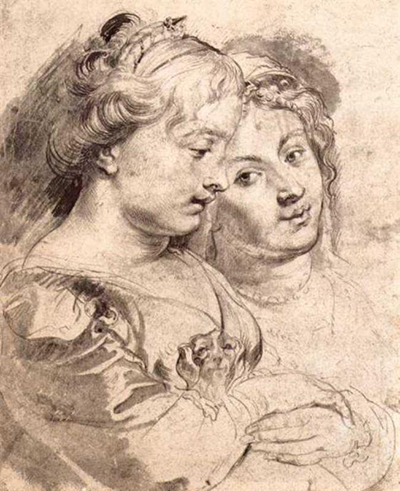
The woman at left turns her face downward and inward. Her companion stands just behind her, raising her eyes towards the first woman's face. A little dog's head appears between their arms near the lower middle of the drawing. Once found, it changes the way the paired figures read: the sheet is an arrangement of two women and an animal held close to the body, rather than a simple double study of heads.
The ALBERTINA in Vienna[1] catalogues this drawing by Peter Paul Rubens as Zwei junge Frauen, die linke hält einen Hund: Two Young Women, the One on the Left Holding a Dog. It is inventory 8274, measures 29 × 23.5 centimetres, and combines black chalk, brown pen and ink, grey wash and white heightening on brownish paper. The collection's descriptive title says which woman holds the dog. It does not give either woman a name or attach the sheet to a known painted commission.
The retained image is a close reproduction of the drawing, so its details matter more than the generic inherited page title. The two women have different turns of the head, different expressions and different degrees of finish. Rubens gives a convincing sense of closeness without enclosing them in a room or supplying a story. Nothing on the catalogue page establishes whether they were related, whether they posed together, or why the dog was included. The drawing invites those questions while leaving them unanswered.
At a Glance
- ArtistPeter Paul Rubens [1]
- SubjectTwo young women, the one at left holding a dog [1]
- DateNot established; older catalogue suggests about 1616–18 [1]
- MediumBlack chalk, brown pen and ink, grey wash and white heightening on brownish paper [1]
- Dimensions29 × 23.5 cm [1]
- CollectionALBERTINA, Vienna, 8274 [1]
Contents
- How are the women arranged?
- Where is the dog?
- What does the mixture of materials do?
- Are the women known?
- When was it made?
- How did the sheet reach Vienna?
- Why does an old photograph matter?
- What should a close look leave us with?
How are the women arranged?
The figure at left fills the foreground. Her head bends towards the middle, and the dark mass of hair behind it makes her pale face stand out. The shoulder and upper sleeve occupy much of the lower left. Broad shading gives the sleeve weight, while a bright fold curves across it. Her face is described more delicately: the line of the nose, the lowered eyelid and the mouth all point towards the space between the figures.
The second woman emerges over her shoulder at right. Her head tilts slightly; her gaze moves sideways towards the foreground figure rather than meeting the viewer directly. Rubens leaves much of her neck and clothing lighter and less resolved. A shadow behind the upper part of her head separates her hair from the brownish paper. The different treatment makes her visible without giving every part of her body equal emphasis.
Their faces nearly touch in the picture plane. The left woman's nose approaches the other's cheek, but the faces keep distinct outlines and directions. That closeness is a visual fact, not proof of an intimate biographical relationship. The glance from right to left and the downward movement of the foreground woman's gaze create a small circuit of attention. The viewer follows it towards the animal and the hands below.
At the lower edge, loosely worked hands and arms overlap. They do not have the same clear finish as the faces. This unevenness is part of the sheet's character as a drawing: Rubens could concentrate on the grouping and on the turns of the two heads while letting other parts remain provisional. A reader should resist filling those passages in with an imagined finished painting. The ALBERTINA lists no such painting in its current record.
Where is the dog?
The little dog's head is tucked near the centre, below the women's faces and above their crossing arms. Its dark eyes and nose give it a surprisingly alert presence once the viewer notices it. On a small reproduction it is easy to miss because the animal shares the same range of brown and grey marks as the sleeves and hands around it.
The museum's German title is unusually helpful here: it specifies that the woman on the left holds a dog. The animal is therefore not merely a chance shape in the shading or an invented detail introduced by a later caption. Its position also explains why the women's bodies converge at the bottom of the sheet. The first figure's arm gives the small head a place within the group; the second woman's attention appears directed towards the foreground figure and the space they share.
A dog in a work of art can carry associations of domestic life or fidelity, but the collection record does not identify this drawing as an allegory of either. Nor does it say that the dog belonged to a sitter. A specific symbolic reading needs evidence from a known subject, commission or related work. Here the secure observation is simpler and richer: Rubens used the animal to make the grouping particular, to bring the figures' arms together, and to give the viewer a third point of attention beneath the two faces.
The dog also tests how we look at sketches. The faces are immediately legible; the animal becomes legible through a slower inspection of the lower centre. This shift in attention is a useful way to approach the sheet. Its effects depend on the placement of a few compact marks amid passages that remain loose and open.
What does the mixture of materials do?
The ALBERTINA names four drawing procedures on brownish paper. Black chalk can establish the hair, facial contours and darker passages. The brown pen gives more definite lines. Grey wash lets broad areas of tone run together, and white heightening picks out selected lights. The paper supplies a middle tone, so a mark can move darker or lighter without requiring the draughtsman to cover the whole surface.
In the reproduced image, hair is worked with curling, directional strokes. The shaded area behind the first woman's head has a softer, spread quality, while narrow lines define the features and parts of the costume. White catches in the sleeve and along some raised surfaces make them project from the toned ground. The distinction between drawn line and brushed tone is central to the effect, although a small digital image cannot always assign an individual mark confidently to chalk, pen or wash. The museum's material description is the reliable guide to what is present on the original sheet.
The foreground woman's face has a relatively clear profile. Behind it, the second woman's face is built in softer gradations, with the darkest accents around eyes, nostrils and hair. White does not act like a complete layer of opaque paint. It is used selectively against the paper's warmer field. This keeps the surface visibly a drawing even where the heads seem rounded and alive.
The lower half shows another range of handling. A strongly modelled sleeve sits beside outlines that remain light and exploratory. A hand is present without every finger being fully resolved. The combination suggests a working sheet in which observation, arrangement and emphasis mattered more than uniform finish. The catalogue does not call it a formal commission drawing, a transfer cartoon or a finished portrait. Those more specific functions would need independent evidence.
At 29 centimetres high, the sheet is intimate in scale. It would be viewed near enough to notice the quick marks around hair and fingers. Enlarged on a screen, the drawing may feel more finished than it does as a physical object; compressed into a thumbnail, the dog almost disappears. Its original dimensions help hold those two digital impressions in proportion.
Are the women known?
The ALBERTINA names Peter Paul Rubens as maker but leaves the women unidentified. Their distinct faces do not supply names on their own. A drawing may record models Rubens saw directly, figures he developed for a larger work, or some combination of observation and invention. The current collection entry does not decide among those possibilities.
The same limit applies to their relationship. A pair of women placed close together need not be sisters, friends, mother and daughter, or named members of the artist's household. The first woman's downward glance and the second woman's sideways look describe a moment of visual contact. They are insufficient evidence for a biography. The dog's presence cannot establish a family portrait either.
Nor does the sheet contain the attributes that would securely identify a mythological or religious subject. There is no inscribed name, distinctive setting or documented companion painting on the ALBERTINA page. A title that describes what is visible is therefore more honest than one that invents a narrative. The German title itself works this way: two young women, with the left one holding a dog.
Rubens made drawings for many purposes, and some of his studies were reused or adapted. That general working practice is not proof of a particular destination for this sheet. The value of the object does not depend on finding a lost painting behind it. Its grouping, material variety and unusually small animal remain worth sustained looking at as features of this drawing.
When was it made?
The current ALBERTINA object record does not state a date for inventory 8274. It cites an older catalogue by Gustav Glück and Franz Martin Haberditzl, published in 1928, which proposed about 1616–18. That is a historical scholarly dating cited by the museum, not a date newly asserted in the current object's main fields.
The MAK in Vienna[2] holds an early photograph of the drawing and gives 1617–18 for the making of the depicted work. This aligns broadly with the older proposal, but the MAK catalogue describes a photograph in its own collection, not the ALBERTINA drawing itself. The two records should be read with that distinction in mind.
It is reasonable to tell readers that the drawing has been placed around the later 1610s in older cataloguing. It would be too strong to print “1617” as a securely documented year. No date is written into the present ALBERTINA object fields, and neither record gives a documentary event that pins the sheet to a single year. The page therefore keeps the date qualified and gives the object number, materials and collection as firmer anchors.
This caution does not make the chronology meaningless. The older estimate tells us how scholars have tried to place the drawing within Rubens's long working life. It also reminds us that attribution and dating answer different questions. The ALBERTINA credits the draughtsman to Rubens while leaving the date open. A caption can accurately convey both judgements.
How did the sheet reach Vienna?
The ALBERTINA lists the collection of Gottfried Winckler (1731–1795) in Leipzig, followed by Duke Albert of Saxony-Teschen. It also records the duke's collector's mark at the lower left, identified with Lugt number 174. These details concern the sheet's later ownership and marking. They do not tell us where Rubens drew the women or how he used the sheet in his workshop.
A collector's mark can be valuable evidence because it physically connects an object to a documented collection. The mark's position also gives a reader something small to seek beyond the two faces and dog. In the retained reproduction it is less conspicuous than the main group. Its purpose was to mark ownership, not to form part of Rubens's original scene.
The sequence Winckler then Duke Albert is what the museum records. The catalogue does not, in this short entry, explain the circumstances of a sale or gift between them. It is best to report the two named collections without supplying an unsupported transaction. The drawing's present home is the ALBERTINA, whose inventory number 8274 distinguishes it from Rubens's other sheets there.
An object may gather several kinds of history: the moment of drawing, later attribution, changing titles, ownership marks and reproductive photographs. Keeping them separate makes this sheet easier to understand. The original drawing belongs to Rubens's artistic practice; the Winckler and Albert entries belong to its collecting history.
Why does an old photograph matter?
The MAK catalogues an anonymous albumen photograph made before 1866 of the drawing of two women with a dog. It is inventory KI 466. The photograph is mounted on a larger card, and its recorded image size is 29 × 23.4 centimetres, very close to the dimensions of the ALBERTINA drawing. The card bears a label naming P. P. Rubens, describing “two women's heads,” and identifying the Albertina.
This is evidence that the drawing was photographed and circulated as an Albertina Rubens by the nineteenth century. The label foregrounds the two heads, whereas the current descriptive title calls attention to the dog. That difference is useful: titles can guide what viewers notice, even when they refer to the same image. The MAK catalogue's modern title explicitly identifies its object as a photograph of a drawing, so it must never be counted as a second Rubens drawing.
The photographic record also limits what can be inferred from reproductions. An albumen print can preserve the appearance of an object at an earlier date, but it translates chalk, ink, wash, paper tone and white heightening into photographic values. The surviving drawing and its present museum catalogue remain the primary references for medium and ownership. The MAK print is a separate historical witness to how the image was recorded and labelled.
The date before 1866 concerns the photograph. It cannot date Rubens's original sheet. Likewise, the MAK's “old stock, 1866” entry concerns the photograph in that institution. Readers who see both records should not fold their inventory numbers or dimensions together: ALBERTINA 8274 is the seventeenth-century drawing; MAK KI 466 is a nineteenth-century photographic reproduction.
What should a close look leave us with?
Begin at the first woman's lowered eyelid, then move across the narrow space to the second woman's raised gaze. Follow the curved hair and the darker wash behind it. Finally, find the dog's head between the arms. The route from one feature to the next shows how the group holds together without a finished background or a named story.
The paper's middle tone and the combination of black chalk, brown ink, grey wash and white highlights make the figures appear and recede at different degrees of certainty. Some features are nearly complete; others remain suggested. That variety lets a small sheet feel lively. It is also why a careful caption matters. The drawing is by Rubens in the ALBERTINA's catalogue; the sitters remain unnamed; the date is proposed in older literature; the little animal is securely present in both image and museum title.
Rubens artworks directory
Frequently Asked Questions
The drawing is in the ALBERTINA, Vienna, inventory 8274. The MAK holds a historic photograph of it, inventory KI 466.
No. The ALBERTINA's descriptive title identifies two young women and says the one at left holds a dog, but it gives neither woman a name.
The museum lists black chalk, brown pen and ink, grey wash and white heightening on brownish paper. The sheet measures 29 × 23.5 centimetres.
The current ALBERTINA record has no main date field. It cites a 1928 catalogue that suggested about 1616–18; the MAK assigns 1617–18 to the drawing depicted in its historical photograph. Both are qualified scholarly datings.
The collection record does not identify a mythological, religious or literary story, nor a documented finished painting. The visible grouping should be described without assigning one.
Discussion
Find the small dog's head below the two faces.
Share a close observation or a reliable source about ALBERTINA 8274.
Reader Insights
How do the figures' different gazes hold the group together?
What does the mixture of chalk, ink, wash and white add to the sheet?
What can the old MAK photograph tell us about its later history?
Join the Conversation
Add your reading below, keeping the drawing and its photograph distinct.
References
- ALBERTINA, Zwei junge Frauen, die linke hält einen Hund , inventory 8274. View source
- MAK, Fotografie einer Zeichnung zweier junger Frauen mit Hund von Peter Paul Rubens , inventory KI 466. View source