by Tom Gurney
Tom Gurney BSc (Hons) is an art history expert with over 20 years experience
Published on June 19, 2020 / Updated on October 14, 2026
Email: tomgurney1@gmail.com / Phone: +44 7429 011000
The moment before a fatal hunt
Adonis is ready to leave. He grips a spear and turns away, while Venus reaches from her seat to hold him. Cupid presses close between them, and hunting dogs wait at the left edge. The outcome is known from the story, but Peter Paul Rubens does not show the fatal attack. His Venus and Adonis makes the moment of separation itself the drama: one body moving outward, another trying to keep it near.
The Metropolitan Museum of Art catalogues this canvas[1] as Rubens's Venus and Adonis, probably mid-1630s, in oil on canvas. Its current dimensions are 197.5 × 242.9 centimetres, including added strips, and its object number is 37.162. The qualification about the strips belongs with the size. It tells us the measured object includes canvas added to the main picture, though the short online record does not establish precisely when or why each addition was made.
The route's “I” distinguishes this New York work from another Rubens treatment on the neighbouring “II” page. It is a local navigation label, not a sequence number supplied by the Met. The Met's painting is the large canvas with Adonis at left and Venus at right in a dark wooded setting. Keeping those particulars together prevents a common error: transferring the date or dimensions of a smaller panel with the same myth to this one.
At a Glance
- ArtistPeter Paul Rubens [1]
- DateProbably mid-1630s [1]
- MediumOil on canvas [1]
- Current size197.5 × 242.9 cm, including added strips [1]
- CollectionThe Metropolitan Museum of Art, 37.162 [1]
- SubjectVenus tries to stop Adonis leaving for the fatal hunt [1]
Where this work sits in Rubens's career
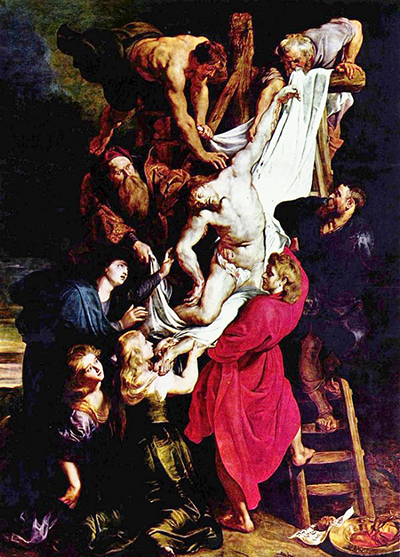
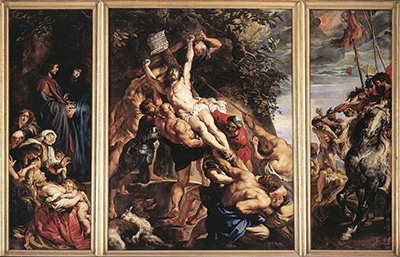
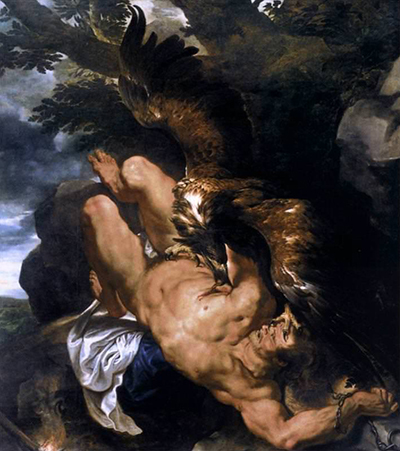
The Elevation of the Cross
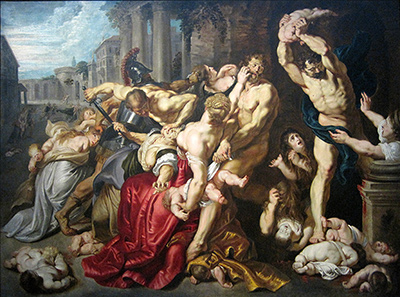
1609–10The Descent from the Cross
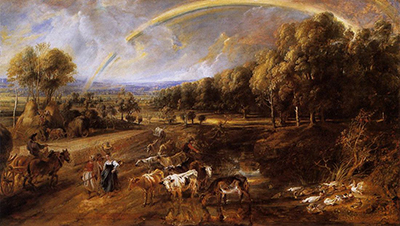
1611–14The Garden of Love
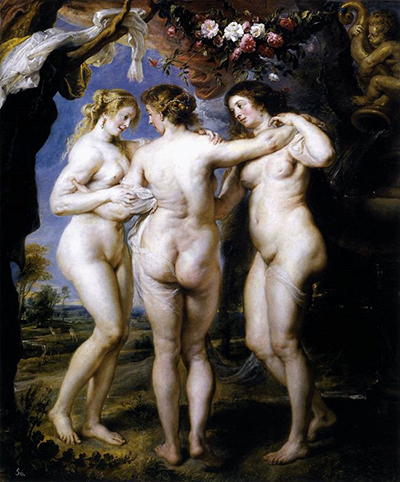
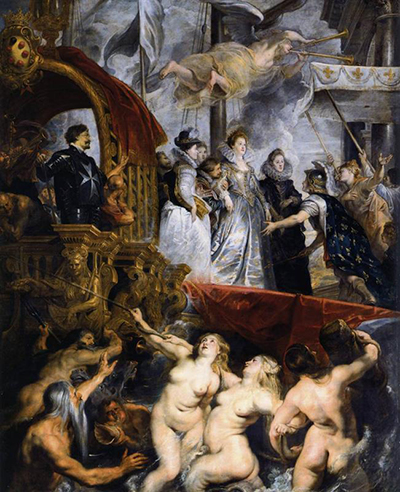
1630–35The Three Graces
1630–35Venus and Adonis
mid-1630sContents
- A departure held in place
- The figures and the landscape
- What Ovid supplies, and what Rubens chooses
- Titian's example and Rubens's answer
- What the added strips do and do not tell us
- Another Rubens Venus and Adonis
- A painting in the Met's collection
- Looking once more at the parting
A departure held in place
The scene depends on opposing movements. Adonis's raised spear points upward and outward. His torso twists away even as Venus reaches across him. Her arm and hand pull the eye back toward the right, and Cupid presses up between the adults. Rubens turns a simple action—someone leaving, someone holding on—into an unstable balance across almost the entire width of the canvas.
The Met explains[1] that the subject comes from Ovid's Metamorphoses. Venus falls in love with the hunter Adonis after an accidental wound from one of Cupid's arrows. She warns him about dangerous animals, but he goes hunting and is killed by a wild boar. This painting chooses the leave-taking. The boar is not the event before our eyes; it is the feared future that gives Venus's gesture urgency.
That choice asks the viewer to read time in a still image. The hounds already look prepared for movement. The spear and the red drapery announce a hunt. Venus's embrace delays it. We can understand why she clings to Adonis even though the painting does not include a written prophecy. Her body and the hunter's opposite turn carry the emotional information.
Cupid gives the tension a smaller scale. In the painting, he stands beneath the meeting of the two larger bodies. His presence links the lovers to the cause of Venus's attachment, as the Met's account of the arrow does. Yet he cannot stop the departure any more than Venus can. Rubens places him in the narrow space where the adults' movements cross, turning a mythic agent into a visible part of the composition.
The figures and the landscape
Adonis stands beside the dogs on a path toward open air at left. The picture darkens behind Venus, where trees and rock enclose her seated figure. The contrast creates two directions: departure into the hunt, and return toward the shaded space of love and warning. Rubens does not need to paint the boar in the distance to make the left side feel like a route away from safety.
The broad red cloth around Adonis makes his movement easy to follow. It crosses his body and stretches outward, joining him to the brighter landscape while also connecting him visually to Venus. The colour is dramatic, but it is not merely a banner. Its folds help the viewer sense the twist of his body and the pull of her hand. Pale skin, red fabric and dark trees form the picture's strongest contrasts.
Venus's seated pose adds resistance. Her body leans upward and toward the hunter rather than resting passively in the shade. The space between her feet, the ground and the dark rock keeps her rooted on the right. Adonis's legs suggest forward movement; her extended arm interrupts it. The picture captures that fraction of a second when leaving is still possible but not yet completed.
The dogs provide a different kind of energy. They face toward the route out of the scene and connect Adonis to the practical activity of hunting. Without them, the spear might seem like a generic heroic attribute. With them, the departure becomes specific. They also set a quieter animal rhythm beside the human struggle. Their readiness reinforces the sense that the hunt will proceed no matter how intensely Venus pleads.
A Met publication on painting masterpieces[2] describes the turning figures as a large triangular arrangement and notices the light of a rising sun on their bodies. That reading helps explain the design's coherence. Adonis, Venus and Cupid occupy different heights, yet their limbs and glances connect them. The soft light makes flesh appear warm at the very moment the myth moves toward loss.
What Ovid supplies, and what Rubens chooses
The story is tragic, but it contains more than one possible picture. An artist might paint the hunt, Adonis's death, Venus mourning over his body, or the last embrace before he leaves. The Met explicitly identifies this canvas as the parting. That distinction matters when images of “Venus and Adonis” appear together in a search result. The title alone does not tell us which episode is shown.
Ovid's account explains Venus's fear and the outcome of Adonis's choice. The Met summarizes the hunter's cavalier indifference to her warnings. Rubens makes that attitude legible through movement rather than by making Adonis expressionless. He seems already half committed to the path at left. The goddess's body tries to turn him back. Their disagreement is staged as a physical encounter.
The viewer knows more than the figures can change. The dogs and spear would normally promise action and skill; here they point toward a fatal encounter. Venus's beautiful, affectionate grasp is therefore charged with futility. The painting offers no comfort of a successful warning. It holds the lovers in a moment that can be prolonged in paint but not saved in the story.
Another Met object after Rubens[6], an etching by Willem Panneels catalogued as Venus mourning Adonis, shows how different moments of the myth could circulate in art. It is not a print after this exact Met canvas, and its maker and date are separate. Its title alone is useful to clarify the narrative sequence: mourning belongs after the hunt, while the large Rubens canvas on this page remains before it.
Titian's example and Rubens's answer
The Met compares Rubens's picture[1] with Titian's treatment of the same departure, another painting now in New York. Its Titian object record[3] identifies Venus and Adonis, object 49.7.16, as a different oil-on-canvas work of the 1550s. The museum describes the same tragic irony: Venus tries unsuccessfully to retain her mortal lover before the boar hunt. The shared moment makes comparison meaningful without making the two works interchangeable.
The Met's older catalogue explains that Titian and his workshop made multiple versions of the subject. The New York Titian belongs to a complex family of pictures, not a single uniquely fixed original that can be treated as Rubens's documented direct model. The Met says Rubens adapted a theme explored by earlier artists; its masterpiece publication names Titian and Veronese as relevant precedents. These statements support a broad artistic conversation, while a claim that Rubens stood before the exact canvas now numbered 49.7.16 would require separate evidence.
The comparison brings out Rubens's compositional decision. His figures are larger relative to the painted field and push against each other in a turning group. Adonis's spear makes a strong vertical at one side, while Venus's reaching arm crosses toward him. The dark setting and the dogs give the group a place and purpose. One can recognize an inherited subject while also seeing a painting designed for Rubens's own sense of bodily force.
The Met publication[2] calls this particular Rubens version entirely by his own hand. That is an institutional scholarly assessment of the painting, not a reason to ignore the physical additions to the canvas. Authorship of the painted scene and later or separately added support material answer different questions. The current online object card credits Rubens and includes the strips in the measured size.
What the added strips do and do not tell us
The Met labels the dimensions “with added strips.” That phrase is brief but important. It confirms the current outline of the canvas includes additions. It does not, in the short public record consulted here, specify their exact positions, their date, the person who added them or the original unextended measurements. A careful caption repeats the measured size with its qualification instead of turning it into an unqualified original dimension.
The addition could affect how a viewer experiences the space around the figures, but the available source does not allow a precise reconstruction of Rubens's first painted edge. The article therefore concentrates its visual reading on the visible composition and keeps the material caveat separate. The strong leftward pull of Adonis, Venus's reach and the triangular group are observable whether or not the added strips are discussed in detail. The limits of the technical record remain real.
An older Met publication gives a slightly different size in inches from the present online entry. Rather than average two numbers or silently choose an older printed measurement, this page uses the current object record's 197.5 × 242.9 centimetres including strips. Measurement and cataloguing practices can change. The museum's current entry provides the most practical identifier for readers seeking the canvas today.
The current Met record also offers a public-domain image, useful for looking more closely at the figures and the canvas's wide format. The measured dimensions still need their qualification about added strips. An image can show the present surface, but it does not by itself reveal when the additional pieces of canvas were attached.
Another Rubens Venus and Adonis
Rubens treated this myth in more than one work. The companion Venus and Adonis page concerns a smaller early panel in the State Hermitage Museum, Saint Petersburg. The Hermitage collection record[5] identifies that work as 1610–11, oil on wood, 83 × 90.5 centimetres, inventory ГЭ-462. Its image includes a swan-drawn chariot, unlike the Met scene centred on a hunter with spear, dogs and a seated Venus.
Those differences are enough to prevent a misleading merge. The Hermitage's wooden support, early date and compact size are not alternative catalogue values for Met 37.162. Likewise, the Met's added canvas strips and mid-1630s date do not belong to the Saint Petersburg panel. The two works can be discussed as Rubens's distinct treatments of the myth without asserting that one is a documented preliminary study for the other.
The Roman story invites repetitions because it has several emotionally charged moments: desire, warning, departure and loss. Comparing two Rubens paintings can show how he approached that narrative at different scales and times. The New York canvas makes the tug between Venus and Adonis large and immediate. A reader interested in the earlier swan-chariot composition should follow the separate route and its own museum record.
A painting in the Met's collection
The Met's object entry gives the credit line Gift of Harry Payne Bingham, 1937. Its accession number, 37.162, reflects that acquisition and is more stable than a gallery location, which may change. The current Met page marks the painting not on view; anyone planning a visit should check that live status rather than rely on an older publication or photograph of a previous display.
The museum provides a public-domain image and an object record that brings together date, support, dimensions and a concise interpretation. Those facts are the basis of the page. They do not establish an original commissioner, first display setting or complete earlier chain of ownership. The narrative and visual analysis here should not be mistaken for a fully documented provenance.
Rubens's place in a tradition of adapting Titian also has an institutional context: the Met owns examples by both painters. The shared collection makes direct comparison possible for researchers, though present display may not put the pictures side by side. Their separate numbers—37.162 for Rubens and 49.7.16 for Titian—keep that comparison clear even when gallery arrangements change.
Looking once more at the parting
Begin with the spear and follow Adonis's turn toward the dogs. Then move back along Venus's arm to her seated body and down to Cupid between them. The path shows two opposed intentions held in one design. Hunting equipment points outward; affection pulls inward. The shadows behind Venus and the lighter path beyond Adonis make the conflict spatial as well as emotional.
The story's ending gives the scene its poignancy, but Rubens paints the moment before it. He lets a viewer remain where Venus would want Adonis to remain, at the point of contact. The canvas's present scale includes added strips, and other artists painted the same myth, yet the work's identity is precise: Rubens, probably mid-1630s, oil on canvas, Met 37.162. Its drama lies in seeing a departure that can be held in paint even though it cannot be stopped in Ovid's tale.
Rubens artworks directory
Frequently Asked Questions
This page covers Rubens's Metropolitan Museum canvas 37.162, probably from the mid-1630s. The smaller early Hermitage panel has a separate route and object number.
He shows Venus trying to keep Adonis from leaving for a hunt. The fatal boar attack happens later in the story and is not depicted in this canvas.
The Met gives 197.5 × 242.9 centimetres, including added strips. Its short online entry does not give an exact original size without those additions.
Cupid stands between Venus and Adonis. In the Met's account of Ovid, an accidental prick from Cupid's arrow causes Venus to fall in love with the hunter; his painted presence connects the lovers to that cause.
No. Titian's Venus and Adonis is a separate painting, 49.7.16. The Met compares the artists' treatments of the parting, but their makers, dates, dimensions and object histories differ.
The Met's current object record marks 37.162 not on view. Check that live record before visiting because display status can change.
Discussion
Trace Adonis's turn toward the hounds and Venus's reach back toward him.
Share an observation about the painting or a reliable source that adds to its history.
Reader Insights
How does Cupid occupy the narrow space between the lovers?
What changes when you know the boar attack is still in the future?
How do Rubens and Titian make different pictures of the same departure?
Join the Conversation
Add your reading below, keeping observations specific and evidence clear.
References
- The Metropolitan Museum of Art, Rubens, Venus and Adonis , 37.162. View source
- The Metropolitan Museum of Art, Masterpieces of Painting , Rubens entry. View source
- The Metropolitan Museum of Art, Titian, Venus and Adonis , 49.7.16. View source
- The Metropolitan Museum of Art, Italian Paintings: Venetian School , Titian versions. View source
- State Hermitage Museum, Rubens, Venus and Adonis , ГЭ-462. View source
- The Metropolitan Museum of Art, Willem Panneels, Venus mourning Adonis. View source