 by Tom Gurney
Tom Gurney BSc (Hons) is an art history expert with over 20 years experience
Published on June 19, 2020 / Updated on October 14, 2026
Email: tomgurney1@gmail.com / Phone: +44 7429 011000
The Child at the centre of a gathering
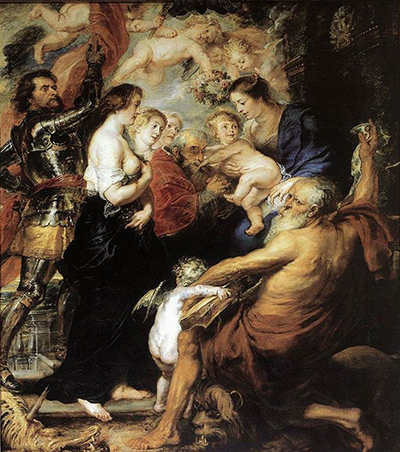
The Virgin Mary holds the Christ Child while saints press close around them. A man in armour stands at the left; a woman bends towards the Child; an older, partly bare figure occupies the right foreground. Angels gather above. The group is crowded but its attention has a centre: Mary presents her son, and the figures respond to him. Rubens's Madonna Surrounded by Saints is now the painting above his tomb in Saint James's Church, Antwerp.
The Flemish Masters in Situ guide[2] says Rubens completed the work around 1630, kept it in his studio after an intended delivery failed, and reworked it there. The Antwerp church heritage account[1] calls it a very late work but says its first patron is unknown. Those statements should remain attributed to their respective sources; they do not establish a single exact year in which the whole painting was finally finished.
The inherited site address says Our Lady with the Saints. The current heritage title, Madonna Surrounded by Saints, describes the same nearly square painting in the Rubens Chapel. It was not originally made as a funerary picture. Rubens reportedly asked shortly before his death in 1640 that it be placed over his grave. The chapel and altar came later. Its present setting is deeply connected with the artist, but its first commission remains an open question.
At a Glance
- ArtistPeter Paul Rubens [1]
- SubjectThe Virgin and Child among saints [1]
- DateAbout 1630, later reworked (Flemish Masters in Situ) [1]
- MediumOil on panel [1]
- Original purposeUnknown; selected later for Rubens's burial chapel [1]
- LocationRubens Chapel, Saint James's Church, Antwerp [1]
Where this work sits in Rubens's career
The Elevation of the Cross
1609–10The Descent from the Cross
1611–14Madonna Surrounded by Saints
c. 1630; reworked laterThe Garden of Love
1630–35The Three Graces
1630–35Contents
- Who are the figures around Mary?
- What is a sacra conversazione?
- How is the nearly square panel organised?
- Was the painting made for Rubens's tomb?
- When was the Rubens Chapel built?
- Did the panel always stay there?
- How does it differ from other Rubens Madonnas?
- How should the painting be read today?
Who are the figures around Mary?
The church heritage account identifies Saint George at the far left, shown in armour. A defeated dragon lies near him. Behind the gathering stands Mary Magdalene, and the older figure at the right is Saint Jerome, with his lion. These familiar attributes help a viewer orient the group, but not every person in the painting has a secure name.
A man in a bishop's robes kneels near the Child. The church account states that he and the figures behind him cannot be identified with certainty. They may have been connected with the painting's original destination, and the bishop may have been a donor, but those are suggestions, not established identities. An article that names him as a particular saint or patron would hide the limit of the evidence.
The Child stretches towards the kneeling man. This gesture makes the uncertain bishop important to the painting's action even though his historical identity is unknown. Mary supports the Child and presents him to the surrounding figures. George, Magdalene and Jerome do not form three isolated devotional portraits; they participate in one encounter around mother and son.
The church account notes that the Child's face resembles Frans Rubens, the young son of Rubens and Helena Fourment. Resemblance is an observation, not documentary proof that Rubens intended a portrait of Frans. It can be mentioned as a cautious reading of the painted face, without turning the Child into a named family likeness in catalogue data or caption.
Jerome's strong back and arm give the foreground much of its weight. The lion near him makes his traditional identity easier to see. At the other edge, George's armour and dragon bring a different surface and story into the picture. Magdalene's presence adds another mode of devotion. Their varied bodies and attributes guide the eye around Mary rather than away from her.
What is a sacra conversazione?
The church describes the composition as a sacra conversazione, a sacred conversation, a form developed in the Italian Renaissance. Mary and the Child appear with saints from different times as if they can gather in one shared sacred space. The picture is not an illustration of an event that happened on a particular day. It is a devotional assembly designed to make relationships among holy figures visible.
The “conversation” here is largely visual. Heads turn, hands reach and bodies lean. Mary presents Jesus, and the saints acknowledge him. The movement does not require speech bubbles or a written text. A viewer can follow the exchange through gaze and gesture, beginning with the Child and passing from one figure to another.
This helps explain why the painting could be chosen for a tomb chapel even though it was not painted for burial. The church account says nothing in the scene itself refers to mourning or a grave. It presents Mary and the Child among saints. That subject was suitable for a chapel devoted to the Mother of God, but it does not tell us what the original patron requested. The later burial use should not be read backwards as the painting's first purpose.
The church also interprets Mary's central role in light of the Counter-Reformation, when Catholic and Protestant views of Mary differed sharply. In its account, Jerome matters because he defended the divine motherhood and virgin birth of Mary. This is an institutional interpretation of the picture's religious language. It does not identify an otherwise unknown original commission, but it clarifies why a Madonna surrounded by saints could be a strong Catholic image.
How is the nearly square panel organised?
The painting's format is unusually close to square, according to the church heritage account. That shape makes the gathering feel compact. There is little empty architecture separating the figures. Instead, bodies press from both sides towards Mary and the Child. The viewer enters through George's armour on the left or Jerome's back at right and is drawn inward.
The Child occupies a small area, yet his light body and reaching gesture give him a strong visual role. Mary sits higher and slightly behind him. A cluster of heads forms a ring around them, while angels and foliage fill the upper edge. The composition balances the heavy figures below with a more airborne movement above.
Rubens uses contrasting surfaces to separate the saints. George's metal armour catches light differently from skin; Magdalene's dress and loose hair differ from the rougher drapery around Jerome. The lion's form appears near the lower right. These details reward close looking, though the small image on a webpage cannot convey the scale or surface of the actual panel.
The near-square format later made fitting the painting into a chapel altar difficult, the church account says. Narrow red marble columns were placed beside it, and an unusually high architectural crown rose above. The painting's shape therefore affected the design of the space that came to house it. Its current altar was built to accommodate an existing object, another sign that the panel had not originally been planned for that exact setting.
Was the painting made for Rubens's tomb?
No known source establishes that as its original commission. The church heritage account says Rubens expressed the wish a few days before his death that the Madonna with Saints should adorn his grave, even though it was not originally intended for this use. Flemish Masters in Situ likewise says the original patron is unknown and that the painting remained in Rubens's studio after delivery failed for an unknown reason.
That history has several stages. A painting was made, probably begun by around 1630 according to Flemish Masters. It stayed in the studio and was reworked. Shortly before Rubens died in 1640, he chose it for his future burial chapel. The chapel was then constructed, and the panel was installed on its altar around 1650. Collapsing those steps would make it seem that Rubens had painted the work specifically as a tomb monument from the outset.
Rubens's request is reported through his widow Helena Fourment in the church account. She and members of the family took part in establishing the burial chapel after his death. The painting thus acquired a family memorial meaning. Its subject remained the Madonna and saints; its location made it part of the public remembrance of the artist.
The original commission remains unknown. The kneeling bishop and figures behind him might carry clues about a first destination, but the church does not identify them securely. Their uncertainty is important evidence against a tidy invented story. A good account can explain the later chapel use fully while leaving the earlier question open.
When was the Rubens Chapel built?
The church heritage history[1] says Rubens agreed to be buried at Saint James's shortly before his death in 1640. A contract for the chapel was made in 1642, and the chapel was complete in 1645. Work on a marble altar followed; the altar was completed in 1650. Flemish Masters in Situ says the painting was placed there around that time.
These dates make clear that Rubens did not stand before the finished altar in his lifetime. His decision about the painting preceded construction of the chapel's final setting. The family and church carried out the arrangement after his death. The painting's present association with Rubens's tomb is therefore a posthumous use chosen in accordance with his expressed wish.
The altar combines white, black and red marble. Its red side columns frame the almost square panel. Above it is a structure with a broken pediment and niche. The church account says Rubens also wished a statue of Our Lady of Sorrows to be placed in the chapel. It notes competing attributions for that statue, so this page does not name a sculptor as certain. The painting and statue together formed part of an elaborate memorial environment.
The chapel is not simply a neutral frame. It made the Madonna image into the centre of a family burial space and helped turn an undelivered studio painting into one of Antwerp's best-known church works. The painting can still be read for its own iconography, but its location adds a second layer of meaning about the artist's death and family memory.
Did the panel always stay there?
No. The church heritage account says the French removed it from Saint James's in 1794. It was returned to the city of Antwerp in 1801, displayed at the Academy and sent back to the church in 1815. During the absence, Jean-Joseph Delin made a copy for the Rubens Chapel in 1803. Those movements are part of the painting's history, not evidence that its original patron was French or that it was painted for a museum.
The return to the chapel restored the relationship between Rubens's painting, tomb and altar, but only after two decades in other settings. A visitor today may see a seemingly continuous seventeenth-century ensemble. The removal and later reinstallation remind us that even a work tied closely to an artist's burial place can have a disrupted afterlife.
The present panel should also be kept distinct from Delin's copy. A copy could occupy the chapel while the original was elsewhere. The work discussed here is Rubens's panel, the one the heritage accounts identify over his grave. The image shown here matches that composition, with George, Magdalene, Mary, the Child, Jerome and the uncertain kneeling bishop gathered together.
How does it differ from other Rubens Madonnas?
Rubens painted several Madonna subjects. This one is the Saint James's Church panel with a nearly square gathering of saints and an unusual later role in his tomb chapel. It is not the large Augustinian church Madonna now associated with Antwerp's museum collections, nor a small modello for another altarpiece. Collection, composition and history all matter more than a broad title such as Our Lady with the Saints.
The exact subject can also be obscured if every surrounding person is given a confident name. The church's identifications of George, Mary Magdalene and Jerome are useful. Its refusal to identify the kneeling bishop and companions is equally useful. Both positive and negative catalogue information help prevent this panel from being conflated with another assembly of saints.
The date should remain carefully stated. Flemish Masters in Situ says the work was completed around 1630 and reworked later. The church heritage account calls it very late without supplying a precise completion year. The page records both descriptions and leaves the later stages open. It does not force a single 1639 or 1640 date onto every visible part of the panel.
How should the painting be read today?
Look first at Mary presenting the Child, then follow the gathering outwards. Find George by armour and dragon, Magdalene by her place among the figures, and Jerome by his age, bare body and lion. Let the uncertain bishop remain uncertain while noticing how the Child reaches towards him. The painting's visual energy lies in that shared attention to mother and son.
Then remember its two histories. The panel was made for an unknown initial purpose and kept in Rubens's studio. Rubens chose it for his grave shortly before dying. His family and the church placed it in a chapel and altar built afterwards. Later removal and return added further chapters. This sequence explains why the painting can be both a sacred conversation and a personal memorial without pretending that its first commission is known.
The most secure identification is the church itself: Madonna Surrounded by Saints in the Rubens Chapel of Saint James's Church, Antwerp. Its near-square form, recognisable saints and unsettled donor figures make it a distinctive object. Its position above the artist's tomb gives it a powerful later meaning, while the panel still asks to be seen as a lively painting of Mary, the Child and their surrounding saints.
Rubens artworks directory
Frequently Asked Questions
The church account says no: its original purpose and patron are unknown. Rubens asked shortly before his death that the existing painting be used in his burial chapel.
Flemish Masters in Situ says it was completed around 1630 and later reworked in Rubens's studio. The church account calls it a very late work. No exact final completion year is established in these sources.
The church identifies Saint George, Mary Magdalene and Saint Jerome. The kneeling bishop and figures behind him are not securely identified.
A construction contract dates to 1642, the chapel was completed in 1645, and the altar was finished in 1650. Rubens had died in 1640.
It is above Rubens's grave in the Rubens Chapel, Saint James's Church (Sint-Jacobskerk), Antwerp.
Discussion
Start with Mary presenting the Child, then follow the saints' gazes.
Share a close observation or a reliable source about the Saint James's panel.
Reader Insights
Which figures can the church identify securely?
How did the nearly square painting shape the later chapel altar?
What remains unknown about its first commission and final reworking?
Join the Conversation
Add your reading below, separating the panel's original purpose from its burial-chapel use.
References
- Antwerp church heritage association, “Rubens: Saint James's Church”. View source
- Flemish Masters in Situ, “St James' Church (Antwerpen)”. View source