by Tom Gurney
Tom Gurney BSc (Hons) is an art history expert with over 20 years experience
Published on June 19, 2020 / Updated on October 14, 2026
Email: tomgurney1@gmail.com / Phone: +44 7429 011000
A face lowered, a hand raised
The young woman tilts her head and looks down. Loose curls frame her face, while a hand rests across her upper chest. Her clothing is only lightly indicated; the features and gesture receive the closest attention. Rubens used black and red chalk, touches of white, and later pen and brown ink to distinguish the dark hair, warm face and points of light. This is a drawing on paper, not a finished painted portrait.
The sheet is usually called Young Woman Looking Down, with Study for the Head of Saint Apollonia as an explanatory title. A 2009 catalogue entry by Giovanna Capitelli[1] identifies it as a Rubens drawing in the Uffizi prints and drawings collection, inventory 1043 E. A published study of Rubens's workshop[2] gives 1628, 41.4 × 28.7 cm, and the mixed chalk and ink technique. The fuller 2009 catalogue text is not available in the university record, so details beyond its title and inventory are drawn from the separately cited scholarship.
The old web address for this page says “head and right hand of a woman.” That describes some visible features but is not the Uffizi drawing's best scholarly name. More seriously, a different Rubens study with a similar descriptive title is linked to The Miracles of Saint Francis Xavier and is known through a copy after a lost original. The image here shows the Uffizi young woman associated with Saint Apollonia. Keeping the old address preserves the reader's route; correcting the displayed title and explanation prevents two drawings from being merged.
At a Glance
- ArtistPeter Paul Rubens [1][2]
- DateAbout 1628 [1][2]
- MediumBlack and red chalk, white heightening, pen and brown ink [1][2]
- Size41.4 × 28.7 cm [2]
- CollectionUffizi prints and drawings, 1043 E [1][2][3]
- Related paintingEnthroned Madonna Adored by Saints, Antwerp, 1628 [4][5]
Where this work sits in Rubens's career
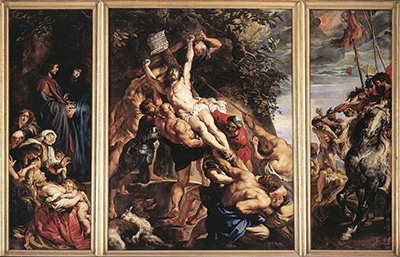
The Elevation of the Cross
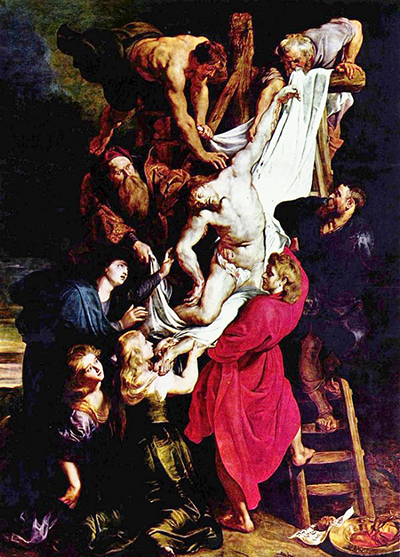
1609–10The Descent from the Cross
1611–14Young Woman Looking Down
c. 1628The Garden of Love
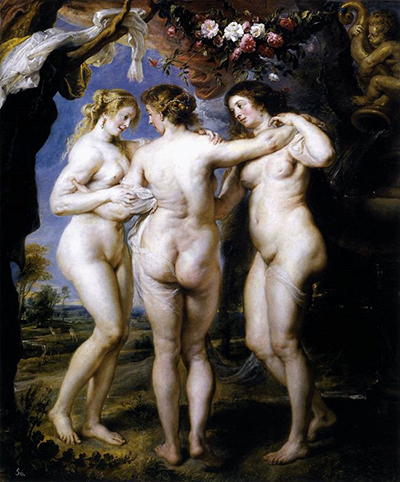
1630–35The Three Graces
1630–35Contents
- What can be seen in the drawing?
- Why is she connected with Saint Apollonia?
- What was the Augustinian commission?
- How did Rubens use chalk and ink?
- Does the hand appear in every version?
- What do we know about the woman's identity?
- Where is the drawing now?
What can be seen in the drawing?
The face occupies the upper half of the sheet. Rubens turns it slightly so that one cheek receives more light and the eyes cast their gaze below the viewer. The nose, mouth and eyelids are resolved with delicate changes of tone. Around them, the hair has a freer rhythm: curls bunch and separate, dark marks crossing the lighter paper. The open work in the clothing contrasts with the carefully observed head.
The hand across the chest is important because it gives the study more than a likeness. The fingers lie against the body in a quiet inward gesture. The arm and sleeve are sketched less fully than the head, yet they tell us how the figure might occupy space in a larger composition. Without the hand, the drawing could be read as a self-contained head study. With it, the woman seems to turn her attention towards something beyond the sheet.
Black chalk gives depth to the hair and the shadows of the face. Red chalk warms flesh and helps distinguish skin from the paper ground. White heightening draws out selected lit areas. The 2005 Metropolitan Museum exhibition caption reproduced with the work[4] specifies that the eyes, eyelashes and left eyebrow were retouched with pen and brown ink. These additions are precise, not a wash over the entire drawing. They sharpen expression at the point where the viewer most wants to read it.
Much of the sheet remains visibly provisional. Rubens did not finish every seam of the dress with the same care he gave to the eye and cheek. The difference is purposeful in a working study: the painter needed to know how a face and a gesture would read inside a larger altarpiece. A blank or faint area is not necessarily missing information about a completed portrait. It may show where the drawing's task ended.
The image on this page is a reproduction of the full sheet, and its warm paper tone can make the red chalk appear close to the colour of flesh. The actual marks remain marks on paper. Seeing their layers helps explain why scholars describe the work by technique as well as subject: its emotional effect depends on the control of red, black and white, and on the selective firmness of the ink.
Why is she connected with Saint Apollonia?
The drawing is related to Rubens's Enthroned Madonna Adored by Saints, made for the high altar of the Augustinian church in Antwerp in 1628. A KMSKA account of that altarpiece[5] describes the Virgin and Child among a large company of saints, with Augustine prominent below. In the museum's account of the companion Apollonia altarpiece[6], it identifies Apollonia standing on the left of Rubens's high-altarpiece composition, holding tongs, the attribute of her martyrdom. The downcast head in the Uffizi study relates to that figure.
The saint is identified in the finished religious painting by her context and attribute, not by an inscription on the woman's forehead in the drawing. The sketch studies a human model for a holy role. It would be inaccurate to claim that the person who sat for Rubens was herself named Apollonia. Nor is there secure evidence here for the suggestion that she was Hélène Fourment, Rubens's second wife. Hélène and Rubens married in 1630, after the altarpiece's 1628 date. Resemblance to other female figures is not enough to identify a sitter.
The Metropolitan Museum's 2005 exhibition overview[3] explains a common Rubens practice: after working out a composition, he made more detailed studies of individual figures, especially their faces, expressions or clothing. The Uffizi sheet fits that way of thinking, though the exact order of every study for this altar project cannot be reconstructed from this one sheet. It shows one face treated as significant within a crowded whole.
A scholarly study of Rubens's workshop[2] compares the features of the painted Apollonia with the Young Woman Looking Down. The link rests on visual correspondence and the 1628 commission. The same study considers whether a drawing like this was made specifically for the painting or drawn from an existing stock of figure studies. That question is useful: Rubens's workshop could reuse studied heads and poses, so a close resemblance does not by itself document the minute when chalk first touched paper.
What was the Augustinian commission?
The Antwerp Augustinians commissioned three large altar paintings for their church. According to the KMSKA[6], Rubens supplied the central Madonna and saints, Anthony van Dyck painted Saint Augustine in Ecstasy for one side altar, and Jacob Jordaens painted The Martyrdom of Saint Apollonia for the other. The works are related by site and patron, but they are separate paintings by three artists.
This distinction matters for the Uffizi sheet. The young woman's head prepares a figure of Apollonia within Rubens's central painting. It is not a design for Jordaens's separate Martyrdom of Saint Apollonia merely because that canvas features the same saint. The high altar showed the Virgin and a gathering of holy figures; the side painting narrated Apollonia's violent ordeal. A study for one role should not be assigned to the other work without evidence.
The KMSKA describes why Apollonia had a place in the programme. Relics of the saint were kept in the church, while Augustine was the order's founding figure. Both appear in Rubens's central image and receive the emphasis of the side altars. The saint holds tongs in the high-altarpiece painting, referring to the tradition that her teeth were pulled out during persecution. The drawing does not show the whole narrative or the attribute; it concentrates on the face needed for the completed figure.
Rubens's finished canvas was large: the museum's object record[7] gives 564 × 401 cm. That number belongs to the painting, not the Uffizi sheet. The drawing's 41.4 × 28.7 cm scale served a different task. It let the artist study expression at a manageable size before that head became one part of a much larger painted assembly.
The original church setting changed the viewer's experience. At the high altar, a worshipper would see an entire community of saints arranged around the Virgin and Child. The drawn young woman is encountered alone, near eye level in reproduction or exhibition. The shift lets us examine one face closely, but we should remember that her eventual role was subordinate to a grand devotional scene.
How did Rubens use chalk and ink?
The Metropolitan Museum's exhibition account[3] divides Rubens's drawings by function and describes his habit of working from broad composition towards individual studies. In this sheet, the highly developed head and comparatively loose garment make that separation visible. The face needed a convincing turn, attention and softness. The dress could be resolved in the painting or in other preparatory work.
The interplay of media gives the face its liveliness. Red chalk does not outline everything evenly. It models the cheek and brow, while darker black marks anchor the eyes and mass of hair. White touches bring back light on the paper. A few ink lines then refine the gaze. Each material has a distinct job, so the study can remain open in some areas without looking unfinished where expression matters.
Rubens's workshop was active and collaborative. The Metropolitan Museum[3] notes that he retained drawings as studio material for assistants and collaborators, rather than treating every sheet as a public artwork to be sold at once. That history helps explain why a preparatory head can be both a beautiful independent image today and a practical source for a monumental commission in its own time.
The sheet is also a reminder that “portrait” and “study” are not mutually exclusive ways of looking. It seems to observe a particular face, yet the recorded purpose is to make a saint convincing in a painting. Calling it a portrait of a known woman requires a sitter identity we do not have. Calling it only a technical exercise misses the individuality Rubens gave the eyes, mouth and curls. The title Young Woman Looking Down keeps the visible person in view while the subtitle states the painting relationship.
Does the hand appear in every version?
No. A Sotheby's scholarly catalogue[8] describes a nineteenth-century French School copy after the Uffizi drawing. That later sheet follows much of Rubens's image but omits the hand across the woman's chest. The catalogue explicitly identifies it as a copy and gives Uffizi inventory 1043 E for the Rubens original.
This is a small difference with a large interpretive effect. Without the hand, the copy reads more like a conventional head portrait. In Rubens's drawing, the hand connects face to body and suggests the saint's inward attention. It also makes the legacy page label, which mentions a hand, partly descriptive of what viewers actually see. The correct title still remains Young Woman Looking Down or Study for the Head of Saint Apollonia.
The later copy cannot be used to assign its paper condition, provenance, date or technique to Rubens's original. Sotheby's describes a nineteenth-century object under sale; its physical tears and mount belong to that copy. Its note is useful because it compares the two images and cites the Uffizi inventory, not because the copy replaces the original as the subject of this page.
There is another similarly titled work to keep apart. The Corpus Rubenianum catalogue, number 104g[10], calls a lost Rubens drawing Study of the Head and Right Hand of a Woman. It relates that drawing to The Miracles of Saint Francis Xavier and records a copy in Besançon. That is not the Uffizi sheet of the downcast young woman. The shared descriptive words “head,” “hand,” and “woman” are too general to establish identity; inventory, image and intended painting do the identifying work.
What do we know about the woman's identity?
The safest answer is that she is unidentified. The drawing is in a scholarly catalogue under a descriptive title, with its sacred role named as a study for Saint Apollonia. That tells us how Rubens used the image, not who posed. A model could be a family member, acquaintance or someone employed for the work, but none of those options is documented for this sheet by the accessible records cited here.
The agency reproduction[9] has circulated with a suggestion that the woman might be Hélène Fourment. That is a proposed resemblance, not a secure sitter identification. It also comes with a date around 1630, while the 2005 exhibition caption and later scholarly study associate the sheet with 1628. The discrepancy should not be flattened into a confident portrait of Hélène.
The face's expression can still be discussed. The lowered eyes, gentle mouth and inward hand gesture suit a religious figure who is present among saints rather than taking part in a violent episode. This is an interpretation of visual effect. It does not prove that Rubens asked a sitter to impersonate Apollonia while posing, or that the drawing was displayed as a devotional image before it entered a collection.
The clear public identity is therefore an Uffizi drawing by Rubens, inventory 1043 E, connected with the Saint Apollonia figure in his 1628 Augustinian high altarpiece. Its young female sitter remains unnamed. That distinction gives the study its proper place between an observed human face and a constructed saint.
Where is the drawing now?
The Roma Tre record of Capitelli's catalogue entry[1] names the Gabinetto Disegni e Stampe degli Uffizi, Florence, and 1043 E. The 2005 exhibition caption[4] likewise credits the Uffizi collection. The drawing was lent for exhibitions of Rubens's work on paper, including the Metropolitan Museum's 2005 survey[3]. An exhibition loan in New York does not make the sheet part of the Met's permanent collection.
The direct Uffizi object page was not accessible during this research pass. Accordingly, this page gives the inventory and holding as supported by scholarly and exhibition records, without inventing a current display room, acquisition date or complete provenance. The finished altarpiece, by contrast, is in the KMSKA's collection care[5] in Antwerp on loan, after having spent centuries at the Augustinian church and a period in Paris. Those are facts about the painting, not a provenance of the drawing.
To read the sheet, begin with the lowered gaze and the slight turn of the head. Follow the curls into the dark marks around the temple, then look down to the lightly stated collar and the hand against the chest. Notice where Rubens stopped resolving the figure and where he added the crispest marks. The sheet turns a working need—a head for one saint in a crowded high altarpiece—into a memorable image of a person whose actual name remains unknown.
Rubens artworks directory
Frequently Asked Questions
It is commonly called Young Woman Looking Down or Study for the Head of Saint Apollonia. The inherited web address uses a broad description of head and hand but refers to this Uffizi sheet.
No. It is a drawing on paper in black and red chalk, heightened with white and retouched in places with pen and brown ink.
Scholarly and exhibition records place it in the Uffizi prints and drawings collection, Florence, inventory 1043 E. A direct public Uffizi object record was unavailable for this review.
Her identity is not established. An agency has suggested Hélène, but the sheet's documented function is a study for Saint Apollonia in a painting dated 1628.
No. It relates to Apollonia in Rubens's central Madonna-and-saints altarpiece. Jordaens's Martyrdom of Saint Apollonia was a separate side-altarpiece commission for the same church.
Discussion
Follow the young woman's lowered gaze and her hand across her chest.
Share a close observation or a reliable source for Uffizi 1043 E.
Reader Insights
How do the chalk and ink marks differ across the face and clothing?
What did this head study contribute to the large Antwerp altarpiece?
Why must the original be kept distinct from the later copy?
Join the Conversation
Add your reading below without assigning an unverified sitter identity.
References
- Roma Tre University, Giovanna Capitelli's 2009 catalogue entry identifying Uffizi 1043 E. View source
- Modi Operandi in Rubens's Workshop , figure 48 and discussion of the Apollonia study. View source
- Metropolitan Museum of Art, Peter Paul Rubens (1577–1640): The Drawings , 2005 exhibition overview. View source
- Metropolitan Museum exhibition caption for Young Woman Looking Down , reproduced by Artnet. View source
- KMSKA, Rubens's Enthroned Madonna Adored by Saints and Augustinian commission. View source
- KMSKA, Jordaens's separate Martyrdom of Saint Apollonia and the three altarpieces. View source
- KMSKA, object record for Rubens's central high altarpiece. View source
- Sotheby's, nineteenth-century copy after the Uffizi drawing, lot 151. View source
- Bridgeman Images, reproduction historically captioned Feminine Portrait. View source
- Corpus Rubenianum , volume VIII/2, catalogue 104g, distinct lost study known through a Besançon copy. View source