by Tom Gurney
Tom Gurney BSc (Hons) is an art history expert with over 20 years experience
Published on June 19, 2020 / Updated on October 14, 2026
Email: tomgurney1@gmail.com / Phone: +44 7429 011000
A scholar surrounded by books and angels
Jerome sits bare-chested at a table, one hand supporting his head while the other rests near papers and an open book. A red cloak gathers around him. A lion lies at his feet, and two small angels animate the room. This is Peter Paul Rubens’s large Saint Jerome[2] in the Potsdam Picture Gallery at Sanssouci. Rubens shows the saint at work among writings, in a study.
The Stiftung Preußische Schlösser und Gärten Berlin-Brandenburg[1] (SPSG) identifies the picture as oil on wood, 185.5 × 135.5 centimetres, inventory GK I 7578, dated around 1610. Its institution-contributed object essay[2] gives about 1609/10. These are compatible approximate dates. The muscular, seated saint, red drapery, books, lion and angels distinguish it from later Rubens paintings of Jerome and from Van Dyck’s interpretations of the subject.
The figure is large within the frame. Rubens lets the cloak swell across the lower half and directs light to the shoulders, chest, face and page. Jerome’s pose seems still, but the angels and the diagonal lines of arm, table and drapery keep the image active. The lion, a traditional companion in the saint’s legend, fills the space beneath him rather than roaming in an outdoor wilderness. This mixture of scholarship, religious devotion and bodily power is what makes the Potsdam work particular.
At a Glance
- ArtistPeter Paul Rubens [1]
- DateAbout 1609/10 [1]
- MediumOil on wood [1]
- Dimensions185.5 × 135.5 cm [1]
- CollectionPotsdam Picture Gallery, Sanssouci, GK I 7578 [1]
Where this work sits in Rubens's career
Saint Jerome in His Study
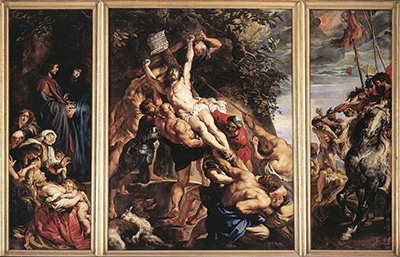
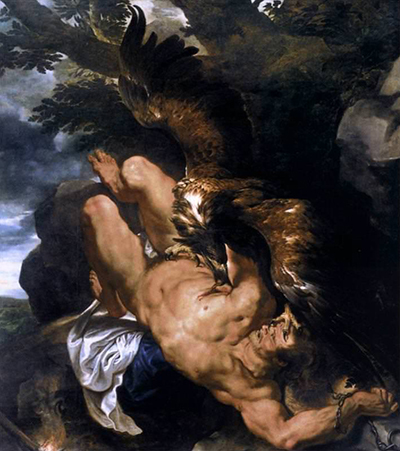
c. 1609–10The Elevation of the Cross
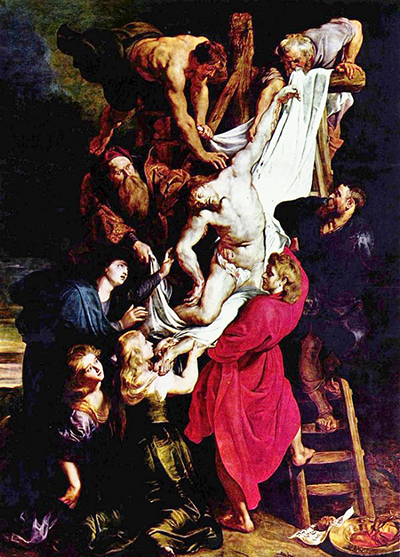
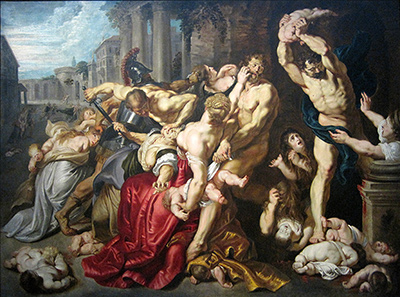
1609–10The Descent from the Cross
1611–14The Garden of Love
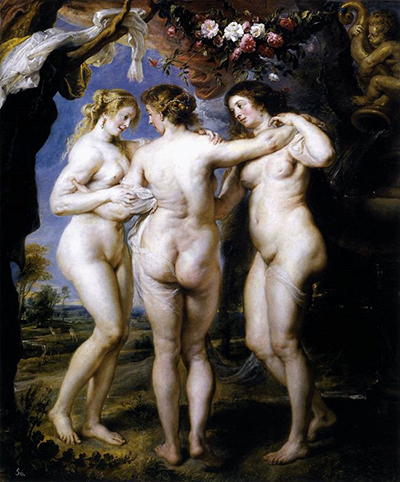
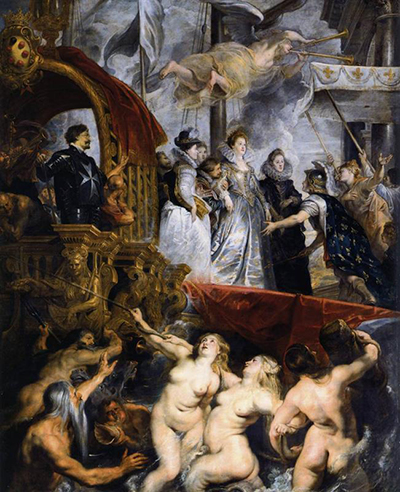
1630–35The Three Graces
1630–35Contents
- Is Jerome resting, thinking or writing?
- Why the books, hourglass and lion?
- A powerful body after Rubens’s Italian years
- What did Van Dyck take from Rubens?
- Why did the attribution change?
Is Jerome resting, thinking or writing?
The saint’s hand against his face makes a moment of thought the image’s centre. Yet this is not a portrait of inactivity. In Hans Vlieghe’s Corpus Rubenianum entry for the Potsdam panel[3], catalogue no. 120, the other hand is described as loosely holding a quill. A large open folio is balanced between Jerome’s knees and the desk; papers, an inkwell and the hourglass sit nearby. The objects locate the pause inside an ongoing intellectual task. We see what he has been working with and what he may use when the pause ends, without needing to claim that Rubens illustrated a particular sentence of the Bible.
Vlieghe’s close description also identifies an action often lost in a small reproduction. The angel at upper right is blowing ink from a quill before writing on a scroll; the smaller angel below touches the lion with a foot. The first gesture echoes Jerome’s writing tools while moving the act of writing into a heavenly register. The second creates a small playful interruption at the edge of the scholarly scene. Neither angel is the central author of the text; the contrast lets Rubens keep the large human thinker and the nimble supernatural figures in one room.
The room is not sealed off. Vlieghe notes a door in the background with a curtain beside it and sky beyond. He also distinguishes the light arriving through that opening from illumination that seems to come from the viewer’s side. These observations help explain why the body is more strongly modelled than the dark shelves. Rubens gives Jerome a place of retreat without turning the study into a cave or a featureless symbolic space. Books pile above him, the opening behind him suggests a world outside, and his body mediates between the two.
Why the books, hourglass and lion?
Jerome was one of the major Latin Church Fathers and is remembered for his work on the Latin Bible. The SPSG account by Alexandra Bauer[2] explains that Rubens places him among books and writings to emphasize the intellectual task. The papers at his desk offer a more specific setting than a lone saint in a desert landscape. His resting head and absorbed expression make thought visible as an action, even though he is not depicted writing at this instant.
The hourglass at the edge of the composition evokes passing time and the limits of earthly life, according to SPSG. A cardinal’s hat is another traditional attribute in the painting’s iconography. It is a later convention for identifying Jerome, not a claim that he held the office of cardinal in the modern institutional sense. Such objects connect a human scholar with religious memory without making every small item a separate secret code.
The lion follows the well-known legend that Jerome removed a thorn from the animal’s paw and was thereafter accompanied by it. It gives the learned interior a sign of the saint’s broader story. Its dark body near the lower edge contrasts with the pale angels and the red mass of cloth. The legend explains the lion’s presence, while its position helps balance Rubens’s composition.
The angels complicate a simple choice between “study” and “hermit.” Jerome’s desk belongs to scholarship, while the small figures suggest divine company. One angel stands at the upper side; another is near the lion and table. They do not make the room a literal account of a witnessed event. Rubens gathers the attributes and figures that allow the saint to be understood as writer, penitent and inspired Church Father at once.
Vlieghe points to earlier pictures of Jerome in his study, including a panel by Jan van Eyck and Albrecht Dürer’s 1514 engraving, as precedents for the combination of books, desk and identifying attributes. This does not mean that Rubens copied either composition wholesale. It places the Potsdam painting in a tradition where a scholar saint can be recognised by his work space and a handful of conventional objects. Rubens’s unusually forceful body and lively angels then change the emotional temperature of that familiar setting. The old books and quiet room contain a figure whose physical presence nearly fills the panel.
A powerful body after Rubens’s Italian years
Rubens painted this work soon after returning from his years in Italy, 1600–08. The SPSG curator[2] points to the saint’s powerful upper body and proposes links to the Farnese Hercules and to figures by Michelangelo that Rubens studied in Rome. Those comparisons are more precise than a generic statement that the work looks “Baroque.” They also remain art-historical readings of visual form rather than a documented declaration by Rubens that he copied one named statue directly into this painting.
The muscular torso matters because Jerome is often shown as an exhausted old hermit. Here his age is apparent in beard and face, but his body looks capable and weighty. Bauer suggests Rubens chose this figure type to present an energetic defender and worker for Christianity. The contrast between age and bodily force allows scholarship to appear vigorous rather than withdrawn. A man sitting with books can have as much dramatic presence as a saint in motion.
The broad panel gives that body room. At 185.5 centimetres high, the picture approaches life scale, and Jerome’s chest, arms and robe occupy much of it. The angels are smaller, adjusting how we read the main figure’s size and solemnity. The reproduction conveys the arrangement; SPSG’s records establish the object’s medium, date and measurements.
Vlieghe’s catalogue makes the Italian comparison more specific than a general influence claim. Following Charles Norris’s 1953 study, he relates Jerome’s upper body and bent supporting arm to a Michelangelo design for Saint Jerome known through an early engraving. He also compares the saint’s crossed legs and arm with the Erythraean Sibyl on the Sistine Chapel ceiling. These are scholarly proposals about form, not documents proving Rubens copied a single source in front of this panel. Vlieghe is less persuaded by Norris’s proposed comparison between the lower angel and Correggio’s Education of Cupid, preferring a detail near Michelangelo’s Sibyl. Their disagreement shows how precise such visual arguments can be, and how open to revision.
Rubens’s reuse of a powerful figure type is relevant to the painting’s date. Vlieghe sets the composition around 1609–10, comparing its nearly frame-filling saint with other large figures of that period. That agrees broadly with SPSG’s dating, while remaining a judgement based on style rather than a dated signature. His note that the lion appears heavily overpainted is an older connoisseurial observation. Without a current technical report, the page should not turn it into a claim about when, why or by whom any alteration was made.
What did Van Dyck take from Rubens?
A later generation of artists encountered Rubens’s Jerome imagery. The Nationalmuseum’s scholarly essay[4] on Anthony van Dyck’s Saint Jerome with an Angel identifies the Potsdam study picture as one possible source for aspects of Van Dyck’s conception. It notes a bare-chested Jerome among books and papers with angels, and it considers how the younger artist could have adapted such a model. The museum emphasizes the difference: Van Dyck’s saint is more inward and physically worn, and his angel has a more serious role. The proposed connection is about artistic response, not identity between the paintings.
The Museum Boijmans Van Beuningen’s account[5] of its distinct Van Dyck canvas similarly says the younger painter drew on Rubens, including a lion, but developed freer, more visibly broken brushwork. Its object belongs to Van Dyck, is on canvas, and dates 1618–20 in the museum’s record. None of those properties should be transferred to Rubens’s earlier Potsdam wood panel. This comparison is valuable because it shows that Rubens’s Saint Jerome was part of an artistic conversation, while the differences make each painter’s decision clear.
The Nationalmuseum essay also discusses other Van Dyck versions in Rotterdam and Stockholm, and a separate later Rubens Saint Jerome in Dresden. These are different objects. Scholars see Rubens’s early study composition as a possible model to which Van Dyck responded in his own paintings.
Why did the attribution change?
The SPSG account[2] says the painting entered the Sanssouci gallery in 1815 as a replacement for a picture removed to Paris during the Napoleonic period. Later catalogues assigned it to several other painters, including Abraham van Diepenbeeck, Gaspar de Crayer and Abraham Janssens. Its Rubens attribution was re-established in 1953. This is a documented history of how the work was understood and classified; it is not a reason to present the present holding museum’s attribution as unresolved.
Vlieghe’s printed catalogue gives a slightly different date for the transfer: 1816, describing the panel as sent from Paris to Potsdam in partial replacement for six pictures previously seized by the French. It also records a move to the Stadtschloss in Berlin from 1892 to 1929 before the return to Sanssouci. The institution’s 1815 arrival date and the catalogue’s 1816 transfer date should remain attributed to their respective sources. They might describe different steps in one movement, but neither text here proves that reconciliation.
The same catalogue preserves an instructive trail of changing names. A nineteenth-century listing assigned the work to de Crayer; a 1930 Sanssouci catalogue called it Janssens. Norris argued for Rubens in 1953, yet later catalogues and discussions did not immediately use the same attribution consistently. The fact that the current museum presents it as Rubens tells the reader its present status; the historical disagreement explains why the change was an act of research, not an automatic correction of a typographical error. Vlieghe also lists a separate painted copy formerly at Port Eliot in Cornwall. That copy is evidence of the composition’s circulation, not another name for the Potsdam panel.
Such changes in attribution can be hard to interpret. A large early Rubens picture may share features with painters in his orbit, and an old catalogue name can persist long after a scholarly correction. SPSG now names Rubens and provides the object number and physical details. The picture itself remains the same physical panel through these changing labels.
The setting is easily mistaken for a hermitage because Jerome is so often shown in solitude. Here the books, desk and architectural enclosure present Jerome at work in a study. The distinction matters when comparing this panel with wilderness images of the saint.
Rubens artworks directory
Frequently Asked Questions
Rubens places him among books and writings in a study, rather than in an outdoor wilderness.
It is Jerome’s traditional companion in Christian legend, associated with the story of the thorn removed from its paw.
SPSG dates it around 1609/10, shortly after Rubens’s return from Italy.
No. Van Dyck made separate later canvases. Museum scholarship discusses Rubens’s Potsdam composition as a possible visual source for aspects of them.
It is in the Potsdam Picture Gallery at Sanssouci, inventory GK I 7578.
Discussion
Look closely at Jerome's books, lion and angels.
Share an observation grounded in the painting or its sources.
Reader Insights
How does the study setting change the familiar hermit image?
Why has the attribution history changed?
How does Van Dyck's response differ from this panel?
Join the Conversation
Add your reading below, keeping observations specific and evidence clear.
References
- SPSG, painting record for Rubens’s St Jerome , GK I 7578. View source
- SPSG / Alexandra Bauer, interpretive object entry for Der heilige Hieronymus. View source
- Hans Vlieghe, Saints , Corpus Rubenianum Ludwig Burchard VIII.2 (1973), catalogue no. 120, pp. 97–99; City of Antwerp digitisation. View source
- Nationalmuseum, scholarly catalogue essay on Van Dyck’s distinct St Jerome with an Angel and Rubens’s Potsdam precedent. View source
- Museum Boijmans Van Beuningen, object text on Van Dyck’s separate Saint Jerome. View source