 by Tom Gurney
Tom Gurney BSc (Hons) is an art history expert with over 20 years experience
Published on June 19, 2020 / Updated on October 14, 2026
Email: tomgurney1@gmail.com / Phone: +44 7429 011000
The queen in blue, white and gold
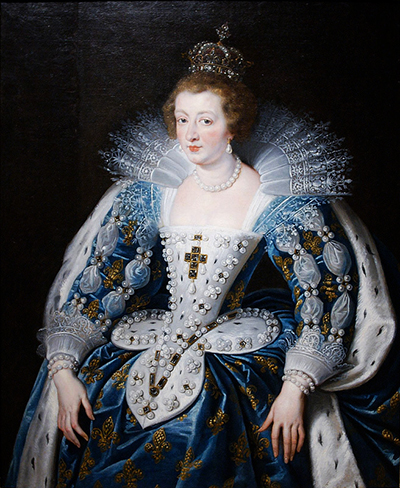
Anne of Austria faces the viewer in a broad blue gown whose gold flowers, pearls and jewels catch the light against a dark ground. A jeweled crown sits above her hair. A high pleated lace collar frames her face, while an ermine-lined mantle opens around her shoulders. Her hands rest visibly against the dress. Nothing in the image shows a ceremony unfolding; costume, pose and the control of the surrounding space make her royal position immediately legible.
The painting reproduced here is the Norton Simon Museum's Portrait of Anne of Austria, Queen of France, accession F.1965.1.059.P, in Pasadena. Its current object record[1] dates it about 1622, identifies oil on canvas and gives dimensions of 119.7 × 96.8 centimetres. The present attribution is “Workshop of Peter Paul Rubens.” That credit is central to the painting's identity: it associates the canvas with Rubens's studio while withholding an unqualified claim that the master painted it himself.
Anne was the Spanish-born wife of Louis XIII of France. She is called “of Austria” because of her Habsburg dynastic identity, not because this painting depicts her as a ruler in modern Austria. The portrait presents her as queen of France, using the blue and gold fleurs-de-lis of that monarchy. It has a similarly sized companion portrait of Louis in the same Pasadena collection. Looking at the pair together reveals two related performances of sovereignty: his armour and baton and her ceremonial dress, crown and jewels.
At a Glance
- AttributionWorkshop of Peter Paul Rubens [1][2]
- DateAbout 1622 [1]
- MediumOil on canvas [1]
- Dimensions119.7 × 96.8 cm [1]
- CollectionThe Norton Simon Foundation, F.1965.1.059.P [1]
- CompanionPortrait of Louis XIII, F.1965.1.060.P [4]
Where this work sits in Rubens's career
The Elevation of the Cross
1609–10The Descent from the Cross
1611–14Anne of Austria
c. 1622The Garden of Love
1630–35The Three Graces
1630–35Contents
- What the dress says
- A queen between the French and Spanish courts
- Rubens in Paris and the workshop portrait
- A pair of royal portraits in Pasadena
- Other portraits of Anne are different objects
- From royal ownership to the Norton Simon Foundation
What the dress says
The Norton Simon description[1] singles out the pleated “Medici” lace ruffle, jeweled crown, satin gown embroidered with fleurs-de-lis and ermine-lined mantle. Each element contributes to a carefully built royal image. The tall collar makes Anne's face the picture's centre even amid abundant decoration. White lace against the blue sleeves and black background enlarges the area around her head without needing a halo or a bright architectural setting.
The gown takes up much of the canvas. Pearls and jewels cross its bodice and sleeves, while the repeated French royal flower joins clothing to office. A jewel on a portrait can advertise wealth, but repeated fleurs-de-lis identify the court to which the sitter belongs. Ermine contributes another recognizable sign of rank. These signs are cumulative: the painting does not rely on the small crown alone to tell the viewer that this is a queen.
Anne's hands remain visible on either side of the fitted centre of the dress. The museum's digital exhibition on women's portraiture[3] draws attention to the way her hands are displayed against the fabric. They interrupt a field of dense ornament, letting the viewer encounter a human body inside the ceremonial outfit. One hand is not holding a document, sceptre or child. Their role here is visual presence rather than evidence for a particular political act.
The blue and white also set up a contrast with the pendant portrait of Louis. In his image, blue drapery lies over metal armour, and a baton and plumed helmet develop an image of martial command. In Anne's, royal colour is embodied in dress. The comparison should not be mistaken for a complete account of either person's political capacities. It describes the roles assigned by these two particular canvases. The queen later governed as regent, a historical role that this early image does not narrate.
The portrait is formal, but not faceless. The richly lit collar and pearls direct attention to Anne's expression; her gaze returns the viewer's. The apparent stillness is part of the arrangement. A court portrait could make authority durable by suspending a sitter in a pose that remained recognizable when the picture moved to another residence or another owner. The flowers and fur could continue to declare status long after the circumstances of the sitting were forgotten.
A queen between the French and Spanish courts
Anne, born in 1601, was the daughter of Philip III of Spain and Margaret of Austria. She married Louis XIII in 1615. The Rijksmuseum's scholarly catalogue of a distinct portrait of her[9] lays out this dynastic background and notes that she became regent of France in 1643, after Louis's death, until her son reached his majority in 1651. Those later facts help identify the sitter's historical importance. They should not be projected backwards as if the Pasadena canvas predicted the regency.
The 1615 marriage was part of a paired royal exchange. The Musée du Luxembourg's Rubens exhibition guide[5] explains that Marie de' Medici helped arrange both Anne's marriage to Louis and the marriage of Louis's sister Elisabeth to the future Philip IV of Spain. Portraits of the people in that alliance carried more than personal likeness. Their costumes and emblems made kinship between courts visible across distance, even when the individuals themselves were elsewhere.
The Norton Simon digital exhibition describes the French marriage as a political alliance and quotes a contemporary account of the weight of Anne's clothing at the wedding Mass. Its author also calls the anecdote likely embellished. That is a useful reminder when looking at this painting: visible finery could be beautiful and burdensome, but this blue dress is not securely documented as the exact outfit worn at the wedding. The portrait was catalogued about seven years later. A viewer can read ceremony in its style without assigning it to an event it does not depict.
The exhibition gives Anne's age as 21 in its circa 1622–25 label, while the current object entry says about twenty-five alongside an approximately 1622 date. Those statements are not chronologically consistent with her birth year. Rather than choose one age phrase, this page gives the dated facts and leaves her apparent age as a matter of visual interpretation. The portrait seeks a youthful, composed queen; the exact age at every stage of production is not documented by the public catalogue.
Rubens in Paris and the workshop portrait
Rubens came to Paris in 1622 to negotiate Marie de' Medici's large painting cycle for the Luxembourg Palace. The Musée du Luxembourg guide[5] says he used that opportunity to capture the appearances of Marie, Louis and Anne. The Norton Simon record[1] proposes that the Anne and Louis portraits were probably painted during one of Rubens's Paris visits connected with that project. The context fits the approximate date, but “probably” is a limit: it does not supply a commission letter for the Pasadena pair or fix a particular day when Anne sat for this canvas.
The queen's image could pass through several stages between a royal encounter and a finished full-length portrait. The Luxembourg exhibition guide describes Rubens's general practice of making royal likenesses through drawings and smaller painted studies, then using workshop assistance for larger versions and replication. That model helps explain how his studio could make court images that still depended on Rubens's access to sitters. It is not proof that a particular surviving sketch was the exact preparatory image for F.1965.1.059.P.
The Norton Simon Museum's workshop artist listing[2] currently groups Anne with Louis under “Rubens, Workshop of Peter Paul.” Its digital exhibition uses the shorter artist line “Peter Paul Rubens” and dates Anne about 1622–25. Those are two present-day museum descriptions of the same Pasadena object. For catalogue facts on this page, the individual object entry and workshop listing carry the clearer current attribution and about 1622 date. The exhibition remains useful for discussing gender, dress and the pendant relationship, as long as its simpler label is not silently adopted as a new attribution.
“Workshop” does not mean the sitter or image was invented later. It is an attribution within the historical production of Rubens's studio. Equally, a high-quality painting that bears his designs should not automatically be labelled autograph. The Prado's exhibition on Rubens's workshop[7] illustrates the difference with two other portraits of Anne: a circa 1622 Prado painting credited to Rubens and a related Vienna version credited to Rubens and workshop. Its curators look at decisions visible in paint, not just surface quality, when distinguishing their hands. Those are other canvases, and that technical comparison cannot be transferred wholesale to the Pasadena painting. It does show why attribution calls need object-specific evidence.
A pair of royal portraits in Pasadena
The companion is Portrait of Louis XIII, King of France[4], accession F.1965.1.060.P. It is also credited by the Norton Simon Museum to Rubens's workshop, dated about 1622, and painted in oil on canvas. It measures 118.1 × 96.5 centimetres, very close to Anne's 119.7 × 96.8. The similar scale and the museum's express companion designation support viewing them as a pair. The published records do not identify their first room, exact original hanging height or documented commissioner.
The pairing works by difference as much as similarity. Louis wears armour and carries a marshal's baton; Anne wears a jewelled crown, embroidered dress and mantle. Both have ample white collars and richly worked textiles, so each likeness belongs to the same world of royal display. The figures face outward toward future viewers. Their marriage and shared dynastic position connect them, but each canvas gives its sitter a separate set of signs.
The pair also puts Anne's portrait in the context of Rubens's French work without making it part of Marie de' Medici's Luxembourg cycle. That cycle is a series of large narrative and allegorical paintings devoted to the queen mother's life. The Pasadena canvases are individual state portraits. Rubens could be involved in both projects during related years, yet the Norton Simon entries do not claim these portraits hung in the Luxembourg gallery or were commissioned by Marie. A connection of time and court is not the same as a documented shared programme.
In the museum's digital exhibition, Anne's portrait is presented partly through the conventions of women's royal representation. Rich textiles, beauty and hands occupy the foreground. Seen beside Louis's portrait, those choices look like a gendered visual language of court authority. That is an interpretation of the pair's design, not evidence that Anne lacked political agency. The later regency makes the distinction particularly clear: the image's assigned symbols and the woman's eventual historical power are different kinds of evidence.
Other portraits of Anne are different objects
Anne's likeness circulated in more than one design. The Museo Nacional del Prado[6] owns a distinct circa 1622 portrait credited to Peter Paul Rubens. Anne wears black, which the Prado associates with mourning for her father Philip III, who died in 1621. She appears in an architectural setting with a blue, fleur-de-lis curtain. The Prado says Rubens painted it in France while working for Marie de' Medici. Its different costume, background and collection history separate it from the Pasadena Anne in blue.
The Prado's workshop exhibition compares its painting with a close Vienna private-collection version dated about 1622–25 and credited to Rubens and workshop. The distinction rests on the two works' individual execution and relation to the design. It does not create a direct, documented sequence leading to Pasadena. The repeated subject is evidence of a demand for the queen's likeness; the separate records tell us which version is which.
The Louvre collection record[8] identifies yet another Anne portrait, INV 1794, as an old copy after Rubens on wood, dated broadly around 1620–25. Its note discusses a lost original and an earlier history of uncertain sitter identifications. The Rijksmuseum's scholarly catalogue[9] treats a related Amsterdam picture, SK-C-296, as a studio work and argues for a date around 1628 on technical and stylistic grounds. These are not the same canvases as Pasadena F.1965.1.059.P. Their varying credits and dates show why a catalogue label from one museum cannot replace the holding museum's attribution for another object.
That distinction is especially important online, where thumbnails of Anne in blue, black or a palatial interior can sit beside the same abbreviated title. The image on this page shows the Pasadena composition: standing blue-gowned Anne, crown, lace collar and ermine mantle against a dark background. It does not show the Prado's black dress and architecture, the Louvre's wood-panel copy or the Amsterdam seated queen with flowers. The caption and identification therefore remain anchored to the image actually displayed.
From royal ownership to the Norton Simon Foundation
The Norton Simon provenance list[1] places Anne's portrait with Frederick II of Prussia at Charlottenburg in 1768, followed by the Hohenzollern family. It records Duveen Inc. in New York by 1936/37 and a later sale to the Norton Simon Foundation. The present accession begins with F.1965, but the record excerpt lists Duveen's range through 1964 rather than supplying a day of purchase. The documented entries should be treated as waypoints; they do not reveal every move from the seventeenth-century studio to the Prussian collection.
The painting has been exhibited repeatedly, including the 2017–18 Rubens royal portraits exhibition at the Musée du Luxembourg. Exhibition under an artist's name makes an object visible in a wider story; it does not, by itself, settle authorship. The current Norton Simon collection entry continues to say “Workshop of Peter Paul Rubens.” Likewise, the museum's present display status may change, so the collection and accession number provide a more durable answer to where this particular canvas belongs.
The provenance has limits. It does not identify the original patron of the pair, state where Anne's portrait first hung, or document its route into Prussian hands. A historical royal collection can be named from the eighteenth century without inventing every earlier transfer. The painting's value as evidence rests partly in what is visible—the queen's formal image—and partly in what its surviving records do and do not establish.
Rubens artworks directory
Frequently Asked Questions
The Norton Simon Museum currently credits the workshop of Peter Paul Rubens. Its digital exhibition uses a shorter Rubens label, but the individual object record and workshop artist listing govern this page's attribution.
The current object record says about 1622. A museum digital exhibition says about 1622–25. Neither supplies an exact sitting date or a dated commission for the Pasadena canvas.
The museum identifies a pleated lace ruff, jeweled crown, satin embroidered with French fleurs-de-lis and an ermine-lined mantle. These elements present royal rank, but they are not documented as the clothes from a particular ceremony.
Yes. The Norton Simon Foundation also has the similarly sized workshop portrait of Louis XIII, accession F.1965.1.060.P. The museum describes the two as companions.
No. The Prado's Anne wears black and stands in an architectural setting. The Pasadena queen wears blue and appears against a dark background. The institutions give the two canvases different object records and attributions.
It belongs to the Norton Simon Foundation and is catalogued by the Norton Simon Museum in Pasadena as F.1965.1.059.P. Consult the museum for current gallery display information.
Discussion
Look closely at how Anne's dress and gestures present her as queen.
Share an observation about the portrait or a reliable source that adds to its history.
Reader Insights
Which details make royal rank legible without showing a ceremony?
How does the Louis XIII companion change your reading of this portrait?
What evidence keeps the Pasadena, Madrid, Paris and Amsterdam images distinct?
Join the Conversation
Add your reading below, keeping observations specific and evidence clear.
References
- Norton Simon Museum, Portrait of Anne of Austria, Queen of France , F.1965.1.059.P. View source
- Norton Simon Museum, workshop artist listing. View source
- Norton Simon Museum, digital exhibition on Anne's portrait and the Louis pendant. View source
- Norton Simon Museum, companion Portrait of Louis XIII , F.1965.1.060.P. View source
- Musée du Luxembourg, 2017 exhibition guide on Rubens's royal portraits. View source
- Museo Nacional del Prado, distinct Queen Anne of Austria , about 1622. View source
- Museo Nacional del Prado, Rubens's Workshop exhibition comparison of two other Anne portraits. View source
- Musée du Louvre, separate old copy after Rubens, INV 1794. View source
- Rijksmuseum, catalogue of the distinct studio portrait SK-C-296. View source