by Tom Gurney
Tom Gurney BSc (Hons) is an art history expert with over 20 years experience
Published on June 19, 2020 / Updated on October 14, 2026
Email: tomgurney1@gmail.com / Phone: +44 7429 011000
A sculpture made active on paper
The central man's body seems to turn in several directions at once. His head tilts back, one arm reaches across the upper edge, and his torso twists against the serpent winding around him. Two smaller figures struggle on either side. Rubens has drawn Laocoön and his sons, the ancient sculptural group in the Vatican, as a mass of changing contours rather than a calm assembly of three bodies. Light catches the large man's shoulder, chest and thigh while the surrounding forms recede into strokes and washes.
This is a drawing after an ancient sculpture, not a painting of the Trojan legend and not the marble itself. The sheet is held by the Biblioteca Ambrosiana in Milan in the album catalogued F 249 inf., no. 4, p. 9. Catherine H. Lusheck reproduces it as Rubens's Study of the Laocoön and His Sons in Rubens and the Eloquence of Drawing. The Ambrosiana-credited Bridgeman reproduction[2] identifies the same sheet and provides a useful visual check against the image shown here.
Lusheck dates the sheet to about 1601. Other publications have proposed later years within Rubens's Italian period, so an exact date is less secure than the identification of the drawing and its model. What can be seen without settling the chronology is an artist testing how a famous three-dimensional group could be understood and reworked on a flat surface. The result is both an observation of sculpture and a forceful drawing in its own right.
At a Glance
- ArtistPeter Paul Rubens [1]
- ModelAncient Laocoön group in the Vatican Museums [1]
- DateItalian period, about 1600–08; precise date disputed [1]
- MediumBlack chalk, white heightening and bistre wash [1]
- Published size47.5 × 47.5 cm (Lusheck; other measurements published) [1]
- CollectionBiblioteca Ambrosiana, Milan, F 249 inf., no. 4, p. 9 [1]
Where this work sits in Rubens's career
Laocoön and His Sons
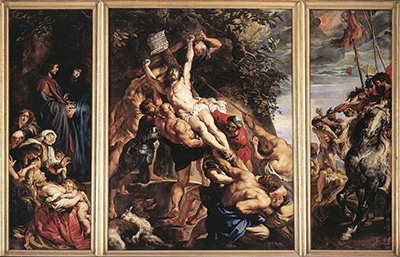
Italian period, c. 1600–08The Elevation of the Cross
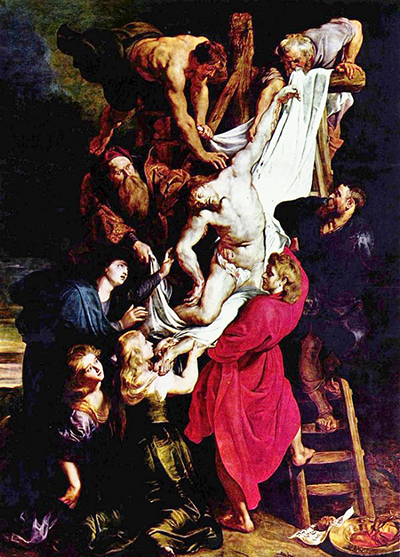
1609–10The Descent from the Cross
1611–14The Garden of Love
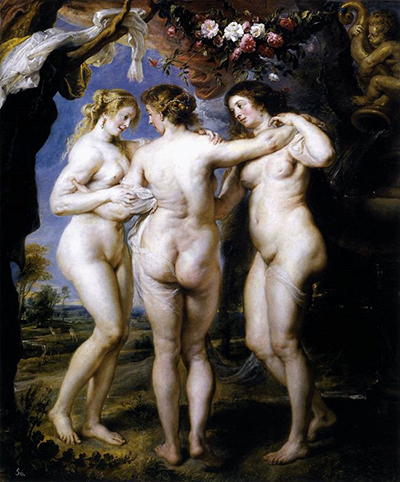
1630–35The Three Graces
1630–35Contents
- Who are Laocoön and his sons?
- What exactly did Rubens draw?
- How was the sheet made?
- Why did Rubens study ancient sculpture?
- How is the drawing different from the marble?
- Is this the only Rubens Laocoön study?
- What can the date tell us?
- How should the sheet be read today?
Who are Laocoön and his sons?
The figures belong to the story of the Trojan War. Laocoön warned the Trojans against bringing the Greeks' wooden horse inside their city. In the version summarised by the Vatican Museums[3], two enormous sea serpents attack him and his sons. The intertwined snakes make the father's struggle and the children's danger parts of one scene. A viewer need not know every variation of the myth to read the drawing: three figures are caught in an attack from which the central figure cannot simply step away.
The Vatican's ancient group was discovered in Rome in 1506 and acquired by Pope Julius II for the sculpture court. The museum identifies it with the Laocoön described by the Roman writer Pliny the Elder, who named sculptors from Rhodes. It also notes that the ancient marble's own date remains debated. Those facts concern the sculpture Rubens studied, not the date or authorship of Rubens's sheet. The two objects are separated by many centuries and by their materials, scale and purpose.
The subject rewards an artist interested in bodies under pressure. Laocoön's large torso, the sons' smaller limbs and the serpents' coils leave little empty space. Struggle is expressed through contact: a hand grips, a limb bends, a head turns away. Rubens could study a sequence of actions without a painted landscape or a written caption. The sculpture offered an unusually concentrated lesson in how anatomy, emotion and narrative might be joined.
What exactly did Rubens draw?
The reproduced Ambrosiana sheet shows the whole group, with Laocoön rising above the two sons. Its near-square format holds the bodies close together. Rubens did not isolate only the father's face or one child's back in this drawing. The serpents cross between the figures, pulling the viewer's eye from the left child through the father's torso to the figure at the right. This connected composition is a major clue to the sheet's identity.
The father is not drawn as a diagram of muscles. Rubens varies the marks: broad grey modelling defines the turning torso, while a denser web of lines traces the hair, faces, limbs and the difficult spaces where figures overlap. Bright passages at the shoulder and chest appear stronger against the darkened contours. This makes the body look as if it pushes out of the paper, even though the drawing is relatively small beside the Vatican marble.
Look at the upper arm extending across the left side. It gives the central figure a diagonal reach that counters the downward drag of his body. The sons pull the composition outward, but the snakes bind it together again. The drawing's visual energy comes partly from this conflict between a wide reach and a tight knot. Rubens could bring those forces into a single view by choosing his position and by deciding which surfaces to stress with chalk and wash.
The drawing does not document every side of the sculpture. A sculpture can be walked around; a sheet fixes one arrangement for a reader facing it. Rubens's viewpoint lets the father's back and shoulders dominate, while the sons are more fragmented by the serpents and by overlaps. Other views would reveal different relationships. This choice is why the sheet should be read as an interpretation of what he saw, not as a complete inventory of the marble.
How was the sheet made?
Lusheck describes black chalk, white heightening and bistre wash. The Ambrosiana-credited Bridgeman caption likewise identifies black chalk and washed bistre. Chalk supplies both searching outlines and soft tonal transitions. A brownish wash can deepen recesses quickly; light accents sharpen selected surfaces. In reproduction, these media work together to make the central body appear rounded and the surrounding struggle less firmly resolved.
These choices matter because the model was marble. Stone presents continuous volumes under real light. Drawing requires the artist to select edges and shades that will make those volumes legible on paper. Rubens stresses the father's bodily turn rather than enclosing each form in an even outline. The uneven finish is useful: a lightly worked area can remain subordinate while a darker contour or highlighted muscle draws attention to the action.
Lusheck gives the sheet as 475 × 475 millimetres, or 47.5 × 47.5 centimetres. The Bridgeman record gives the same square measurement. Other published descriptions of Rubens Laocoön drawings give different dimensions, and a direct Ambrosiana folio record has not been located for comparison. The measurement here is therefore best understood as the figure supplied by those named sources for F 249 inf., no. 4, rather than a fresh measurement of the original paper.
The paper's modest size changes the encounter with the subject. The Vatican sculpture occupies space around a visitor; the drawing brings the whole struggle within arm's reach. It invites close comparison of individual strokes and tonal decisions. A figure conceived in stone and viewed from a changing position becomes a portable study that another viewer can examine from one chosen direction.
Why did Rubens study ancient sculpture?
Rubens lived in Italy intermittently from 1600 to 1608, as the National Museum of Western Art's Rubens exhibition[4] explains. He studied works available in Rome and other Italian centres while developing the figure language that would mark his later painting. The Laocoön offered an example of movement and suffering rendered through carefully organised human bodies. It was already an admired antique when he encountered it.
An artist drawing from sculpture can investigate more than appearance. Working through one body's turn may clarify how the shoulders join the chest, how weight passes into a bent leg, or how a limb disappears behind another. Such questions become sharper in this group because every figure is constrained. The two serpents are not decorative borders; their coils help organise where the bodies can move and where they cannot.
Lusheck's study of Rubens's drawings treats drawing as a place where he developed ideas, rather than as a mechanical step before painting. This sheet supports that approach. It is possible to see him selecting from the marble's complex surface: the strongest passages concentrate bodily force and the less insistent ones preserve the tangle around it. That observation does not prove that this particular page was the direct preparatory source for a named later painting. It shows a method of learning through close visual work.
The ancient subject also entered a seventeenth-century artistic conversation. The Vatican group had been displayed in Rome for about a century before Rubens's Italian years. Artists could compare their own treatment of anatomy and emotion with a recognised example. By making a drawing, Rubens joined that conversation physically: he put marks on paper in response to the sculptors' arrangement rather than merely admiring it from a distance.
How is the drawing different from the marble?
The marble gives viewers the same bodies from many positions, changing as they walk around it. Rubens selected one position and compressed the experience into a rectangle. He could push some surfaces forward with dark outlines or light touches and allow others to fade. A drawing can therefore intensify one reading of the group, even as it loses the sculpture's actual depth and scale.
The Vatican marble's surface carries the sculpture's form continuously. Rubens's chalk has stops, overlaps and variations in pressure. Around the father's torso, these marks describe a large twisting volume; around the limbs and snakes, they can become quick signs of difficult contact. The page's texture reminds us that the artist is translating between media. It is not a photograph of what the sculpture looked like under one fixed light.
The difference is especially clear in the figures at the edges. In a gallery, a visitor can move to understand where a son's limb passes behind the father or a serpent. On the page, the overlap remains deliberately crowded. Rubens does not give the viewer an explanatory gap between every form. The closeness helps communicate the subject's danger: the figures are entangled, not lined up for separate portraits.
The drawing may also reveal what Rubens found most useful in the antique. The father's powerful back and strained gesture receive the strongest emphasis. The children and serpents make that central strain visible by resisting and redirecting it. This is an interpretation based on the image's distribution of marks, not a documented statement of Rubens's intention. What survives is the visual decision, not his private explanation of it.
Is this the only Rubens Laocoön study?
No. Rubens made other studies of the group and its figures, and identifying one sheet by subject alone can lead to confusion. An Ambrosiana-credited drawing of the younger son from behind[6] is listed under F 249 inf., no. 3, p. 5 and measures 44.4 × 26.5 cm in the agency record. It is a tall study of one figure, not the near-square whole-group sheet shown here.
Separate studies are useful because they show the difference between gathering a composition and examining a part. The image on this page holds all three struggling figures together. The single-son sheet has the opposite emphasis: one body and its pose can be examined more closely. A reference to “Rubens's Laocoön drawing” may refer to either unless the view, dimensions or album reference is supplied.
The folio reference F 249 inf., no. 4, p. 9 is therefore more than an archival detail. It prevents facts from a different sheet being transferred into this one's caption. It also makes it possible to compare the reproduced page with scholarly accounts of a particular object. The description “after the Vatican sculpture” identifies the ancient model; it does not suggest that every surviving Rubens Laocoön study has the same material, format or date.
What can the date tell us?
The secure broad setting is Rubens's Italian period, when study of ancient and Renaissance art helped shape his practice. Lusheck's figure caption proposes circa 1601 for this sheet. Other scholarly presentations of the near-square Ambrosiana drawing have placed it later, around 1606–08. The competing dates should not be made into a falsely precise year in a short caption.
The distinction matters for interpretation. A date at the beginning of the Italian stay might cast the sheet as an early encounter with Roman antiquity; a later date might suggest return and accumulated experience. The drawing itself does not carry a visibly dated inscription in the reproduction used here. Until the holding catalogue and the competing scholarly arguments are reconciled, its place within 1600–08 is the defensible public summary.
The age of the marble is a different question again. The Vatican Museums indicate that the ancient group's chronology remains disputed, while a late first-century BC date currently has support. That debate does not change the modern sheet's identity. Rubens studied a marble already famous in his time; he did not make the ancient sculpture, and its proposed date cannot be used to date his drawing.
How should the sheet be read today?
Begin with the large central torso and follow its turn towards the raised arm. Then trace how the serpents and the two sons pull against that movement. Watch where chalk becomes dark and where light is reserved. The exercise makes visible Rubens's central problem: how to hold a sculpture's complex physical struggle in a single view on paper.
The drawing also asks for care with its labels. It is a whole-group study in the Ambrosiana, associated with F 249 inf., no. 4, p. 9. Its model is the ancient Vatican Laocoön. The media are given as black chalk with bistre wash and white heightening in Lusheck's account; published measurements and dates require source labels because descriptions differ. Those limits do not make the sheet less compelling. They let us appreciate the drawing without treating uncertain catalogue fields as settled facts.
Rubens's line moves across a subject that was already centuries old. The image records neither a literal Trojan event nor a new sculpture by Rubens. It records the artist's encounter with a sculptural solution to bodily tension, and the different solution he fashioned in chalk and wash. The result still makes the struggle feel immediate, even though it reaches us through several layers of art, history and reproduction.
Rubens artworks directory
Frequently Asked Questions
No. It is Rubens's drawing after the ancient marble group now in the Vatican Museums. The drawing is associated with the Biblioteca Ambrosiana in Milan.
The sheet is credited to the Biblioteca Ambrosiana, Milan, under F 249 inf., no. 4, p. 9 in Lusheck's published figure caption.
It belongs to his Italian years, 1600–08. Lusheck proposes about 1601; another scholarly presentation dates the near-square sheet about 1606–08. The exact year remains disputed.
Lusheck records black chalk, white heightening and bistre wash. These marks translate the light, depth and intertwined bodies of the marble into a drawing.
No. A separate Ambrosiana study of the younger son from behind has a different album reference and a tall format. The image here shows the whole group.
Discussion
Follow the father's twisting torso into the serpents' coils.
Share a close observation or a source for Ambrosiana F 249 inf., no. 4.
Reader Insights
How does chalk turn a marble group into one view?
Which marks give the central body its sense of movement?
Why do published dates for the drawing differ?
Join the Conversation
Add your reading below, keeping the drawing distinct from the ancient marble.
References
- Catherine H. Lusheck, Rubens and the Eloquence of Drawing , Routledge publisher record and figure 3.15. View source
- Bridgeman Images, Ambrosiana-credited reproduction of the whole-group sheet. View source
- Vatican Museums, the ancient Laocoön group. View source
- National Museum of Western Art, Rubens and the Birth of the Baroque exhibition overview. View source
- Eric Jan Sluijter, lecture slides presenting a later date for the Ambrosiana drawing. View source
- Bridgeman Images, separate Ambrosiana study of the younger son from behind. View source