 by Tom Gurney
Tom Gurney BSc (Hons) is an art history expert with over 20 years experience
Published on June 19, 2020 / Updated on October 14, 2026
Email: tomgurney1@gmail.com / Phone: +44 7429 011000
A painting surrounded by flowers
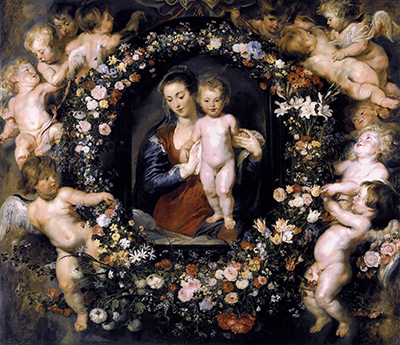
Mary and the infant Jesus appear in a dark central oval. Around them, a dense wreath of flowers fills a broad band of colour. Eleven putti lift, touch or gather near the frame and garland. At first, the entire scene seems like one continuous vision. Look again and the black edge and red suspension cord reveal a picture inside the picture: the central Madonna is presented as an image being honoured by flowers and angels.
The Bayerische Staatsgemäldesammlungen[1] credits Madonna in a Garland of Flowers to Peter Paul Rubens and Jan Brueghel the Elder. It dates the work to about 1616–18, gives its painted image as 185 × 209.8 centimetres, and identifies the support as oak. Its inventory number is 331 in the Alte Pinakothek, Munich. Both names belong in the opening label: the painting's unity came from the work of two accomplished artists.
The museum's object essay explains their division of labour. Rubens painted Mary, Jesus and the putti first; Brueghel then added the flowers. This is a documented account for this particular painting, not a rule to apply automatically to every collaborative garland. The visible picture makes the combination convincing. Large figures and lively bodies meet an extraordinarily varied field of petals, leaves and tiny details.
At a Glance
- ArtistsPeter Paul Rubens and Jan Brueghel the Elder [1]
- DateAbout 1616–18 [1]
- SupportOak [1]
- Painted image185 × 209.8 cm [1]
- Division of workRubens: figures; Brueghel: flowers [1][2]
- CollectionAlte Pinakothek, inventory 331 [1]
Where this work sits in Rubens's career
The Elevation of the Cross
1609–10The Descent from the Cross
1611–14Madonna in a Garland of Flowers
c. 1616–18The Garden of Love
1630–35The Three Graces
1630–35Contents
- The devotional image inside the image
- Rubens's Mary, Jesus and putti
- Brueghel's floral wreath
- How the two artists worked together
- A composition built to be seen twice
- Scale, support and collection history
- Looking again at the garland
The devotional image inside the image
The central Virgin and Child are set off by a dark painted frame. A red cord above suggests that the picture is suspended rather than simply appearing as a heavenly opening. The collection says this is easy to miss until a second glance. Once seen, the frame changes the whole composition: the flowers do not merely decorate Mary and Jesus; they decorate a painting of Mary and Jesus.
The museum relates this device to a practice of honouring images of Mary and saints with flower garlands. The garland in Rubens and Brueghel's work brings that real devotional act into a painted fiction. We see a reverenced image, the flowers arranged around it and putti apparently taking part in the presentation. The picture therefore speaks about how sacred images are treated as well as showing a sacred subject.
Inside the oval, Mary looks downward with a thoughtful expression. Jesus stands facing forward, bright against the dark background. The Alte Pinakothek's focus exhibition[2] reads the child's frontal, vulnerable body as an invitation to adoration and as a foreshadowing of his later death. That is the museum's interpretation, not a written statement from Rubens explaining every part of his design.
The inner picture is comparatively still. Mary supports the child and their faces invite close attention. Around them the putti twist, lean and carry. The contrast makes the oval a calm centre in a restless surrounding field. The garland mediates between these zones, enclosing the devotional image while giving the outer figures something tangible to hold.
Rubens's Mary, Jesus and putti
Rubens painted the main figures, according to the collection. Mary wears red and blue, with her head bowed toward the child. Jesus stands upright at the opening's front edge. His small body is lighter than much of the oval's background, so a viewer finds him quickly even within the very large arrangement of flowers.
The putti occupy the top, sides and lower corners. Some seem to support the painted frame or garland; others reach into the flowers. Their bodies vary in position and scale. The group creates movement around the oval rather than forming a neat repeated border. Rubens used their arms, legs and wings to connect the black frame to the outer field.
The Alte Pinakothek says Rubens drew on studies of his own children for several putti and for the Christ Child. The museum presents this as a connection between preparatory observation and the finished composition. It does not mean the painting is a straightforward family portrait with each putto individually identifiable as a named child. The relation is one of artistic study and adaptation.
The figures are carefully placed to make the very large painting legible. The child's upright body marks the centre, and the putti's gestures point back toward it. Their warm flesh stands out among dark leaves and pale blossoms. Without them, the wreath might appear as a beautiful but closed ring; with them, the outer space feels active and devotional.
Brueghel's floral wreath
Jan Brueghel the Elder painted the flowers after Rubens's figures. The garland is not a single generic bouquet. It contains many kinds of blossoms, leaves and small insects, described by the museum as closely observed. The flowers shift in colour and size as they circle the oval, making the frame look abundant without erasing the picture inside it.
The museum notes that some plants shown together bloom at different times of year. The wreath is therefore not a literal record of one freshly gathered arrangement on one date. Brueghel combined careful observation with a constructed devotional image. The abundance is persuasive precisely because the small parts are so sharply distinguished, even though the ensemble is an artistic invention.
White lilies have a particular meaning in the Pinakothek's object essay: it connects them to purity and the Immaculate Conception. This is the museum's reading of a selected flower, not a licence to assign a certain coded meaning to every petal in the picture. A viewer can appreciate the flowers' variety and the one documented symbolism without turning the garland into a complete dictionary of plant emblems.
At this scale, Brueghel's work is as important as the central figures. The garland takes a large share of the surface and makes the image-within-an-image idea visible. Its small details reward a close look, while its overall dark green arc can be read from farther away. The painting depends on both levels of viewing.
How the two artists worked together
The Pinakothek's 2024–25 focus display brought technical research on the painting into public view. X-rays and infrared imaging helped the museum reconstruct changes made during production. The findings make the collaboration more specific than a broad statement that one painter did figures and the other did flowers.
Rubens began on an oak panel of seven vertical planks, nearly square in format. According to the museum, he later added two outer planks, each about twenty-five centimetres wide, increasing the painting's breadth. The joints were carefully adjusted so the new surface met the earlier panel. This is evidence of a composition expanding while work was underway, not simply a finished picture cut down or enlarged centuries later.
Infrared imaging shows that Rubens prepared a dark background while leaving an area for Brueghel's future garland. He also initially reserved space for four putti, one near each corner. As the support widened and the design changed, the final composition grew to eleven putti. The lively outer ring was developed during making rather than fixed completely at the first stage.
Brueghel then painted the rich garland into the reserved space. The museum notes that some flowers overlap Rubens's putti. The overlap is a small but telling sign of sequence and cooperation: the floral painter was not restricted to a perfectly isolated strip. His details help join the two artists' zones into one image.
The museum describes Rubens as leading the concept, while stressing that the unified work could not have achieved its effect without Brueghel. This balance is important. A label that names only Rubens erases the flowering structure. A description that calls Brueghel a mere decorator misses the way his garland completes the work's devotional premise. Their contributions differ but are equally necessary to the finished picture.
A composition built to be seen twice
From a distance, the painting offers a strong overall design: dark central oval, brilliant child, green floral ring and moving putti. At closer range, flowers, insects, frame and cord become clearer. That second look reveals the central image as a represented painting. The viewer's understanding changes without the object itself moving.
The black frame matters because it separates the Mary-and-child image from the wreath. The red cord matters because it makes that framed image seem suspended. Putti seem to lift or hang the whole devotional construction. The collection points to these details as the clues that disclose the “picture within a picture.” They turn an attractive arrangement into a reflection on the veneration of images.
The outer figures also bridge sacred and material ideas. They are painted putti around a painted picture, yet their hands behave as though frame and flowers have weight. Rubens plays on that ambiguity. Brueghel's flowers look tangible enough to have been placed there by real worshippers, while the entire assembly exists inside a single oak painting.
The composition remains anchored by the child. He stands at the centre, looking outward, while Mary's face bends toward him. The floral richness and active putti do not displace the devotional subject. Instead, they make the act of surrounding and honouring that subject visible.
Scale, support and collection history
The painted image is 185 × 209.8 cm—more than two metres wide. It is a monumental collaboration on oak, not a miniature still life placed around a small detachable icon. The scale gives Brueghel room for individual blossoms and insects while allowing Rubens's putti to be fully developed bodies.
The collection records acquisition in 1806 from the Düsseldorf Gallery. This provides a documented later point in the painting's movement into the Bavarian collection. It does not, by itself, establish who first commissioned the picture or the exact location where Rubens and Brueghel painted it. The present record supplies a firm current collection and an acquisition milestone, not a complete original patron narrative.
The museum's online record provides a useful larger view of the painting. It helps separate the central Virgin and Child from the many flowers, insects and small animals that the page's image shows at a reduced scale.
The Alte Pinakothek's gallery listing can change, so a visitor should check the museum's current display information. The stable object identifier is inventory 331. That number helps distinguish the Munich painting from other flower-garland Madonnas, including works where Brueghel collaborated with different figure painters or where Rubens contributed to another version.
Looking again at the garland
Start with Mary's thoughtful face and the upright Christ Child. Then find the thin dark frame around them and follow the red cord at the top. Let the eye move outward through Rubens's putti to Brueghel's flowers. Notice how petals cross in front of some bodies and how the wreath makes a complete visual enclosure.
The painting rewards both a theological and a material reading. It evokes the custom of decorating a sacred image with flowers, and it records the decisions of two artists adapting a large oak support and sharing the surface. Technical study does not diminish the devotional effect. It shows how carefully that effect was built.
This is Rubens and Jan Brueghel the Elder's Madonna in a Garland of Flowers, about 1616–18, Alte Pinakothek inventory 331. Rubens painted Mary, Jesus and the putti; Brueghel painted the garland, completing and sometimes overlapping Rubens's figures. The black frame and red cord show that the oval is a picture being honoured. The flowers and angels make the act of honouring visible across an unusually large painted panel.
Rubens artworks directory
Frequently Asked Questions
Peter Paul Rubens and Jan Brueghel the Elder. The Pinakothek says Rubens painted Mary, Jesus and the putti first, then Brueghel added the flowers.
It belongs to the Bayerische Staatsgemäldesammlungen, Alte Pinakothek, Munich, inventory 331. Check current gallery information before visiting.
The museum dates it about 1616–18. It is painted on oak and the painted image measures 185 × 209.8 cm.
They show that the central Madonna is a picture within the picture, presented as though suspended and honoured with a floral garland.
The garland recalls the custom of decorating sacred images with flowers. The museum specifically reads white lilies as signs of purity and the Immaculate Conception; it does not assign a certain meaning to every flower.
The Pinakothek reports that Rubens expanded an initial seven-plank oak panel with two outer planks, changed an early four-putto arrangement to eleven, and left space for Brueghel's later garland.
It is a distinct part of the depicted composition, painted by Brueghel on the same oak support. The dark frame makes the central Madonna look like another painting hanging within the larger picture.
Discussion
Find the black frame and red cord, then move outward into the garland.
Share an observation about the painting or a reliable source that adds to its history.
Reader Insights
How do Rubens's figures and Brueghel's flowers make one devotional image?
What does the black frame reveal about the central Madonna?
How does the technical evidence change your picture of their collaboration?
Join the Conversation
Add your reading below, keeping observations specific and evidence clear.
References
- Bayerische Staatsgemäldesammlungen, Rubens and Brueghel, Madonna in a Garland of Flowers , inventory 331. View source
- Alte Pinakothek, focus exhibition and technical study of the Rubens–Brueghel collaboration. View source