 by Tom Gurney
Tom Gurney BSc (Hons) is an art history expert with over 20 years experience
Published on June 19, 2020 / Updated on November 5, 2026
Email: tomgurney1@gmail.com / Phone: +44 7429 011000
Introduction
Thomas Gainsborough belongs to that small group of artists whose fame can be both helpful and misleading. His name immediately calls up elegant portraits, silvery trees, blue satin, pale aristocratic faces and country roads disappearing into feathery shadow. Those are not false signs. They are among the reasons he remains one of the most recognisable British painters of the eighteenth century. But they can make him sound easier than he is.
Gainsborough was not simply a society portraitist who occasionally escaped into landscape, nor a landscape painter reluctantly trapped by fashionable sitters. He was both things at once, and the tension between them shaped nearly everything he made. Portrait commissions gave him status, income and contact with provincial, Bath and London elites. Landscape, drawing, printmaking and studio experiment gave him another field of freedom. His art is most alive when those worlds meet: a sitter posed outdoors, a couple turned into a social scene, a rural track made theatrical, a portrait surface handled with the speed and looseness of a landscape sketch.
Born in Sudbury, Suffolk, in 1727, Gainsborough trained in London and worked first in East Anglia before moving to Bath in 1759 and then to London in 1774. He became a founder member of the Royal Academy, rivalled Joshua Reynolds as a leading portrait painter, attracted royal patronage, and still kept returning to the landscape subjects that had absorbed him from youth. He died in London in 1788, leaving a body of work that refuses to settle into one category.[1][2]
The best way into Gainsborough is not to choose between portraiture and landscape. It is to see how the two forms changed one another in his hands. His portraits are often performances in air and movement rather than static displays of rank. His landscapes often feel staged, almost musical, rather than simple records of places. His drawings and prints show a restlessness with materials and effects. His letters and reputation suggest a painter who could be professionally ambitious, socially alert, technically experimental and impatient with the constraints of the art world in which he succeeded.[1][3]
At a Glance
- NameThomas Gainsborough
- Life1727–1788 [1]
- BirthplaceSudbury, Suffolk [1]
- Main working centresSudbury, London, Ipswich, Bath and London again [1]
- Known forPortraits, landscapes, drawings, prints and rustic or fancy subjects
- Professional identityA leading later eighteenth-century British portrait painter and a major landscape artist [2]
- Institutional roleFounder member of the Royal Academy [2]
- Major influencesDutch landscape, Anthony van Dyck, French rococo drawing and British portrait culture [5]
- Famous worksThe Blue Boy, Mr and Mrs Andrews, The Honourable Mrs Graham and The Market Cart
- Essential cautionLandscape and the portrait economy must be understood together
Contents
- Introduction
- At a Glance
- Why Gainsborough Matters
- A Life in Stages
- Portraiture: Society Made Mobile
- Landscape: Suffolk, Memory and Invention
- Drawing, Prints and Experiment
- The Two Flagships
- Other Ways Into the Work
- Four Shortcuts That Hide Gainsborough
Why Gainsborough Matters
Gainsborough matters because he made eighteenth-century British art feel lighter, quicker and more open without making it less ambitious. At a time when portraiture was a social necessity for the wealthy and powerful, he found ways to make likeness look alive. His sitters do not simply occupy positions. They turn, stroll, lean, listen, gaze, gesture and shimmer. Costume and setting still signal rank, but his paint often works against stiffness. A dress, tree, dog, hand or cloud may be handled with a freedom that keeps the image from becoming merely official.
This mattered in a culture where portraiture was both art and transaction. Sitters paid to be represented. Families wanted continuity, status and taste recorded. Artists needed patrons. Gainsborough understood those demands, but his best portraits do not feel trapped by them. He gave society portraiture a fluid surface: fluttering fabric, powdered hair, soft weather, wooded backgrounds and open gestures. The National Gallery describes him as, with Reynolds, one of the leading portrait painters in later eighteenth-century England, but also notes that he differed from Reynolds in his relation to Italian and classical precedent.[2] That distinction is important. Gainsborough's elegance is not simply academic grandeur softened; it is often something more mobile, informal and atmospherically British.
He matters just as much for landscape. Gainsborough's early works in Suffolk show his close attention to trees, paths, cattle, common land and rural movement. They also show his debt to Dutch seventeenth-century landscape painting. Later landscapes become less topographical and more invented. The rural world in them is observed, remembered, arranged and transformed. A cart, a pool, a cottage or a group of figures may feel familiar, but the picture is not a neutral report from the countryside. It is a construction of mood, rhythm and pictorial movement.
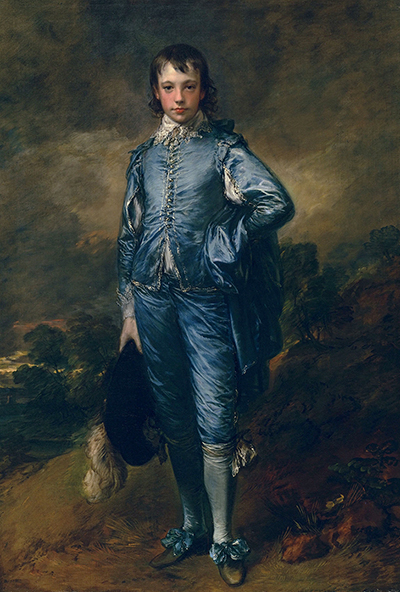
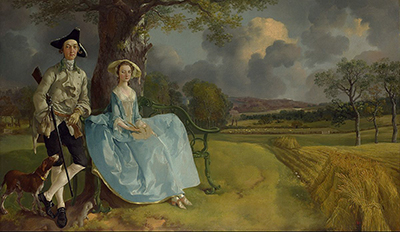
That doubleness makes Gainsborough unusually useful for readers. His art opens onto fashion, land, status, family, childhood, music, collecting, exhibition culture, rural imagery and the changing role of British painting. A sustained look at Mr and Mrs Andrews becomes a study in marriage, land, unfinished paint and social confidence. A sustained look at The Blue Boy leads into Van Dyck costume, sitter uncertainty, restoration, national reception and the modern afterlife of an image. A landscape such as Cornard Wood can lead back to Suffolk and forward to the invented rural scenes of his later years.[6][7][8]
Gainsborough also matters because he was not only a painter of finished oils. Gainsborough's House emphasises the breadth of his practice across painting, drawing and printmaking, and its collection and archive preserve material that connects his art to working method, letters, books and the culture around him.[1][10] Drawings were not incidental exercises. They were a way of thinking through movement, light, figure and landscape. Prints and experimental techniques show that he was interested in what images could become when translated across media.
A Life in Stages
The shape of Gainsborough's career is clear enough to guide the reader, though the fuller sequence belongs to biography. He was born in Sudbury, a Suffolk market town that remained central to his imaginative geography. Gainsborough's House, his birthplace and now a museum, presents Sudbury not merely as a biographical origin but as a continuing point of reference for his work and reputation.[1]
As a teenager, Gainsborough went to London for training. There he encountered the visual culture of the capital: drawing, engraving, French design, portraiture and the market for art. His early formation is usually associated with figures such as Hubert-François Gravelot and Francis Hayman, and with the broader world of London design and print culture. This matters because Gainsborough's later ease of line and decorative intelligence did not emerge from nowhere. He learned to think through drawing and composition before he became a fashionable portrait painter.
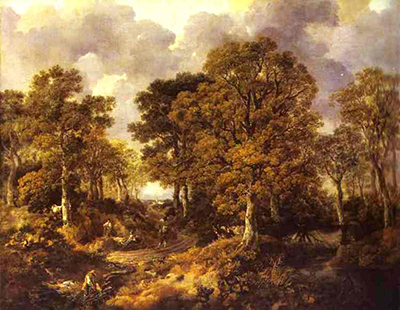
After returning to Suffolk, he worked in Sudbury and then Ipswich. These years matter more than a quick summary sometimes allows. They produced portraits for local patrons, family images and early landscapes. They also established a pattern that would remain with him: portraiture as the practical foundation of a career, landscape as a persistent imaginative drive. Works such as Cornard Wood, near Sudbury, Suffolk belong to this early world but already show the complexity of his landscape thinking, combining local associations with Dutch pictorial models and a carefully staged rural scene.[8]
The move to Bath in 1759 changed the scale of his career. Bath was fashionable, sociable and full of potential sitters. It gave Gainsborough access to a clientele that wanted elegance, status and modern refinement. Portraiture became the centre of his professional life. The full-length society portrait, the fashionable dress, the outdoor setting and the polished social persona became increasingly important. Yet Bath did not make him abandon landscape. It intensified the divide between what he had to paint for patrons and what he continued to pursue for himself.
In 1774 Gainsborough moved to London. There he worked in the same city as Reynolds, exhibited, attracted royal attention and navigated the Royal Academy world that he helped found but did not always comfortably inhabit. The National Gallery notes both his role as a founder member and his later quarrel with the Academy over the hanging of his pictures.[2] This was not a small matter of temperament alone. Exhibition placement affected how works were seen, judged and remembered. Gainsborough's sensitivity to display belongs to his professionalism as much as to his personality.
The final London years include some of his most admired portraits and landscapes. He developed a late manner whose touch can be loose, silvery, atmospheric and surprisingly bold. The result is not a simple progression from early awkwardness to late polish. Gainsborough's career is better understood as an expanding set of problems: how to keep likeness alive, how to make landscape move, how to combine figure and setting, how to satisfy patrons without surrendering painterly freedom, and how to make British art feel socially alert without becoming heavy.
Portraiture: Society Made Mobile
Portraiture made Gainsborough famous. It also made him vulnerable to simplification. A portrait is never just a face. In eighteenth-century Britain it could record inheritance, marriage, rank, taste, ambition, friendship, beauty, political belonging, military service or family continuity. It could also flatter, negotiate and conceal. Gainsborough entered this world early and mastered it by degrees.
His portraits often depend on movement. Even when a sitter is standing still, the surface seems to breathe. Hair, lace, satin, foliage and clouds are handled with a responsiveness that makes the figure part of an atmosphere. This is why Gainsborough's elegance rarely feels purely hard or architectural. He understood pose and status, but he also understood instability. A sitter's identity is made from fabric, light, air, gesture and the pressure of being looked at.
Van Dyck was one important model. The National Galleries of Scotland notes Gainsborough's relation to Van Dyck in the context of his portrait practice, and the connection is visible in aristocratic ease, long forms, costly costume and the dream of a more graceful earlier court style.[5] Yet Gainsborough's use of Van Dyck is not merely imitation. It can be theatrical, nostalgic, playful or strategic, depending on the sitter and work. The Blue Boy is the most famous case: its seventeenth-century costume helped create an image that later viewers treated almost as an emblem of British painting, even while modern research keeps the sitter identity under careful review.[6]
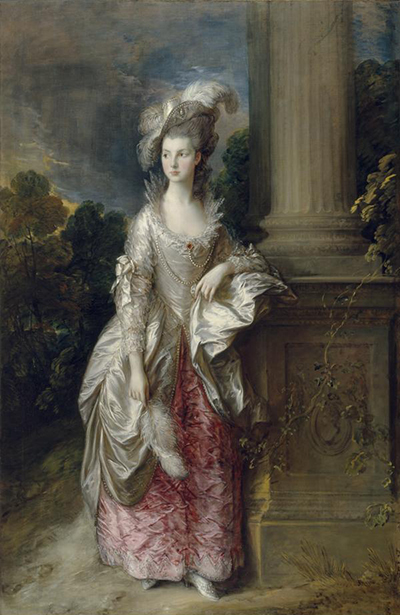
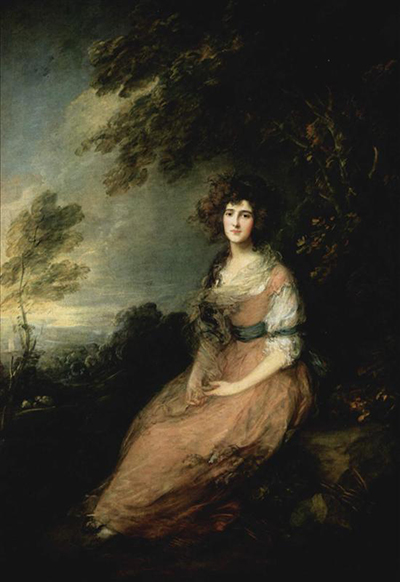
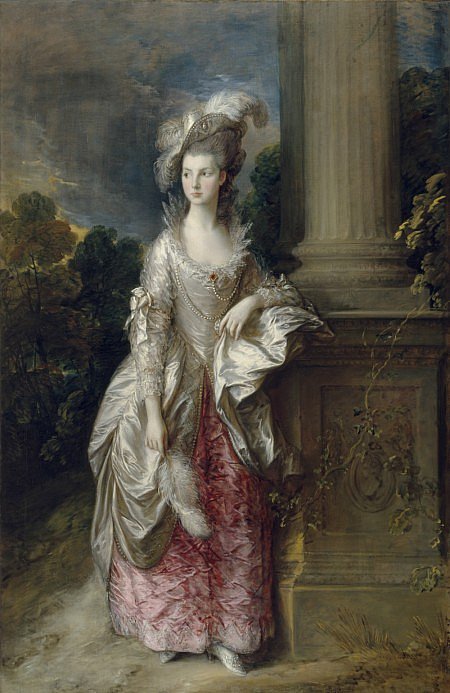
Gainsborough's female portraits need especially careful handling. It is easy to reduce them to beauty, dress and charm. That misses the social intelligence of the images. A sitter's white dress, powdered hair, turned head or outdoor setting participates in a language of class, gender, taste and display. The Honourable Mrs Graham, Mrs Richard Brinsley Sheridan, Elizabeth Wrottesley and other portraits each require their own evidence. A broad account should not flatten them into one type of “Gainsborough woman.”
His male portraits are equally varied. Some present military or aristocratic rank; others show musicians, family members, intellectuals or local gentlemen. Captain William Wade belongs to Bath's social world. Karl Friedrich Abel connects portraiture to music. Edward Vernon and Charles Howard, 11th Duke of Norfolk raise questions of attribution, version, display and incomplete state that must be handled from the relevant collection records rather than from general assumptions.
The double portrait was one of Gainsborough's most interesting forms because it could join likeness to landscape and social drama. Mr and Mrs Andrews is the great example, but it should not be treated as the model for every couple in a landscape. An early work such as Dulwich Picture Gallery's A Couple in a Landscape belongs to a different moment and scale. Mr and Mrs William Hallett, The Morning Walk belongs to the late society portrait world. Gainsborough repeatedly returned to the problem of people placed outdoors, but each solution has its own social temperature.
Landscape: Suffolk, Memory and Invention
Landscape was not Gainsborough's hobby. It was central to his imagination from the beginning of his career to the end. The difficulty is that landscape did not offer him the same professional rewards as portraiture. This imbalance has encouraged a romantic story in which he only painted portraits for money and only painted landscapes for love. There is truth in the pressure, but the story is too simple. His landscapes are ambitious, learned and constructed. His portraits, meanwhile, can show real painterly pleasure. The two practices were not enemies so much as unequal partners.
Early Suffolk landscapes such as Cornard Wood are anchored in local geography but shaped by pictorial tradition. The National Gallery's object record connects Cornard Wood with the area around Sudbury and Great Cornard, while also pointing to Dutch influence and the present appearance of the painting, including changes caused by faded blue pigment.[8] That combination is typical of the care Gainsborough demands. One must hold place, influence, technique and present viewing condition together.
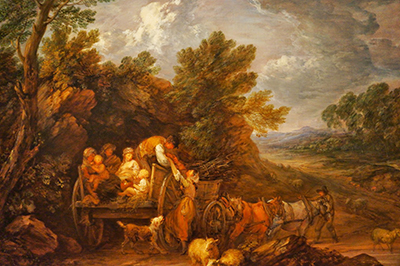
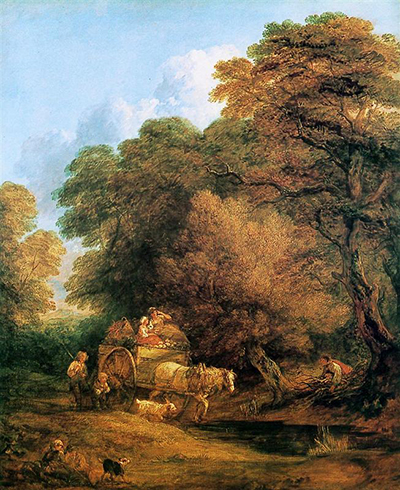
The landscapes are rarely empty. Cattle, carts, cottages, children, travellers, pools, trees and paths appear again and again. These elements do not simply illustrate rural life. They organise the eye. A path draws the viewer inward; cattle slow the scene; trees frame light; a cart gives weight and direction. In later works such as The Market Cart, the rural world becomes increasingly theatrical and atmospheric.[9] Gainsborough makes landscape feel like a performance of memory and movement.
He was also deeply responsive to other art. Dutch seventeenth-century landscapes provided models for composition and rural subject matter. Rubens mattered too, especially for more expansive landscape ambition. The National Gallery's The Watering Place is a useful example of how Gainsborough's landscape practice could connect to old-master admiration, exhibition culture and printmaking.[11] These influences should not be treated as labels pasted onto the surface. They helped Gainsborough think through scale, movement and pictorial drama.
The rural subjects also ask social questions. A child, peasant girl, wagon or cottage can be sentimentalised too easily. Gainsborough's rustic imagery is not straightforward documentary evidence of rural life, but neither is it empty decoration. The best writing on Gainsborough needs to keep looking carefully: who is named, who is anonymous, who is staged, what kind of work is visible, and what kind of social relation the painting invites the viewer to enjoy.
Drawing, Prints and Experiment
Gainsborough's drawings are one of the best antidotes to a polished view of the artist. They show speed, testing, repetition and material curiosity. A line of trees, a figure on a path, a group of riders or a patch of light could be worked out in chalk, wash, graphite or other media. Gainsborough's House foregrounds his work across drawings and prints as part of the museum's collection identity, and major museum records similarly guide readers toward his works on paper.[10][3]
This matters because Gainsborough's finished oils often look effortless. The ease is deceptive. A loose brushmark may carry years of looking and practice. A portrait's apparent spontaneity may depend on decisions about costume, pose, lighting, background and display. A landscape's naturalness may be the product of drawings, memory, models and studio arrangement.
Printmaking and reproductive culture also shaped his reputation. Some works became widely known through prints. Others survive in records, versions or later objects that complicate simple authorship. The British Museum and National Gallery of Art records for Gainsborough-related prints help show how images circulated and how attribution, publication and after-Gainsborough production must be distinguished.[12][13] That distinction is especially important for subjects such as Gainsborough Dupont and Gainsborough's printmaking.
Technique should be treated with the same care. Gainsborough is often described in terms of feathery brushwork and shimmering surfaces, but technical language needs object support. Conservation projects around The Blue Boy, National Gallery technical studies and collection records can give the interpretation more than adjectives. They allow the writing to connect visual effect with materials, condition, restoration and display.[6]
The Two Flagships
Two works deserve flagship attention: The Blue Boy and Mr and Mrs Andrews. That does not mean they are the only important Gainsborough paintings. It means they carry unusually large interpretive burdens and deserve especially deep treatment.
The Blue Boy has become one of Gainsborough's most famous images partly because it is visually unforgettable: blue satin, confident stance, dark ground, youthful presence and Van Dyck costume. But its modern importance also comes from its history of ownership, conservation, exhibition and reproduction. The Huntington's records and Project Blue Boy material give interpretation a strong foundation for sitter uncertainty, technical investigation, restoration and twentieth- and twenty-first-century reception.[6] A broad introduction should point readers toward those issues without trying to settle them here.
Mr and Mrs Andrews is a different kind of flagship. It is an early double portrait in which marriage, land, property, outdoor setting, unfinished paint and social display sit in unusually close relation. The National Gallery object record and catalogue entry give enough evidence for a full treatment that can move slowly through the sitters, estate context, composition, unfinished lap, landscape and later interpretation.[7] A broad introduction should name the painting as a central work without reducing it to a slogan about class or property.
The two paintings make a useful pair because they show the breadth of Gainsborough's reputation. One is a single figure transformed by costume, colour and later myth. The other is a couple embedded in land and social identity. Together they show why Gainsborough cannot be understood only through beauty or charm. His most famous works are also arguments about looking, status, display and memory.
Other Ways Into the Work
Readers arriving at Gainsborough often know one image and need pathways outward. A good account should give them several.
Portraits
Gainsborough's portraits show the social world that sustained him. They include aristocratic sitters, women in fashionable dress, musicians, naval figures, family connections and double portraits. Recurring issues such as Van Dyck influence, sitter status, costume, pose and portrait-in-landscape formats help readers move between them, while each individual work still needs its own evidence.
Landscapes
Gainsborough's landscapes follow him from Suffolk woods and common land to late rustic invention. Cornard Wood, The Market Cart, Landscape in Suffolk, A Coastal Landscape and Drinkstone Park each require different kinds of title and collection evidence, but together they show how persistent landscape was in his art. They also make room for broader discussion of Dutch influence, rural motifs, studio invention and the difference between place and pictorial construction.
Family and fancy pictures
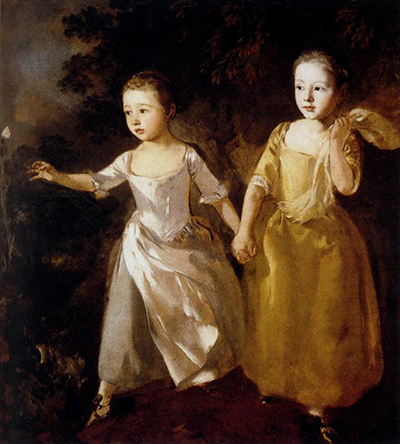
Works involving children, rural figures or family intimacy need a tone that is warm but unsentimental. The Painter's Daughters Chasing a Butterfly is central here. The National Gallery's object and catalogue material allow a careful discussion of Gainsborough's daughters, childhood, unfinished condition and possible meaning without forcing a single allegory.[14] Rustic and child subjects are best handled through strong shared themes rather than thin, repetitive treatments of every related title.
Drawings, prints and technique
Drawings, prints and technique help readers see how Gainsborough thought with materials. They also prevent every individual account from repeating the same general explanation of brushwork, drawing practice, print circulation and experiment. The result is cleaner, more precise writing about individual works.
Biography and quotes
Biography and quotations need different standards. The life story requires sequence, context and judgement; quoted words require traceable archive or published-edition evidence. Gainsborough's letters are lively and tempting, but internet quote culture is a swamp with nice typography. Any direct quotation should be anchored in reliable sources such as Gainsborough's House, the British Library, the Folger or the Morgan Library where appropriate.[15][16][17][18]
Four Shortcuts That Hide Gainsborough
“He was really a landscape painter forced to paint portraits”
This is the most seductive shortcut because it contains a recognisable truth. Gainsborough did have a deep attachment to landscape, and portrait commissions dominated the professional economy in which he worked. But the shortcut makes the portraits sound insincere and the landscapes sound pure. The art is more interesting than that. Portraiture gave him problems of likeness, surface, fashion, social presence and display. Landscape gave him problems of movement, atmosphere, rural imagery and invention. Each sharpened the other.
“His portraits are just elegant society images”
Gainsborough's portraits are elegant, but elegance is not emptiness. A society portrait can be a complex negotiation among sitter, artist, family, audience and future reputation. Costume, pose and background are decisions, not accessories. The best Gainsborough portraits are not only records of privilege; they are pictorial events in which status is made visible, softened, performed or unsettled.
“His landscapes are direct views of the countryside”
Some landscapes have local anchors, especially in Suffolk, but Gainsborough's landscape art is not simple topography. It draws on memory, older art, drawing practice and studio construction. A title may name a place while the painting transforms that place into a composed image. This is why object records and title caveats matter so much, especially for works with uncertain or inherited names.
“The famous pictures explain the whole artist”
The Blue Boy and Mr and Mrs Andrews are essential, but they do not exhaust Gainsborough. A fuller view also needs musicians, daughters, prints, drawings, late landscapes, Bath portraits, aristocratic sitters, uncertain attributions and documentary letters. Gainsborough's fame becomes more useful when the famous works are treated as entrances rather than endpoints.
Gainsborough Among His Contemporaries
Gainsborough is often placed beside Joshua Reynolds, and the comparison is unavoidable. They were the two dominant portrait painters in later eighteenth-century England, both connected to the Royal Academy, both working for sitters who wanted images of status and taste. Yet the comparison becomes useful only when it moves beyond rivalry. Reynolds built his public authority around theory, institution and the grand manner. Gainsborough's authority came more from touch, responsiveness, mood and the ability to make a portrait feel socially graceful without becoming heavy.
This difference should not be exaggerated into a cartoon. Gainsborough was no innocent outsider, and Reynolds was not merely academic. Both artists understood ambition, patronage and reputation. But Gainsborough's pictures often refuse the weight of explicit intellectual programme. He does not usually ask a portrait sitter to become an antique hero or a Renaissance figure. He is more likely to make modern dress, landscape atmosphere and fluent handling carry the image. The National Gallery's artist entry makes this distinction especially clearly when it notes how Gainsborough differed from Reynolds in his attitude to Italian Renaissance art and the antique.[2]
The Royal Academy also needs careful treatment. Gainsborough was a founder member, which places him inside the institutional formation of British art. At the same time, his later conflict with the Academy over the hanging of his pictures shows that membership did not mean comfort. Hanging was not a trivial question. Eighteenth-century exhibitions were crowded, hierarchical and social. Where a picture appeared on the wall could change its visibility and prestige. Gainsborough's frustration therefore belongs to a larger history of artists negotiating public display, not merely to a story about wounded pride.
The National Portrait Gallery's records help show how deeply Gainsborough is embedded in British portrait culture.[4] He is represented not just as an artist of individual masterpieces but as a producer of likenesses, a sitter, a subject of later prints and an artist whose images circulated through reproduction. This wider portrait economy matters because many Gainsborough works are not isolated “pretty pictures.” They belong to networks of sitters, families, versions, engravings, reference images and later collecting.
It is also important to remember that Gainsborough's career was provincial before it was metropolitan. Sudbury, Ipswich and Bath were not warm-up acts for London. They shaped the kinds of patrons he met, the landscapes he remembered, the scale of his early portraits and the practical conditions of his ambition. Bath in particular was not a minor stop. It gave him a fashionable social arena in which portraiture could flourish. The move to London then changed the stakes again: royal attention, Academy politics, major exhibitions and comparison with the most visible artists of the day.
This movement between places is one reason Gainsborough feels so flexible. He could paint local Suffolk subjects, Bath society figures, London aristocrats, musicians, family members, royal circles and imagined rural scenes. The same artist could produce an intimate picture of his daughters, a swaggering costume portrait, a wooded landscape, a double portrait of landowners, a naval sitter and a late rustic scene. The variety is not accidental. It reflects a career built across different markets and forms of attention.
Gainsborough's art also sits between British and European sources. Dutch landscape painting helped him think about rural composition and tonal structure. Van Dyck gave him a language of aristocratic ease and elegant extension. French design and drawing culture formed part of his early training environment. Yet the works that result are not simply a mixture of foreign influences. They are localised within British portrait patronage, Suffolk memory, Bath sociability and London exhibition culture. He absorbed models into a practice that remained recognisably his own.
For modern readers, this context prevents two opposite mistakes. One mistake is to make Gainsborough too purely British, as if his art emerged untouched from Suffolk lanes and English character. The other is to make him a passive borrower of European models. He was neither. His career shows how eighteenth-century British art was made through movement: people, prints, styles, patrons, exhibitions and collections all circulating through particular places.
Reputation and Afterlife
Gainsborough's reputation did not remain fixed after his death. Some works became icons; others changed status through scholarship, conservation, collecting or reproduction. The Blue Boy is the clearest example because it became a public image far beyond its original circumstances. Its sale, movement to the Huntington, restoration history and return to London for exhibition all belong to the modern life of the picture.[6] That afterlife can enrich interpretation, but it can also distract from the object. A famous image has to be reattached to its source record again and again.
Other works have quieter but equally important afterlives. A painting may enter a national collection, appear in a catalogue, be reattributed, survive through a print, or become known through a later reference object. A sitter's name may be clarified. A title may be corrected. A technical study may reveal changes in pigment or condition. That is why collection records, catalogue entries and technical evidence matter more than familiar titles or inherited labels.
Reputation also changes because viewers change. Modern readers are more likely to ask about class, land, gender, empire, conservation, reproduction and museum display than earlier viewers might have been. Those questions can be valuable, but only when they are attached to evidence. Gainsborough's paintings should not be turned into generic illustrations of eighteenth-century privilege, nor protected from social history because they are beautiful. The task is to let object evidence decide how far an argument can go.
The strongest writing on Gainsborough therefore needs two kinds of attention. It must preserve the pleasures that made his art famous: grace, colour, atmosphere, movement and charm. It must also ask what those pleasures are doing. A charming surface can carry status. A landscape can stage rural labour as picturesque. A portrait can make power look natural. A family picture can feel tender and unsettling at the same time. Gainsborough remains interesting because pleasure and difficulty are not separable in his best work.
How to Look at Gainsborough
Begin with the surface. Gainsborough's handling often tells you how the picture wants to move. In a portrait, compare the face with the costume, the hands with the trees, the satin with the sky. In a landscape, follow the path, cart, cattle or line of trees. Ask where the paint tightens and where it loosens.
Then look at the setting. Is the background a named place, a general landscape, a park, a wood, a road, a studio invention or a socially meaningful estate? Gainsborough frequently uses outdoor settings to change the temperature of a portrait. A sitter in a landscape does not become natural merely by standing near trees. The setting may express status, leisure, marriage, taste or poetic distance.
Next, consider costume. Gainsborough's clothing can be contemporary, theatrical, Van Dyck-inspired, military, fashionable or deliberately ambiguous. Costume is one of the places where likeness meets performance. A blue satin suit, white dress, naval uniform or walking outfit is never just fabric.
Finally, respect uncertainty. Gainsborough's works often come with title variants, sitter questions, attribution histories, later prints, conservation changes or inherited names. Good writing should not iron those out. It should make uncertainty legible without making the discussion feel confused.
How the Gainsborough Section Fits Together
Gainsborough is clearest when each kind of evidence is allowed to do its proper work. Biography explains movement between Sudbury, Ipswich, Bath and London. Portraiture explains patronage, fashion, likeness, status and performance. Landscape explains memory, Dutch influence, rural motifs and studio invention. Drawings, prints, technique and fancy pictures explain working methods and subject types, while The Blue Boy and Mr and Mrs Andrews demand the slowest attention because they carry unusually dense histories of image, object and reception.
That balance also protects individual paintings from being made to carry arguments that belong elsewhere. The Honourable Mrs Graham can stay with Mary Cathcart Graham, Van Dyck dress and National Galleries of Scotland evidence. Cornard Wood can stay with Suffolk, Dutch influence and National Gallery object facts. The Market Cart can stay with late rustic landscape rather than retelling the whole landscape story. Captain William Wade can stay with Bath society and object evidence rather than becoming a general Bath chapter.
This discipline matters because weaker or poorly documented subjects are often better understood within broader themes than as isolated monuments. Responsible writing should not enlarge every familiar image beyond the evidence available for it. It should move carefully between major works, supporting examples and broader contexts, giving readers confidence about what is known, what is uncertain and why each painting matters.
Gainsborough's Continuing Interest
Gainsborough's appeal has lasted because his art offers immediate pleasure and continuing difficulty. The pleasure is obvious: colour, grace, trees, satin, faces, dogs, paths, clouds, children, musicians and shimmering paint. The difficulty arrives more slowly. Who is being represented, and for whom? What is the difference between social truth and social performance? When does landscape record a place, and when does it invent one? How can a picture be charming and still serious?
He also remains interesting because he sits at a crossroads in British art. He was provincial and metropolitan, commercial and experimental, sociable and resistant, a portraitist and a landscape painter, a founder of institutions and a painter who disliked institutional constraint. He belonged to the eighteenth century's systems of patronage and display, but his surfaces often feel restless inside those systems.
That is why Gainsborough should not be reduced to a blue costume, a landowning couple or a soft wooded path. Those images matter enormously, but they are parts of a larger practice. The real Gainsborough is the artist who could make a sitter breathe inside fashion, make a landscape feel remembered rather than copied, make a family picture tremble between affection and allegory, and make the demands of society painting open onto something freer, quicker and stranger.
Frequently Asked Questions
Discussion
Where do elegance, atmosphere and social performance meet in Gainsborough's art?
Reader Insights
Where does the paint tighten around a face and loosen across satin, foliage or sky?
How does an outdoor setting change the social temperature of a portrait?
Which uncertainty—identity, title, condition or attribution—most changes your reading?
Join the Conversation
Share your reading below.
References
- Gainsborough's House, “About Thomas Gainsborough.” View source.
- National Gallery, London, “Thomas Gainsborough.” View source.
- National Gallery of Art, Washington, “Thomas Gainsborough.” View source.
- National Portrait Gallery, London, “Thomas Gainsborough.” View source.
- National Galleries of Scotland, “Thomas Gainsborough.” View source.
- The Huntington, “The Blue Boy” object and Project Blue Boy material. Object record; Project history.
- National Gallery, London, “Mr and Mrs Andrews” object and catalogue entry. Object record; Catalogue entry.
- National Gallery, London, “Cornard Wood, near Sudbury, Suffolk.” View source.
- National Gallery, London, “The Market Cart.” View source.
- Gainsborough's House, “Collection.” View source.
- National Gallery, London, “The Watering Place.” View source.
- British Museum, “Thomas Gainsborough” biography/collection term. View source.
- British Museum, “Wooded landscape with country cart and figures.” View source.
- National Gallery, London, “The Painter's Daughters Chasing a Butterfly” object and catalogue entry. Object record; Catalogue entry.
- Gainsborough's House, “Books and manuscripts.” View source.
- British Library Archives and Manuscripts, Gainsborough-related archive search results. View source.
- Folger Shakespeare Library, “Autograph letter signed from Thomas Gainsborough, Bath, to [David Garrick].” View source.
- Morgan Library & Museum, “Autograph letter in third person, not signed: [n.p.], to [William] Hoare.” View source.