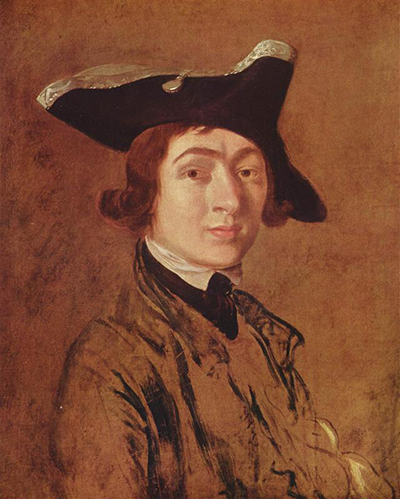
 by Tom Gurney
Tom Gurney BSc (Hons) is an art history expert with over 20 years experience
Published on June 19, 2020 / Page Updated on November 5, 2026
Email: tomgurney1@gmail.com / Phone: +44 7429 011000
Introduction
Thomas Gainsborough's quoted words are useful only when they are traceable. The artist's letters are lively, funny, irritated, practical and revealing, but they are also easy prey for loose internet quotation. A responsible account of Thomas Gainsborough quotes should begin with documents, catalogues and reliable transcriptions, not with unattributed sayings.
Gainsborough's House gives the broad reason these materials matter. Its books-and-documents collection includes original letters by Gainsborough to friends and patrons, and the museum explains that those letters reveal professional affairs, temperament, method, materials and his concern with how pictures were displayed.[1] That is the right framework. The letters are not decorative captions. They are evidence for how a working painter thought, negotiated and complained.
This account therefore separates direct quotation from source summary. Where exact words are given, they are short and attached to a traceable record. Where exact wording is not available from a reliable online transcription, the document is described rather than quoted. For Gainsborough, a paraphrase tied to a catalogue record is better than a dazzling line with no parentage.
At a Glance
- ArtistThomas Gainsborough
- Primary evidenceOriginal letters, institutional transcriptions and catalogue records [1]
- Key letterTo William, 2nd Earl of Dartmouth, 18 April 1771; Gainsborough’s House 1973.002 [2]
- Portrait problemDress, likeness and the fact that a picture has no moving voice [2]
- Display evidenceGarrick correspondence on lighting, hanging height and mobile expression [3]
- Technique evidenceA 1773 Hoare letter concerning Reynolds, fresco and differing methods [4]
- Private evidenceThe 1763 Unwin letter joins health, housing, studio space and clients [5]
- Quotation ruleQuote briefly only where wording is traceable; otherwise summarise the record
- Reading methodIdentify writer, recipient, date and circumstance before interpretation
- ExploreBiography; Paintings
Contents
- Why Gainsborough’s Letters Matter
- The Dartmouth Letter
- Truth, Dress and Likeness
- Display and the Garrick Letters
- William Hoare, Reynolds and Technique
- James Unwin and Private Candour
- What Not to Quote
- How to Read Gainsborough’s Voice
- Why the Quotes Matter
Why Gainsborough's Letters Matter
Gainsborough's paintings can make him seem effortless: soft handling, vivid sitters, rustling landscapes, musical ease. The letters complicate that impression. They show an artist managing patrons, display, health, money, friendship, rivalry, studio conditions and the practical difficulty of making pictures work in rooms.
Gainsborough's House states that the letters reveal interactions with friends and patrons, professional affairs, character, temperament, methods, materials and display concerns.[1] That list is important because it prevents a narrow reading. The letters are not only charming biography. They connect voice to practice.
They also show why quotation needs caution. A letter is usually written to one person for one occasion. It may be playful, defensive, irritated or strategic. A sentence lifted from that setting can become misleading. The value lies not in making Gainsborough sound witty for its own sake, but in using his words to understand the pressure around his art.
This is especially true because Gainsborough's public reputation often turns on temperament: sensitive, impatient, spontaneous, anti-academic, fond of landscape, reluctant about portraits. Those claims need evidence. Letters can support them, but only when the source and circumstance are clear.
Rosenthal's Paul Mellon Centre study is useful for this reason, because it treats Gainsborough's career as a living negotiation among looking, business, pleasure, professional strategy and artistic ambition.[6] The letters give that negotiation a voice. They show not a mythic solitary genius, but a painter arguing, accommodating, refusing and adjusting in relation to other people.
This makes the quoted material especially valuable here. A painting can show what Gainsborough achieved; a letter can reveal the pressure surrounding the achievement. The two kinds of evidence should work together rather than compete.
The Dartmouth Letter
The most useful online transcription for exact wording is the 18 April 1771 letter from Gainsborough to William, 2nd Earl of Dartmouth, held by Gainsborough's House and presented in a curatorial feature by Mahaut de La Motte-Broöns.[2] The feature identifies the object as a letter to Dartmouth, Bath, 18 April 1771, Gainsborough's House accession 1973.002.[2]
The curatorial introduction explains the setting: Dartmouth and his wife had been painted by Gainsborough in 1769, and Lady Dartmouth likely wanted to be represented in a fancied dress.[2] Gainsborough objected because such costume could compromise likeness. That is the central issue in the letter: dress is not a harmless addition; it affects whether a portrait works.
One short phrase captures the complaint. Gainsborough calls such inventions "Poetical impossibilities."[2] That is a sharp phrase, but it should not be detached from the sitter problem. He is not rejecting imagination altogether. He is arguing that fanciful dress can damage resemblance when a portrait has only a fixed face and no moving voice or action to identify the sitter.
The same letter gives a glimpse of comic self-presentation. Gainsborough refers to himself as a "wild Goose."[2] The joke softens the force of his complaint, but it does not cancel it. The letter is funny because it is serious. He is negotiating with a patron while defending his judgement as a painter.
Truth, Dress and Likeness
The Dartmouth letter is valuable because it links costume directly to likeness. Gainsborough argues that stage actors can still be recognised because they have voice and movement, whereas a portrait has only a fixed view. His phrase "had a picture a Voice" points to that difference.[2] Painting is silent, and therefore dress can help or harm recognition.
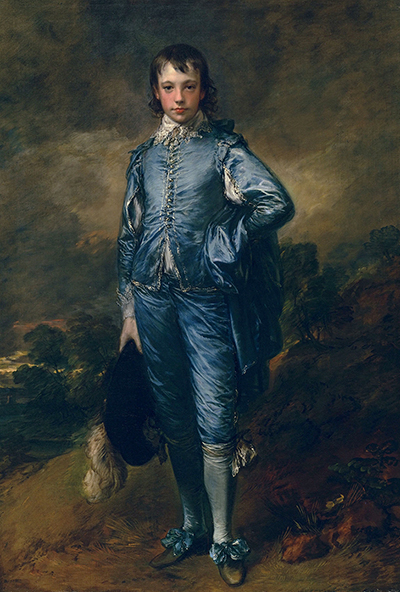
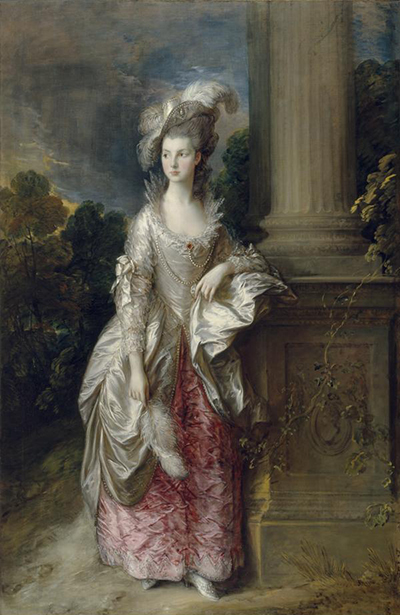
This idea matters across Gainsborough's portraits. The Blue Boy depends on historical dress, but it is not a simple sitter record. Charles Howard's portrait uses regalia to declare altered rank. Elizabeth Wrottesley's portrait uses dress to structure social presentation. Gainsborough understood that clothing changed identity on the surface of a painting.
The Dartmouth letter also contains the phrase "I have that regard for truth."[2] The point is not that Gainsborough lacked invention. His landscapes, fancy pictures and studio experiments prove otherwise. The point is that in portraiture, invention had to answer to likeness. A fanciful costume could become a visual lie if it overwhelmed the face.
Even the comic phrase "Land of Roast Beef" belongs to this argument.[2] Gainsborough is mocking a world that loves fashionable froth and official honours. The humour is local and sharp. It should be quoted sparingly because too much excerpting turns a professional letter into a joke book.
Display and the Garrick Letters
Gainsborough's letters to David Garrick show another recurring concern: how pictures should be seen. A Folger essay on Garrick's image notes a letter of 22 June 1772 in which Gainsborough apologised for keeping Garrick's portrait so long and admitted he had hoped to make a copy for his own parlour.[3] The same essay describes a follow-up letter in which Gainsborough warned against excessive stage lighting and advised that the portrait be hung breast high to preserve effect and likeness.[3]
That summary is enough. Without the full letter text in front of the reader, the safer method is to describe the letter rather than quote it at length. The point is clear: Gainsborough did not think a portrait ended when the paint dried. Hanging height and lighting could affect likeness.
This display concern connects directly to Gainsborough's House's statement that the letters reveal his concern with how pictures were displayed.[1] It also connects to the wider history of eighteenth-century exhibition culture. Portraits were made for rooms, viewers, social encounters and changing light. Gainsborough's eye extended beyond the canvas edge.
The Garrick material is especially apt because actor portraits raise the problem of likeness under performance. Folger's essay quotes Gainsborough as saying he "never found any portrait" so difficult as Garrick's, because the actor's countenance was so flexible.[3] That is not just a compliment to Garrick. It is a technical observation about the difficulty of fixing a mobile face in paint.
William Hoare, Reynolds and Technique
The Morgan Library record for a 1773 letter to William Hoare is useful even without a full transcription. It identifies the document as an autograph letter in third person, not signed, by Thomas Gainsborough to William Hoare, dated 1773, and summarises it as concerning Sir Joshua Reynolds's discourse on fresco and discussing the painters' differing techniques.[4]
That summary matters because it places Gainsborough in dialogue with Reynolds at the level of technique, not only rivalry. Reynolds was not merely a name to complain about. He represented theory, institutional authority and a different model of painting. Gainsborough's response to him helps explain the artist's independence.
Since the Morgan record gives a summary rather than a full public transcription, exact quotation would be unwise here. The documentary evidence proves the topic: Reynolds, fresco and differing techniques. That is enough to support an account of Gainsborough as technically alert and argumentative.
This kind of record is a good reminder that quote scholarship often depends on restraint. A catalogue summary may establish that a letter exists and what it concerns. It does not automatically license polished quotation. Strong documentary writing knows the difference.
The Hoare record also matters because it places Gainsborough among fellow artists, not only patrons. Hoare was himself a painter, and Reynolds was the institutional rival whose discourses defined much academic conversation. The letter therefore belongs to a professional exchange about method and theory.
This is different from the Dartmouth letter, which is a patron-management document, and different again from the Unwin letter, which is private and practical. Together they show several Gainsborough voices: argumentative painter, negotiating portraitist and candid friend.
James Unwin and Private Candour
The James Unwin correspondence gives a more private Gainsborough. The British Library archive trail and later catalogue records point to correspondence with Unwin, while a 2024 Sotheby's catalogue entry describes an autograph letter to Unwin, docketed 30 December 1763.[5] The entry notes that James Unwin was Gainsborough's attorney and banker and that the letter was listed as number 12 in John Hayes's edition of the letters.[5]
The Sotheby's description summarises an unguarded letter about health, moving out of central Bath, studio arrangements, friendship and a difficult client.[5] A few short phrases are safe to use because they are visible in the catalogue entry. Gainsborough refers to a "Nervous complaint" and to a house "sweetly situated."[5] Those phrases suggest both bodily strain and the practical search for a workable living arrangement.
The same description notes that Gainsborough kept his "Painting Room and best parlour" for showing pictures.[5] That small detail is important. It connects domestic space, business space and display space. Gainsborough's working life was not abstract. It had rooms, rent, lodgings, clients and show arrangements.
The Unwin material also warns against romanticising the artist's candour. A private letter to a banker and friend is not the same as a public theory of art. It can be revealing precisely because it is situational: health, money, lodging and work are tangled together.
The house detail also links to Gainsborough's wider display concerns. Keeping a painting room and a best parlour was not merely domestic convenience. It suggests a working arrangement in which pictures could be made, stored, shown and discussed. The painter's house was part of the business.
That is why practical letters can be as revealing as aesthetic declarations. Rent, illness, lodgings and client management all affected how art was produced. Gainsborough's voice becomes most useful when those ordinary pressures remain visible.
What Not to Quote
The old style of artist quote collection often gathers attractive sayings without giving document locations, editions, dates or recipients. That method is not good enough for Gainsborough. His real letters are already lively. They do not need invented garnish.
Some familiar claims may still be true in broad form: Gainsborough disliked portrait drudgery, loved landscape, cared about display and distrusted certain forms of academic pretension. But each claim needs the right evidence. A quote without a source can make a true idea unreliable.
There is also a difference between quoting Gainsborough and quoting later writers about Gainsborough. Constable, Thicknesse, Reynolds, modern curators and later scholars may all be useful, but their words are not Gainsborough's words. A responsible account labels witness, artist and commentator separately.
The safest hierarchy is simple. Use exact transcriptions from holding institutions or published scholarly editions when quoting directly. Use archive records for the existence and subject of letters. Use museum summaries to explain why the documents matter. Leave decorative internet sayings outside.
This hierarchy also protects later writers. Constable, Folger scholars, Gainsborough's House curators and modern catalogue editors can all illuminate the artist, but they should not be merged into one voice. If a line comes from a later commentator, it belongs to reception history. If it comes from Gainsborough, it belongs to the artist's own documentary record.
That distinction is especially important for support material. Readers often arrive looking for a memorable sentence. The task is to slow that appetite just enough to make the sentence trustworthy.
How to Read Gainsborough's Voice
Gainsborough's voice is often comic, but the comedy usually protects a serious point. In the Dartmouth letter, joking about being a wild goose comes after a sharp argument about costume, likeness and truth.[2] The humour makes the letter socially survivable; the argument remains firm.
His voice is also practical. The Unwin letter described by Sotheby's concerns illness, house arrangements, studio rooms, patrons and money.[5] Gainsborough may sound informal, but he is thinking through the conditions of work. The artist's temperament appears through logistics.
His voice is technical. The Morgan record shows him engaging with Reynolds and questions of technique.[4] The Garrick letters show him thinking about lighting, hanging height and the difficulty of fixing a performer's face.[3] The Dartmouth letter shows him thinking about costume's effect on scale and likeness.[2]
Taken together, these records show a painter who cared intensely about the conditions under which images succeed. Likeness, dress, lighting, room, technique, patron request and viewer response all mattered. Gainsborough's letters make that sensitivity audible.
The voice is therefore best read as part of the studio, not apart from it. Gainsborough's remarks on dress point back to portraits. His remarks on rooms point back to display. His remarks on technique point back to rival methods and professional judgement. The letters do not float above the art as personality evidence only; they return the reader to the practical business of making and showing pictures.
Why the Quotes Matter
Thomas Gainsborough quotes matter because they bring the working artist back into view. The paintings can make the process look effortless. The letters show negotiation, frustration, humour, technical thought and social pressure.
They also matter because they connect individual works to larger habits. The Dartmouth letter helps explain why dress and likeness recur as serious problems. The Garrick letters show that display and lighting could affect portrait success. The Morgan record places Gainsborough in technical argument with Reynolds. The Unwin material brings health, space and professional strain into the picture.
They matter, too, because they slow down easy mythmaking. Gainsborough was not simply the painter who wished to escape portraiture, nor simply the sensitive landscape lover, nor simply the witty correspondent. The documents show a more mixed figure: ambitious, tired, amused, tactical, proud of judgement and alert to the social life of images.
The best quote-led account is therefore not a heap of aphorisms. It is a map of evidence. Each excerpt should answer three questions: who wrote it, to whom, and in what circumstance? If those questions cannot be answered, the line should not carry weight.
Gainsborough does not need unsourced sayings to sound alive. The authenticated record is vivid enough: painter, patron, actor, banker, rival, room, dress, truth, lighting and work all appear in the letters. The voice that emerges is not a slogan machine, but a working mind, amused and exasperated, trying to make pictures keep their force in the real world.
That is the final value of a responsible quotes account. It does not freeze Gainsborough into a few shareable sentences. It restores situation. The best excerpts lead back to letters, and the letters lead back to pictures, rooms, patrons, materials and viewers.
For that reason, the strongest use of Gainsborough quotation is modest. A short excerpt can open a problem; it should not close it. The line should send the reader back to the painting, the recipient, the date and the room in which the work had to function. Used that way, his words do what good evidence should do: they sharpen looking.
Frequently Asked Questions
Discussion
Which documentary context most changes how you hear Gainsborough’s voice?
Reader Insights
How does the Dartmouth letter turn costume from decoration into a technical problem?
What do the Garrick and Unwin records reveal about where pictures worked and were seen?
When does Gainsborough’s comedy soften negotiation without weakening professional judgement?
Join the Conversation
Share your reading below.
References
- Gainsborough's House, “Books and manuscripts.” View source.
- Les Amis du Patrimoine Européen / Gainsborough's House, “Letter from Thomas Gainsborough to the Earl of Dartmouth,” 18 April 1771, Gainsborough's House 1973.002. View source.
- Folger Shakespeare Library / Folgerpedia, Heather McPherson, “Garrickomania: Garrick's Image.” View source.
- The Morgan Library & Museum, “Autograph letter in third person, not signed: to William Hoare, 1773,” record 102188. View source.
- Sotheby's, “Thomas Gainsborough, autograph letter signed to James Unwin, December 1763,” lot description, 2024. View source.
- Michael Rosenthal, The Art of Thomas Gainsborough: "A Little Business for the Eye" (New Haven and London: Yale University Press for the Paul Mellon Centre for Studies in British Art, 1999). Publication record.