 by Tom Gurney
Tom Gurney BSc (Hons) is an art history expert with over 20 years experience
Published on June 19, 2020 / Page Updated on November 5, 2026
Email: tomgurney1@gmail.com / Phone: +44 7429 011000
Introduction
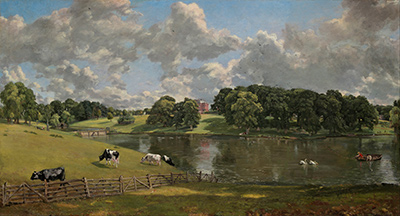
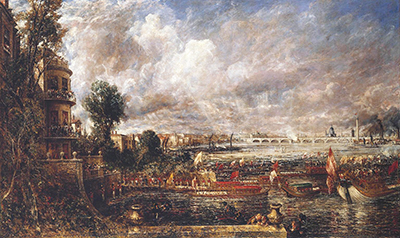
John Constable's best-known words are useful because they do not float above the paintings. They return us to the things he looked at most closely: Suffolk lanes, mills, banks, trees, clouds, moving water, the pressure of weather and the emotional force of remembered places. His statements can sound simple when separated from the work, but they are rarely casual. They belong to letters, lectures, object histories and later accounts of his practice, and they help explain why his landscapes still feel both observed and felt.
This selection treats the quotations as evidence rather than ornament. A good Constable quotation should do more than decorate a biography; it should clarify a habit of looking. Some of the most repeated phrases are authentic and central to his art. Others are later descriptions of his work that have sometimes been mistaken for his own words. The distinction matters, because Constable was a precise, thoughtful artist whose reputation is best served by careful attribution.
At a Glance
- ArtistJohn Constable (1776–1837)
- Page focusEight short authenticated phrases, each returned to its source and artistic context
- Feeling“Another word for feeling” [1][5]
- Place“I should paint my own places best” [3][5]
- Nature“Natural painture” [1][5]
- SkyLandscape’s “chief organ of sentiment” [3]
- River subjects“I love such things” [4]
- Sketching“In the lid of my box on my knees” [2]
- Lecture principleApproach the fields with a “humble mind” [6]
- Reception boundary“Nature caught in the very act” is a later reviewer’s phrase, not Constable’s [2]
Contents
- Introduction
- Feeling and Painting
- Own Places
- Nature and Originality
- Skies and Sentiment
- Water, Banks and Working Places
- Sketches and Outdoor Looking
- Humility before Nature
- A Phrase Constable Did Not Write
- Why the Quotations Matter
Feeling and painting
The most compact statement of Constable's artistic temperament is his remark that painting was “another word for feeling”.[1] It is often quoted because it seems to unlock the emotional warmth of his landscapes. Yet the phrase should not be read as an excuse for vagueness. Constable did not mean that painting could drift away into private sentiment. His feeling was anchored in things seen, places remembered and effects tested repeatedly in drawing and paint.
The V&A places the phrase beside C. R. Leslie's description of Constable's career as “a history of his affections”, and the National Portrait Gallery likewise treats feeling, local attachment and outdoor painting as linked ideas in his career.[1][5] That pairing is revealing. Constable's deepest affections were not abstract. They had geography. East Bergholt, Dedham, Stratford St Mary, Langham, Flatford, the River Stour, Hampstead and Salisbury all entered his art because they carried personal weight as well as pictorial promise. Feeling, for him, was not a decorative mood added after observation. It was one of the reasons observation mattered.
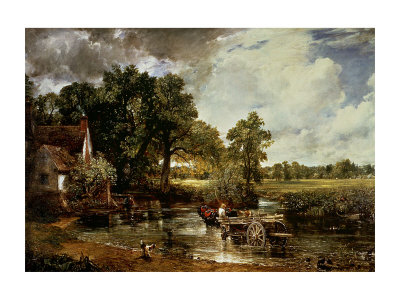
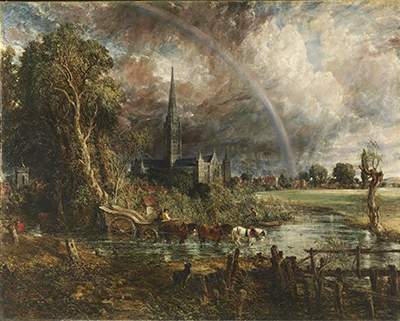
This is why the phrase belongs with the paintings rather than above them. In The Hay Wain, the feeling is not announced by melodrama; it is embedded in the slow water, the mill, the wagon, the cottage and the summer air. In the Hampstead cloud studies, feeling is held in weather and notation. In the Salisbury works, it can darken into crisis and consolation. Constable's words remind us that his landscapes are not neutral views. They are records of attachment.
The quotation also helps prevent a common misunderstanding. Constable was not merely copying local scenery. He was making feeling credible by submitting it to close visual discipline. If painting was another word for feeling, it was feeling sharpened by looking, revised through studies and carried into finished compositions with unusual patience.
Own places
Constable's statement “I should paint my own places best” is one of the clearest explanations of his artistic geography.[3] It is not a narrow provincial boast. It is a declaration of method. He knew that repeated contact with a place could produce a depth of seeing that travel alone could not supply. The Met connects the phrase to his concentration on the Stour Valley and to the way he repeatedly returned to familiar motifs rather than chasing more fashionable scenery.[3]
The words “own places” are important. Constable did not say simply that he liked local views, or that Suffolk happened to be convenient. He claimed a form of imaginative ownership rooted in memory, use and affection. His father's mills, the navigable river, the towpath, the lock, the barges and the working edges of the Stour were part of his early life before they became subjects in art. He had known these places as a boy and as a young man connected with the family business. That knowledge gave the paintings their unusual texture.
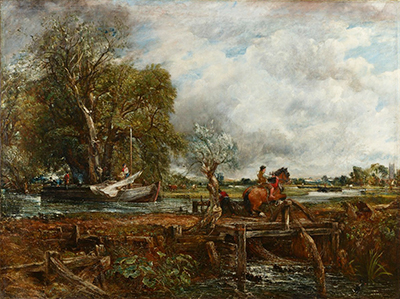
The phrase also separates Constable from a purely picturesque approach. The picturesque traveller could collect scenes as pleasing arrangements. Constable's strongest art comes from dwelling with a smaller set of places until they become visually and emotionally inexhaustible. Flatford could yield a mill, a dry dock, a lock, a barge, a meadow, a cottage, a gleam of water or a sky reflected in the river. Familiarity did not exhaust the subject. It made the subject fuller.
There is humility in the phrase as well as confidence. Constable does not claim that his own places are objectively grander than mountains, ruins or foreign scenery. He claims that he can paint them best because he knows how they feel from within. That is why the words remain so valuable: they make locality central to ambition rather than a limitation on it.
Nature and originality
The 1802 letter to John Dunthorne is central to Constable's public image because it shows a young artist turning away from imitation and toward direct study. The V&A quotes his plan to return to Bergholt and make “laborious studies from nature”, adding his belief that there was room for “natural painture”.[1] The older spelling has charm, but the idea is serious. Constable wanted landscape to have intellectual and artistic dignity without pretending to be history painting.
The phrase “natural painture” should be handled carefully. It is not a polished slogan but a period expression from an artist thinking his way out of dependence on other pictures. Constable had studied old masters and never ceased to respect them. What he resisted was second-hand truth: the habit of making art from inherited formulas rather than renewed contact with nature. His originality came from refusing to choose between tradition and experience. He learned from art, then tested art against the world.
The V&A also records his later description of the challenge of translating “close and continual observance of nature” into finished compositions.[1] That phrase may be less famous than “another word for feeling”, but it is just as revealing. Constable's naturalism was not a single outdoor flash. It required sustained looking, repeated sketching and difficult studio transformation. The finished picture had to retain the freshness of observation while gaining the structure needed for exhibition.
This helps explain why sketches matter so much in his career. They were not only private exercises. They were acts of investigation. A tree trunk, a cloud, a riverbank or a patch of moving light could become a test of how paint might carry living effect. Constable's quotations about nature therefore belong with the physical labour of making studies, not with a vague worship of scenery.
Skies and sentiment
Constable's sky quotations are among his most important because they show how he understood landscape as a whole system. The Met notes that he regarded the sky as landscape's “chief organ of sentiment”.[3] The phrase is memorable because it gives the sky an active emotional role. It is not a backdrop. It is the element that sets light, weather, motion and mood into relation.
The V&A records a related warning to John Fisher: the landscape painter who fails to make skies a material part of the composition neglects one of the greatest aids available to the art.[1] Constable's Hampstead work proves that this was not a passing thought. In 1821 and 1822 he made intense sky studies, often noting date, time, wind and weather. Those notes are not pedantry. They show an artist trying to understand change as accurately as possible so that feeling could be built on observed conditions.
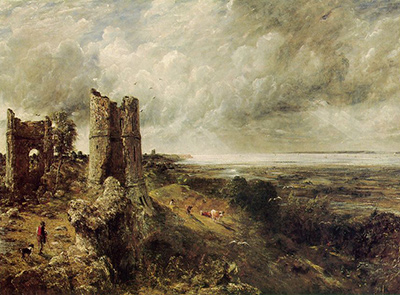
The words “chief organ of sentiment” also help explain the difference between a cloud study and a cloud decoration. Constable's skies do not merely fill empty space. They press on the land, govern reflections, alter colour and change the emotional temperature of a picture. A grey sky over a coastal scene, a summer sky over the Stour and a storm-darkened sky over a ruin do different kinds of work.
His sky language also keeps science and emotion together. The Hampstead notations can look almost meteorological, yet the aim was not scientific illustration alone. Constable wanted to make the sky expressive because the sky was where light and weather became visible. His words insist that emotional force in landscape is not separate from physical truth. It emerges through it.
Water, banks and working places
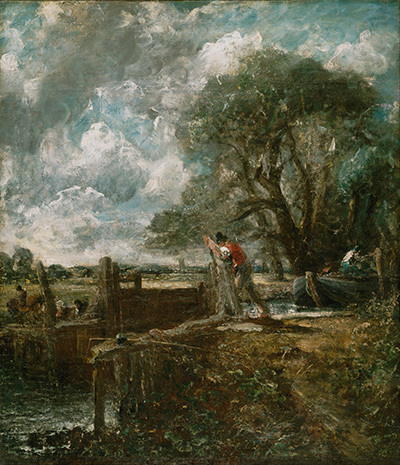
Constable's affection for ordinary river subjects appears with unusual vividness in the letter quoted by the Philadelphia Museum of Art in relation to Sketch for “A Boat Passing a Lock”. The museum records his enthusiasm for mill dams, willows, old banks, slimy posts and brickwork, followed by the brief admission: “I love such things”.[4] The phrase is plain, almost disarming, and it explains a great deal about his art.
These are not grand subjects in the conventional hierarchy of early nineteenth-century art. Mill dams, posts, locks and brickwork belong to labour, use and maintenance. They are places touched by water and weather, but also by work. Constable's love for them was not antiquarian prettiness. He saw pictorial richness in worn surfaces, damp timber, reflected light and the practical machinery of rural life.
The quotation also clarifies the human world inside the Stour paintings. Even when figures are small, the landscape is not empty. Barges move because goods must be transported. Locks exist because water levels have to be managed. Mills are part of family and local economy. The river is beautiful, but it is also worked. Constable's phrase gives dignity to this mixed world of nature, labour and memory.
The same words help explain why his landscapes can feel so tactile. Old banks, posts and brickwork are surfaces as much as motifs. They invite paint. Roughness, wetness and age become visual opportunities. Constable's brushwork often seems to discover texture as feeling: the damp edge of a bank, the broken light on water, the weight of timber, the dark shine of weathered posts. “I love such things” is therefore not just a personal confession. It is a painter's statement of appetite.
Sketches and outdoor looking
Constable's words about sketching are valuable because they connect his finished art with physical practice. The V&A describes the improvised supports he used in the open air, from small bits of canvas to millboard and paper, and quotes his 1825 account that oil sketches were done “in the lid of my box on my knees”.[2] The phrase gives a wonderfully concrete sense of scale and circumstance.
It also corrects any idea that Constable's freshness was effortless. Outdoor sketching meant inconvenience, speed, adjustment and bodily involvement. The painter had to balance materials, weather, changing light and the need to seize an effect before it vanished. A small study made in that manner was not a lesser thing simply because it was not finished for exhibition. It preserved contact with a passing condition.
The V&A also notes that Constable made full-size studio sketches for major exhibition paintings, a practice that made him unusual.[2] This matters because his method moved between quick outdoor study and large compositional planning. He did not simply enlarge a pretty sketch. He gathered evidence, revised structure, tested effects and worked toward a final painting that could stand before the Royal Academy public while keeping some of the vitality of direct observation.
That is why the sketches have become central to his modern reputation. They reveal the intelligence behind the freshness. A cloud, tree trunk or riverbank study may look spontaneous, but it belongs to a disciplined pattern of looking. The phrase about the box lid is charming because it is practical. It shows Constable close to the ground, close to the motif and close to the conditions under which the motif changed.
Humility before nature
Constable's late lecture language gives a more reflective version of the same commitment. In the public-domain lecture tradition preserved on Wikisource, he tells young painters to become patient pupils of Nature and says that the landscape painter must walk in the fields with a “humble mind”.[6] The phrase is worth keeping because it reveals an ethical dimension in his looking.
Humility, here, does not mean weakness. It means receptiveness. Constable believed the painter had to approach nature without arrogance, without assuming that formulas already possessed the truth. The artist needed discipline, patience and willingness to be corrected by what was actually seen. That idea connects directly to his early rejection of second-hand truth and to his lifelong commitment to observation.
The phrase also explains why his landscapes often avoid theatrical self-importance. Even the large six-foot Stour paintings do not make nature submit to a grandiose scheme. They organise, heighten and compose, but they still seem answerable to specific weather, terrain and rural use. Constable's ambition was great, yet it was grounded in attention.
The lecture language can sound moralising if separated from the pictures. In context, it is better understood as practical advice. A painter with a humble mind notices more. He notices that no two skies behave alike, that light alters colour, that water changes shape, that a tree is not a generic tree, and that a familiar lane can contain endless variation. Humility becomes a condition of accuracy.
A phrase Constable did not write
One celebrated phrase needs special care: “Nature caught in the very act”.[2] It is a superb description of the freshness people find in Constable's sketches, but it is not Constable's own phrase. The V&A identifies it as part of a London Standard review written after Isabel Constable gave the remaining family oil sketches to the South Kensington Museum.[2] It is reception history, not autobiography.
The distinction is not pedantic. If the phrase is treated as Constable's own, it changes the evidence. As a reviewer's response, it tells us how later viewers understood the oil sketches: immediate, vivid, and alive to a passing moment. As a false artist quotation, it would make Constable sound more rhetorically modern than the record supports. Keeping the attribution straight protects both the painter and the critic.
The phrase is still useful, provided it is used honestly. It captures why the oil sketches came to look so important to later audiences. In Constable's lifetime, many viewers preferred the finish of exhibition paintings. Later critics and museum audiences often prized the sketches for their urgency. “Nature caught in the very act” belongs to that later recognition of freshness.
This caution also applies more broadly. Constable attracts loose quotation because his art seems to invite lyrical summary. But the real words are stronger than the doubtful ones. They are specific, grounded and often practical. They speak of feeling, own places, natural painting, skies, box lids, water, banks and humble looking. That vocabulary is more convincing than generic inspirational language.
Why the quotations matter
Taken together, Constable's most reliable quotations form a compact map of his art. “Another word for feeling” explains the emotional charge. “My own places best” explains the geography. “Natural painture” and “close and continual observance of nature” explain the discipline. “Chief organ of sentiment” explains the sky. “I love such things” explains the tenderness toward ordinary working river subjects. “In the lid of my box” explains the bodily reality of sketching. “Humble mind” explains the attitude behind the looking.[1][2][3][4][6]
The quotations also show why Constable remains difficult to reduce to a single label. He was a Romantic painter, but not because he abandoned observation. He was a naturalist, but not because he lacked feeling. He was a painter of locality, but not because he lacked ambition. His words insist on combinations: feeling with discipline, affection with accuracy, place with imagination, and weather with structure.
For readers, the safest way to use Constable's quotations is to return them to the paintings. A phrase should send the eye back to the river, the sky, the bank, the lock, the cottage or the cloud. When that happens, the words do not replace looking. They sharpen it. Constable's finest statements still matter because they lead us back to the visible world he loved and to the patient art he made from it.
Frequently Asked Questions
Discussion
Which authenticated phrase most changes how you look at Constable's art: feeling, own places, natural painting, the sky's sentiment, ordinary river subjects, outdoor sketching or humility before nature?
Reader Insights
Which phrase becomes more useful once it is returned to its letter, lecture, museum object or later reception context?
How do Constable's words connect familiarity with place to the discipline of repeated looking?
What is lost when a later critic's vivid phrase is presented as if Constable wrote it himself?
Join the Conversation
Share your reading below.
References
- V&A, “John Constable – an introduction”, https://www.vam.ac.uk/articles/john-constable-an-introduction
- V&A, “John Constable's sketches”, https://www.vam.ac.uk/articles/john-constables-sketches/
- Metropolitan Museum of Art, Elizabeth E. Barker, “John Constable (1776–1837)”, https://www.metmuseum.org/de/essays/john-constable-1776-1837
- Philadelphia Museum of Art, Sketch for “A Boat Passing a Lock”, https://www.philamuseum.org/objects/103807
- National Portrait Gallery, “John Constable”, https://www.npg.org.uk/collections/search/person/mp01007/john-constable
- Wikisource, Constable/Introduction, https://en.wikisource.org/wiki/Constable/Introduction