 by Tom Gurney
Tom Gurney BSc (Hons) is an art history expert with over 20 years experience
Published on November 5, 2026 / Page Updated on November 5, 2026
Email: tomgurney1@gmail.com / Phone: +44 7429 011000
Introduction
John Constable's technique is often mistaken for spontaneity alone. His sketches can look immediate, his white touches can sparkle like weather caught in motion, and his late watercolours can appear almost abrupt in their force. Yet the power of his art depends on a much more demanding process. Constable drew, observed, copied, revised, stored motifs, reworked earlier material and transformed studies into carefully organised exhibition pictures. The freshness was real, but it was earned.
The V&A's account of Constable's sketches gives the clearest starting point: his pencil, pen, watercolour and oil studies made in the open air are now prized for their vitality, but his own public world expected polished studio painting.[1] That tension sits at the centre of his technique. Constable wanted the authority of direct looking without surrendering the structure required by large finished works. His method was therefore not a recipe for painting outdoors; it was a way of carrying outdoor experience into ambitious art.
Constable's technique is also inseparable from the changing reputation of the sketch. What later viewers admire as immediacy could once seem incomplete, rough or insufficiently finished. The modern understanding of Constable depends heavily on the survival of drawings, oil sketches, watercolours and full-scale studies, especially in the V&A collection. Those works allow us to see him thinking in materials: line becoming mass, oil becoming weather, white paint becoming flicker, and a quick study becoming the seed of a major composition.[2]
At a Glance
- ArtistJohn Constable
- Core methodDirect observation carried into constructed studio painting [1][2]
- FoundationDrawing trained structure, intervals and visual memory [6]
- Outdoor supportsCanvas fragments, millboard and homemade paper [1]
- Paint handlingRaised paint, translucent layers, dry strokes and white accents [1]
- Large methodFull-scale oil studies prepared major exhibition paintings [1][2]
- Key exampleThe Hay Wain, developed through studies and revision [3][4]
- WeatherSky organised light, scale and feeling [2][7]
- Late mediumExperimental watercolour became especially important after 1829 [5]
- Working archiveIsabel Constable preserved drawings, oil sketches and sketchbooks [2]
Contents
- Introduction
- Technique as a Way of Thinking
- Drawing and the Discipline of Attention
- Oil Sketching and Open-Air Practice
- Supports, Surfaces and Handling
- From Study to Composition
- Full-Scale Studies and Exhibition Ambition
- Weather, Sky and the Moving Effect
- Colour, Light and the Problem of Finish
- Watercolour and Late Experiment
Technique as a way of thinking
Constable did not treat technique as a set of tricks placed on top of a subject. For him, method was a form of thought. A drawing could test the structure of a tree, a quick oil sketch could register the passage of cloud shadow, a full-scale study could hold the whole arrangement of a future exhibition picture, and a finished canvas could combine remembered place with composed pictorial order. Technique mattered because it allowed him to make landscape both observed and shaped.
This is why his work resists any simple opposition between nature and studio. The V&A notes that many exhibition paintings developed through a complex process that could involve oil sketches, graphite drawings, watercolour studies and earlier paintings.[2] Such a process does not weaken the claim to truth. It changes what truth means. Constable's art is rarely the record of one untouched moment. It is more often a constructed image built from repeated acts of attention.
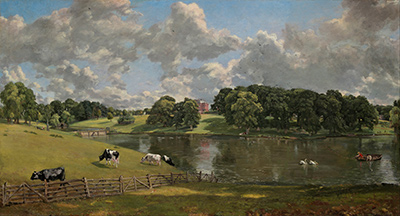
The distinction matters because Constable's paintings are still sometimes read as if they were transparent rural views. They are not. Even the most familiar Stour scenes involve selection, transfer, adjustment and scale. A cottage may come from one study, a wagon from another, a boat from memory or earlier use, and a sky from a disciplined understanding of weather. Technique is the bridge between those materials. It lets the picture appear whole without pretending that it arrived whole.
Drawing and the discipline of attention
Drawing was the base of Constable's practice. Before the great oil surfaces, before the full-scale Stour studies and before the celebrated cloud sketches, there was the habit of looking through line. Graham Reynolds's study of the early paintings and drawings is especially important here because it treats the works from 1790 to 1816 as a substantial formation rather than a prelude to the famous maturity.[6] Constable's early art shows a painter learning how to organise attention before he made the large landscapes for which he is best known.
That early discipline was not only academic. The Paul Mellon Centre's description of Reynolds's catalogue emphasises drawings and paintings from East Bergholt, Dedham and the Stour region, including works on which later masterpieces were based.[6] This helps explain why Constable's technique feels local without being merely topographical. He learned places by drawing them. Repetition allowed particular motifs to become available to him later, not as stock decoration but as remembered forms with weight.
Drawing trained Constable to notice structure. Trees, banks, bridges, roofs and mills have to hold together before weather can animate them. A poor structure cannot be redeemed by brilliant atmosphere. His strongest paintings suggest that he understood this deeply. The flickering paint may catch the eye first, but beneath it lies a tested relation of masses: trunk against cloud, roof against foliage, water against bank, horizon against sky.
It is tempting to separate drawing from colour, as though one belonged to design and the other to sensation. Constable's practice makes that division too tidy. The act of drawing sharpened his later use of paint because it made him attentive to intervals, pressures and weights. A broken brushstroke works only when it lands in the right structural place. A white highlight convinces only when the underlying form can carry it.
Oil sketching and open-air practice
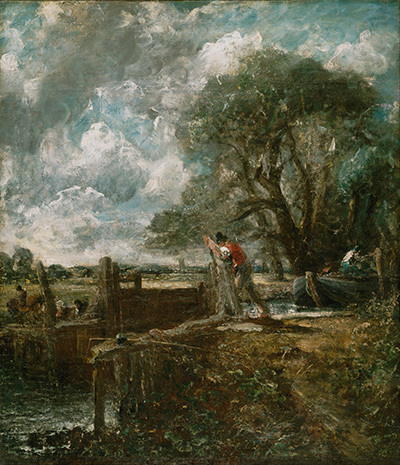
Constable's oil sketches are central to his technique, but they need careful handling. The V&A explains that he used sketches as source material for fully worked compositions, while also making studies from nature that recorded motifs and effects of light, shade or weather.[1] Some sketches were made outdoors, some in the studio, and some direct studies were later revised. This variety is important. The oil sketch was not one thing with one purpose.
Outdoor oil sketching gave Constable a way to meet speed. Light changes, wind moves foliage, clouds alter the shape of a field, and water shifts colour by the minute. A slow, highly finished procedure cannot catch such effects at first encounter. The sketch allowed him to record what would otherwise disappear. It was a practical answer to the problem of time.
The materials of that practice were modest and flexible. The V&A records that when Constable worked outdoors he painted on fragments of canvas, millboard or homemade paper, and that he could work with the support set in the lid of his box on his knees.[1] This small detail matters because it changes the imagined scene of making. Constable was not always standing before a grand easel in an ordered studio. He was often working with portable means, adjusting his hand to weather, light, surface and bodily position.
Those supports encouraged compression. A small piece of millboard or paper does not permit the same kind of performance as a large canvas. It asks for selection: the mass of a cloud, the turn of a bank, the colour of light on a roof, the dark accent of a tree. Constable's sketch technique is therefore a discipline of abbreviation. It does not record everything. It records what can later become pictorially useful.
The sketch also encouraged courage. A small study can accept risk more readily than a public painting. Thick paint can be tried, a sudden white touch can be placed, a dark cloud can be blocked in strongly, and an uncertain relation can remain visible. This freedom helps explain why Constable's sketches often feel more modern than the finished canvases. They show decision before it has been fully smoothed into public form.
Supports, surfaces and handling
Constable's technical variety depends partly on support. Canvas, millboard, homemade paper and watercolour paper each alter what the hand can do. A rougher surface catches dry brush differently from a smooth one. A brown ground can warm the whole image and appear through later strokes. Paper can absorb, resist, buckle or brighten. Support is not neutral. It shapes the speed, pressure and visibility of marks.
The V&A identifies a wide range of paint handling in the open-air oil sketches, from dense raised paint and translucent oil layers to bright colour points, clean white accents and dry strokes that let lower tones remain visible.[1] These are not decorative flourishes. They are different answers to different visual problems. Thick paint can give weight to light; glaze can deepen atmosphere; dry brush can imitate broken surfaces; a pure white touch can make water, leaf or cloud feel active.
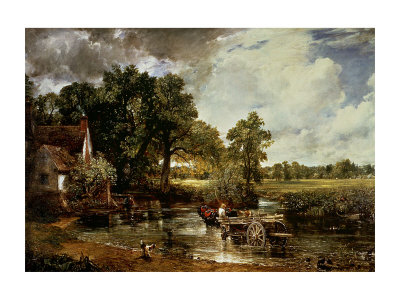
The visible ground is especially important. In some works, Constable allows areas of the underlying surface to remain active rather than burying them under continuous finish. The National Gallery's account of The Hay Wain notes that the full-scale oil sketch left large areas of the brown canvas ground bare.[3] That exposed ground is not simply absence. It gives the image warmth, speed and openness, while also reminding us that the large study was a working arena rather than a fully closed surface.
Constable's white touches have become almost a signature. They can suggest glints on water, flashes on leaves, brightness along cloud edges or damp sparkle in the air. They also caused difficulty for viewers accustomed to smoother brown-toned landscape painting. In the National Gallery audio material for The Hay Wain, those small white dabs are connected with the critical nickname often attached to his manner.[3] The term may sound affectionate now, but it points to a real period discomfort with his broken surfaces.
Broken colour is not the same as carelessness. Constable's marks often work because they are placed against steadier structures. A dab of light needs a dark support; a dry stroke needs an underlying tone; a bright accent needs a larger colour relationship. His surfaces can look restless, but the best of them are not random. They are controlled disturbances.
From study to composition
Constable's technique becomes most interesting when studies begin to travel. A quick image made from nature might remain an independent work, but it might also become material for a later composition. The National Gallery's discussion of The Hay Wain is a useful example because it explains that the final picture was created in the London studio from open-air sketches made over several years, followed by a full-size preparatory oil sketch.[3] The finished painting is therefore fresh in effect but deeply mediated in process.
This method allowed Constable to gather time. A study of Willy Lott's house, a study of a wagon, a small boat motif and a remembered relation of river and meadow could be brought together into a single image. That does not make the painting false. It makes it cumulative. The finished picture becomes a concentration of many encounters with place.
Studio composition also allowed Constable to test balance. A natural scene rarely arrives already shaped for a large public canvas. Forms have to be weighted, openings created, light distributed and movement directed. A viewer has to be led through the picture without feeling pushed. The studio gave Constable room to manage that orchestration while preserving the living pressure of the studies.
This is one reason Constable's technique should not be reduced to outdoor painting. He valued outdoor work because it gave him vitality, evidence and surprise. He relied on studio work because it gave him scale, sequence and coherence. The strength of his mature method lies in the friction between the two. Observation kept the studio from becoming formulaic; composition kept observation from remaining scattered.
Full-scale studies and exhibition ambition
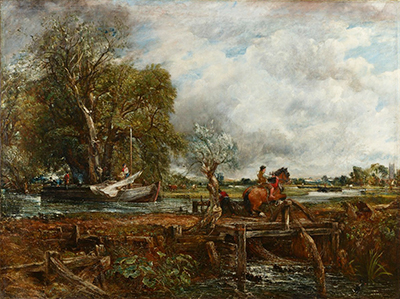
Constable's full-scale oil studies are among his most distinctive technical achievements. The V&A describes him as unique in making full-size studio sketches in preparation for exhibition paintings, naming the full-scale oil sketch for The Hay Wain as a key example.[1] These works occupy a fascinating middle ground. They are not small outdoor notes, but neither are they final exhibition pictures. They are large acts of thinking.
The need for such studies grew from ambition. Constable's Stour paintings of 1819 to 1825 were large public works, not private souvenirs. The V&A explains that full-size preparatory oil sketches helped him coordinate motifs and balance colour, light and shade while retaining the freshness of smaller drawings and oil sketches.[2] At that scale, a small uncertainty becomes a large problem. The full-scale study let him discover the problem before committing the final picture.
The full-scale study also protected movement. Enlargement can stiffen a composition. A small sketch may breathe because it was made quickly, but the energy can die when copied onto a large canvas. Constable's large studies gave him a way to rehearse the whole image without sealing it too soon. He could move forms, test masses and alter light while the surface still remained open.
In the case of The Hay Wain, the National Gallery notes that the full-scale oil sketch developed the composition and that certain elements present in the study were altered before the final painting.[3] Such changes are invaluable for understanding technique. They show Constable not as a passive recorder of a beloved scene but as an artist making decisions. The landscape had to be composed into conviction.
The National Gallery catalogue strengthens that point with unusually concrete evidence. It records the final painting as oil on canvas and places it third within Constable's Royal Academy sequence of large Stour subjects from 1819 to 1825.[4] It also describes X-radiographic evidence of details altered in the central foreground, including a horse and rider that had appeared in the full-scale sketch and was later painted out.[4] For technique, this matters because the change is not cosmetic. It shows the final canvas as a worked surface in which composition continued to be judged, revised and clarified.
The same catalogue entry follows several ingredients of the final image back through earlier studies: views of Willy Lott's house, the appearance of the wagon, and an unobtrusive boat motif that had already served other compositions.[4] Constable's method was economical in the best sense. He did not waste visual knowledge. A motif could be recalled, altered and put to new use when it solved a fresh compositional need. The technique is therefore cumulative, storing earlier looking until it could become newly active.
The full-scale study is therefore one of the best answers to the old charge that Constable's method was merely rough. Roughness alone cannot solve a large composition. These studies show roughness under pressure, roughness serving design, roughness as a way of keeping pictorial invention alive until the final relations are secure.
Weather, sky and the moving effect
Weather is not an accessory in Constable's technique. It changes the way paint has to behave. A still architectural subject can tolerate firmer edges and slower transitions, but a moving sky demands a different hand. Cloud, rain, gleam, shadow and wind require marks that can suggest instability without dissolving the whole picture. Constable's technical originality lies partly in making that instability visible.
Mark Evans's Constable's Skies is central to this question because it gathers the artist's sky studies, weather interests and wider treatment of English weather across the career.[7] The book's description emphasises that skies are essential components of the landscapes, not empty upper zones, and that the cloud studies on Hampstead Heath form part of a broader fascination with weather.[7] For the technique article, the point is not to repeat the full Cloud Studies story. It is to recognise that sky altered the mechanics of painting.
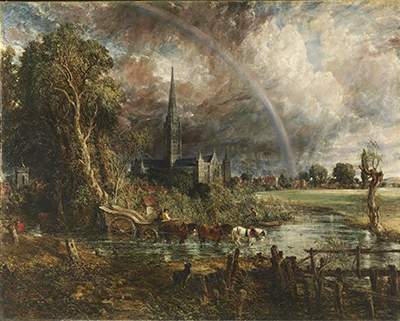
The V&A introduction records Constable's view that the sky was a material aid to landscape composition.[2] That idea has a technical consequence. If sky is structure, then clouds cannot be added at the end as atmosphere alone. They have to organise light, scale and sentiment from the beginning. A field may glow because the sky opens; a river may darken because cloud moves overhead; a cathedral may gain emotional force from the pressure above it.
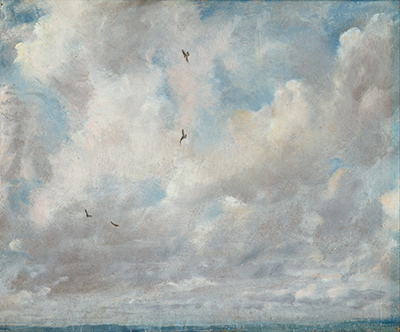
Constable's cloud studies are often admired because they feel immediate, but their importance lies in disciplined observation. They helped him understand how forms in the sky grow, mass, break and move. They also trained a vocabulary of handling: dragged strokes, loaded touches, translucent passages, sharp lights and dark masses that can be made quickly without becoming shapeless.
The later specialist treatment of Cloud Studies can dwell on individual examples, inscriptions and meteorological context. Here the technical lesson is broader. Constable saw weather as a moving system that forced painting to become more responsive. His method gave paint a way to register change without abandoning composition.
Colour, light and the problem of finish
Constable's colour often works through local freshness rather than grand chromatic display. Greens, browns, whites, greys and blues are made active by contrast and handling. A patch of bright colour may enliven a horse harness or a field figure; a white accent may make foliage flicker; a dark cloud may strengthen the whole lower landscape by forcing light into sharper relief. His colour is less about spectacle than pressure.
The difficulty was finish. Constable worked in a culture that often valued smooth surfaces and resolved compositions. The V&A notes that public expectation in his time favoured polished oil painting made in the studio.[1] Against that expectation, Constable's broken handling could seem problematic. The very qualities now prized as vitality could appear insufficiently controlled to some contemporaries.
This makes the finished paintings more complex than they first appear. They are not simply freer versions of traditional landscapes. They are negotiated surfaces. Constable had to decide how much vitality to preserve and how much polish to supply. Too much finish could kill the effect of weather; too little could risk public rejection. Technique here becomes a social as well as artistic question.
That tension is visible in the relation between sketch and exhibition canvas. The sketch may carry the first force of perception. The finished canvas must withstand public viewing, scale, framing, comparison and sale. Constable's art repeatedly tries to keep the first force alive under those heavier conditions.
This also explains why a technical discussion should avoid calling him simply unpolished. His art is more interesting than that. He used polish where he needed it, left brokenness where it carried truth, and allowed different zones of a painting to operate at different speeds. A cloud, a tree trunk, a roof and a human figure need not all be handled in the same key.
A finished Constable surface often asks the eye to adjust between these different speeds. Some passages are descriptive enough to identify a place, building or figure; others work as sensation, catching wetness, leaf movement or cloud pressure with far less literal detail. This unevenness is not a failure of concentration. It is one of the ways his paintings keep air moving through a composed scene. The viewer feels both the stability of place and the instability of weather.
That balance also affects scale. A small oil study can sustain a very high degree of abbreviation because the whole support can be taken in quickly. A six-foot painting has to hold attention across distance and time. Constable's technical challenge was to translate the authority of the small study into a much larger field without making every passage equally emphatic. He needed quiet areas as well as brilliant ones, brown ground as well as white glitter, and structural shadow as well as open light.
Watercolour and late experiment
Constable's later work in watercolour extends the same technical intelligence into a different medium. The V&A's conservation-led discussion of his watercolour sketches notes that after 1829 he preferred working with watercolour, and that the later Sussex works could be vigorous and experimental rather than delicately transparent in the conventional manner.[5] This is important because it shows that technical restlessness did not end with the great oil sketches.
Watercolour changed the terms of speed and pressure. Wash, pencil, opaque pigment, abrasion and reserve all behave differently from oil. The V&A account describes Constable using opaque pigments, different brushes, coarse-haired handling, graphite, washes and even the end of a brush handle to score or abrade the paper and recover touches of light.[5] Such methods reveal a painter willing to push materials physically, not merely apply them politely.
The late watercolours also show how Constable's concern with weather survived beyond oil. In one example discussed by the V&A, he used the side of a graphite stick to evoke sheets of rain striking a hill.[5] That is a wonderfully practical technical solution: not a symbol of rain, but a material action that produces a visual equivalent. The hand imitates the force it wants the viewer to feel.
These works complicate the idea that Constable's technique moved from freshness to decline. The later watercolours are not simply softer afterthoughts. They are experiments in how landscape can be made with different kinds of pressure: scratched, rubbed, washed, thickened, darkened and lit. They suggest an artist still testing how materials might carry atmosphere and emotional weight.
They also clarify a continuity across media. Whether Constable used oil, graphite or watercolour, he repeatedly searched for a physical action that could stand in for natural force. A loaded brush could become damp foliage; a dragged dry touch could suggest rough ground; a scored line could recover light; a side-stroke of graphite could become rain. Technique was not an external polish applied after observation. It was the means by which observation found its equivalent in matter.
Preservation and modern understanding
The survival of Constable's working materials changed his afterlife. The V&A records that Isabel Constable, the artist's last surviving child, gave the South Kensington Museum a major body of family-held works, including drawings, watercolours, oil sketches, easel paintings and sketchbooks.[2] Without that gift, the modern picture of Constable's technique would be far thinner. We would know the finished paintings, but not the working intelligence behind them.
The numbers matter because they show scale. The V&A identifies the Isabel Constable gift as including 297 drawings and watercolours, 92 oil sketches, three easel paintings and three sketchbooks.[2] This body of material lets viewers follow Constable across media and stages of thought. It also helps explain why the sketch has become so central to his reputation.
There is a gentle irony here. Works that may once have looked secondary are now indispensable. The sketch, the study and the preparatory work reveal the artist with unusual intimacy. They show what a finished picture cannot always show: hesitation, speed, transfer, correction, attack, pressure and return. They make technique visible as an unfolding process.
This afterlife also affects how the finished paintings should be seen. Once the sketches are known, the large canvases look different. Their freshness is no longer a mysterious effect. It can be understood as a survival from a wider practice of direct observation and experimental handling. Their order is also clearer, because the studies reveal the amount of decision behind the apparent ease.
How to look at Constable's technique
A useful way to look at Constable's technique is to begin with the relation between speed and structure. Ask which parts of the work appear quickly handled and which parts are more deliberately built. Notice whether broken marks sit on a stable composition or whether the whole image feels unsettled. Constable is often at his strongest when movement and order hold each other in tension.
Then look for the behaviour of light. In Constable, light is rarely a simple wash over an already completed scene. It is carried by touches, openings, reserves, glazes, white accents, dark clouds and exposed ground. It may appear as glitter on water, brightness on a wall, a flare in the sky or warmth on a field. The technique works by making light local and mobile.
Next, distinguish the type of work. Is it a drawing, an oil sketch, a full-scale study, a finished exhibition painting, a watercolour or a later reworking? The answer changes what one should expect. A small sketch may be valuable because it is rapid and concentrated. A full-scale study may be valuable because it shows large compositional thought in motion. A finished canvas may be valuable because it holds freshness inside public form.
It also helps to look for reuse. Constable's technique involved returning to earlier material, not beginning from nothing each time. The National Gallery's Hay Wain account notes how particular studies and motifs fed into the final painting, including earlier studies of Willy Lott's house and a small boat used in more than one composition.[3] This reuse should not be treated as weakness. It shows an artist building a visual memory bank and recombining it with judgement.
Finally, attend to surfaces without forgetting feeling. Constable's technique is not cold procedure. It serves affection, memory, weather, labour and place. A brushstroke is never only a brushstroke in his best works. It is a way of making the world feel observed, loved and passing.
Technique without formula
Constable's technique cannot be reduced to a single formula: paint outdoors, add white, leave the surface broken. That would miss nearly everything important. His method moved across drawing, oil sketching, watercolour, studio revision, full-scale studies and finished canvases. It used both speed and patience. It depended on direct looking, but also on memory and composition.
The most distinctive feature of his technique may be its refusal to choose between freshness and construction. He wanted the look of weather without mere accident, the intimacy of remembered place without local illustration, and the seriousness of large painting without dead polish. The result is a body of work in which technique becomes a moral and emotional instrument. Paint is asked to carry truth, feeling and time.
That is why Constable still feels alive. His pictures do not hide the act of making. They let us see observation becoming form. A cloud thickens, a tree flickers, a river darkens, a wagon moves, a sheet of rain crosses a hill, and the surface itself seems to respond. Technique, in Constable, is the means by which landscape stops being scenery and becomes experience.
Frequently Asked Questions
Discussion
Which part of Constable's method most changes how you read a finished landscape?
Reader Insights
Where does a rapid mark depend on a carefully built underlying form?
What is gained when several observations are combined into one composition?
Which brushstroke, white accent or scored line most convincingly becomes light or atmosphere?
Join the Conversation
Share your reading below.
References
- Victoria and Albert Museum, “John Constable's sketches,” https://www.vam.ac.uk/articles/john-constables-sketches/
- Victoria and Albert Museum, “John Constable – an introduction,” https://www.vam.ac.uk/articles/john-constable-an-introduction
- National Gallery, “John Constable, The Hay Wain,” https://www.nationalgallery.org.uk/paintings/the-hay-wain
- National Gallery, “The Hay Wain,” National Gallery Catalogues, https://www.nationalgallery.org.uk/paintings/catalogues/egerton-2000/the-hay-wain
- Victoria and Albert Museum, “Constable's watercolour sketches,” https://www.vam.ac.uk/articles/constables-watercolour-sketches
- Graham Reynolds, The Early Paintings and Drawings of John Constable, Paul Mellon Centre / Yale University Press, 1996, https://www.paul-mellon-centre.ac.uk/publications/browse/9780300063370
- Mark Evans, Constable's Skies: Paintings and Sketches by John Constable, V&A / Thames & Hudson, 2018, https://www.thamesandhudson.com/products/constables-skies-victoria-and-albert-museum