 by Tom Gurney
Tom Gurney BSc (Hons) is an art history expert with over 20 years experience
Published on June 19, 2020 / Page Updated on November 5, 2026
Email: tomgurney1@gmail.com / Phone: +44 7429 011000
Introduction
John Constable's The Valley Farm is a late return to one of the most familiar places in his art: Flatford, the River Stour and the house associated with Willy Lott. Painted in 1835, it looks back across decades of sketches, memories and earlier paintings. It is not as universally famous as The Hay Wain, but it belongs to the same deep imaginative territory. Constable returns to the riverbank, the timbered house, the trees and the water, but he does so with the density and urgency of his final years.
The painting is Tate N00327, an oil on canvas now held by Tate Britain. Tate-linked and Art UK-derived metadata identify it as The Valley Farm, dated 1835 or c.1835, with the older National Gallery number NG327 also attached to its history.[1][2] The best orientation-controlled metadata gives the dimensions as about 125.1 by 147.3 centimetres.[2] That older National Gallery number matters because Robert Vernon bought the painting from Constable and later included it in his 1847 gift of British pictures to the nation.[10][11]
The title needs care. The Valley Farm is not simply a topographical portrait of the separate Flatford building called Valley Farm. The painting is centred on the back of Willy Lott's House and the Stour-side setting Constable had drawn and painted for much of his life.[3][6] Its subject is therefore both a place and a memory of place: a late reworking of the Flatford world that had already supplied some of Constable's greatest images.
At a Glance
- ArtistJohn Constable (1776–1837)
- TitleThe Valley Farm
- Date1835 [1][2]
- MediumOil on canvas [1][2]
- Dimensions125.1 × 147.3 cm [2]
- CollectionTate / Tate Britain [1][2]
- AccessionN00327 [1][2]
- Former numberNational Gallery NG327 [10]
- ExhibitionRoyal Academy, 1835 [3]
- ProvenanceBought by Robert Vernon for £300 in 1835; presented to the nation in 1847 [3][10][11]
Contents
- Introduction
- Object Identity
- The Title and the Place
- Willy Lott's House and Flatford
- A Late Return to an Old Subject
- Composition and Surface
- Relation to The Hay Wain
- Robert Vernon and Public Success
- Why the Painting Matters
Object identity
The central object is the Tate painting The Valley Farm, N00327.[1][2] It was painted in 1835, exhibited at the Royal Academy that year, and sold to the collector Robert Vernon. East Bergholt Society's local account states that Vernon saw it in Constable's painting room before the Academy exhibition and bought it for £300, a high price in Constable's career.[3] The National Gallery catalogue for The Cornfield also uses Vernon's purchase of The Valley Farm as a benchmark for the later £300-guinea valuation of The Cornfield after Constable's death.[9]
The painting later entered the national collection through Vernon's gift. The National Gallery archive records the 22 December 1847 deed of gift and includes NG327 among the paintings referenced in that record.[10] Robert Vernon was an important patron and collector of modern British art; the National Portrait Gallery notes that he gave more than 150 pictures to the National Gallery in 1847.[11] This explains why The Valley Farm carries both Tate and former National Gallery identities in public metadata.
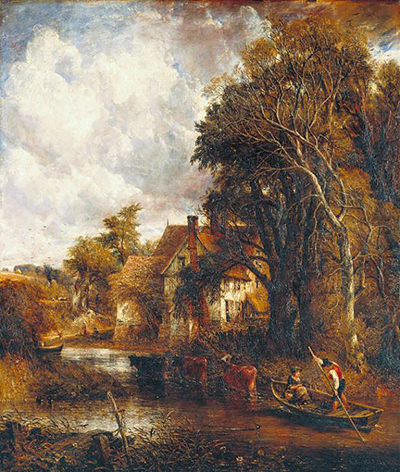
Visually, the local image corresponds to the Tate/National Gallery visual family: a horizontal river scene with a house partly hidden by trees, cattle standing in shallow water, figures in a small boat at the right, and a broad sky moving above a dense autumnal riverbank. The composition is familiar enough to recall earlier Flatford works, but the late handling is more agitated and compressed.
The title and the place
The title The Valley Farm can mislead if read too literally. National Trust material distinguishes Willy Lott's House from the building called Valley Farm at Flatford. Willy Lott's House was originally part of Gibbeon's Gate Farm and was occupied by the tenant farmer William Lott, while Valley Farm itself is described as the oldest building at Flatford, a mid-fifteenth-century medieval open hall house.[6]
Flatford and Constable's local history makes the point even more directly: Constable gave this painting the title The Valley Farm, but the painted view is actually the back of Willy Lott's House and its surrounding area.[12] That distinction is important because Constable was not making an architectural survey. He was returning to a cluster of buildings, water, trees and associations that had become inseparable in his imagination.
The painting therefore works through a kind of accumulated naming. Valley Farm, Willy Lott's House, Gibbeon's Gate Farm, Flatford and the Stour all belong to the same local field of memory, but they are not identical. Constable's art often compresses such distinctions, especially when a place has been seen repeatedly over many years. In The Valley Farm, the title carries local resonance while the image centres on the riverside house and surrounding water.
This distinction also helps explain why the painting can feel more poetic than literal. If the subject were only an architectural record, the title would be a problem to correct and move past. In Constable's art, however, names, memories and views often overlap. The house, the farm, the river and the old working landscape form a single emotional geography. The painting's power depends on that overlap while still requiring the viewer to understand the actual place clearly.
Willy Lott's House and Flatford
Willy Lott's House was already famous in Constable's art before The Valley Farm. The National Gallery's account of The Hay Wain explains that the house on the left of that painting was occupied by tenant farmer Willy Lott, and that Constable knew the view extremely well.[7] The fuller National Gallery catalogue notes that Constable made many drawings and oil sketches of the house from various angles, with its red roofs, chimneys, whitewashed walls and brick buttresses appearing repeatedly in his Stour scenes.[8]
Historic England identifies Willy Lott's Cottage as a Grade I listed building, a late sixteenth- or seventeenth-century timber-framed farmhouse, and specifically notes its significance within the Flatford Mill group and in Constable's work.[13] The National Trust adds the local social history: Willy Lott, born in 1761, was a tenant farmer who worked the 39 acres around Flatford that made up Gibbeon's Gate Farm, and the house was associated with his family over generations.[6]
For Constable, the house was not picturesque in a detached, tourist sense. It stood across the water from the mill world of his family, within the working geography of Flatford. The mill, the lock, the river, the dry dock, the farm buildings and the house belonged to the practical environment he had known since childhood. In later paintings, that practical environment could become charged with memory without losing its physical specificity.
A late return to an old subject
The date of The Valley Farm is crucial. By 1835, Constable had already completed the great Stour six-footers, the Salisbury and Hampstead works, the Brighton and Weymouth coastal pictures and the late memorial subjects. Maria Constable had died in 1828, he had become a full Royal Academician in 1829, and his late manner had grown more forceful, broken and emotionally concentrated.
Returning to Flatford in this period was not the same as painting it in the 1810s or early 1820s. The place was still real, but it had become retrospective. The Valley Farm belongs to the late phase in which Constable revisited familiar material with new urgency. The house, water and trees are not merely remembered; they are reworked, enlarged and intensified.
The British Museum's record for a related drawing or study notes that Willy Lott's house varied in appearance across Constable's related versions, and that small and larger oil sketches have been connected with the development of The Valley Farm.[5] This is a useful warning against treating the painting as a fixed architectural document. Constable was composing from a long store of visual material rather than copying a single view.
That late process gives the painting its power. It is made from return and alteration. Constable had looked at this riverside world for most of his life, yet in 1835 he still found it capable of new pictorial pressure. The old subject had not been exhausted.
The related V&A sketch helps make this process visible. East Bergholt Society's V&A-focused account identifies a small 1835 oil sketch of The Valley Farm as preparatory material for the larger painting and links it to the Isabel Constable gift context.[4] The sketch evidence matters because it shows that Constable did not simply rely on memory in a vague way. Even late in life, he worked through versions, adjustments and tests before arriving at the exhibition canvas.
Those versions also show the difference between repetition and return. Repetition would mean repainting an old motif without new purpose. Return, in Constable's case, meant bringing a familiar place under the pressure of a changed emotional and artistic situation. The Valley Farm is therefore not a nostalgic retreat from ambition. It is a late attempt to make an old subject answer new needs.
Composition and surface
The house sits just left of centre, partly concealed by trees and shadow. Its pale wall catches the eye, but it does not dominate the whole scene. Large trees rise on the right, darkening and crowding the composition, while the water opens across the foreground. Cattle stand in the shallow river, and a small boat with figures at the right gives the scene a crossing movement.
The picture is built from contrasts. The pale house is set against heavy foliage; bright sky presses against dark trees; human activity is small but pointed; and the water reflects both sky and bank. Constable uses the familiar Flatford vocabulary, but he makes it more turbulent than in many earlier Stour compositions. The scene feels intimate, yet it is restless.
The handling is central to that restlessness. The surface has the worked, late Constable energy of broken paint, sharp lights and rapidly animated foliage. This is not the smooth pastoral calm that later audiences sometimes expect from Constable. It is a late picture in which memory itself seems to have texture: thick, interrupted, bright in places and shadowed in others.
The boat and cattle are not decorative additions only. They keep the river active. The Stour is not a scenic mirror but a lived crossing, a place of movement, work and rural routine. Even in a late retrospective painting, Constable does not entirely detach Flatford from use. The water still carries bodies, animals, reflections and practical life.
The large trees on the right are especially important. They make the house feel protected and almost engulfed, as if the place is both preserved and overtaken by time. The pale wall and red roof still catch light, but they are pressed by branches and dense foliage. Constable often used trees as structural anchors; here they become emotional anchors too, holding the memory of the house inside a darkened natural frame.
The sky provides the counterweight. It is bright and active enough to stop the painting from collapsing into enclosure. Clouds move across the upper left, opening the scene beyond the dense bank. This balance between heavy trees and mobile sky is one reason the painting feels late rather than merely picturesque. Constable is not smoothing memory into a postcard view; he is letting the old place remain unsettled.
Relation to The Hay Wain
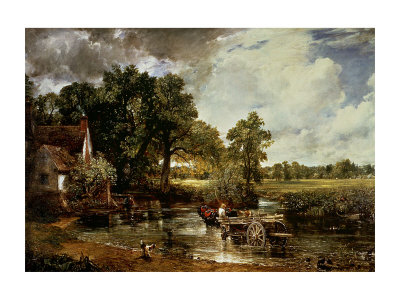
Any discussion of The Valley Farm inevitably touches The Hay Wain, because Willy Lott's House is central to both. In The Hay Wain, the house appears beside the millpond as the empty wagon crosses the shallow water.[7] In The Valley Farm, the same local world returns in a more enclosed and late form. The connection is real, but it should not make the later painting merely an appendix to the earlier masterpiece.
The National Gallery stresses that The Hay Wain was created in the studio from earlier open-air studies and was part of the sequence of large Stour landscapes shown at the Royal Academy between 1819 and 1825.[7] The Valley Farm comes after that heroic sequence. It does not launch Constable's national landscape ambition in the same way; instead, it looks back at one of the sources from which that ambition grew.
The difference in mood is striking. The Hay Wain spreads outward, with a broad horizontal balance between water, meadow, sky and labour. The Valley Farm feels more compressed. Trees crowd the right side, the house is partly hidden, and the river scene is smaller in human scale. It is not a young or middle-career claim for landscape's public importance, but a late act of return.
This makes The Valley Farm valuable precisely because it is not just another version of The Hay Wain. It shows how the same place could change meaning over time. The Flatford setting could be a great national exhibition landscape in 1821 and a more inward-looking late memory in 1835.
The difference also protects The Valley Farm from being overshadowed by its famous neighbour. The Hay Wain has become a national emblem, but The Valley Farm is more private and more complicated in mood. It asks what happens after an artist has already made the definitive public image of a place. Constable's answer is not to abandon Flatford, but to repaint it from another stage of life, with a darker surface and a more concentrated sense of return.
Robert Vernon and public success
The sale to Robert Vernon gives the painting an unusual place in Constable's career. Many of his major landscapes were difficult to sell during his lifetime. The Cornfield, for instance, entered the National Gallery only after Constable's death, through a subscription by admirers.[9] The Valley Farm, by contrast, found a major buyer in Vernon before or around its public exhibition.[3][9]
Vernon's importance was not only financial. He collected living British artists and later gave a large body of modern British pictures to the nation.[11] When The Valley Farm entered that gift, it moved from a private purchase into the public story of British art. The former National Gallery number NG327 records that phase of its life.[10]
This provenance also helps explain the painting's scale and ambition. It is not a small nostalgic sketch. It is a large, finished exhibition picture, made by an ageing artist who still wanted major recognition and public presence. The late Flatford subject is intimate in memory but substantial in format.
The sale does not mean the painting was simple or universally admired. Late Constable could divide viewers. His more broken surfaces and forceful colour were not always easy for contemporary critics. But Vernon's purchase shows that the painting had immediate weight for at least one serious collector, and its later national status confirmed that it belonged among Constable's major works.
The Vernon connection also connects The Valley Farm to the wider emergence of modern British art as a public collection. Vernon's 1847 gift did not merely preserve individual works; it helped establish a national audience for recent British painting.[10][11] Constable's late Flatford scene therefore entered public life through the collecting culture that followed his death. A private memory of Suffolk became part of a public story about British landscape.
Why the painting matters
The Valley Farm matters because it shows Constable returning to the source of his art without merely repeating himself. Flatford, Willy Lott's House and the River Stour had supplied him with motifs for decades. In 1835, he made them carry the weight of a late career, a changed life and a long memory of place.
It also matters because it corrects an overly simple picture of Constable as a painter of calm rural England. The painting is rural, but not calm in any easy sense. Its surface is restless, its trees are heavy, its light is intermittent and its familiar house is half hidden. The scene is cherished, but also worked over. It feels remembered rather than simply observed.
The work also shows how Constable's local subjects became national art. A tenant farmer's house, a shallow reach of the Stour, cattle, trees and a small boat become a large Royal Academy painting, then a Vernon collection picture, then part of the public British collection.[10][11] The transformation is remarkable, but it rests on Constable's conviction that deeply known local places could bear serious artistic meaning.
Most of all, The Valley Farm is a painting about return. It looks back to the house across the water, to early sketches, to The Hay Wain, to family geography and to the long labour of landscape painting. It is late Constable at his most concentrated: not inventing a new subject, but finding that an old one still had more to give.
Frequently Asked Questions
Discussion
What makes The Valley Farm feel most like a late act of return: Willy Lott's House, the crowded trees, active water, broken surface, or its link to Constable's earlier Flatford paintings?
Reader Insights
How does the painting change when its title is separated from the distinct medieval building called Valley Farm?
What does the 1835 handling add to a place Constable had already represented for decades?
How do Robert Vernon's purchase and gift change the meaning of this intimate Flatford subject?
Join the Conversation
Share your reading below.
References
- Wikimedia Commons, John Constable - The Valley Farm, c. 1835.jpg, https://commons.wikimedia.org/wiki/File%3AJohn_Constable_-_The_Valley_Farm%2C_c._1835.jpg
- Wikimedia Commons, John Constable (1776-1837) - The Valley Farm - N00327 - National Gallery.jpg, https://commons.wikimedia.org/wiki/File%3AJohn_Constable_%281776-1837%29_-_The_Valley_Farm_-_N00327_-_National_Gallery.jpg
- East Bergholt Society, The Valley Farm, https://www.ebsoc.org.uk/constable-painting/the-valley-farm-2/
- East Bergholt Society, The Valley Farm (V&A), https://www.ebsoc.org.uk/constable-painting/the-valley-farm/
- British Museum, drawing/print study linked to The Valley Farm, https://www.britishmuseum.org/collection/object/P_1888-0215-33
- National Trust, “History of Flatford,” https://www.nationaltrust.org.uk/visit/suffolk/flatford/history-of-flatford
- National Gallery, The Hay Wain, https://www.nationalgallery.org.uk/paintings/john-constable-the-hay-wain
- National Gallery catalogue, The Hay Wain, https://www.nationalgallery.org.uk/paintings/catalogues/egerton-2000/the-hay-wain
- National Gallery catalogue, The Cornfield, https://www.nationalgallery.org.uk/paintings/catalogues/egerton-2000/the-cornfield
- National Gallery Archive, Deed of Gift of Robert Vernon Esq of Pictures to the National Gallery, https://www.nationalgallery.org.uk/research/research-centre/archive/record/NG5/70/1
- National Portrait Gallery, Robert Vernon, https://www.npg.org.uk/collections/search/portrait/mw06500/Robert-Vernon
- Flatford and Constable, “Valley Farm,” https://www.flatfordandconstable.org.uk/flatford-places/valley-farm/
- Historic England, Willy Lotts Cottage listing, https://historicengland.org.uk/listing/the-list/list-entry/1033438