 by Tom Gurney
Tom Gurney BSc (Hons) is an art history expert with over 20 years experience
Published on November 5, 2026 / Page Updated on November 5, 2026
Email: tomgurney1@gmail.com / Phone: +44 7429 011000
Introduction
John Constable's landscapes are famous for fields, rivers, cottages, mills, trees and clouds, but their real subject is not countryside in the easy sense. His art asks what happens when a familiar place is studied so closely that it becomes inexhaustible. Constable painted landscapes as memory, labour, weather, affection, observation and artistic ambition. He found seriousness in river traffic, cloud movement, damp banks, working mills, cathedral meadows and coastal light. That is why his paintings can feel intimate without feeling small.
The V&A describes Constable's work as transforming landscape painting and shaping a lasting popular image of the English countryside.[1] That image is powerful, but it can be misleading if it turns him into a painter of simple rural charm. Constable's landscapes are built from study and revision. The National Gallery stresses that his open-air sketches often served as the basis for larger paintings completed in the studio.[2] His most convincing works are therefore not casual transcripts of nature. They are deliberate constructions that preserve the pressure of direct looking.
The landscapes fall into several related worlds: the Stour Valley of his youth, the Hampstead sky studies, the Salisbury Cathedral and meadow subjects, the Brighton and Weymouth coast, late watercolours and stormier works, and a wider artistic conversation with Dutch, Flemish, classical and British landscape traditions. Each world has its own emotional climate. Together they show an artist who made landscape carry the full weight of feeling.
What joins those worlds is Constable's belief that landscape could be truthful without being merely factual. He did not want scenery copied without selection, but neither did he want inherited formulas to smother observation. The finest landscapes hold those pressures together. A known river becomes a composed work. A cloud is observed with discipline and made expressive. A cathedral view is at once architectural, social and atmospheric. Constable's landscape art is strongest where the seen world is neither prettified nor left unshaped.
This makes his landscapes useful for readers trying to understand the wider change in British art around 1800. Landscape was becoming more than a background, more than estate record, more than picturesque excursion. Constable helped make it a field of serious modern feeling. He did so not by abandoning tradition, but by making tradition answer to weather, place and direct study.
At a Glance
- ArtistJohn Constable
- Core landscapeThe River Stour and Suffolk countryside [1][3]
- Working worldMills, locks, barges, fields and river transport [3]
- MethodOutdoor studies developed into studio compositions [2][7]
- Major sequenceSix-foot Stour exhibition paintings, 1819–1825 [1]
- FlagshipThe Hay Wain, exhibited in 1821 [5]
- Sky studiesHampstead cloud and weather studies in the early 1820s [1][9]
- Other placesSalisbury, Brighton and Weymouth
- Late characterStorm, rainbow, watercolour and more urgent handling [1]
- LegacyLocal observation with international influence [2]
Contents
- Introduction
- Landscape as Affection and Work
- Suffolk and the River Stour
- Mills, Locks, Barges and the Working Landscape
- Sketching, Memory and Studio Landscape
- The Six-Foot Stour Paintings
- Hampstead and the Sky
- Salisbury and Cathedral Landscape
- Brighton, Weymouth and the Coastal Landscape
- How Constable Changed Landscape Painting
Landscape as Affection and Work
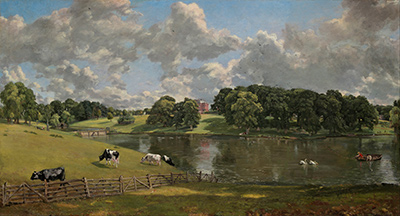
Constable's landscapes begin in affection, but they are not merely affectionate. He loved the countryside of East Bergholt, Dedham, Flatford, Stratford St Mary and the River Stour, yet that countryside was not an untouched idyll. It was worked, owned, managed and traversed. His father Golding Constable's business involved mills, corn, coal, barges and river transport.[1] The National Trust's history of Flatford describes locks, lighters, mills and water-management systems that helped sustain local prosperity.[3] This practical world is essential to the paintings.
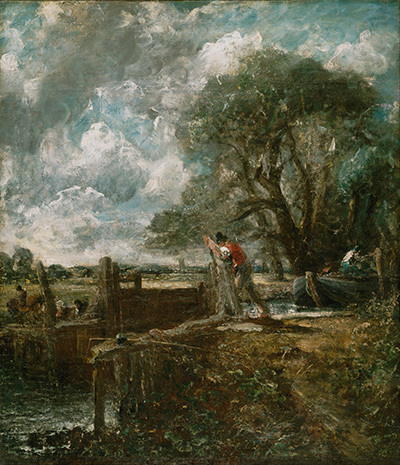
The Stour Valley offered Constable a landscape of use. Mills ground corn; barges moved goods; locks controlled water; dry docks serviced boats; fields produced crops; paths and bridges connected villages. When these things appear in his paintings, they are not decorative rural signs. They belong to the logic of place. A lock is a mechanism as well as a motif. A mill is family history as well as architecture. A barge is labour as well as shape.
This gives Constable's landscapes a distinctive tension. They often project peace, but they are full of work. The labour may be quiet, distant or absorbed into the scene, yet it structures the view. A wagon crossing water, a boy fishing, a barge moored by the bank, a mill in shadow or a church tower beyond fields all helps anchor the landscape in lived time. Beauty and usefulness are not opposed.
Constable's affection for landscape is therefore best understood as informed attachment. He knew the Stour not as a visitor but as someone whose family, memory and early work were tied to it. That intimacy made him alert to details that a more theatrical painter might have missed: damp posts, worn banks, leaning trees, reflected light, small figures at work, the difference between still water and moving cloud. His landscapes are tender because they are knowledgeable.
The phrase “natural painter” can sound simple, but for Constable it involved effort. Naturalness had to be earned through looking, selecting and composing. A natural landscape was not merely a view free from artifice. It was a painting in which artifice had been made obedient to nature. This is why his most persuasive works rarely feel schematic. They are organised, but their organisation allows for irregular banks, broken foliage, uneven light and passing weather.
His landscapes also resist the separation of human and natural worlds. A field is planted, a path worn, a river managed, a cottage inhabited, a lock engineered. Even when people appear only as small figures, human presence is built into the scene. Constable's countryside is not wilderness. It is a place where nature and use have become inseparable over time.
Suffolk and the River Stour
The Suffolk and Stour landscapes form the emotional foundation of Constable's art. They include views of Flatford, Dedham, Stratford, East Bergholt and the river landscape around them. Graham Reynolds's The Early Paintings and Drawings of John Constable is fundamental for this early development, because it traces how the young artist's local studies, drawings and paintings prepared the later masterpieces.[4] The mature Stour pictures were not sudden nostalgic inventions. They grew from a long practice of looking.
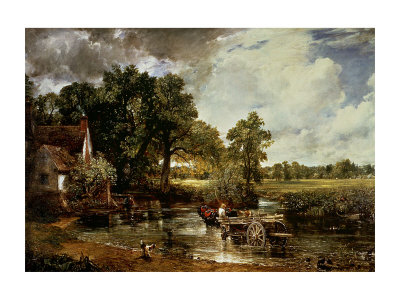
The National Gallery's account of The Hay Wain identifies the scene as Flatford millpond on the River Stour, close to Constable's birthplace, with the tenant farmer Willy Lott's cottage anchoring one side of the view and the Constable family mill lying just beyond the visible focus.[5] This example makes clear how his landscapes combine topographical specificity with artistic construction. The finished painting was made in London from studies gathered over years, including sketches of the house, the wagon and the broader setting.[5]
Other Stour pictures work through related concerns. Stratford Mill, also in the National Gallery, is described as one of the monumental Stour landscapes shown at the Royal Academy between 1819 and 1825.[6] It presents a water-powered paper mill on the River Stour, with figures, shade, light and river movement held inside a large composition.[6] The subject is local, but the ambition is grand. Constable was asking viewers to treat such places as worthy of the scale and seriousness of exhibition painting.
The Stour also gave Constable a way to paint time. The river carries childhood, family business, seasonal work, remembered views and later artistic reconstruction. A Stour landscape often feels immediate because the weather is alive, but it also feels retrospective because the place is known through return. Constable's Suffolk is not frozen. It is a landscape remembered in motion.
This is one reason his Stour landscapes differ from conventional picturesque tourism. The picturesque often framed rural places as scenes to be consumed by a mobile viewer. Constable's Stour works are more rooted. They know the backs of buildings, the function of water, the weight of timber and the working relation between river and field. The viewpoint may be carefully chosen, but it does not feel like a stranger's discovery.
The Stour also let Constable make landscape personal without turning it into autobiography in a narrow sense. The works rarely explain the artist's private life directly. Instead, they show a place saturated by memory. The viewer senses return, not confession. That restraint is part of their power. Feeling is absorbed into water, light, air and structure.
Mills, Locks, Barges and the Working Landscape
The mills and locks in Constable's landscapes deserve close attention because they prevent the countryside from becoming vague. Flatford Mill, Dedham Lock, boat-building subjects, river barges and towing horses all connect his art to the practical economy of the Stour. The National Trust notes that Flatford Lock and other locks along the River Stour increased prosperity, especially for Golding Constable's business.[3] Such information changes how the paintings read. Water is not only reflective beauty; it is infrastructure.
This working landscape gave Constable a powerful visual structure. Locks create horizontal and vertical interruptions. Barges introduce weight and direction. Mills offer blocks of architecture set within trees and water. Horses and wagons move across or along the river. These elements allow the eye to travel through a painting while remaining grounded in believable activity.
The theme is especially important because Constable's later reputation sometimes detaches his scenes from labour. A famous rural image may be consumed as serenity, but the underlying landscape was shaped by work. In The Hay Wain, the wagon is travelling through water toward haymaking activity in the meadow beyond.[5] In Stour subjects more broadly, river traffic and agricultural rhythm belong to the scene's meaning. The countryside is not empty leisure.
Constable's achievement was to make this working landscape poetic without falsifying it. He did not paint industry in the dramatic modern sense of steam, factory and smoke. Yet he did paint economic life: mills, waterways, transport and cultivated land. The poetry comes from attention, not from removal. The more precisely the world is observed, the more emotionally charged it becomes.
The importance of work also changes the apparent quiet of the paintings. A calm water surface may depend on a managed river. A cottage may be part of an agricultural tenancy. A barge implies routes, cargo and labour beyond the frame. Constable often leaves these larger systems unstated, but he paints their visible traces. His landscapes feel lived in because use has shaped their forms.
This is one of the reasons the Stour subjects have aged so richly. Modern viewers can read them as images of loss, heritage or rural continuity, but they also record an earlier working environment. They show a countryside before industrial modernity became visually dominant, but not before labour. Constable's rural world is pre-industrial in some respects, not pre-economic.
Sketching, Memory and Studio Landscape
Constable's landscapes depend on a productive difference between outdoor study and studio completion. The V&A explains that his sketches included direct studies from nature and source material for fully worked compositions, while some studies were later revised or developed.[7] He worked outdoors on canvas fragments, millboard or paper, recording transient effects of light and weather through varied handling.[7] But the large public paintings were often composed in the studio.
This process can be misunderstood. Studio work did not make the landscapes artificial in a weak sense. It allowed Constable to organise many acts of looking into a single persuasive image. A finished landscape might draw on studies of a house, a river, a wagon, a cloud effect or a tree made at different times. The studio was where observation became structure.
Memory mattered as much as direct sight. Constable could return to Suffolk through earlier sketches and remembered experience while living in London. The finished image might not reproduce a single instant, but it could still be true to a place. His landscapes are often most powerful when they hold direct observation and remembered knowledge together.
This also explains their unusual freshness. Because Constable valued sketches and studies, he tried to keep some of their vitality within finished paintings. The V&A notes his distinctive use of full-size preparatory sketches for major exhibition pictures.[1] These large studies allowed him to test composition without losing the energy of invention. A Constable landscape can be highly worked and still feel open to weather.
The method also allowed him to create landscapes from accumulated time. A sketch might preserve a morning effect; another might record a building; a memory might supply the relation of house, water and tree; the studio might organise all of this into a coherent scene. The finished work can feel like one moment, but it may contain many moments of looking. Constable's landscapes often compress duration into immediacy.
This has consequences for how they should be read. Their truth is not limited to whether every detail occupied the exact position shown at the exact moment implied. Their truth lies in a deeper fidelity to place, weather and experience. Constable's studio was a place of synthesis. It gathered the landscape rather than replacing it.
The Six-Foot Stour Paintings
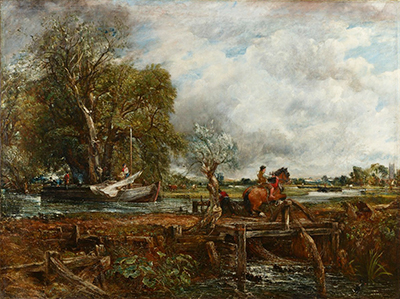
The large Stour paintings made between 1819 and 1825 are among Constable's most important contributions to landscape art. The V&A describes the group as major River Stour subjects and explains that Constable used full-scale oil studies to work out arrangement, colour relationships, illumination and tonal balance.[1] These works include The Hay Wain and The Leaping Horse, but the group matters as a sustained project rather than a sequence of isolated famous images.
Their size was a statement. By painting the Stour on a six-foot scale, Constable gave familiar local scenery the physical presence of major public art. The river of his youth became an exhibition subject large enough to compete with historical, classical and portrait works. This was not modest naturalism. It was a strategic elevation of the local.
The National Gallery places The Hay Wain as the third of the large Stour landscapes exhibited at the Royal Academy between 1819 and 1825.[5] Stratford Mill had appeared the previous year, and The Leaping Horse would later extend the Stour subject into greater movement and compositional complexity.[6] The sequence shows Constable testing how much drama, scale and structure could be drawn from a landscape he knew intimately.
These paintings also show why Constable's landscapes should not be reduced to photographic realism. He adjusted, combined and enlarged. The British Museum's study for The Leaping Horse notes that the finished painting involved topographical licence, including a reorganisation of real viewpoints and motifs.[8] Such licence did not betray nature. It allowed Constable to make a more forceful pictorial truth from observed materials.
The six-footers also demonstrate his courage as an exhibitor. Their size announced seriousness, but it also increased risk. A large landscape required time, materials and confidence. It had to survive public scrutiny in a competitive exhibition setting. Constable's choice of Stour subjects on that scale was therefore a professional wager. He was not simply painting what he loved; he was asking the public to adjust its sense of what landscape could be.
Their effect depends on the balance between monumentality and local detail. A six-foot canvas can hold breadth, but Constable refused to let breadth become emptiness. The viewer still finds dogs, boats, weeds, figures, posts, harness and reflected light. The local facts keep the grand scale honest. The grand scale gives the local facts authority.
The Hay Wain and the Problem of Fame
The Hay Wain is the unavoidable centre of Constable's public reputation, but its fame can flatten the rest of the landscape career. It is best treated as a flagship rather than a summary. The painting gathers many of his central concerns: Flatford, family geography, agricultural work, studio construction, full-size preparation, Dutch and Flemish echoes, French reception and later national symbolism.
The National Gallery's account helps keep the painting grounded. The setting is Flatford millpond on the River Stour; the cottage at the left is Willy Lott's house, and the wagon moves through shallow water toward the haymaking beyond.[5] The painting evokes a Suffolk scene but was created in Constable's London studio from open-air sketches made over several years.[5] That balance between place and construction is central to all his major landscapes.
The painting's later popularity can make it seem timeless, but its early history was uncertain. It did not sell when first exhibited in London, though its later showing in Paris helped strengthen Constable's reputation.[5] The modern image of The Hay Wain as beloved national icon should not hide its original role as an ambitious and risky exhibition landscape.
For the wider landscape story, The Hay Wain matters because it shows how Constable could make a local scene carry broad feeling. Yet it should not consume every discussion of him. Other landscapes are darker, rougher, more experimental, more architectural or more exposed to the sea. The full landscape career is richer than the single famous image.
The fame of The Hay Wain can also obscure how strange its achievement is. It appears effortless, yet its making involved accumulated studies, compositional revision and exhibition ambition. It appears timeless, yet it belongs to a period of rural change and artistic uncertainty. It appears national, yet it first gained special importance through French response. The painting's familiarity is real, but it rests on tensions that make it worth returning to.
As a flagship, it should guide rather than swallow the landscape story. It gives readers a way to understand Constable's method, but the same method changes character elsewhere. In Salisbury, architecture enters. In Hampstead, sky dominates. On the coast, sea air sharpens the touch. In late work, storm and watercolour loosen the language. The landscape career is a set of variations, not one repeated formula.
Hampstead and the Sky
Hampstead gave Constable a different kind of landscape. It was close to London, but it opened onto sky, heath and weather. The V&A notes that in the early 1820s he made a series of studies of clouds and atmospheric effects there, and records his belief that the sky was one of the landscape painter's greatest aids.[1] This was not a decorative concern. For Constable, sky governed light, scale and mood.
Mark Evans's Constable's Skies is especially valuable here because it treats the sky studies as a central part of the painter's achievement rather than a side interest.[9] Constable's cloud studies often included careful attention to time, weather and atmospheric conditions. Such discipline shows a painter interested in observation almost as a form of experiment.
Hampstead skies changed the structure of Constable's landscape art. In the Stour paintings, sky animates a remembered working world. In the cloud studies, sky can become the event itself. Land may recede to a low strip, while clouds take command. These works show Constable training himself to understand change: the gathering of cloud, the clearing of light, the pressure of wind and the movement of shadow.
The Cloud Studies deserve their own extended treatment, but their effect spreads across the whole landscape career. Once Constable understood sky as active structure, no finished landscape could treat it as background. Clouds became the emotional machinery of the painting. They determine whether a field glows, a cathedral darkens, a shore sharpens or a river scene feels suspended before rain.
This attention to sky was also part of Constable's resistance to convention. A conventional landscape could use sky to complete a balanced view. Constable made it restless. His clouds move, gather, break and threaten. They are often specific enough to suggest a moment of weather rather than a general atmospheric mood. The result is a landscape art in which time is visible overhead.
The sky studies also reveal a scientific temperament working in an artistic register. Constable's interest in weather did not make his landscapes coldly empirical. Instead, observation deepened feeling. A cloud carefully watched could become the carrier of mood because it was understood as a real phenomenon. In his landscapes, sentiment grows out of accuracy.
Salisbury and Cathedral Landscape
Salisbury offered Constable a landscape shaped by architecture, friendship and weather. It was not the family ground of Suffolk, but it became deeply personal through his relationship with Archdeacon John Fisher. The V&A identifies Salisbury as one of the places to which Constable returned often, closely tied to Fisher's presence there.[1] Cathedral, close, river, meadow and sky became recurring elements in a landscape of friendship and later emotional weight.
The National Gallery entry for Salisbury Cathedral and Leadenhall from the River Avon gives the essential coordinates: an oil sketch connected with Constable's 1820 stay, seen across the Avon toward the Cathedral and Leadenhall.[10] The work shows the cathedral within a lived setting rather than as an isolated monument. Buildings, trees, water, figures and sky all interact.
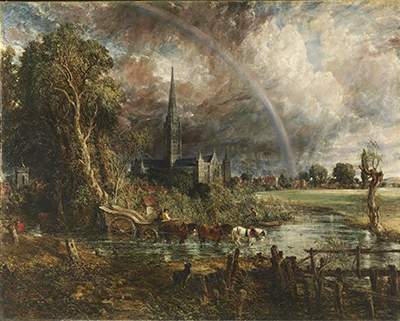
Constable's Salisbury paintings must be kept distinct. The Bishop's Grounds view, the storm-charged Meadows composition, the River Avon and Leadenhall oil sketch, and Water Meadows near Salisbury are related but not interchangeable. They differ in viewpoint, date, occasion, handling and emotional register. The cathedral can be commission, memory, friendship, religious symbol, architectural anchor or weathered presence depending on the work.
The Salisbury landscapes show Constable's ability to make architecture behave like landscape. Stone is not separate from air. The cathedral spire rises through trees and weather; water and meadow complicate the view; clouds affect the emotional force of the building. These paintings are not only about Salisbury Cathedral. They are about how a fixed structure is transformed by atmosphere.
This makes Salisbury one of the most important tests of Constable's landscape language. The cathedral brings inherited meaning: church, history, authority, patronage and architecture. Constable surrounds that meaning with changing air. The paintings do not reduce the building to a symbol; they place it inside a living environment. The result is a landscape in which permanence and transience meet.
Salisbury also extends the emotional geography beyond childhood. Suffolk is the landscape of origin; Salisbury is the landscape of friendship, commission and later reflection. This difference matters because it shows Constable's range. He could make a landscape personally charged even when it was not the ground of his early life. Attachment could be formed through friendship and repeated looking as well as birth.
Brighton, Weymouth and the Coastal Landscape
Constable's coastal landscapes extend his weather language beyond inland rivers and fields. Weymouth and Brighton brought open horizon, sea wind, shore, cliffs, boats, fishermen and stronger light. The National Gallery describes Weymouth Bay: Bowleaze Cove and Jordon Hill as a view from Osmington, connected with Constable's 1816 honeymoon stay, and notes the existence of several versions of the subject.[11] This already suggests how coastal experience could become a sustained pictorial problem.
The V&A connects Brighton with Maria Constable's ill health and the family's lodgings there from 1824 to 1828.[1] During those years Constable made drawings and oil sketches of the shore, fascinated by cliffs, light and dark sky effects.[1] Brighton was therefore both personal and artistic. It belonged to illness and family care, but also to experiment with marine atmosphere.
The coastal works differ from the Stour landscapes in their exposure. The river valley gives Constable sheltering trees, mills, banks and enclosed water. The coast gives him glare, wind, surf, moving boats and a more open horizon. The paint must work differently. It must suggest brightness, wetness, rough air and shifting sea conditions.
These works also bring Constable closer to a broader modern field of marine and weather painting. They should not be treated as Turner-like by default, but they do show him engaging with subjects that Turner also made central: coast, light, weather and movement. Constable's response remains grounded in observed place, but the coast expands his range.
The coast also changes the role of human figures. Inland figures often belong to agriculture, river work or village life. Coastal figures may be fishermen, walkers, sailors or labourers beside boats and shore traffic. They can appear more exposed because the landscape offers less enclosure. Constable's coastal art is therefore not only a change of scenery. It is a change in the relation between body, weather and space.
Brighton and Weymouth also make clear that Constable's art was responsive to circumstance. He did not travel widely in the Turner sense, but when life took him to new places, he looked intensely. Illness, marriage, lodging and friendship all became routes into landscape. The coast is part of the biography of care as well as the biography of painting.
Late Landscapes, Storm and Rainbow
Constable's late landscapes often carry a darker and more experimental emotional charge. Maria Constable died in 1828, and the years that followed brought grief, family responsibility and continued artistic labour.[1] It is tempting to read every stormy late work as a direct expression of bereavement, but that is too simple. Weather had always mattered to him. What changed was the intensity with which weather, memory and material handling could converge.
Late Salisbury subjects, ruined places, rainbows and watercolours show a painter pressing landscape into more expressive territory. The V&A notes that after 1829 Constable increasingly preferred watercolour for outdoor work.[1] This shift opened new possibilities of speed, texture, transparency and force. Late Constable can be rough, urgent and atmospheric, but the roughness is often a form of thought.
The rainbow is a particularly telling motif. The V&A connects Constable's use of rainbow imagery with Romantic feeling and transience.[1] In late landscapes, such effects can suggest hope, instability, memory or spiritual tension. Yet they must be read in context. A rainbow is not a simple symbol pasted onto a scene. It is light passing through weather, and that physical fact is part of its emotional power.
Constable's late landscapes show that his art did not settle into repetition after the Stour successes. He continued to test what landscape could bear. Ruin, storm, cathedral, watercolour and cloud became means of thinking about loss and endurance. The landscapes become less easy, but also more daring.
The late works also challenge the comfortable version of Constable. Their energy can be abrasive. Their weather can feel unstable. Their handling may seem urgent, even raw. Such qualities matter because they show that his landscape art was not a retreat into calm. It was a language flexible enough to register difficulty.
At the same time, the late landscapes remain connected to his earlier practice. They still depend on looking, memory and weather. What changes is the pitch. Earlier observation becomes more openly expressive. The landscape is still the subject, but it is asked to carry more pressure.
Influence, Tradition and Difference
Constable's landscapes grew from a deep engagement with earlier art. The National Gallery notes his debt to Dutch painters such as Ruisdael, as well as to Rubens, Claude and Gainsborough.[2] He admired tradition, but he did not imitate it passively. He used older landscape models to strengthen his own claim that observed English scenery could become serious painting.
Dutch and Flemish art helped him see value in low horizons, carts, fords, trees, mills and weather. Claude and classical landscape offered compositional grandeur. Gainsborough, another Suffolk-born artist, offered a nearer English precedent. But Constable's originality lay in the way he made inherited landscape structures answer to direct local observation.
His difference from Turner also clarifies his landscape art. Amy Concannon's edited Turner and Constable: Rivals and Originals frames both artists as transformative figures in British landscape, though with radically different visions.[12] Turner often moves through travel, history, light and elemental drama. Constable returns to known ground, observed weather and the emotional force of repeated attention. Both enlarged landscape painting; they did so from different directions.
Constable's influence abroad further complicates the idea of him as a purely English painter. The National Gallery presents his work as important for later French landscape circles, including Barbizon and Romantic painting.[2] French artists responded to the freshness of his handling and his renewed relation to nature. The local Stour could therefore have international consequences. Constable's landscapes begin in Suffolk, but they do not end there.
How Constable Changed Landscape Painting
Constable changed landscape painting by insisting that familiar places could be profound. He did not need mountains, ruins, myth or distant travel to create seriousness, though he could paint ruins and cathedrals when they mattered. He made rivers, fields, mills, clouds and ordinary weather carry emotional force.
He also changed the relationship between sketch and finished painting. The V&A's account of his sketch practice shows how direct studies, oil sketches and full-size preparatory works became central to his method.[7] Modern viewers now value many of these sketches as works of extraordinary vitality. In Constable's own time, the public often expected a more polished studio finish. His process helped shift later taste toward visible freshness and experiment.
His landscapes also changed how viewers think about sky. Mark Evans's Constable's Skies rightly places cloud and weather at the centre of the artist's achievement.[9] Constable made sky the active partner of land. He showed that light and weather were not additions to landscape, but conditions that shape everything seen below.
Most of all, he made landscape painting feel emotionally honest without becoming melodramatic. His best works do not announce feeling loudly. They let feeling arise from attachment, weather, distance, memory and paint. This is why his landscapes continue to reward slow looking. They are not simply pretty scenes. They are acts of sustained attention.
This change was not only stylistic. It altered the moral status of attention. Constable implies that ordinary places deserve serious looking. A river crossing, a field path or a cloud study can matter because the world is not exhausted by grand subjects. His landscapes teach viewers to look again at what habit makes familiar.
That lesson has outlived the historical conditions of the paintings. The Stour Valley has changed; rural labour has changed; museum display has changed; national feeling around landscape has changed. Yet the act of attention remains fresh. Constable's landscapes still ask viewers to slow down before weather, water, trees and light.
Legacy of Constable's Landscapes
Constable's landscapes have become part of the visual memory of Britain, but their familiarity should not dull their strangeness. They are rougher, more constructed and more ambitious than their postcard afterlife suggests. Their surfaces often show experiment. Their compositions often combine several stages of observation. Their subjects often contain work as well as beauty.
The legacy rests on this complexity. The Stour landscapes preserve a working river world while elevating it to public art. The cloud studies turn weather into disciplined observation. The Salisbury views make architecture and atmosphere inseparable. The coastal works open the landscape to sea air and modern exposure. The late works press weather and memory toward a more urgent emotional language.
Constable's landscapes matter because they make the local expansive. A millpond becomes a national image. A cloud study becomes a theory of landscape. A cathedral view becomes a meditation on weather, friendship and loss. A familiar river becomes a field of artistic ambition.
To look at Constable's landscapes is to see that place is never merely place. It is memory, work, weather, history, affection and change. Constable's genius was to make those layers visible without breaking the spell of the view. He painted landscapes that feel natural, but their naturalness is earned through art.
Frequently Asked Questions
Discussion
Which landscape best reveals the difference between rural beauty and a working place?
Reader Insights
Where do mills, locks, barges or fields make usefulness part of the landscape's beauty?
Which sky or light effect most clearly turns a familiar view into a changing event?
How does studio synthesis affect your sense of truth in Constable's landscapes?
Join the Conversation
Share your reading below.
References
- Victoria and Albert Museum, “John Constable – an introduction,” https://www.vam.ac.uk/articles/john-constable-an-introduction
- National Gallery, “John Constable (1776–1837),” https://www.nationalgallery.org.uk/artists/john-constable
- National Trust, “History of Flatford,” https://www.nationaltrust.org.uk/visit/suffolk/flatford/history-of-flatford
- Graham Reynolds, The Early Paintings and Drawings of John Constable, Paul Mellon Centre / Yale University Press, 1996, bibliographic record: https://www.paul-mellon-centre.ac.uk/publications/browse/9780300063370
- National Gallery, “John Constable, The Hay Wain,” https://www.nationalgallery.org.uk/paintings/john-constable-the-hay-wain
- National Gallery, “John Constable, Stratford Mill,” https://www.nationalgallery.org.uk/paintings/john-constable-stratford-mill
- Victoria and Albert Museum, “John Constable's sketches,” https://www.vam.ac.uk/articles/john-constables-sketches/
- British Museum, “Study for the painting ‘The Leaping Horse’,” https://www.britishmuseum.org/collection/object/P_1888-0215-72
- Mark Evans, Constable's Skies: Paintings and Sketches by John Constable, V&A / Thames & Hudson, 2018, bibliographic record: https://www.thamesandhudson.com/products/constables-skies-victoria-and-albert-museum
- National Gallery, “John Constable, Salisbury Cathedral and Leadenhall from the River Avon,” https://www.nationalgallery.org.uk/paintings/john-constable-salisbury-cathedral-and-leadenhall-from-the-river-avon
- National Gallery, “John Constable, Weymouth Bay: Bowleaze Cove and Jordon Hill,” https://www.nationalgallery.org.uk/paintings/john-constable-weymouth-bay-bowleaze-cove-and-jordon-hill
- Amy Concannon, ed., Turner and Constable: Rivals and Originals, Tate Publishing, 2026, bibliographic record: https://www.abramsbooks.com/product/turner-and-constable_9781849769846/