 by Tom Gurney
Tom Gurney BSc (Hons) is an art history expert with over 20 years experience
Published on November 5, 2026 / Page Updated on November 5, 2026
Email: tomgurney1@gmail.com / Phone: +44 7429 011000
Introduction
John Constable's drawings reveal the artist before the celebrated oil paintings harden into familiar images. They show him measuring a bank of trees, returning to a bend of the Stour, testing the weight of a clouded sky, or pulling an old memory back into use years later. They also make clear that drawing was not a lesser activity beside painting. For Constable it was a form of thinking: quick when the weather demanded speed, patient when a composition needed testing, and deeply practical when a later canvas had to be built from earlier observation.
The surviving record is unusually rich. The Victoria and Albert Museum holds a major group of Constable material, much of it preserved through the gift made by his daughter Isabel in the late nineteenth century. That inheritance included hundreds of drawings and watercolours, many oil sketches, three sketchbooks and several paintings, allowing later viewers to trace relationships between outdoor notes, studio decisions and finished works with rare closeness.[1] The result is a view of Constable that differs from the tidy image of a painter simply copying the countryside. His drawings show selection, revision and invention. They catch a working mind moving between fact and memory, between a place seen directly and a picture imagined more fully afterwards.
At a Glance
- ArtistJohn Constable (1776–1837)
- Core purposeObservation, composition, revision and memory
- Key mediaPencil, pen, ink, wash and watercolour [3]
- Major holdingThe Victoria and Albert Museum [1]
- Family legacyIsabel Constable’s gift preserved a major working archive [1]
- Early groundThe Stour Valley around East Bergholt and Flatford [11]
- Hampstead recordAn 1819 British Museum sketchbook [6]
- Revision studyThe Leaping Horse, 1825 [5]
- Late watercolourA Mill Near Colchester, 1833 [8]
- Working principleDirect looking joined to later invention
Contents
- Introduction
- Why the Drawings Matter
- Drawing Before Painting
- Sketchbooks and Daily Looking
- The V&A Inheritance
- Early Stour Drawings
- Hampstead in a Small Book
- Drawing as Composition
- The Leaping Horse and Revision
- Watercolour as Drawing in Colour
Why the drawings matter
Constable's finished paintings often depend on a sense of direct encounter: wet earth, moving trees, carts in shallow water, distant church towers, wind entering a field. The drawings explain how that effect was made. They show that immediacy was not the same as haste. A sketch could record a topographical fact, a tonal pattern, a tree trunk, a roofline, a luminous gap in weather or the relation between foreground and distance. Later, the same note could be reworked, combined with another memory, or transformed into a larger structure.
This is why the drawings should not be treated as mere preliminaries. Some are modest aids toward larger paintings, but others have an independent force of their own. A pencil line may feel spare beside the dense surface of an oil painting, yet it can expose Constable's intelligence more directly. He strips a view to its essential parts: the angle of a lane, the rise of a bank, the silhouette of a mill, the pressure of weather over low country. The image may look simple, but the decisions are not. Drawing allowed him to decide what mattered.
The V&A's account of Constable's sketching practice stresses the breadth of media involved: pencil, pen, watercolour and oil all served the larger business of observation and invention.[2] That variety matters because Constable did not draw in one fixed manner. A small graphite note from a walk, a wash drawing, a watercolour made years after an earlier visit and an oil sketch on a prepared support all answer different needs. Together they form a flexible system of looking.
They also alter the question of finish. A Constable drawing may appear incomplete beside a public oil painting, yet incompletion can be the condition that makes it valuable. A line stops once it has done enough. A patch of wash remains open because the air around it matters more than solid description. A bare area of paper can carry light more convincingly than a heavily worked passage. Constable's works on paper often invite the viewer to watch the choice being made: enough information to make the subject live, not so much that the searching quality disappears.
Drawing before painting
Constable was born into a world where drawing still had a strong practical role. It trained the hand, ordered the eye and gave an artist portable command over a subject. For him it also had a private usefulness. He could carry a book or loose sheet into the landscape more easily than a full painting apparatus. He could note the relation of trees to a river, the tilt of a roof, the profile of a church tower, or the changing light across a meadow. Those fragments later helped him build larger pictures without losing contact with particular places.
The early Stour Valley material is especially important here. Graham Reynolds's study of Constable's early paintings and drawings remains a major guide to the formation of the artist before 1816, when East Bergholt, Dedham, Flatford and the neighbouring countryside became the basis of his pictorial language.[11] In those years Constable was not merely discovering attractive views. He was learning how a local landscape could be organised into art: how a tree mass could hold one side of a design, how water could carry the eye inward, how a path or bank could lead the viewer into depth.
Drawing gave Constable a way to make those lessons cumulative. A place could be revisited across years, and each return added another layer of knowledge. That is one reason his mature paintings can feel both observed and remembered. They do not simply record a single instant. They often gather many acts of attention into one construction.
Sketchbooks and daily looking
Constable's sketchbooks are among the clearest witnesses to his daily habit of looking. They were not elegant albums made for display. They were working companions, small enough to carry, responsive to whatever presented itself. A sketchbook could include a cart, a pond, a cottage, a tree, a grave, a road, or a distant view, without insisting that every subject already belonged to a grand painting. The value lay in repeated contact with the visible world.
The British Museum's 1819 sketchbook is a useful example. It is one of a small group of intact or nearly intact sketchbooks associated with Constable, and it contains early Hampstead subjects alongside everyday observations such as sand carts, ponds and family graves.[6] Its small format changes how we understand the act of drawing. This was not an artist staging a grand confrontation with nature. It was an artist working at walking scale, catching motifs as they appeared and saving them for later thought.
That smallness is not trivial. A modest sketchbook encourages close attention rather than theatrical effect. Constable could respond to a minor arrangement of forms before it became a formal composition. He could study how a road bends, how a tree interrupts a skyline, how a pool holds reflected light, or how work carts alter the mood of a common landscape. These observations fed his larger art because they kept it tethered to lived experience.
The V&A inheritance
Modern understanding of Constable's drawings owes an exceptional debt to the material preserved by his family and later given to the V&A. Isabel Constable's gift transformed the public record of his working practice. The collection includes drawings made directly from nature, watercolours, oil sketches, sketchbooks and finished paintings, making the museum central to any serious account of how Constable moved between outdoor study and studio picture-making.[1]
This surviving body of work also helps correct a common misunderstanding. Constable's art is sometimes described as if sincerity alone explained it, as though he simply loved his native countryside and therefore painted it truly. The drawings show something more exacting. Sincerity mattered, but it operated through discipline. He gathered visual evidence, returned to subjects, stored impressions and reactivated them when a later composition demanded it.
The V&A's holdings also reveal how porous the boundaries were between drawing and painting. An oil sketch could be as investigative as a pencil study. A watercolour could behave like drawing in colour, recording a visual problem rather than presenting a polished performance. A sketchbook note could become useful long after the moment that prompted it had passed. Constable's drawings therefore belong to a continuum, not to a separate minor category.
The preservation of so many working objects also gives modern viewers a rare advantage. We can compare an apparently informal mark with a later compositional choice; we can see how a tree, cottage, bank or cloud form survives alteration; and we can recognise how much of Constable's authority rests on repeated trial rather than single inspiration. Without that archive of drawings and sketches, the oils would still be impressive, but the labour behind their naturalness would be far harder to see.[1]
Early Stour drawings
The Stour Valley gave Constable a landscape he knew bodily before he made it pictorially famous. The fields, mills, locks, towpaths and river bends around East Bergholt and Flatford were familiar through family, work, walking and memory. His drawings from this world do more than document local scenery. They show him working out how a region of ordinary labour could become a serious artistic subject.
Early drawings of the Stour often carry a structural clarity that can be missed in the warmer colour of the oils. Without the fullness of paint, the arrangement of masses becomes easier to see. Trees stand as dark weights. Riverbanks form planes. Buildings mark human presence without overwhelming the landscape. Distance is organised by small changes of tone and line. Drawing lets Constable reduce complexity without emptying it.
This reduction was crucial to his later paintings. A large canvas could not simply absorb the whole countryside. It had to be composed. The artist needed to know what to retain, what to move, what to omit and what to strengthen. Drawing supplied that discipline. It sharpened his sense of place while giving him freedom to transform place into design.
Reynolds's concentration on the early paintings and drawings is especially useful because it places those decisions before the later fame of the six-footers.[11] It shows an artist forming habits before the most celebrated results arrive. The early drawings do not merely anticipate masterpieces; they record the apprenticeship of attention. Constable learns the grammar of his own country before turning it into a language large enough for exhibition.
Hampstead in a small book
Hampstead expanded Constable's drawing practice in a different direction. The heath gave him wider skies, higher viewpoints and a more open relation between land and atmosphere. His first Hampstead drawings appear in the 1819 British Museum sketchbook, a reminder that this major later subject began with compact, portable observation rather than with grand studio ambition.[6] The shift from the Stour to Hampstead did not mean abandoning local study. It meant applying the same habits to a new landscape.
The small book also helps bridge two sides of Constable often kept apart: the intimate observer and the ambitious exhibitor. In a sketchbook, Hampstead is not yet the setting for a dramatic sky or a finished statement about weather. It is a place of paths, ponds, carts, trees and distances. The later force of his sky studies and heath views depends on that ground-level familiarity.
Hampstead drawing also altered Constable's sense of scale. The Stour gave him enclosed river spaces, mills and low meadows. Hampstead offered a view over London, broken ground, broad weather and sudden atmospheric change. Drawing allowed him to test how much information a view could carry before it lost coherence. It trained him to bind land and sky without making either one merely decorative.
Drawing as composition
Constable's drawings often resist the simple idea that a study is made first and a painting follows obediently afterwards. Sometimes that happens, but often the relationship is more complex. A drawing may come before, during or after work on a painting. It may preserve a motif, solve a compositional difficulty, re-examine a topographical question, or help the artist rethink a subject already underway.
The V&A material on Constable's sketches is especially helpful because it shows drawing, oil sketch and large-scale study working in relation to one another.[2] Constable could produce rapid observations outdoors, return to them in the studio, and make larger studies when a major composition required testing. The process was flexible rather than mechanical. A painting was not a mere enlargement of a small note. It was the result of comparison, adjustment and selection.
That flexibility is one reason the drawings remain exciting. They show decisions still alive. A line may test a contour. A wash may weigh a dark mass against a pale opening. A composition may shift from topographical fidelity toward pictorial necessity. Drawing allowed Constable to keep invention close to observation, so that even altered scenes retained the authority of things seen.
The Leaping Horse and revision
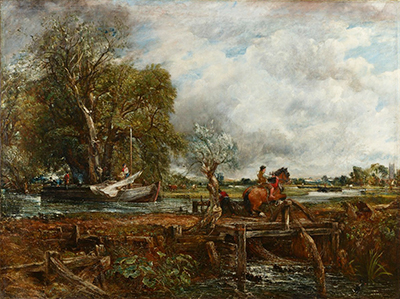
The British Museum's drawing related to The Leaping Horse gives a particularly valuable glimpse of drawing as revision. The work is a graphite, pen, ink and wash study from 1825, connected with the last of Constable's Stour six-footers. The museum notes that the painting is unusual within that series because preparatory drawings exist for the whole composition, while also warning against a neat, step-by-step progression from drawing to final painting.[5]
That warning matters. It prevents us from treating the drawing as a fixed blueprint. Instead, the sheet belongs to a moving exchange between memory, observation and design. Constable used drawing to test the arrangement of the scene, but he also allowed the painting to change as its pictorial demands became clearer. Topography could be adjusted. Motifs could be repositioned. What mattered was not literal transcription, but the force of the final image.
The Leaping Horse study is also important because it shows Constable's willingness to invent within a landscape he knew intimately. Familiarity did not bind him to passive accuracy. It gave him the confidence to alter. Drawing helped him determine how much freedom the subject could bear while still feeling rooted in real country.
Watercolour as drawing in colour
Constable's watercolours complicate any strict separation between drawing and painting. Many are works on paper, built from graphite, wash, colour and acts of abrasion or scoring. They can be quick, experimental and observational, but they can also be revisited and elaborated. The V&A's account of his watercolour sketches stresses his later use of opaque pigment, graphite underdrawing, expressive washes and scratched or scored highlights.[3]
Watercolour suited Constable because it could carry both line and weather. A graphite structure might hold a view in place while washes registered cloud, rain, sea air or fading light. Unlike a polished exhibition oil, a watercolour sketch could remain visibly provisional and still feel complete in another sense. Its vitality lies in the tension between record and improvisation.
This was especially important in the later years, when Constable's handling grew freer and more turbulent. Watercolour allowed him to work with suddenness without surrendering structure. The sheet could bear scraping, strengthening, darkening and rethinking. In such works, drawing becomes almost atmospheric. Line, wash and surface disturbance combine to make weather legible.
London from Hampstead Heath
The British Museum's London from Hampstead Heath shows how a watercolour drawing can look spontaneous while also carrying deliberate adjustment. The work dates from 1830 and presents a view toward London under dark weather, with cloud and rain central to its mood.[7] It belongs to the later Constable in whom landscape is increasingly charged by atmospheric pressure.
Yet the interest of the work is not only meteorological. The museum's account indicates that the image involves topographical adjustment, a useful reminder that immediacy and invention can coexist.[7] Constable could preserve the sensation of looking across a rainy distance while modifying the arrangement of the view. The drawing is therefore not a neutral transcript. It is an image made from observation shaped by pictorial intelligence.
That combination is central to Constable's achievement. He wanted nature to feel active, but he also knew that an artwork had to be organised. In London from Hampstead Heath, watercolour gives him a medium supple enough to hold both demands. Rain, cloud and city distance are not accessories. They are the very substance through which the view is understood.
A Mill Near Colchester
The Metropolitan Museum of Art's A Mill Near Colchester offers a late example of drawing as memory, watercolour experiment and transfer device. The work dates from 1833 and is made in watercolour over traces of graphite, with other media and scratched highlights contributing to its force.[8] It was not simply the result of a fresh encounter with the subject. The Met notes that Constable drew on sketches made at the location many years earlier, transforming old material into a late, emotionally charged image.[8]
This return to earlier observation is revealing. Constable's drawings did not expire once their immediate purpose had passed. They formed an archive of experience that could be reactivated when mood, memory or a later project required it. In A Mill Near Colchester, the earlier record becomes the basis for a work whose energy belongs to the 1830s. The result is both remembered and newly made.
The work also points toward print culture without needing to leave drawing behind. The Met identifies evidence of squaring for transfer and notes the later mezzotint connection with David Lucas.[8] That matters because drawing, watercolour and print were not isolated worlds in Constable's late career. A work on paper could preserve memory, construct atmosphere and prepare an image for wider circulation. The deeper question of Constable's prints belongs elsewhere, but this example shows how drawings could move outward into other forms.
Oil sketches and works on paper
Although drawings in the narrow sense often mean pencil, pen, ink or watercolour, Constable's oil sketches deserve a brief place in this discussion because many function like drawings in paint. The V&A's material on oil sketches describes supports made from paper or card, coloured grounds and evidence revealed by close technical examination, including information on backs and reverses.[4] These works show how freely Constable could investigate form, colour and light outside the finish expected of formal exhibition painting.
Oil sketches can be misleading if treated only as spontaneous outbursts. Some are direct and rapid, but they also belong to a disciplined practice of study. A prepared support, a coloured ground or a reused reverse tells us that practical decisions shaped what seems effortless. Constable's art often depends on this paradox: the freshness is real, but it is made possible by preparation.
Seen beside pencil drawings and watercolours, the oil sketches enlarge the meaning of drawing. They are not drawings by material, but they share drawing's investigative purpose. They seek, test and discover. They let Constable bring colour and tone into the same exploratory space where graphite or wash might otherwise operate.
This is also why small material facts matter. A card support, a coloured ground, a worked reverse or a roughly handled surface is not only a conservation detail. It tells us how Constable made room for experiment. Working materials could be practical, reused, portable and responsive. They suited an artist who wanted to keep looking active, even when he was no longer standing before the original subject.[4]
Drawing, memory and change
One of the most powerful lessons of Constable's drawings is that observation and memory were partners. The artist often worked from direct encounter, yet his mature art also depends on recall, return and recombination. A view from youth could become newly useful in middle age. A sketchbook note could help organise a larger painting. A watercolour could reinterpret an older study through later feeling.
The Metropolitan Museum's broader essay on Constable emphasises the role of outdoor studies as foundations for studio paintings and notes the later use of earlier outdoor material in more developed works.[9] That pattern helps explain why the drawings feel so alive. They are not inert records. They are stored acts of attention, capable of further life.
This also changes how we read Constable's realism. His fidelity to nature was not a demand that nothing be altered. It was a commitment to grounding invention in sustained seeing. Drawings allowed him to keep that ground under his feet even when a composition became increasingly constructed. They gave his imagination something firm to push against.
What to look for
When looking at a Constable drawing, it helps to ask what kind of problem the work is solving. Is it fixing a motif, testing a composition, noting weather, preserving a place, or revisiting a memory? A spare graphite drawing may be chiefly structural. A pen and wash study may clarify masses of dark and light. A watercolour may use colour to make air, rain or distance active. An oil sketch may test tonal unity or surface movement with unusual freedom.
It also helps to notice what is omitted. Constable often leaves out as much as he records. Empty space may be active. A quick contour may stand for a mass of foliage. A few tonal patches may establish a whole sky. The drawings teach us that observation is selective, not merely accumulative. He saw intensely because he chose sharply.
The National Gallery of Art's holdings, including works such as A Great Oak Tree and watercolour or graphite examples, help demonstrate the range of Constable's works on paper beyond the best-known Stour and Hampstead subjects.[10] That range matters. Constable's drawing practice was not an occasional supplement to a few famous paintings. It was a long, varied habit that extended across places, media and decades.
Drawings as a working mind
Constable's drawings are among the best ways to meet the artist without the varnish of fame. They are intimate, but not small in ambition. They reveal a painter who needed repeated contact with nature, but who also understood that nature had to be remade as art. They show him gathering evidence, testing structures, revising effects and carrying memory forward.
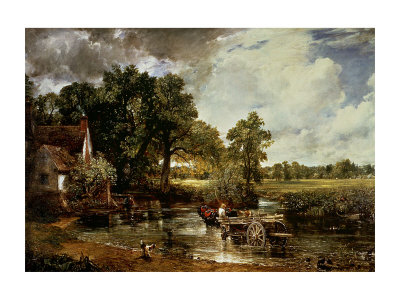
They also make the finished paintings more interesting. After spending time with the drawings, The Hay Wain, The Leaping Horse, the Hampstead views, the late watercolours and the Stour landscapes no longer appear as isolated achievements. They become visible as the results of a long practice of looking. The drawings are the connective tissue: between place and picture, between early observation and later invention, between private work and public art.
Constable once sought to make landscape painting serious without losing its local truth. His drawings show how he pursued that ambition at the most immediate level, line by line and wash by wash. They are not simply studies for something else. They are the record of attention becoming form.
Frequently Asked Questions
Discussion
Which kind of drawing brings Constable's mind closest: a quick notation, a revised composition or a late remembered landscape?
Reader Insights
Where does a sparse contour tell you more than a fully described surface?
Which works feel most rooted in direct looking, and which depend on later transformation?
When does a study stop feeling preparatory and become a complete work in its own right?
Join the Conversation
Share your reading below.
References
- Victoria and Albert Museum, “John Constable,” https://www.vam.ac.uk/collections/john-constable
- Victoria and Albert Museum, “John Constable's sketches,” https://www.vam.ac.uk/articles/john-constables-sketches/
- Victoria and Albert Museum, “Constable's watercolour sketches,” https://www.vam.ac.uk/articles/constables-watercolour-sketches
- Victoria and Albert Museum, “Constable's oil sketches,” https://www.vam.ac.uk/articles/constables-oil-sketches
- British Museum, “Study for ‘The Leaping Horse’,” https://www.britishmuseum.org/collection/object/P_1888-0215-72
- British Museum, “Sketchbook,” 1819, https://www.britishmuseum.org/collection/object/P_1972-0617-15
- British Museum, “London from Hampstead Heath,” https://www.britishmuseum.org/collection/object/P_1888-0215-51
- Metropolitan Museum of Art, “A Mill Near Colchester,” https://www.metmuseum.org/art/collection/search/375834
- Metropolitan Museum of Art, “John Constable (1776–1837),” https://www.metmuseum.org/de/essays/john-constable-1776-1837
- National Gallery of Art, “John Constable,” https://www.nga.gov/artists/1158-john-constable
- Graham Reynolds, The Early Paintings and Drawings of John Constable, Paul Mellon Centre / Yale University Press, 1996, https://www.paul-mellon-centre.ac.uk/publications/browse/9780300063370