



 by Tom Gurney
Tom Gurney BSc (Hons) is an art history expert with over 20 years experience
Published on June 19, 2020 / Updated on October 16, 2026
Email: tomgurney1@gmail.com / Phone: +44 7429 011000
The Virgin with Angels by William-Adolphe Bouguereau: Introduction
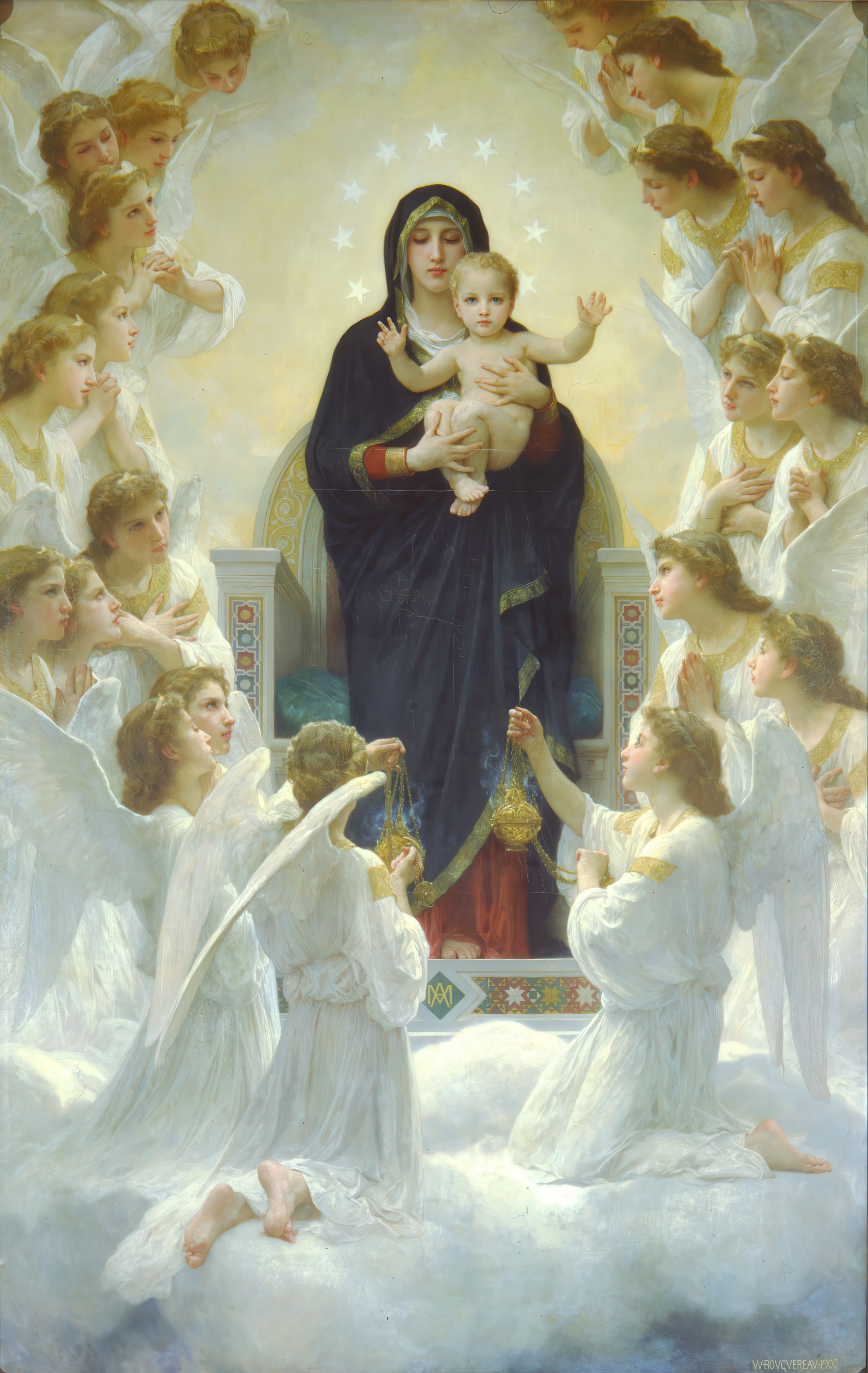
William-Adolphe Bouguereau's The Virgin with Angels is best securely tied to the painting recorded by Paris Musees as La Vierge aux anges. The Petit Palais record identifies the artist as William Bouguereau, dates the work to 1900, gives the original exhibition title as Regina Angelorum, and lists the painting in the collection of the Petit Palais, musee des Beaux-Arts de la Ville de Paris, under inventory number PPP3766 [1]. The work is an oil on canvas, signed and dated at the lower right in 1900 [1].
The familiar English title The Virgin with Angels is a usable translation, but the official French record is La Vierge aux anges, with Regina Angelorum as the original title [1]. The official dimensions are also important: Paris Musees gives the work as 280 cm high by 184 cm wide [1]. Those measurements emphasize the painting's vertical, altarpiece-like presence.
The subject is the Virgin Mary with the Christ Child and angels. Paris Musees describes Mary with a halo of stars, holding the infant Jesus before a Byzantine-style throne enriched with colored stones. The Child raises his arms in a blessing gesture, while angels gather around them; two kneeling angels in the foreground hold censers [1]. The painting is therefore not only a tender Madonna and Child. It is a formal image of the Virgin in majesty.
For Bouguereau's wider religious work, compare Pieta, Virgin Comforter, The Madonna of the Lilies and The Flagellation of Christ. For the whole artist cluster, begin with the William-Adolphe Bouguereau biography and the paintings hub.
At a Glance
- ArtistWilliam-Adolphe Bouguereau
- Official TitleLa Vierge aux anges [1]
- Original TitleRegina Angelorum [1]
- English TitleThe Virgin with Angels
- Date1900 [1]
- MediumOil on canvas [1]
- Dimensions280 x 184 cm [1]
- CollectionPetit Palais, musee des Beaux-Arts de la Ville de Paris; inventory PPP3766 [1]
- AcquisitionGift from Charles Vincens-Bouguereau, acquired October 24, 1983 [1]
- SubjectThe Virgin Mary with the Christ Child, angels, incense and a Byzantine-style throne [1]
Contents
- Introduction
- Object Facts and Collection Route
- Virgin in Majesty
- Angels, Incense and Decorative Structure
- Academic Finish and Replica Context
- Relationship to Bouguereau's Religious Works
- Reception and Modern Reading
- Where to Go Next
- Annotated Details
Object Facts and Collection Route
The object facts for this page are stronger than many other privately sourced Bouguereau pages. Paris Musees identifies the museum, title, alternative title, date, medium, dimensions, signature/date, iconography, acquisition route and current display location [1]. It records the painting as a manual gift from Charles Vincens-Bouguereau, acquired on October 24, 1983, and exhibited at the Petit Palais, Rez-de-Jardin, Salle 06 [1].
The acquisition route is useful because it connects the painting to the Bouguereau family line rather than to a simple auction trail. Charles Vincens-Bouguereau appears in other Bouguereau records as a family-associated donor, including the Orsay study material used for The Youth of Bacchus [8]. Here, Paris Musees gives him directly as donor of La Vierge aux anges [1].
The Paris Musees page also gives a CC0 image indication for the object and a Paris Musees / Petit Palais credit line [1]. That makes the official Petit Palais record especially useful when compared with market records for L'Amour et Psyche, Enfants or Pieta.
Getty's Virgin of the Angels material also needs to be kept in its proper place. Getty discusses a related 1881 Virgin of the Angels from Forest Lawn, including a preparatory sketch, a half-size replica and conservation work at the Getty [2]. That is not the same object as the 1900 Petit Palais La Vierge aux anges, but it is valuable context for Bouguereau's repeated Marian compositions, replica practice and technical precision.
Virgin in Majesty
Paris Musees explicitly connects La Vierge aux anges to the iconography of the Virgin in Majesty [1]. This means the painting should not be read only as a sweet image of Mary and the Child. It belongs to an older tradition in which Mary is enthroned or placed in a position of sacred authority, often surrounded by angels and signs of heavenly honor.
Bouguereau's version is late nineteenth-century in finish, but deliberately archaic in structure. Paris Musees notes that the work was conceived as a monumental altarpiece and relates it to thirteenth-century Virgin in Majesty imagery associated with Cimabue and Duccio [1]. The throne, the halo of stars, the angels and the incense all point toward devotional ceremony rather than domestic intimacy.
The painting's original title, Regina Angelorum, deepens that reading. It means Queen of Angels. The title helps explain why the angels are not merely decorative attendants. They are gathered around Mary and Christ in an act of veneration. Their bodies, faces and gestures create a circle of worship.
The Christ Child's blessing gesture is also central. Paris Musees describes the infant raising his arms in the gesture of Christ blessing [1]. That gesture gives the child theological authority even as he remains physically small. Bouguereau's surface may be soft and graceful, but the subject is hierarchical: Mary, Christ, angels, throne, stars and incense all organize a sacred order.
The star halo is another key element. It identifies Mary not simply as a mother, but as a heavenly figure. In the painting's structure, the stars, throne and angels frame her as queenly, while the Child's gesture points toward divine authority. Bouguereau therefore joins tenderness and hierarchy. The central figures are intimate in scale and contact, but the surrounding signs make the scene ceremonial.
The Child is not passive decoration. His lifted arms make him the active theological center of the painting, even though Mary gives the composition its monumental form. Bouguereau balances mother and child carefully: Mary presents and protects, while Christ blesses. The angels' attention confirms that the center of the image is not only maternal tenderness, but sacred recognition.
This is why the work reads differently from a domestic Madonna and Child. Mary does not sit in an ordinary room, and the angels are not casual companions. The space is constructed as a sacred court. The viewer looks into an image of worship, with Mary and Christ at the center and the angels arranged as participants in a heavenly liturgy.
Annotated Details from The Queen of the Angels
This annotated view uses the high-resolution source to follow the figure group, light and devotional staging without altering the underlying image.
Details from THE QUEEN OF THE ANGELS
These close views use the high-resolution public-domain source while keeping annotation markers in CSS rather than in the image file.
Central figures
The central group anchors the subject and gives the surrounding movement a visual center.
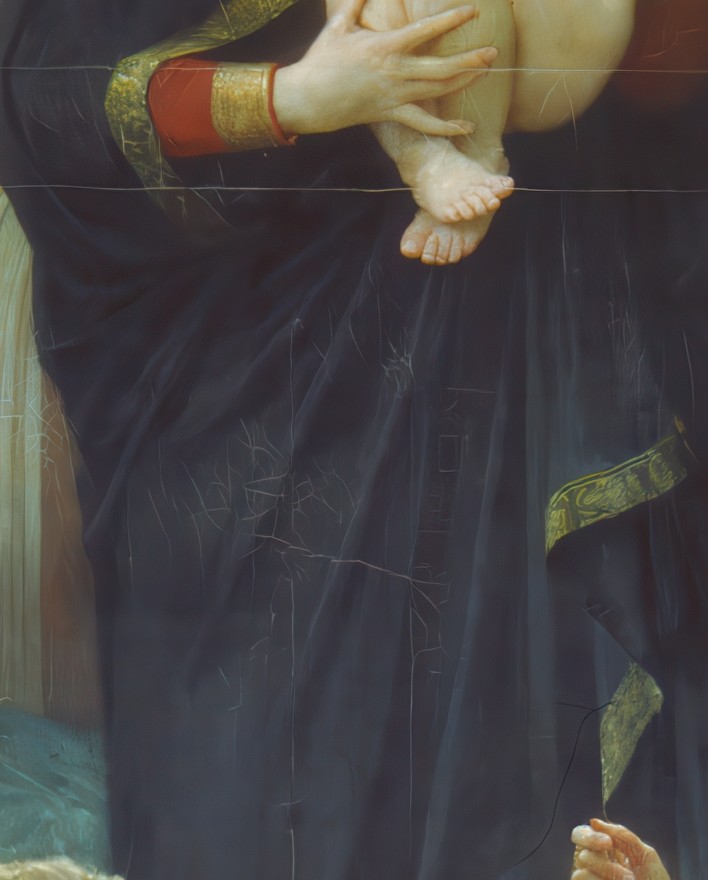
Faces and glances
Small changes of gaze help explain the relationship between figures without needing a separate narrative cue.
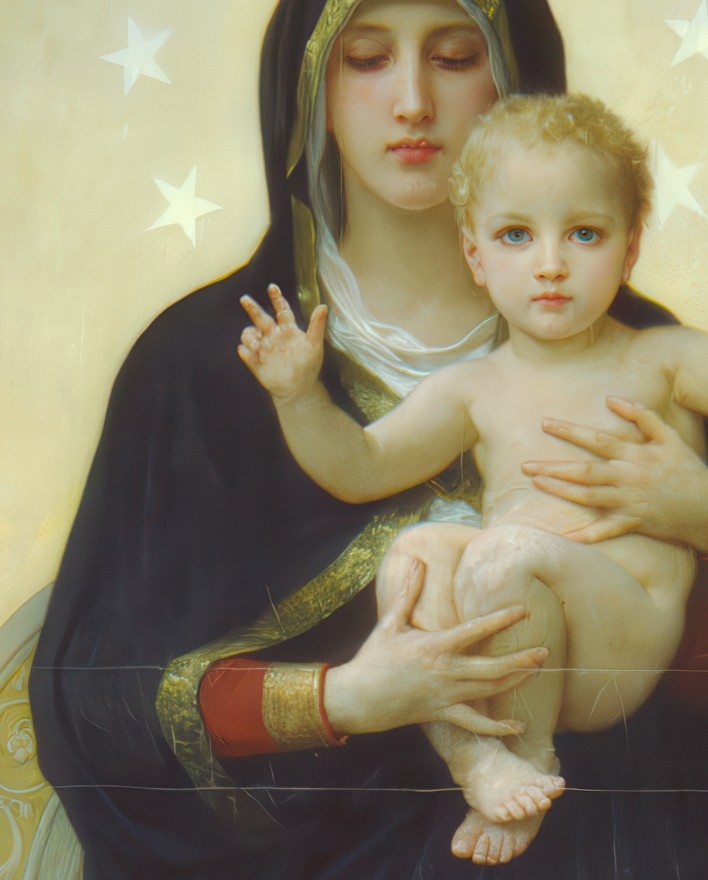
Hands and contact
Hands and points of contact make the figure group feel constructed through touch rather than simple placement.
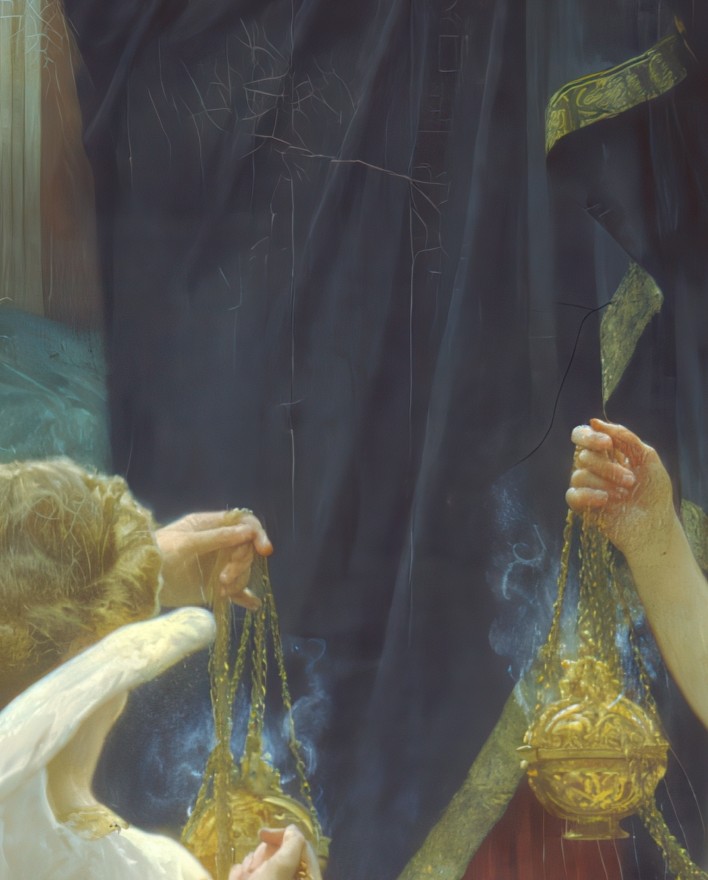
Drapery and light
Drapery gathers the brightest passages into a readable rhythm around the bodies.
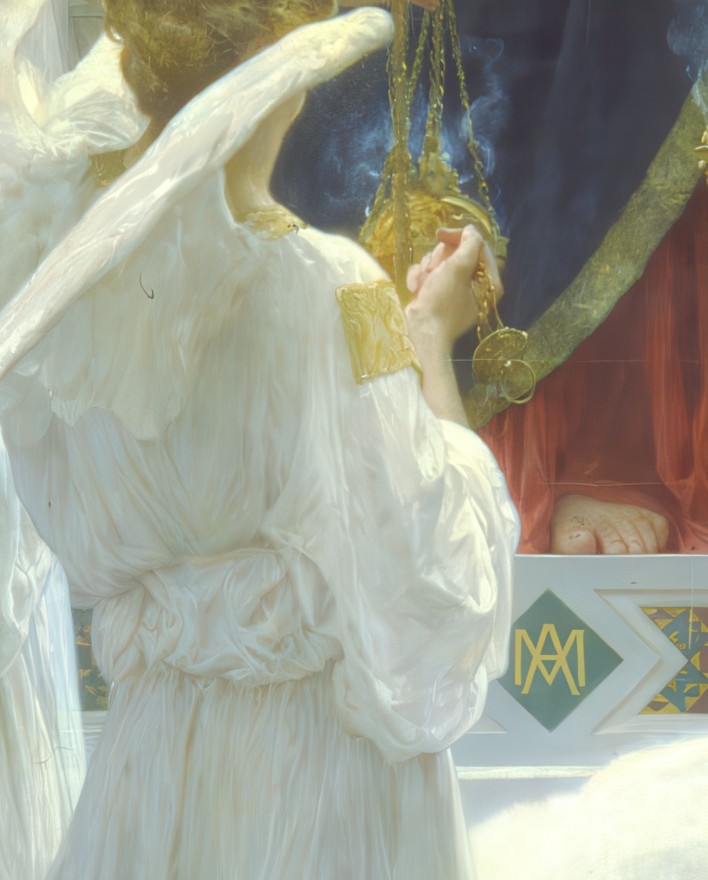
Setting edge
The background and edges create depth while keeping the main figures close to the viewer.
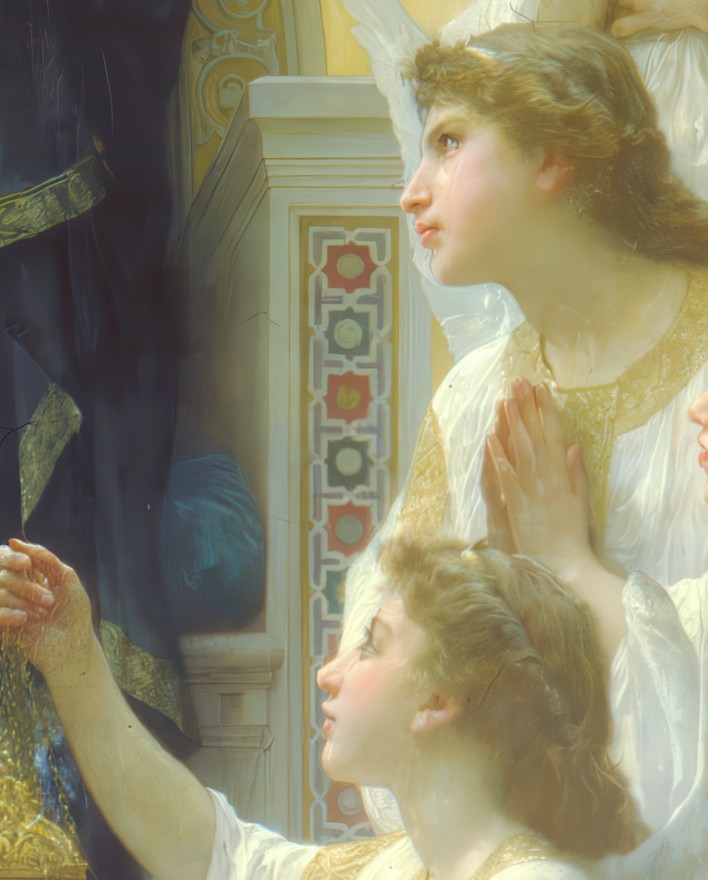
Lower movement
The lower passage supplies balance, weight and directional movement for the composition.
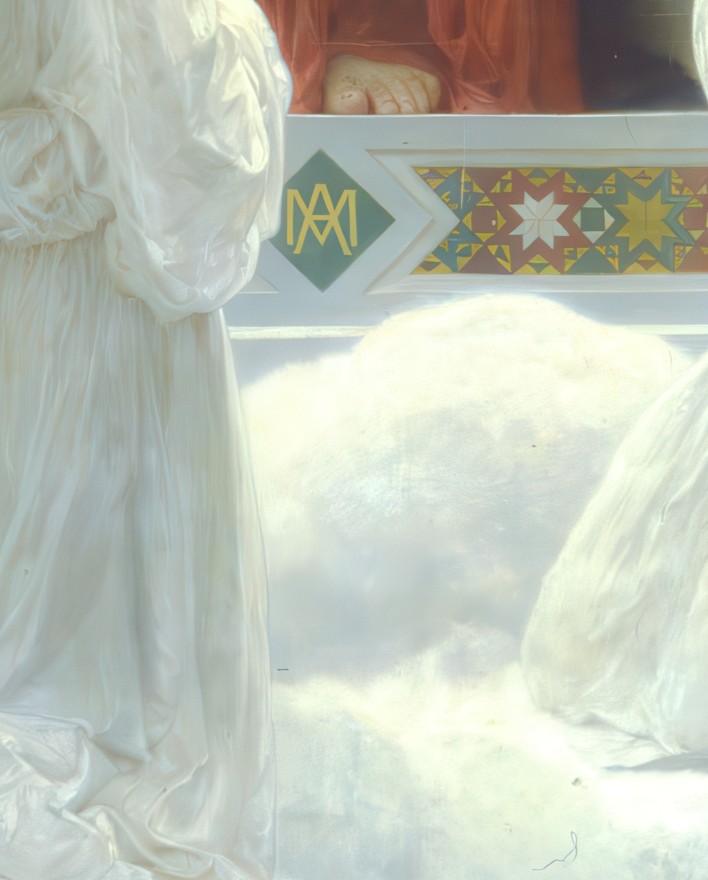
Upper light
The upper tones frame the figures and set the emotional temperature of the scene.
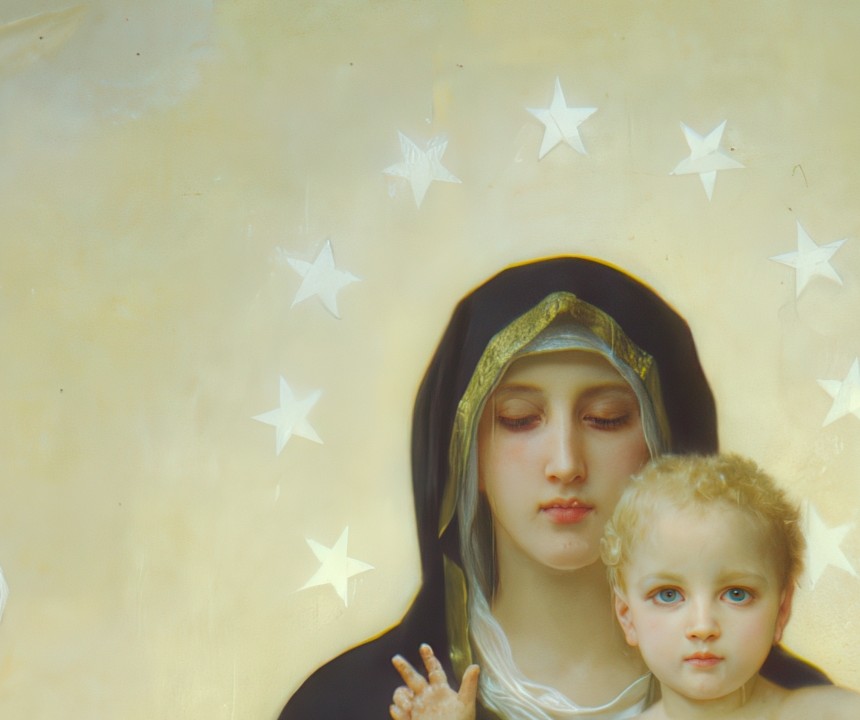
Angels, Incense and Decorative Structure
The angels are the painting's most visible surrounding presence. Paris Musees describes angels in a circle around the Virgin and Child, some with hands joined, some with hands placed on the chest, and two kneeling in front with censers [1]. These details give the painting a liturgical rhythm. The figures do not simply admire the central pair; they participate in a devotional act.
The censers matter because incense belongs to worship, procession and sacred offering. The incense can be read as more than a general sign of praise. In the stronger source-backed reading, it helps turn the painting into an altarpiece-like vision. The foreground angels introduce ritual action into a still image.
The throne is just as important. Paris Musees describes it as Byzantine in motif and set with colored stones [1]. The museum's historical comment connects that throne to Bouguereau's admiration for the mosaics of Ravenna [1]. This is a useful corrective to a simple "gold equals authority" reading. The throne is not generic decoration. It points toward early Christian and Byzantine visual memory.
Bouguereau combines those older references with his familiar idealized figure style. Paris Musees notes the influence of the Italian Renaissance in the graceful celestial figures [1]. This makes the painting a deliberate blend: medieval and Byzantine authority, Renaissance grace and nineteenth-century academic finish.
The color structure reinforces that blend. The pale robes and wings of the angels create a luminous ring around Mary and the Child, while the throne introduces gold, jewel-like color and architectural richness. The painting does not depend on narrative action. Its drama comes from arrangement, surface, ritual objects and the contrast between white, gold and the darker central robe.
The angels' faces also deserve attention. Paris Musees describes them as very feminine celestial figures [1]. This is typical of Bouguereau's late style, where idealized beauty often softens even the most formal religious subjects. In The Virgin with Angels, that grace is not incidental. It makes the heavenly court approachable, almost musical, while the throne and incense preserve ceremonial seriousness.
Academic Finish and Replica Context
Getty's Bouguereau introduction is useful because it explains the technical culture behind works like Virgin with Angels. In the Getty installation, conservator Mark Leonard studied and restored the related 1881 Virgin of the Angels and its replica, removing yellowed varnish and revealing clearer whites in the angels' wings and robes and clearer color in Mary's cloak [2]. That conservation context is not the Petit Palais object, but it tells us what Bouguereau's religious surfaces were meant to do.
Getty also describes Bouguereau as a highly skilled technician, and notes that X-rays of the related Virgin of the Angels revealed very few changes, suggesting an artist who planned extensively before executing the final design [2]. This matters for La Vierge aux anges because the Petit Palais painting is a large, highly ordered Marian composition. Its apparent smoothness is not casual. It depends on preparation, control and exact placement.
The related Getty discussion of replicas also helps readers understand Bouguereau's practice. Getty notes that nineteenth-century artists often made replicas of successful compositions, but describes the precision of Bouguereau's replicas as unusual [2]. That is context, not a claim that the Petit Palais painting is a replica. Getty helps explain Bouguereau's broader technical habits and repeated Marian imagery, while the main object facts remain tied to Paris Musees.
This technical discipline separates The Virgin with Angels from the grief-driven force of Pieta. Pieta uses academic order to contain mourning. Virgin with Angels uses academic order to create devotional symmetry and splendor. Both are religious, but their emotional registers are different.
The contrast also clarifies Bouguereau's range. In Pieta, the viewer is confronted by loss, mortality and the dead body of Christ. In The Virgin with Angels, the viewer encounters blessing, hierarchy and sacred presence. The same academic method can serve anguish or reverence. Bouguereau's religious painting is not a single mood; it moves between lamentation, consolation and majesty.
This is one reason the painting is important inside the artist's late career. By 1900, Bouguereau had little reason to abandon the language that made him famous. Instead, he refined it. The Virgin with Angels shows him using old forms with total confidence, at a moment when many younger artists had already moved toward very different modernist possibilities.
Relationship to Bouguereau's Religious Works
The Virgin with Angels belongs to a family of Bouguereau's religious images centered on Mary, Christ, angels and sacred consolation. Orsay's Vierge consolatrice offers a useful related route: it records Bouguereau's painting from about 1877, bought by the state at the Salon of 1877, and later assigned to the Musee d'Orsay [3]. That painting is not the same object, but it shows Bouguereau returning to Marian imagery in the years after Pieta.
Together, Pieta, Vierge consolatrice and La Vierge aux anges show how Bouguereau treated Mary in different emotional modes. In Pieta, Mary is the bereaved mother holding the dead Christ. In Vierge consolatrice, she belongs to consolation and grief. In The Virgin with Angels, she appears in majesty, surrounded by worship and celestial order.
This range is important because Bouguereau is often reduced to mythological nudes, peasant girls and sentimental children. The religious pages show a different side of the same academic method. He could use clarity, polish and idealized figures for sorrow, consolation or ceremony. The style remains recognizable, but the purpose changes.
The Virgin with Angels also belongs beside The Madonna of the Lilies and The Virgin Jesus and Saint John Baptist. Those related pages form a coherent Marian pathway inside the Bouguereau cluster, with The Virgin with Angels serving as the monumental altarpiece-like anchor.
It also belongs beside Bouguereau's non-religious works because it uses the same visual grammar for a different purpose. The idealized figures, smooth finish and carefully controlled light are familiar from mythological works such as The Birth of Venus and The Oreads. In The Virgin with Angels, those qualities are redirected toward devotion rather than mythological spectacle.
Reception and Modern Reading
The painting's date, 1900, matters. By this point Bouguereau was near the end of his career and firmly identified with the academic tradition. Paris Musees frames his career through the Ecole des Beaux-Arts, the Prix de Rome, official commissions and his election to the Institut [1]. The Virgin with Angels is therefore a late statement of a visual system he had spent decades perfecting.
Its display and exhibition history also matter. Paris Musees records the painting as shown in the Exposition universelle de 1900 / Exposition decennale des Beaux-Arts de 1889 a 1900 at the Grand Palais, and later in The Year 1900: Art at the Crossroads in London and New York in 2000 [1]. Those exhibition routes place the work in conversations about the end of the nineteenth century and the many competing directions art could take around 1900.
The Petit Palais setting reinforces that historical position. The museum itself was created for the 1900 Exposition Universelle, the same cultural moment in which Bouguereau's painting entered public exhibition history. The work now belongs to a Paris museum collection that preserves exactly the kind of official, academic and decorative ambition that modernism often pushed against. That setting helps make The Virgin with Angels more than a devotional image; it is also a document of artistic confidence at the end of a century.
Getty's Bouguereau introduction makes the modern reception problem explicit: admirers value his flawless technique and graceful compositions, while critics have seen his work as conservative, sentimental and opposed to modernist experimentation [2]. The Virgin with Angels sits at the center of that debate. To one viewer, it may be a technically dazzling Marian vision. To another, it may feel too smooth or ceremonial.
The best reading allows both responses to remain visible. The painting is not modernist, and it is not trying to be. It is a deliberately polished, monumental religious image rooted in older sacred traditions and nineteenth-century academic skill. Its interest lies in how confidently Bouguereau carries that tradition into 1900.
For visitors coming from the mythological pages, The Virgin with Angels may feel like another world. Yet it uses the same gifts visible in The Birth of Venus, The Oreads and The Youth of Bacchus: ordered bodies, controlled light, graceful surfaces and a belief that beauty can still carry large symbolic meaning.
The painting's modern value may lie precisely in that confidence. It is not experimental, anxious or fractured. It is ceremonial. It asks the viewer to take sacred order, ideal beauty and technical finish seriously at the threshold of the twentieth century. Whether one admires or resists that ambition, The Virgin with Angels gives a clear view of what Bouguereau still believed painting could do.
Where to Go Next
To understand The Virgin with Angels within Bouguereau's career, start with the William-Adolphe Bouguereau biography and the paintings hub. For religious comparison, continue to Pieta, Virgin Comforter, The Madonna of the Lilies and The Flagellation of Christ.
For process and reproduction context, use William-Adolphe Bouguereau drawings and William-Adolphe Bouguereau prints. For contrast with the artist's mythological scale, compare The Birth of Venus and The Youth of Bacchus.
The Virgin with Angels is a late monumental statement of Bouguereau's religious imagination. It joins Mary, Christ, angels, incense, throne, stars, Byzantine memory, Renaissance grace and academic finish into a single devotional image. It shows Bouguereau using his most polished language not for mythology or sentiment, but for sacred majesty.
Related Bouguereau Religious, Marian and Context Pages


Frequently Asked Questions
Discussion
The Virgin with Angels is a useful test case for Bouguereau because it joins Marian iconography, late Academic finish, replica context and a strong Petit Palais object route.
Use the prompts below to connect Regina Angelorum, the Virgin in Majesty tradition, the angels' ritual gestures and the painting's place in Bouguereau's religious work.
Reader Insights
How does Regina Angelorum change the way you read Mary's place among the angels?
What do the censers, throne, stars and blessing gesture add to the painting's sacred structure?
Where does the Getty replica context help explain Bouguereau's method without replacing the Petit Palais object route?
Join the Conversation
Share your reading of Bouguereau's The Virgin with Angels below.
References
- Paris Musees / Petit Palais, La Vierge aux anges, accessed 28 July 2026.
- Getty, Adolphe-William Bouguereau: An Introduction, accessed 28 July 2026.
- Musee d'Orsay, Vierge consolatrice, accessed 28 July 2026.
- Musee d'Orsay artist directory, William Bouguereau, accessed 28 July 2026.
- Getty, Bouguereau reception and conservation context, accessed 28 July 2026.
- Musee des Beaux-Arts de Bordeaux, William Bouguereau, accessed 28 July 2026.
- TheHistoryOfArt.org, Pieta by William-Adolphe Bouguereau, accessed 28 July 2026.
- TheHistoryOfArt.org, The Youth of Bacchus by William-Adolphe Bouguereau, accessed 28 July 2026.
- TheHistoryOfArt.org, William-Adolphe Bouguereau Drawings, accessed 28 July 2026.
- TheHistoryOfArt.org, William-Adolphe Bouguereau Paintings, accessed 28 July 2026.
- TheHistoryOfArt.org, William-Adolphe Bouguereau, accessed 28 July 2026.
- TheHistoryOfArt.org, William-Adolphe Bouguereau Prints, accessed 28 July 2026.


