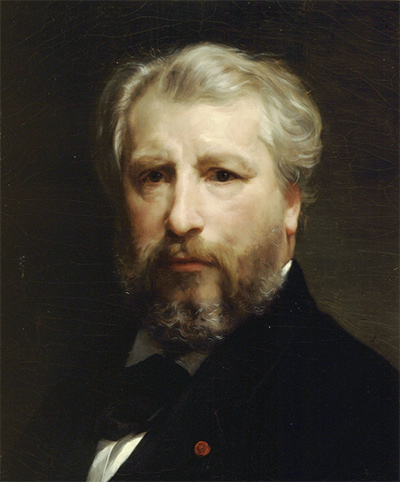
 by Tom Gurney
Tom Gurney BSc (Hons) is an art history expert with over 20 years experience
Published on June 19, 2020 / Updated on October 16, 2026
Email: tomgurney1@gmail.com / Phone: +44 7429 011000
William-Adolphe Bouguereau: Introduction
William-Adolphe Bouguereau was one of the most admired and argued-over French painters of the nineteenth century. Born in La Rochelle in 1825 and active in Paris, Bordeaux and La Rochelle, he became a leading figure in the Academic tradition, the world of the Ecole des Beaux-Arts, the Prix de Rome and the annual Salon [1][2]. His paintings are famous for their polished surfaces, carefully constructed figures, mythological and religious subjects, and idealised images of women and children. They are also famous because later generations disagreed so strongly about them.
For Bouguereau's admirers, his art represents a peak of disciplined figure painting. He could make skin, fabric, hair, marble, feathers and light appear with extraordinary smoothness. His compositions often seem effortless, but they were built from drawing, study and repeated adjustment. The Getty's account of his technique describes an artist who planned paintings in detail, made oil sketches and figure drawings, and changed little once the final canvas was underway [3]. For his critics, especially those who preferred the new painting of modern life, visible brushwork and experimental form, Bouguereau came to stand for official taste: beautifully made, but too polished, sentimental or conservative.
That tension is part of why he remains so interesting. Bouguereau is not simply a painter of pretty images, and he is not simply a defeated academic left behind by modernism. He was a celebrated professional artist who understood the institutions, markets and visual languages of his age with exceptional clarity. His art belongs to the Paris Salon, to French art education, to the international market for highly finished pictures, and to the long afterlife of classical and Christian subjects in the modern nineteenth century.
This page introduces the artist, his career, his themes and the works that define him. For a fuller account of his life, see the William-Adolphe Bouguereau biography. For a catalogue-led guide, continue to Bouguereau paintings, Bouguereau drawings and Bouguereau prints.
At a Glance
- Born30 November 1825, La Rochelle, France [1][2]
- Died19 August 1905, La Rochelle, France [1][2]
- NationalityFrench [1][2]
- TrainingEcole des Beaux-Arts; pupil of Francois-Edouard Picot; Prix de Rome winner in 1850 [2]
- Known ForAcademic figure painting, Salon success, mythological subjects, religious images and childhood scenes [2][3]
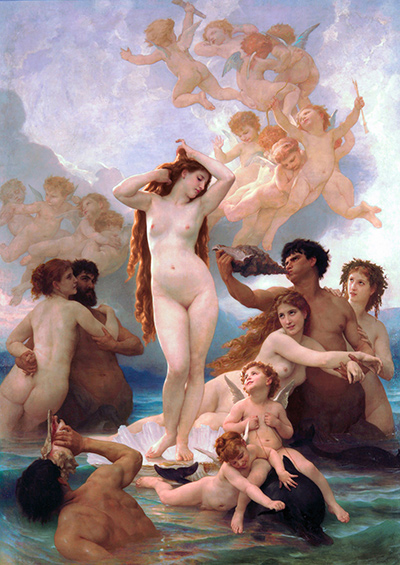
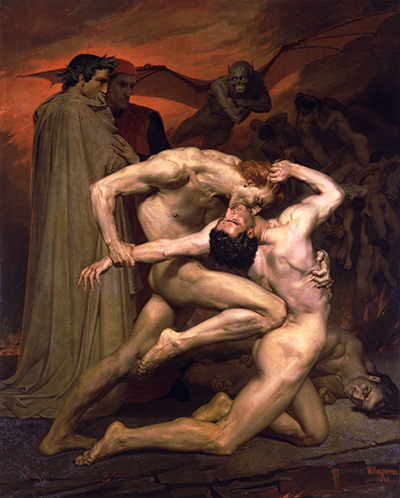
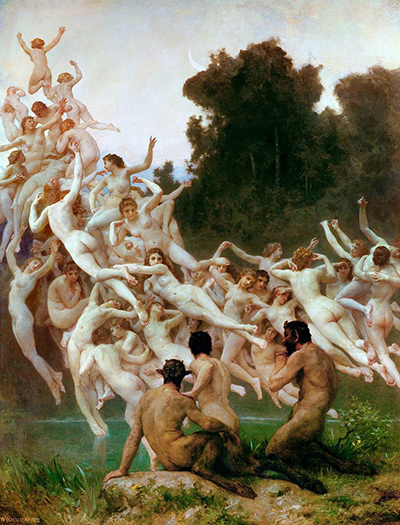
- Major WorksThe Birth of Venus, Dante and Virgil in Hell, The Oreads and The Nut Gatherers [5][6][7][8]
Contents
- Introduction
- Career at a Glance
- Early Life, Training and the Academic Path
- The Salon and Public Success
- Mythology, Religion and Childhood
- How Bouguereau Painted
- The Ideal Figure and the Modern Viewer
- Women, Children and Sentiment
- Bouguereau and the Art World Around Him
- Major Works to Start With
Career at a Glance
William-Adolphe Bouguereau was born in La Rochelle, France, in 1825 and died there in 1905 [1][2]. Museum records and authority files identify him as a French painter and draftsman, and the Musee d'Orsay notes his training with Francois-Edouard Picot at the Ecole des Beaux-Arts, his Prix de Rome in 1850, his Italian stay until 1854, and his Salon debut in 1849 [1][2].
His main artistic setting was nineteenth-century French Academic painting. This was not a single style in the narrow sense, but a system of training, exhibition, prizes, hierarchy and professional recognition. Bouguereau worked within that system with unusual success. He painted history subjects, mythological scenes, religious compositions, portraits, decorative commissions and genre images of children and rural life. Museums now preserve examples of these different sides of his career, from the vast mythological The Birth of Venus at the Musee d'Orsay to the Dante subject Dante and Virgil in Hell, the late mythological The Oreads and the Detroit Institute of Arts painting The Nut Gatherers [5][6][7][8].
His name appears in several forms, including William Bouguereau, William-Adolphe Bouguereau and Adolphe-William Bouguereau. Getty ULAN records the artist under the preferred form Bouguereau, William Adolphe, while Orsay's artist directory gives William Bouguereau and notes Adolphe-William as a civil-name form [1][2]. On this site, the main name is William-Adolphe Bouguereau, with shortened forms used only where they make the prose clearer.
Early Life, Training and the Academic Path
Bouguereau's career began far from the Paris art world that later made him famous. La Rochelle and Bordeaux mattered to his formation, and Bordeaux has continued to treat him as a significant regional figure. The Musee des Beaux-Arts de Bordeaux describes him as the son of a wine merchant established in Bordeaux and emphasises the solid artistic education that allowed him to excel in large, carefully ordered compositions [4]. That wording is useful because it points to a key feature of his mature art: Bouguereau's pictures were not improvised scenes. They were composed, corrected and refined.
The institutional path of his career was very much the path of a talented nineteenth-century French academic. Orsay records him as a pupil of Picot at the Ecole des Beaux-Arts in 1846, a Prix de Rome winner in 1850, and an artist who stayed in Italy until 1854 [2]. These facts place him inside the academic sequence of drawing, competition, classical study and public exhibition. The Prix de Rome was more than a prize. It was a sign that an artist had mastered the official language of composition and could compete at the highest level of state-supported art.
Italy mattered because Bouguereau's art repeatedly looks back to antique sculpture and Renaissance ideals. Bordeaux's artist page notes his study of antique sculpture, Byzantine mosaics and the masters of the Italian Renaissance, and connects his idealism especially to Raphael [4]. That does not mean Bouguereau copied the Renaissance. It means he treated clarity, balanced design and the idealised body as living artistic values. In an age when painters were increasingly turning toward contemporary streets, trains, cafes and private perception, Bouguereau remained committed to a slower and more controlled language of figure painting.
This commitment shaped his art from early ambition to late career. Dante and Virgil in Hell, painted in 1850, belongs to the young painter's desire to prove himself with anatomy, drama and literary subject matter [6]. The Oreads, painted in 1902, shows that even near the end of his life he remained attached to mythology, academic drawing and the expressive arrangement of the human body [7]. The two works feel very different, but they share an underlying belief: painting begins with the disciplined figure.
The Salon and Public Success
Bouguereau's reputation cannot be understood without the Salon. In nineteenth-century France, the Salon was one of the most important places where careers were made, debated and measured. Orsay's artist directory records that Bouguereau made his Salon debut in 1849 and became highly reputed [2]. Individual object records show how central Salon display was to his major works. The Birth of Venus was exhibited at the Salon of the Societe des artistes francais in 1879 [5]. Dante and Virgil in Hell was exhibited at the Salon of 1850-1851 [6]. The Oreads appeared at the Salon in 1902 [7].
The Salon was not simply a wall full of pictures. It was a public stage. Crowds, critics, collectors and institutions moved through it together. The Getty's introduction to Bouguereau describes him as one of the most popular French artists of the late 1800s, with crowds attending the Salon to see his latest canvases and wealthy buyers competing for them [3]. That popularity should not be treated as a footnote. Bouguereau's art made sense to many nineteenth-century viewers. It offered beauty, technical finish, recognisable subjects and emotional clarity at a time when art was also becoming more experimental and unstable.
His success also travelled. The Bordeaux museum notes that Bouguereau enjoyed strong success in the United States and that many of his works remain in American museums [4]. The Metropolitan Museum of Art's Breton Brother and Sister is one example of how his images of rural life appealed to American collectors [9]. The Detroit Institute of Arts' The Hazelnuts (The Nut Gatherers) offers another, with provenance that traces the painting from Bouguereau to Goupil, Samuel P. Avery, American collector Mary Jane Morgan and eventually the Scripps family before entering the DIA [8]. These pages remind us that Bouguereau was not only a French official painter. He was also an international market phenomenon.
Mythology, Religion and Childhood
Bouguereau's best-known paintings often fall into three broad families: mythological subjects, religious subjects and scenes of childhood or rural life. These categories overlap in tone. A mythological painting can be tender or sensual; a religious painting can be organised around grief or consolation; a child subject can carry moral, sentimental or social meaning. What binds many of them together is Bouguereau's preference for legible emotion and idealised form.
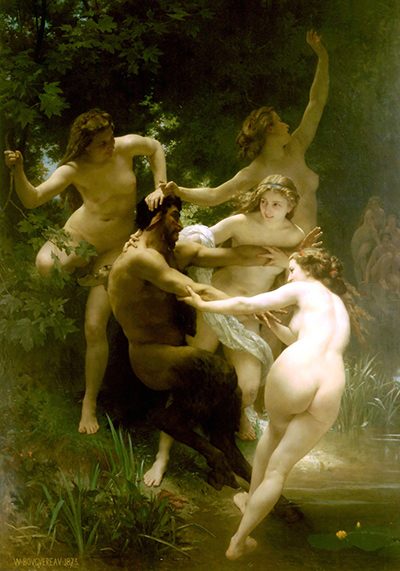
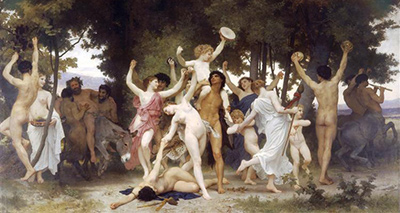
His mythological works are the most spectacular entry point. The Birth of Venus is a monumental 1879 oil on canvas now at the Musee d'Orsay, purchased from the artist that same year [5]. It presents Venus not as a fragment of antique mythology but as a grand Salon image: a large, carefully staged body surrounded by attendants, sea creatures and theatrical motion. The Oreads turns a mythological subject into a rising procession of mountain nymphs, while Nymphs and Satyr explores the playful, erotic and choreographed possibilities of a group scene. Youth of Bacchus belongs to the Bacchic side of his imagination, a subject family also represented in Bordeaux's collection [4].
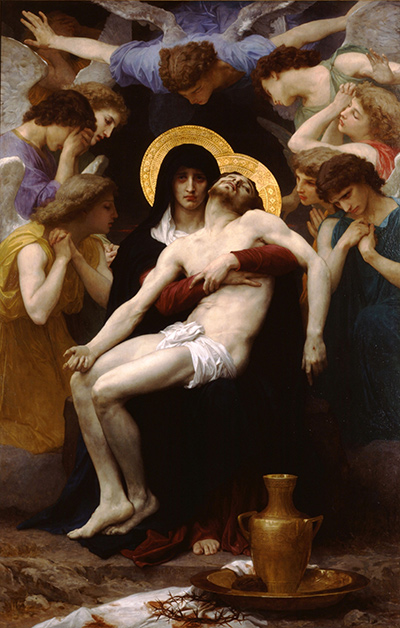
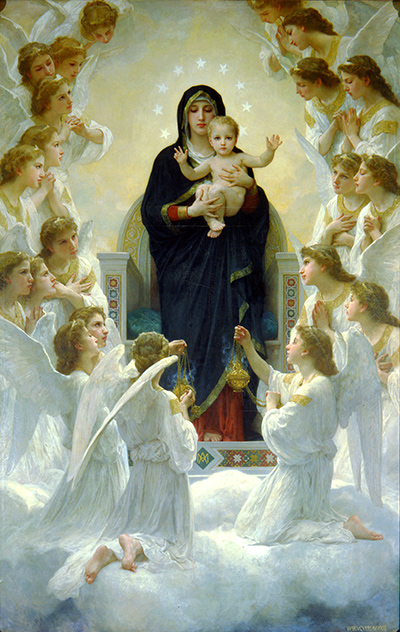
His religious paintings show a different emotional register. Pages such as Pieta, Virgin with Angels, Virgin Comforter and Madonna of the Lilies connect Bouguereau to Christian iconography, devotional feeling and the nineteenth-century market for polished religious images. The Musee d'Orsay's record for Vierge consolatrice, while not the same as every Virgin subject on this site, confirms how strongly Marian and consolatory imagery belonged to his exhibited religious world [10]. The Getty's account of Virgin of the Angels also shows the importance of replica practice and conservation evidence for understanding his method [3].
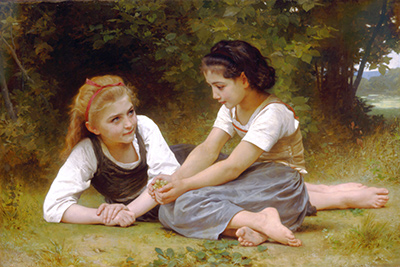
His childhood and rural subjects are sometimes dismissed too quickly as sentimental, but they are central to his public appeal. Works such as The Nut Gatherers, Breton Brother and Sister, Young Shepherdess, Innocence and Two Sisters show children, mothers, siblings and rural figures through an idealising lens. The DIA describes The Nut Gatherers as an idealised vision of country life, with two young girls near the woods and a smooth, nearly life-size presence [8]. The Met's Breton Brother and Sister similarly frames Bouguereau's Breton models as an image of attractive rural virtue made in the studio from earlier sketches [9].
The key is not to pretend these paintings are documentary realism. They are not. They transform rural life, childhood and family feeling into a highly finished pictorial language. That transformation is exactly what made them popular, and exactly what later critics found suspicious.
How Bouguereau Painted
Bouguereau's art depends on a paradox: the finished paintings often hide the labor that made them. Their surfaces are smooth, the anatomy looks natural, the gestures appear poised, and the lighting seldom calls attention to the painter's hand. Yet the process behind that smoothness was intensely structured.
The Getty's introduction is especially useful here. It explains that Bouguereau planned compositions carefully, used oil sketches and detailed drawings for individual figures, and made few changes once painting began [3]. In the Getty conservation discussion around Virgin of the Angels, technical study even found few major corrections, which reinforces the image of an artist who resolved problems before the final surface took shape [3]. The Bordeaux museum makes a similar point, describing him as thoughtful and methodical, repeatedly making drawings, detail studies, drapery studies and compositional research [4].
This is why the drawings section matters. Bouguereau's drawings are not secondary decorations. They are evidence of how his paintings were built. A study for a hand, a torso, a drapery fall or a group arrangement can reveal the academic engine behind the apparently effortless image. The prints section matters too, because many nineteenth-century viewers knew paintings through reproductions. Bouguereau's fame spread through exhibitions, dealers, photographs, engravings and printed images, not through museum display alone.
His technical finish also shaped the emotional effect of his pictures. A rougher painter might have made mythological bodies feel immediate or unstable. Bouguereau's finish makes them feel perfected and remote. A realist painter might have made rural childhood feel socially specific and uncomfortable. Bouguereau's finish makes it tender, composed and universalised. This is the strength and the limitation of his style. His pictures do not ask us to watch paint behaving as paint. They ask us to enter a perfected fiction.
The Ideal Figure and the Modern Viewer
One of the central questions in Bouguereau's art is what an ideal figure can still mean in the nineteenth century. Earlier European art had long used ideal bodies for gods, saints, heroes and allegorical figures. Bouguereau inherited that language through academic training, Italian study and the example of Raphael and classical sculpture [4]. But he used it in a world that was changing around him. By the second half of the nineteenth century, painters were increasingly drawn to ordinary urban life, industrial modernity, new leisure, optical experiment and subjective sensation. Bouguereau continued to make the perfected body a serious artistic project.
That commitment can feel alien to viewers trained by modern art. In Bouguereau, the skin is often too smooth to feel accidental. The gesture is too complete to look caught in passing. The child, the peasant girl, the goddess and the Madonna are shaped for legibility, not for documentary friction. Yet this is precisely why the paintings mattered to his public. They offered an image-world in which suffering, desire, innocence, devotion and beauty could be ordered. Even Dante and Virgil in Hell, one of his most violent early works, turns horror into a controlled display of anatomy, theatre and composition [6].
The ideal figure also allowed Bouguereau to move between different kinds of subject. A mythological nude could be treated with antique dignity. A religious body could carry grief or consolation. A child in a rural setting could become a sign of innocence, family feeling or moral simplicity. These meanings were not neutral. They belonged to a society with strong ideas about class, gender, childhood and taste. Bouguereau's images often soften those realities. They transform working rural life into beauty, turn myth into spectacle, and make religious emotion readable through polished faces and carefully arranged hands.
A serious reading of Bouguereau should not ignore that idealising pressure. His peasant children are not the same as the rural laborers of social realism. His goddesses are not ancient sculpture reborn without nineteenth-century assumptions. His saints and Virgins are not simply devotional images detached from the market. They are products of a world in which museums, Salons, dealers, wealthy collectors and printed reproductions all shaped what a successful picture could be. The Met's account of Breton Brother and Sister, for example, stresses the attractiveness of Bouguereau's idealised Breton figures to American collectors [9]. The DIA's record for The Nut Gatherers similarly places a tender country-life image inside an international chain of sale, collecting and museum history [8].
This makes Bouguereau more complex, not less. The polish of the work can be read as an artistic achievement and as a cultural choice. His surfaces ask viewers to believe in harmony, but the history around those surfaces reveals competition, ambition, commerce and debate. His art is therefore useful for understanding the nineteenth century because it shows not only what was painted, but what many powerful viewers wanted painting to do.
Women, Children and Sentiment
Many of Bouguereau's best-known images center on women and children. This is one reason his work has remained popular with broad audiences and controversial among critics. A painting such as The Nut Gatherers presents childhood with grace, calm and physical immediacy. The DIA describes the two girls as dominant figures in a wooded landscape, painted with flawless technique and a smooth surface [8]. The scene is not dramatic in the narrative sense. Its appeal lies in attention, stillness and the suggestion of a shared private moment.
That kind of tenderness can be powerful. Bouguereau's children often look absorbed rather than theatrical. They hold fruit, gather nuts, carry younger siblings, pause with animals or appear in moments of quiet exchange. Their faces and gestures are clear enough to read quickly, but the technical handling gives them a visual dignity that goes beyond anecdote. In a painting such as Breton Brother and Sister, the traditional clothing and rural identity matter, but so does the careful studio construction behind the image [9].
At the same time, sentiment in Bouguereau is never innocent of style. The paintings arrange feeling. They clean and clarify it. They remove many signs of hardship from rural life and many signs of conflict from family life. That is why they could be loved by collectors looking for beauty, virtue and emotional reassurance, and why later critics could find them too comfortable. Both responses tell us something real about the paintings.
Women appear across his art as goddesses, nymphs, Virgins, mothers, shepherdesses, bathers and personifications. The female figure became one of Bouguereau's principal artistic languages. In The Birth of Venus, the central figure is monumental and public, staged through myth and Salon display [5]. In The Oreads, groups of female figures rise into a mythological landscape, their bodies organised into rhythm and ascent [7]. In religious works, the female body can become maternal, sorrowing or consoling. In genre paintings, it often becomes rural, youthful or domestic.
The best approach is to read these images both visually and historically. Visually, they show Bouguereau's command of anatomy, skin, gesture and composition. Historically, they show how nineteenth-century Academic art could turn women and children into carriers of beauty, virtue, desire, grief and reassurance. That double reading keeps the paintings alive. It allows admiration without naivety and criticism without caricature.
Bouguereau and the Art World Around Him
Bouguereau's career overlapped with some of the artists who now dominate public memory of nineteenth-century France. Manet, Monet, Degas, Renoir, Cezanne and Van Gogh are often used to represent the modern turn away from academic finish. Bouguereau belonged to a different artistic ecology. He did not build his art around broken color, visible touch, urban contingency or the fleeting impression. He built it around drawing, finish, subject hierarchy, technical control and public recognition.
This difference should not be reduced to a simple contest between progress and failure. The nineteenth-century art world was large enough to contain many competing ideas of seriousness. Bouguereau's seriousness lay in the disciplined body, in composition, in professional training and in the belief that painting could still make ideal beauty persuasive. The modernist seriousness of his opponents and successors lay elsewhere: in perception, immediacy, fragmentation, ambiguity and the truth of modern life.
The Getty's introduction makes this contrast clear by setting Bouguereau's smooth technique against the spontaneous handling and visible brushwork of younger artists such as the Impressionists [3]. But it also records that admirers and critics could agree on his technical skill [3]. That point matters. Technical accomplishment alone does not settle the value of a painting, but it is part of the historical fact. Bouguereau's influence and fame depended on abilities that even some unsympathetic viewers had to acknowledge.
His institutional position also matters. The Academie des beaux-arts records his election in 1876, and Orsay identifies him as a highly reputed Salon artist [2][11]. These institutions were not background scenery. They helped decide which artists received visibility, honors, teaching roles and commissions. Bouguereau's art shows how powerful that structure remained even while avant-garde artists were challenging it from the edges and, eventually, from the center of later art history.
To place Bouguereau beside modernism, then, is not only to compare styles. It is to compare systems of value. One system prized finish, tradition, ideal form and public acceptance. Another increasingly prized experiment, subjective seeing and resistance to official taste. Bouguereau's homepage belongs at the entrance to this debate because his paintings give the older system one of its clearest and most impressive faces.
Major Works to Start With
The best way into Bouguereau is through a group of works rather than a single masterpiece. His art changes when seen across myth, religion, rural life and study practice.
The Birth of Venus is the major mythological flagship. Orsay records it as an 1879 oil on canvas, purchased from the artist in that year, shown at the Salon and now held by the Musee d'Orsay [5]. It is the clearest example of Bouguereau's ability to turn classical myth into a public, theatrical image.
Dante and Virgil in Hell shows another side of him. Orsay's record identifies it as an 1850 oil on canvas, and its interpretation emphasises the young artist's ambitious response to Dante's Inferno [6]. Instead of calm ideal beauty, the painting offers contorted bodies, biting violence and dramatic shadow. It is useful because it prevents a too-simple view of Bouguereau as only a painter of sweetness.
The Oreads belongs to his late mythological mode. Orsay dates it to 1902 and describes the Oreads as mountain and grotto nymphs rising in a joyful, luminous procession [7]. The work shows how Bouguereau continued to use mythology as a way to arrange many bodies in movement while still holding to academic design.
Nymphs and Satyr is another essential mythological group scene. It has long been one of his best-known works, in part because it compresses so many Bouguereau qualities: nude figure painting, classical subject matter, theatrical grouping, erotic play and polished surface. It should be read beside The Birth of Venus and The Oreads rather than in isolation.
Pieta and Virgin with Angels introduce the religious side of his career. These pages should be approached with attention to subject, emotion, replica practice, preparatory evidence and verified object history. Bouguereau's religious art is not separate from his technique. It uses the same high finish and figure discipline, but aims those tools toward grief, consolation and devotion.
The Nut Gatherers is a strong entry point for his childhood and rural imagery. The DIA record dates it to 1882, gives the alternate title The Hazelnuts, and describes its idealised country setting and later American collecting history [8]. It is a useful corrective to the idea that Bouguereau's importance rests only on grand mythological nudes.
The drawings and prints pages complete the picture. Drawings show how he built the figure; prints and reproductions show how his images circulated. Together, they help explain why Bouguereau was so visible in his own time and why his reputation could survive even after academic painting fell from fashion.
Popularity, Criticism and Modern Reassessment
Bouguereau's reputation has always been unusually divided. During his lifetime, he was admired by many viewers and collectors. The Getty describes him as popular and controversial, a painter whose Salon canvases drew crowds and whose works attracted wealthy buyers [3]. The Academie des beaux-arts presents him as one of the leading figures of French academic painting and notes his election to the Academie in 1876 [11]. These are not minor honors. They place him close to the center of official French artistic life.
At the same time, criticism was part of his story even when he was famous. The Getty introduction notes how critics attacked the smoothness, sentiment and social conservatism they saw in his images [3]. Later modernist narratives often made him a symbol of everything modern art had to reject: polished finish, ideal bodies, literary subject matter, institutional power and market-friendly beauty. In that story, Bouguereau becomes the opposite of Manet, Monet, Degas, Cezanne or Van Gogh.
That opposition is useful, but only up to a point. It explains why younger artists and later historians reacted against him, but it can make his actual paintings harder to see. Bouguereau did not fail at what he was trying to do. He succeeded at a project that later taste distrusted. His art asks different questions from Impressionism. Instead of asking how a street, face or landscape appears in a passing moment, he asks how the figure can be perfected, how a story can be clarified, how feeling can be staged, and how a surface can conceal the labor of making.
Modern reassessment has not required everyone to like Bouguereau. It has required a more precise account of why he mattered. He mattered because he dominated a major artistic system. He mattered because he trained, exhibited, sold and reproduced within that system with rare success. He mattered because his works entered public museums, private collections and popular visual culture. He mattered because his paintings expose the values of nineteenth-century Academic art as clearly as Impressionist paintings expose another set of values.
To look seriously at Bouguereau today is to hold two ideas together. His paintings can feel idealised, sentimental and resistant to modern uncertainty. They can also be technically astonishing, compositionally intelligent and historically essential. The question is not whether he was secretly an Impressionist, or whether modernism was wrong to challenge him. The better question is what his art reveals about beauty, training, public taste and the cultural authority of the finished body.
How to Look at Bouguereau
Bouguereau rewards slow looking, even when the first impression seems easy. Many of his paintings announce themselves immediately: a goddess rises, a child pauses, a grieving figure bends over a body, a group of nymphs lifts into the air. The subject is often clear before the viewer has studied the picture closely. But the deeper interest is in how that clarity is produced.
Start with the drawing. Look at how Bouguereau places the weight of a body, how a knee turns, how fingers meet fabric, how a shoulder leads the eye into a face. His academic training taught him to make the body both anatomically convincing and compositionally useful. In a painting such as Dante and Virgil in Hell, anatomy becomes spectacle: the contorted bodies are there to carry terror, ambition and technical display at once [6]. In The Oreads, bodies become rhythm, rising as a group rather than simply standing as individual figures [7].
Then look at surfaces. Bouguereau's finish is not a neutral polish added at the end. It is one of the meanings of the work. The smoothness makes myth feel timeless, makes childhood feel protected, and makes grief feel solemn rather than chaotic. It also creates distance. Viewers are rarely invited into the messy present tense of making. Instead, they encounter a resolved image, almost sealed against accident.
Finally, look at context. A Bouguereau painting belongs to more than its subject. It belongs to the Salon, to academic teaching, to museum collecting, to American buyers, to religious and classical imagery, and to the later backlash against official art. The same picture can be beautiful, problematic, technically formidable and historically revealing. That combination is why Bouguereau still deserves attention. He helps us understand not only what nineteenth-century Academic painting looked like, but why it mattered so much before modern art rewrote the story.
Where to Go Next
Start with the biography if you want the full career arc: La Rochelle, Bordeaux, Paris, Rome, the Salon, teaching, late success and reputation after his death. Use the paintings page for a catalogue-led guide to the major works and subject families.
For mythology, begin with The Birth of Venus, Dante and Virgil in Hell, The Oreads, Nymphs and Satyr and Youth of Bacchus. For religious painting, move through Pieta, Virgin with Angels, Virgin Comforter and Madonna of the Lilies.
For childhood, rural life and sentiment, compare The Nut Gatherers, Breton Brother and Sister, Young Shepherdess, Innocence and Two Sisters. Then use drawings and prints to see how his images were planned and circulated.
Bouguereau's art is easiest to dismiss when reduced to a stereotype. It becomes more useful when treated as a complete artistic world: academic training, classical memory, religious feeling, family sentiment, public spectacle, private collecting, reproductive culture and technical control. His paintings show what nineteenth-century viewers could want from art before modernism changed the terms of the argument. They also show why that argument has never quite ended.
Frequently Asked Questions
Discussion
Bouguereau can divide viewers quickly, which makes close looking especially useful. Use the page below to compare what you notice in the finish, the figure drawing and the historical setting of his paintings.
The strongest responses often hold admiration and criticism together: technical command, idealised bodies, public taste, sentiment, institutional power and the later modernist reaction.
Reader Insights
Which detail makes Bouguereau's polish feel persuasive, distant or theatrical?
How does the Salon setting change the way you read his mythological or childhood subjects?
Where do you think Bouguereau's art sits between technical achievement and cultural idealisation?
Join the Conversation
Share your reading of Bouguereau's work below.
References
- Getty ULAN full record, accessed 28 July 2026.
- Musee d'Orsay artist directory, accessed 28 July 2026.
- Getty, Adolphe-William Bouguereau: An Introduction, accessed 28 July 2026.
- Musee des Beaux-Arts de Bordeaux, William Bouguereau, accessed 28 July 2026.
- Musee d'Orsay, Naissance de Venus, accessed 28 July 2026.
- Musee d'Orsay, Dante et Virgile, accessed 28 July 2026.
- Musee d'Orsay, Les Oreades, accessed 28 July 2026.
- Detroit Institute of Arts, The Hazelnuts (The Nut Gatherers), accessed 28 July 2026.
- The Metropolitan Museum of Art, Breton Brother and Sister, accessed 28 July 2026.
- Musee d'Orsay, Vierge consolatrice, accessed 28 July 2026.
- Academie des beaux-arts, William Bouguereau, accessed 28 July 2026.
- Art Institute of Chicago, The Bathers, accessed 28 July 2026.
- Cleveland Museum of Art, A Calling, accessed 28 July 2026.
- A&AePortal, Nymphs and Satyr image metadata, accessed 28 July 2026.
- Musee d'Orsay, Salon database, William Bouguereau exhibitor record, accessed 28 July 2026.
- Christie's, William Bouguereau, Pieta, accessed 28 July 2026.
- Musee d'Orsay, Salon database, La jeunesse de Bacchus, accessed 28 July 2026.
- Sotheby's, William Bouguereau, La Jeunesse de Bacchus, accessed 28 July 2026.
- Christie's, William Bouguereau, L'Amour et Psyche, enfants, accessed 28 July 2026.
- Paris Musees Collections, Petit Palais, La Vierge aux anges, accessed 28 July 2026.