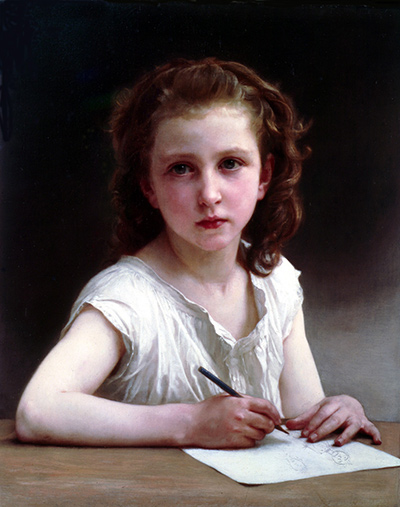
 by Tom Gurney
Tom Gurney BSc (Hons) is an art history expert with over 20 years experience
Published on June 19, 2020 / Updated on November 6, 2026
Email: tomgurney1@gmail.com / Phone: +44 7429 011000
William-Adolphe Bouguereau Quotes and Their Context
William-Adolphe Bouguereau's remarks about painting become more interesting when they are read beside the work that produced them. His reputation rests on carefully drawn figures, idealised beauty and remarkably controlled surfaces. His recorded words also reveal a young student who doubted his progress, a teacher who distinguished craft from artistic personality, and a successful painter who insisted that money could not explain his need to work. These voices belong to different moments of his life. Bringing them together gives a fuller picture than a list of inspirational sayings. [1]
The selection below identifies the source of each quotation. English renderings of passages from Marius Vachon's French biography, published in 1900, are translations made for this article. Vachon reproduces extracts from Bouguereau's early journal and reports conversations with the mature artist. His book is valuable contemporary testimony, although his admiring account remains a biographer's selection rather than an unedited transcript of everything Bouguereau said. Later museum explanations are identified separately. [1]
At a Glance
- FocusBouguereau’s words on nature, study and painting
- Contemporary sourceMarius Vachon, W. Bouguereau (1900)
- TranslationsFrench extracts translated for this article
Contents
- “Nature is truly the only great master”
- “Everything must be thought through beforehand”
- “All the moments of life should be devoted to study”
- “How much I still have to learn”
- “The craft is learned through study, observation and practice”
- Drawing and the whole picture
- “The search for the ideal has been the aim of my life”
- “I need to keep painting”
- Finish, revision and the evidence of paintings
“Nature is truly the only great master”
This sentence appears in the early journal extracts reproduced in Vachon's chapter on the young artist's memorial notebook. Bouguereau follows it by bringing colour, drawing, character and composition together within nature. His example is a crowd gathered in a church: many individual expressions and personalities nevertheless form a whole. The passage describes an education in looking, extending beyond copying a single posed figure. [1]
The idea helps explain why idealisation and observation could coexist in his practice. A painter might study a real arm, a particular face or the weight of a garment while arranging those observations within an invented scene. Nature supplies relationships and particulars; the composition gives them a purpose. The quotation does not establish that every finished painting records an event witnessed outdoors. It describes the richness of the material available to the attentive eye.
The church crowd is an especially useful detail. Bouguereau is considering difference within unity, a problem encountered whenever several figures share a composition. A picture needs individual gestures, yet those gestures must also work together. His youthful observation already connects the study of life with the organisation of a painting. Reading the surrounding passage restores that practical meaning to a sentence that otherwise sounds like a general tribute to nature. [1]
“Everything must be thought through beforehand”
In the same journal chapter, Bouguereau advises himself to understand his subject before beginning. If he cannot understand it, he should search further or work on something else. He then insists that thought must extend to small matters as well as the main idea, including drawing, colour and arrangement. The instruction is directed inward: a student setting standards for his own work. [1]
There is a difference between planning a picture and predicting every mark that will appear on its surface. Vachon's later account describes repeated sketches, studies from models and changes during execution. Preparation gives the painter something definite to test. A study can reveal that an appealing idea becomes awkward when a body must actually carry its weight or a gesture must connect two figures. Planning and revision can therefore reinforce one another. [1]
The quotation also offers a way to look at Bouguereau's finished paintings. Follow a hand toward the person it touches, or notice how a tilted head changes the relationship between two figures. Such apparently effortless connections depend on decisions about position and scale. The viewer sees the resolved relationship; the early notebook reminds us of the thought required to produce it.
“All the moments of life should be devoted to study”
Vachon quotes this resolve while describing the young painter's appetite for learning. The nearby journal entries record interests ranging from architecture and ancient costume to anatomy, literature and visits to the Louvre. Bouguereau's training involved a broad store of visual and historical knowledge, alongside sustained practice with the pencil and brush. [1]
That breadth matters for an artist who would paint religious, mythological and literary subjects. A convincing figure alone cannot settle every problem in a narrative picture. Costume, setting, gesture and the relationship between bodies all influence what a scene communicates. The journal shows a student trying to acquire the resources needed to imagine such scenes with confidence.
The passage should also be read as youthful ambition. Its absolute language expresses determination; it need not become advice that every reader should organise an entire life around work. In the notebook, study is tied to an urgent personal wish to become capable of painting the pictures he imagines. That situation gives the sentence emotional force. It is a declaration made before mastery, when the distance between intention and ability still feels large. [1]
“How much I still have to learn”
This short phrase comes from a longer expression of uncertainty reproduced by Vachon. The young Bouguereau wonders whether the studies he needs might cool his imagination. He longs to produce worthwhile work, yet feels that more preparation is necessary. His concern is about the relationship between knowledge and creative energy: will the means arrive while the original excitement is still alive? [1]
These admissions complicate the familiar image of an entirely assured academic painter. The polished surface of a mature canvas gives little indication of a student's hesitation. The journal preserves that earlier state, in which discipline is something being built rather than an effortless possession. It allows readers to recognise uncertainty without converting it into a claim that the artist distrusted all formal training.
The tension remains useful when considering his later art. Technical accomplishment can make a difficult action appear easy. The notebook asks us to remember that ease as an achieved effect. It also reminds us that an artist's later confidence does not erase earlier doubt. Bouguereau's public success and his youthful impatience belong to the same career. [1]
“The craft is learned through study, observation and practice”
Vachon reports this statement in his discussion of Bouguereau's teaching. The painter distinguishes teachable craft from an artistic instinct that he regards as innate. He describes instruction as giving students the means to express what they see and feel and to develop their own particular faculties. These remarks join rigorous training to a concern for individual expression. [1]
Bouguereau's belief in innate artistic ability is a historical opinion, rather than a demonstrated rule about who can learn to make art. His account of craft is more directly practical: repeated observation and work improve the means of expression. A student needs a command of form and colour to communicate an imagined subject clearly.
Vachon strongly praises the teacher's encouragement of independence. That praise should remain attached to its author. It is evidence of how an admiring contemporary presented Bouguereau, and does not by itself establish how every pupil experienced his studio. The useful point is the relationship the reported teaching proposes: shared exercises and technical standards can serve different artistic personalities. [1]
Drawing and the whole picture
“Paint as you see and be accurate in your drawing.” Mark Walker reproduces this instruction in his study of Bouguereau's working methods, with a source trail to Émile Bayard. Walker separately cites the painter's journal for advice about attending to details and the whole together. Keeping those trails separate avoids treating every maxim in a modern essay as a sentence from the same speech. [2]
The advice addresses a familiar visual problem. A carefully described eye or hand can still feel misplaced when the larger head or body is wrong. Equally, a convincing general pose can lose force when an important small gesture is poorly understood. Moving between the whole arrangement and particular forms helps prevent either scale of attention from becoming isolated.
An 1899 Bordeaux address discussed by Walker concerns Bouguereau's encounter with casts after the Parthenon sculptures. The painter recalled recognising the importance of accents in relation to broad forms. This is a more specific lesson than the claim that academic painting simply accumulates details. The hierarchy of forms matters: some passages carry the structure, while others give it articulation. [2]
“The search for the ideal has been the aim of my life”
The Académie des beaux-arts places the French sentence “La recherche de l'idéal a été le but de ma vie” on its account of Bouguereau. The English wording here is a translation. The institutional page provides a reliable place to find the attribution, but does not identify the sentence's original occasion. It should therefore be cited as a statement reproduced by the Académie, without assigning it an unsupported date or interview. [3]
The ideal can be understood as a goal of selection and arrangement. The painter works toward a chosen expression of beauty rather than preserving every accidental feature of a model or setting. That ambition helps readers understand the deliberate resolution of his images. It does not require a viewer to accept his preferences as universal.
One viewer may respond warmly to the clarity of a pose; another may feel that its refinement removes too much of ordinary life's irregularity. The quotation helps locate their disagreement. They may recognise the same pictorial decision and value it differently. Understanding the artist's stated ambition gives criticism a more definite object than either admiration or dismissal alone.
“I need to keep painting”
Vachon records the mature artist defending his work against the suggestion that he painted solely to make money. Bouguereau says that he already has enough, that he wishes to paint as he sees and feels, and that lower prices would not make him abandon his manner. The short quotation above translates the central insistence of that conversation. [1]
This testimony presents the artist's own explanation of his motivation. It should not be made to prove that the market had no influence on his career. The Dahesh Museum reproduces an 1891 interview in which he discussed changing his painting in response to buyers' preferences, saying that “the public only buys what it likes.” Different contexts bring different aspects of a working career into view: a painter can care intensely about making art and also know what sells. [4]
Vachon's account of the studio gives the desire to paint a concrete form. He describes a developing idea passing through small sketches, studies, a large cartoon and work from the model. The finished image is the outcome of decisions sustained over time. In that setting, the declaration concerns the activity of making pictures as much as the achievement of having made them. [1]
Finish, revision and the evidence of paintings
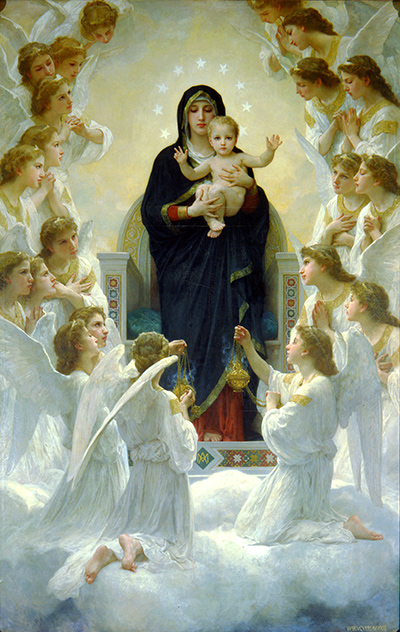
Getty conservator Mark Leonard called Bouguereau “a masterful technician” while discussing the museum's 2006 presentation of his paintings. The Getty account describes detailed preparation and few alterations visible in X-rays of Virgin of the Angels. Its comparison of the large painting and a smaller replica also shows the precision with which the artist could repeat a composition. [5]
Those observations concern particular examined paintings. Vachon's studio account, by contrast, describes occasions when an unsatisfactory picture was set aside, or figures were repositioned during execution. There is no need to force every canvas into one identical process. Preparation, revision and confident execution can all form part of a career, with their balance changing from work to work. [1] [5]
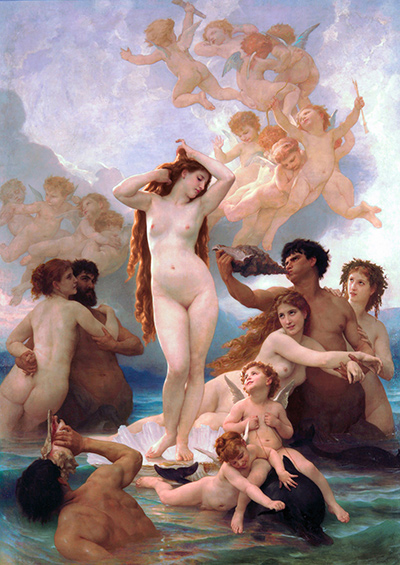
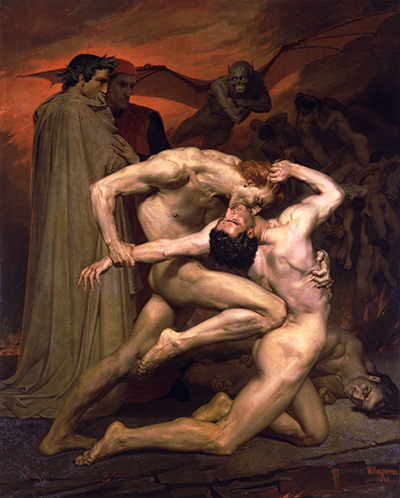
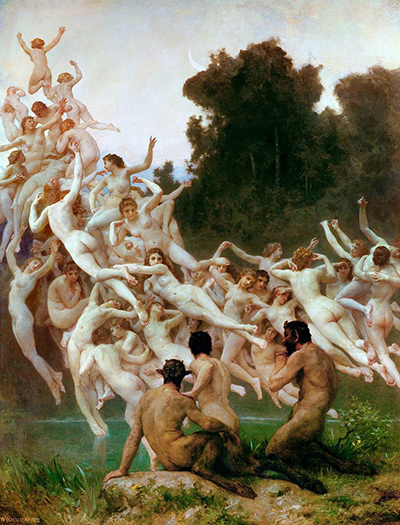
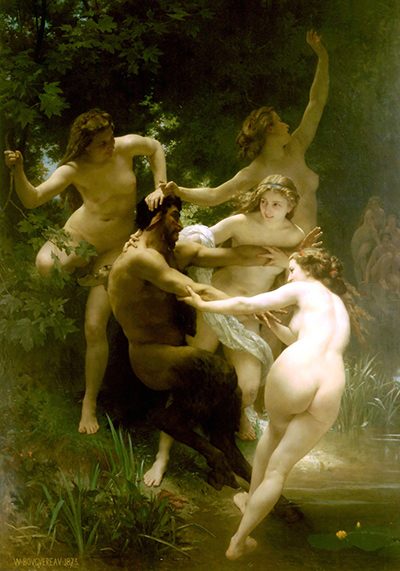
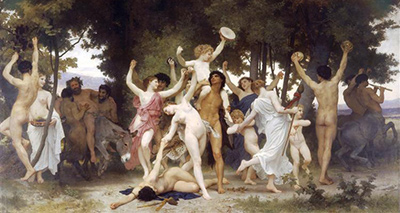
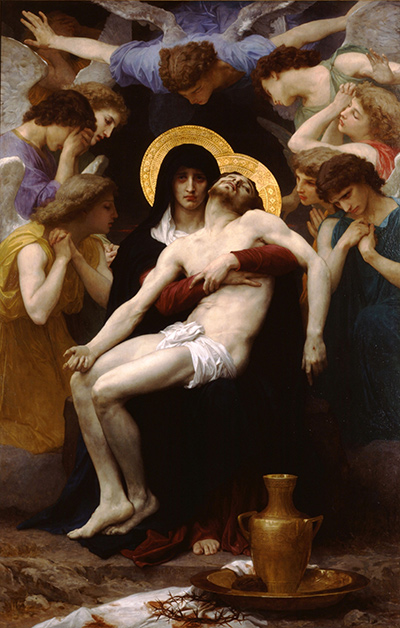
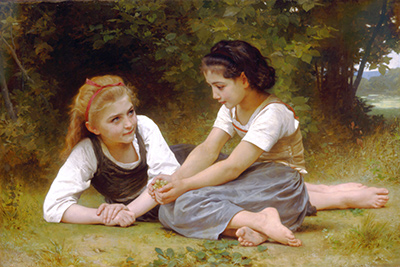
For readers looking at Bouguereau, the most useful result of these quotations is renewed attention. His words about study invite us to examine structure; his remarks about nature direct us toward observed relationships; his idealism explains the purposeful transformations of those observations. The quotations become starting points for looking closely at the paintings, with enough context to understand who recorded them and what they can reasonably tell us.
Artworks and records
Selected documented works and records relevant to this article; this is not a complete catalogue.
| Name | Date | Record |
|---|---|---|
| Italian Woman with Tambourine | 1869 | Painting |
| Mignon Pensive | 1869 | Painting |
| Mignon Pensive — print after Bouguereau | Nineteenth century |
Discussion
Which relationship between words and images most interests you in this article?
Reader Insights
Which detail or passage changes your reading?
Which comparison would you like to discuss?
Join the Conversation
Share a detail, comparison or question about William-Adolphe Bouguereau Quotes and Their Context below.
References
- Marius Vachon, W. Bouguereau, Paris: A. Lahure, 1900. Chapters “Le mémorial du jeune artiste,” pp. 17–22; “Genèse de la composition,” pp. 105–108; and “Principes et méthode d'enseignement,” pp. 113–115. Contemporary biography reproducing journal passages and reporting conversations. English extracts translated for this article. View source.
- Mark Walker, “Bouguereau at Work,” Art Renewal Center. Discussion of drawing, journal statements, Émile Bayard and the 1899 Bordeaux address; the distinct source trails are retained above. View source.
- Académie des beaux-arts, “William Bouguereau.” French idealism quotation reproduced by the institution; original occasion unspecified there. View source.
- Dahesh Museum of Art, “Bouguereau's ‘Amiable’ Pictures Cross the Atlantic,” on the museum's Spotlight On page. Includes an extract attributed to an 1891 interview in L'Éclair. View source.
- J. Paul Getty Museum, “Adolphe-William Bouguereau: An Introduction,” account of the 2006 installation and conservation findings. View source.