 by Tom Gurney
Tom Gurney BSc (Hons) is an art history expert with over 20 years experience
Published on June 19, 2020 / Updated on October 16, 2026
Email: tomgurney1@gmail.com / Phone: +44 7429 011000
The Elder Sister by William-Adolphe Bouguereau: Introduction
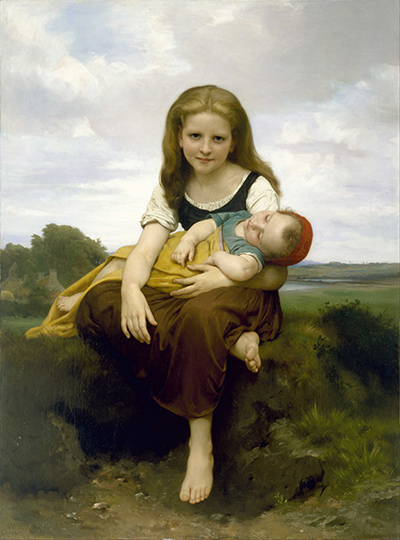
The Elder Sister is one of William-Adolphe Bouguereau's clearest images of childhood protection. Painted in 1869, it shows an older girl holding a baby close to her body in a calm outdoor setting. The Museum of Fine Arts, Houston identifies the work as an oil on canvas measuring 51 1/4 x 38 1/4 inches, or 130.2 x 97.2 cm, and records it under the object number `92.163`. Those basic facts matter because they give the page a stable institutional route: this is not just a familiar reproduction image, but a documented museum painting with a clear object record.
The subject appears simple at first glance. A young girl sits in the foreground and holds a smaller child, meeting the viewer with a direct, composed gaze. The baby rests against her body, supported by her arms and by the secure triangular shape of the composition. Bouguereau removes almost every sign of accident. The figures are still, the contours are clean, the skin is smoothly modeled, and the rural background is quiet enough to keep attention on the relation between the two children.
At a Glance
- ArtistWilliam-Adolphe Bouguereau
- TitleThe Elder Sister
- Date1869 [1]
- MediumOil on canvas [1]
- Dimensions51 1/4 x 38 1/4 in. (130.2 x 97.2 cm) [1]
- Collection RouteThe Museum of Fine Arts, Houston [1]
- Object Number92.163 [1]
- Credit LineGift of an Anonymous Lady in memory of her father [1]
- ModelsHenriette and Paul, noted by MFAH [1]
Contents
- Introduction
- Object Facts and Models
- Sibling Care and Composition
- Ideal Childhood and Collecting
- Why the Painting Matters
Object Facts and Models
The MFAH record notes that the models were Bouguereau's daughter Henriette and son Paul. That detail should be handled with care. It can deepen the page because it connects the picture to the artist's family, but the painting is not a documentary family snapshot. Bouguereau turns the children into an ideal image of sibling care. Their individuality matters, yet the final canvas also belongs to a larger nineteenth-century language of innocence, tenderness, and moral order.
The older child is the emotional center of the painting. She is not shown playing, moving, or caught in an anecdote. She sits upright and performs care through stillness. Her hands hold the baby without strain, and her expression is steady rather than sentimental. Bouguereau makes responsibility visible through pose. The title The Elder Sister directs attention to that role: the girl is defined by relation, by the act of holding, guarding, and presenting the younger child.
Sibling Care and Composition
The baby changes the whole structure of the picture. Its small body softens the older girl's vertical presence and gives the scene its intimate weight. Bouguereau's academic training is visible in the way he balances the two figures. The older child faces outward, while the baby turns inward; one gaze meets the viewer, the other remains absorbed in the sheltered space of the embrace. That contrast makes the painting more than a pretty image of children. It becomes a carefully staged study of dependence and protection.
Like many of Bouguereau's family and childhood paintings, The Elder Sister offers idealization rather than documentary realism. The children are placed in a rustic setting, but the scene does not ask us to study rural labor, hardship, or social conditions. Instead, Bouguereau uses rural simplicity as a frame for emotional clarity. The background opens gently behind the figures; the dress and bare feet suggest pastoral ease; the finish turns the whole scene into an image of harmony. The painting's beauty depends on that act of selection.
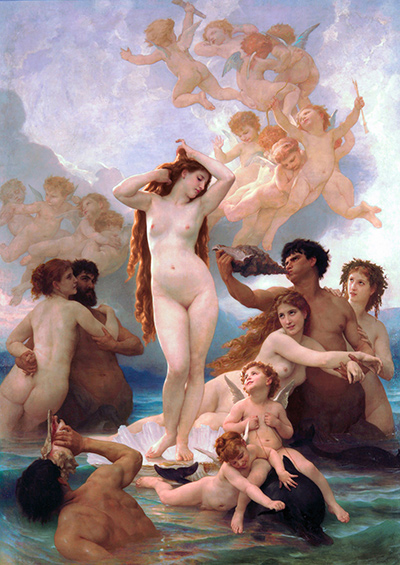
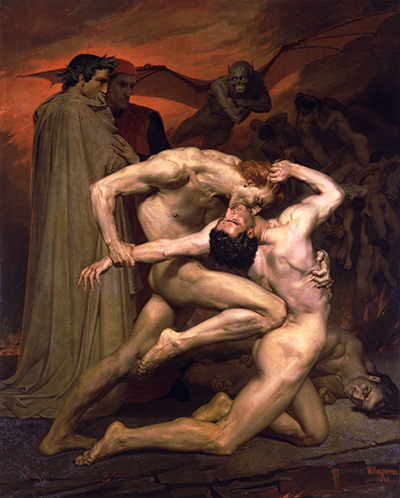
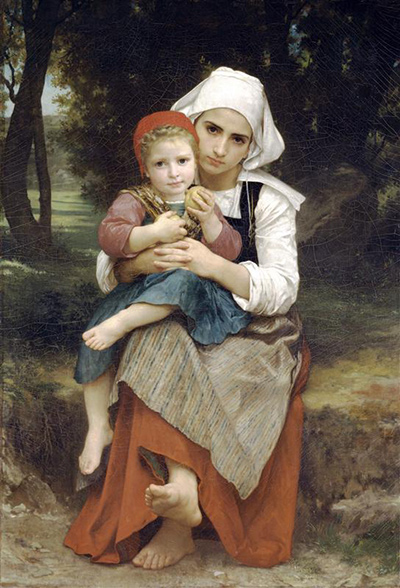
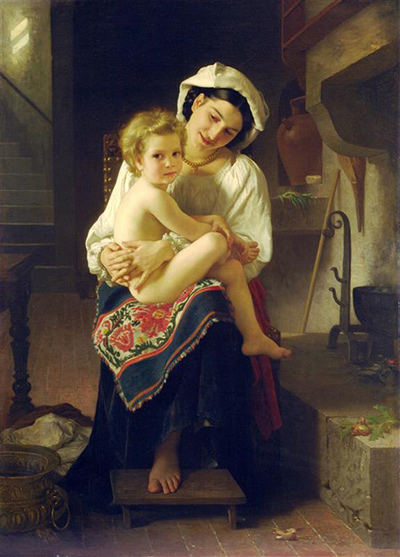
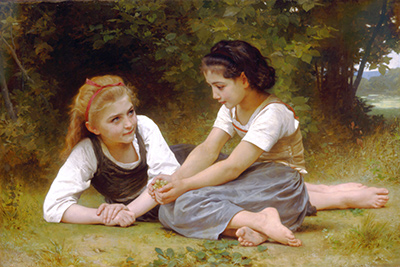
This is where the work belongs beside Breton Brother and Sister, Young Mother Gazing at Her Child, and The Nut Gatherers. In each case Bouguereau uses childhood or family feeling as a subject that can carry academic finish without grand historical drama. These paintings are smaller in ambition than The Birth of Venus or Dante and Virgil in Hell, but they reveal another side of his success. Bouguereau knew how to make domestic tenderness feel complete, polished, and worthy of museum-scale attention.
Ideal Childhood and Collecting
The composition also helps explain his popularity with collectors. The Elder Sister is emotionally legible. It does not require specialist knowledge of mythology or biblical narrative. A viewer can understand the relation between the children immediately, then linger over the painter's technical control. Bouguereau's smooth surface slows the image down. Flesh, fabric, hair, hands, and landscape are made to seem settled into a world without visible disruption. That clarity made his art accessible to audiences who valued beauty, sentiment, and finished craft.
At the same time, modern viewers can read the painting with a little more tension. Its tenderness is real in effect, but highly designed. The painting offers childhood as an ideal: ordered, graceful, affectionate, and untouched by disorder. That ideal is historically revealing. Bouguereau was not recording childhood as an open-ended social condition; he was shaping it into a moral and pictorial type. The girl becomes "the elder sister," a figure of care and composure. The baby becomes vulnerability made safe.
The painting's museum history adds another layer. MFAH records the work as a gift of an anonymous lady in memory of her father, and its presence in an American museum continues the broader story of Bouguereau's appeal outside France. American collectors and institutions valued his ability to combine technical mastery with subjects that felt tender and reassuring. The Elder Sister fits that history well. It is refined enough to show academic authority and intimate enough to work as a family image.
Why the Painting Matters
The work's provenance and exhibition history also help keep the painting grounded as an object rather than just an internet image. MFAH records earlier ownership and later exhibition contexts, showing that the painting has had a public life beyond reproduction. That matters for a page like this because The Elder Sister is widely circulated online, often detached from the museum record that gives it scale, medium, credit line, and collection history. Restoring those details changes the reading. The picture becomes not only a tender scene of childhood but also a collected, exhibited nineteenth-century painting whose polished sentiment had durable institutional appeal.
The work should therefore be read neither as mere sweetness nor as accidental nostalgia. It is a deliberate painting by an artist who understood how to turn a simple relationship into a durable visual form. The older girl's gaze, the baby's weight, the secure pose, and the polished finish all work together. Bouguereau's achievement lies in making care look stable. The painting turns sibling responsibility into a calm, idealized image that still speaks clearly because its structure is so exact.
Related Childhood and Family Pages
Frequently Asked Questions
Discussion
The Elder Sister is a useful page for looking at how Bouguereau turned childhood care into a polished academic subject.
Use the prompts below to connect the MFAH painting with Bouguereau's wider family and childhood imagery.
Reader Insights
How does the older child's direct gaze change the emotional balance of the painting?
How do the MFAH object facts help separate this painting from other Bouguereau sibling subjects?
How does this image of protection compare with Breton Brother and Sister or Young Mother Gazing at Her Child?
Join the Conversation
Share your reading of Bouguereau's composition and family imagery below.
References
- The Museum of Fine Arts, Houston, The Elder Sister, object 19172, accessed 28 July 2026.
- The Museum of Fine Arts, Houston, William Bouguereau objects, accessed 28 July 2026.
- Wikimedia Commons, William Bouguereau - The Elder Sister - 92.163 - Museum of Fine Arts, accessed 28 July 2026.
- Wikimedia Commons, William-Adolphe Bouguereau - The Elder Sister (1869), accessed 28 July 2026.
- MFAH Shop, William-Adolph Bouguereau The Elder Sister framed print, accessed 28 July 2026.
- TheHistoryOfArt.org, Breton Brother and Sister, accessed 28 July 2026.
- TheHistoryOfArt.org, Young Mother Gazing at Her Child, accessed 28 July 2026.
- TheHistoryOfArt.org, The Nut Gatherers, accessed 28 July 2026.