 by Tom Gurney
Tom Gurney BSc (Hons) is an art history expert with over 20 years experience
Published on June 19, 2020 / Updated on October 16, 2026
Email: tomgurney1@gmail.com / Phone: +44 7429 011000
Evening Mood by William-Adolphe Bouguereau: Introduction
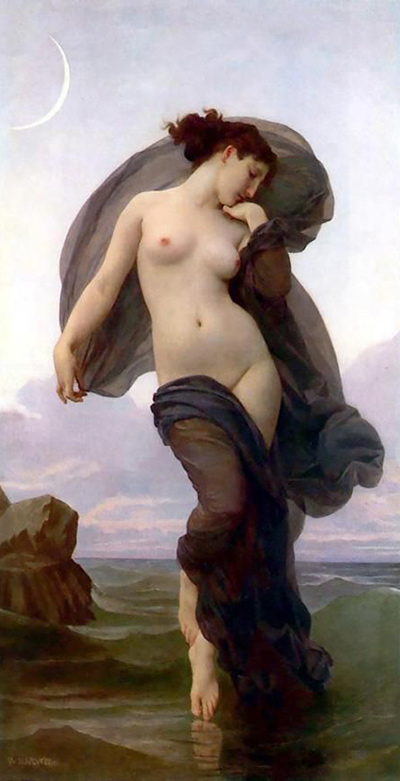
William-Adolphe Bouguereau painted Evening Mood, known in Spanish as Atardecer and in French as Le Crépuscule, in 1882. The Museo Nacional de Bellas Artes de Cuba records the work as Atardecer, 1882, by Wiliam Adolphe Bouguereau, measuring 207 by 108 cm, with inventory number 91-186 [1]. The same museum page identifies it as a painting in the French School collection and gives its exhibition location as the Universal Art Building, French art room [1].
Those object facts are important because this page has often circulated through copy-print sites with uncertain or thin sourcing. The museum record confirms the central claim: Evening Mood belongs to the Cuban National Museum of Fine Arts in Havana. Wikimedia Commons and WikiArt preserve the more familiar English title Evening Mood, the French title Le Crépuscule, the date 1882, the oil-on-canvas medium and closely matching dimensions of 207.5 by 108 cm [2][3]. The safest public title is therefore Evening Mood, with Atardecer and Le Crépuscule used as title variants.
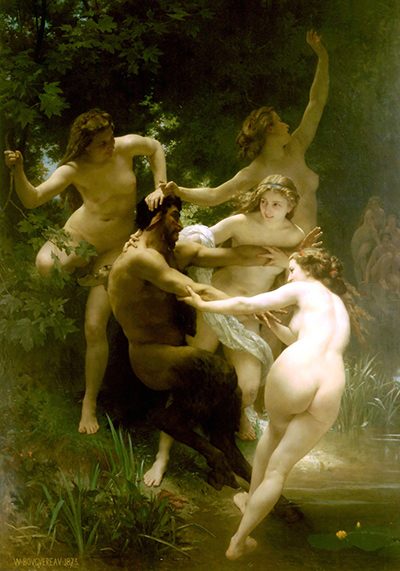
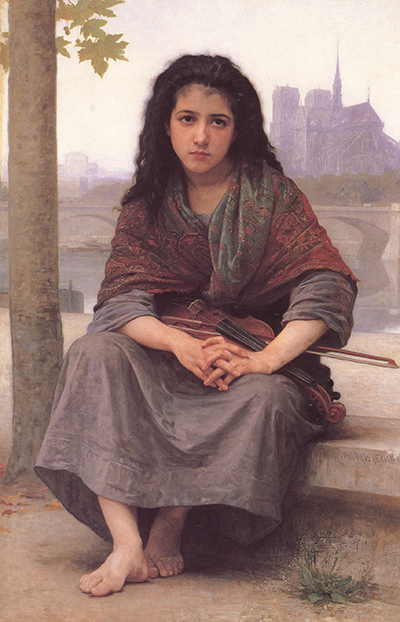
For Bouguereau's wider career, start with the William-Adolphe Bouguereau biography and the paintings hub. For related mythological and allegorical figure paintings, compare The Birth of Venus, The Oreads and Youth of Bacchus. For a smaller source-cautious figure page, compare The Bohemian.
At a Glance
- ArtistWilliam-Adolphe Bouguereau
- Museum TitleAtardecer [1]
- English TitleEvening Mood
- French TitleLe Crepuscule
- Date1882 [1]
- Dimensions207 x 108 cm [1]
- InventoryMuseo Nacional de Bellas Artes de Cuba, 91-186 [1]
- Display RouteUniversal Art Building, French art room [1]
- SubjectAn allegorical figure of twilight within Bouguereau's hour-of-day context [1][4]
Contents
- Introduction
- Twilight as an Allegorical Figure
- The Figure, the Sea and the Veil
- Salon Context and the Hours of the Day
- How to Read Evening Mood Today
Twilight as an Allegorical Figure
Evening Mood shows a single idealised female figure at the edge of water, half veiled and set against a darkening sky. The subject is not a portrait of an identified sitter. It is an allegory of twilight: a body used to personify a time of day, a mood and the transition from light into night.
The Cuban museum's short note says Bouguereau exhibited the work at the Salon of 1882 and describes it as probably part of a set, with dimensions and plastic treatment similar to La Aurora [1]. Sotheby's later catalogue writing on a reduced version of Le Crépuscule gives useful context for that set. It describes Bouguereau's early-1880s series of four panels representing the hours of the day: L'Aurore, Le Crépuscule, La Nuit and Le Jour [4]. In that group, Evening Mood is the twilight panel.
The painting turns evening into a figure rather than a landscape alone. The water, clouds, crescent moon, veil and exposed body all work together. The figure appears poised between movement and stillness, between visibility and concealment. Bouguereau does not paint twilight as weather only. He gives it a human form, then uses that form to make the hour feel calm, sensual and theatrical.
The Figure, the Sea and the Veil
The figure's pose is central to the painting. She stands close to the water, with drapery moving around her body and the evening sky behind her. The veil is not just a covering. It gives the image motion, softens the nude and connects the body to air and wind. The result is one of Bouguereau's characteristic balances: ideal anatomy made public through allegory, but moderated by setting, fabric and atmosphere.
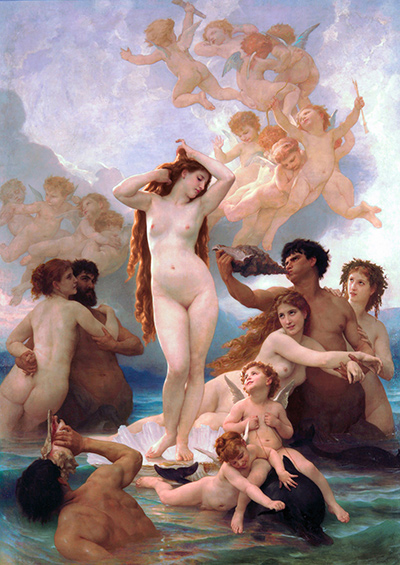
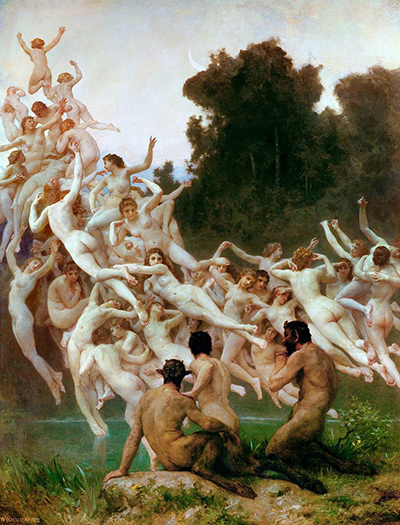
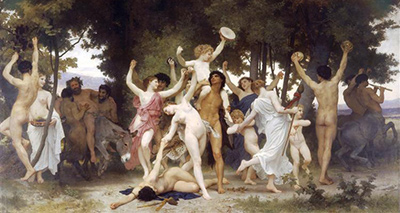
This makes Evening Mood different from Bouguereau's large mythological narratives. The Birth of Venus is ceremonial and crowded. The Oreads is full of ascending bodies. Youth of Bacchus spreads mythological revelry across a huge horizontal procession. Evening Mood is much quieter. It uses one figure to carry the whole meaning.
That simplicity should not be mistaken for casualness. Bouguereau's academic training depended on drawing, controlled anatomy, polished surface and careful preparation. The completed drawings hub explains how his finished paintings grew from study and planning. In Evening Mood, the viewer sees the result of that discipline in the line of the body, the controlled gesture and the smooth transition between flesh, veil and setting.
Salon Context and the Hours of the Day
The museum's note that Evening Mood was exhibited at the 1882 Salon places it in the public exhibition world of late nineteenth-century Paris [1]. This matters because the painting's nudity and sensuality are not presented as an everyday scene. They are framed through allegory and Salon tradition. A figure representing twilight could be shown as an ideal body because the subject belonged to a poetic and classical language.
The Sotheby's record for the reduced Le Crépuscule is also useful because it confirms the larger Salon version as the painting now in the Museo Nacional de Bellas Artes de La Habana [4]. It explains that the reduced version followed the same subject and identifies the Havana canvas as the Salon painting of 1882 [4]. The reduction should not be confused with the museum painting, but it helps confirm the broader history of the image and its place among Bouguereau's hour-of-day allegories.
Those related panels show how Bouguereau used the female figure to personify time. Dawn, twilight, night and day become bodies, gestures and atmospheres. The idea is decorative, but not empty. It lets Bouguereau test changes in light, movement and mood while keeping the human figure at the center of the image.
How to Read Evening Mood Today
Evening Mood is best read as a compact example of Bouguereau's mature allegorical style. It has the smooth finish, ideal figure and controlled sensuality associated with his Academic career, but it does not need the narrative machinery of a mythological crowd. The painting's effect comes from concentration: one body, one hour, one atmosphere.
Modern readers should also be careful with older descriptions that treat the work mainly as a nude or as a romantic beach scene. The painting is certainly sensual, and its beach or shoreline setting matters, but its subject is more specific. It is twilight personified. The crescent moon, darkened clouds, water and veil turn the figure into a visual threshold between day and night.
The confirmed Havana object record makes the account stronger than a reproduction-only route would be. At the same time, the account should remain disciplined. The museum page gives title, date, dimensions, inventory number, collection, exhibition room, Salon note, set comparison and signature [1]. It does not provide a full provenance narrative or a broad interpretive essay. The page can therefore explain what can be supported while avoiding a fuller history than the source provides.
Seen within Bouguereau's cluster, Evening Mood is useful because it fills the space between the major mythological pages and the smaller figure pages. It belongs with The Birth of Venus through the academic nude, with The Oreads through idealised allegorical bodies, and with The Bohemian through the need for careful object-source handling. Its scale is quieter, but its purpose is clear: Bouguereau turns the fading of daylight into a polished human presence.
Related Bouguereau Figure, Allegory and Context Pages
Frequently Asked Questions
Discussion
Evening Mood is a useful test case for Bouguereau because it turns a time of day into an ideal figure while relying on a specific Havana museum object route.
Use the prompts below to connect Atardecer, Le Crepuscule, the Salon context and the hour-of-day series without confusing the museum painting with later reduced versions.
Reader Insights
How do Atardecer, Evening Mood and Le Crepuscule each frame the same twilight subject?
Where does the painting make evening feel like atmosphere, and where does it make evening feel like a person?
Why does it matter that Sotheby's describes a reduced version rather than the Havana Salon canvas?
Join the Conversation
Share your reading of Bouguereau's Evening Mood below.
References
- Museo Nacional de Bellas Artes de Cuba, Wiliam Adolphe Bouguereau, Atardecer, 1882, accessed 28 July 2026.
- Wikimedia Commons, Le Crepuscule (1882), accessed 28 July 2026.
- WikiArt, Twilight or Dusk or Evening Mood, accessed 28 July 2026.
- Sotheby's, William Bouguereau, Le Crepuscule (Dusk), accessed 28 July 2026.
- TheHistoryOfArt.org, William-Adolphe Bouguereau Paintings, accessed 28 July 2026.
- TheHistoryOfArt.org, The Birth of Venus by William-Adolphe Bouguereau, accessed 28 July 2026.
- TheHistoryOfArt.org, The Youth of Bacchus by William-Adolphe Bouguereau, accessed 28 July 2026.
- TheHistoryOfArt.org, The Bohemian by William-Adolphe Bouguereau, accessed 28 July 2026.