



 by Tom Gurney
Tom Gurney BSc (Hons) is an art history expert with over 20 years experience
Published on June 19, 2020 / Updated on October 16, 2026
Email: tomgurney1@gmail.com / Phone: +44 7429 011000
The Nut Gatherers by William-Adolphe Bouguereau: Introduction
William-Adolphe Bouguereau painted The Nut Gatherers in 1882. The Detroit Institute of Arts records the work under the title The Hazelnuts (The Nut Gatherers), preserving both the literal subject and the familiar English name by which many viewers know the picture [1]. It is an oil on canvas showing two young girls seated near the edge of a wooded landscape, close together in a moment that feels quiet, private and tender.
This is not Bouguereau at his most mythological or spectacular. There is no Venus rising from the sea, no Dantean violence, no airborne procession of nymphs. Instead, The Nut Gatherers belongs to his childhood and rural-life subjects: images in which peasant identity, youth, beauty and sentiment are transformed into polished Academic painting. That makes the work essential to understanding Bouguereau's broader appeal. His fame did not rest only on grand mythological nudes. It also rested on pictures of children, girls, mothers and rural figures that collectors found immediately accessible.
The DIA records the painting as an oil on canvas dated 1882, measuring 34 1/2 by 52 3/4 inches, or 87.6 by 134 cm, unframed [1]. Its accession number is 54.458, and the credit line is Gift of Mrs. William E. Scripps [1]. The museum also records that it is signed and dated at the lower left [1]. These facts place the work in Bouguereau's mature period, after his public mythological success and during the years when his market in Europe and the United States was especially strong.
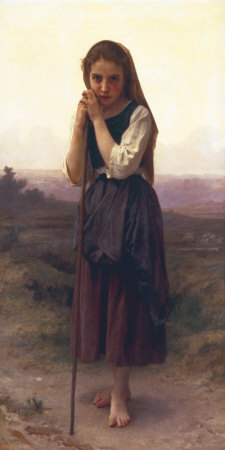
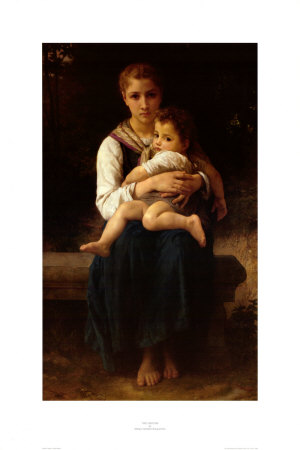
For Bouguereau's wider life, see the William-Adolphe Bouguereau biography. For the larger catalogue, continue to William-Adolphe Bouguereau paintings. The Nut Gatherers should also be read beside Breton Brother and Sister, Young Shepherdess, Innocence and Two Sisters, which show how central childhood and rural feeling were to his public image.
At a Glance
- ArtistWilliam-Adolphe Bouguereau
- TitleThe Hazelnuts (The Nut Gatherers); also known as The Nut Gatherers [1]
- Date1882 [1]
- MediumOil on canvas [1]
- Dimensions34 1/2 x 52 3/4 in.; 87.6 x 134 cm, unframed [1]
- CollectionDetroit Institute of Arts; accession 54.458 [1]
- Credit lineGift of Mrs. William E. Scripps [1]
- SubjectTwo young girls in an idealised rural childhood scene, gathering hazelnuts near the woods [1]
Contents
- Introduction
- Object Facts and Title Variants
- Two Girls at the Edge of the Woods
- Sentiment and Bouguereau's Childhood Subjects
- Rural Life and the Market
- Academic Technique in a Quiet Register
- American Collecting and the DIA
- How to Look at The Nut Gatherers
- Where to Go Next
Object Facts and Title Variants
The title matters. The DIA's preferred title, The Hazelnuts (The Nut Gatherers), keeps the gathered nuts at the center of the painting [1]. The older French title Les Noisettes is often associated with the work, and it also points directly to hazelnuts [2]. These title variants are useful because they remind the viewer that this is not only a picture of two girls. It is a picture organised around a small rural activity: gathering nuts at the edge of the woods.
The medium and scale also matter. At 87.6 by 134 cm, the painting is not monumental in the way The Birth of Venus is, but it is large enough for the girls to feel physically present [1]. The DIA describes the figures as nearly life-size and dominant within the landscape [1]. That scale gives the scene intimacy without reducing it to a small anecdote. The girls occupy the viewer's space with unusual immediacy.
The painting's department and classification at the DIA place it in European Modern Art to 1970 and classify it as a painting [1]. Google Arts & Culture, using the DIA route, records the same basic facts: title, artist, date, physical location in Detroit, oil on canvas and unframed dimensions [2]. The two routes support the page's object foundation, while the DIA record remains the primary source.
The signature and date recorded by the DIA matter because Bouguereau's smooth finish can sometimes make his pictures feel detached from ordinary time. The lower-left signature and date bring the work back to an exact historical moment: 1882, in the middle of a market for polished, idealised peasant and childhood subjects.
Two Girls at the Edge of the Woods
The composition is simple at first glance. Two girls sit together near the woods. One appears to hold hazelnuts, while the other turns toward her with close attention. The background is wooded, subdued and green. The figures are lighter, clearer and more carefully staged than the landscape around them. Bouguereau uses this contrast to make the girls feel immediate and protected.
The DIA describes the painting as an idealised vision of country life, with the girls placed near the edge of the woods and identified through simple clothing that suggests peasant identity [1]. That description is important because the painting should not be read as a documentary record of rural labor. The girls are not shown exhausted by work or pressed by poverty. They are transformed into a tender, polished image of childhood.
This idealisation is part of the painting's appeal and part of its historical complexity. Bouguereau gives the viewer rural life without social harshness. The scene suggests gathering, rest, friendship and innocence. The girls' bare feet, simple clothes and wooded setting all point toward a peasant world, but the surface of the painting makes that world graceful and calm.
The intimacy between the girls is central, but the scene does not need to be made too literal or too sentimental. We do not need to invent exactly what they are saying. The power of the painting lies in the suspended moment: two children absorbed in one another, with the gathered nuts providing a small action around which feeling gathers.
Sentiment and Bouguereau's Childhood Subjects
Bouguereau's childhood images were central to his popularity. The homepage and biography packets already place The Nut Gatherers beside works such as Breton Brother and Sister, Young Shepherdess, Innocence and Two Sisters [3][4]. These paintings show how often he returned to children, young girls, siblings and rural figures. They are not side notes to his mythological art. They are one of the main reasons he became widely admired.
The Nut Gatherers is a particularly clear example because it avoids overt drama. There is no visible crisis, no religious miracle and no mythological transformation. The subject is ordinary, but the treatment is highly refined. Bouguereau makes childhood legible through faces, hands, posture, costume, light and surface. The painting invites the viewer to linger over a small emotional exchange.
The Getty's introduction to Bouguereau helps explain why this kind of painting could be both beloved and criticised. Getty describes him as one of the most popular French artists of the late nineteenth century, admired for technique but also attacked for smooth, romanticised images of peasant girls, cupids and nudes [5]. The Nut Gatherers sits directly in that debate. Its finish, sweetness and controlled feeling are exactly what many collectors valued. They are also what later critics could find too polished.
That double response should not flatten the painting. It is sentimental, but sentiment is not the same as carelessness. Bouguereau constructs feeling with precision. The closeness of the girls, the warm attention between them, the softened landscape and the careful finish all work together. The painting's emotion is designed.
Rural Life and the Market
The DIA record gives the painting an unusually helpful market context. It notes that peasant subjects became increasingly popular among collectors in continental Europe and especially in industrialising England and the United States during the second half of the nineteenth century [1]. That statement is crucial for understanding The Nut Gatherers. The painting is not only an image of rural childhood. It is also an image made for a world of dealers and collectors who wanted idealised rural subjects.
The provenance makes that market visible. The DIA traces the painting from Bouguereau to Adolph Goupil & Cie. in Paris on November 22, 1882, then to Samuel P. Avery in New York on December 5, 1882 [1]. By 1884 it belonged to Mary Jane Morgan in New York. It appeared in the American Art Association sale of her collection in March 1886, where it was lot 154, and then passed to James E. Scripps in Detroit [1]. It remained with the Scripps family before becoming a gift to the DIA in 1954 [1].
This chain of ownership tells a larger story. Bouguereau's painting moved rapidly from Paris to New York and then into an important Detroit collection. The DIA also notes that the original price tripled when the dealer offered the work to an American shortly after buying it from the artist [1]. That detail shows how attractive such paintings could be in the transatlantic market.
This collecting history should be part of the page because it prevents a purely innocent reading. The Nut Gatherers may show children in a wooded setting, but its historical life belongs to dealers, exhibitions, auctions, wealthy collectors and a major American museum. The painting turns rural simplicity into a collectible object for urban and industrial audiences.
Academic Technique in a Quiet Register
Bouguereau's technique in The Nut Gatherers is quieter than in his large mythological works, but it is no less important. The DIA describes the painting's surface as smooth and its technique as flawless [1]. Getty and MusBA Bordeaux both help explain that kind of finish. Getty emphasises Bouguereau's careful planning, figure drawings and limited changes once a final canvas began [5]. MusBA Bordeaux describes him as a reflective, methodical painter who made drawings, detail studies and compositional research [6].
The Nut Gatherers depends on that method. The girls' bodies must feel relaxed but composed. Their faces must be individual enough to hold attention, yet idealised enough to belong to Bouguereau's world. Their clothing must suggest rural identity without becoming rough or documentary. The wooded setting must support them without competing with them.
This is where the painting connects to Bouguereau's more famous works. Dante and Virgil in Hell uses the body for violence and strain. The Oreads uses bodies for ascent and rhythm. The Nut Gatherers uses bodies for stillness, attention and tenderness. The emotional register changes, but the underlying belief remains the same: the carefully drawn human figure can carry meaning.
The painting also shows how Bouguereau could make small emotion feel public. A private moment between two girls becomes a finished exhibition-quality image. The viewer is brought close to a scene of childhood intimacy, but every part of that intimacy has been organised by the painter.
American Collecting and the DIA
The painting's home at the Detroit Institute of Arts is not incidental. The DIA provenance places The Nut Gatherers inside a pattern of American collecting that also appears elsewhere in Bouguereau's career [1]. The biography packet already notes that Bouguereau's success travelled to the United States, where collectors responded strongly to his idealised images [4]. The Nut Gatherers is one of the clearest examples.
James E. Scripps acquired the painting in 1886, the same year it appeared in the Mary Jane Morgan sale [1]. The painting then remained connected to the Scripps family until Mrs. William E. Scripps gave it to the DIA in 1954 [1]. This route turns a private collecting history into a public museum object. It also gives Detroit a strong Bouguereau anchor, alongside the many American museums that preserve his work.
The DIA credit line is therefore part of the painting's meaning. "Gift of Mrs. William E. Scripps" is not only an administrative fact [1]. It records the moment when a painting long held in private hands entered a public collection. From there, the work could function differently: not only as a collector's possession, but as evidence of nineteenth-century taste, transatlantic art dealing and the enduring appeal of Bouguereau's childhood subjects.
Google Arts & Culture confirms the Detroit location and gives a shorter provenance route through the Morgan sale, James E. Scripps, William E. Scripps and the 1954 gift [2]. That secondary record should remain supportive rather than primary, but it helps reinforce the collecting path.
How to Look at The Nut Gatherers
Begin with the relationship between the girls. Their heads, hands and bodies form the emotional center of the painting. The nuts are small, but they focus the scene. They give the girls a reason to be together and a reason for the viewer to imagine conversation, exchange or shared attention.
Then look at the clothing. The DIA notes that the simple attire suggests peasant identity [1]. Bouguereau does not present the girls as fashionable urban children. He gives them rural costume, bare feet and a wooded setting. But he also cleans and idealises the scene. The clothing signals class and setting while the surface turns that class identity into beauty.
Look next at the background. The woods are essential because they create shelter and contrast. The girls are at the edge of nature rather than lost inside it. The setting supports the mood of childhood freedom, but it remains arranged around the figures. Bouguereau is not painting landscape for its own sake. He is using landscape to frame human feeling.
Finally, notice the scale. Because the figures are nearly life-size, the scene can feel surprisingly present [1]. The viewer does not look down at tiny children in a decorative vignette. The girls occupy the picture with calm authority. This is one reason the painting works as more than a sweet anecdote. It gives childhood a serious pictorial presence.
Where to Go Next
To place The Nut Gatherers within Bouguereau's career, start with the William-Adolphe Bouguereau biography and the paintings hub. For related childhood and rural subjects, continue to Breton Brother and Sister, Young Shepherdess, Innocence and Two Sisters.
For contrast, compare Bouguereau's mythological pages. The Birth of Venus shows the ideal body as public ceremony. The Oreads turns bodies into upward movement. Nymphs and Satyr explores erotic play and group choreography. The Nut Gatherers is quieter, but it belongs to the same artistic world of polished bodies, controlled feeling and carefully staged looking.
The drawings and prints pages are also useful next steps. They help explain how Bouguereau's images were prepared, reproduced, circulated and collected. The Nut Gatherers began as a painted scene of rural childhood, but its later history reveals a wider network of dealers, collectors and museums.
Seen this way, The Nut Gatherers is not merely a charming picture of two girls. It is a mature Bouguereau work in which childhood, rural identity, Academic finish and American collecting history meet. Its tenderness is real, but carefully made. Its simplicity is part of the art.
Related Bouguereau Childhood and Rural Paintings


Frequently Asked Questions
Discussion
The Nut Gatherers is a useful test case for Bouguereau because it turns rural childhood, sentiment and collecting history into a polished mature painting.
Use the prompts below to connect the DIA object record, title variants, childhood theme and American provenance.
Reader Insights
Which detail most strongly creates the sense of intimacy between the two girls?
How does the DIA title The Hazelnuts change the way you notice the small action in the picture?
How does the Scripps/DIA history change the painting from private sentiment into public museum evidence?
Join the Conversation
Share your reading of Bouguereau's The Nut Gatherers below.
References
- Detroit Institute of Arts, The Hazelnuts (The Nut Gatherers), accessed 28 July 2026.
- Google Arts & Culture, The Nut Gatherers, accessed 28 July 2026.
- TheHistoryOfArt.org, William-Adolphe Bouguereau, accessed 28 July 2026.
- TheHistoryOfArt.org, William-Adolphe Bouguereau Biography, accessed 28 July 2026.
- Getty, Adolphe-William Bouguereau: An Introduction, accessed 28 July 2026.
- Musee des Beaux-Arts de Bordeaux, William Bouguereau, accessed 28 July 2026.
- TheHistoryOfArt.org, William-Adolphe Bouguereau Paintings, accessed 28 July 2026.
- TheHistoryOfArt.org, The Birth of Venus by William-Adolphe Bouguereau, accessed 28 July 2026.
- TheHistoryOfArt.org, Dante and Virgil in Hell by William-Adolphe Bouguereau, accessed 28 July 2026.
- TheHistoryOfArt.org, The Oreads by William-Adolphe Bouguereau, accessed 28 July 2026.


