 by Tom Gurney
Tom Gurney BSc (Hons) is an art history expert with over 20 years experience
Published on June 19, 2020 / Updated on October 16, 2026
Email: tomgurney1@gmail.com / Phone: +44 7429 011000
William-Adolphe Bouguereau Prints and Reproductions: Introduction
William-Adolphe Bouguereau is famous above all as a painter, not as an original printmaker. His reputation, however, cannot be understood through paintings alone. In the nineteenth century, many of his images moved through photographs, engravings, illustrated journals, dealer publications and later art reproductions. A prints page for Bouguereau should therefore be read as a guide to reproduction and circulation: how his finished paintings travelled beyond the single canvas.
That distinction matters. A painting such as Pieta or The Youth of Bacchus is an original work in oil. A Goupil engraving, a Braun albumen photograph or a periodical illustration after that painting is a different object. It may preserve the composition, title and public reach of the painting, but it is not the painting itself.
Bouguereau's polished academic style was unusually well suited to reproduction. His figures were clearly drawn, his compositions were legible and his subjects were attractive to collectors and readers: mothers and children, religious scenes, mythological figures, peasant girls and sentimental images of childhood. These qualities helped his paintings survive translation into black-and-white prints, photographs and illustrated press formats.
For the main career overview, start with the William-Adolphe Bouguereau biography. For original works, use the paintings hub and the drawings hub. This page focuses on the afterlife of images: how Bouguereau's art was copied, published, collected and seen by people who might never stand before the original canvas.
At a Glance
- Page TypePrints and reproductions hub for the Bouguereau cluster
- ScopeReproductive engravings, photographs, periodical illustrations, dealer publications and later art reproductions
- Not A ClaimBouguereau is treated here primarily as a painter whose images circulated through prints, not as an original printmaker
- Dealer RouteGoupil contract, reproduction control and international image circulation [1]
- Object ExamplesMignon, Pieta, L'Amour et Psyche, Enfants and The Youth of Bacchus [1][2][4][5]
- Use Withpaintings for finished canvases and drawings for preparation
Contents
- Introduction
- Goupil, Dealers and Reproductive Prints
- Photographs and Periodical Illustrations
- How to Read Bouguereau Prints
- Selected Bouguereau Reproduction Routes
Goupil, Dealers and Reproductive Prints
The most important name in Bouguereau's reproduction history is Goupil. The Metropolitan Museum of Art's record for Mignon Pensive, from Illustrated London News states that in 1866 Bouguereau signed an exclusive contract with Goupil & Cie for the sale of his paintings and control of their reproduction [1]. The same Met record explains that the image of Mignon circulated through Goupil's photograph and through a wood engraving published in the Illustrated London News [1].
This is a crucial source for understanding the prints hub. It shows that reproduction was not a minor afterthought. Dealer control of painting sales and published images shaped how Bouguereau's works reached collectors and readers in France, Britain and the United States. The Met notes that such circulation helped build Bouguereau's reputation, especially in the United States and the United Kingdom [1].
Goupil's system helped turn paintings into networks. A canvas could be exhibited or sold to a private collector, but its image could continue moving through photographs, engravings, magazines and dealer catalogues. That movement mattered especially for an artist like Bouguereau, whose work appealed to an international collecting public. The original might be in Paris, The Hague, New York or a private house, while the image could still be encountered in print.
The Goupil record for Pieta gives a second route. It identifies an 1881 black burin engraving after Bouguereau's Pieta, engraved by Achille Jacquet and published through Goupil & Cie and M. Knoedler [2]. The print belongs to the reproductive life of a painting that had begun as a deeply personal religious image. Through engraving and dealer networks, that image became portable and international.
The British Museum's Bouguereau-related print records show the same system at work across other subjects. Its collection includes prints after Bouguereau published by Goupil and Knoedler, including La Vierge, l'Enfant Jesus et St Jean Baptiste, a photogravure after a Bouguereau painting, and other works such as Pepita, Fleurs de printemps and L'Orage [3]. These records show that Bouguereau's images circulated through named printmakers, publishers and international publication cities.
The phrase "after Bouguereau" is important. It usually means that another maker, engraver, photographer or publisher translated an image from Bouguereau's painting into another medium. That object has its own maker, date, technique and collecting history. It can tell us a great deal about Bouguereau's fame, but it should not be confused with a drawing made by Bouguereau's own hand or with the original painted canvas.
This is also why the prints hub should be selective. It does not need to repeat the full catalogue of paintings. The paintings hub can guide readers through original canvases; the prints hub should point to works where reproduction itself is part of the story. Pieta, Mignon, L'Amour et Psyche, Enfants and Youth of Bacchus are useful examples because museum records show specific print, photographic or periodical routes connected to them.
Photographs and Periodical Illustrations
Not every reproduction route was an engraving. The George Eastman Museum holds an Adolphe Braun albumen silver print titled Reproduction of L'Amour et Psyche Enfants by William Bouguereau, dated 1876-1889 [4]. Its inscriptions identify W. Bouguereau, L'Amour et Psyche Enfants and the Braun firm [4]. This photograph helps explain why L'Amour et Psyche, Enfants became such a familiar image: it was built for circulation as well as for viewing as a canvas.
The Paris Musees record for W. Bouguereau - La Jeunesse de Bacchus offers a different kind of print object. It is a photomechanical periodical illustration connected to Paris-Illustre / Au Salon de 1884, held by Musee Carnavalet and marked CC0 by Paris Musees [5]. The object is not the painting The Youth of Bacchus itself. It is evidence that the Salon painting circulated through printed visual culture.
The Met also lists Bouguereau-related print and publication objects in its collection search, including Mignon Pensive, Art and Literature and illustrated almanac/library records [6]. These records remind us that the nineteenth-century public often encountered paintings through pages, albums and magazines as much as through museums and private galleries.
This is why a prints hub should not simply list modern posters for sale. It should help readers understand reproduction as history. Prints, photographs and illustrated journals carried Bouguereau's images across countries, class boundaries and collecting contexts. They helped make his art famous, familiar and commercially powerful.
Periodicals changed the speed of that circulation. A Salon picture could be reproduced while public attention was still fresh. Readers who could not travel to Paris could still see a version of a major exhibition work in an illustrated paper. The printed image might simplify tone, scale and surface, but it widened the audience. For Bouguereau, whose paintings were admired for finish and clear figural design, that wider audience was crucial.
Photography changed the story in another way. A photograph after a painting could preserve more tonal detail than many earlier line engravings, and firms such as Braun created photographic objects that could circulate among collectors, students and image libraries. The Eastman record is valuable because it preserves one of those photographic afterlives as a museum object rather than as a vague modern reproduction [4].
How to Read Bouguereau Prints
When looking at a Bouguereau print or reproduction, start by asking what kind of object it is. Is it a reproductive engraving after a painting? A photogravure? An albumen photograph? A magazine illustration? A modern decorative print? Each type has a different relationship to the original artwork.
The next question is source. A museum record for a print can confirm title, maker, publisher, technique, dimensions and object history. A Paris Musees periodical illustration, a Met print record and an Eastman photograph each describe a specific object, not a general permission to treat every version of a Bouguereau image as the same thing. They should not be treated as interchangeable.
The most useful Bouguereau print routes in this cluster connect back to specific pages. Pieta links to Goupil and Jacquet [2]. L'Amour et Psyche, Enfants links to Braun and photographic reproduction [4]. Youth of Bacchus links to Paris-Illustre and the Salon press [5]. Other collection routes, such as Met and British Museum records, show the breadth of Bouguereau's circulation through illustrated publications and reproductive print culture [1][3][6].
A useful print record often preserves names that disappear in a painting-only account. Engravers such as Achille Jacquet, publishers such as Goupil and Knoedler, photographers such as Braun and periodical publishers all helped Bouguereau's images travel. That does not reduce Bouguereau's role; it shows the larger visual economy around his paintings. Academic art was not only made in studios and judged at Salons. It was also marketed, copied, published and collected through paper objects.
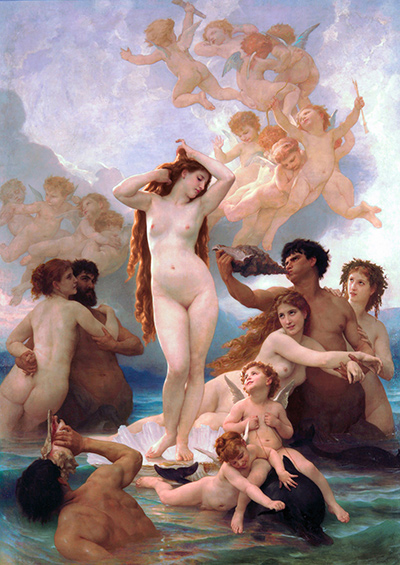
For related artworks, compare Pieta, L'Amour et Psyche, Enfants, The Youth of Bacchus, The Virgin with Angels and The Birth of Venus. For the artist's working process before the finished canvas, use William-Adolphe Bouguereau drawings.
Bouguereau prints are therefore best understood as evidence of fame. They show how academic painting became reproducible, collectible, durable and international. The printed afterlife of his works helps explain why his images remained widely recognizable even when critical opinion turned against academic painting in the twentieth century.
They also help explain why modern viewers often know Bouguereau through fragments: a child, a winged Psyche, a grieving Virgin, a beautiful head, a Salon procession. Reproduction separates an image from its original scale and setting. That can flatten the painting, but it can also keep it alive. A good prints hub should make that double effect clear: reproductions spread Bouguereau's art, but they also transform the way it is seen.
Selected Bouguereau Reproduction Routes
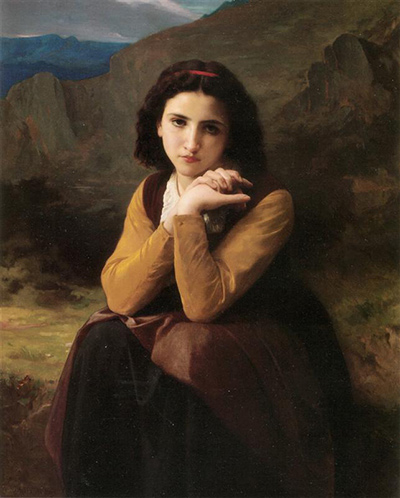
Mignon
Met / Illustrated London News route
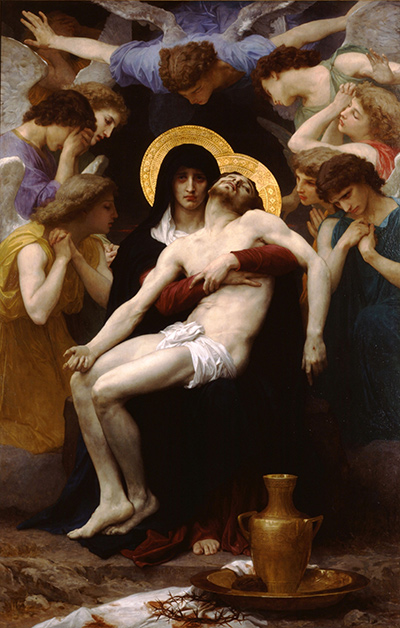
Pieta
Goupil / Achille Jacquet engraving route
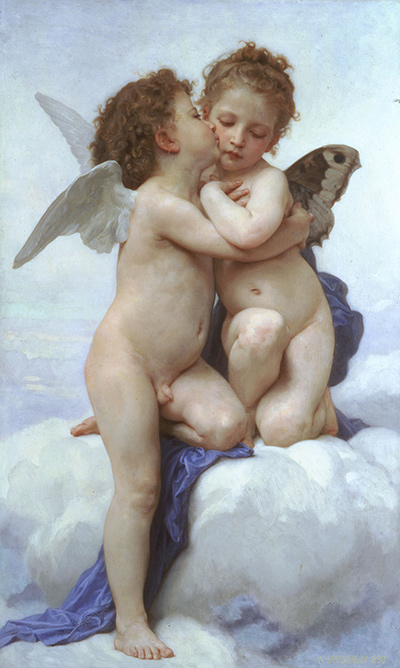
L'Amour et Psyche, Enfants
George Eastman Museum / Braun photograph route
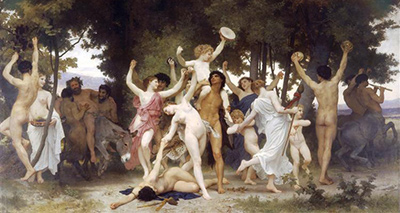
The Youth of Bacchus
Paris-Illustre / Salon periodical route
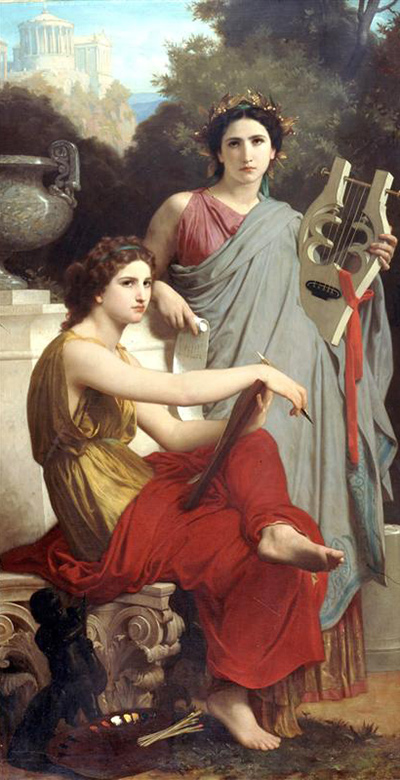
Art and Literature
Met collection-search publication context
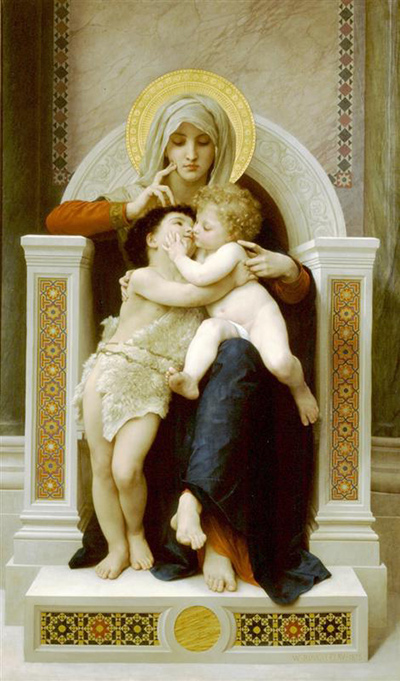
The Virgin Jesus and Saint John Baptist
British Museum / photogravure-after-Bouguereau context
Frequently Asked Questions
Discussion
Bouguereau's prints and reproductions make his paintings visible as public images that moved through dealers, engravers, photographers and illustrated journals.
Use the prompts below to separate the original canvas from the reproductive object and to think about how circulation changed Bouguereau's reputation.
Reader Insights
What changes when a Bouguereau painting becomes an engraving, photograph or periodical illustration?
How do publishers such as Goupil and photographers such as Braun shape the afterlife of a painting?
How should a reader avoid confusing a reproduction record with permission to use the original painting image?
Join the Conversation
Share your reading of Bouguereau's print and reproduction history below.
References
- The Met, Mignon Pensive, from Illustrated London News, accessed 28 July 2026.
- Collection Goupil, Pieta, accessed 28 July 2026.
- British Museum, Adolphe William Bouguereau related objects, accessed 28 July 2026.
- George Eastman Museum, Reproduction of L'Amour et Psyche Enfants by William Bouguereau, accessed 28 July 2026.
- Paris Musees / Musee Carnavalet, W. Bouguereau - La Jeunesse de Bacchus, accessed 28 July 2026.
- The Met, Bouguereau collection search, accessed 28 July 2026.
- TheHistoryOfArt.org, Pieta by William-Adolphe Bouguereau, accessed 28 July 2026.
- TheHistoryOfArt.org, L'Amour et Psyche, Enfants by William-Adolphe Bouguereau, accessed 28 July 2026.
- TheHistoryOfArt.org, The Youth of Bacchus by William-Adolphe Bouguereau, accessed 28 July 2026.
- TheHistoryOfArt.org, William-Adolphe Bouguereau Drawings and Paintings, accessed 28 July 2026.