by Tom Gurney
Tom Gurney BSc (Hons) is an art history expert with over 20 years experience
Published on June 19, 2020 / Updated on October 14, 2026
Email: tomgurney1@gmail.com / Phone: +44 7429 011000
A figure lifted from the Sistine ceiling
A young man sits with his legs spread and his body turning. One arm crosses his chest towards the drapery at his shoulder. His head lowers, but the torso opens broadly to the viewer. The drawing gives weight to the seated body even though it offers almost no setting. Its inherited web title, Naked Young Man, describes the appearance while concealing the important relationship: this is Peter Paul Rubens studying a figure from Michelangelo's Sistine Chapel ceiling.
The British Museum's object record[1] identifies the sheet as Ignudo Turning to the Right, drawn by Rubens after Michelangelo, about 1606, in red chalk with some red wash. It is 38.8 × 27.8 centimetres, museum number 1870,0813.882. The legacy website image matches this particular sheet in pose, drapery, edge and paper marks. Its grey reproduction hides the actual red colour of the drawing medium.
“Ignudo” is an Italian term for a nude male figure. Michelangelo painted pairs of such figures around the central scenes of the Sistine ceiling. The Vatican Museums' ceiling guide[3] describes the nudes as part of the ceiling's painted architectural structure, beside the Genesis stories and holding medallions. Rubens's sheet extracts one of these painted figures for concentrated study. It is not a portrait of an unidentified sitter who posed in Rubens's studio.
At a Glance
- Drawing byPeter Paul Rubens [1]
- AfterMichelangelo's Sistine Chapel ignudo [1]
- DateAbout 1606 [1]
- MediumRed chalk with some red wash [1]
- Dimensions38.8 × 27.8 cm [1]
- CollectionBritish Museum, London, 1870,0813.882 [1]
Where this work sits in Rubens's career
Ignudo Turning to the Right
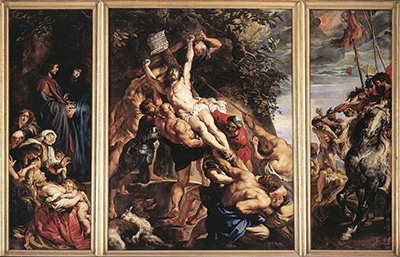
c. 1606The Elevation of the Cross
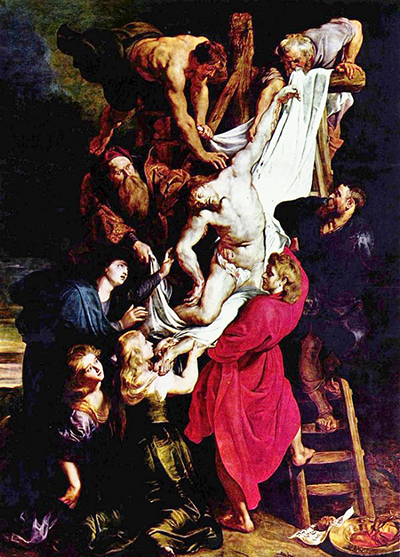
1609–10The Descent from the Cross
1611–14The Garden of Love
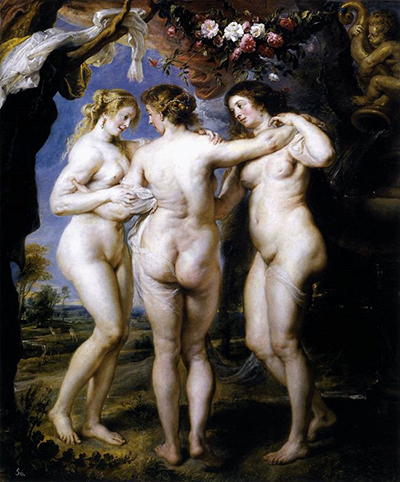
1630–35The Three Graces
1630–35Contents
- Which ceiling figure did Rubens study?
- What is the pose doing?
- Why use red chalk?
- Did Rubens draw from life?
- What is a counterproof, and why is there another sheet?
- How did the figure reach Whitehall?
- What does the sheet tell us about artistic learning?
Which ceiling figure did Rubens study?
The British Museum locates Rubens's model as the ignudo between Jonah and the Libyan Sibyl. These are named figures in Michelangelo's larger programme: Jonah among the prophets, and the Libyan Sibyl among the seers. The Vatican Museums' guide to the prophets and sibyls[4] places Jonah above the altar and the prophets and sibyls on monumental thrones along the ceiling's sides. The ignudo Rubens chose belongs to that painted system, not to a separate narrative of its own.
The identification matters because the drawing can be mistaken for an independent exercise from a live model. Rubens certainly studied bodies, but this sheet records a particular figure invented and painted by Michelangelo decades before Rubens visited Italy. The pose, body turn and gathered drapery are therefore evidence of artistic copying. Rubens's interest lies in how another artist made a seated nude carry force within an enormous fresco programme.
Michelangelo's ignudi are not small framed paintings hung around the chapel. They appear high in a painted architectural structure surrounding the central histories. Seen on the ceiling, each contributes to rhythm, scale and the movement of the viewer's eye between the Genesis scenes and the prophets and sibyls. On Rubens's paper, one figure becomes nearly the entire subject. That change of context is part of the sheet's significance.
The drawing also gives the viewer a different position. In the chapel, looking upward is unavoidable; the painted youth belongs to a surface far above. A sheet measuring under forty centimetres can be examined from a hand's breadth. Rubens's copy makes the twist of the torso, the pressure of the legs and the folds at the shoulder available for close comparison.
What is the pose doing?
The body does not settle into a simple front view or side view. The knees move away from one another, the torso turns across them, and the head dips. An arm cuts diagonally over the upper chest, drawing attention to the meeting of shoulder, neck and drapery. The other arm seems to help hold or gather the fabric behind the figure. Each part has to make sense individually, yet all of them must belong to one weighted seated body.
Rubens follows the broad structure of Michelangelo's figure while working through it in lines and tone. The chest and abdomen are strong but not flat. Muscles change shape with the rotation of the rib cage; the near thigh advances towards the viewer, while the other leg angles downward. The feet anchor the pose near the bottom of the sheet. A reader can trace the figure from the rounded shoulder through the rib cage and down into each leg without needing a fully drawn room.
The lowered face is important. The youth does not confront the viewer like a self-portrait. His gaze follows the movement of the body inward and down. This prevents the drawing from becoming a mere catalogue of muscles. The pose has direction and concentration, even though the ignudo does not enact a named biblical episode in isolation.
The drapery gives the arm something to do. It also creates a contrast between flesh and fabric. The upper arm presses against a gathered mass at right, and long curved lines lead behind the body. Those marks make the twist more legible. The nude body is therefore not an anatomy diagram detached from action: its form is shown through a particular reach, grip and shift of weight.
Why use red chalk?
The British Museum catalogues the original sheet as red chalk with some red wash. Chalk can make a precise edge, a broad rubbed shadow or a sequence of searching lines. Wash adds more continuous tone. In the retained grayscale image, those tonal differences are still visible, but the red of the actual drawing is not. A public caption should give the museum's material description so readers do not leave believing this is a black-chalk study.
Some outlines stay comparatively light and open. The large muscles of the torso are rounded through stronger modelling; hatching and wash darken recesses around the arm, chest and hip. The figure is not uniformly finished. Rubens can press hard where weight and form need emphasis and let other passages remain more exploratory. That variety keeps the drawing from reading like a mechanically traced outline.
The paper bears small spots and worn-looking areas visible in the legacy reproduction. Those features help match the image to the British Museum sheet, but they are not part of Michelangelo's painted figure. The sheet has its own material life as an object. A reproduction can reproduce such marks clearly while suppressing the red colour, reminding us that photographs do not preserve every property equally.
Red chalk also makes the act of translation apparent. Michelangelo's original is fresco on plaster, planned for a vast ceiling. Rubens worked on paper. He was not trying to duplicate the fresco's wall, colour and architecture in miniature. He isolated the anatomy and pose, giving himself a portable record of how the body had been conceived.
Did Rubens draw from life?
The subject of this sheet is a nude male figure, but the museum identifies its immediate model as Michelangelo's fresco. Calling the figure “a naked young man” is visually understandable; calling the sheet a study from a particular live sitter would change its meaning. No sitter's identity or sitting is documented in the record. The first attribution to make is to Rubens as draughtsman, then to Michelangelo as the maker of the design he studied.
This distinction does not make Rubens's drawing passive. Copying a painted body requires choices. A fresco seen overhead cannot simply be moved onto a vertical sheet. The draughtsman decides which contours to reinforce, how to describe a muscle that turns in space, and how much of the surrounding painted structure to omit. The British Museum's identification of the source gives a basis for studying those decisions instead of inventing a studio session.
Rubens was in Italy during the first decade of the seventeenth century. The British Museum dates the drawing about 1606, and its curatorial discussion places it in his study of Michelangelo during a Roman visit. That is an approximate art-historical placement, not a diary entry for a particular day in the Sistine Chapel. The value of the date is that it locates the sheet within Rubens's sustained encounter with Italian art before his mature Antwerp career.
The broader lesson is that a figure study may have more than one artistic author in its history. Michelangelo conceived the ceiling youth. Rubens made a new drawing after him. Later collectors and viewers handled, labelled and reproduced the sheet. The picture on this page is Rubens's paper object, not a crop of the Sistine fresco.
What is a counterproof, and why is there another sheet?
The British Museum holds a related but distinct drawing, 1870,0813.883[2]. Its catalogue calls it an inverted offset, or counterproof, from the original red-chalk study. The figure therefore turns in the opposite direction. Rubens later reworked that transferred image with red chalk, red wash and white heightening. It measures 32.2 × 20 centimetres and is dated about 1630–33 in the museum entry.
The process explains how an early drawing could become useful again decades later. An offset transfers some of a drawing's marks to another sheet, reversing the image. Once Rubens retouched the impression, it was no longer just a pale mirror image. The museum describes changes to the figure and drapery. This later object records an active reconsideration of the earlier pose.
The two sheets must not be collapsed in a caption. The image on this route matches the right-turning original, 1870,0813.882, about 1606, 38.8 × 27.8 centimetres. The left-turning counterproof, 1870,0813.883, is smaller and later. Both are credited to Rubens after Michelangelo, but they represent different stages and different physical sheets.
The distinction is especially easy to lose when both images circulate separately online. A mirrored figure can seem nearly identical at first glance. The direction of the turn, the dimensions, and the added white heightening on the later sheet help identify which is which. The retained image's pose and proportions align with the original, so the later object's 1630–33 date should not be imported into this page's lead caption.
How did the figure reach Whitehall?
The British Museum relates the later counterproof to Rubens's ceiling design Bounty Triumphant Over Avarice for the Banqueting House at Whitehall in London. The museum says Rubens used the figure in the reversed direction and altered aspects of it for that project. In its fuller curatorial note, the later sheet's drapery becomes a garland of oak leaves, and the design develops further towards a cornucopia in an oil sketch.
This is a particularly revealing afterlife for a copied figure. Rubens first studied a Michelangelo ignudo on a ceiling in Rome. Years later, a reversed and reworked version of that pose could serve a very different ceiling programme for an English royal setting. The bodily energy travelled farther than the original iconographic role. It was no longer simply one of Michelangelo's framing nudes in the Sistine Chapel.
The Whitehall connection is evidence for the reuse of the counterproof, not proof that the about-1606 original drawing was made for Whitehall. Rubens could not have planned every later application when first studying the fresco. The museum's two records let us see a sequence: copy, reverse, revise, adapt. The years and materials for each stage should remain attached to the correct object.
For the reader, this sequence answers why a copied drawing matters. Rubens did not only admire the earlier artist's work; he kept a form available for future invention. The body could be revisited, turned and transformed as the demands of another commission emerged.
What does the sheet tell us about artistic learning?
The Vatican ceiling brought biblical history, seers, architecture and idealized nude bodies into one painted system. Rubens singled out one bodily problem: how to make a muscular youth sit, twist, hold drapery and occupy space convincingly. His paper copy preserves that act of selection. It lets modern viewers isolate a detail that would otherwise be part of a far larger visual field.
Study by copying also gives a long timeline to an artist's work. The original drawing belongs to Rubens's early Italian encounter; the later counterproof shows him returning to it in the 1630s. This is more specific than a general statement that Michelangelo “influenced” Rubens. The British Museum holds the two sheets through which an individual figure was copied and then revived.
The drawing's title is therefore a small correction with large consequences. Ignudo Turning to the Right identifies the pose and signals a link to Michelangelo's Sistine figures. The legacy phrase Naked Young Man can remain the route for continuity, but the page should lead with the museum's object identity. Readers can then understand why the figure has such an elaborate seated twist and why Rubens would devote a whole sheet to it.
Begin your own close look at the hand and drapery across the chest. Follow the shoulder into the torso, then the branching legs to the feet. Finally, remember the original setting overhead in Rome. The drawing rewards attention both as a study of bodily form and as a record of one artist carefully engaging with another.
Rubens artworks directory
Frequently Asked Questions
The British Museum credits Peter Paul Rubens. It identifies the figure as copied after Michelangelo's Sistine Chapel fresco.
The original is red chalk with some red wash. The retained web reproduction is monochrome and does not show the red medium.
The museum places Michelangelo's model between Jonah and the Libyan Sibyl on the Sistine Chapel ceiling.
The British Museum dates original sheet 1870,0813.882 about 1606. The related counterproof 1870,0813.883 is a separate later work dated about 1630–33.
The museum links the later reversed counterproof to Bounty Triumphant Over Avarice for Whitehall. That does not make the early original a Whitehall preparatory drawing.
Discussion
Follow the twist from the shoulders into the separated legs.
Share a close observation or a reliable source about BM 1870,0813.882.
Reader Insights
How does a ceiling figure change when copied onto paper?
What does the red-chalk medium contribute to the study?
How does the later counterproof alter the pose's future use?
Join the Conversation
Add your reading below, keeping the original and counterproof distinct.
References
- British Museum, Ignudo Turning to the Right , 1870,0813.882. View source
- British Museum, Ignudo Turning to the Left , counterproof, 1870,0813.883. View source
- Vatican Museums, Sistine Chapel ceiling. View source
- Vatican Museums, Prophets and Sibyls. View source