 by Tom Gurney
Tom Gurney BSc (Hons) is an art history expert with over 20 years experience
Published on June 19, 2020 / Updated on October 14, 2026
Email: tomgurney1@gmail.com / Phone: +44 7429 011000
A body turned against the picture
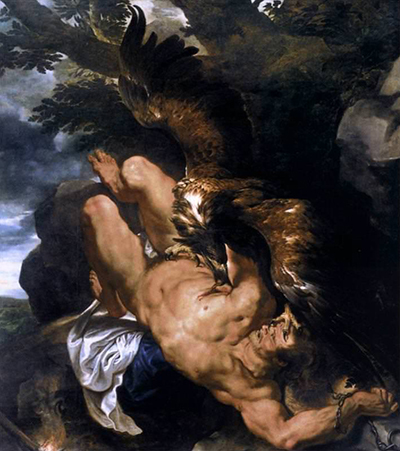
Rubens makes the punishment in Prometheus Bound difficult to look away from. The Titan's body falls diagonally across the canvas, with his head low at the right and his feet raised against the dark rock. Above him, a huge eagle presses into his torso. The pale, exposed figure and the bird's dark wings meet at the centre of the attack. There is little space between them, and little room for the viewer to imagine an escape. The Philadelphia Museum of Art[1] dates the painting as begun around 1611–12 and completed by 1618. It is an oil painting on canvas measuring 242.6 × 209.6 centimetres, large enough to give the struggle almost bodily scale.
The painting is also a documented collaboration. Rubens painted Prometheus; the animal painter Frans Snyders painted the eagle. That division is unusually secure because Rubens himself identified Snyders's contribution when listing the picture for Sir Dudley Carleton in 1618. The bird's presence is central to the work, so naming its painter changes how we understand the picture. The eagle is neither an accessory nor an anonymous studio addition: it is a second artist's answer to Rubens's human figure. The museum's teaching account[2] contrasts Rubens's freer handling of flesh with Snyders's finely worked feathers.
At a Glance
- ArtistsPeter Paul Rubens and Frans Snyders [2][5]
- DateBegun about 1611–12; completed by 1618 [1]
- MediumOil on canvas [2]
- Dimensions242.6 × 209.6 cm [2]
- CollectionPhiladelphia Museum of Art, W1950-3-1 [1]
Where this work sits in Rubens's career
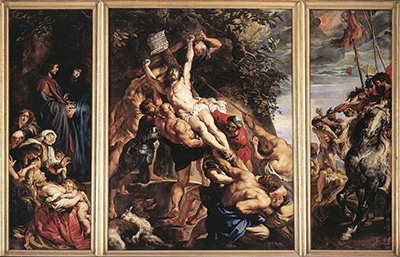
The Elevation of the Cross
1609–10Prometheus Bound
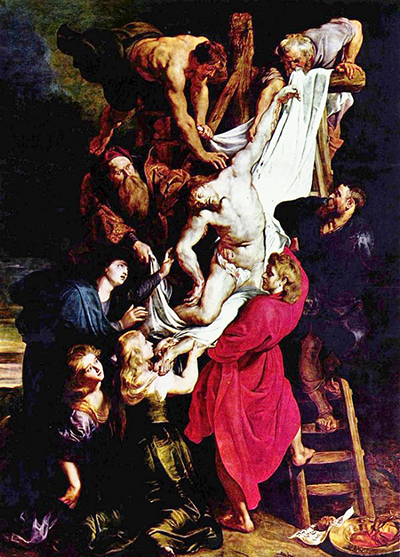
c. 1611–18The Descent from the Cross
1611–14The Garden of Love
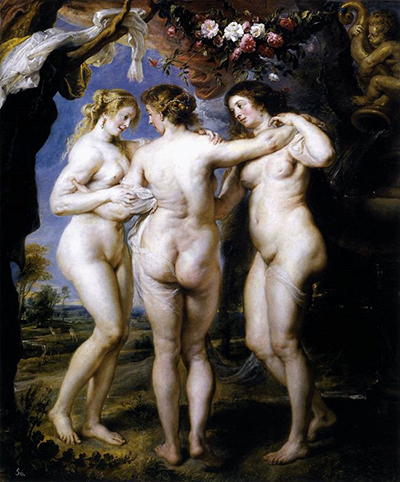
1630–35The Three Graces
1630–35Contents
- What happens to Prometheus?
- Why are two painters named?
- How the eagle was fitted to Prometheus
- A canvas enlarged, a torch brought into view
- What did Rubens's 1618 offer tell Carleton?
- Looking back at Italy
- Does the painting take a side in the myth?
- What is present, and what has Rubens left out?
- Date, ownership and present location
- A response while Rubens still owned it
What happens to Prometheus?
In the Greek story, Prometheus brings fire to human beings against Zeus's will. Zeus has him fastened to a rock, where a bird feeds on his liver. The wound renews, so the punishment repeats. Later traditions tell of Heracles killing the bird and releasing him. Rubens chooses the recurring assault, not the theft of fire or the rescue. The chain fixes Prometheus to the stone while his limbs twist with the force of the attack. The myth explains why he cannot simply pull away; the picture concentrates on what that inability feels like. Philadelphia's account of the myth[3] identifies the daily torment, while its teaching sheet[2] notes the eventual rescue.
The image invites a slow reading of direction and weight. Prometheus's raised legs lead the eye toward the top of the canvas, but his head and outstretched left arm pull it down again. The eagle cuts across that movement. Its body nearly merges with the rock and dark sky, while light catches Prometheus's shoulder, chest and thighs. The contrast makes the human body visible as a sequence of strained muscles. The museum's close-reading text[3] points to the bird's talon at Prometheus's eye and to the way his other eye remains fixed on the attacker. His pain is expressed through an active encounter with the eagle, rather than a passive pose.
That description matters because the subject could have become a static display of anatomy. Instead, neither painter lets the body settle. The eagle's beak and claws anchor the action at the torso, and the figure's limbs push in competing directions. Even the open space at the left does not relieve the pressure: it sets off the abrupt descent of the body. The large canvas makes the movement legible from a distance, while the wound, feathers and clenched hand reward closer looking.
Why are two painters named?
Rubens worked in Antwerp with assistants and other artists, but the word workshop alone is too vague for this picture. In a list attached to his 28 April 1618 letter to Carleton[7], Rubens described the Prometheus as his own work while assigning the eagle to Snyders. The letter was part of a negotiation over paintings and antiquities. It gives a contemporary account of the division of labour, though it is also Rubens's own commercial description of an object he was offering. Philadelphia's current exhibition credit[4] names both artists and identifies the painting as W1950-3-1.
The museum's teaching sheet describes Snyders as a specialist in animals and flowers and credits him with the dark bird. It does not assign him the rocks, landscape or every dark passage. The visible difference in brush handling makes the two contributions worth comparing, but visual comparison alone cannot establish a precise boundary across every feather and shadow. What the documents do establish is the central collaboration: Rubens conceived and painted the suffering Titan, while Snyders made the attacking eagle. See Workshop and Collaborators for how other Rubens projects used different kinds of assistance and shared work.
How the eagle was fitted to Prometheus
Anne T. Woollett's catalogue entry in the Getty Museum's Rubens and Brueghel: A Working Friendship[10], pp. 166–73, goes beyond a simple assignment of bird and figure. A Snyders study for an eagle survives in the British Museum. Its faint chalk marks locate a human torso and the liver, while the bird is worked out more fully. Comparing that sheet with Philadelphia's canvas, Woollett notes adjustments to a wing's contour and to the gap between foot and head. The drawing gives material evidence that the artists were coordinating the animal's attack with the human body. It does not prove the content of any particular conversation between them; Woollett presents discussion between the painters as a likely explanation of the changes.
The canvas itself preserves further signs of planned contact. Woollett observes that Rubens left portions of Prometheus's face and torso less resolved where the eagle's foot and talons would enter. Once Snyders painted the bird, Rubens appears to have added highlights to its feet and beak, and may have strengthened some red marks around the wounds. The last suggestion is more tentative than the bird's documented authorship. These observations change the picture from a tidy two-column division—one man paints the Titan, another simply fills in the eagle—to an integrated sequence in which Rubens anticipated, and later touched, the place where the two painted forms meet.
Woollett also notes why the eagle could be entrusted to Snyders without implying that Rubens could not paint birds. Rubens had painted eagles elsewhere. Here the specialist's close description of feathers and bodily mass creates a distinct texture against Rubens's broad, lit flesh. The painting asks the viewer to believe the bird's size and pressure as much as the Titan's pain. In Woollett's reading, its form and wingspan are informed by the golden eagle rather than a purely heraldic sign. That natural specificity serves a mythic episode: the bird is both Jupiter's punitive agent and a creature that can physically pin its victim.
A canvas enlarged, a torch brought into view
The Getty catalogue documents an addition to the left side of the canvas of roughly seventeen inches. This strip contains landscape and the burning torch, a small but decisive sign of Prometheus's stolen fire. Its ground and paint were added after the main canvas had dried. The physical evidence establishes a change of format; the date of the change remains debated. Peter Sutton proposed that Rubens added the strip during the 1618 Carleton negotiations. Woollett argues that the enlargement more probably belongs to the early working phase, around 1611 or early 1612. She reasons that Rubens's dimensions in the Carleton list fit the enlarged canvas and that adding a torch and a substantial breadth of landscape seems larger than the final retouching he promised Carleton. Neither view is a dated receipt for the addition, so the page should keep the disagreement visible.
The strip affects more than the support's measurements. Without it, Prometheus and the eagle would be packed into a narrower field, their downward slide harder to arrest. The added torch and distant landscape provide a counterweight at the left and make the story of fire legible within the scene of punishment. A detail that looks like a fixed symbol in today's painting was part of a material revision. It shows Rubens adjusting the balance between bodily force and narrative clue while the work was still developing.
What did Rubens's 1618 offer tell Carleton?
The 1618 document gives a rare view of Rubens explaining a painting while it was still in his possession. He offered a group of pictures to Sir Dudley Carleton, the British ambassador in The Hague, in an exchange involving Carleton's ancient sculptures. The Philadelphia exhibition account[4] notes that Rubens placed Prometheus Bound at the head of his proposed group. The digitised correspondence[7] names Prometheus, his punishment on Mount Caucasus and the eagle painted by Snyders. This was a sales description, written to persuade a buyer, but the particular attribution to Snyders is valuable contemporary evidence.
The exchange also explains why “by Rubens” and “with Snyders” can both be true. Rubens was presenting the picture as one of the major works he could offer, while explicitly naming another painter's contribution. He did not conceal the partnership to protect a single-artist label. For a modern reader, the letter is more useful than an unsupported attempt to divide every square inch by visual style. We can identify the commissioned specialist role it records without claiming that every stroke of brown or black on the canvas has been mapped to one hand.
The letters also trace a more specific sequence than a single sale. Rubens's list offered twelve pictures and distinguished works painted by his own hand from those begun by pupils and subsequently retouched. Carleton selected only the “originals,” as Rubens reported in May. Later that month Rubens said that he had given finishing touches to most of the chosen paintings and named Prometheus among those entirely finished and ready to deliver. Woollett reads this sequence against the physical evidence of the enlarged canvas. The letters establish what Rubens said was ready in 1618; they do not date the left-hand extension itself. Woollett's discussion[10], pp. 171, 173, keeps those two kinds of evidence distinct.
Rubens's own valuation is evidence of how he marketed the picture, not a neutral ranking of all his work. Philadelphia's 2015 exhibition quotes him describing paintings then in his house as the best of what he had available. It would be an overstatement to turn that phrase into a claim that Prometheus Bound was indisputably his personal favourite. What the record does show is that he considered the canvas strong enough to lead a proposal to a collector who owned the antique sculpture Rubens wanted.
Looking back at Italy
The painting emerged after Rubens's Italian years, when he had studied ancient sculpture and sixteenth-century Italian art. Philadelphia's 2015 exhibition[4] brought Prometheus Bound together with works by Michelangelo and Titian to examine those relationships. Its curators compare the mass and tension of the Titan's body with Michelangelo's figures, and the downward, unstable arrangement with Titian's Tityus. The Prado's record for Titian's painting[8] identifies a different mythic victim whose liver is attacked by a bird. Rubens did not simply illustrate Titian's story under a new name. He used a related problem—how to make a large human body appear trapped, falling and alive under attack—for his own Prometheus.
These comparisons explain formal choices without reducing the picture to a list of borrowings. A body as large as Prometheus's might seem stable. Rubens turns it, cuts across it with the eagle, and places it on a sharp diagonal. Snyders makes the bird physically credible enough to resist the Titan's strength. The collision of those approaches gives the myth its force. The Philadelphia exhibition also showed a sketch by Snyders for the bird, evidence of the thought given to the animal's role. That sketch is a related preparatory work, not a second version of the completed painting.
Rubens had been testing related problems in his own work before Prometheus. Woollett places the canvas among the forceful subjects he painted around 1609–11. The inverted Hippolytus in The Death of Hippolytus and the extended Argus in Juno and Argus offer particularly close precedents for a body that seems to lose its hold on the picture. She also points to the muscular violence of The Beheading of Saint John the Baptist and Judith Killing Holofernes. These are separate narratives, and none explains the eagle or stolen fire. Together they show that the Philadelphia canvas develops a sustained experiment with bodily weight, exposed muscle and sudden movement. Its originality lies partly in making that experiment carry a mythic punishment on the scale of a near-life-size figure. Woollett, pp. 168–69[10].
The comparison with the Laocoön sculpture adds another kind of pressure. In the ancient group, a father and his sons are attacked by serpents, their bodies turning against an inescapable assault. Philadelphia included a full-size cast in its Wrath of the Gods exhibition[5] to show a model of strained anatomy and pain that Rubens had studied. The subjects are unrelated in narrative, but both confront the artist with a problem: how can a still figure suggest simultaneous resistance and defeat? In Prometheus Bound, the diagonal body and the bird's claws offer one painted answer. This is a curatorial comparison of forms, not proof that Rubens traced a particular limb from the statue.
Philadelphia also placed Michelangelo's drawing of Tityus beside the canvas. The museum's exhibition account notes that Michelangelo drew a resurrected Christ on the other side of that sheet. Its curators used the two-sided drawing to explore how a heroic or suffering body could travel between pagan and Christian imagery. This does not turn Rubens's Prometheus into a hidden depiction of Christ. It helps explain the exhibition's argument that Rubens measured his invention against major models from antiquity and the Italian Renaissance. A viewer can compare the bodily strain and still keep the mythic identities separate.
The museum's published account of Christopher Atkins's 2015 catalogue[6] makes the Michelangelo comparison more specific. Atkins proposes parallels between Rubens's tormented Prometheus and the Risen Christ in Michelangelo's Last Judgment. That is a curator's argument about Rubens's artistic ambition and the mobility of a powerful figure type across subjects. It is not documentary evidence that Rubens copied a particular detail of the Sistine Chapel fresco, nor does it change the painting's identity from pagan myth to Christian history. It does give the comparison more purpose than a loose resemblance of muscular bodies: Atkins asks how Rubens could take a form associated with triumphant rising and turn it into one that falls, twists and endures punishment.
The Titian comparison has a useful complication. Titian's Prado painting depicts Tityus, another punished figure attacked by a bird. Woollett notes that Rubens might have seen the painting in Madrid, but Cornelis Cort's engraving after it could also have supplied a model. Cort's print added a torch to the composition, recasting Tityus as Prometheus; surviving impressions are catalogued under both names, including a National Galleries of Scotland engraving[11]. A bird, a twisted body and a torch could therefore travel between mythic identities in print before Rubens painted his own scene. That history makes the torch on Rubens's added canvas strip especially worth noticing. It does not prove that he copied Cort's print or that Cort prompted the later extension: the route of visual influence and the date of the canvas addition remain open. Woollett, pp. 169, 173[10].
Does the painting take a side in the myth?
The punishment can be read as a warning or as the suffering of a benefactor. Woollett sets out several ancient and later versions. In Hesiod's account Prometheus deceives the gods and steals fire; in the tradition of Aeschylus, the gift helps make human knowledge and civilisation possible. Later moral readings could turn his ordeal into an example of pride punished, while others could stress the painful cost of acquiring knowledge. The painting does not label one of these readings as its programme. It shows the torment with extraordinary directness and leaves the judgement of the theft less explicit. Woollett's catalogue entry[10], pp. 168–69, treats the horror of the physical scene as its dominant effect without ruling out allegory.
The torch helps keep that question open. It marks the act that led to the punishment, but the flame also stands apart from the torn body: what Prometheus gave to humans persists while he suffers. Mandabach proposes a further, expressly interpretive connection between stolen fire and the painters' power to animate matter. That reading gains force from Baudius's early poem, which marvels at the bird's seeming life, yet it is not a surviving statement of Rubens's intended meaning. The image can sustain the comparison between fire and artistic making without forcing every viewer to accept a single moral about Prometheus. Mandabach's study[9] makes the case for that painterly reading.
What is present, and what has Rubens left out?
The story contains a theft, a punishment that repeats and an eventual liberation. Rubens shows only one attack. He does not paint Zeus giving the order or Heracles arriving to end it. The present instant therefore has no visible beginning or finish. The chain and rock tell us that Prometheus has been immobilised, while the eagle makes the recurring wound immediate. The museum's teaching sheet[2] invites readers to find a torch and chain in the composition, signs that connect the bodily struggle with the stolen fire and its consequence. In the small reproduction, some of those details require closer inspection than the broad diagonal figure.
The most unsettling choice is not simply to show violence, but to hold Prometheus conscious within it. Philadelphia's collection highlight[3] describes the eagle's talon at one eye and the other eye turned toward the attacker. That observation gives the face a narrative role. Prometheus cannot escape, but he is not pictured as an inert trophy. His clenched fist and turning body register resistance even when the myth promises that the eagle will return. The tension between awareness and repetition is sharper than a picture of a single final death would be.
The eagle, in turn, is no heraldic symbol placed at a safe distance. Snyders makes it heavy enough to grip and tear. Its wings occupy much of the dark upper field, and its head pushes toward the lit body. Without that scale and physical contact, Rubens's anatomical drama could look like a posed study. The specialist bird painter gives the mythic agent a believable force, which is why the collaborative division affects the work's meaning as well as its credit line.
Date, ownership and present location
The span in Philadelphia's date—begun about 1611–12, completed by 1618—should be kept intact. The 1618 Carleton correspondence proves the picture existed by then and records how Rubens presented its authorship; it does not establish a single day or year when each part was painted. Philadelphia's teaching material says it hung in Rubens's studio for years, cautiously suggesting that he kept it for inspiration. Woollett notes another possibility: an earlier owner could have returned or resold it to Rubens. Neither account identifies a first commissioner. The letter places the canvas in a later exchange with Carleton, while the physical enlargement shows it had a working history before or during those negotiations.
The Getty catalogue follows the painting after that exchange with careful qualifications. It was offered to the Danish king in September 1618 but not sold; a move from Carleton to Charles I is marked possible rather than certain. The work may have passed through the Antwerp dealer Matthijs Musson in 1658. It was in the Manchester family collection at Kimbolton Castle by 1687, stayed with that family until an auction in 1948, and entered Philadelphia in 1950 through the Wilstach Fund. The firm points and the tentative links are not interchangeable. They show both the painting's long survival in British collecting and the gaps that remain between Rubens's exchange and its later documented owners.
Today the painting belongs to the Philadelphia Museum of Art. Its accession number is W1950-3-1; the number 104468 in the museum's web address is an online object identifier, not its accession. The museum gives the medium as oil on canvas and the size as 242.6 × 209.6 centimetres. It credits Rubens and, specifically for the eagle, Snyders. The museum's object page[1] records its identification and dating.
The painting also had an afterlife among artists, as well as collectors. Philadelphia's 2015 exhibition included Jacob Jordaens's Prometheus as an artistic response to Rubens's subject. Placing the two together let the museum ask what could be carried forward from a famous composition: a large body under torment, a bird as aggressor and a challenge to make agony visible. That later response does not tell us what Rubens intended in 1611, but it shows that the canvas became a model other painters could answer. The same exhibition brought together drawings and prints that helped viewers trace artistic questions in both directions, toward Rubens's sources and away from his finished work.
Jordaens's painting offers a telling difference as well as a resemblance. As Mandabach notes[9], it places a small marble bust on the mountainside. The detail makes the association of Prometheus with sculpture more explicit than it is in Rubens's picture. Rubens's Prometheus was the chained giver of fire; later viewers could also recognise a mythical maker of human forms. That sculptural reading helps explain why the punishment attracted artists thinking about their own powers of creation, but the bust belongs to Jordaens's later work, not to the Philadelphia canvas.
Rubens himself returned to the myth from another angle. His 1636–37 oil sketch in the Prado[12] shows Prometheus carrying stolen fire away from Olympus and looking back as he escapes. It was a design for the Torre de la Parada; Jan Cossiers executed the related finished painting. This is an earlier moment in the story, made more than two decades after the Philadelphia picture. Seeing the two designs together clarifies the choice in Prometheus Bound: Rubens could make the theft itself into an image of action, but here he committed his large canvas to the cost that follows. The Prado panel is a separate sketch and should not be mistaken for a study for Philadelphia's canvas.
A response while Rubens still owned it
The painting was already prompting words as well as pictures by 1612. In a scholarly study of Rubens and painterly matter[9], Marisa Mandabach discusses a poem by Dominicus Baudius sent to Rubens that year. Baudius describes the eagle as if its wings and eyes were alive with the stolen fire. His response is evidence that the picture's animal and human parts impressed an early viewer, and it gives a date by which an identifiable state of the composition was visible. It does not mean every final passage was finished in 1612; Philadelphia's date deliberately allows completion by 1618.
Woollett dates Baudius's verses more closely to 7 April 1612 and takes them to mean that the painting was finished or nearly finished by then. Baudius called the attacking bird a vulture, an instructive slip in a culture where the similar punishments of Prometheus and Tityus were easily confused. The bird Rubens assigned to Snyders is identified as an eagle in the artist's later account and in the museum's credit. The poem is valuable for early reception and dating; its bird name does not override the painting's documented subject or authorship. Woollett, pp. 168–69 and note 25[10].
Baudius's language draws attention to a small object easy to miss at ordinary reproduction size: the torch at the lower left. In the myth it recalls the fire Prometheus brought to human beings. In Mandabach's reading it also creates a comparison between the fire and a painter's ability to make feathers, flesh and blood appear living. Her interpretation connects Prometheus Bound with Rubens and Snyders's Medusa, another collaboration in which violent injury and newly active matter meet. The two works are not the same allegory, but they show how a specialist animal painter's contribution could become an intellectual part of a myth rather than a detachable display of skill.
Mandabach also places the collaboration within a collecting culture whose experienced viewers enjoyed recognizing different artistic hands. That context makes Rubens's candid 1618 credit to Snyders more than a bookkeeping detail. The giant eagle visibly answers the giant figure. A viewer can follow both an agonizing story and a contest of abilities: Rubens's anatomy and Snyders's exacting animal surface act upon one another. The early poem and later Carleton description together show that this divided achievement was legible to people close to its making.
Rubens artworks directory
Frequently Asked Questions
Frans Snyders painted it. Rubens named him in the 1618 Carleton list, and the Philadelphia Museum of Art identifies the bird as Snyders's contribution.
The Philadelphia Museum dates it as begun around 1611–12 and completed by 1618. The latter date is supported by Rubens's letter offering the painting to Sir Dudley Carleton.
No. The myths involve different figures and offences, although both pictures show a large captive body tormented by a bird. Philadelphia compares Rubens's composition with Titian's painting as an artistic relationship, not an identification of the same subject.
It is in the Philadelphia Museum of Art, accession W1950-3-1.
Discussion
Use the evidence above to look closely at how Rubens and Snyders make the myth visible.
Share an observation about the painting or a reliable source that adds to its history.
Reader Insights
How do the eagle and Prometheus's body direct your eye through the painting?
What does Rubens's 1618 description tell us about the two painters' work?
Which details can you see in this reproduction, and which need the museum record?
Join the Conversation
Add your reading below, keeping observations specific and evidence clear.
References
- Philadelphia Museum of Art, Prometheus Bound , object record. View source
- Philadelphia Museum of Art, teaching resource on Prometheus Bound. View source
- Philadelphia Museum of Art, collection highlight and close reading. View source
- Philadelphia Museum of Art, The Wrath of the Gods exhibition. View source
- Philadelphia Museum of Art, 2015 exhibition research and comparison with Michelangelo, Titian and the Laocoön. View source
- Philadelphia Museum of Art, Christopher D. M. Atkins, The Wrath of the Gods catalogue description. View source
- Max Rooses, ed., Correspondance de Rubens , vol. 2, letter CLXVI, Herzog August Bibliothek digitisation. View source
- Museo Nacional del Prado, Titian's Tityus. View source
- Marisa Mandabach, “Matter as an Artist: Rubens’s Myths of Spontaneous Generation,” Journal of Historians of Netherlandish Art 13.2 (2021). View source
- Anne T. Woollett, catalogue entry on Prometheus Bound in the Getty Museum's Rubens and Brueghel: A Working Friendship (2006), pp. 166–73. View source
- National Galleries of Scotland, Cornelis Cort, Prometheus (Tityus) , engraving. View source
- Museo Nacional del Prado, Rubens, Prometheus oil sketch for the Torre de la Parada. View source