by Tom Gurney
Tom Gurney BSc (Hons) is an art history expert with over 20 years experience
Published on June 19, 2020 / Updated on November 4, 2026
Email: tomgurney1@gmail.com / Phone: +44 7429 011000
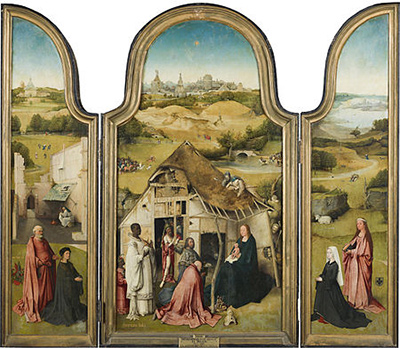
A kneeling king raises his gift towards a child standing on his mother’s lap. Behind him, two richly dressed companions wait beside a large wooden table. Their green, red and white costumes fill the foreground, while a crumbling stable opens onto fields and a distant town. Philadelphia’s Adoration of the Magi makes the Epiphany an encounter between small, attentive figures and extraordinarily elaborate objects.
The painting belongs to the Philadelphia Museum of Art’s John G. Johnson Collection, inventory 1321. The museum currently attributes it to Hieronymus Bosch and dates it to the early sixteenth century.[1] The Bosch Research and Conservation Project, or BRCP, instead assigns it to his workshop, around 1495–1520.[3] Familiar Bosch motifs connect the panel with his artistic circle, but they have not secured agreement about who painted it.
At a Glance
- TitleAdoration of the Magi, also called Epiphany
- AttributionHieronymus Bosch in the museum record; workshop of Bosch in the 2016 BRCP catalogue
- DateEarly sixteenth century in the museum record; around 1495–1520 in the BRCP catalogue
- MediumOil on oak panel
- Dimensions77.5 × 55.9 cm, following the museum
- CollectionPhiladelphia Museum of Art, John G. Johnson Collection, 1917
- Inventory1321; museum object 103592
- SubjectThe Magi presenting gifts to the Virgin and Child
Compare these works across Bosch’s career
These date ranges are estimates, not a documented year-by-year sequence. These works provide context for the article; none is highlighted as the object discussed here.
Saint Jerome at Prayer
Circa 1485–1495 [2]Crucifixion with a Donor
Circa 1490–1500 (BRCP) [2]Hermit Saints Triptych
Circa 1495–1505 [2]Saint Liberata Triptych
Circa 1495–1505 [2]The Hearing Forest and the Seeing Field
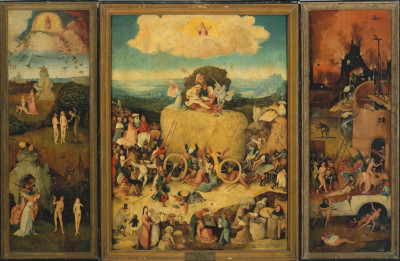
Circa 1500–1505 (Berlin exhibition) [4]The Haywain Triptych
1510–1516 (BRCP) [2]Contents
- Introduction
- Annotated Details
- A Gift Offered at Close Range
- Three Visitors, Three Different Presences
- The Small Story on the White Sleeve
- A Stable That Does Not Quite Fit Together
- Older Models and Familiar Bosch Motifs
- Drawing Beneath the Colour
- What the Wood Can Tell Us
- A Surface Changed by Treatment
- From an English Collection to Philadelphia
Annotated Details from Adoration of the Magi: Philadelphia Panel
The Philadelphia panel groups the visitors around Mary and the child beneath a patched thatched roof. The museum and BRCP catalogue differ on its attribution, as the article explains.
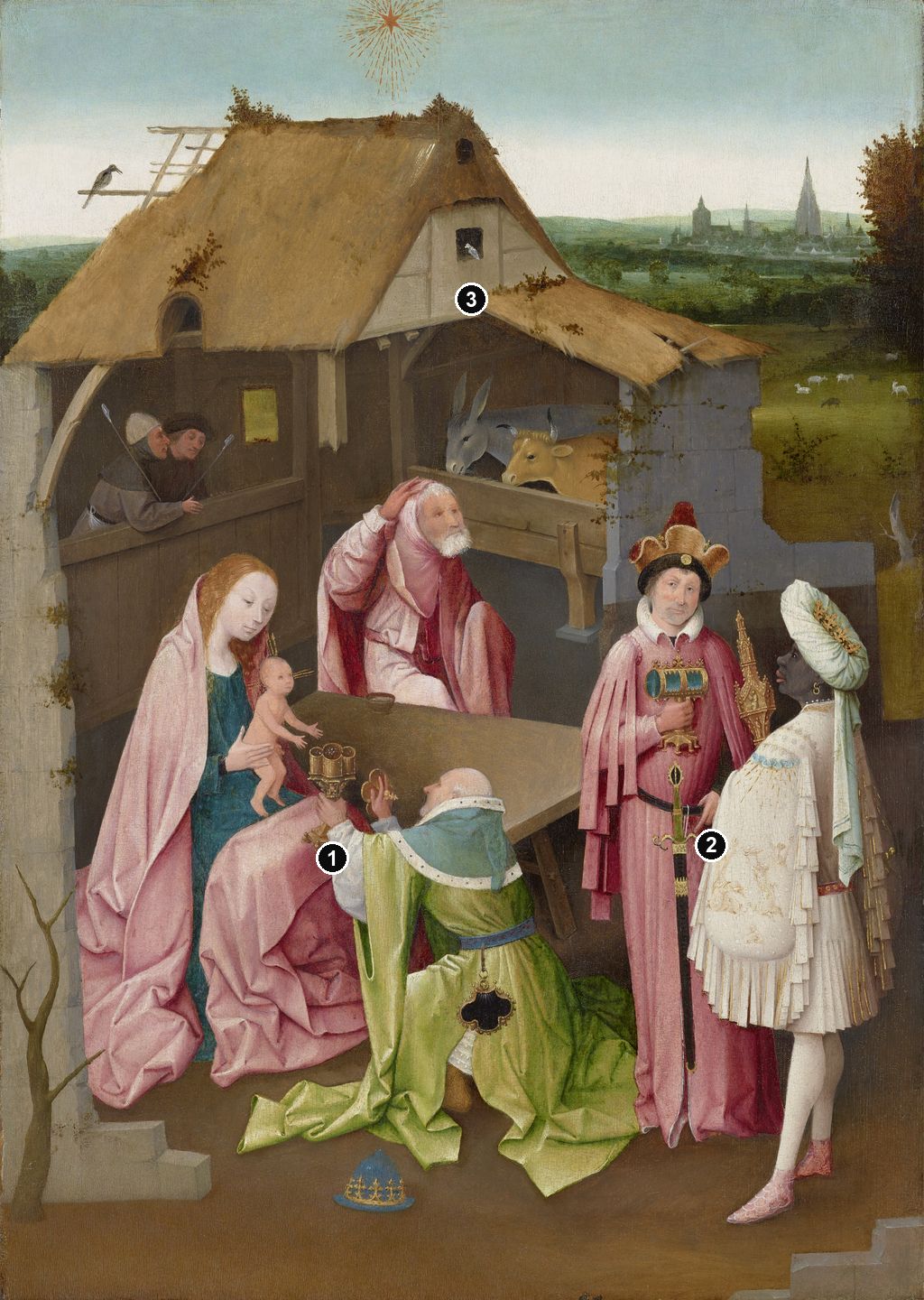
Details from ADORATION OF THE MAGI: PHILADELPHIA PANEL
Compare the gestures, gifts and setting in these three details.
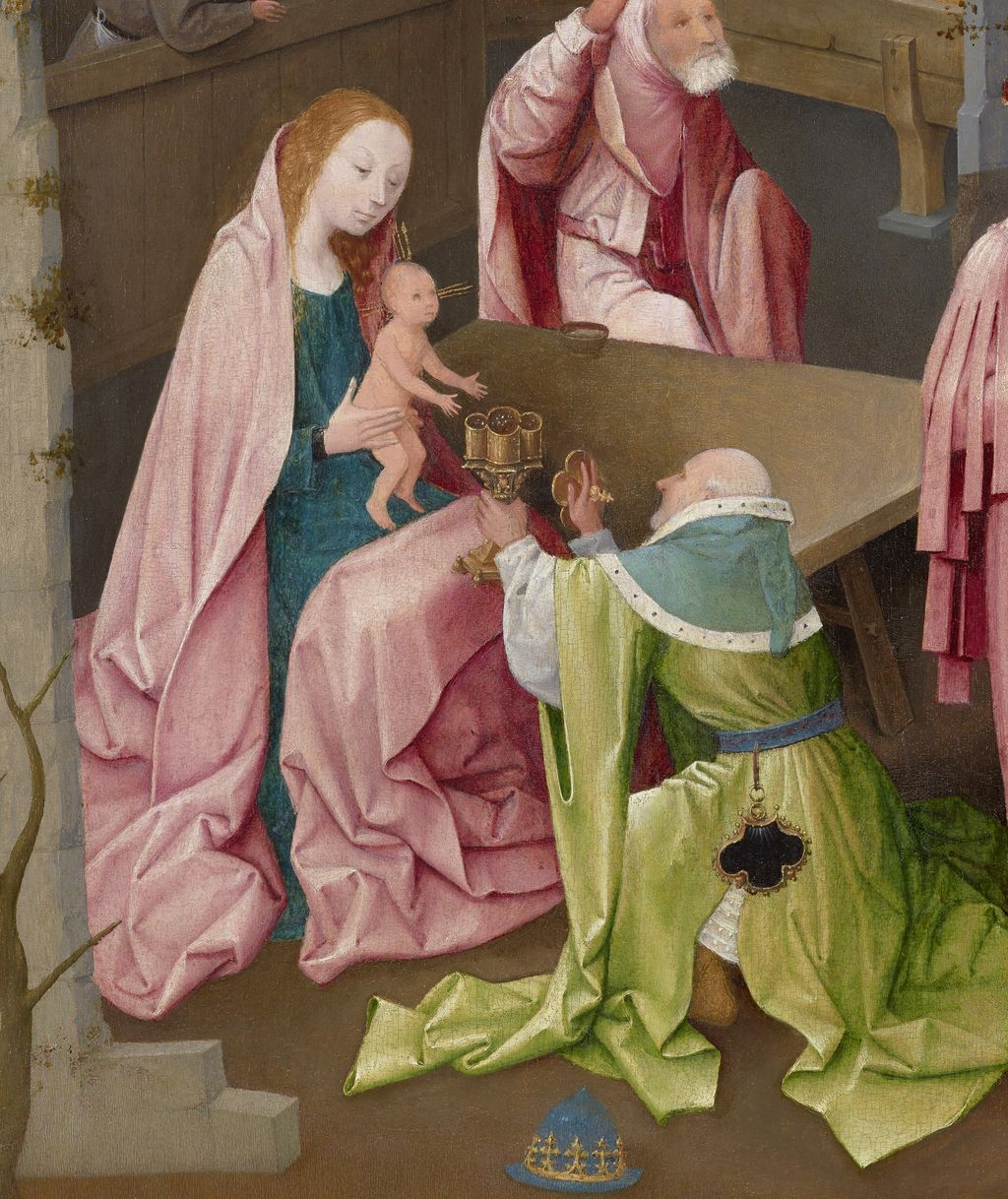
Mary and the kneeling king
Mary supports the child while the kneeling king approaches with a gold vessel. His green mantle spreads across the foreground beside the crown placed on the ground.
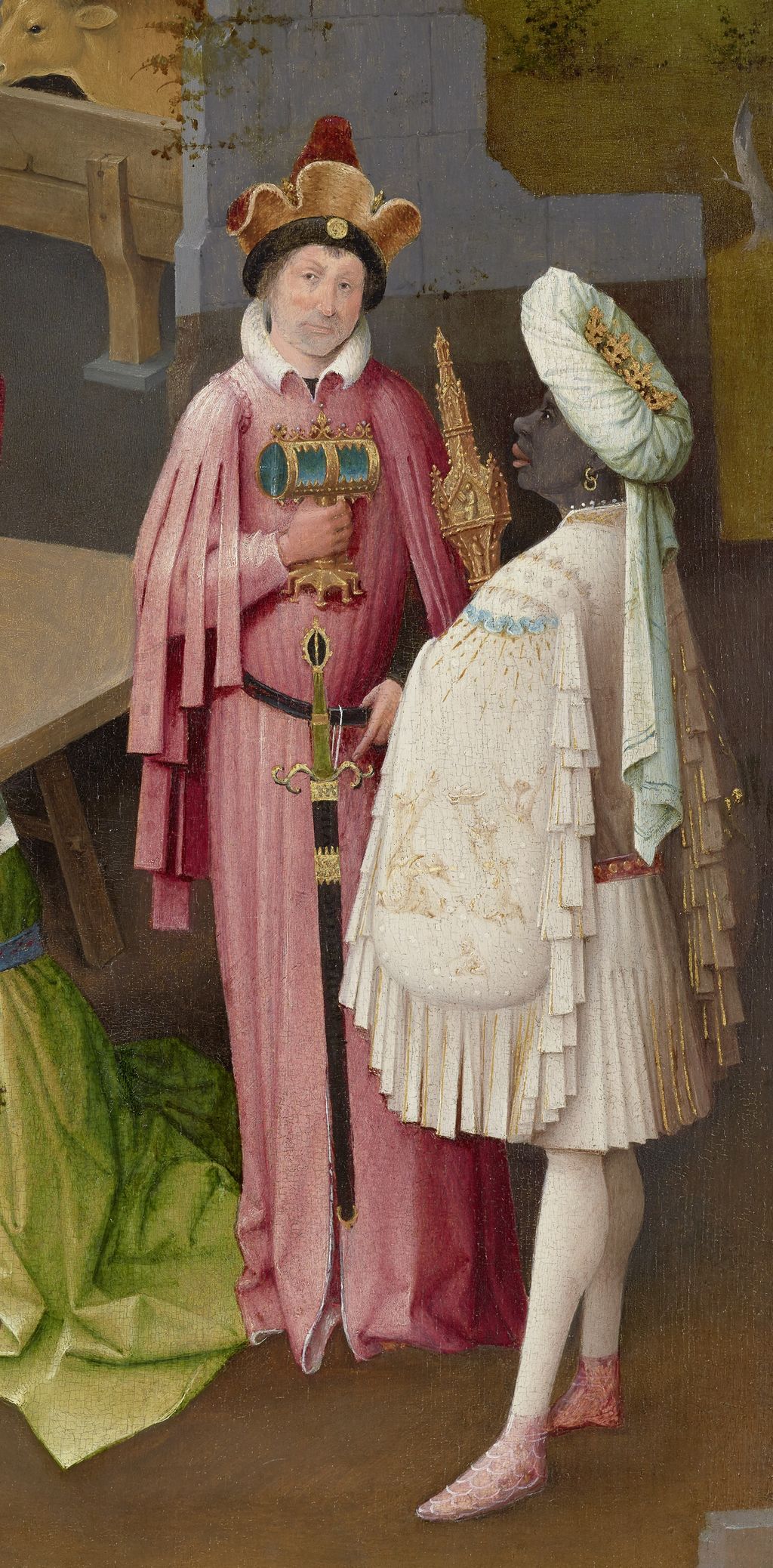
The standing visitors
Two richly dressed visitors stand on the right. Pale fringes, patterned fabrics and the objects they carry distinguish them from the broad green mantle of the kneeling figure.
The stable and distant town
A broken ladder and birds occupy the thatched roof. Behind the stable, fields and a distant town extend across a lower band of landscape.
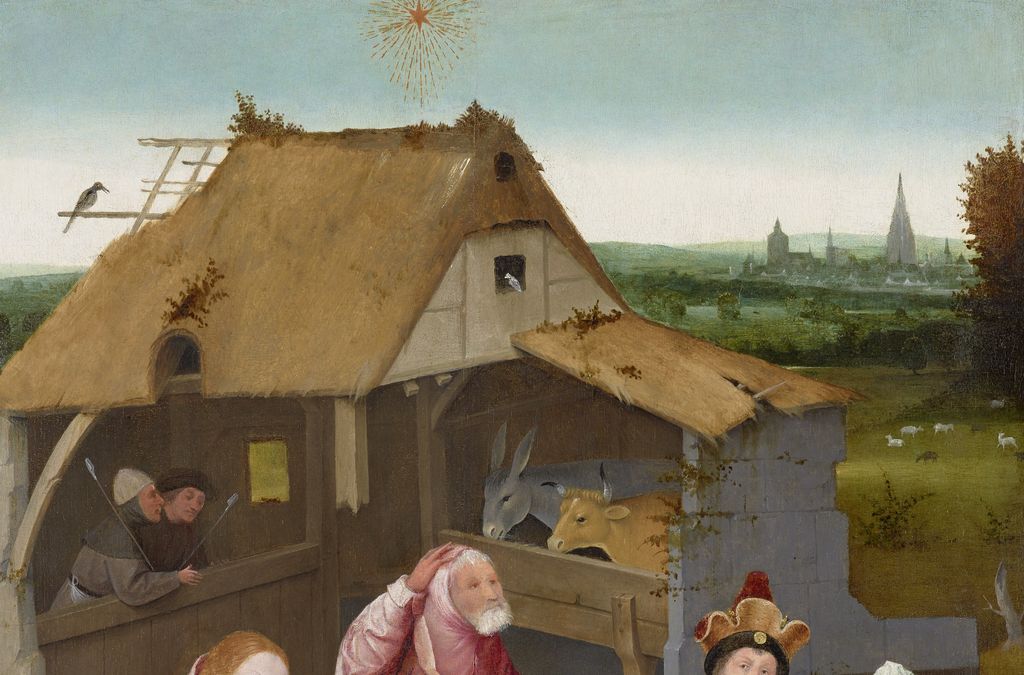
Image and detail crops: Wikimedia Commons source 1 (public domain reproductions).
A Gift Offered at Close Range
Mary occupies the left side of the gathering. Her lowered head and the broad folds of her pink mantle frame the naked child, whose arms extend towards the offering. The king kneels close enough for the exchange to feel possible, yet his bent back conceals much of his face. Our attention passes from the expanse of green cloth to his hands and then to the tiny recipient above them.
His removed crown rests on the ground. Its blue surface and delicate gold ornament create a small island of colour below the robe’s angular folds. Removing it makes the act of homage visible: the visitor has set aside a sign of his own rank before approaching the child. The purse hanging against his back adds another carefully isolated dark shape, edged with gold against the brighter fabric.
The gift resembles a gold ciborium, a covered vessel associated with sacred use, although here three small compartments are open at the top. The BRCP describes their shining contents as frankincense or myrrh.[3] It is unnecessary to decide which substance each painted grain represents. The vessel’s raised position and intricate supports already make the material offering a focus of concentrated attention.
A plain table extends behind this meeting. Its broad surface offers relief from the elaborate clothing, while its slanting edges lead towards Joseph, seated beyond it with one hand raised to his head. His aged face turns towards the visitors. His lifted hand and turned face introduce a pause beside the king’s more purposeful gesture.
Three Visitors, Three Different Presences
The second king wears red and faces almost directly out of the painting. His look interrupts the inward exchange between Mary, the child and the kneeling visitor. It gives the spectator a point of contact within the group: someone seems aware of an observer beyond the stable. Meanwhile, his gift remains held close against his body, waiting rather than advancing.
The BRCP compares that gift to a reliquary with a rock-crystal cylinder and gold fittings.[3] The object combines a clear-looking central section with a strongly articulated frame. Its compact horizontal form contrasts with the tall, pointed container carried by the Black king beside him. These differences let the painter display several kinds of precious workmanship within a tightly limited space.
The youngest king stands in profile at the right. A pale blue-and-white turban rises above his face, and gold details ornament his white costume. Layered strips of cloth create a repeated vertical rhythm below the huge hanging sleeve; narrow legs and pink shoes emerge underneath. The clothing makes his silhouette immediately recognisable even before the sleeve’s narrative decoration comes into view.
The museum relates the three kings to the traditional representation of Europe, Asia and Africa.[1] That interpretation belongs to the subject’s later visual history. Matthew’s account describes visitors from the east, their homage and their gifts of gold, frankincense and myrrh; it neither specifies three visitors nor calls them kings.[5] The painting gives the biblical episode the differentiated ages, royal appearance and geographic breadth developed in subsequent Christian imagery.
The Small Story on the White Sleeve
The Black king’s sleeve contains a second biblical scene. Small figures gather falling manna, the food provided to the Israelites in the wilderness in Exodus 16. Both the museum and BRCP identify this embroidery with that episode.[1][3] Its setting on a garment creates a picture within the picture: the viewer must move from the king’s whole figure to a miniature narrative carried on his body.
The technical report describes pinkish, nearly monochrome figures, gold touches and small raised white dots representing the falling food.[6] These material distinctions helped make a tiny event legible across a pale surface. They also explain why the scene is difficult to read in some reproductions. Abrasion and changes in the paint have reduced details that were once more distinct; an indistinct sleeve should not be filled with imagined figures.
Exodus describes the food appearing with the morning dew and being gathered according to need. The chapter later states that the Israelites ate manna for forty years.[7] The episode concerns provision during their journey through the wilderness. It does not place the first gift of manna after forty years of wandering, a distinction that matters when summarising the little scene.
The BRCP explains the embroidery through Christian typology, in which an Old Testament event anticipates a New Testament one. Manna saving the Israelites from hunger could prefigure Christ’s saving role and, more specifically, the Eucharist.[3] In this reading, the king brings a costly gift while wearing an image of food received from God. The miniature scene enriches the larger exchange between giving and receiving.
This embroidery should also be distinguished from the Dance around the Golden Calf associated with the corresponding king in the Prado Adoration of the Magi. The BRCP explicitly separates the two subjects.[3] Similar costume and placement do not make their narrative details interchangeable. The repeated costume thus carries a different story within a related arrangement of figures.
A Stable That Does Not Quite Fit Together
The building occupies much of the panel, but it never becomes an entirely convincing architectural enclosure. A high remnant of masonry rises along the left edge, while the thatched roof descends towards a smaller shelter on the right. Open partitions reveal two shepherds on one side and the ox and ass on the other. Different sections seem plausible individually, then become harder to reconcile as a single construction.
The BRCP draws particular attention to these spatial inconsistencies.[3] Roof supports and walls do not correspond comfortably to the spaces they supposedly enclose. The table adds another assertive diagonal, opening a broad plane between the figures. Instead of leading effortlessly into a measured interior, the eye repeatedly encounters an edge, a partition or a change of angle.
Yet this awkwardness also gives the gathering its setting. The broken building exposes the visitors to our view, like figures on a shallow stage. Above them, the large area of thatch balances the density of ornament below. A bird perches near an exposed roof ladder, while a small opening punctuates the pale upper wall. Such details make the stable more than an abstract backdrop.
Beyond it, the scene becomes quieter and more spacious. Small pale animals graze in a field; bands of trees and buildings extend towards a distant skyline. The star is positioned high above the roof, linking the humble structure with the visitors’ celestial guide. The landscape opens a world around the close encounter without overwhelming the figures that occupy the foreground.
Older Models and Familiar Bosch Motifs
The composition’s traditional appearance once encouraged scholars to place it very early in Bosch’s career. The BRCP instead points to the persistence of older models. It compares the arrangement of Mary, the child and the kings with fifteenth-century manuscript illuminations, including examples by the Master of Catherine of Cleves.[3] A design can look old-fashioned because an artist reuses an established arrangement, even when the painting itself is later.
The catalogue also identifies connections with accepted Bosch paintings. The stable’s basic form recalls the tavern in the Rotterdam Wayfarer, and the ox has a closely corresponding shape. Mary’s features invite comparisons with women elsewhere in Bosch’s work, while the Black king’s profile and costume belong to a broader network of repeated figures and inventions.[3]
Such correspondences explain why the painting remains important to the study of Bosch’s workshop. They do not, by themselves, establish the hand responsible for every passage. A shared design, access to a model or familiarity with another painting can all create resemblance. The BRCP notes that the Philadelphia and Rotterdam cattle differ in execution despite the close similarity of their forms.
Nor does resemblance establish a complete order of production. The catalogue allows that the grouping here and in the New York Adoration might derive from a shared compositional sketch.[3] That is a possibility rather than a surviving document proving the relationship. The Philadelphia panel is best examined as a particular use of familiar material, with its own grouping, costume and uneven spatial construction.
Drawing Beneath the Colour
Infrared examination revealed extensive preparation beneath the main figures. Contours, folds, hands and faces were mapped out, with parallel and crossing lines helping to model shadow. The investigators distinguished several stages and apparently different liquid drawing materials.[6] The underdrawing therefore records sustained planning rather than a few simple outlines added before the colour.
The paint follows this preparation unusually closely in the BRCP’s comparison with Bosch’s core works.[3] Small adjustments remain: the red king’s robe changed near its lower edge, and a shepherd’s hat was drawn taller than it was painted. The kneeling king’s belt also changed during painting, from a dark design with red chevrons to blue.[6] These revisions are local, rather than a wholesale reorganisation of the scene.
The elaborate surfaces were built through successive applications. The green robe has lighter undermodelling followed by green layers and darker glazes. Gold leaf was attached to a coloured adhesive, or mordant, worked into raised lines and dots.[6] Some apparent gold is therefore actual applied metal, not simply yellow paint imitating a precious object. Its reflections would have contributed to the gifts’ and costumes’ richness.
What the Wood Can Tell Us
Tree-ring analysis changed the painting’s chronology. The youngest surviving heartwood ring on one plank dates to 1482, but that is not the year the picture was painted. Missing outer rings must be allowed for, followed by time for transport and drying. The technical report concludes that use of the panel was possible from 1493 and statistically more probable from 1495.[6]
Those dates rule out the much earlier placement once proposed for the painting. They do not choose an exact year within the BRCP’s broader estimate of around 1495–1520. The museum’s early-sixteenth-century dating falls within that general period.[1][3] Dating the wood narrows the possibilities, while questions of style, workshop practice and authorship still require separate assessment.
A Surface Changed by Treatment
The wooden support consists of two vertically joined oak planks. Its bottom edge was slightly cropped, its reverse thinned, and a wooden cradle added before 1958. The original frame is lost.[6] The present object has therefore undergone changes beyond the visible painting surface, and its surviving edges cannot all be treated as untouched evidence of the initial format.
Condition also complicates judgements of the brushwork. During the BRCP’s 2012 examination, the investigators recorded abrasion, losses, discoloured retouching and badly worn gilding, particularly in areas including Joseph, the kneeling king and the sky. A full treatment followed in 2014–15.[3][6] The technical volume includes photographs after that treatment; its earlier condition observations should not be mistaken for a fresh report on the painting today.
The workshop attribution rests on comparisons of drawing and painting as well as repeated motifs, with the damaged surface acknowledged as a limitation. The museum continues to present the painting under Bosch’s name.[1][6] The difference leaves room for close study without requiring an invented named assistant or a false certainty that every visible stroke belongs to one undisputed artist.
From an English Collection to Philadelphia
The documented ownership history includes Edward Law, first Earl of Ellenborough. The painting was sold at Christie’s in London in April 1914, passed through the Munich dealer Julius Böhler, and was acquired by John G. Johnson in 1915. Johnson’s bequest brought it to the City of Philadelphia in 1917.[1][3] This modern sequence does not identify the original patron or the setting for which the panel was made.
Its place in the Johnson Collection preserves a distinctive version of the Epiphany: a broad table dividing a fragile building, a king who looks towards the spectator, and another whose white sleeve carries a story of divine provision. The child’s reaching arms answer the kneeling visitor’s raised hands, bringing the elaborate royal display back to a simple human gesture.
Artworks and related attributions
Browse paintings, drawings and related attributions. Records group triptychs, fragments and two-sided sheets where appropriate. Dates follow the cited museum records or catalogue headings and are generally estimates. Rows marked “2016 catalogue” report that publication’s attribution and collection information; these are dated opinions, rather than a claim that every work is an accepted autograph Bosch.
| Name | Date | Medium, attribution and collection |
|---|---|---|
| A Crossbowman | Second half of the sixteenth century | Oil on oak panel · Copy after Hieronymus Bosch · Museo Nacional del Prado, Madrid · P002695 Source 1. Source 2. |
| A Woman Spinning and an Old Woman | Museum estimates: about 1480–1490 for the women and 1500–1505 for the reverse; the precise chronology is disputed | Pen and brown and grey ink on the front; pen and brown ink on the reverse · Hieronymus Bosch · Museum Boijmans Van Beuningen, Rotterdam · N 190 recto and verso (PK) Source 1. Source 2. |
| Adoration of the Child in Cologne | Second half of the sixteenth century | Oil on oak panel · Imitator of Hieronymus Bosch, in the city collection record · Wallraf-Richartz-Museum & Fondation Corboud, Cologne · WRM 0474 Source 1. Source 2. |
| Adoration of the Magi in Philadelphia | Early sixteenth century in the museum record; around 1495–1520 in the BRCP catalogue | Oil on oak panel · Hieronymus Bosch in the museum record; workshop of Bosch in the 2016 BRCP catalogue · Philadelphia Museum of Art, John G. Johnson Collection, 1917 · 1321; museum object 103592 Source 1. Source 2. |
| Adoration of the Magi — New York | c.1470–1480 | 2016 catalogue: Bosch; oil on oak · Metropolitan Museum 13.26 2016 catalogue. |
| Adoration of the Magi — Prado triptych | c.1494 | Oil on oak; grisaille exterior · Bosch · Prado P002048 Object source. |
| Adoration of the Magi — three associated fragments | c.1515–1535 | 2016 catalogue: Follower of Bosch · Two Shepherds / Retinue in Philadelphia; associated Adoration in private collection in 2016 2016 catalogue. |
| Ascent of the Blessed — Venice | c.1505–1515 | Oil on panel · Bosch · Gallerie dell’Accademia; Visions of the Hereafter Object source. |
| Battle of the Birds and Mammals | Not specified in catalogue heading | 2016 catalogue: Bosch; pen and brown ink · Berlin KdZ 14715 2016 catalogue. |
| Beggars and Musicians | Around 1530–1540 | Ink and wash on paper · Unknown follower of Hieronymus Bosch · Albertina, Vienna · 7798 Source 1. Source 2. |
| Christ Carrying the Cross Drawing | Around 1470 in the museum catalogue | Black chalk or charcoal, pen and brush in brown ink, white corrections · Anonymous, workshop of Rogier van der Weyden · Museum Boijmans Van Beuningen, Rotterdam · N 81 recto and verso (PK) Source 1. Source 2. |
| Christ Carrying the Cross in Vienna | Around 1490–1510 in the current KHM record and BRCP catalogue | Oil on oak, painted on both sides · Hieronymus Bosch; possible workshop involvement in the Passion side discussed by the BRCP · Kunsthistorisches Museum, Vienna · Gemäldegalerie, GG 6429 Source 1. Source 2. |
| Christ Carrying the Cross — El Escorial | c.1495–1505 | 2016 catalogue: Bosch; oil on oak · Patrimonio Nacional 10014739 2016 catalogue. |
| Christ Carrying the Cross — Ghent | c.1510–1516 (museum) | Oil on panel · Bosch in museum listing; authorship disputed · MSK Ghent 1902-H Object source. |
| Christ Mocked — London | c.1510 | Oil on wood · Bosch · National Gallery NG4744 Object source. |
| Concert in the Egg, After Hieronymus Bosch | Around 1561; third quarter of the sixteenth century | Oil on canvas · Anonymous, after Hieronymus Bosch · Palais des Beaux-Arts, Lille · P 816 Source 1. Source 2. |
| Conjurer / Comical Concert — Louvre drawing | Not specified in catalogue heading | 2016 catalogue: Bosch (recto), follower (concert verso) · Pen and brown ink · Louvre INV 19197 2016 catalogue. |
| Conjurer / Cross-bearing and beggars — Liège sheet | Not specified in catalogue heading | 2016 catalogue: Bosch (verso), follower (recto) · Pen and brown ink · Album d’Arenberg 534 2016 catalogue. |
| Crowning with Thorns — El Escorial | c.1530–1540 | 2016 catalogue: Follower of Bosch; oil on oak · Patrimonio Nacional 10014743 2016 catalogue. |
| Crucifixion with a Donor | Circa 1495–1505; Circa 1490–1500 | Oil on oak panel · Hieronymus Bosch · Royal Museums of Fine Arts of Belgium, Brussels · 6639 Source 1. Source 2. |
| Death and the Miser Drawing | Not securely established; probably made after the painting | Pen and brush, dark ink and white highlights on prepared paper · Workshop of Hieronymus Bosch in the BRCP catalogue; alternatives recorded by the Louvre · Musée du Louvre, Department of Prints and Drawings, Paris · RF 6947, Recto Source 1. Source 2. |
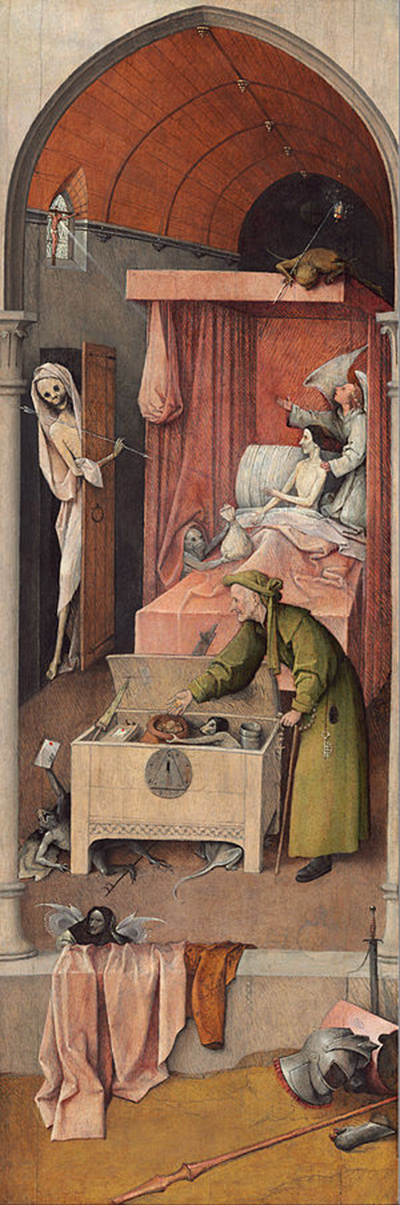
| Death and the Miser — Washington | c.1485/1490 (NGA) | Oil on panel · Bosch · National Gallery of Art 1952.5.33 Object source. |
| Ecce Homo Triptych — Boston | c.1495–1500; wings c.1500/1503 | 2016 catalogue: Workshop of Bosch; oil on oak · Museum of Fine Arts Boston; several production phases 2016 catalogue. |
| Ecce Homo — Frankfurt | c.1490 | Mixed technique on oak · Bosch · Städel 1577 Object source. |
| Fall of the Damned — Venice | c.1505–1515 | 2016 catalogue: Bosch; oil on panel · Visions of the Hereafter · Venice 2016 catalogue. |
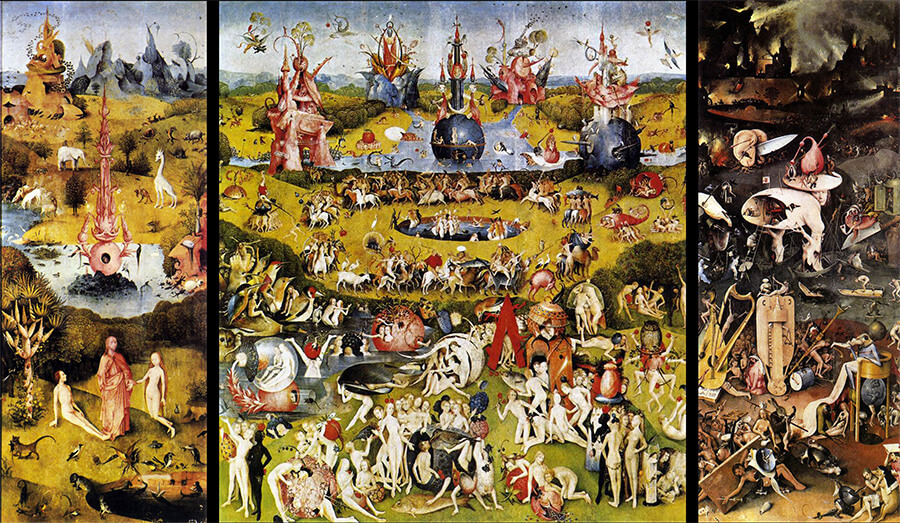
| Garden of Earthly Delights | 1490–1500 (Prado) | Oil on oak; grisaille exterior · Bosch · Prado; triptych Object source. |
| Gluttony and Lust / Allegory of Intemperance — Yale fragment | c.1500–1510 (group dating) | 2016 catalogue: Bosch; oil on oak · Yale 1959.15.22; fragment associated with Ship of Fools 2016 catalogue. |
| Group of Ten Spectators, a Follower of Bosch | Around 1510–1540 in the current museum record | Pen and two brown inks on paper, with a brown framing line · Follower of Hieronymus Bosch in the Morgan record; Bosch in the BRCP catalogue · Morgan Library & Museum, New York · I, 112 Source 1. Source 2. |
| Head of an Old Woman | About 1500 | Oil on panel · Attributed to Jacob Cornelisz. van Oostsanen · Museum Boijmans Van Beuningen, Rotterdam · 2439 (OK) Source 1. Source 2. |
| Hell and the Flood — Rotterdam panels | Around 1515 in the museum records; around 1510–1520 in the BRCP catalogue | Oil on oak panels · Jheronimus Bosch in the museum records; workshop of Bosch in the BRCP catalogue · Museum Boijmans Van Beuningen, Rotterdam Source 1. Source 2. |
| Hermit Saints Triptych | Circa 1495–1505 | Oil on oak panels · Hieronymus Bosch · Gallerie dell’Accademia, Venice · 2044 Source 1. Source 2. |
| Infernal Landscape | Not specified in catalogue heading | 2016 catalogue: Bosch; pen and brown ink, red accent · Private collection in 2016 2016 catalogue. |
| Infernal Scene with Anvil / Monster Studies | Not specified in catalogue heading | 2016 catalogue: Bosch; attribution debated in entry · Pen and brown ink · Berlin KdZ 548 2016 catalogue. |
| Infernal Scene with Tree-Man / Standing Man | Not specified in catalogue heading | 2016 catalogue: Workshop of Bosch; pen and brown ink · Dresden C 1875; historical reverse title includes a proposed prophet 2016 catalogue. |
| Job Triptych — Bruges | c.1510–1520 | 2016 catalogue: Workshop of Bosch; oil on oak · Groeningemuseum / Hoeke loan in 2016 2016 catalogue. |
| Last Judgement — Bruges triptych | c.1495–1505 | 2016 catalogue: Bosch; oil on oak · Groeningemuseum 2016 catalogue. |
| Last Judgement — Munich fragment | c.1530–1540 | 2016 catalogue: Follower of Bosch; oil on oak · Alte Pinakothek 5752 2016 catalogue. |
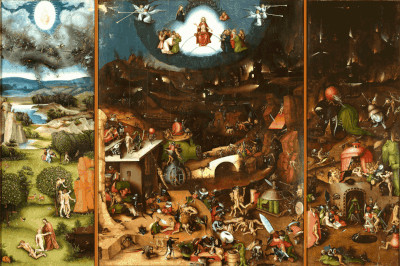
| Last Judgement — Vienna triptych | c.1500–1505 (BRCP 2016) | Oil on oak · Bosch and workshop (BRCP 2016) · Academy of Fine Arts Vienna 2016 catalogue. |
| Man in a Basket and Comic Figures | Around 1500–1515 in the museum record | Pen and brown ink on paper; the reverse is catalogued as iron-gall ink · Hieronymus Bosch in the current Albertina record; attribution has been debated · Albertina, Vienna · 7797 recto and verso Source 1. Source 2. |
| Man Seen from Behind | About 1550–1569; About 1565–1570 | Traces of black chalk, pen and brush in light brown ink · Anonymous, circle of Pieter Bruegel the Elder · Museum Boijmans Van Beuningen, Rotterdam Source 1. Source 2. |
| Mary and John at the Foot of the Cross | About 1440 | Brush in grey and black · Unknown, possibly Netherlandish · Kupferstich-Kabinett, Staatliche Kunstsammlungen Dresden · C 815 Source 1. Source 2. |
| Model Sheet with ‘Witches’ | Disputed; proposals depend on the attribution | Pen and brown ink; the BRCP also records underlying black chalk · Hieronymus Bosch; follower attributions also recorded · Musée du Louvre, Département des Arts graphiques, Paris · INV 19721 recto Source 1. Source 2. |
| Peasant and Three Bust-Length Figures | 1401–1500 | Brown pen over a black preliminary drawing · Attributed to the Master of the Drapery Studies; Bosch circle also recorded · Kupferstichkabinett, Staatliche Museen zu Berlin · KdZ 777 Source 1. Source 2. |
| River to Hell — Venice | c.1505–1515 | 2016 catalogue: Bosch; oil on panel · Visions of the Hereafter · Venice 2016 catalogue. |
| Saint Anthony and a Concert in an Egg | Around 1510–1525 in the museum’s 2016–17 exhibition texts | Pen in light and dark brown inks · Workshop of Hieronymus Bosch; underlying monsters: Bosch (BRCP), possibly Bosch (exhibition text) · Kupferstichkabinett, Staatliche Museen zu Berlin · KdZ 711 recto and verso Source 1. Source 2. |
| Saint Christopher Carrying the Christ Child | c.1500; 1490–1505 in restoration material | Oil on panel · Bosch · Boijmans St 26 Object source. |
| Saint James and Hermogenes | About 1551–1575 in the KIK-IRPA catalogue | Oil on wood, painted on both sides · Anonymous follower of Hieronymus Bosch · Musée des Beaux-Arts, Valenciennes · P.46.1.44; older number 176 Source 1. Source 2. |
| Saint Jerome at Prayer | Circa 1485–1495 | Oil on oak panel · Hieronymus Bosch · Museum of Fine Arts, Ghent · 1908-H Source 1. Source 2. |
| Saint John on Patmos / Passion Scenes | c.1495–1505; estimates vary | Oil on oak · Bosch · Gemäldegalerie Berlin 1647A Object source. |
| Saint John the Baptist in Meditation | Late 15th century; c.1485–1510 (Prado exhibition) | Oil on panel · Bosch · Lázaro Galdiano 8155 Object source. |
| Saint Liberata Triptych | Circa 1495–1505 | Oil on oak panels · Hieronymus Bosch · Gallerie dell’Accademia, Venice · 2045 Source 1. Source 2. |
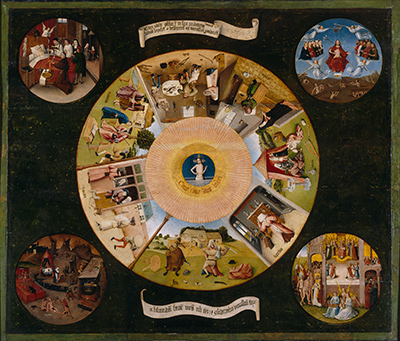
| Seven Deadly Sins and the Four Last Things | 1505–1510 (Prado) | Oil on poplar · Bosch (Prado); workshop/follower disputed · Prado Object source. |
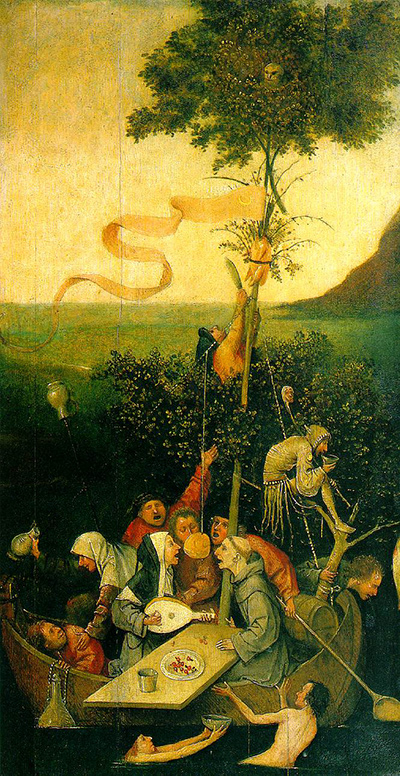
| Ship of Fools — Louvre painting | 1475–1500 (record); c.1505–1515 (exhibition) | Oil on oak · Bosch · Louvre RF 2218; fragment Object source. |
| Ship of Fools — Louvre workshop drawing | Not specified in catalogue heading | 2016 catalogue: Workshop of Bosch · Pen, brush, grey-brown ink and white highlights on prepared paper · Louvre RF 3714 2016 catalogue. |
| Studies of Monsters | About 1530–1550, according to the current Ashmolean record | Pen and brown ink on laid paper, both faces · Anonymous follower of Hieronymus Bosch · Ashmolean Museum, University of Oxford · WA1863.155 Source 1. Source 2. |
| Studies of Saint Anthony and Monsters | No execution date specified in the current Louvre records | Pen and brown ink on paper · Bosch listed; reverse questioned by Louvre; BRCP accepts both faces · Musée du Louvre, Département des Arts graphiques, Paris · INV 20871 recto and verso Source 1. Source 2. |
| Temptation of Saint Anthony — Kansas City fragment | c.1500–1510 | 2016 catalogue: Bosch; oil on oak · Nelson-Atkins 35–22 2016 catalogue. |
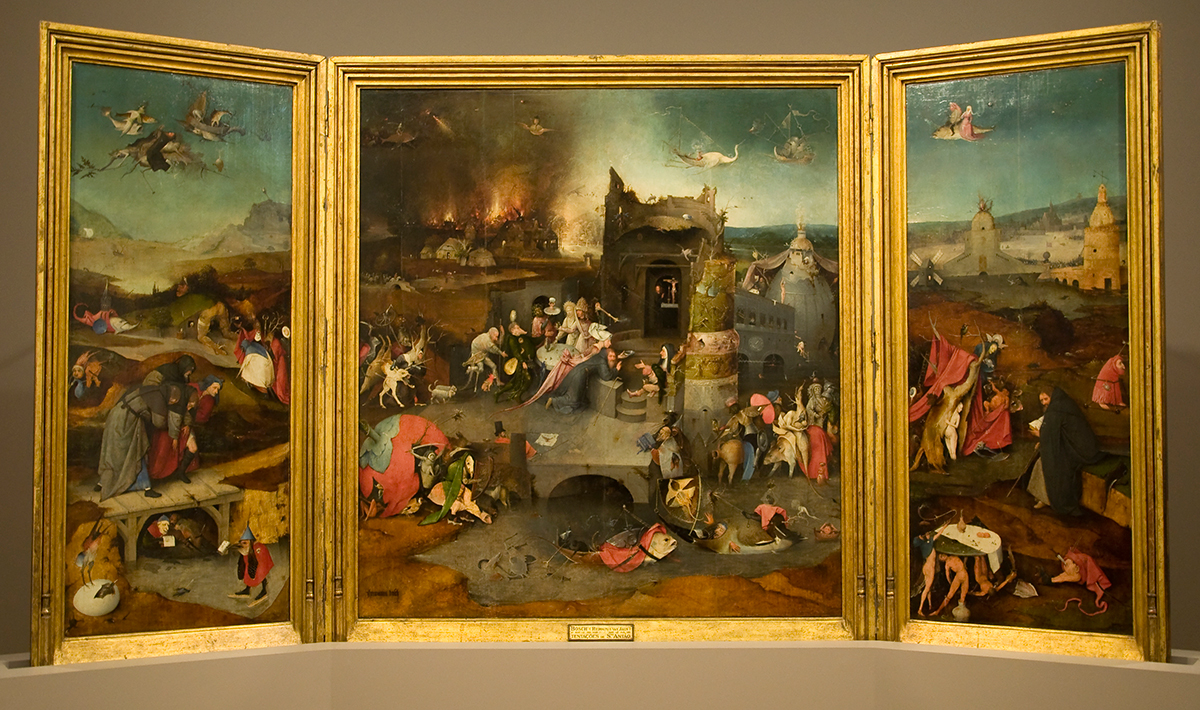
| Temptation of Saint Anthony — Lisbon triptych | c.1500 | Oil on oak · Bosch · Museu Nacional de Arte Antiga 1498 Pint Museum. |
| Temptation of Saint Anthony — Prado panel | c.1530–1540 | 2016 catalogue: Follower of Bosch (2016 opinion); oil on oak · Prado P002049 2016 catalogue. |
| Terrestrial Paradise | Approximately 1505–1515 | Oil on oak panel · Hieronymus Bosch · Gallerie dell'Accademia, Venice Source 1. Source 2. |
| The Burning Ship Drawing | 1500–1520 | Pen and iron gall ink on paper · Attributed to Hieronymus Bosch · Academy of Fine Arts Vienna, Graphic Collection · HZ-2554; numbered 2554 in the BRCP catalogue Source 1. Source 2. |
| The Comical Barber Scene | About 1550–1580, according to the British Museum | Pen and brown ink, grey and brown wash, over black chalk · Anonymous follower, after Hieronymus Bosch · British Museum, Department of Prints and Drawings, London · 1854,0628.46 Source 1. Source 2. |
| The Conjuror, After Hieronymus Bosch | Probably after 1525; around 1530–1540 in the BRCP technical report | Oil on oak panel · Anonymous follower of Hieronymus Bosch · Musée Ducastel-Vera, Saint-Germain-en-Laye · 872.1.87 Source 1. Source 2. |
| The Cure of Folly / Extraction of the Stone of Madness | 1501–1505 (Prado) | Oil on oak · Bosch (Prado); workshop/follower disputed · Prado P002056 Object source. |
| The Entombment Drawing | About 1505–1515, current museum record | Brush and black and grey ink, with grey wash, over black chalk · Workshop of Hieronymus Bosch; drawn by the Master of the Prado Haywain Triptych; Hieronymus Bosch, argued by the BRCP in 2016 · British Museum, Department of Prints and Drawings, London · 1952,0405.9 Source 1. Source 2. |
| The Gathering of the Birds | Not specified in catalogue heading | 2016 catalogue: Bosch; pen and brown ink · Berlin KdZ 13136 2016 catalogue. |
| The Haywain — Prado triptych | 1510–1516 (BRCP 2016) | Oil on oak · Bosch (BRCP 2016) · Prado; separate Escorial version exists 2016 catalogue. |
| The Hearing Forest and the Seeing Field | Circa 1500–1505 | Pen and brown ink on paper · Hieronymus Bosch; reverse: Bosch and workshop · Kupferstichkabinett, Staatliche Museen zu Berlin · KdZ 549, front and reverse Source 1. Source 2. |
| The Owl’s Nest — Rotterdam | Not specified in catalogue heading | 2016 catalogue: Bosch; pen and brown ink · Boijmans N 175 2016 catalogue. |
| The Passion Triptych in Valencia | Workshop of Bosch, about 1510–1520; Follower of Bosch; centre about 1530–1540, wings about 1540–1550 | Oil and gold on oak panels · Workshop of Bosch, about 1510–1520; Follower of Bosch; centre about 1530–1540, wings about 1540–1550 · Museu de Belles Arts de València Source 1. Source 2. |
| The Pedlar / Wayfarer — Rotterdam | c.1500 (museum) | Oil on panel · Bosch · Boijmans 1079 (OK); rejoined exterior Object source. |
| The Tree-Man — Vienna drawing | c.1505 | Pen and brown ink · Bosch · Albertina, Vienna Object source. |
| The Wedding at Cana, After Hieronymus Bosch | Approximately 1560 in the current museum record | Oil on panel, 93 cm high × 72 cm wide · Anonymous, after Hieronymus Bosch · Museum Boijmans Van Beuningen, Rotterdam, St 25 Source 1. Source 2. |
| Two Fantastical Creatures — Berlin KdZ 550 | Around 1505–1515 in the museum’s 2016 exhibition text | Pen in brown ink on reddish prepared laid paper · Hieronymus Bosch · Kupferstichkabinett, Staatliche Museen zu Berlin · KdZ 550, recto and verso Source 1. Source 2. |
| Two Figures Wearing Mitres | About 1480 | Oil on panel · Anonymous (Boijmans); Bosch circle (RKD) · Museum Boijmans Van Beuningen, Rotterdam · 1177 (OK) Source 1. Source 2. |
| Two Men and the Temptation of Eve | About 1505–1515 in the Prado’s 2016 exhibition guide | Pen and grey-brown ink on paper · Hieronymus Bosch in the 2016 catalogues discussed here · Private collection, as recorded in 2016 Source 1. Source 2. |
| Two Men Fighting | Not specified in the current Louvre record | Pen and brown ink · In the manner of Hieronymus Bosch · Musée du Louvre, Département des Arts graphiques, Paris · INV 20660 recto; formerly NIII 8896 and MA 8400 Source 1. Source 2. |
| Two Men — Berlin KdZ 5210 | Not specified in catalogue heading | 2016 catalogue: Bosch questioned · Pen, brush, ink, chalk and white highlights · Berlin KdZ 5210; historical title Two Oriental Men 2016 catalogue. |
| Two Monsters — Berlin KdZ 547 | Approximately 1500–1510 in Berlin's 2016 exhibition catalogue; an estimated range | Pen and brown ink on paper · Hieronymus Bosch · Kupferstichkabinett, Staatliche Museen zu Berlin · KdZ 547, drawn on both sides Source 1. Source 2. |
Frequently Asked Questions
It belongs to the Philadelphia Museum of Art’s John G. Johnson Collection, inventory 1321, received with the collection in 1917.[1]
The elaborate gold vessel has open compartments. The BRCP describes its shining contents as frankincense or myrrh, without making every painted grain securely identifiable.[3]
The museum records 77.5 × 55.9 cm. It is painted in oil on oak panel.[1]
Discussion
Look at the gift, crown and differing gazes, while keeping the museum and workshop attributions distinct.
Reader Insights
How does the king’s removed crown change the act of presenting his gift?
Compare the plain table with the elaborate garments and vessels. Where does your eye rest?
How does the second king’s outward look change your relationship with the scene?
Join the Conversation
Share a detail, comparison or question about Adoration of the Magi in Philadelphia below.
References
- Philadelphia Museum of Art, Adoration of the Magi, John G. Johnson Collection 1321, current collection record, description, metadata and provenance. View source.
- BRCP Catalogue Raisonné (2016), object dates in catalogues 1, 2, 8, 15 and 20; catalogue 20 object metadata only for the Haywain comparison. View source
- Matthijs Ilsink and colleagues, Hieronymus Bosch, Painter and Draughtsman: Catalogue Raisonné (2016), catalogue 25, pp. 416–421, complete entry and plates. View source.
- Staatliche Museen zu Berlin, 2016 exhibition wall texts, p. 3: approximate date of KdZ 549. View source
- Gospel of Matthew, chapter 2, USCCB, verses 1–12 and relevant notes on the Magi. View source.
- Luuk Hoogstede and colleagues, Hieronymus Bosch, Painter and Draughtsman: Technical Studies (2016), catalogue 25, research reports 57–58, pp. 356–365, complete report and post-treatment plates. View source.
- Exodus, chapter 16, USCCB, manna narrative and notes on its Christian interpretation. View source.
- Splash image, Adoration of the Magi, early sixteenth century, oil on oak panel, Philadelphia Museum of Art, John G. Johnson Collection, 1917, 1321. Attributed to Hieronymus Bosch by the museum and to his workshop by the BRCP. View source. View source.