by Tom Gurney
Tom Gurney BSc (Hons) is an art history expert with over 20 years experience
Published on June 19, 2020 / Updated on November 4, 2026
Email: tomgurney1@gmail.com / Phone: +44 7429 011000
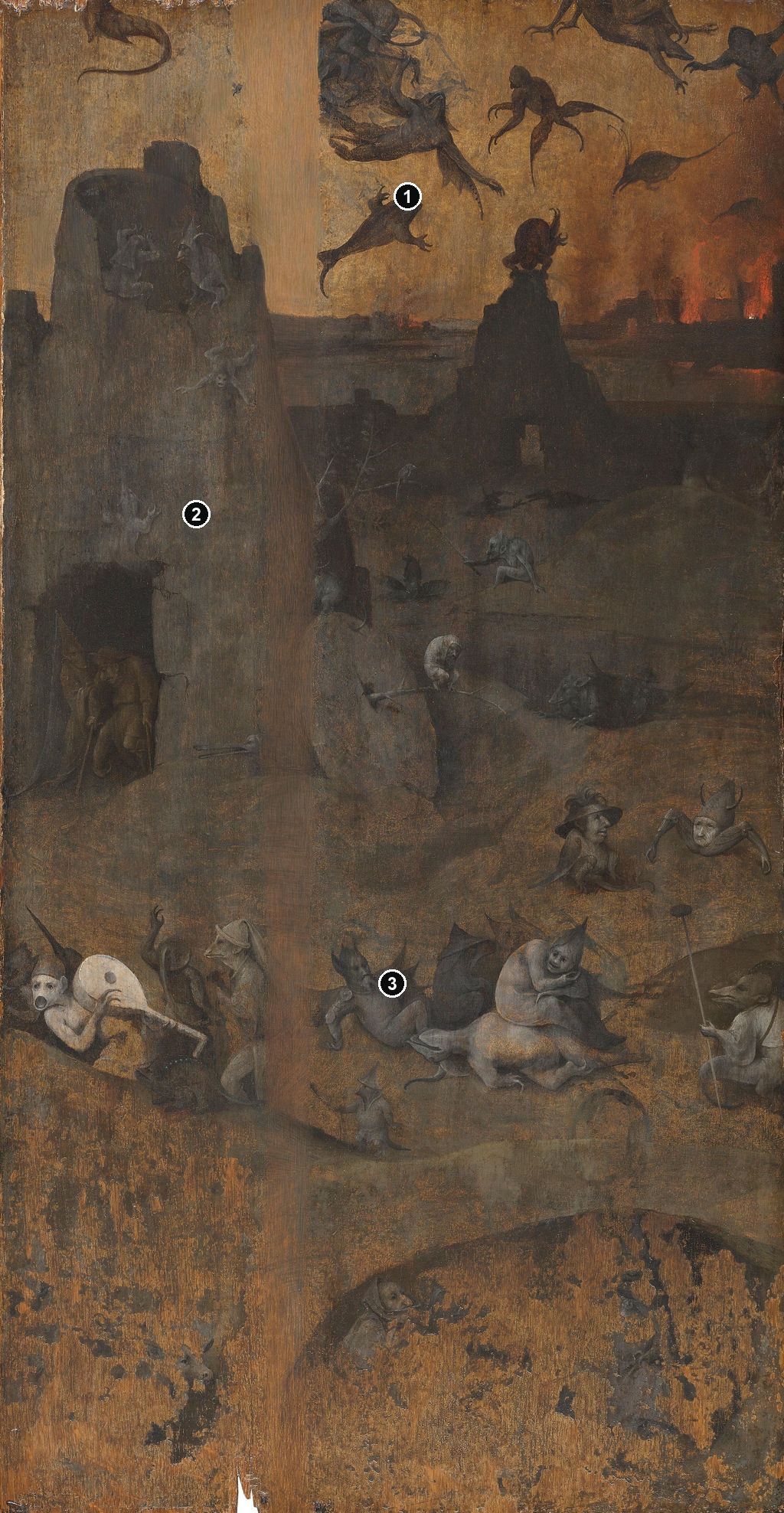
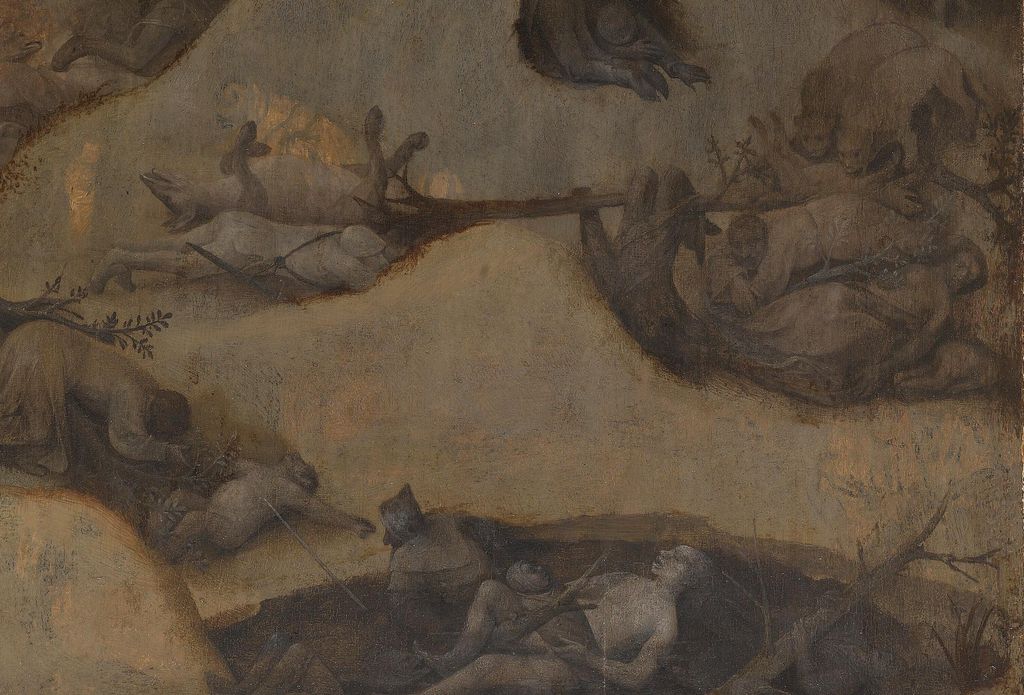
Monsters fill the air above a desolate landscape, while a distant city burns against an orange sky. At ground level, creatures crawl, squat, make music and gather around strange bodies. The painting is known as Hell in the collection of Museum Boijmans Van Beuningen, Rotterdam. It belongs with a second panel showing Noah’s Ark after the Flood, and both wooden supports carry further scenes on their backs.[1][4]
These four painted surfaces preserve parts of a larger work whose central image is lost. The museum attributes the panels to Jheronimus Bosch, around 1515. The Bosch Research and Conservation Project, or BRCP, places them in his workshop, around 1510–1520.[1][5] The original order of the wings and the meaning of their imagery have also prompted different reconstructions.
At a Glance
- Surviving workTwo double-sided panels, probably wings of a triptych
- AttributionJheronimus Bosch in the museum records; workshop of Bosch in the BRCP catalogue
- DateAround 1515 in the museum records; around 1510–1520 in the BRCP catalogue
- MediumOil on oak panels
- HellSt 27 recto, 69 × 35 cm, following the museum
- The FloodSt 28 recto, 69.5 × 38 cm, following the museum
- Reverse of HellFleeing woman and burning farm above; unseated farmer below
- Reverse of The FloodMan attacked by demons above; blessing scene below
- CollectionMuseum Boijmans Van Beuningen, Rotterdam
- Current creditLoan from Stichting Museum Boijmans Van Beuningen, former Koenigs collection, 1940
Compare these works across Bosch’s career
These date ranges are estimates, not a documented year-by-year sequence. These works provide context for the article; none is highlighted as the object discussed here.
Saint Jerome at Prayer
Circa 1485–1495 [2]Crucifixion with a Donor
Circa 1490–1500 (BRCP) [2]Hermit Saints Triptych
Circa 1495–1505 [2]Saint Liberata Triptych
Circa 1495–1505 [2]The Hearing Forest and the Seeing Field
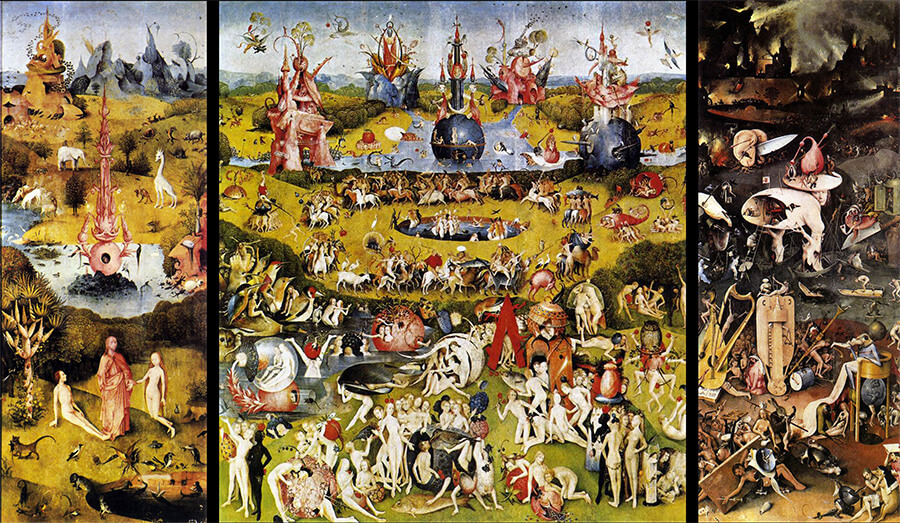
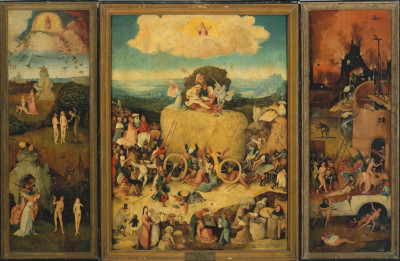
Circa 1500–1505 (Berlin exhibition) [6]The Haywain Triptych
1510–1516 (BRCP) [2]Contents
- Introduction
- Annotated Details
- Identifying the Burning Landscape
- Hell or the World After Judgement?
- Noah’s Ark and the Return to Land
- A Flood Scene Changed During Painting
- Two Roundels Behind the Burning Panel
- Assault and Blessing on the Other Reverse
- Do the Roundels Tell the Story of Job?
- The Uncertain Order of the Wings
- Bosch and the Workshop
Annotated Details from Hell and the Flood: Four Painted Surfaces
These views show all four surviving painted surfaces of Rotterdam St 27 and St 28. They belong to two double-sided panels. The museum and BRCP catalogue differ on the attribution, as the article explains.
Rotterdam Hell St27 Front
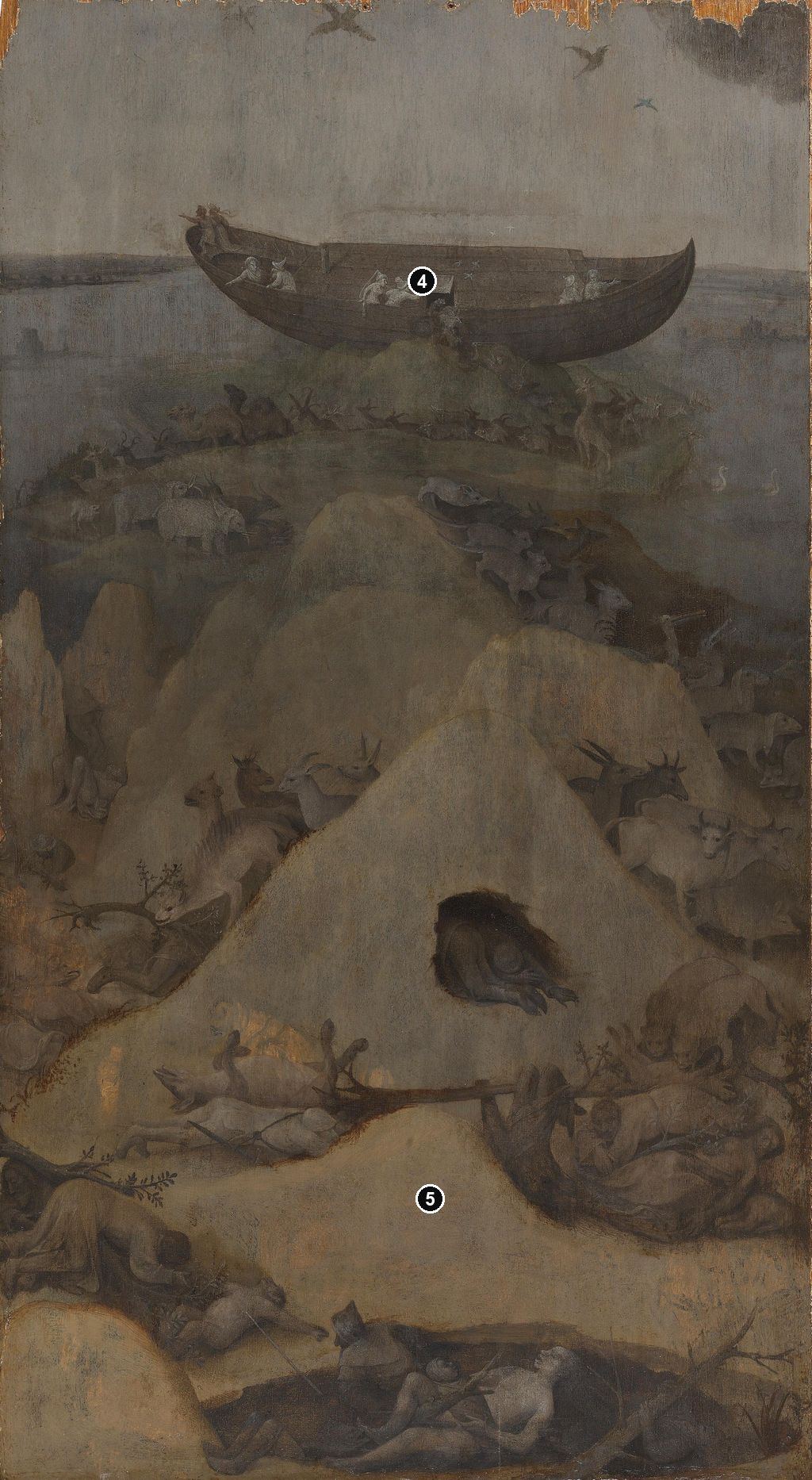
Rotterdam Flood St28 Front
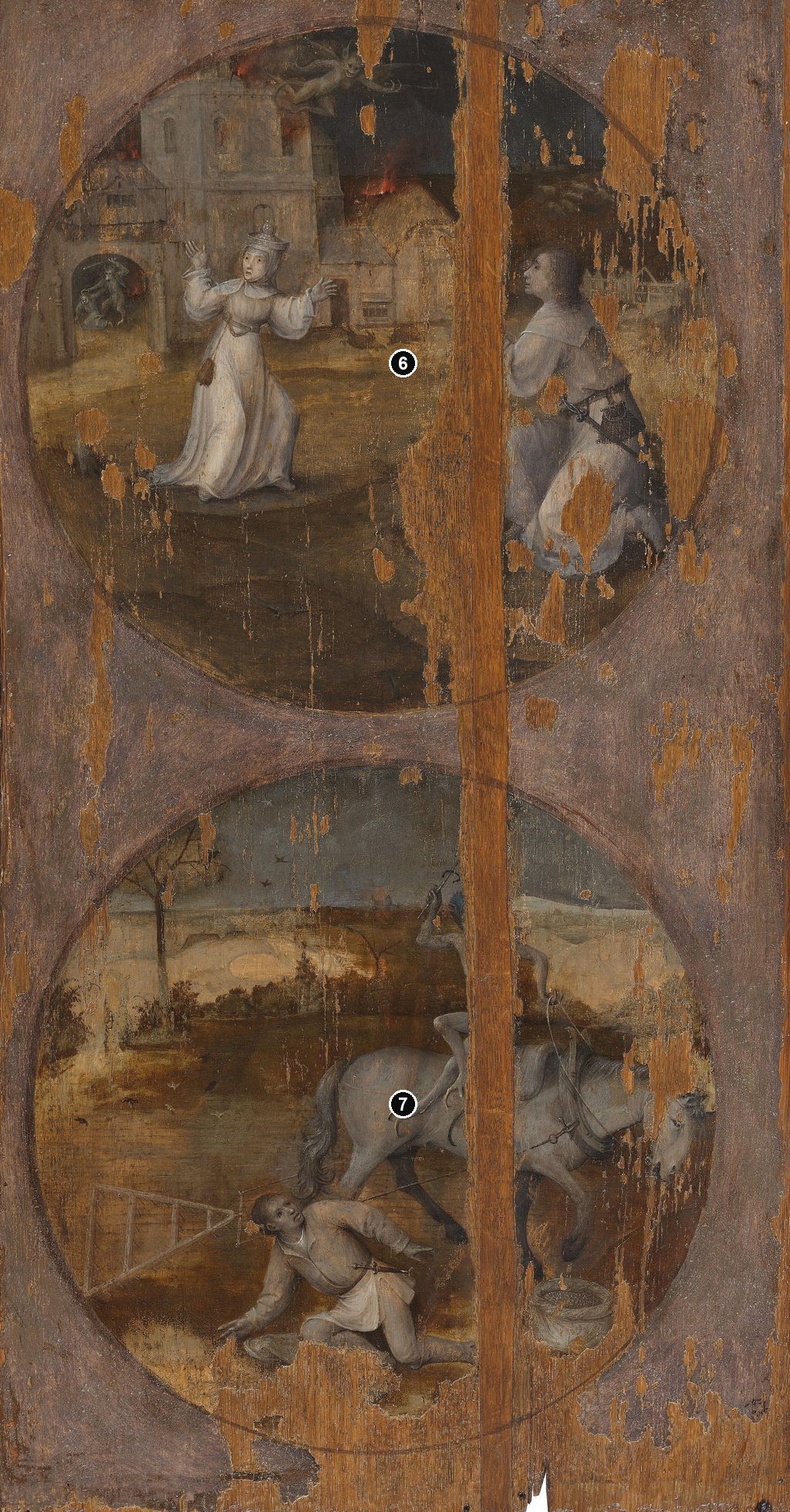
Rotterdam St27 Reverse
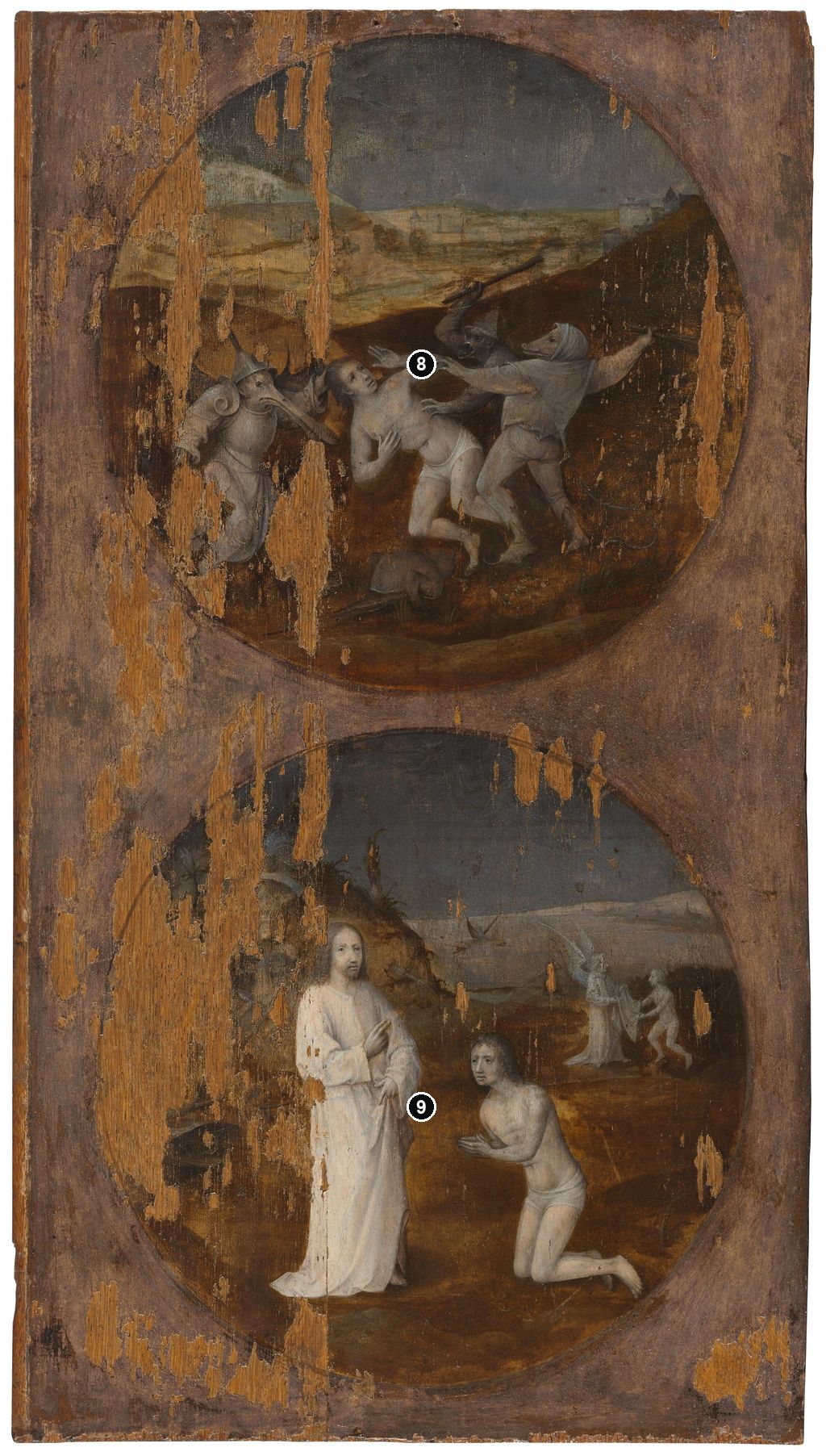
Rotterdam St28 Reverse
Details from HELL AND THE FLOOD: FOUR PAINTED SURFACES
Explore the details on each surface. The photographs show the paintings’ visible condition, including areas of loss.
Rotterdam Hell St27 Front
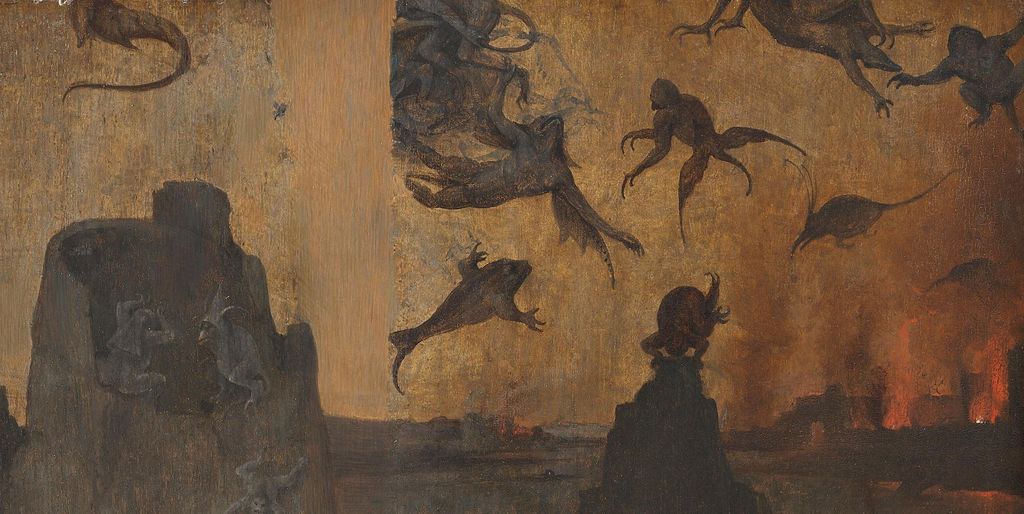
Creatures over the burning city
Dark creatures cross the ochre sky above towers and a burning city. Their differing wings, tails and limbs interrupt the broad open background.
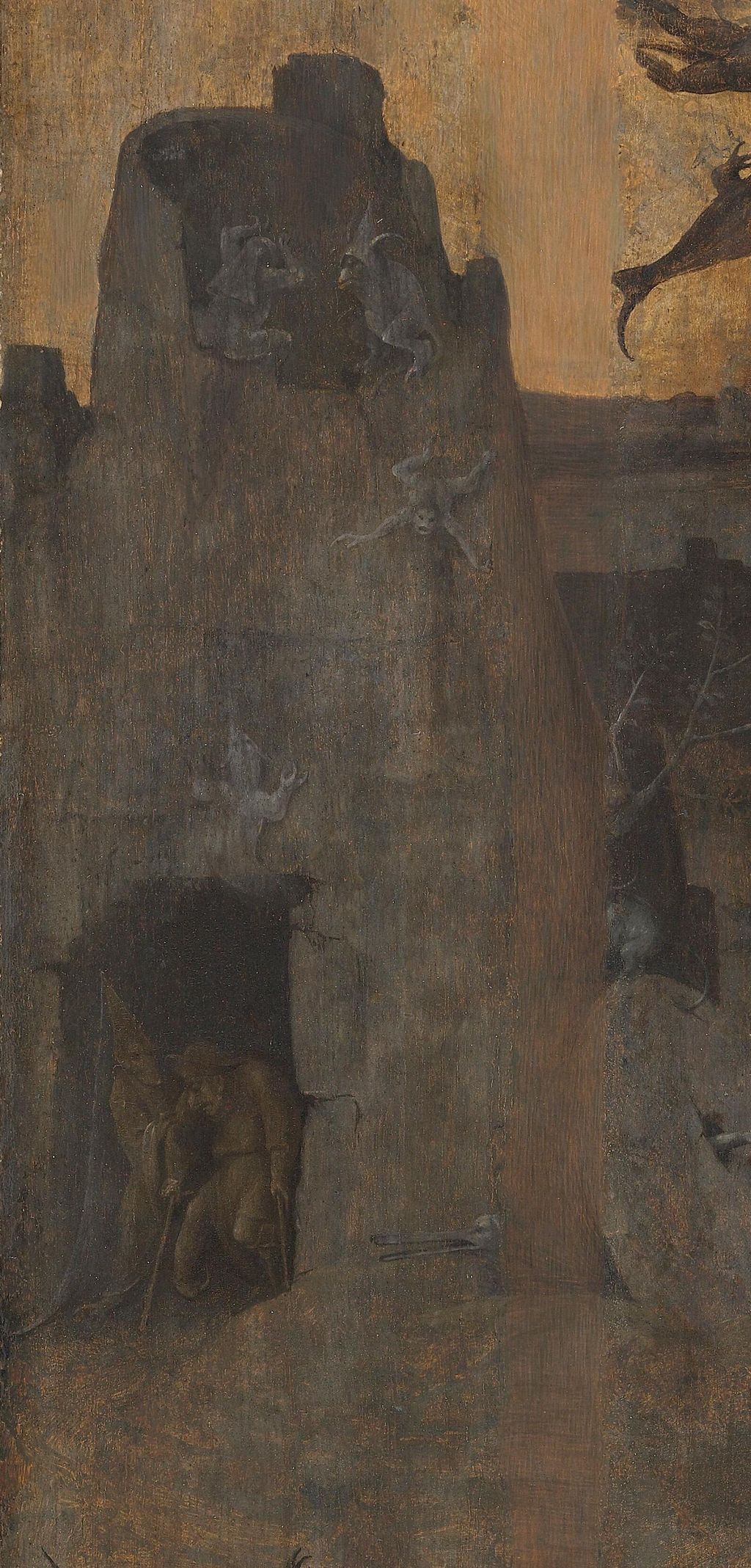
The hollow tower
The tall, hollow structure contains small figures at different heights. Its pale, broken contours contrast with the darker land around it.
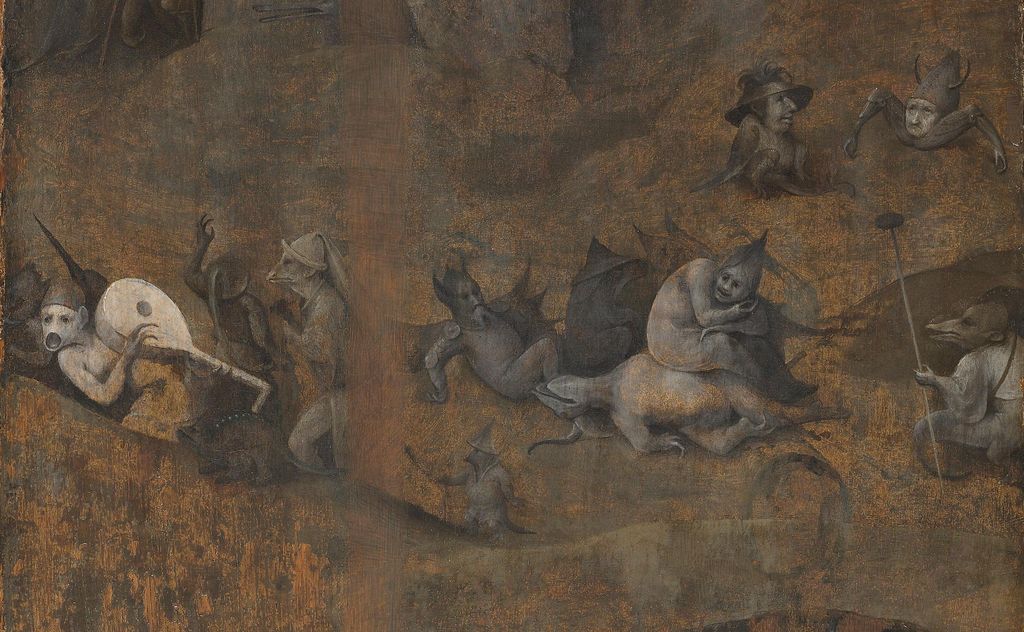
Creatures on the ground
Figures gather around low, rounded bodies in the foreground. A pale bird-like head at the left and a large, seated form on the right break up the brown landscape.
Rotterdam Flood St28 Front
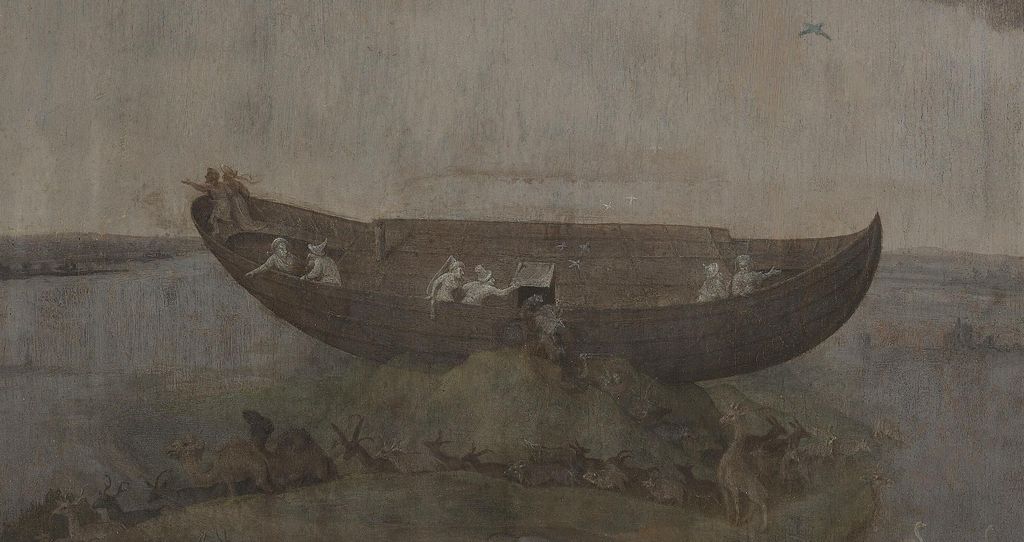
The ark above the hillside
Animals and small figures emerge around the long hull of the ark. Its horizontal form occupies the upper part of the steep landscape.
Bodies across the foreground
Animal bodies lie across the uneven foreground. Their scattered positions and the largely empty ground separate this scene from the clustered activity in Hell.
Rotterdam St27 Reverse
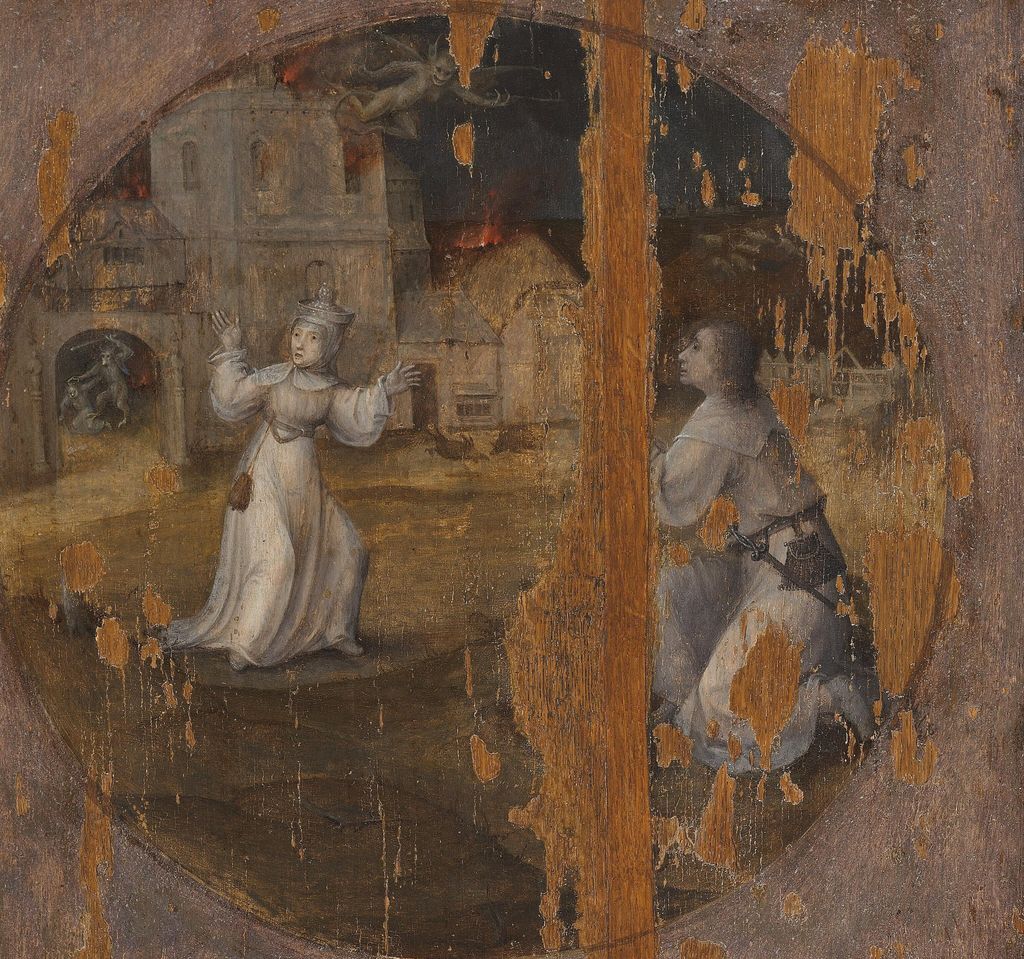
The woman and burning farm
The upper medallion contains a woman with raised hands near farm buildings. Damage interrupts parts of the figure and the surrounding architecture.
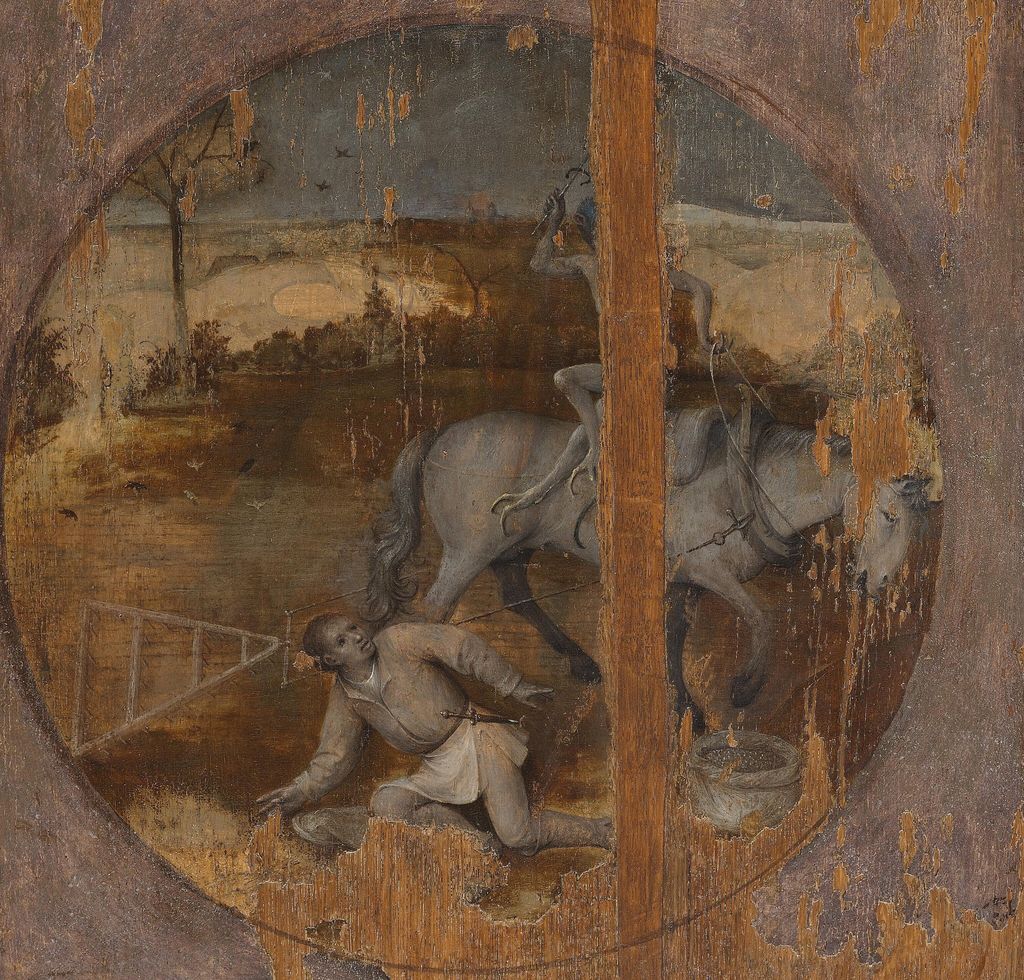
The fallen rider
Below, a man falls beside a horse. The circular boundary encloses the episode while the worn surface leaves some forms fragmentary.
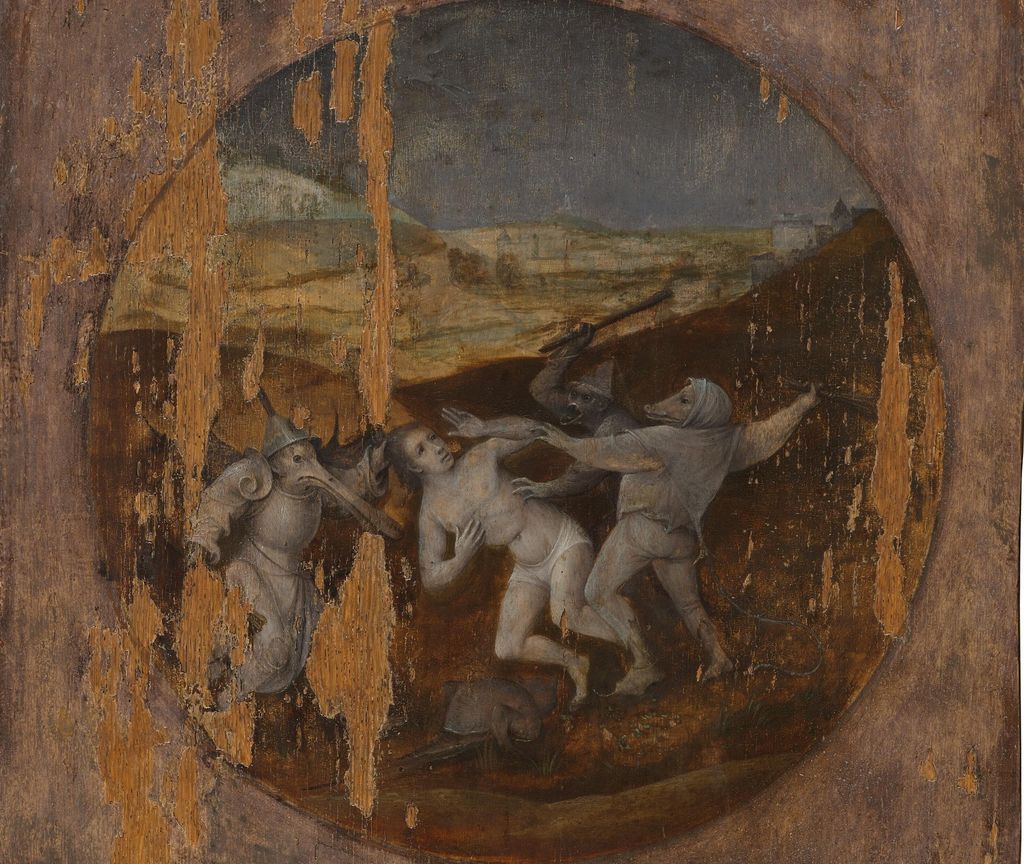
Rotterdam St28 Reverse
A man attacked by creatures
Several creatures close around a man in the upper medallion. Their reaching limbs create a compact action against the open landscape behind.
The blessing scene
The lower medallion places a standing figure beside a kneeling man. Small creatures remain visible in the darker background at the right.
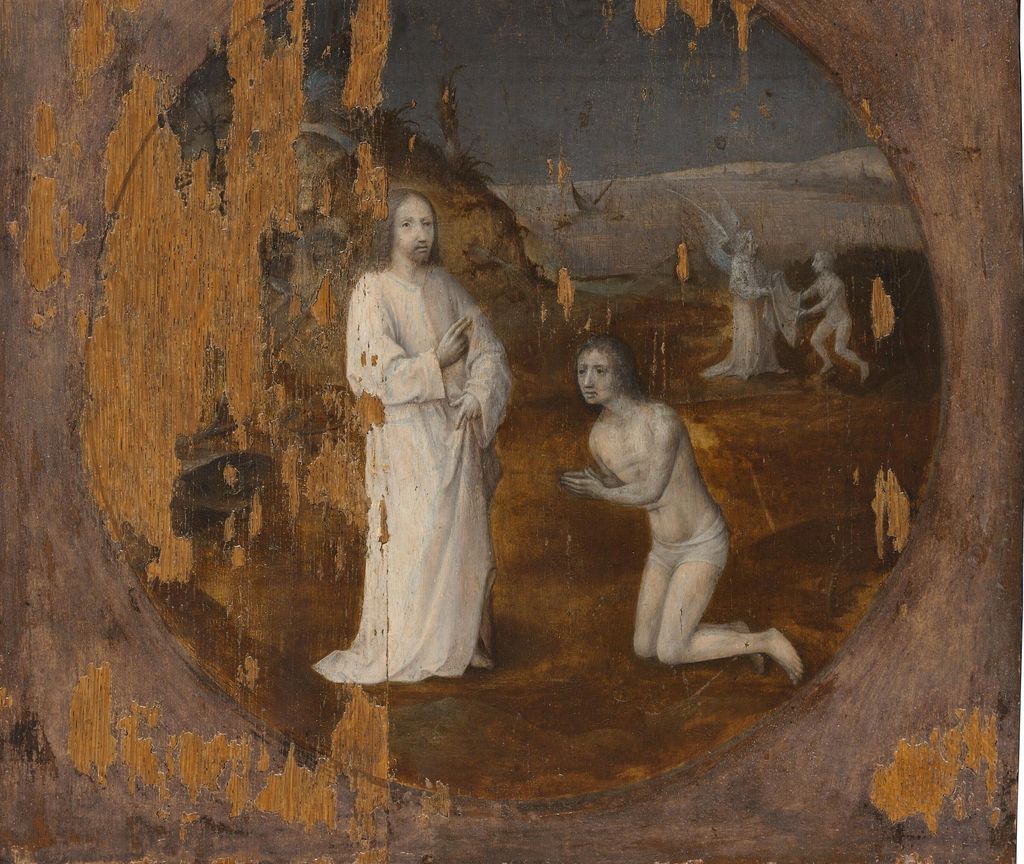
Image and detail crops: Wikimedia Commons source 1; Wikimedia Commons source 2; Wikimedia Commons source 3; Wikimedia Commons source 4 (public domain reproductions).
Identifying the Burning Landscape
The title Hell identifies the panel with the blazing city, inventory St 27 recto. Its airborne demons can encourage another description, Fall of the Rebel Angels, but that name makes the narrative sound more definite than the surviving scene allows. Flying monsters alone do not establish a particular moment of angelic rebellion. The museum’s title and the BRCP’s alternative, After the Last Judgement, offer different ways of interpreting the same damaged painting.[1][5]
A tall rock rises near the left edge, its dark opening enclosing two figures. Another narrower formation stands nearer the centre, supporting a crouching creature. Between and around them, the landscape recedes towards buildings in flames. These strong uprights organise a scene otherwise crowded with small, irregular bodies and unpredictable movements.
The demons overhead extend the painting’s activity into the sky. Some have wings; others seem to swim or drift through the air with long tails and awkward limbs. The spaces between them isolate their varied silhouettes against the sky. Below, the creatures become heavier and more closely grouped, drawing attention towards the ground.
The foreground includes a pale instrument resembling a lute, pointed headgear, distorted faces and bodies assembled from incompatible parts. Familiar objects help give the inventions a physical scale. Music-making and ordinary gestures become unsettling when performed by figures whose anatomy never quite settles into a recognisable animal or person.
Hell or the World After Judgement?
The BRCP argues that the burning landscape represents the world after the Last Judgement rather than Hell itself. Its reading emphasises the apparent departure of humanity and the dominance of demons, with an old man held by a female demon in the rocky opening as the principal human exception.[5] The museum continues to use Hell. The alternative is therefore an interpretation to examine, rather than a universally accepted replacement title.
Placed beside the Flood panel, the scene could contrast two destructions of the world: one by water, another by fire. The catalogue connects this opposition with the Second Letter of Peter, whose third chapter recalls the flooded world and describes the present heavens and earth as reserved for judgement by fire.[5][7] The biblical passage supplies a possible framework, without identifying these particular paintings.
That argument also affects how the lost work is reconstructed. The BRCP proposes that a Last Judgement occupied the centre, offering the possibility of salvation between the two landscapes.[5] No surviving central panel proves the proposal. Nor can its precise colours, figures or scale be recovered simply by extending the imagery of the wings across the missing space.
Noah’s Ark and the Return to Land
The companion panel, St 28 recto, contains a broad vessel high in the composition. Noah and his family look out as animals emerge and make their way onto land. The boat’s long curve forms a comparatively calm horizontal shape above the ridges and hollows below. Its position gives the procession a clear origin within an otherwise broken landscape.[4]
The ground remains littered with drowned creatures. Surviving animals and inert bodies occupy the same earth, so the return to land does not erase the catastrophe. The arrangement makes the viewer distinguish movement from stillness: animals proceeding in a line from the Ark, shapes stranded in hollows, and bodies lying at awkward angles in the foreground.
Genesis 8 describes the waters receding, the Ark coming to rest in the mountains of Ararat, and God instructing Noah to leave with his family and the animals.[8] The painting concentrates on the emergence of living creatures. Its landscape holds together the evidence of destruction and the possibility of renewed life, rather than illustrating a single action of rescue from rising water.
The contrast with the burning panel is striking even in their restrained colours. Here the main movement leads away from the Ark and into the landscape. There, the eye encounters scattered demons, pockets of activity and distant fire. The two surfaces share an atmosphere of devastation while presenting different possibilities for what can follow it.
A Flood Scene Changed During Painting
Technical examination revealed that the Ark did not occupy its present position throughout the painting’s development. The investigators distinguished an initial design with the Flood still underway, followed by a larger painted Ark, and finally the smaller vessel placed higher in the surviving composition.[3] These changes affected the story as well as the arrangement of shapes.
In the first design, people struggled in the water and attempted to climb towards higher ground. Some figures were left in reserve, meaning the surrounding paint was applied around spaces intended for them. Elements of that abandoned arrangement remain detectable beneath later layers. The technical report describes swimming heads, raised arms and fleeing figures that no longer function as the main narrative.[3]
The intermediate painted version already showed an Ark on land with animals leaving it. When the vessel was reduced and moved upward, part of the animal procession was retained and extended. A hill replaced an earlier ramp.[3] The final scene therefore incorporates earlier work while changing the relation between the ship, its passengers and the newly exposed earth.
The BRCP interprets this development as a shift from the destruction of Creation towards its preservation.[5] That reading follows a substantial visual revision, rather than a minor change to a costume or gesture. It also reminds us that the finished painting cannot be treated as the straightforward execution of one unchanged preliminary plan.
Two Roundels Behind the Burning Panel
The reverse of Hell, St 27 verso, contains two circular scenes. In the upper one, a woman raises her hands near a burning building, facing a kneeling man. In the lower one, a farmer falls beside his horse while a demon takes control of the work. These scenes belong to this support, rather than the reverse of the Noah panel.[9]
The upper scene brings danger close to a recognisable household. The buildings, clothing and gestures provide the setting for an attack that interrupts ordinary life. The BRCP identifies a barely visible child with a toy windmill near the gateway and dead animals around the farm.[5] Such details are difficult to read in the damaged surface, and some become clearer only through technical documentation.
In the lower roundel, the horse’s large body stretches across the confined circle. The displaced farmer twists away beneath it, while the harrow extends into the space behind him. His movement makes the loss of control visible: the animal and implement continue to organise the scene even as the person who should direct them falls aside.
Examination showed that the demon and horse were moved towards the right through successive stages. An earlier demon’s head resembled a fox, while the surviving painted head has a different appearance. Shifting the group created room for the harrow, which was added late.[3] The apparent spontaneity of the scene thus rests on a series of considered adjustments.
Assault and Blessing on the Other Reverse
The back of The Flood, St 28 verso, presents a different pair of roundels. A man is attacked by demons in the upper scene. Below, a long-robed figure blesses a kneeling man; an angel assists another figure in the distance.[10] The pale bodies and clothing emerge against dark land and sky, making their gestures the principal means of following the action.
The assault is organised around the victim’s exposed torso and raised arms. Demons press in from either side, one lifting an implement for a blow. Their different heads and limbs surround a body recognisably human in its vulnerability. A small crouching monster occupies the foreground, linking the immediate attack with a wider population of threatening creatures.
The blessing scene changes the relationship between its main figures. The standing figure’s lifted hand answers the kneeling man’s appeal, while the background angel offers clothing to an almost naked person. The catalogue allows the principal figure to be God the Father or Christ.[5] The museum describes the scene in terms of Christ bringing salvation.[10]
Taken together, the four roundels oppose demonic threat with the possibility of divine help. Their circular boundaries give each episode a distinct stage, yet the repeated scale and arrangement encourage comparison across the two supports. They should be studied as a group even though damage and uncertainty about the wings’ order complicate their sequence.
Do the Roundels Tell the Story of Job?
Sylvie Wuhrmann proposed that the four episodes relate to Job’s trials. The BRCP discusses the suggestion but questions how readily a contemporary viewer could have recognised Job in scenes lacking his more familiar attributes.[5] It also notes the difficulty of placing a divine encounter, which belongs late in Job’s biblical story, before scenes interpreted as earlier trials.
The proposal remains useful as a question about the relationship between suffering, demonic action and salvation. It does not establish that every human figure is Job or a member of his household. The surviving scenes might refer to another saint’s life or an exemplary narrative whose precise identity is no longer clear.[5]
What is more secure is the contrast between exposure to harm and the offer of help. A threatened household, an interrupted labourer and an assaulted man provide three different forms of vulnerability. The blessing roundel introduces another outcome. The larger landscapes would have expanded those small encounters into scenes concerning the fate of the world.
The Uncertain Order of the Wings
The museum’s explanatory text places the burning landscape on the left and the Ark on the right.[1][4] The BRCP reverses that order, placing After the Flood on the left and After the Last Judgement on the right.[5] Its proposed sequence develops the contrast between the earlier destruction by water and the later one by fire.
This disagreement changes the sequence of the roundels when the work is imagined closed. It also changes which surviving landscape would have been encountered on either side of the lost centre. The difference matters when imagining how a viewer would have moved between the closed and opened work.
The supports have lost their original frames and have been cropped. The technical study regards them as taller in their initial form, while rejecting the suggestion that an entire additional roundel is missing above the surviving pair.[3] Their present dimensions consequently cannot supply a simple, complete blueprint for the original triptych.
Bosch and the Workshop
The BRCP’s workshop attribution rests on differences in painted handling and underdrawing, considered alongside numerous links with Bosch’s work. Its technical report further distinguishes the fronts from the backs and allows greater personal involvement by Bosch in the two large landscapes.[3] This is a more nuanced position than either calling every surface autograph or excluding his participation altogether.
One particularly close connection concerns the crouching creature in the assault roundel. It repeats a figure on Bosch’s Berlin drawing KdZ 550, discussed in Two Fantastical Creatures on Tinted Paper.[5] In the drawing it stands as an isolated invention; here it has a place within an attack. The correspondence supports a relationship between studio designs and painted motifs.
Other connections include animals leaving the Ark that resemble those in the Paradise wing of the Garden of Earthly Delights, and a barrel-bodied monster preserved beneath the burning panel’s final paint.[5] Such repetitions suggest access to shared inventions. They do not identify a particular assistant or prove that a drawing was created specifically for this lost triptych.
Wood, Paint and the Passage of Time
Each panel was constructed from two oak planks, and corresponding planks in the two supports came from the same trees. The youngest preserved heartwood ring dates to 1497. Allowances for missing outer wood, drying and transport led the investigators to an earliest possible use from 1508, with use after 1510 statistically more probable.[3] Those limits are distinct from a precise date of execution.
The muted surfaces also preserve evidence of deliberate paint effects. In the Flood sky, a light grey layer over a darker one creates a bluish impression. The roundels’ skies were built with blue and grey layers, while small brighter accents interrupt the subdued landscapes.[3] The present brown tones partly reflect changes in originally greener paint, rather than an entirely brown initial palette.
Tiny red marks across the burning panel have been interpreted as glowing ash. The technical report is more cautious than the catalogue’s narrative, allowing that the marks could have been applied accidentally.[5][3] Their presence is observable; their intended meaning is less secure. Keeping that distinction prevents a striking material detail from becoming more definite evidence than the examination supports.
Damage, Restoration and Different Reproductions
The panels underwent extensive treatment between 1982 and 1985. The technical study describes different approaches to filling and retouching across the four faces, leaving the roundels particularly fragmented.[3] Bare wood, surviving paint and later repairs can therefore compete for attention in photographs. A blank-looking patch is sometimes a loss, rather than empty space designed by the painter.
A narrow wooden insert runs through the Hell support and its reverse. It replaced an older repair during that treatment and interrupts the painted scenes. Abrasion, increased transparency and discoloured retouching further affect the experience of the work.[3] These observations derive from the BRCP’s 2011 examination and published report, rather than a new assessment of its condition today.
Older reproductions may show a more continuous image than the museum’s present photographs, particularly in the two roundels behind Hell. They must still be recognised as reproductions of the same object. Comparing their apparent completeness without considering restoration could make later filling or retouching look like securely surviving original detail.
The documented modern history places the panels in Spain in 1927, with the dealer Nicolaas Beets in 1929 and in Franz Koenigs’s collection during the 1930s.[5] The museum currently credits them as a 1940 foundation loan from the former Koenigs collection.[1][4] Their original patron and first setting remain unknown. What survives is an ensemble of changing images: threatened individuals on one side, devastated worlds on the other, and repeated signs that the compositions evolved as they were made.
Artworks and related attributions
Browse paintings, drawings and related attributions. Records group triptychs, fragments and two-sided sheets where appropriate. Dates follow the cited museum records or catalogue headings and are generally estimates. Rows marked “2016 catalogue” report that publication’s attribution and collection information; these are dated opinions, rather than a claim that every work is an accepted autograph Bosch.
| Name | Date | Medium, attribution and collection |
|---|---|---|
| A Crossbowman | Second half of the sixteenth century | Oil on oak panel · Copy after Hieronymus Bosch · Museo Nacional del Prado, Madrid · P002695 Source 1. Source 2. |
| A Woman Spinning and an Old Woman | Museum estimates: about 1480–1490 for the women and 1500–1505 for the reverse; the precise chronology is disputed | Pen and brown and grey ink on the front; pen and brown ink on the reverse · Hieronymus Bosch · Museum Boijmans Van Beuningen, Rotterdam · N 190 recto and verso (PK) Source 1. Source 2. |
| Adoration of the Child in Cologne | Second half of the sixteenth century | Oil on oak panel · Imitator of Hieronymus Bosch, in the city collection record · Wallraf-Richartz-Museum & Fondation Corboud, Cologne · WRM 0474 Source 1. Source 2. |
| Adoration of the Magi in Philadelphia | Early sixteenth century in the museum record; around 1495–1520 in the BRCP catalogue | Oil on oak panel · Hieronymus Bosch in the museum record; workshop of Bosch in the 2016 BRCP catalogue · Philadelphia Museum of Art, John G. Johnson Collection, 1917 · 1321; museum object 103592 Source 1. Source 2. |
| Adoration of the Magi — New York | c.1470–1480 | 2016 catalogue: Bosch; oil on oak · Metropolitan Museum 13.26 2016 catalogue. |
| Adoration of the Magi — Prado triptych | c.1494 | Oil on oak; grisaille exterior · Bosch · Prado P002048 Object source. |
| Adoration of the Magi — three associated fragments | c.1515–1535 | 2016 catalogue: Follower of Bosch · Two Shepherds / Retinue in Philadelphia; associated Adoration in private collection in 2016 2016 catalogue. |
| Ascent of the Blessed — Venice | c.1505–1515 | Oil on panel · Bosch · Gallerie dell’Accademia; Visions of the Hereafter Object source. |
| Battle of the Birds and Mammals | Not specified in catalogue heading | 2016 catalogue: Bosch; pen and brown ink · Berlin KdZ 14715 2016 catalogue. |
| Beggars and Musicians | Around 1530–1540 | Ink and wash on paper · Unknown follower of Hieronymus Bosch · Albertina, Vienna · 7798 Source 1. Source 2. |
| Christ Carrying the Cross Drawing | Around 1470 in the museum catalogue | Black chalk or charcoal, pen and brush in brown ink, white corrections · Anonymous, workshop of Rogier van der Weyden · Museum Boijmans Van Beuningen, Rotterdam · N 81 recto and verso (PK) Source 1. Source 2. |
| Christ Carrying the Cross in Vienna | Around 1490–1510 in the current KHM record and BRCP catalogue | Oil on oak, painted on both sides · Hieronymus Bosch; possible workshop involvement in the Passion side discussed by the BRCP · Kunsthistorisches Museum, Vienna · Gemäldegalerie, GG 6429 Source 1. Source 2. |
| Christ Carrying the Cross — El Escorial | c.1495–1505 | 2016 catalogue: Bosch; oil on oak · Patrimonio Nacional 10014739 2016 catalogue. |
| Christ Carrying the Cross — Ghent | c.1510–1516 (museum) | Oil on panel · Bosch in museum listing; authorship disputed · MSK Ghent 1902-H Object source. |
| Christ Mocked — London | c.1510 | Oil on wood · Bosch · National Gallery NG4744 Object source. |
| Concert in the Egg, After Hieronymus Bosch | Around 1561; third quarter of the sixteenth century | Oil on canvas · Anonymous, after Hieronymus Bosch · Palais des Beaux-Arts, Lille · P 816 Source 1. Source 2. |
| Conjurer / Comical Concert — Louvre drawing | Not specified in catalogue heading | 2016 catalogue: Bosch (recto), follower (concert verso) · Pen and brown ink · Louvre INV 19197 2016 catalogue. |
| Conjurer / Cross-bearing and beggars — Liège sheet | Not specified in catalogue heading | 2016 catalogue: Bosch (verso), follower (recto) · Pen and brown ink · Album d’Arenberg 534 2016 catalogue. |
| Crowning with Thorns — El Escorial | c.1530–1540 | 2016 catalogue: Follower of Bosch; oil on oak · Patrimonio Nacional 10014743 2016 catalogue. |
| Crucifixion with a Donor | Circa 1495–1505; Circa 1490–1500 | Oil on oak panel · Hieronymus Bosch · Royal Museums of Fine Arts of Belgium, Brussels · 6639 Source 1. Source 2. |
| Death and the Miser Drawing | Not securely established; probably made after the painting | Pen and brush, dark ink and white highlights on prepared paper · Workshop of Hieronymus Bosch in the BRCP catalogue; alternatives recorded by the Louvre · Musée du Louvre, Department of Prints and Drawings, Paris · RF 6947, Recto Source 1. Source 2. |
| Death and the Miser — Washington | c.1485/1490 (NGA) | Oil on panel · Bosch · National Gallery of Art 1952.5.33 Object source. |
| Ecce Homo Triptych — Boston | c.1495–1500; wings c.1500/1503 | 2016 catalogue: Workshop of Bosch; oil on oak · Museum of Fine Arts Boston; several production phases 2016 catalogue. |
| Ecce Homo — Frankfurt | c.1490 | Mixed technique on oak · Bosch · Städel 1577 Object source. |
| Fall of the Damned — Venice | c.1505–1515 | 2016 catalogue: Bosch; oil on panel · Visions of the Hereafter · Venice 2016 catalogue. |
| Garden of Earthly Delights | 1490–1500 (Prado) | Oil on oak; grisaille exterior · Bosch · Prado; triptych Object source. |
| Gluttony and Lust / Allegory of Intemperance — Yale fragment | c.1500–1510 (group dating) | 2016 catalogue: Bosch; oil on oak · Yale 1959.15.22; fragment associated with Ship of Fools 2016 catalogue. |
| Group of Ten Spectators, a Follower of Bosch | Around 1510–1540 in the current museum record | Pen and two brown inks on paper, with a brown framing line · Follower of Hieronymus Bosch in the Morgan record; Bosch in the BRCP catalogue · Morgan Library & Museum, New York · I, 112 Source 1. Source 2. |
| Head of an Old Woman | About 1500 | Oil on panel · Attributed to Jacob Cornelisz. van Oostsanen · Museum Boijmans Van Beuningen, Rotterdam · 2439 (OK) Source 1. Source 2. |
| Hell and the Flood — Rotterdam panels | Around 1515 in the museum records; around 1510–1520 in the BRCP catalogue | Oil on oak panels · Jheronimus Bosch in the museum records; workshop of Bosch in the BRCP catalogue · Museum Boijmans Van Beuningen, Rotterdam Source 1. Source 2. |
| Hermit Saints Triptych | Circa 1495–1505 | Oil on oak panels · Hieronymus Bosch · Gallerie dell’Accademia, Venice · 2044 Source 1. Source 2. |
| Infernal Landscape | Not specified in catalogue heading | 2016 catalogue: Bosch; pen and brown ink, red accent · Private collection in 2016 2016 catalogue. |
| Infernal Scene with Anvil / Monster Studies | Not specified in catalogue heading | 2016 catalogue: Bosch; attribution debated in entry · Pen and brown ink · Berlin KdZ 548 2016 catalogue. |
| Infernal Scene with Tree-Man / Standing Man | Not specified in catalogue heading | 2016 catalogue: Workshop of Bosch; pen and brown ink · Dresden C 1875; historical reverse title includes a proposed prophet 2016 catalogue. |
| Job Triptych — Bruges | c.1510–1520 | 2016 catalogue: Workshop of Bosch; oil on oak · Groeningemuseum / Hoeke loan in 2016 2016 catalogue. |
| Last Judgement — Bruges triptych | c.1495–1505 | 2016 catalogue: Bosch; oil on oak · Groeningemuseum 2016 catalogue. |
| Last Judgement — Munich fragment | c.1530–1540 | 2016 catalogue: Follower of Bosch; oil on oak · Alte Pinakothek 5752 2016 catalogue. |
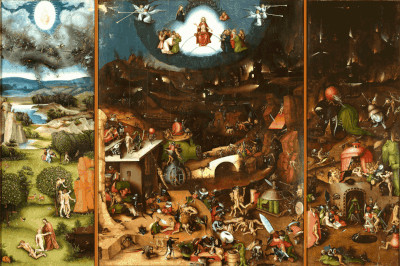
| Last Judgement — Vienna triptych | c.1500–1505 (BRCP 2016) | Oil on oak · Bosch and workshop (BRCP 2016) · Academy of Fine Arts Vienna 2016 catalogue. |
| Man in a Basket and Comic Figures | Around 1500–1515 in the museum record | Pen and brown ink on paper; the reverse is catalogued as iron-gall ink · Hieronymus Bosch in the current Albertina record; attribution has been debated · Albertina, Vienna · 7797 recto and verso Source 1. Source 2. |
| Man Seen from Behind | About 1550–1569; About 1565–1570 | Traces of black chalk, pen and brush in light brown ink · Anonymous, circle of Pieter Bruegel the Elder · Museum Boijmans Van Beuningen, Rotterdam Source 1. Source 2. |
| Mary and John at the Foot of the Cross | About 1440 | Brush in grey and black · Unknown, possibly Netherlandish · Kupferstich-Kabinett, Staatliche Kunstsammlungen Dresden · C 815 Source 1. Source 2. |
| Model Sheet with ‘Witches’ | Disputed; proposals depend on the attribution | Pen and brown ink; the BRCP also records underlying black chalk · Hieronymus Bosch; follower attributions also recorded · Musée du Louvre, Département des Arts graphiques, Paris · INV 19721 recto Source 1. Source 2. |
| Peasant and Three Bust-Length Figures | 1401–1500 | Brown pen over a black preliminary drawing · Attributed to the Master of the Drapery Studies; Bosch circle also recorded · Kupferstichkabinett, Staatliche Museen zu Berlin · KdZ 777 Source 1. Source 2. |
| River to Hell — Venice | c.1505–1515 | 2016 catalogue: Bosch; oil on panel · Visions of the Hereafter · Venice 2016 catalogue. |
| Saint Anthony and a Concert in an Egg | Around 1510–1525 in the museum’s 2016–17 exhibition texts | Pen in light and dark brown inks · Workshop of Hieronymus Bosch; underlying monsters: Bosch (BRCP), possibly Bosch (exhibition text) · Kupferstichkabinett, Staatliche Museen zu Berlin · KdZ 711 recto and verso Source 1. Source 2. |
| Saint Christopher Carrying the Christ Child | c.1500; 1490–1505 in restoration material | Oil on panel · Bosch · Boijmans St 26 Object source. |
| Saint James and Hermogenes | About 1551–1575 in the KIK-IRPA catalogue | Oil on wood, painted on both sides · Anonymous follower of Hieronymus Bosch · Musée des Beaux-Arts, Valenciennes · P.46.1.44; older number 176 Source 1. Source 2. |
| Saint Jerome at Prayer | Circa 1485–1495 | Oil on oak panel · Hieronymus Bosch · Museum of Fine Arts, Ghent · 1908-H Source 1. Source 2. |
| Saint John on Patmos / Passion Scenes | c.1495–1505; estimates vary | Oil on oak · Bosch · Gemäldegalerie Berlin 1647A Object source. |
| Saint John the Baptist in Meditation | Late 15th century; c.1485–1510 (Prado exhibition) | Oil on panel · Bosch · Lázaro Galdiano 8155 Object source. |
| Saint Liberata Triptych | Circa 1495–1505 | Oil on oak panels · Hieronymus Bosch · Gallerie dell’Accademia, Venice · 2045 Source 1. Source 2. |
| Seven Deadly Sins and the Four Last Things | 1505–1510 (Prado) | Oil on poplar · Bosch (Prado); workshop/follower disputed · Prado Object source. |
| Ship of Fools — Louvre painting | 1475–1500 (record); c.1505–1515 (exhibition) | Oil on oak · Bosch · Louvre RF 2218; fragment Object source. |
| Ship of Fools — Louvre workshop drawing | Not specified in catalogue heading | 2016 catalogue: Workshop of Bosch · Pen, brush, grey-brown ink and white highlights on prepared paper · Louvre RF 3714 2016 catalogue. |
| Studies of Monsters | About 1530–1550, according to the current Ashmolean record | Pen and brown ink on laid paper, both faces · Anonymous follower of Hieronymus Bosch · Ashmolean Museum, University of Oxford · WA1863.155 Source 1. Source 2. |
| Studies of Saint Anthony and Monsters | No execution date specified in the current Louvre records | Pen and brown ink on paper · Bosch listed; reverse questioned by Louvre; BRCP accepts both faces · Musée du Louvre, Département des Arts graphiques, Paris · INV 20871 recto and verso Source 1. Source 2. |
| Temptation of Saint Anthony — Kansas City fragment | c.1500–1510 | 2016 catalogue: Bosch; oil on oak · Nelson-Atkins 35–22 2016 catalogue. |
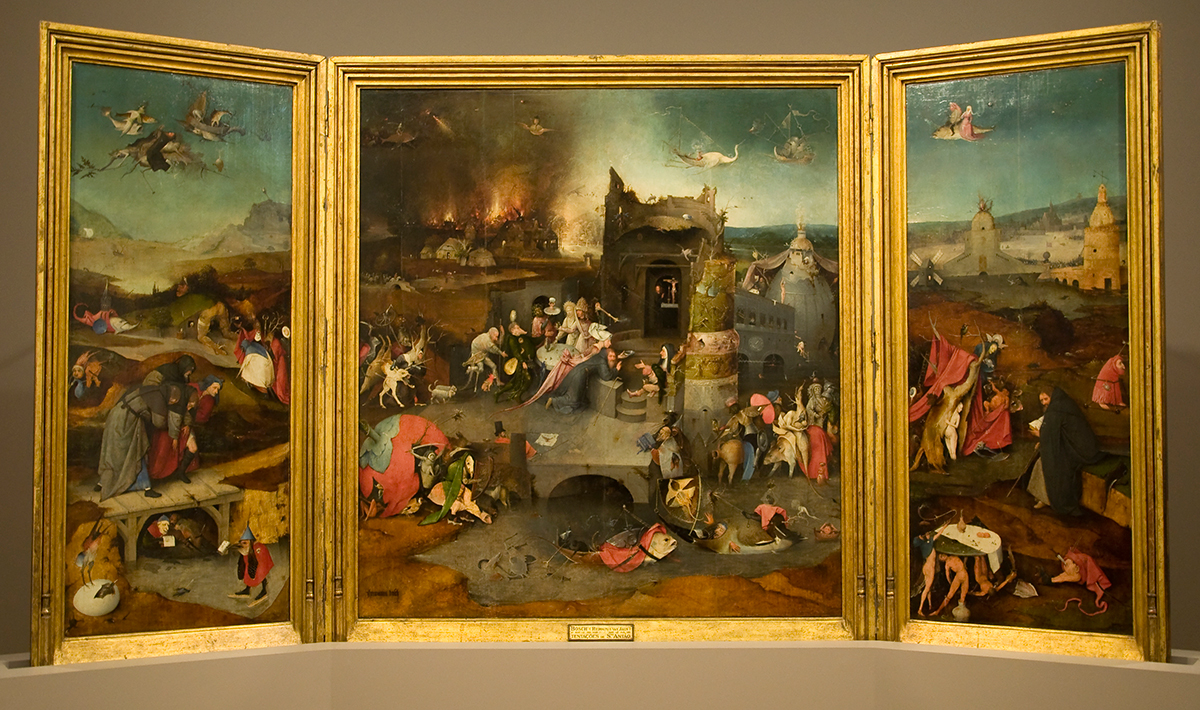
| Temptation of Saint Anthony — Lisbon triptych | c.1500 | Oil on oak · Bosch · Museu Nacional de Arte Antiga 1498 Pint Museum. |
| Temptation of Saint Anthony — Prado panel | c.1530–1540 | 2016 catalogue: Follower of Bosch (2016 opinion); oil on oak · Prado P002049 2016 catalogue. |
| Terrestrial Paradise | Approximately 1505–1515 | Oil on oak panel · Hieronymus Bosch · Gallerie dell'Accademia, Venice Source 1. Source 2. |
| The Burning Ship Drawing | 1500–1520 | Pen and iron gall ink on paper · Attributed to Hieronymus Bosch · Academy of Fine Arts Vienna, Graphic Collection · HZ-2554; numbered 2554 in the BRCP catalogue Source 1. Source 2. |
| The Comical Barber Scene | About 1550–1580, according to the British Museum | Pen and brown ink, grey and brown wash, over black chalk · Anonymous follower, after Hieronymus Bosch · British Museum, Department of Prints and Drawings, London · 1854,0628.46 Source 1. Source 2. |
| The Conjuror, After Hieronymus Bosch | Probably after 1525; around 1530–1540 in the BRCP technical report | Oil on oak panel · Anonymous follower of Hieronymus Bosch · Musée Ducastel-Vera, Saint-Germain-en-Laye · 872.1.87 Source 1. Source 2. |
| The Cure of Folly / Extraction of the Stone of Madness | 1501–1505 (Prado) | Oil on oak · Bosch (Prado); workshop/follower disputed · Prado P002056 Object source. |
| The Entombment Drawing | About 1505–1515, current museum record | Brush and black and grey ink, with grey wash, over black chalk · Workshop of Hieronymus Bosch; drawn by the Master of the Prado Haywain Triptych; Hieronymus Bosch, argued by the BRCP in 2016 · British Museum, Department of Prints and Drawings, London · 1952,0405.9 Source 1. Source 2. |
| The Gathering of the Birds | Not specified in catalogue heading | 2016 catalogue: Bosch; pen and brown ink · Berlin KdZ 13136 2016 catalogue. |
| The Haywain — Prado triptych | 1510–1516 (BRCP 2016) | Oil on oak · Bosch (BRCP 2016) · Prado; separate Escorial version exists 2016 catalogue. |
| The Hearing Forest and the Seeing Field | Circa 1500–1505 | Pen and brown ink on paper · Hieronymus Bosch; reverse: Bosch and workshop · Kupferstichkabinett, Staatliche Museen zu Berlin · KdZ 549, front and reverse Source 1. Source 2. |
| The Owl’s Nest — Rotterdam | Not specified in catalogue heading | 2016 catalogue: Bosch; pen and brown ink · Boijmans N 175 2016 catalogue. |
| The Passion Triptych in Valencia | Workshop of Bosch, about 1510–1520; Follower of Bosch; centre about 1530–1540, wings about 1540–1550 | Oil and gold on oak panels · Workshop of Bosch, about 1510–1520; Follower of Bosch; centre about 1530–1540, wings about 1540–1550 · Museu de Belles Arts de València Source 1. Source 2. |
| The Pedlar / Wayfarer — Rotterdam | c.1500 (museum) | Oil on panel · Bosch · Boijmans 1079 (OK); rejoined exterior Object source. |
| The Tree-Man — Vienna drawing | c.1505 | Pen and brown ink · Bosch · Albertina, Vienna Object source. |
| The Wedding at Cana, After Hieronymus Bosch | Approximately 1560 in the current museum record | Oil on panel, 93 cm high × 72 cm wide · Anonymous, after Hieronymus Bosch · Museum Boijmans Van Beuningen, Rotterdam, St 25 Source 1. Source 2. |
| Two Fantastical Creatures — Berlin KdZ 550 | Around 1505–1515 in the museum’s 2016 exhibition text | Pen in brown ink on reddish prepared laid paper · Hieronymus Bosch · Kupferstichkabinett, Staatliche Museen zu Berlin · KdZ 550, recto and verso Source 1. Source 2. |
| Two Figures Wearing Mitres | About 1480 | Oil on panel · Anonymous (Boijmans); Bosch circle (RKD) · Museum Boijmans Van Beuningen, Rotterdam · 1177 (OK) Source 1. Source 2. |
| Two Men and the Temptation of Eve | About 1505–1515 in the Prado’s 2016 exhibition guide | Pen and grey-brown ink on paper · Hieronymus Bosch in the 2016 catalogues discussed here · Private collection, as recorded in 2016 Source 1. Source 2. |
| Two Men Fighting | Not specified in the current Louvre record | Pen and brown ink · In the manner of Hieronymus Bosch · Musée du Louvre, Département des Arts graphiques, Paris · INV 20660 recto; formerly NIII 8896 and MA 8400 Source 1. Source 2. |
| Two Men — Berlin KdZ 5210 | Not specified in catalogue heading | 2016 catalogue: Bosch questioned · Pen, brush, ink, chalk and white highlights · Berlin KdZ 5210; historical title Two Oriental Men 2016 catalogue. |
| Two Monsters — Berlin KdZ 547 | Approximately 1500–1510 in Berlin's 2016 exhibition catalogue; an estimated range | Pen and brown ink on paper · Hieronymus Bosch · Kupferstichkabinett, Staatliche Museen zu Berlin · KdZ 547, drawn on both sides Source 1. Source 2. |
Frequently Asked Questions
Discussion
Compare Hell, the Flood and the two painted reverses without assuming a securely reconstructed original order.
Reader Insights
How do the tall rocks organise the monsters and distant burning city?
Compare the return to land after the Flood with the damaged world of Hell.
What changes when the roundels are considered as the backs of these panels rather than as independent images?
Join the Conversation
Share a detail, comparison or question about Hell and the Flood Panels in Rotterdam below.
References
- Museum Boijmans Van Beuningen, Hell, St 27 recto, current collection record, interpretation and specifications. View source.
- BRCP Catalogue Raisonné (2016), object dates in catalogues 1, 2, 8, 15 and 20; catalogue 20 object metadata only for the Haywain comparison. View source
- Luuk Hoogstede and colleagues, Hieronymus Bosch, Painter and Draughtsman: Technical Studies (2016), catalogue 22, research reports 3–6, pp. 316–327, complete report and plates. View source.
- Museum Boijmans Van Beuningen, The Flood, St 28 recto, current collection record and specifications. View source.
- Matthijs Ilsink and colleagues, Hieronymus Bosch, Painter and Draughtsman: Catalogue Raisonné (2016), catalogue 22, pp. 380–391, complete entry and notes. View source.
- Staatliche Museen zu Berlin, 2016 exhibition wall texts, p. 3: approximate date of KdZ 549. View source
- Second Letter of Peter, chapter 3, USCCB, verses 5–7 and corresponding notes. View source.
- Genesis, chapter 8, USCCB, receding waters, the Ark and the departure of Noah’s family and the animals. View source.
- Museum Boijmans Van Beuningen, Two Medallions, St 27 verso, current record and exact reverse photograph. View source.
- Museum Boijmans Van Beuningen, Two Medallions, St 28 verso, current record and exact reverse photograph. View source.
- Splash image, Hell, around 1515, oil on oak panel, Museum Boijmans Van Beuningen, Rotterdam, St 27 recto. The museum attributes the panels to Jheronimus Bosch; the BRCP assigns them to his workshop, around 1510–1520. View source. View source. View source.