by Tom Gurney
Tom Gurney BSc (Hons) is an art history expert with over 20 years experience
Published on June 19, 2020 / Updated on November 4, 2026
Email: tomgurney1@gmail.com / Phone: +44 7429 011000
Jerome has lowered himself almost to the ground. His knees and bare feet extend behind him, while his arms enclose a small crucifix beneath his bowed head. A red robe hangs over a hollow tree beside him, and his broad hat lies farther forward. Everything that might identify a public, learned figure has been set aside for an intimate act of prayer.
Hieronymus Bosch’s Saint Jerome at Prayer belongs to the Museum of Fine Arts in Ghent, where it has the inventory number 1908-H. Painted in oil on oak around 1485–1495, it places the saint in a strange foreground of rocks, hollow wood and uncertain organic forms. Beyond that confined shelter, water and cultivated land open into a much quieter distance. The painting brings these environments together without allowing Jerome to withdraw into an entirely reassuring wilderness.[1][2]
Its design also developed as Bosch worked. Technical examination shows that the crucifix, now essential to the saint’s action, was added late over the already painted figure and background. The image’s apparent concentration therefore emerged through a sequence of decisions, rather than through an unchanging preparatory plan.[3]
At a Glance
- ArtistHieronymus Bosch
- TitleSaint Jerome at Prayer; Saint Jerome in the Wilderness
- DateCirca 1485–1495
- MediumOil on oak panel
- BRCP dimensions80 × 60.7 cm
- CollectionMuseum of Fine Arts, Ghent
- Inventory number1908-H
- SubjectThe penitent Jerome embracing a crucifix
Compare these works across Bosch’s career
These date ranges are estimates, not a documented year-by-year sequence. The highlighted row is the work discussed here.
Saint Jerome at Prayer
Circa 1485–1495 [4]Crucifixion with a Donor
Circa 1490–1500 (BRCP) [4]Hermit Saints Triptych
Circa 1495–1505 [4]Saint Liberata Triptych
Circa 1495–1505 [4]The Hearing Forest and the Seeing Field
Circa 1500–1505 (Berlin exhibition) [5]The Haywain Triptych
1510–1516 (BRCP) [4]Contents
Annotated Details from Saint Jerome at Prayer
Three details connect Jerome’s prayer with the ordinary and unusual forms around him. Explore each numbered area in the detail views below.
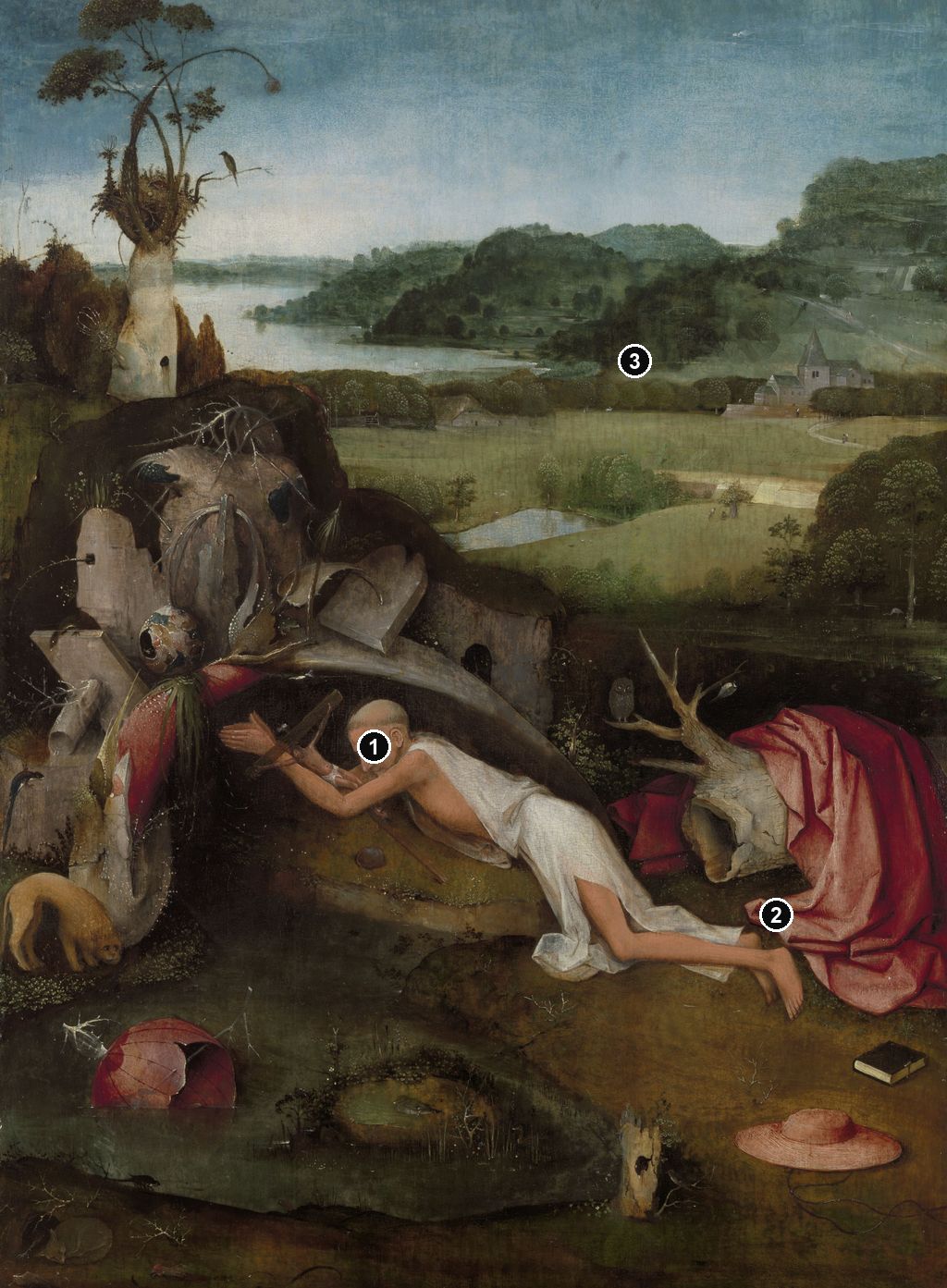
Details from SAINT JEROME AT PRAYER
Look from the saint and crucifix to the lion, discarded clothing and distant country.
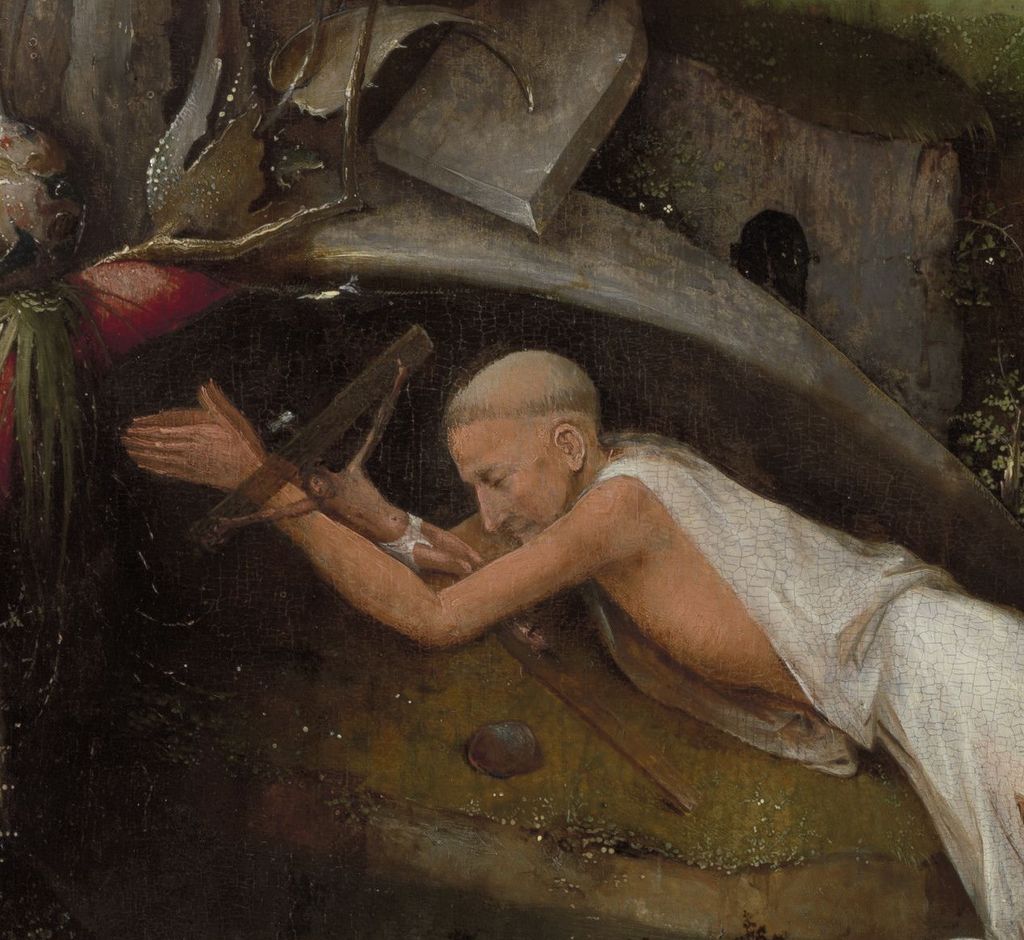
Jerome and the crucifix
Jerome lies close to the small crucifix, turning his head and hands towards it. The light cloth picks out his extended body against the darker ground.
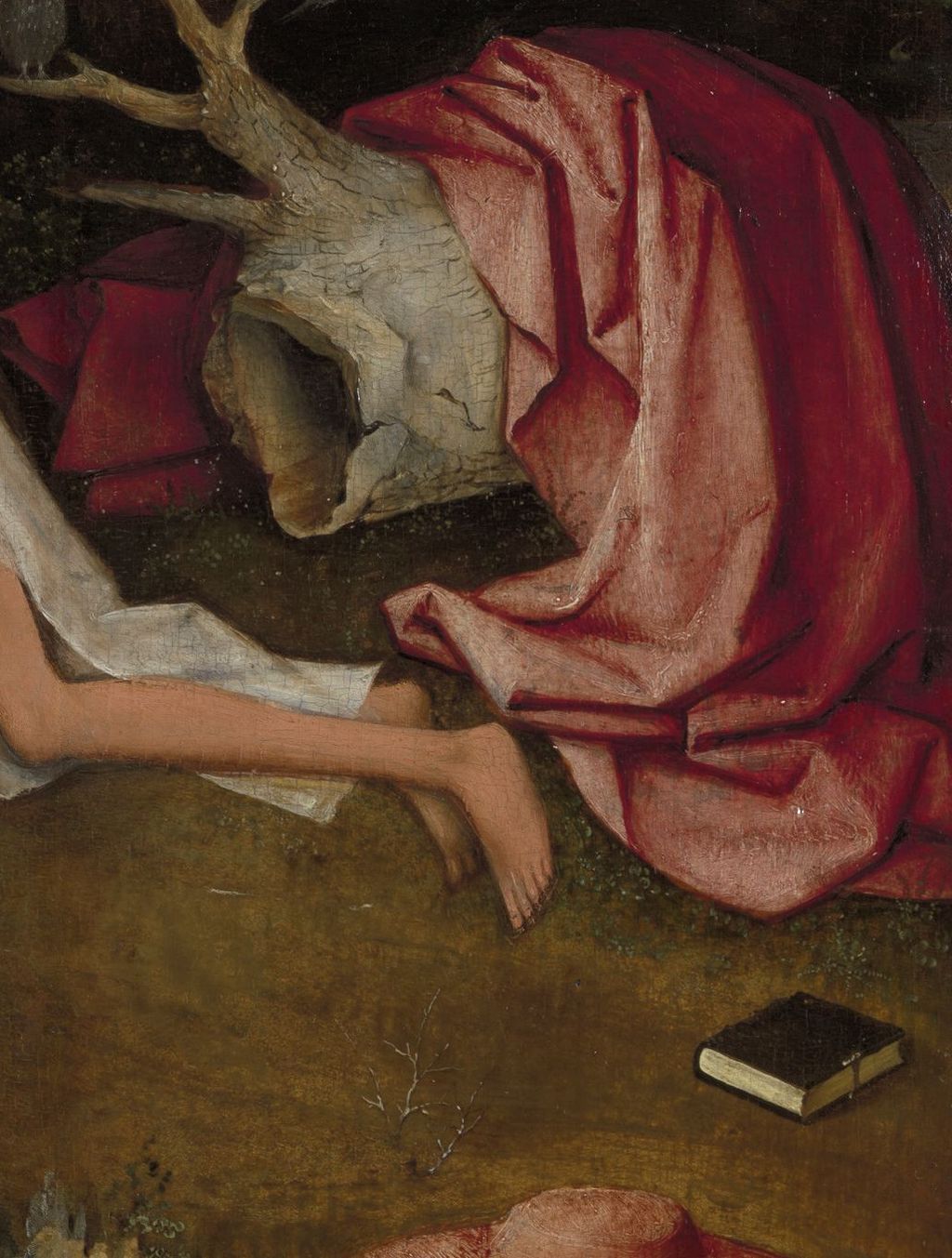
Lion robe and book
The lion sits beside the red robe. The closed book lies lower down, separated from the saint by the open foreground.
The distant landscape
Water, trees and a small church continue beyond the rocky retreat. Their measured distances offer a different scale from the compressed foreground.
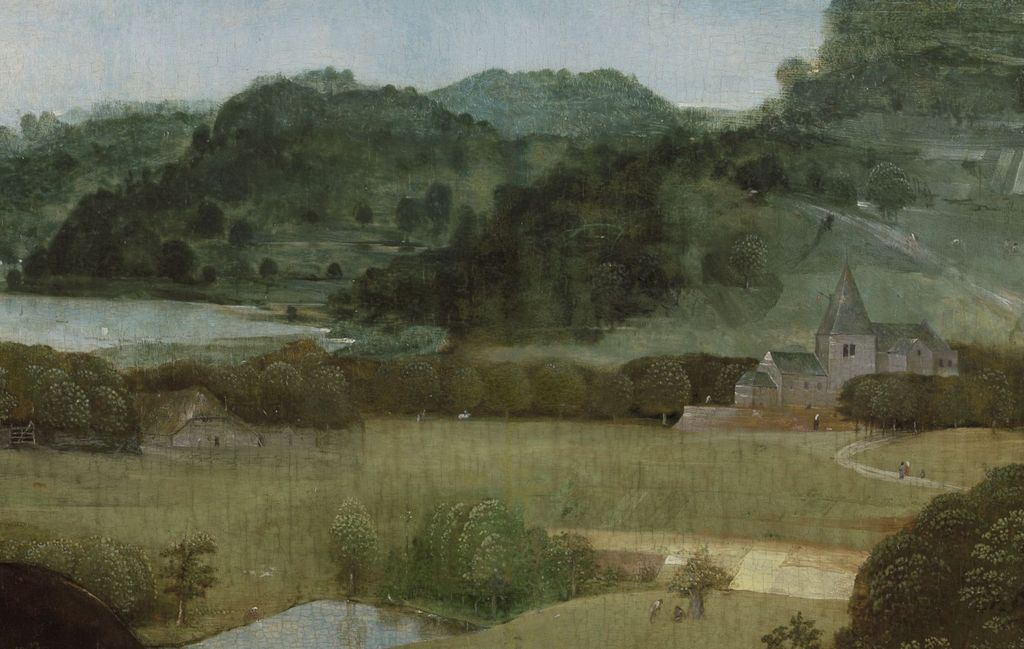
Image and detail crops: Wikimedia Commons source file (public domain reproduction).
The Body Turned towards Christ
The saint’s body follows a long diagonal across the lower part of the picture. His white garment gathers around his hips and legs, leaving his upper body exposed. Rather than kneeling upright before a cross, he stretches forward until the face, hands and crucifix form a close group. The pose gives the act of prayer a physical intensity without showing him in the middle of a violent movement.
His closed eyes matter. They deny the viewer a straightforward exchange of looks between saint and painted Christ. Jerome does not appear to be inspecting the small body in his arms; his attention is directed inward. The BRCP catalogue interprets this as meditation in which an image of Christ is held in the mind. The object remains visible to us, while the saint’s expression suggests a different kind of seeing.[2]
The stone nearby supplies a contrast. In familiar images of the penitent Jerome, he raises a stone to strike his chest. Here it is no longer in use. Bosch concentrates on the prayer that follows or takes the place of that action. This is a historical representation of ascetic devotion, in which bodily deprivation and repentance were linked; the painting’s immediate focus is the still, absorbed relationship with the crucifix.[2]
The red clothing provides a second contrast. It spreads across a much larger area than the small cross, but its empty folds have no power to pull Jerome’s attention away. The eye can follow the brilliant fabric outwards before returning along the pale body towards his hands. Colour gives worldly identity a conspicuous presence precisely where the figure has temporarily relinquished it.
Hat, Book and Lion
The cardinal’s hat, red robe and nearby book identify a saint whose importance extended well beyond his retreat. Jerome was revered as a learned Church Father and biblical translator. The book recalls that intellectual work, while the cardinal’s costume belongs to a later pictorial convention. It should not be taken as evidence that the fourth-century Jerome held the office in the form familiar to Bosch’s contemporaries.[2]
These attributes have not been removed from the saint’s world; they have been moved outside the immediate embrace. They allow a viewer to recognise him before considering the unusual posture. Bosch joins a recognisable religious subject to a less conventional bodily arrangement, making learning, ecclesiastical dignity and penitence available within one small landscape.
The lion stands at the left. In the legend associated with Jerome, he removed a thorn from the animal’s paw and gained a faithful companion. Here the creature is small and almost domestic beside the saint’s shelter, rather than a grand heraldic beast. Its presence establishes identity while fitting into the scale of the other animals and plants around it.[1][2]
Not every irregularity in the lion’s body belongs to that legend or to Bosch’s imagination. The catalogue and technical report caution that small circular marks in the paint arose through ageing. Distinguishing a painted feature from a changed surface is especially useful in a picture whose surroundings already encourage viewers to search for extraordinary details.[2][3]
An Unsettling Place of Retreat
Jerome’s shelter resists a single architectural description. Stone slabs, holes, thorny growths and hollow timber gather into a place that offers cover without looking comfortably habitable. Rounded, fruitlike forms sit beside harder, fractured surfaces. The setting shifts between recognisable material and invented structure, making it difficult to decide where natural growth ends and a constructed refuge begins.
That uncertainty gives the foreground much of its tension. Jerome’s body is clearly legible, but the objects around him demand repeated looking. A hole might suggest a dark entrance; a curved surface resembles an enormous piece of vegetation; a sharp branch cuts across a softer shape. The saint has found a position for prayer within this environment without mastering or tidying it.
Small animals complicate the apparent quiet. The fox near the lower left rests beside the remains of a cockerel. An owl occupies the hollow tree, looking out from a different kind of shelter. The BRCP interpretation treats these details as warnings within the saint’s surroundings. The fox’s repose is particularly deceptive: the evidence of predation remains close to its apparently peaceful body.[2]
Such details do not require the same interpretation every time they occur in Bosch. The owl’s effect depends on where it sits, what it faces and what surrounds it. Here its watchfulness contrasts with Jerome’s closed eyes. The distinction is visible before any symbolic meaning is assigned: one creature looks outwards while the praying man turns away from the distractions of the external scene.
The hollow tree and watchful bird also invite comparison with The Hearing Forest and the Seeing Field. Similar motifs can connect works without making their purposes identical. In the Ghent painting, they surround a specific saint at prayer; the broader question is how he sustains that attention in a place full of possible disturbances.[2]
The Cultivated Country Beyond
The foreground’s dense forms give way to more regular spaces above. Water, fields, a farmhouse and a church establish a landscape shaped by human activity. Its distances are easier to follow than the saint’s immediate shelter. The eye can move along a shore or across a field, rather than becoming caught among holes, projections and overlapping objects.
This contrast does not simply oppose an evil wilderness to an innocent village. The cultivated land supplies a different visual rhythm and a clearer light, but Jerome remains in the difficult foreground. The painting lets viewers experience the distance between these spaces while keeping his act of prayer closest to them. The ordered country can suggest calm without becoming a literal destination towards which the saint is travelling.
A tiny woman washing clothes contributes to one interpretation of the contrast. Lieven Van Den Abeele, writing for the Flemish Art Collection, connects the laundry with purification, and compares the saint’s white garment with Christ’s pale loincloth. The BRCP catalogue develops a related reading. An everyday task in the distance thus offers a parallel to the spiritual cleansing associated with the saint, though it remains an interpretation of the composition rather than a recorded explanation by Bosch.[2][6]
The scale of the washerwoman helps the connection work subtly. She does not compete with Jerome or announce her role through an oversized gesture. Her activity belongs plausibly to the inhabited landscape, allowing ordinary labour and religious meditation to coexist within the same view. Bosch gives attention different forms, from the saint’s concentrated prayer to a task almost lost in the distance.
Jerome’s Account of Inner Struggle
Jerome’s own writing supplies a historical context for this image of withdrawal. In section seven of his letter to Eustochium, he recalls the persistence of desire while living in the desert. Separation from Rome and bodily hardship did not automatically still his imagination. He describes turning to prayer and tears as he struggled with memories and temptation.[7]
That account helps explain why a secluded saint can remain surrounded by disturbance. Retreat changes the setting of the struggle rather than guaranteeing its end. Bosch makes the saint’s physical surroundings visibly difficult, while the closed eyes suggest that the most important activity cannot be displayed as a sequence of outward events. The arms around the crucifix give that inward concentration a form the viewer can see.
The letter is relevant context, not proof that Bosch read a particular surviving edition or followed a passage word for word. The BRCP catalogue relates the painting to a wider tradition in which Jerome’s penitence offered an example for meditation on Christ. It also associates his popularity in the fifteenth-century Low Countries with the Devotio Moderna, a movement emphasising disciplined religious life and personal devotion.[2]
Jerome shared Bosch’s given name, Hieronymus. The catalogue further explores an old interpretation of the saint’s name as a sacred grove or holy wood, and its resonance with the painter’s chosen name, Bosch. Such associations may deepen the relationship between artist, saint and landscape. They do not turn this figure into a disguised portrait of Bosch or establish a private autobiographical confession.[2]
A Crucifix Added Late
The most consequential change identified beneath the surface concerns the cross. It was not prepared in the surviving underdrawing. Bosch painted it after completing the underlying landscape and the saint’s arms, so the object now enclosed by those arms belongs to a late stage of execution. The technical report allows that the earlier paint may already have dried fully before the addition.[3]
The finding gives the finished picture a particular interest. The pose and setting existed before the small crucified body assumed its present place. Yet it does not establish why Bosch added it, or prove that the painting had previously been intended as a different subject. Preparatory absence identifies a change in making; interpreting the crucifix as a visualisation of inward prayer remains a further scholarly proposal.[2][3]
Other revisions were less decisive but numerous. Jerome’s head became smaller, features moved slightly, and the extent of his garments changed. Bosch also revised the shelter and landscape, including the hollow tree’s opening and the arrangements around the farmhouse. Several details were introduced in paint rather than fixed in advance by drawing.[3]
These changes distinguish the Ghent panel from a mechanically enlarged design. Drawing supplied a framework that could be altered as forms developed. The painting’s concentration emerges through that flexibility: a head reduced, a robe adjusted, an opening extended and finally a cross placed within the embrace. No single revision by itself identifies another painter or a separate workshop hand.
Colour, Drawing and the Painting’s Date
The underdrawing was applied with a brush in a fluid medium, with contours built from varied strokes rather than a uniform outline. Some passages are carefully prepared, especially the saint and his clothing; others remained open to later invention. The report relates this combination of planning and change to Bosch’s accepted practice and supports the museum’s attribution of the work to him.[1][3]
That attribution has not been entirely unquestioned: the BRCP catalogue records a challenge by Fritz Koreny, which its authors reject on stylistic and technical grounds. The current museum record likewise presents the painting as Bosch’s own work.[1][2]
Colour was built through layers whose present appearance can differ from the original effect. The red robe combines pale modelling with red glazes; wear has exposed some of the lighter paint beneath. Copper-containing greens have turned brown, changing the appearance of lizards and parts of the landscape. Increased transparency also allows underlying marks to become more apparent. An older reproduction’s sombre colour therefore contains the effects of material change as well as the artist’s choices.[3]
The approximate date of 1485–1495 should be distinguished from the age of the support. The youngest preserved tree ring dates to 1465. The technical study calculates that painting could have begun from 1476, with a date after 1478 statistically more probable once missing rings, drying and transport are considered. Those limits allow the later execution range; they do not independently narrow the act of painting to a particular decade.[3]
Cropping, Conservation and Ghent
The oak support consists of three boards. Its original frame is gone, and the panel has been cropped at the top and bottom. Later intervention thinned the reverse and attached a wooden cradle. Two wax seals survived by being transferred to the altered back with small pieces of the original wood still attached. These traces belong to the object’s history, rather than to the religious scene on its front.[3]
The technical examination in 2010 documented the restrictions imposed by the old cradle, damage near a crack, yellowed varnish and discoloured retouching. Those observations preceded the major 2015–16 treatment. They explain the need for conservation without describing every problem as if it remained unchanged today.[1][3]
A February 2015 institutional announcement identified structural stabilisation and improved colour contrasts as aims of the work at the Royal Institute for Cultural Heritage in Brussels. The present museum record confirms that extensive restoration and scientific investigation took place in 2015 and 2016.[1][8]
The painting entered the Ghent collection in 1908 through the museum’s friends. The catalogue traces the acquisition through the Brussels sale and intermediaries, while seals associate earlier stages of its history with France. They do not identify the original commissioner or securely recover the room in which Bosch’s first audience encountered the panel.[1][2]
Returning to the Embrace
In the Hermit Saints Triptych, Jerome kneels at the centre of an ensemble shared with Anthony and Giles. Here he occupies an entire panel alone, and the low, extended pose brings the body into an unusually close relationship with the cross. The different arrangement changes the experience of devotion even where the saint’s familiar attributes recur.
Look again from his discarded hat to the hanging robe, then along the white garment towards the clasped hands. That long passage through the picture ends at an object small enough to fit between his forearms. Added only after much of the surrounding paint was complete, the crucifix binds the extended body into the intimate encounter that now defines the image.
Artworks and related attributions
Browse paintings, drawings and related attributions. Records group triptychs, fragments and two-sided sheets where appropriate. Dates follow the cited museum records or catalogue headings and are generally estimates. Rows marked “2016 catalogue” report that publication’s attribution and collection information; these are dated opinions, rather than a claim that every work is an accepted autograph Bosch.
| Name | Date | Medium, attribution and collection |
|---|---|---|
| A Crossbowman | Second half of the sixteenth century | Oil on oak panel · Copy after Hieronymus Bosch · Museo Nacional del Prado, Madrid · P002695 Source 1. Source 2. |
| A Woman Spinning and an Old Woman | Museum estimates: about 1480–1490 for the women and 1500–1505 for the reverse; the precise chronology is disputed | Pen and brown and grey ink on the front; pen and brown ink on the reverse · Hieronymus Bosch · Museum Boijmans Van Beuningen, Rotterdam · N 190 recto and verso (PK) Source 1. Source 2. |
| Adoration of the Child in Cologne | Second half of the sixteenth century | Oil on oak panel · Imitator of Hieronymus Bosch, in the city collection record · Wallraf-Richartz-Museum & Fondation Corboud, Cologne · WRM 0474 Source 1. Source 2. |
| Adoration of the Magi in Philadelphia | Early sixteenth century in the museum record; around 1495–1520 in the BRCP catalogue | Oil on oak panel · Hieronymus Bosch in the museum record; workshop of Bosch in the 2016 BRCP catalogue · Philadelphia Museum of Art, John G. Johnson Collection, 1917 · 1321; museum object 103592 Source 1. Source 2. |
| Adoration of the Magi — New York | c.1470–1480 | 2016 catalogue: Bosch; oil on oak · Metropolitan Museum 13.26 2016 catalogue. |
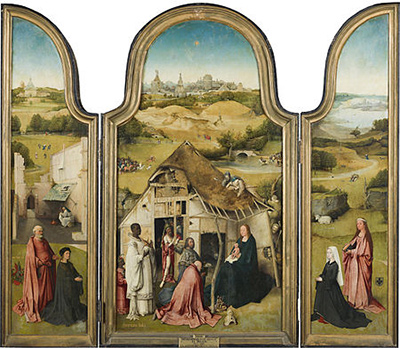
| Adoration of the Magi — Prado triptych | c.1494 | Oil on oak; grisaille exterior · Bosch · Prado P002048 Object source. |
| Adoration of the Magi — three associated fragments | c.1515–1535 | 2016 catalogue: Follower of Bosch · Two Shepherds / Retinue in Philadelphia; associated Adoration in private collection in 2016 2016 catalogue. |
| Ascent of the Blessed — Venice | c.1505–1515 | Oil on panel · Bosch · Gallerie dell’Accademia; Visions of the Hereafter Object source. |
| Battle of the Birds and Mammals | Not specified in catalogue heading | 2016 catalogue: Bosch; pen and brown ink · Berlin KdZ 14715 2016 catalogue. |
| Beggars and Musicians | Around 1530–1540 | Ink and wash on paper · Unknown follower of Hieronymus Bosch · Albertina, Vienna · 7798 Source 1. Source 2. |
| Christ Carrying the Cross Drawing | Around 1470 in the museum catalogue | Black chalk or charcoal, pen and brush in brown ink, white corrections · Anonymous, workshop of Rogier van der Weyden · Museum Boijmans Van Beuningen, Rotterdam · N 81 recto and verso (PK) Source 1. Source 2. |
| Christ Carrying the Cross in Vienna | Around 1490–1510 in the current KHM record and BRCP catalogue | Oil on oak, painted on both sides · Hieronymus Bosch; possible workshop involvement in the Passion side discussed by the BRCP · Kunsthistorisches Museum, Vienna · Gemäldegalerie, GG 6429 Source 1. Source 2. |
| Christ Carrying the Cross — El Escorial | c.1495–1505 | 2016 catalogue: Bosch; oil on oak · Patrimonio Nacional 10014739 2016 catalogue. |
| Christ Carrying the Cross — Ghent | c.1510–1516 (museum) | Oil on panel · Bosch in museum listing; authorship disputed · MSK Ghent 1902-H Object source. |
| Christ Mocked — London | c.1510 | Oil on wood · Bosch · National Gallery NG4744 Object source. |
| Concert in the Egg, After Hieronymus Bosch | Around 1561; third quarter of the sixteenth century | Oil on canvas · Anonymous, after Hieronymus Bosch · Palais des Beaux-Arts, Lille · P 816 Source 1. Source 2. |
| Conjurer / Comical Concert — Louvre drawing | Not specified in catalogue heading | 2016 catalogue: Bosch (recto), follower (concert verso) · Pen and brown ink · Louvre INV 19197 2016 catalogue. |
| Conjurer / Cross-bearing and beggars — Liège sheet | Not specified in catalogue heading | 2016 catalogue: Bosch (verso), follower (recto) · Pen and brown ink · Album d’Arenberg 534 2016 catalogue. |
| Crowning with Thorns — El Escorial | c.1530–1540 | 2016 catalogue: Follower of Bosch; oil on oak · Patrimonio Nacional 10014743 2016 catalogue. |
| Crucifixion with a Donor | Circa 1495–1505; Circa 1490–1500 | Oil on oak panel · Hieronymus Bosch · Royal Museums of Fine Arts of Belgium, Brussels · 6639 Source 1. Source 2. |
| Death and the Miser Drawing | Not securely established; probably made after the painting | Pen and brush, dark ink and white highlights on prepared paper · Workshop of Hieronymus Bosch in the BRCP catalogue; alternatives recorded by the Louvre · Musée du Louvre, Department of Prints and Drawings, Paris · RF 6947, Recto Source 1. Source 2. |
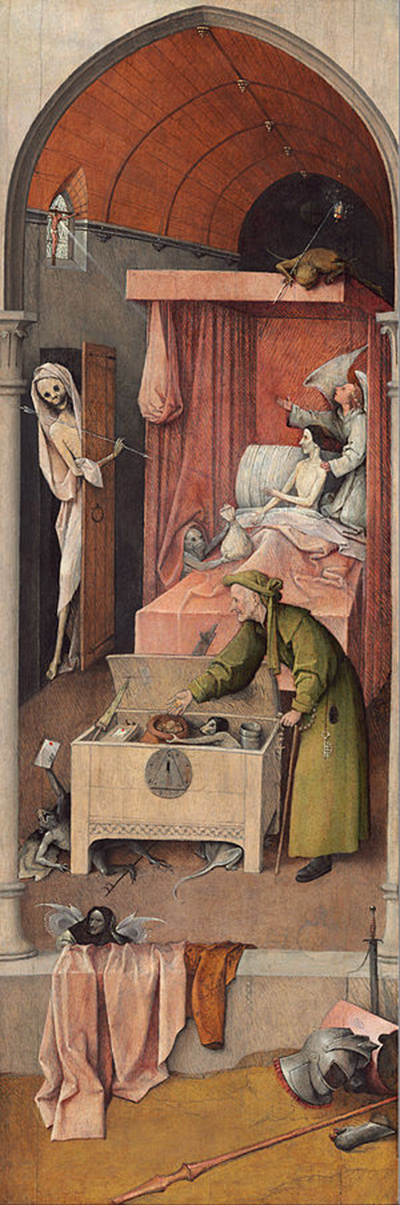
| Death and the Miser — Washington | c.1485/1490 (NGA) | Oil on panel · Bosch · National Gallery of Art 1952.5.33 Object source. |
| Ecce Homo Triptych — Boston | c.1495–1500; wings c.1500/1503 | 2016 catalogue: Workshop of Bosch; oil on oak · Museum of Fine Arts Boston; several production phases 2016 catalogue. |
| Ecce Homo — Frankfurt | c.1490 | Mixed technique on oak · Bosch · Städel 1577 Object source. |
| Fall of the Damned — Venice | c.1505–1515 | 2016 catalogue: Bosch; oil on panel · Visions of the Hereafter · Venice 2016 catalogue. |
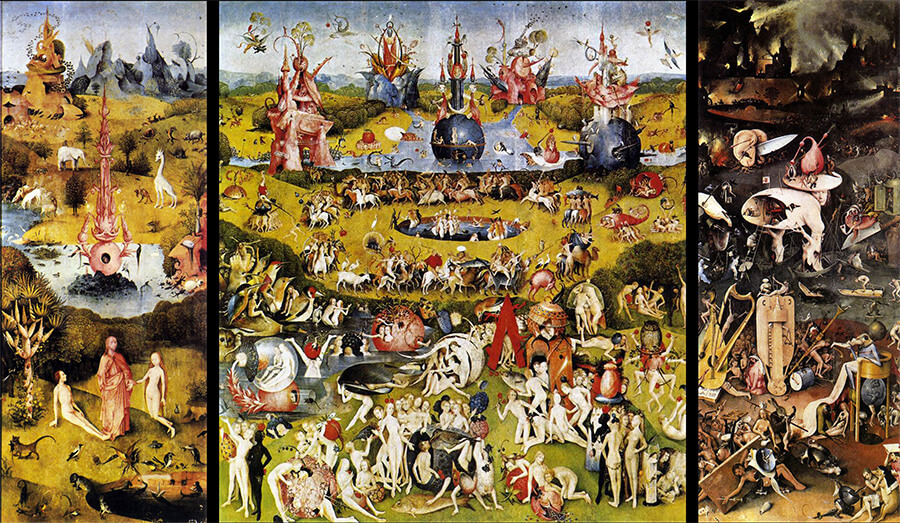
| Garden of Earthly Delights | 1490–1500 (Prado) | Oil on oak; grisaille exterior · Bosch · Prado; triptych Object source. |
| Gluttony and Lust / Allegory of Intemperance — Yale fragment | c.1500–1510 (group dating) | 2016 catalogue: Bosch; oil on oak · Yale 1959.15.22; fragment associated with Ship of Fools 2016 catalogue. |
| Group of Ten Spectators, a Follower of Bosch | Around 1510–1540 in the current museum record | Pen and two brown inks on paper, with a brown framing line · Follower of Hieronymus Bosch in the Morgan record; Bosch in the BRCP catalogue · Morgan Library & Museum, New York · I, 112 Source 1. Source 2. |
| Head of an Old Woman | About 1500 | Oil on panel · Attributed to Jacob Cornelisz. van Oostsanen · Museum Boijmans Van Beuningen, Rotterdam · 2439 (OK) Source 1. Source 2. |
| Hell and the Flood — Rotterdam panels | Around 1515 in the museum records; around 1510–1520 in the BRCP catalogue | Oil on oak panels · Jheronimus Bosch in the museum records; workshop of Bosch in the BRCP catalogue · Museum Boijmans Van Beuningen, Rotterdam Source 1. Source 2. |
| Hermit Saints Triptych | Circa 1495–1505 | Oil on oak panels · Hieronymus Bosch · Gallerie dell’Accademia, Venice · 2044 Source 1. Source 2. |
| Infernal Landscape | Not specified in catalogue heading | 2016 catalogue: Bosch; pen and brown ink, red accent · Private collection in 2016 2016 catalogue. |
| Infernal Scene with Anvil / Monster Studies | Not specified in catalogue heading | 2016 catalogue: Bosch; attribution debated in entry · Pen and brown ink · Berlin KdZ 548 2016 catalogue. |
| Infernal Scene with Tree-Man / Standing Man | Not specified in catalogue heading | 2016 catalogue: Workshop of Bosch; pen and brown ink · Dresden C 1875; historical reverse title includes a proposed prophet 2016 catalogue. |
| Job Triptych — Bruges | c.1510–1520 | 2016 catalogue: Workshop of Bosch; oil on oak · Groeningemuseum / Hoeke loan in 2016 2016 catalogue. |
| Last Judgement — Bruges triptych | c.1495–1505 | 2016 catalogue: Bosch; oil on oak · Groeningemuseum 2016 catalogue. |
| Last Judgement — Munich fragment | c.1530–1540 | 2016 catalogue: Follower of Bosch; oil on oak · Alte Pinakothek 5752 2016 catalogue. |
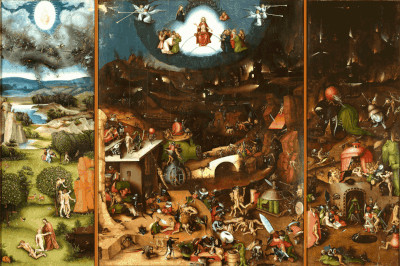
| Last Judgement — Vienna triptych | c.1500–1505 (BRCP 2016) | Oil on oak · Bosch and workshop (BRCP 2016) · Academy of Fine Arts Vienna 2016 catalogue. |
| Man in a Basket and Comic Figures | Around 1500–1515 in the museum record | Pen and brown ink on paper; the reverse is catalogued as iron-gall ink · Hieronymus Bosch in the current Albertina record; attribution has been debated · Albertina, Vienna · 7797 recto and verso Source 1. Source 2. |
| Man Seen from Behind | About 1550–1569; About 1565–1570 | Traces of black chalk, pen and brush in light brown ink · Anonymous, circle of Pieter Bruegel the Elder · Museum Boijmans Van Beuningen, Rotterdam Source 1. Source 2. |
| Mary and John at the Foot of the Cross | About 1440 | Brush in grey and black · Unknown, possibly Netherlandish · Kupferstich-Kabinett, Staatliche Kunstsammlungen Dresden · C 815 Source 1. Source 2. |
| Model Sheet with ‘Witches’ | Disputed; proposals depend on the attribution | Pen and brown ink; the BRCP also records underlying black chalk · Hieronymus Bosch; follower attributions also recorded · Musée du Louvre, Département des Arts graphiques, Paris · INV 19721 recto Source 1. Source 2. |
| Peasant and Three Bust-Length Figures | 1401–1500 | Brown pen over a black preliminary drawing · Attributed to the Master of the Drapery Studies; Bosch circle also recorded · Kupferstichkabinett, Staatliche Museen zu Berlin · KdZ 777 Source 1. Source 2. |
| River to Hell — Venice | c.1505–1515 | 2016 catalogue: Bosch; oil on panel · Visions of the Hereafter · Venice 2016 catalogue. |
| Saint Anthony and a Concert in an Egg | Around 1510–1525 in the museum’s 2016–17 exhibition texts | Pen in light and dark brown inks · Workshop of Hieronymus Bosch; underlying monsters: Bosch (BRCP), possibly Bosch (exhibition text) · Kupferstichkabinett, Staatliche Museen zu Berlin · KdZ 711 recto and verso Source 1. Source 2. |
| Saint Christopher Carrying the Christ Child | c.1500; 1490–1505 in restoration material | Oil on panel · Bosch · Boijmans St 26 Object source. |
| Saint James and Hermogenes | About 1551–1575 in the KIK-IRPA catalogue | Oil on wood, painted on both sides · Anonymous follower of Hieronymus Bosch · Musée des Beaux-Arts, Valenciennes · P.46.1.44; older number 176 Source 1. Source 2. |
| Saint Jerome at Prayer | Circa 1485–1495 | Oil on oak panel · Hieronymus Bosch · Museum of Fine Arts, Ghent · 1908-H Source 1. Source 2. |
| Saint John on Patmos / Passion Scenes | c.1495–1505; estimates vary | Oil on oak · Bosch · Gemäldegalerie Berlin 1647A Object source. |
| Saint John the Baptist in Meditation | Late 15th century; c.1485–1510 (Prado exhibition) | Oil on panel · Bosch · Lázaro Galdiano 8155 Object source. |
| Saint Liberata Triptych | Circa 1495–1505 | Oil on oak panels · Hieronymus Bosch · Gallerie dell’Accademia, Venice · 2045 Source 1. Source 2. |
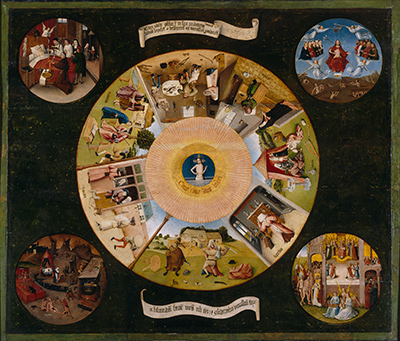
| Seven Deadly Sins and the Four Last Things | 1505–1510 (Prado) | Oil on poplar · Bosch (Prado); workshop/follower disputed · Prado Object source. |
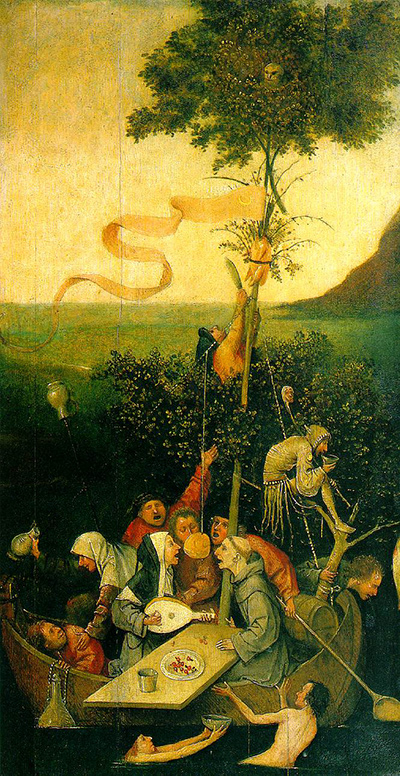
| Ship of Fools — Louvre painting | 1475–1500 (record); c.1505–1515 (exhibition) | Oil on oak · Bosch · Louvre RF 2218; fragment Object source. |
| Ship of Fools — Louvre workshop drawing | Not specified in catalogue heading | 2016 catalogue: Workshop of Bosch · Pen, brush, grey-brown ink and white highlights on prepared paper · Louvre RF 3714 2016 catalogue. |
| Studies of Monsters | About 1530–1550, according to the current Ashmolean record | Pen and brown ink on laid paper, both faces · Anonymous follower of Hieronymus Bosch · Ashmolean Museum, University of Oxford · WA1863.155 Source 1. Source 2. |
| Studies of Saint Anthony and Monsters | No execution date specified in the current Louvre records | Pen and brown ink on paper · Bosch listed; reverse questioned by Louvre; BRCP accepts both faces · Musée du Louvre, Département des Arts graphiques, Paris · INV 20871 recto and verso Source 1. Source 2. |
| Temptation of Saint Anthony — Kansas City fragment | c.1500–1510 | 2016 catalogue: Bosch; oil on oak · Nelson-Atkins 35–22 2016 catalogue. |
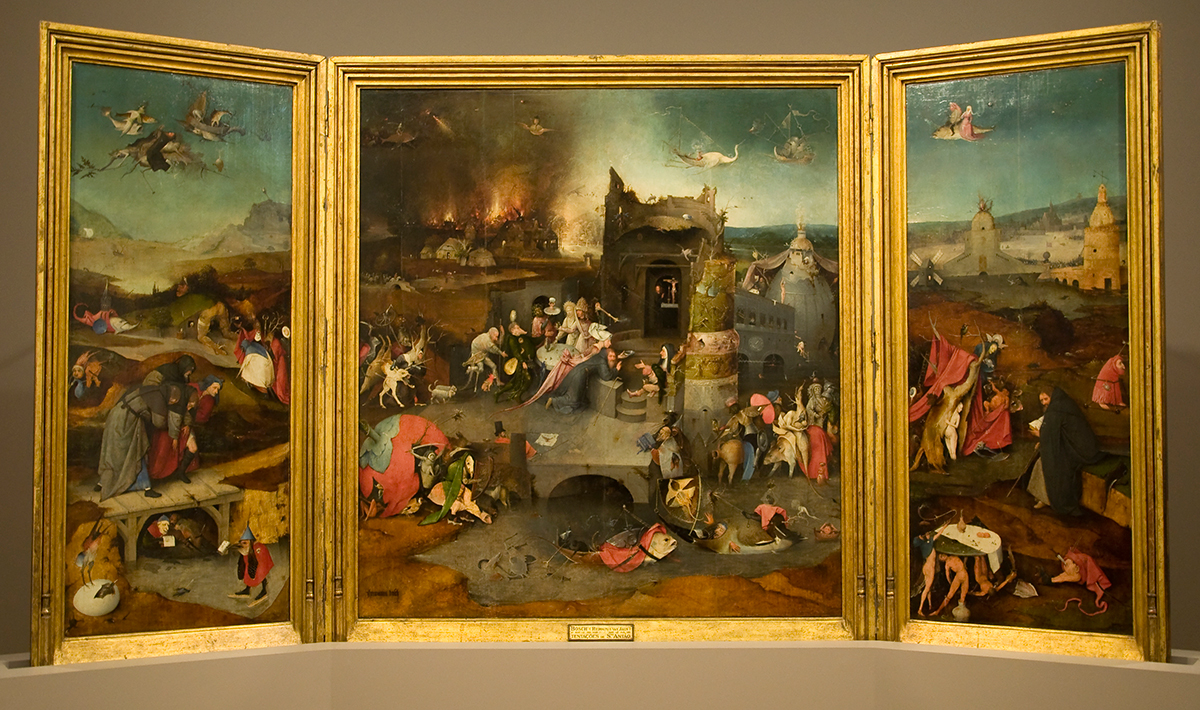
| Temptation of Saint Anthony — Lisbon triptych | c.1500 | Oil on oak · Bosch · Museu Nacional de Arte Antiga 1498 Pint Museum. |
| Temptation of Saint Anthony — Prado panel | c.1530–1540 | 2016 catalogue: Follower of Bosch (2016 opinion); oil on oak · Prado P002049 2016 catalogue. |
| Terrestrial Paradise | Approximately 1505–1515 | Oil on oak panel · Hieronymus Bosch · Gallerie dell'Accademia, Venice Source 1. Source 2. |
| The Burning Ship Drawing | 1500–1520 | Pen and iron gall ink on paper · Attributed to Hieronymus Bosch · Academy of Fine Arts Vienna, Graphic Collection · HZ-2554; numbered 2554 in the BRCP catalogue Source 1. Source 2. |
| The Comical Barber Scene | About 1550–1580, according to the British Museum | Pen and brown ink, grey and brown wash, over black chalk · Anonymous follower, after Hieronymus Bosch · British Museum, Department of Prints and Drawings, London · 1854,0628.46 Source 1. Source 2. |
| The Conjuror, After Hieronymus Bosch | Probably after 1525; around 1530–1540 in the BRCP technical report | Oil on oak panel · Anonymous follower of Hieronymus Bosch · Musée Ducastel-Vera, Saint-Germain-en-Laye · 872.1.87 Source 1. Source 2. |
| The Cure of Folly / Extraction of the Stone of Madness | 1501–1505 (Prado) | Oil on oak · Bosch (Prado); workshop/follower disputed · Prado P002056 Object source. |
| The Entombment Drawing | About 1505–1515, current museum record | Brush and black and grey ink, with grey wash, over black chalk · Workshop of Hieronymus Bosch; drawn by the Master of the Prado Haywain Triptych; Hieronymus Bosch, argued by the BRCP in 2016 · British Museum, Department of Prints and Drawings, London · 1952,0405.9 Source 1. Source 2. |
| The Gathering of the Birds | Not specified in catalogue heading | 2016 catalogue: Bosch; pen and brown ink · Berlin KdZ 13136 2016 catalogue. |
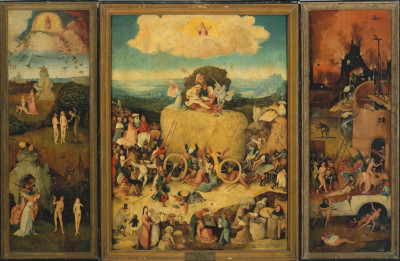
| The Haywain — Prado triptych | 1510–1516 (BRCP 2016) | Oil on oak · Bosch (BRCP 2016) · Prado; separate Escorial version exists 2016 catalogue. |
| The Hearing Forest and the Seeing Field | Circa 1500–1505 | Pen and brown ink on paper · Hieronymus Bosch; reverse: Bosch and workshop · Kupferstichkabinett, Staatliche Museen zu Berlin · KdZ 549, front and reverse Source 1. Source 2. |
| The Owl’s Nest — Rotterdam | Not specified in catalogue heading | 2016 catalogue: Bosch; pen and brown ink · Boijmans N 175 2016 catalogue. |
| The Passion Triptych in Valencia | Workshop of Bosch, about 1510–1520; Follower of Bosch; centre about 1530–1540, wings about 1540–1550 | Oil and gold on oak panels · Workshop of Bosch, about 1510–1520; Follower of Bosch; centre about 1530–1540, wings about 1540–1550 · Museu de Belles Arts de València Source 1. Source 2. |
| The Pedlar / Wayfarer — Rotterdam | c.1500 (museum) | Oil on panel · Bosch · Boijmans 1079 (OK); rejoined exterior Object source. |
| The Tree-Man — Vienna drawing | c.1505 | Pen and brown ink · Bosch · Albertina, Vienna Object source. |
| The Wedding at Cana, After Hieronymus Bosch | Approximately 1560 in the current museum record | Oil on panel, 93 cm high × 72 cm wide · Anonymous, after Hieronymus Bosch · Museum Boijmans Van Beuningen, Rotterdam, St 25 Source 1. Source 2. |
| Two Fantastical Creatures — Berlin KdZ 550 | Around 1505–1515 in the museum’s 2016 exhibition text | Pen in brown ink on reddish prepared laid paper · Hieronymus Bosch · Kupferstichkabinett, Staatliche Museen zu Berlin · KdZ 550, recto and verso Source 1. Source 2. |
| Two Figures Wearing Mitres | About 1480 | Oil on panel · Anonymous (Boijmans); Bosch circle (RKD) · Museum Boijmans Van Beuningen, Rotterdam · 1177 (OK) Source 1. Source 2. |
| Two Men and the Temptation of Eve | About 1505–1515 in the Prado’s 2016 exhibition guide | Pen and grey-brown ink on paper · Hieronymus Bosch in the 2016 catalogues discussed here · Private collection, as recorded in 2016 Source 1. Source 2. |
| Two Men Fighting | Not specified in the current Louvre record | Pen and brown ink · In the manner of Hieronymus Bosch · Musée du Louvre, Département des Arts graphiques, Paris · INV 20660 recto; formerly NIII 8896 and MA 8400 Source 1. Source 2. |
| Two Men — Berlin KdZ 5210 | Not specified in catalogue heading | 2016 catalogue: Bosch questioned · Pen, brush, ink, chalk and white highlights · Berlin KdZ 5210; historical title Two Oriental Men 2016 catalogue. |
| Two Monsters — Berlin KdZ 547 | Approximately 1500–1510 in Berlin's 2016 exhibition catalogue; an estimated range | Pen and brown ink on paper · Hieronymus Bosch · Kupferstichkabinett, Staatliche Museen zu Berlin · KdZ 547, drawn on both sides Source 1. Source 2. |
Frequently Asked Questions
The pose concentrates the image on prayer and inward meditation. The BRCP catalogue relates it to the saint’s devotion to Christ and the historical practice of meditating on the Passion.[2]
It was not prepared in the surviving underdrawing. Bosch added it late over the completed arms and background; the reason for that decision is not documented.[3]
Discussion
Compare the saint’s extended body, the small crucifix and the two contrasting parts of the landscape.
Reader Insights
Trace the line from the discarded hat through the robe to the small cross. Where does your eye pause?
How does the distant cultivated country differ from the saint’s immediate shelter?
Does the late addition of the crucifix change how you understand the finished pose?
Join the Conversation
Share a detail, comparison or question about Saint Jerome at Prayer below.
References
- Museum of Fine Arts, Ghent, Saint Jérôme, 1908-H. View source.
- Bosch Research and Conservation Project, catalogue 1: Saint Jerome at Prayer. View source.
- Bosch Research and Conservation Project, Technical Studies, catalogue 1. View source.
- BRCP Catalogue Raisonné (2016), object dates in catalogues 1, 2, 8, 15 and 20; catalogue 20 object metadata only for the Haywain comparison. View source
- Staatliche Museen zu Berlin, 2016 exhibition wall texts, p. 3: approximate date of KdZ 549. View source
- Lieven Van Den Abeele, De heilige Hiëronymus in gebed, Flemish Art Collection. View source.
- Jerome, Letter 22 to Eustochium, section 7, English translation. View source.
- Flemish Art Collection, restoration announcement, 6 February 2015. View source.