by Tom Gurney
Tom Gurney BSc (Hons) is an art history expert with over 20 years experience
Published on June 19, 2020 / Updated on November 4, 2026
Email: tomgurney1@gmail.com / Phone: +44 7429 011000
A standing man occupies the left side of this irregularly cut drawing. Three smaller figures appear beside him, one above another, their hats, hair and faces treated in different ways. No landscape or room connects them. The sheet brings four human figures into a compact field without presenting a single, continuous encounter.
The drawing has circulated under the descriptive title Peasant and Three Bust-Length Figures and with an attribution to Hieronymus Bosch. Berlin's Kupferstichkabinett now calls it Studienblatt mit mehreren Figuren, or Study Sheet with Several Figures. Its catalogue attributes it to the Master of the Drapery Studies and separately records a connection with Bosch's circle.[1] Those qualified descriptions are essential to understanding the object today.
At a Glance
- Current museum titleStudienblatt mit mehreren Figuren
- Historical descriptive titleA peasant at full-length and three bust-length figures
- Current attributionAttributed to the Master of the Drapery Studies; Bosch circle also recorded
- Museum date range1401–1500
- MediumBrown pen over a black preliminary drawing
- Maximum dimensions27.3 × 16.5 cm, irregularly trimmed
- CollectionKupferstichkabinett, Staatliche Museen zu Berlin
- InventoryKdZ 777
Compare these works across Bosch’s career
These date ranges are estimates, not a documented year-by-year sequence. These works provide context for the article; none is highlighted as the object discussed here.
Saint Jerome at Prayer
Circa 1485–1495 [2]Crucifixion with a Donor
Circa 1490–1500 (BRCP) [2]Hermit Saints Triptych
Circa 1495–1505 [2]Saint Liberata Triptych
Circa 1495–1505 [2]The Hearing Forest and the Seeing Field
Circa 1500–1505 (Berlin exhibition) [3]The Haywain Triptych
1510–1516 (BRCP) [2]Contents
Annotated Details from A Peasant and Three Bust-Length Figures
The Berlin fragment brings a standing figure together with three smaller bust-length studies. Its attribution history is explained in the article.
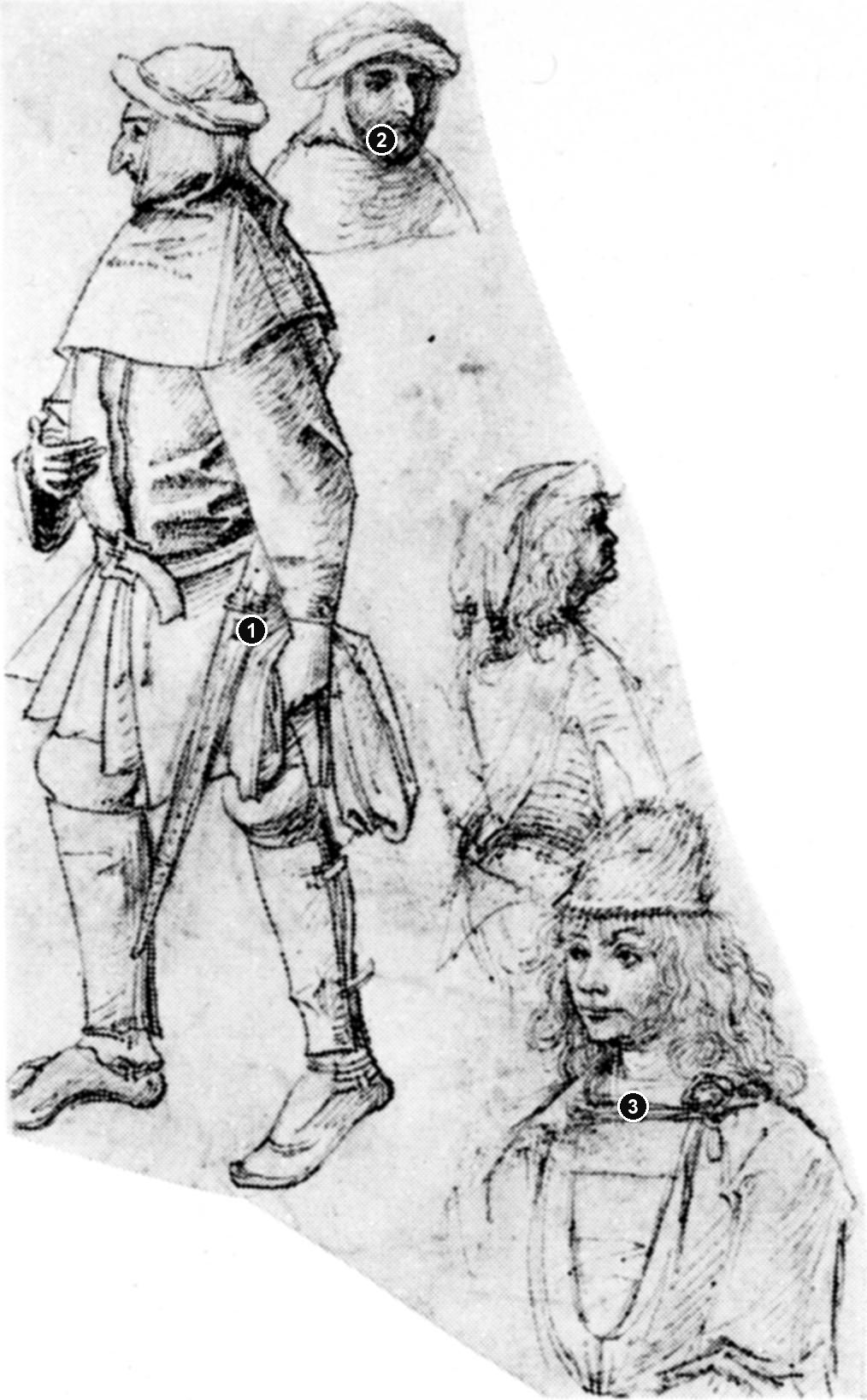
Details from A PEASANT AND THREE BUST-LENGTH FIGURES
Compare the complete pose with the separate heads and shoulders at the right.
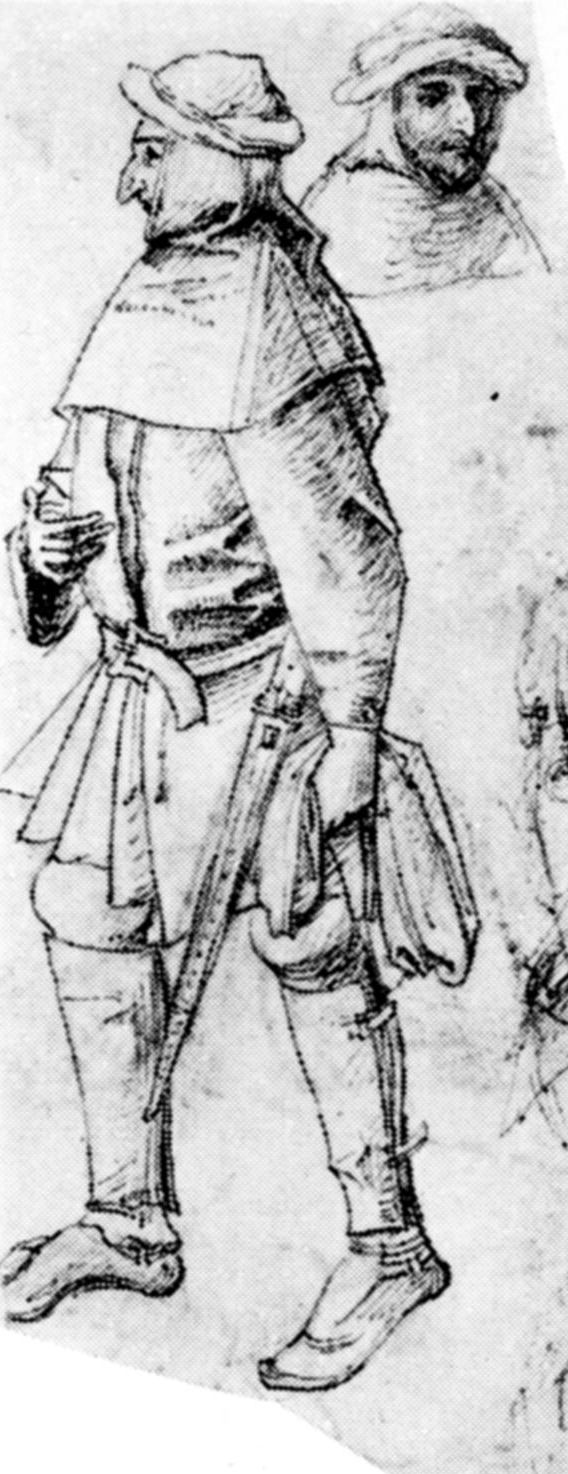
The standing figure
The main figure turns sideways beneath a soft cap. One hand rises near the waist while the other hangs beside the gathered clothing.
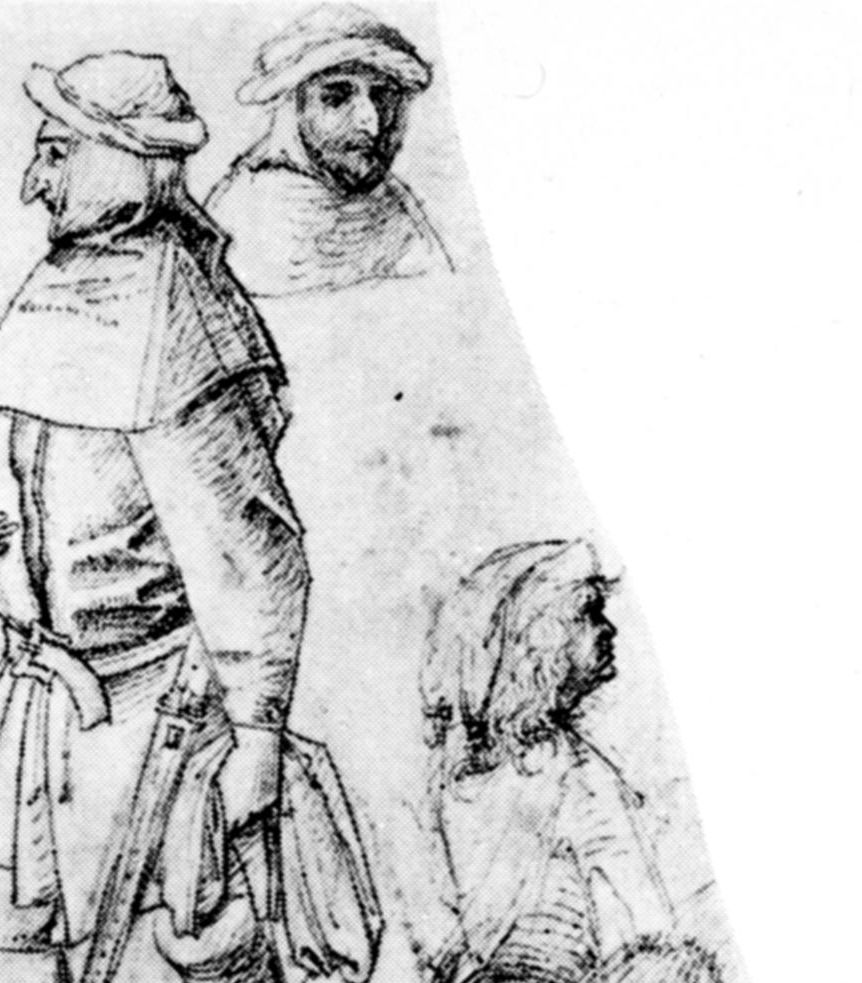
The upper bust-length studies
Two smaller studies turn in different directions above and beside the standing figure. Short parallel strokes describe the shoulders and neck.
The lower bust-length figure
The lower figure wears a tall cap and a garment fastened near the shoulder. Its broad front contrasts with the narrower profile above.
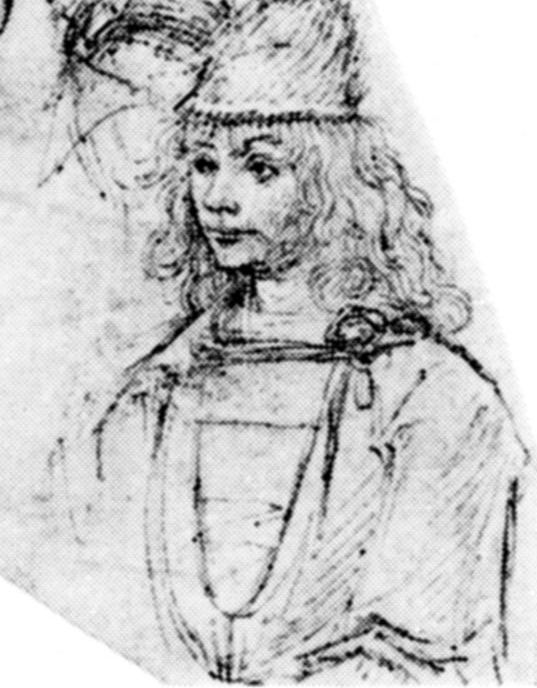
Image and detail crops: Wikimedia Commons source 1 (public domain reproductions).
One Standing Figure and Three Busts
The man at the left is the only figure shown from head to foot. His head turns towards the left edge, while the body remains open enough to reveal both arms and legs. The broad hat, short cape and layered clothing give the upper body considerable volume. Below, the legs separate into a stance that occupies much less of the paper's width.
His profile is immediately distinctive. The nose projects sharply from beneath the hat, and the chin turns back towards the covering around his head and neck. A small eye and short mouth line give detail to this larger outline. They make him individually recognisable without identifying a historical sitter.
One hand rises towards the middle of the body. The other is lower, beside the hip, where several narrow forms and loops complicate the silhouette. These details reward close inspection, but the catalogue does not identify the objects he holds. Calling them a particular agricultural implement or weapon would give the figure a more specific role than the available evidence supports.
The older title calls him a peasant. That word directs attention towards occupation and social position, whereas the current museum title simply describes several figure studies. The clothing and accessories can be observed closely without treating the historical label as documentary proof of the man's livelihood.
The other three figures appear at different heights on the right. Their shoulders and upper garments provide enough body to support each head, but none shares the standing man's complete format. Changes in scale and direction encourage the eye to move between them rather than settle on a common ground beneath their feet.
Three Different Heads
The upper bust is placed close to the standing man's head. Its broad, folded headwear spreads out above a face turned more towards the viewer. Dark lines around the eyes and brow make this head emphatic even though it occupies comparatively little space. Dense shading continues into the material surrounding the face.
The middle head turns the opposite way from the standing man. Its nose and mouth project towards the right, establishing a second clear profile. Long, curling strands descend behind the cheek and along the neck. The shoulder line gives this figure a small independent base rather than joining it to the person above.
At the bottom, a larger bust looks back across the sheet. A wide hat with an upright feather or tuft creates an elaborate upper contour. Long hair frames the cheeks and falls towards the shoulders. The face is comparatively open, with rounded cheeks and small features contained inside a broad arrangement of hat, hair and clothing.
These differences are more useful than an attempt to assign a fixed emotion to every face. One head is strongly shaded, another is defined through a profile, and the lowest is enclosed by a particularly expansive silhouette. The artist varies the means of giving each figure a presence.
Their gazes do not establish a clear conversation. The standing man looks left, the middle head looks right, and the other faces offer different degrees of frontal view. Such contrasts make the sheet lively, but they do not supply a narrative with an identifiable beginning or outcome.
Clothing as a Structure of Lines
The garments contribute as much to the drawing's organisation as the faces. Around the standing man's upper body, sloping folds broaden and narrow the cape. Near the waist, more closely gathered marks describe layers pressing against one another. The change in density distinguishes the heavy upper mass from the more exposed legs beneath it.
Long contours carry the viewer down towards the footwear. The pointed ends extend the direction of each foot, while short crossing marks interrupt the longer lines around the lower legs. A relatively small number of strokes separates joints, edges and overlapping pieces of clothing.
On the lower bust, broad folds spread from the neck and shoulders towards the bottom of the sheet. Parallel lines give some passages a darker tone without filling the garment with an even wash. The direction of those strokes helps describe a surface turning away from the light.
The upper head presents a denser version of this approach. Lines gather around the face and head covering, so that the boundary between flesh, cloth and shadow needs careful looking. Elsewhere, especially around the middle profile, lighter intervals allow the paper to remain more prominent. The four figures therefore differ in finish as well as size.
Pen, Preliminary Drawing and Paper
The museum identifies brown pen over a preliminary drawing made with a black drawing instrument.[1] This distinguishes the darker preliminary stage from the brown pen work without specifying a more precise material for every underlying mark. A reproduction does not necessarily let the viewer separate those stages stroke by stroke.
The visible pen lines alternate between long outlines and short accumulations of shading. Some describe the outer edge of a hat or leg in a continuous movement. Others build a shadow through repeated touches. Their relationship is especially clear where a relatively open face sits beside more densely worked clothing.
The paper's irregular shape also affects the composition as it survives. The right edge slopes outward as it descends, leaving more room for the lowest bust. Below the standing figure, the lower boundary curves inward before passing beneath the larger head and shoulders. The four studies occupy a field that is far from a regular rectangle.
Berlin records the sheet as irregularly trimmed and gives its greatest height and width.[1] Those measurements describe the surviving object. They do not recover its earlier outline, explain when each cut occurred or establish which additional marks might once have existed beyond the present edges.
Why the Bosch Title Survives
The older Bosch attribution has a substantial published history. In volume V of Early Netherlandish Painting, published in English in 1969, Max J. Friedländer discusses drawings he regarded as Bosch's own work. His list explicitly includes Berlin catalogue number 777, describing a full-length peasant and three bust-length figures. Plate 126 reproduces the sheet.[4]
This is more than a resemblance suggested by a modern image caption. The catalogue number and reproduction connect Friedländer's description to the present Berlin object. They explain why the drawing belongs in a discussion of works historically associated with Bosch, even though the current museum record uses different authorship terms.
Friedländer's broader discussion praises the inventiveness and speed he perceived in Bosch's drawing. That interpretation helps situate his list, but it should not be turned into proof that this particular sheet was prepared for a known painting. The four studies are not identified there as a secure preliminary design for a named surviving composition.
Reading the Current Attribution Carefully
The Berlin record uses attributed to for the Master of the Drapery Studies and circle for its Bosch entry.[1] Neither expression means a signed, securely documented drawing by Bosch himself. The two fields should also not be converted into a claim that two artists collaborated on the paper.
The catalogue does not provide an explanatory attribution essay or a chronology of successive reassessments. Friedländer's older opinion and the current fields can be set alongside one another, but they do not reveal every intermediate judgement. A complete account of how and why the classification changed would require further evidence.
The date requires similar care. Berlin gives the broad production range 1401–1500. Its separate activity label for the Master of the Drapery Studies is approximately 1470–1500.[1] An artist's activity range and an object's catalogued date are different kinds of information; neither supplies a precise year for the drawing.
The sheet remains engaging within those limits. A full standing body, two strongly contrasting profiles and differently framed faces invite comparison across a small surface. The surviving image offers a concentrated exercise in human appearance and clothing, while its changing attribution records a separate history of deciding whose hand produced those lines.
Artworks and related attributions
Browse paintings, drawings and related attributions. Records group triptychs, fragments and two-sided sheets where appropriate. Dates follow the cited museum records or catalogue headings and are generally estimates. Rows marked “2016 catalogue” report that publication’s attribution and collection information; these are dated opinions, rather than a claim that every work is an accepted autograph Bosch.
| Name | Date | Medium, attribution and collection |
|---|---|---|
| A Crossbowman | Second half of the sixteenth century | Oil on oak panel · Copy after Hieronymus Bosch · Museo Nacional del Prado, Madrid · P002695 Source 1. Source 2. |
| A Woman Spinning and an Old Woman | Museum estimates: about 1480–1490 for the women and 1500–1505 for the reverse; the precise chronology is disputed | Pen and brown and grey ink on the front; pen and brown ink on the reverse · Hieronymus Bosch · Museum Boijmans Van Beuningen, Rotterdam · N 190 recto and verso (PK) Source 1. Source 2. |
| Adoration of the Child in Cologne | Second half of the sixteenth century | Oil on oak panel · Imitator of Hieronymus Bosch, in the city collection record · Wallraf-Richartz-Museum & Fondation Corboud, Cologne · WRM 0474 Source 1. Source 2. |
| Adoration of the Magi in Philadelphia | Early sixteenth century in the museum record; around 1495–1520 in the BRCP catalogue | Oil on oak panel · Hieronymus Bosch in the museum record; workshop of Bosch in the 2016 BRCP catalogue · Philadelphia Museum of Art, John G. Johnson Collection, 1917 · 1321; museum object 103592 Source 1. Source 2. |
| Adoration of the Magi — New York | c.1470–1480 | 2016 catalogue: Bosch; oil on oak · Metropolitan Museum 13.26 2016 catalogue. |
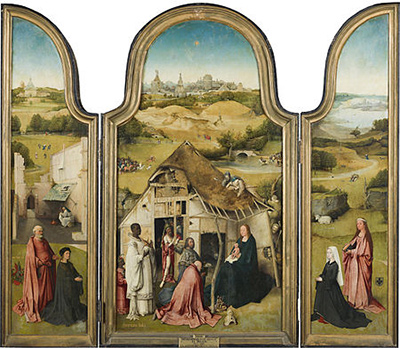
| Adoration of the Magi — Prado triptych | c.1494 | Oil on oak; grisaille exterior · Bosch · Prado P002048 Object source. |
| Adoration of the Magi — three associated fragments | c.1515–1535 | 2016 catalogue: Follower of Bosch · Two Shepherds / Retinue in Philadelphia; associated Adoration in private collection in 2016 2016 catalogue. |
| Ascent of the Blessed — Venice | c.1505–1515 | Oil on panel · Bosch · Gallerie dell’Accademia; Visions of the Hereafter Object source. |
| Battle of the Birds and Mammals | Not specified in catalogue heading | 2016 catalogue: Bosch; pen and brown ink · Berlin KdZ 14715 2016 catalogue. |
| Beggars and Musicians | Around 1530–1540 | Ink and wash on paper · Unknown follower of Hieronymus Bosch · Albertina, Vienna · 7798 Source 1. Source 2. |
| Christ Carrying the Cross Drawing | Around 1470 in the museum catalogue | Black chalk or charcoal, pen and brush in brown ink, white corrections · Anonymous, workshop of Rogier van der Weyden · Museum Boijmans Van Beuningen, Rotterdam · N 81 recto and verso (PK) Source 1. Source 2. |
| Christ Carrying the Cross in Vienna | Around 1490–1510 in the current KHM record and BRCP catalogue | Oil on oak, painted on both sides · Hieronymus Bosch; possible workshop involvement in the Passion side discussed by the BRCP · Kunsthistorisches Museum, Vienna · Gemäldegalerie, GG 6429 Source 1. Source 2. |
| Christ Carrying the Cross — El Escorial | c.1495–1505 | 2016 catalogue: Bosch; oil on oak · Patrimonio Nacional 10014739 2016 catalogue. |
| Christ Carrying the Cross — Ghent | c.1510–1516 (museum) | Oil on panel · Bosch in museum listing; authorship disputed · MSK Ghent 1902-H Object source. |
| Christ Mocked — London | c.1510 | Oil on wood · Bosch · National Gallery NG4744 Object source. |
| Concert in the Egg, After Hieronymus Bosch | Around 1561; third quarter of the sixteenth century | Oil on canvas · Anonymous, after Hieronymus Bosch · Palais des Beaux-Arts, Lille · P 816 Source 1. Source 2. |
| Conjurer / Comical Concert — Louvre drawing | Not specified in catalogue heading | 2016 catalogue: Bosch (recto), follower (concert verso) · Pen and brown ink · Louvre INV 19197 2016 catalogue. |
| Conjurer / Cross-bearing and beggars — Liège sheet | Not specified in catalogue heading | 2016 catalogue: Bosch (verso), follower (recto) · Pen and brown ink · Album d’Arenberg 534 2016 catalogue. |
| Crowning with Thorns — El Escorial | c.1530–1540 | 2016 catalogue: Follower of Bosch; oil on oak · Patrimonio Nacional 10014743 2016 catalogue. |
| Crucifixion with a Donor | Circa 1495–1505; Circa 1490–1500 | Oil on oak panel · Hieronymus Bosch · Royal Museums of Fine Arts of Belgium, Brussels · 6639 Source 1. Source 2. |
| Death and the Miser Drawing | Not securely established; probably made after the painting | Pen and brush, dark ink and white highlights on prepared paper · Workshop of Hieronymus Bosch in the BRCP catalogue; alternatives recorded by the Louvre · Musée du Louvre, Department of Prints and Drawings, Paris · RF 6947, Recto Source 1. Source 2. |
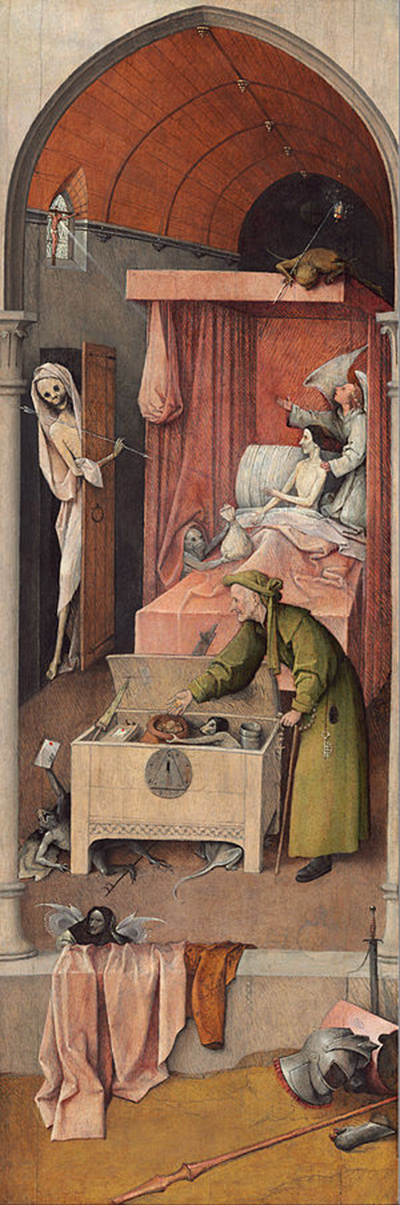
| Death and the Miser — Washington | c.1485/1490 (NGA) | Oil on panel · Bosch · National Gallery of Art 1952.5.33 Object source. |
| Ecce Homo Triptych — Boston | c.1495–1500; wings c.1500/1503 | 2016 catalogue: Workshop of Bosch; oil on oak · Museum of Fine Arts Boston; several production phases 2016 catalogue. |
| Ecce Homo — Frankfurt | c.1490 | Mixed technique on oak · Bosch · Städel 1577 Object source. |
| Fall of the Damned — Venice | c.1505–1515 | 2016 catalogue: Bosch; oil on panel · Visions of the Hereafter · Venice 2016 catalogue. |
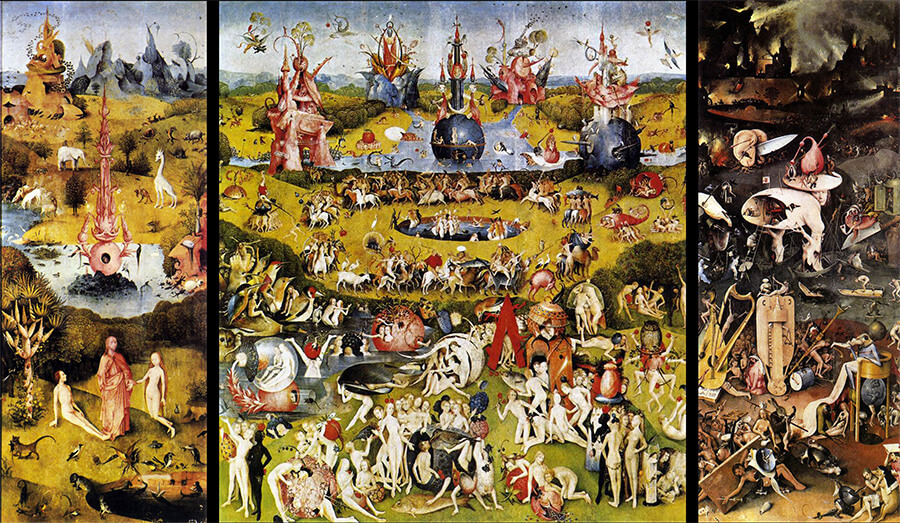
| Garden of Earthly Delights | 1490–1500 (Prado) | Oil on oak; grisaille exterior · Bosch · Prado; triptych Object source. |
| Gluttony and Lust / Allegory of Intemperance — Yale fragment | c.1500–1510 (group dating) | 2016 catalogue: Bosch; oil on oak · Yale 1959.15.22; fragment associated with Ship of Fools 2016 catalogue. |
| Group of Ten Spectators, a Follower of Bosch | Around 1510–1540 in the current museum record | Pen and two brown inks on paper, with a brown framing line · Follower of Hieronymus Bosch in the Morgan record; Bosch in the BRCP catalogue · Morgan Library & Museum, New York · I, 112 Source 1. Source 2. |
| Head of an Old Woman | About 1500 | Oil on panel · Attributed to Jacob Cornelisz. van Oostsanen · Museum Boijmans Van Beuningen, Rotterdam · 2439 (OK) Source 1. Source 2. |
| Hell and the Flood — Rotterdam panels | Around 1515 in the museum records; around 1510–1520 in the BRCP catalogue | Oil on oak panels · Jheronimus Bosch in the museum records; workshop of Bosch in the BRCP catalogue · Museum Boijmans Van Beuningen, Rotterdam Source 1. Source 2. |
| Hermit Saints Triptych | Circa 1495–1505 | Oil on oak panels · Hieronymus Bosch · Gallerie dell’Accademia, Venice · 2044 Source 1. Source 2. |
| Infernal Landscape | Not specified in catalogue heading | 2016 catalogue: Bosch; pen and brown ink, red accent · Private collection in 2016 2016 catalogue. |
| Infernal Scene with Anvil / Monster Studies | Not specified in catalogue heading | 2016 catalogue: Bosch; attribution debated in entry · Pen and brown ink · Berlin KdZ 548 2016 catalogue. |
| Infernal Scene with Tree-Man / Standing Man | Not specified in catalogue heading | 2016 catalogue: Workshop of Bosch; pen and brown ink · Dresden C 1875; historical reverse title includes a proposed prophet 2016 catalogue. |
| Job Triptych — Bruges | c.1510–1520 | 2016 catalogue: Workshop of Bosch; oil on oak · Groeningemuseum / Hoeke loan in 2016 2016 catalogue. |
| Last Judgement — Bruges triptych | c.1495–1505 | 2016 catalogue: Bosch; oil on oak · Groeningemuseum 2016 catalogue. |
| Last Judgement — Munich fragment | c.1530–1540 | 2016 catalogue: Follower of Bosch; oil on oak · Alte Pinakothek 5752 2016 catalogue. |
| Last Judgement — Vienna triptych | c.1500–1505 (BRCP 2016) | Oil on oak · Bosch and workshop (BRCP 2016) · Academy of Fine Arts Vienna 2016 catalogue. |
| Man in a Basket and Comic Figures | Around 1500–1515 in the museum record | Pen and brown ink on paper; the reverse is catalogued as iron-gall ink · Hieronymus Bosch in the current Albertina record; attribution has been debated · Albertina, Vienna · 7797 recto and verso Source 1. Source 2. |
| Man Seen from Behind | About 1550–1569; About 1565–1570 | Traces of black chalk, pen and brush in light brown ink · Anonymous, circle of Pieter Bruegel the Elder · Museum Boijmans Van Beuningen, Rotterdam Source 1. Source 2. |
| Mary and John at the Foot of the Cross | About 1440 | Brush in grey and black · Unknown, possibly Netherlandish · Kupferstich-Kabinett, Staatliche Kunstsammlungen Dresden · C 815 Source 1. Source 2. |
| Model Sheet with ‘Witches’ | Disputed; proposals depend on the attribution | Pen and brown ink; the BRCP also records underlying black chalk · Hieronymus Bosch; follower attributions also recorded · Musée du Louvre, Département des Arts graphiques, Paris · INV 19721 recto Source 1. Source 2. |
| Peasant and Three Bust-Length Figures | 1401–1500 | Brown pen over a black preliminary drawing · Attributed to the Master of the Drapery Studies; Bosch circle also recorded · Kupferstichkabinett, Staatliche Museen zu Berlin · KdZ 777 Source 1. Source 2. |
| River to Hell — Venice | c.1505–1515 | 2016 catalogue: Bosch; oil on panel · Visions of the Hereafter · Venice 2016 catalogue. |
| Saint Anthony and a Concert in an Egg | Around 1510–1525 in the museum’s 2016–17 exhibition texts | Pen in light and dark brown inks · Workshop of Hieronymus Bosch; underlying monsters: Bosch (BRCP), possibly Bosch (exhibition text) · Kupferstichkabinett, Staatliche Museen zu Berlin · KdZ 711 recto and verso Source 1. Source 2. |
| Saint Christopher Carrying the Christ Child | c.1500; 1490–1505 in restoration material | Oil on panel · Bosch · Boijmans St 26 Object source. |
| Saint James and Hermogenes | About 1551–1575 in the KIK-IRPA catalogue | Oil on wood, painted on both sides · Anonymous follower of Hieronymus Bosch · Musée des Beaux-Arts, Valenciennes · P.46.1.44; older number 176 Source 1. Source 2. |
| Saint Jerome at Prayer | Circa 1485–1495 | Oil on oak panel · Hieronymus Bosch · Museum of Fine Arts, Ghent · 1908-H Source 1. Source 2. |
| Saint John on Patmos / Passion Scenes | c.1495–1505; estimates vary | Oil on oak · Bosch · Gemäldegalerie Berlin 1647A Object source. |
| Saint John the Baptist in Meditation | Late 15th century; c.1485–1510 (Prado exhibition) | Oil on panel · Bosch · Lázaro Galdiano 8155 Object source. |
| Saint Liberata Triptych | Circa 1495–1505 | Oil on oak panels · Hieronymus Bosch · Gallerie dell’Accademia, Venice · 2045 Source 1. Source 2. |
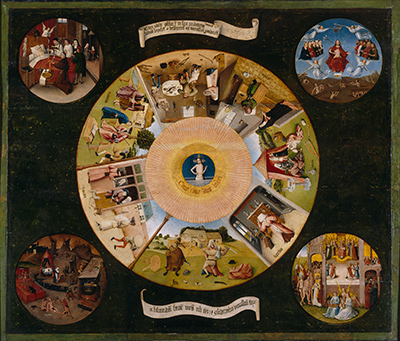
| Seven Deadly Sins and the Four Last Things | 1505–1510 (Prado) | Oil on poplar · Bosch (Prado); workshop/follower disputed · Prado Object source. |
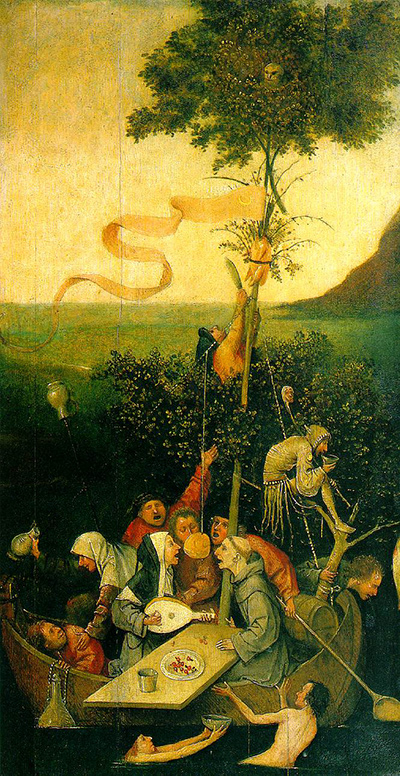
| Ship of Fools — Louvre painting | 1475–1500 (record); c.1505–1515 (exhibition) | Oil on oak · Bosch · Louvre RF 2218; fragment Object source. |
| Ship of Fools — Louvre workshop drawing | Not specified in catalogue heading | 2016 catalogue: Workshop of Bosch · Pen, brush, grey-brown ink and white highlights on prepared paper · Louvre RF 3714 2016 catalogue. |
| Studies of Monsters | About 1530–1550, according to the current Ashmolean record | Pen and brown ink on laid paper, both faces · Anonymous follower of Hieronymus Bosch · Ashmolean Museum, University of Oxford · WA1863.155 Source 1. Source 2. |
| Studies of Saint Anthony and Monsters | No execution date specified in the current Louvre records | Pen and brown ink on paper · Bosch listed; reverse questioned by Louvre; BRCP accepts both faces · Musée du Louvre, Département des Arts graphiques, Paris · INV 20871 recto and verso Source 1. Source 2. |
| Temptation of Saint Anthony — Kansas City fragment | c.1500–1510 | 2016 catalogue: Bosch; oil on oak · Nelson-Atkins 35–22 2016 catalogue. |
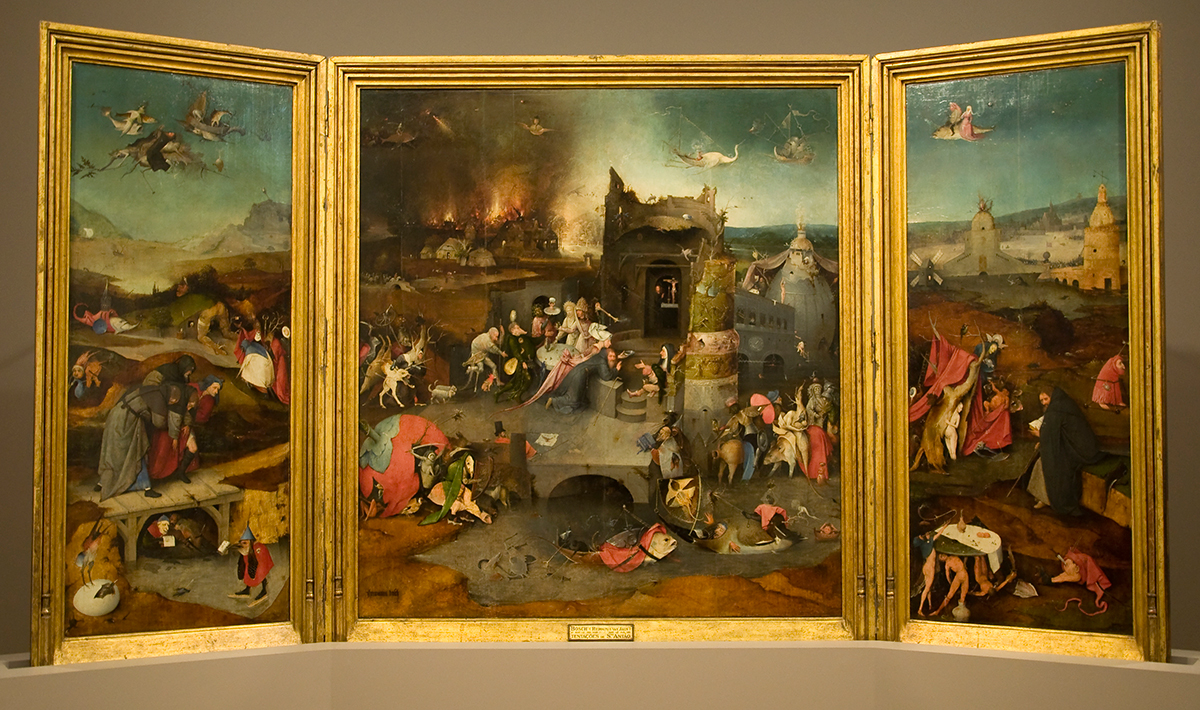
| Temptation of Saint Anthony — Lisbon triptych | c.1500 | Oil on oak · Bosch · Museu Nacional de Arte Antiga 1498 Pint Museum. |
| Temptation of Saint Anthony — Prado panel | c.1530–1540 | 2016 catalogue: Follower of Bosch (2016 opinion); oil on oak · Prado P002049 2016 catalogue. |
| Terrestrial Paradise | Approximately 1505–1515 | Oil on oak panel · Hieronymus Bosch · Gallerie dell'Accademia, Venice Source 1. Source 2. |
| The Burning Ship Drawing | 1500–1520 | Pen and iron gall ink on paper · Attributed to Hieronymus Bosch · Academy of Fine Arts Vienna, Graphic Collection · HZ-2554; numbered 2554 in the BRCP catalogue Source 1. Source 2. |
| The Comical Barber Scene | About 1550–1580, according to the British Museum | Pen and brown ink, grey and brown wash, over black chalk · Anonymous follower, after Hieronymus Bosch · British Museum, Department of Prints and Drawings, London · 1854,0628.46 Source 1. Source 2. |
| The Conjuror, After Hieronymus Bosch | Probably after 1525; around 1530–1540 in the BRCP technical report | Oil on oak panel · Anonymous follower of Hieronymus Bosch · Musée Ducastel-Vera, Saint-Germain-en-Laye · 872.1.87 Source 1. Source 2. |
| The Cure of Folly / Extraction of the Stone of Madness | 1501–1505 (Prado) | Oil on oak · Bosch (Prado); workshop/follower disputed · Prado P002056 Object source. |
| The Entombment Drawing | About 1505–1515, current museum record | Brush and black and grey ink, with grey wash, over black chalk · Workshop of Hieronymus Bosch; drawn by the Master of the Prado Haywain Triptych; Hieronymus Bosch, argued by the BRCP in 2016 · British Museum, Department of Prints and Drawings, London · 1952,0405.9 Source 1. Source 2. |
| The Gathering of the Birds | Not specified in catalogue heading | 2016 catalogue: Bosch; pen and brown ink · Berlin KdZ 13136 2016 catalogue. |
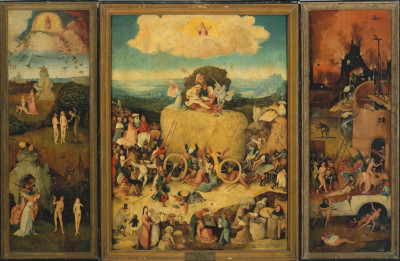
| The Haywain — Prado triptych | 1510–1516 (BRCP 2016) | Oil on oak · Bosch (BRCP 2016) · Prado; separate Escorial version exists 2016 catalogue. |
| The Hearing Forest and the Seeing Field | Circa 1500–1505 | Pen and brown ink on paper · Hieronymus Bosch; reverse: Bosch and workshop · Kupferstichkabinett, Staatliche Museen zu Berlin · KdZ 549, front and reverse Source 1. Source 2. |
| The Owl’s Nest — Rotterdam | Not specified in catalogue heading | 2016 catalogue: Bosch; pen and brown ink · Boijmans N 175 2016 catalogue. |
| The Passion Triptych in Valencia | Workshop of Bosch, about 1510–1520; Follower of Bosch; centre about 1530–1540, wings about 1540–1550 | Oil and gold on oak panels · Workshop of Bosch, about 1510–1520; Follower of Bosch; centre about 1530–1540, wings about 1540–1550 · Museu de Belles Arts de València Source 1. Source 2. |
| The Pedlar / Wayfarer — Rotterdam | c.1500 (museum) | Oil on panel · Bosch · Boijmans 1079 (OK); rejoined exterior Object source. |
| The Tree-Man — Vienna drawing | c.1505 | Pen and brown ink · Bosch · Albertina, Vienna Object source. |
| The Wedding at Cana, After Hieronymus Bosch | Approximately 1560 in the current museum record | Oil on panel, 93 cm high × 72 cm wide · Anonymous, after Hieronymus Bosch · Museum Boijmans Van Beuningen, Rotterdam, St 25 Source 1. Source 2. |
| Two Fantastical Creatures — Berlin KdZ 550 | Around 1505–1515 in the museum’s 2016 exhibition text | Pen in brown ink on reddish prepared laid paper · Hieronymus Bosch · Kupferstichkabinett, Staatliche Museen zu Berlin · KdZ 550, recto and verso Source 1. Source 2. |
| Two Figures Wearing Mitres | About 1480 | Oil on panel · Anonymous (Boijmans); Bosch circle (RKD) · Museum Boijmans Van Beuningen, Rotterdam · 1177 (OK) Source 1. Source 2. |
| Two Men and the Temptation of Eve | About 1505–1515 in the Prado’s 2016 exhibition guide | Pen and grey-brown ink on paper · Hieronymus Bosch in the 2016 catalogues discussed here · Private collection, as recorded in 2016 Source 1. Source 2. |
| Two Men Fighting | Not specified in the current Louvre record | Pen and brown ink · In the manner of Hieronymus Bosch · Musée du Louvre, Département des Arts graphiques, Paris · INV 20660 recto; formerly NIII 8896 and MA 8400 Source 1. Source 2. |
| Two Men — Berlin KdZ 5210 | Not specified in catalogue heading | 2016 catalogue: Bosch questioned · Pen, brush, ink, chalk and white highlights · Berlin KdZ 5210; historical title Two Oriental Men 2016 catalogue. |
| Two Monsters — Berlin KdZ 547 | Approximately 1500–1510 in Berlin's 2016 exhibition catalogue; an estimated range | Pen and brown ink on paper · Hieronymus Bosch · Kupferstichkabinett, Staatliche Museen zu Berlin · KdZ 547, drawn on both sides Source 1. Source 2. |
Frequently Asked Questions
It is Study Sheet with Several Figures, KdZ 777, a full-length figure with three busts on an irregularly trimmed sheet.[1]
Berlin attributes it to the Master of the Drapery Studies and separately records Bosch’s circle. Those concurrent fields do not establish an autograph Bosch drawing or a collaboration.[1]
Friedländer included Berlin catalogue 777 among drawings he regarded as Bosch’s own and reproduced it in plate 126 of his 1969 volume. That is a historical opinion, distinct from the current fields.[4]
No. The museum gives the broad object range 1401–1500. The Master’s separate activity label of about 1470–1500 does not supply a precise execution year.[1]
Discussion
Compare four differently treated figures and the historical Bosch opinion with Berlin’s qualified current record.
Reader Insights
Compare the standing man’s profile with the head facing right beside him.
How do the different hats and degrees of shading distinguish the three busts?
What effect do the irregular edges have on the space available for each figure?
Join the Conversation
Share a detail, comparison or question about Peasant and Three Bust-Length Figures: The Berlin Study Sheet below.
References
- Staatliche Museen zu Berlin: Studienblatt mit mehreren Figuren, KdZ 777, current attribution, date, medium and dimensions View source.
- BRCP Catalogue Raisonné (2016), object dates in catalogues 1, 2, 8, 15 and 20; catalogue 20 object metadata only for the Haywain comparison. View source
- Staatliche Museen zu Berlin, 2016 exhibition wall texts, p. 3: approximate date of KdZ 549. View source
- Max J. Friedländer, Early Netherlandish Painting, volume V (1969), pp. 67–68 and plate 126: Berlin catalogue 777 View source.
- Splash image, Attributed to the Master of the Drapery Studies; Bosch circle also recorded. Study Sheet with Several Figures, catalogued 1401–1500, brown pen over black preliminary drawing, maximum 27.3 × 16.5 cm, irregularly trimmed. Kupferstichkabinett, Staatliche Museen zu Berlin, KdZ 777. View source.