by Tom Gurney
Tom Gurney BSc (Hons) is an art history expert with over 20 years experience
Published on June 19, 2020 / Updated on November 4, 2026
Email: tomgurney1@gmail.com / Phone: +44 7429 011000
Two Old Women: Introduction
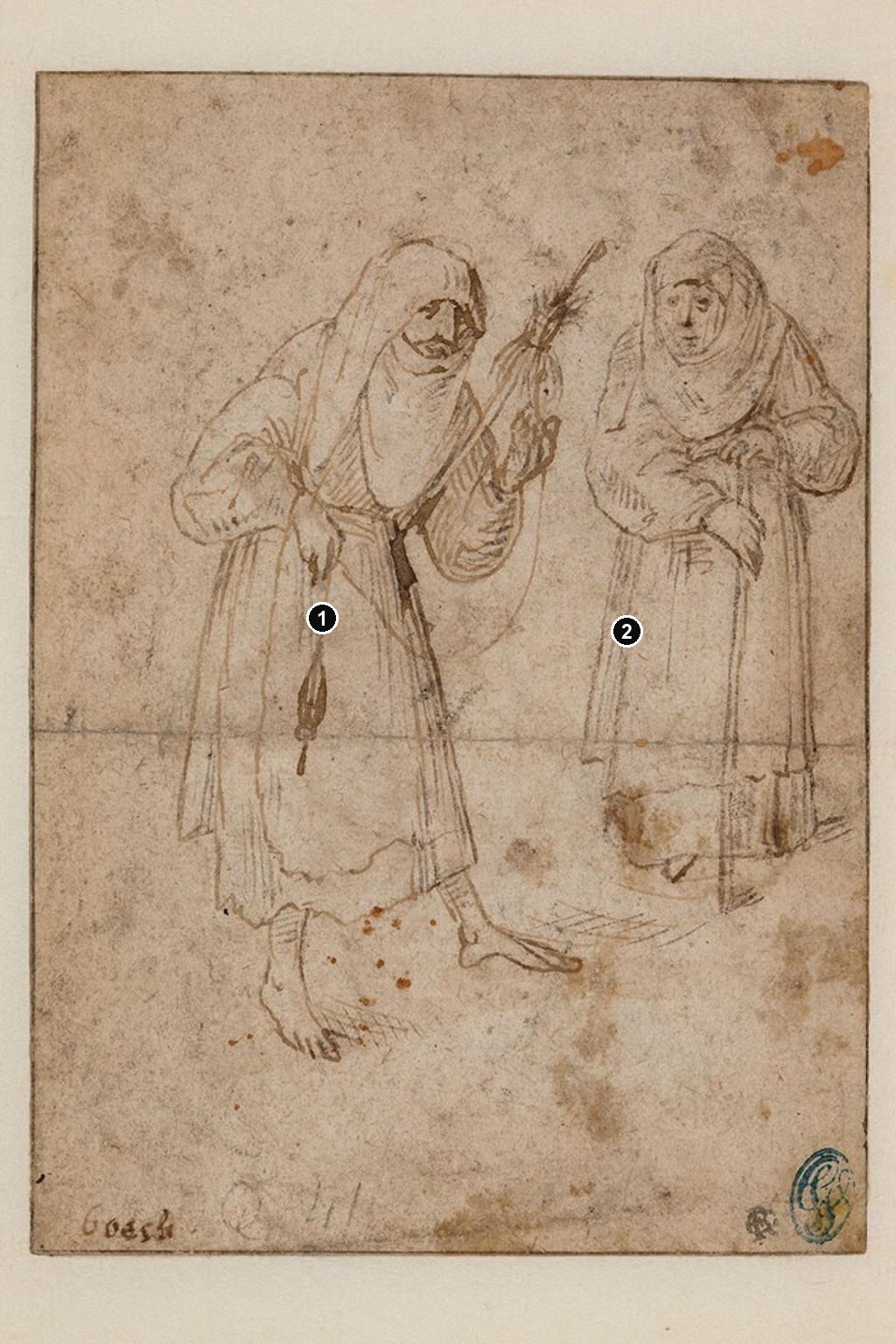
One woman holds a distaff beside her face; another bends over a stick. Their gestures are small, their clothes loose, and their bare feet and worn features receive close attention. The drawing has often been called Two Witches, but nothing in these surviving figures conclusively identifies witchcraft. In the Museum Boijmans Van Beuningen, the front of this little sheet is catalogued more descriptively as A Woman Spinning and an Old Woman. [1][2]
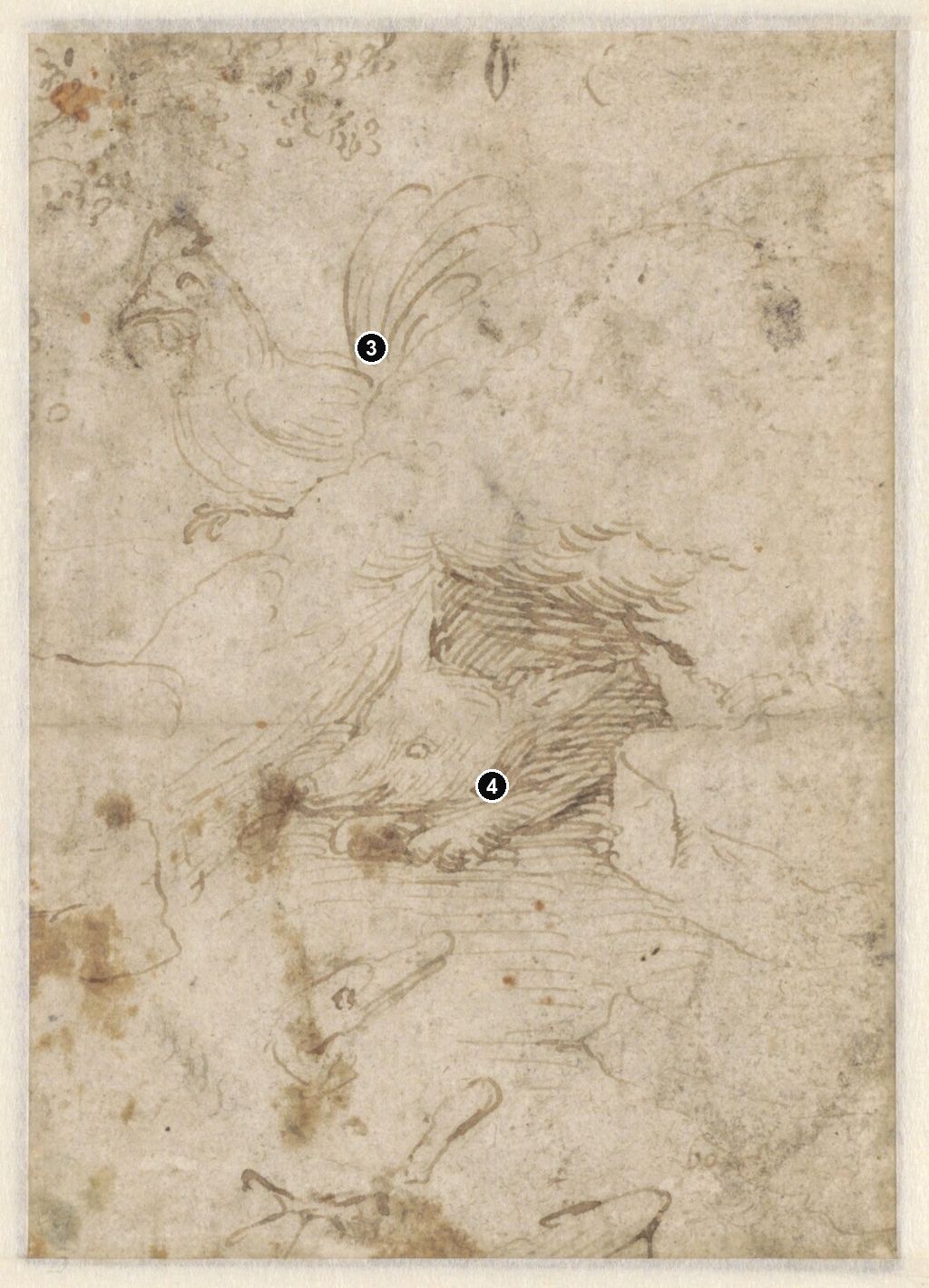
The object is drawn on both sides. Behind the women, on the reverse of the paper rather than within their scene, a fox waits in a hollow while a rooster approaches. That animal encounter belongs to the same physical fragment, inventory N 190, although it need not have been drawn at the same time. Together, the two faces reveal Bosch's interest in concentrated gestures, watchfulness and the expressive possibilities of a pen. They also show how much interpretation depends on recognizing what a fragment has lost. [2][3]
At a Glance
- ArtistHieronymus Bosch. [1]
- CollectionMuseum Boijmans Van Beuningen, Rotterdam. [1]
- InventoryN 190 recto and verso (PK). [1][3]
- Size120 × 85 mm. [1]
- MediumPen and brown and grey ink on the front; pen and brown ink on the reverse. [1][3]
- DatingMuseum estimates: about 1480–1490 for the women and 1500–1505 for the reverse; the precise chronology is disputed. [1][2][3]
Compare these works across Bosch’s career
These date ranges are estimates, not a documented year-by-year sequence. These works provide context for the article; none is highlighted as the object discussed here.
Saint Jerome at Prayer
Circa 1485–1495 [4]Crucifixion with a Donor
Circa 1490–1500 (BRCP) [4]Hermit Saints Triptych
Circa 1495–1505 [4]Saint Liberata Triptych
Circa 1495–1505 [4]The Hearing Forest and the Seeing Field
Circa 1500–1505 (Berlin exhibition) [5]The Haywain Triptych
1510–1516 (BRCP) [4]Contents
Annotated Details from A Woman Spinning and an Old Woman
These views show both faces of Rotterdam N190. The traditional title Two Witches is discussed in the article; it does not establish the women’s identity.
Front: the two women
Reverse: fox and rooster
Details from A WOMAN SPINNING AND AN OLD WOMAN
Compare the paired human figures with the animals drawn on the reverse.
Front: the two women
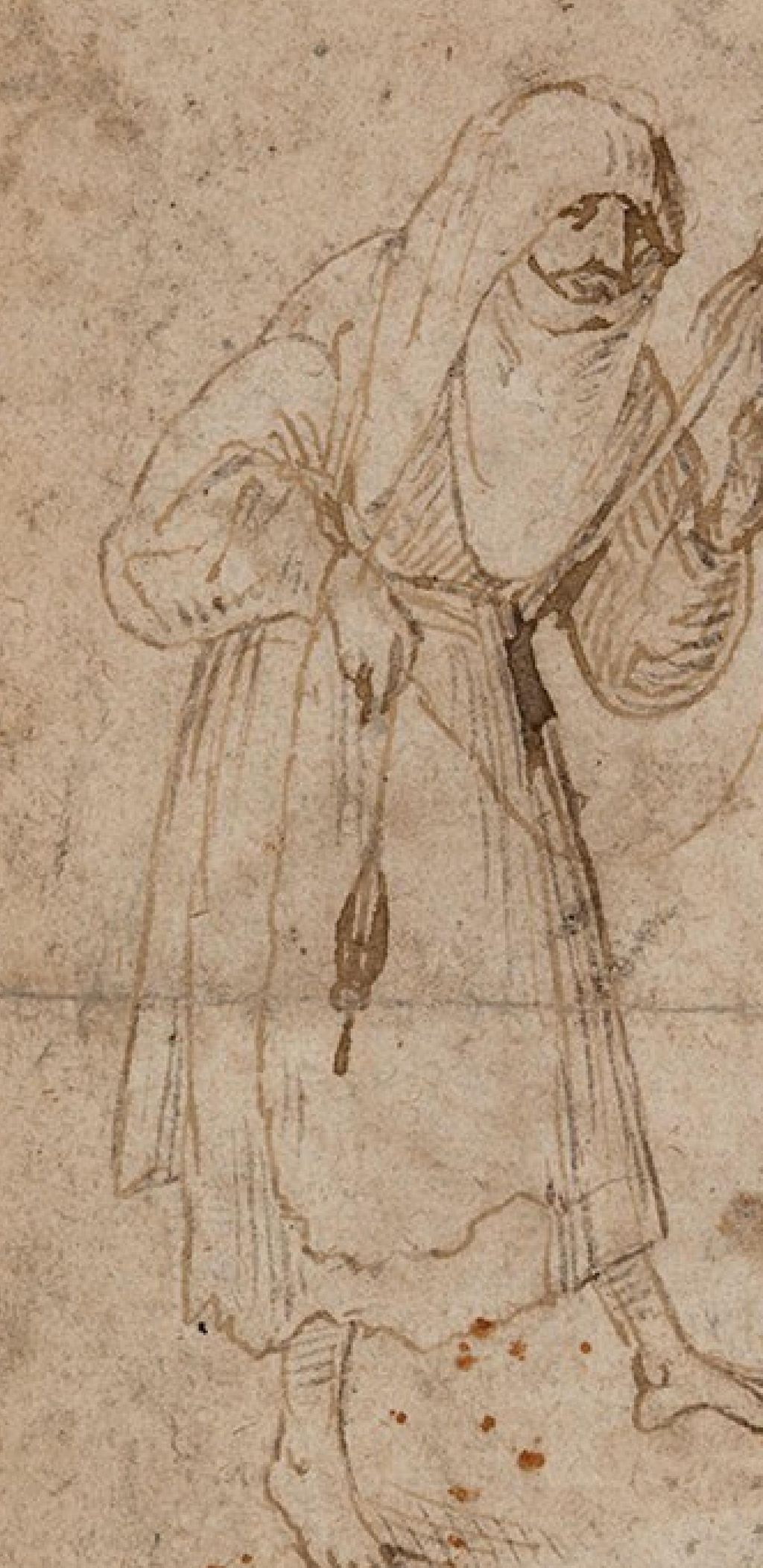
The spinning woman
The left figure bends forward, her raised hand near the thread. The folds of her clothing continue the long movement down towards her feet.
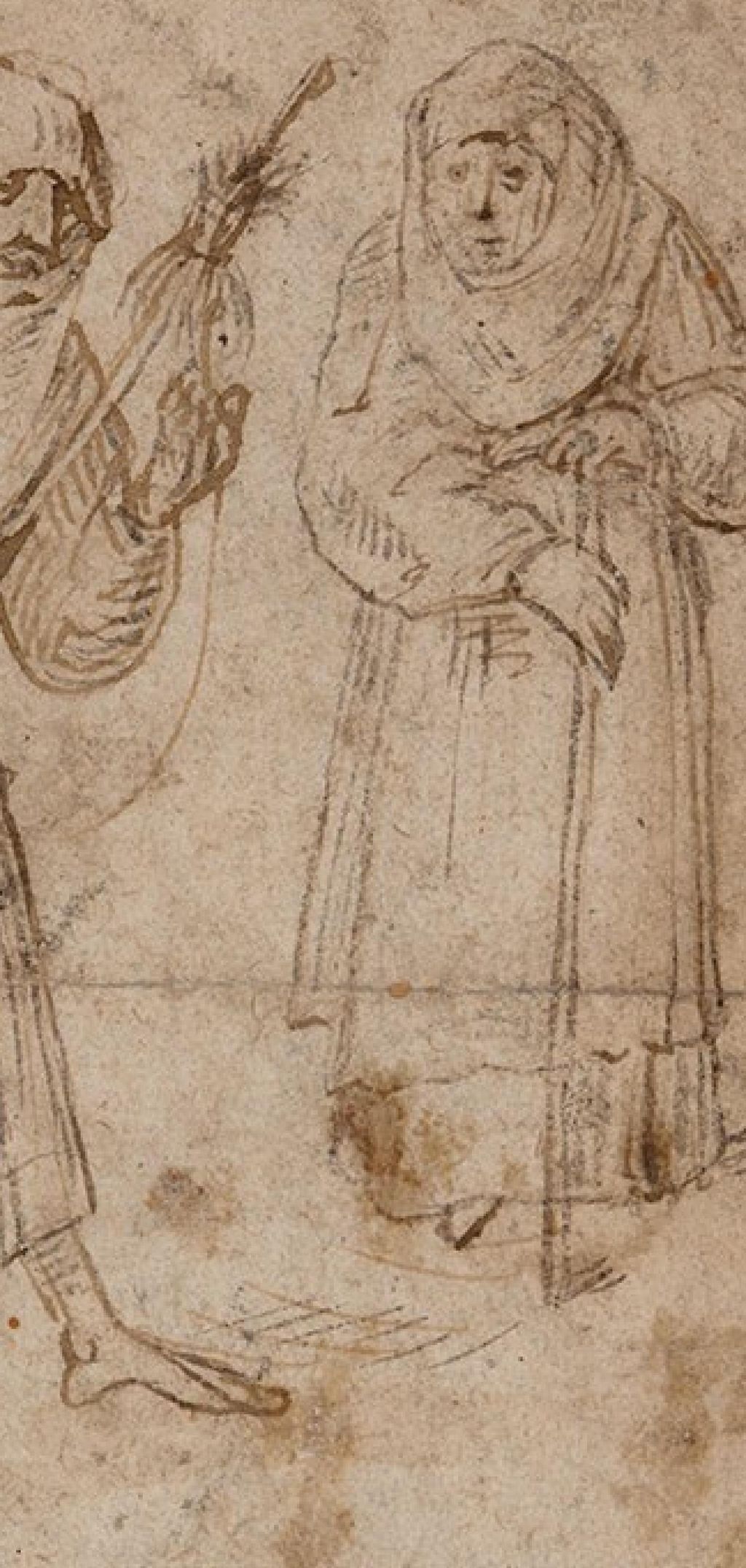
The older woman
The woman on the right holds her hands close to her body. Her covered head and downturned face differ from the more active pose beside her.
Reverse: fox and rooster
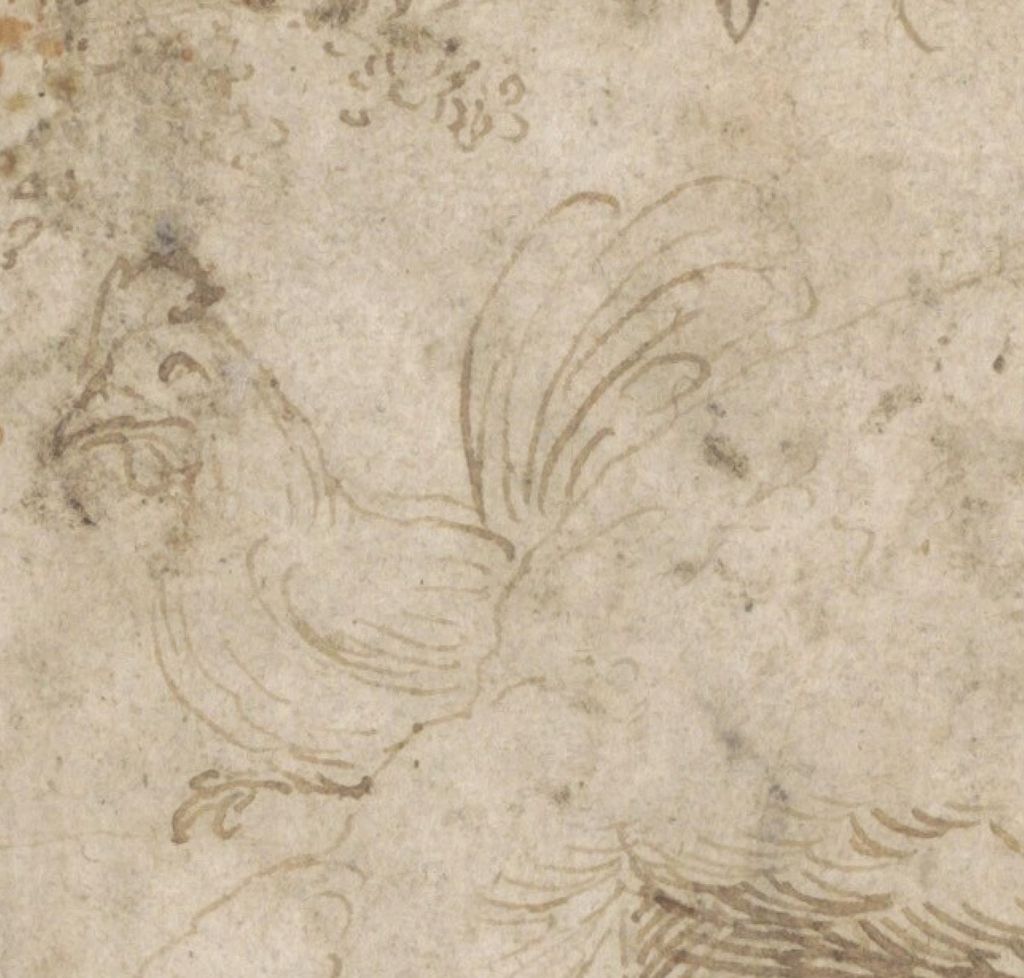
The rooster
The rooster lifts its head and spreads the long feathers of its tail. The faint lines require a slower look than the stronger marks on the front of the sheet.
The fox
The fox’s pointed face emerges from the dark hollow below the bird. Closely spaced strokes enclose the animal, making its concealment visible.
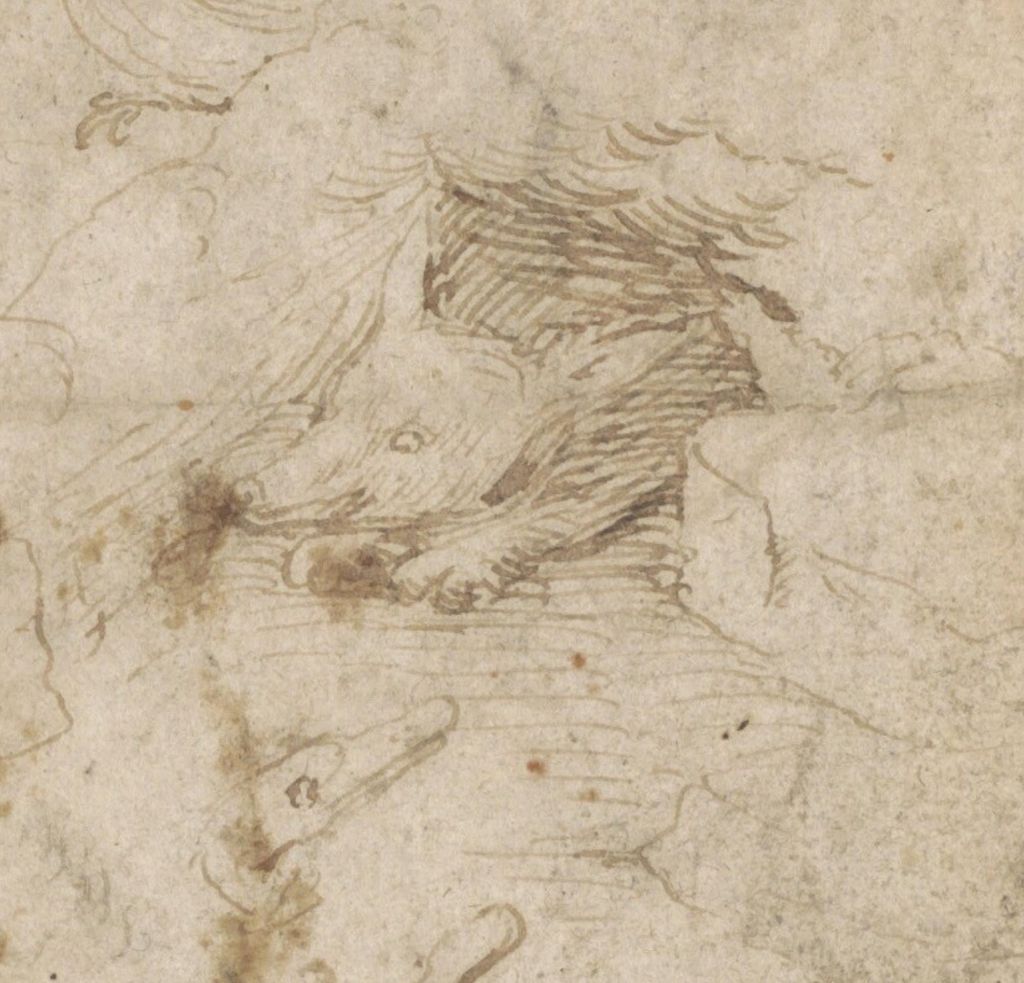
Image and detail crops: Wikimedia Commons source file and reverse source file (public domain reproduction).
Looking at the Two Figures
The woman on the left stands with her feet spread apart and her upper body tilted forward. Her right arm bends towards her waist, while her other hand lifts the distaff close to her shoulder. The exposed feet are drawn with more articulation than the largely concealed legs. Their separation gives the figure a definite stance beneath the long garment: she appears to occupy the ground rather than float within its folds. [2]
The second woman is more compact. Her forearms gather near the top of the stick, and the curve of her back brings her head forward. A veil encloses her face and merges with the larger shapes of the clothing. Compared with her companion's open stance and raised hand, she seems folded inwards. The difference gives the two figures separate rhythms even though Bosch places them close together and uses related clothing forms. [2]
Their positions do not explain their relationship. They might be participating in a larger scene, but its other figures and setting are gone. Neither woman makes an unmistakable gesture of greeting, accusation or exchange. Bosch provides enough particularity for us to distinguish their bodies, while the fragment withholds the action that might once have joined them. A convincing description should preserve that difference between expressive posture and an identifiable story. [2]
A Distaff and a Walking Stick
The distaff supplies a useful descriptive anchor. It holds the material associated with spinning, giving the left-hand woman a practical attribute. The museum title consequently refers to a woman spinning, while the BRCP catalogue describes her as holding a distaff. The object should not simply become a broom because the drawing has acquired a witch-related title. A new label cannot substitute one visible implement for another. [1][2]
The stick performs a different function in the composition. Its near-vertical line helps explain the second woman's bent posture and the position of her hands. The long clothing hides much of her anatomy, so support is communicated through this arrangement of arms, shoulders and shaft. Bosch makes physical dependence legible with very little setting. The drawing does not establish the woman's name, an illness or a particular social identity beyond what can reasonably be inferred from the figure itself. [2]
The attention to feet, hands and protruding faces also gives these apparently ordinary bodies a force familiar from Bosch's more fantastic inventions. Yet their force comes from recognizable human movement. The raised distaff, outward-pointing feet and huddled shoulders create interest without the addition of a monster. The sheet is valuable partly because it asks the viewer to notice how expressive an everyday object or a slight bodily inclination can become. [2]
Why the Title Two Witches Needs Qualification
The familiar title belongs to the drawing's interpretation, rather than to an inscription naming its subjects. The BRCP catalogue points out that the women do not perform the unusual actions seen in the separate Louvre sheet traditionally associated with witches. Here there is no visible flight, spell or magical ceremony. The surviving actions are holding a distaff and leaning on a stick. Since both sides have been cut down, the missing context cannot now supply a secure identification. [2]
That does not require us to imagine the picture as a straightforward, sympathetic record of two real individuals. The BRCP authors consider a morally charged treatment plausible within Bosch's imagery. Their argument concerns historical associations between outward appearance and character. Such associations must be examined as part of the image's possible reception; age, poverty or an unconventional face are not evidence that a person is wicked, and they cannot by themselves establish the subject of a drawing. [2]
Two Old Women therefore remains a useful alternative title, while the museum's A Woman Spinning and an Old Woman is still more specific about the visible attributes. Neither provides a recovered name for a lost scene. Keeping Two Witches as a qualified historical label allows the work to be found and discussed without treating the label as proof. It also prevents the Rotterdam fragment from being confused with the different figures and actions on the Louvre sheet. [1][2]
Brown and Grey Ink
The drawing was worked in more than one phase. The BRCP examination distinguishes two inks whose compositions have caused them to age differently. Brown lines established the women, while greyer strokes were added to strengthen contours and build shading. Their contrast is more evident now than it was likely to have been when the drawing was new. The appearance of two colours in a reproduction therefore includes the effects of time as well as the artist's decisions. [2]
This layered handling matters when following the clothes. Long outlines establish the fall of fabric, while shorter groups of strokes deepen selected folds. The cloth does not receive an even covering of hatching. Lighter areas remain open, and darker touches gather near bends and overlaps. Because the figures are small, a reinforced edge can substantially change how firmly an arm or shoulder separates from the surrounding garment. [2]
Two working phases do not, by themselves, identify two different artists or establish an interval of years. An artist can return to a figure within a short period, while different inks can later develop different appearances. The surviving lines give evidence of sequence, but a calendar date requires another kind of support. This distinction becomes especially useful when considering the disputed relationship between the women and the animal drawing on the back. [2]
How Early Is the Drawing?
The current museum record dates the women to about 1480–1490. In discussing that early proposal, the BRCP catalogue reports Fritz Koreny's comparison with the underdrawing of the Frankfurt Ecce Homo. The pose of the spinning woman and the treatment of feet offer points of resemblance. Peter van der Coelen also adopted the early dating. These are arguments from visual comparison rather than a date written on the sheet. [1][2]
The BRCP authors accept that the similarities are worth considering but question their ability to establish a narrow chronology. They point to comparable feet in the Paradise wing of the much later Haywain. A feature that appears in works from different periods cannot securely date a drawing on its own. Their catalogue therefore declines to place this sheet within a precise sequence of Bosch's drawings. [2]
Larry Silver's review of Koreny's catalogue offers another useful perspective. Silver considered the case for an early date for the Rotterdam women strong, while emphasizing the provisional state of Bosch chronology more broadly. The disagreement is therefore about how much confidence to place in comparative evidence, not about whether the paper bears a hidden date that one scholar has overlooked. The museum's estimate can be reported without turning it into a settled fact. [6]
Fox and Rooster on the Reverse
The back has a different visual centre. A rooster stands above and to the left of a dark hollow, its lifted head and spreading tail clearly outlined. The fox's pointed face emerges much lower, beneath the mass of closely spaced strokes that defines its shelter. Scattered bird remains add a consequence to the encounter. The scene contains more than two animals occupying adjacent spaces: one is exposed while the other is concealed. [2]
Bosch makes concealment visible through the unequal distribution of ink. The rooster has room around its contour, while dense hatching encloses the fox. Its head projects just far enough from the darkness to be recognized. The viewer can see the danger more readily than the approaching bird appears to do. The small scale does not prevent narrative tension; it concentrates that tension in the distance between an open stance and a waiting face. [2]
The museum dates this reverse to approximately 1500–1505, later than its estimate for the women. Those dates allow for the possibility that Bosch returned to the paper, but the stylistic chronology remains an interpretation. The physical certainty is that front and back belong to one fragment. The two scenes need not form a single allegory, and there is no secure basis for identifying either woman with the fox or rooster. [2][3]
A Motif Bosch Could Vary
The fox-and-bird encounter has close relatives elsewhere in Bosch's work. In The Hearing Forest and the Seeing Field, a rooster approaches the hollow of a tree occupied by a fox. In Saint Jerome at Prayer, a sleeping fox is associated with the remains of a bird. The BRCP catalogue also points out a reversal in Saint Christopher, where a dead fox hangs from a tree and living roosters appear nearby. [2]
These variations discourage a mechanical reading in which an animal always carries one fixed message. An encounter can be threatening, completed or reversed. What matters is the relationship between the creatures, the traces of previous action and the viewer's awareness of what may happen next. On the Rotterdam reverse, the crouching predator and exposed bird make that relationship particularly economical. The fragment preserves enough to suggest danger even though it no longer preserves the whole scene. [2]
What the Fragment Preserves
The support bears a fold, stains, later borders and collectors' marks, while abrupt edges on the reverse disclose the loss of surrounding drawing. These features are part of the object's history. They should not all be read as intentional marks within Bosch's scenes. The museum also records inscriptions containing versions of Bosch's name but lists no autograph signature. Attribution depends on the drawing and its scholarly assessment, rather than on treating the name inscriptions as authentication. [1][2]
The documented collection history passes through Giuseppe Vallardi, Eugène Rodrigues, Leo Baer and Franz Koenigs. The sheet was lent to Rotterdam in 1935–1940 and entered the foundation's loan collection through the 1940 purchase and presentation associated with D.G. van Beuningen. That history identifies successive custodians; it does not recover the original purpose of the larger drawing. What remains is a remarkably concentrated example of Bosch's draughtsmanship: two human figures whose action is incomplete, and an animal encounter whose danger is immediately legible. [1][2][3]
Artworks and related attributions
Browse paintings, drawings and related attributions. Records group triptychs, fragments and two-sided sheets where appropriate. Dates follow the cited museum records or catalogue headings and are generally estimates. Rows marked “2016 catalogue” report that publication’s attribution and collection information; these are dated opinions, rather than a claim that every work is an accepted autograph Bosch.
| Name | Date | Medium, attribution and collection |
|---|---|---|
| A Crossbowman | Second half of the sixteenth century | Oil on oak panel · Copy after Hieronymus Bosch · Museo Nacional del Prado, Madrid · P002695 Source 1. Source 2. |
| A Woman Spinning and an Old Woman | Museum estimates: about 1480–1490 for the women and 1500–1505 for the reverse; the precise chronology is disputed | Pen and brown and grey ink on the front; pen and brown ink on the reverse · Hieronymus Bosch · Museum Boijmans Van Beuningen, Rotterdam · N 190 recto and verso (PK) Source 1. Source 2. |
| Adoration of the Child in Cologne | Second half of the sixteenth century | Oil on oak panel · Imitator of Hieronymus Bosch, in the city collection record · Wallraf-Richartz-Museum & Fondation Corboud, Cologne · WRM 0474 Source 1. Source 2. |
| Adoration of the Magi in Philadelphia | Early sixteenth century in the museum record; around 1495–1520 in the BRCP catalogue | Oil on oak panel · Hieronymus Bosch in the museum record; workshop of Bosch in the 2016 BRCP catalogue · Philadelphia Museum of Art, John G. Johnson Collection, 1917 · 1321; museum object 103592 Source 1. Source 2. |
| Adoration of the Magi — New York | c.1470–1480 | 2016 catalogue: Bosch; oil on oak · Metropolitan Museum 13.26 2016 catalogue. |
| Adoration of the Magi — Prado triptych | c.1494 | Oil on oak; grisaille exterior · Bosch · Prado P002048 Object source. |
| Adoration of the Magi — three associated fragments | c.1515–1535 | 2016 catalogue: Follower of Bosch · Two Shepherds / Retinue in Philadelphia; associated Adoration in private collection in 2016 2016 catalogue. |
| Ascent of the Blessed — Venice | c.1505–1515 | Oil on panel · Bosch · Gallerie dell’Accademia; Visions of the Hereafter Object source. |
| Battle of the Birds and Mammals | Not specified in catalogue heading | 2016 catalogue: Bosch; pen and brown ink · Berlin KdZ 14715 2016 catalogue. |
| Beggars and Musicians | Around 1530–1540 | Ink and wash on paper · Unknown follower of Hieronymus Bosch · Albertina, Vienna · 7798 Source 1. Source 2. |
| Christ Carrying the Cross Drawing | Around 1470 in the museum catalogue | Black chalk or charcoal, pen and brush in brown ink, white corrections · Anonymous, workshop of Rogier van der Weyden · Museum Boijmans Van Beuningen, Rotterdam · N 81 recto and verso (PK) Source 1. Source 2. |
| Christ Carrying the Cross in Vienna | Around 1490–1510 in the current KHM record and BRCP catalogue | Oil on oak, painted on both sides · Hieronymus Bosch; possible workshop involvement in the Passion side discussed by the BRCP · Kunsthistorisches Museum, Vienna · Gemäldegalerie, GG 6429 Source 1. Source 2. |
| Christ Carrying the Cross — El Escorial | c.1495–1505 | 2016 catalogue: Bosch; oil on oak · Patrimonio Nacional 10014739 2016 catalogue. |
| Christ Carrying the Cross — Ghent | c.1510–1516 (museum) | Oil on panel · Bosch in museum listing; authorship disputed · MSK Ghent 1902-H Object source. |
| Christ Mocked — London | c.1510 | Oil on wood · Bosch · National Gallery NG4744 Object source. |
| Concert in the Egg, After Hieronymus Bosch | Around 1561; third quarter of the sixteenth century | Oil on canvas · Anonymous, after Hieronymus Bosch · Palais des Beaux-Arts, Lille · P 816 Source 1. Source 2. |
| Conjurer / Comical Concert — Louvre drawing | Not specified in catalogue heading | 2016 catalogue: Bosch (recto), follower (concert verso) · Pen and brown ink · Louvre INV 19197 2016 catalogue. |
| Conjurer / Cross-bearing and beggars — Liège sheet | Not specified in catalogue heading | 2016 catalogue: Bosch (verso), follower (recto) · Pen and brown ink · Album d’Arenberg 534 2016 catalogue. |
| Crowning with Thorns — El Escorial | c.1530–1540 | 2016 catalogue: Follower of Bosch; oil on oak · Patrimonio Nacional 10014743 2016 catalogue. |
| Crucifixion with a Donor | Circa 1495–1505; Circa 1490–1500 | Oil on oak panel · Hieronymus Bosch · Royal Museums of Fine Arts of Belgium, Brussels · 6639 Source 1. Source 2. |
| Death and the Miser Drawing | Not securely established; probably made after the painting | Pen and brush, dark ink and white highlights on prepared paper · Workshop of Hieronymus Bosch in the BRCP catalogue; alternatives recorded by the Louvre · Musée du Louvre, Department of Prints and Drawings, Paris · RF 6947, Recto Source 1. Source 2. |
| Death and the Miser — Washington | c.1485/1490 (NGA) | Oil on panel · Bosch · National Gallery of Art 1952.5.33 Object source. |
| Ecce Homo Triptych — Boston | c.1495–1500; wings c.1500/1503 | 2016 catalogue: Workshop of Bosch; oil on oak · Museum of Fine Arts Boston; several production phases 2016 catalogue. |
| Ecce Homo — Frankfurt | c.1490 | Mixed technique on oak · Bosch · Städel 1577 Object source. |
| Fall of the Damned — Venice | c.1505–1515 | 2016 catalogue: Bosch; oil on panel · Visions of the Hereafter · Venice 2016 catalogue. |
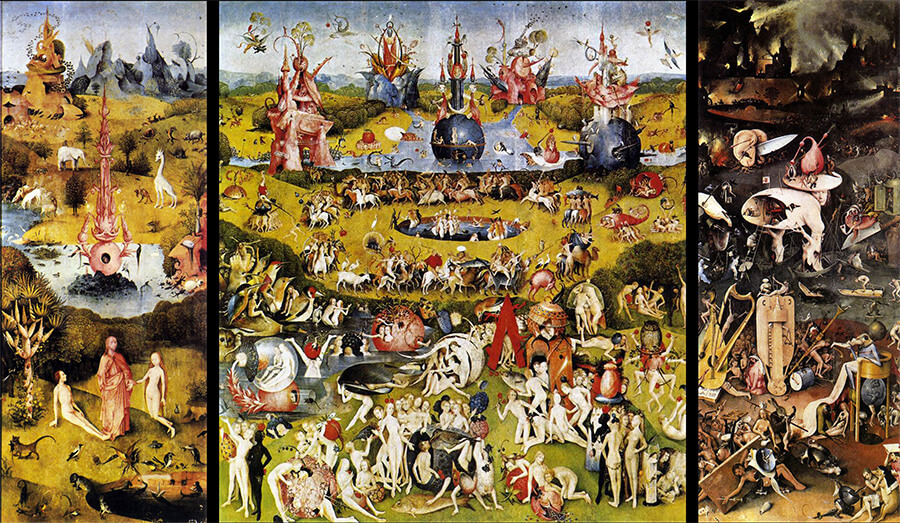
| Garden of Earthly Delights | 1490–1500 (Prado) | Oil on oak; grisaille exterior · Bosch · Prado; triptych Object source. |
| Gluttony and Lust / Allegory of Intemperance — Yale fragment | c.1500–1510 (group dating) | 2016 catalogue: Bosch; oil on oak · Yale 1959.15.22; fragment associated with Ship of Fools 2016 catalogue. |
| Group of Ten Spectators, a Follower of Bosch | Around 1510–1540 in the current museum record | Pen and two brown inks on paper, with a brown framing line · Follower of Hieronymus Bosch in the Morgan record; Bosch in the BRCP catalogue · Morgan Library & Museum, New York · I, 112 Source 1. Source 2. |
| Head of an Old Woman | About 1500 | Oil on panel · Attributed to Jacob Cornelisz. van Oostsanen · Museum Boijmans Van Beuningen, Rotterdam · 2439 (OK) Source 1. Source 2. |
| Hell and the Flood — Rotterdam panels | Around 1515 in the museum records; around 1510–1520 in the BRCP catalogue | Oil on oak panels · Jheronimus Bosch in the museum records; workshop of Bosch in the BRCP catalogue · Museum Boijmans Van Beuningen, Rotterdam Source 1. Source 2. |
| Hermit Saints Triptych | Circa 1495–1505 | Oil on oak panels · Hieronymus Bosch · Gallerie dell’Accademia, Venice · 2044 Source 1. Source 2. |
| Infernal Landscape | Not specified in catalogue heading | 2016 catalogue: Bosch; pen and brown ink, red accent · Private collection in 2016 2016 catalogue. |
| Infernal Scene with Anvil / Monster Studies | Not specified in catalogue heading | 2016 catalogue: Bosch; attribution debated in entry · Pen and brown ink · Berlin KdZ 548 2016 catalogue. |
| Infernal Scene with Tree-Man / Standing Man | Not specified in catalogue heading | 2016 catalogue: Workshop of Bosch; pen and brown ink · Dresden C 1875; historical reverse title includes a proposed prophet 2016 catalogue. |
| Job Triptych — Bruges | c.1510–1520 | 2016 catalogue: Workshop of Bosch; oil on oak · Groeningemuseum / Hoeke loan in 2016 2016 catalogue. |
| Last Judgement — Bruges triptych | c.1495–1505 | 2016 catalogue: Bosch; oil on oak · Groeningemuseum 2016 catalogue. |
| Last Judgement — Munich fragment | c.1530–1540 | 2016 catalogue: Follower of Bosch; oil on oak · Alte Pinakothek 5752 2016 catalogue. |
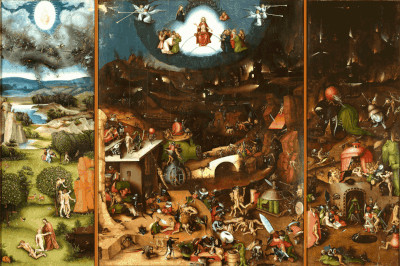
| Last Judgement — Vienna triptych | c.1500–1505 (BRCP 2016) | Oil on oak · Bosch and workshop (BRCP 2016) · Academy of Fine Arts Vienna 2016 catalogue. |
| Man in a Basket and Comic Figures | Around 1500–1515 in the museum record | Pen and brown ink on paper; the reverse is catalogued as iron-gall ink · Hieronymus Bosch in the current Albertina record; attribution has been debated · Albertina, Vienna · 7797 recto and verso Source 1. Source 2. |
| Man Seen from Behind | About 1550–1569; About 1565–1570 | Traces of black chalk, pen and brush in light brown ink · Anonymous, circle of Pieter Bruegel the Elder · Museum Boijmans Van Beuningen, Rotterdam Source 1. Source 2. |
| Mary and John at the Foot of the Cross | About 1440 | Brush in grey and black · Unknown, possibly Netherlandish · Kupferstich-Kabinett, Staatliche Kunstsammlungen Dresden · C 815 Source 1. Source 2. |
| Model Sheet with ‘Witches’ | Disputed; proposals depend on the attribution | Pen and brown ink; the BRCP also records underlying black chalk · Hieronymus Bosch; follower attributions also recorded · Musée du Louvre, Département des Arts graphiques, Paris · INV 19721 recto Source 1. Source 2. |
| Peasant and Three Bust-Length Figures | 1401–1500 | Brown pen over a black preliminary drawing · Attributed to the Master of the Drapery Studies; Bosch circle also recorded · Kupferstichkabinett, Staatliche Museen zu Berlin · KdZ 777 Source 1. Source 2. |
| River to Hell — Venice | c.1505–1515 | 2016 catalogue: Bosch; oil on panel · Visions of the Hereafter · Venice 2016 catalogue. |
| Saint Anthony and a Concert in an Egg | Around 1510–1525 in the museum’s 2016–17 exhibition texts | Pen in light and dark brown inks · Workshop of Hieronymus Bosch; underlying monsters: Bosch (BRCP), possibly Bosch (exhibition text) · Kupferstichkabinett, Staatliche Museen zu Berlin · KdZ 711 recto and verso Source 1. Source 2. |
| Saint Christopher Carrying the Christ Child | c.1500; 1490–1505 in restoration material | Oil on panel · Bosch · Boijmans St 26 Object source. |
| Saint James and Hermogenes | About 1551–1575 in the KIK-IRPA catalogue | Oil on wood, painted on both sides · Anonymous follower of Hieronymus Bosch · Musée des Beaux-Arts, Valenciennes · P.46.1.44; older number 176 Source 1. Source 2. |
| Saint Jerome at Prayer | Circa 1485–1495 | Oil on oak panel · Hieronymus Bosch · Museum of Fine Arts, Ghent · 1908-H Source 1. Source 2. |
| Saint John on Patmos / Passion Scenes | c.1495–1505; estimates vary | Oil on oak · Bosch · Gemäldegalerie Berlin 1647A Object source. |
| Saint John the Baptist in Meditation | Late 15th century; c.1485–1510 (Prado exhibition) | Oil on panel · Bosch · Lázaro Galdiano 8155 Object source. |
| Saint Liberata Triptych | Circa 1495–1505 | Oil on oak panels · Hieronymus Bosch · Gallerie dell’Accademia, Venice · 2045 Source 1. Source 2. |
| Seven Deadly Sins and the Four Last Things | 1505–1510 (Prado) | Oil on poplar · Bosch (Prado); workshop/follower disputed · Prado Object source. |
| Ship of Fools — Louvre painting | 1475–1500 (record); c.1505–1515 (exhibition) | Oil on oak · Bosch · Louvre RF 2218; fragment Object source. |
| Ship of Fools — Louvre workshop drawing | Not specified in catalogue heading | 2016 catalogue: Workshop of Bosch · Pen, brush, grey-brown ink and white highlights on prepared paper · Louvre RF 3714 2016 catalogue. |
| Studies of Monsters | About 1530–1550, according to the current Ashmolean record | Pen and brown ink on laid paper, both faces · Anonymous follower of Hieronymus Bosch · Ashmolean Museum, University of Oxford · WA1863.155 Source 1. Source 2. |
| Studies of Saint Anthony and Monsters | No execution date specified in the current Louvre records | Pen and brown ink on paper · Bosch listed; reverse questioned by Louvre; BRCP accepts both faces · Musée du Louvre, Département des Arts graphiques, Paris · INV 20871 recto and verso Source 1. Source 2. |
| Temptation of Saint Anthony — Kansas City fragment | c.1500–1510 | 2016 catalogue: Bosch; oil on oak · Nelson-Atkins 35–22 2016 catalogue. |
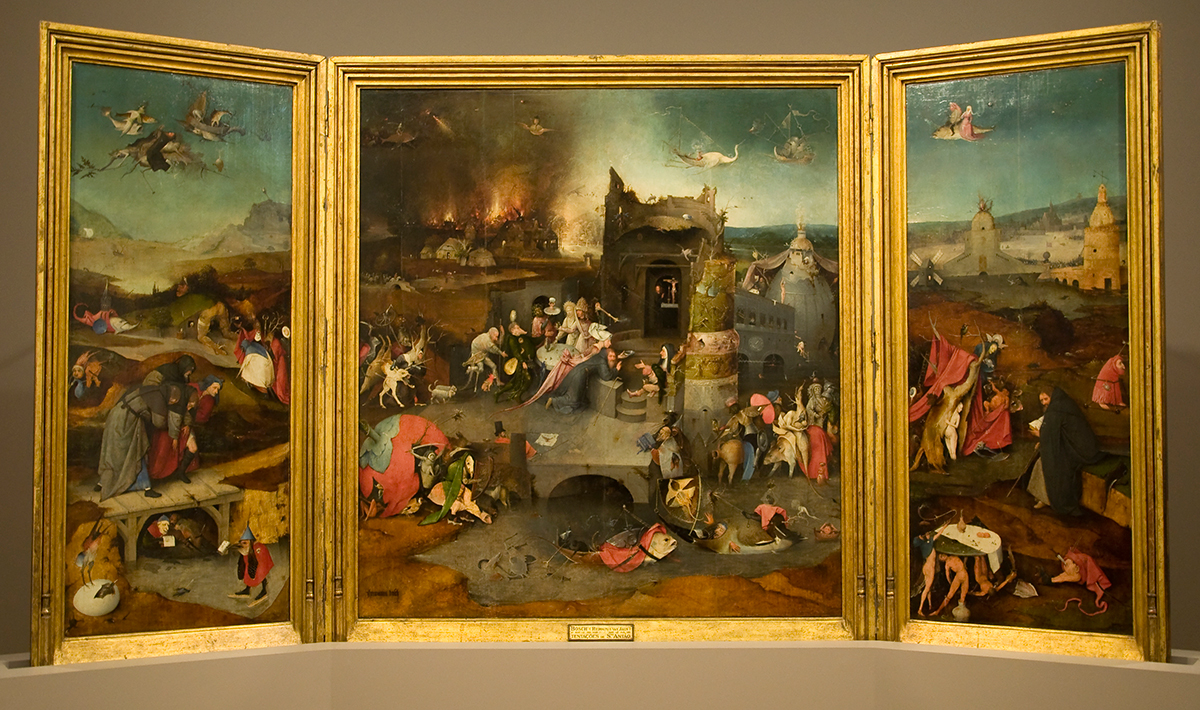
| Temptation of Saint Anthony — Lisbon triptych | c.1500 | Oil on oak · Bosch · Museu Nacional de Arte Antiga 1498 Pint Museum. |
| Temptation of Saint Anthony — Prado panel | c.1530–1540 | 2016 catalogue: Follower of Bosch (2016 opinion); oil on oak · Prado P002049 2016 catalogue. |
| Terrestrial Paradise | Approximately 1505–1515 | Oil on oak panel · Hieronymus Bosch · Gallerie dell'Accademia, Venice Source 1. Source 2. |
| The Burning Ship Drawing | 1500–1520 | Pen and iron gall ink on paper · Attributed to Hieronymus Bosch · Academy of Fine Arts Vienna, Graphic Collection · HZ-2554; numbered 2554 in the BRCP catalogue Source 1. Source 2. |
| The Comical Barber Scene | About 1550–1580, according to the British Museum | Pen and brown ink, grey and brown wash, over black chalk · Anonymous follower, after Hieronymus Bosch · British Museum, Department of Prints and Drawings, London · 1854,0628.46 Source 1. Source 2. |
| The Conjuror, After Hieronymus Bosch | Probably after 1525; around 1530–1540 in the BRCP technical report | Oil on oak panel · Anonymous follower of Hieronymus Bosch · Musée Ducastel-Vera, Saint-Germain-en-Laye · 872.1.87 Source 1. Source 2. |
| The Cure of Folly / Extraction of the Stone of Madness | 1501–1505 (Prado) | Oil on oak · Bosch (Prado); workshop/follower disputed · Prado P002056 Object source. |
| The Entombment Drawing | About 1505–1515, current museum record | Brush and black and grey ink, with grey wash, over black chalk · Workshop of Hieronymus Bosch; drawn by the Master of the Prado Haywain Triptych; Hieronymus Bosch, argued by the BRCP in 2016 · British Museum, Department of Prints and Drawings, London · 1952,0405.9 Source 1. Source 2. |
| The Gathering of the Birds | Not specified in catalogue heading | 2016 catalogue: Bosch; pen and brown ink · Berlin KdZ 13136 2016 catalogue. |
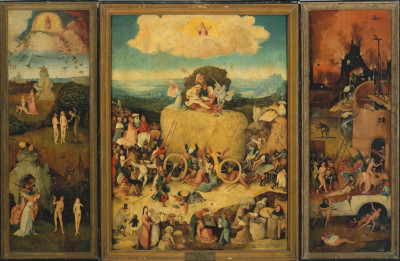
| The Haywain — Prado triptych | 1510–1516 (BRCP 2016) | Oil on oak · Bosch (BRCP 2016) · Prado; separate Escorial version exists 2016 catalogue. |
| The Hearing Forest and the Seeing Field | Circa 1500–1505 | Pen and brown ink on paper · Hieronymus Bosch; reverse: Bosch and workshop · Kupferstichkabinett, Staatliche Museen zu Berlin · KdZ 549, front and reverse Source 1. Source 2. |
| The Owl’s Nest — Rotterdam | Not specified in catalogue heading | 2016 catalogue: Bosch; pen and brown ink · Boijmans N 175 2016 catalogue. |
| The Passion Triptych in Valencia | Workshop of Bosch, about 1510–1520; Follower of Bosch; centre about 1530–1540, wings about 1540–1550 | Oil and gold on oak panels · Workshop of Bosch, about 1510–1520; Follower of Bosch; centre about 1530–1540, wings about 1540–1550 · Museu de Belles Arts de València Source 1. Source 2. |
| The Pedlar / Wayfarer — Rotterdam | c.1500 (museum) | Oil on panel · Bosch · Boijmans 1079 (OK); rejoined exterior Object source. |
| The Tree-Man — Vienna drawing | c.1505 | Pen and brown ink · Bosch · Albertina, Vienna Object source. |
| The Wedding at Cana, After Hieronymus Bosch | Approximately 1560 in the current museum record | Oil on panel, 93 cm high × 72 cm wide · Anonymous, after Hieronymus Bosch · Museum Boijmans Van Beuningen, Rotterdam, St 25 Source 1. Source 2. |
| Two Fantastical Creatures — Berlin KdZ 550 | Around 1505–1515 in the museum’s 2016 exhibition text | Pen in brown ink on reddish prepared laid paper · Hieronymus Bosch · Kupferstichkabinett, Staatliche Museen zu Berlin · KdZ 550, recto and verso Source 1. Source 2. |
| Two Figures Wearing Mitres | About 1480 | Oil on panel · Anonymous (Boijmans); Bosch circle (RKD) · Museum Boijmans Van Beuningen, Rotterdam · 1177 (OK) Source 1. Source 2. |
| Two Men and the Temptation of Eve | About 1505–1515 in the Prado’s 2016 exhibition guide | Pen and grey-brown ink on paper · Hieronymus Bosch in the 2016 catalogues discussed here · Private collection, as recorded in 2016 Source 1. Source 2. |
| Two Men Fighting | Not specified in the current Louvre record | Pen and brown ink · In the manner of Hieronymus Bosch · Musée du Louvre, Département des Arts graphiques, Paris · INV 20660 recto; formerly NIII 8896 and MA 8400 Source 1. Source 2. |
| Two Men — Berlin KdZ 5210 | Not specified in catalogue heading | 2016 catalogue: Bosch questioned · Pen, brush, ink, chalk and white highlights · Berlin KdZ 5210; historical title Two Oriental Men 2016 catalogue. |
| Two Monsters — Berlin KdZ 547 | Approximately 1500–1510 in Berlin's 2016 exhibition catalogue; an estimated range | Pen and brown ink on paper · Hieronymus Bosch · Kupferstichkabinett, Staatliche Museen zu Berlin · KdZ 547, drawn on both sides Source 1. Source 2. |
Frequently Asked Questions
Discussion
Compare the women’s practical attributes and the watchful animal encounter on the reverse.
Reader Insights
How do the distaff and stick give the women different postures?
Which details of the bare feet make the figures seem to stand on real ground?
How does knowing that the drawing is a fragment affect your willingness to invent a story around the women?
Join the Conversation
Share a detail, comparison or question about Two Old Women, Traditionally Called Two Witches below.
References
- Museum Boijmans Van Beuningen, A Woman Spinning and an Old Woman, N 190 recto (PK), current collection record. View source.
- Matthijs Ilsink and colleagues, Hieronymus Bosch, Painter and Draughtsman: Catalogue Raisonné (2016), catalogue 40, pp. 512–515. View source.
- Museum Boijmans Van Beuningen, Fox and Rooster, N 190 verso (PK), current collection record. View source.
- BRCP Catalogue Raisonné (2016), object dates in catalogues 1, 2, 8, 15 and 20; catalogue 20 object metadata only for the Haywain comparison. View source
- Staatliche Museen zu Berlin, 2016 exhibition wall texts, p. 3: approximate date of KdZ 549. View source
- Larry Silver, review of Fritz Koreny, Hieronymus Bosch. Die Zeichnungen, HNA Newsletter 29, no. 2 (November 2012), pp. 19–20. View source.
- Splash image, A woman holding a distaff and an older woman leaning on a stick, N190recto, Museum Boijmans Van Beuningen. View source.