by Tom Gurney
Tom Gurney BSc (Hons) is an art history expert with over 20 years experience
Published on June 19, 2020 / Updated on October 17, 2026
Email: tomgurney1@gmail.com / Phone: +44 7429 011000
Looking at The Foxes
At first glance, The Foxes is a weave of russet, red, green and blue planes. Then two heads come into view. One fox looks down from near the upper centre, with tall ears and a narrow pale muzzle. Another turns across the lower right, its eye and pointed nose emerging from colour that almost becomes part of the surrounding ground. Their bodies overlap so closely that it takes time to decide which shape belongs to which animal. Franz Marc painted this work in 1913, when he was bringing his animal subjects into a more fractured, interlocking kind of space. [1] [2]
The German title is Die Füchse. The oil painting measures 88.3 × 66.4 cm according to the 2022 Christie’s catalogue. It is the two-fox picture formerly in Düsseldorf’s municipal collection and restituted to the heirs of Kurt and Else Grawi in 2021. The route title “The Fox” can sound singular, but this is a painting of two animals. Marc’s earlier Blue-black Fox is another work entirely; their similar English names should not collapse them into one image or history. [1] [3]
Finding two foxes
The upper fox’s triangular ears point towards the top of the canvas. A long muzzle descends into a white and yellow patch, dark at the nose. Beneath it, pale legs and reddish planes draw the eye down. The lower fox is easier to miss. Its head turns towards the right across the lower half, marked by a dark eye and a tapering snout above a pale diagonal. Once the second face is found, the reds around both animals start to act as bodies and as connecting bands. The picture keeps switching between a pair of creatures and a near-abstract pattern. [1]
Marc does not put a clean outline around each fox. Deep red and orange zones are cut by dark diagonals; white and yellow flashes separate one head from another. Green and blue passages move through the edges, especially towards the lower part of the canvas. The colours do not merely fill a pre-drawn pair of silhouettes. They create the animals and make the boundary between them uncertain. Looking at a small reproduction can flatten this to “two red foxes.” Looking for the exact placement of ears, eyes and muzzles reveals how deliberately Marc lets recognition arrive in stages. [1]
There is tenderness in their proximity, but the painting does not give us a fixed story of what the foxes are doing. One appears higher, one lower; their heads bend in different directions. Their forms touch and overlap within a compressed vertical format. The viewer may see a resting pair, protection, or simply shared space. Those are responses to the visible arrangement, not facts the canvas establishes about their relationship. What we can say securely is that Marc made two animals hard to separate visually without making either disappear. [1]
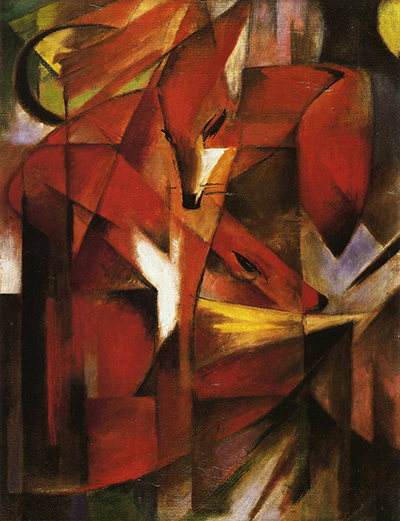
Franz Marc, The Foxes. Two foxes are woven into a field of red and orange planes.
Watch: Franz Marc
Explore Marc’s blue horses, the Blue Rider circle and the move towards abstraction in English-language videos.
Franz Marc, Blue Horses and Der Blaue Reiter
An English-language introduction to Marc’s blue horses, animals, spirituality and the Blue Rider.
Watch on YouTubeAnimal and environment joined together
The spaces around the foxes are as active as the bodies. Dark verticals and slanting planes make a kind of forest or shelter without mapping a specific place. A curve at upper left meets sharp red facets; green opens in small patches against the darker background. Marc gave the animals no comfortable stage set. He fitted them into a world with the same broken rhythms as their own forms. This helps explain why the picture can appear both intimate and unsettled. [2]
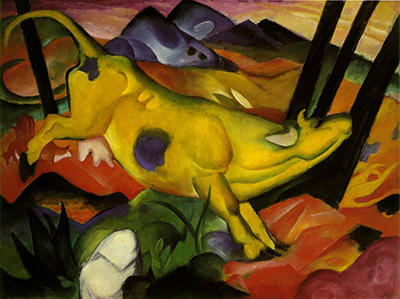
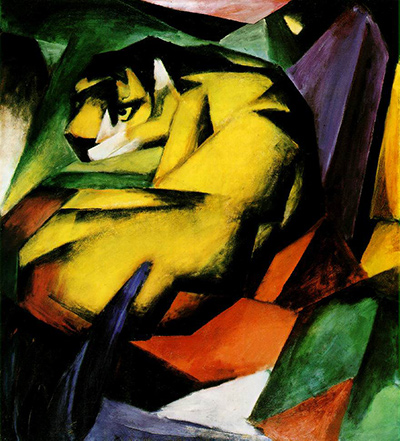
This way of making a setting differs from the broad coloured landscape beneath Yellow Cow and the nearly square enclosure around Tiger. In the cow, body and landscape move in a lively horizontal sweep. The tiger’s angular habitat holds a single animal in a poised crouch. In The Foxes, two bodies and the surrounding planes exchange shapes across a narrow vertical canvas. Marc’s formal experiment responds to the number, posture and closeness of these animals. [4] [5] [1]
Marc had asked in notes written around 1911–12 how the world might appear to a horse, deer, dog or other animal. He challenged the habit of treating an animal as a subject placed in scenery built for a human viewer. That question can help us look at the foxes’ shared space. It does not prove that the painting is a literal picture of fox vision. It suggests why joining creature and environment could matter to an artist who wanted to move beyond the conventional landscape with an animal inserted into it. [6]
A work of 1913
By 1913 Marc was pushing beyond the rounded contours and broad colour fields of many 1911 pictures. Christie’s describes this painting as part of a more dynamic visual language shaped by his encounters with contemporary French and Italian experiments. It is useful to see those connections in the painting itself: overlapping colour planes and diagonal cuts make both foxes seem to occupy several directions at once. But the work remains a specific study of two close animals, not a generic example of a borrowed style. [2] [1]
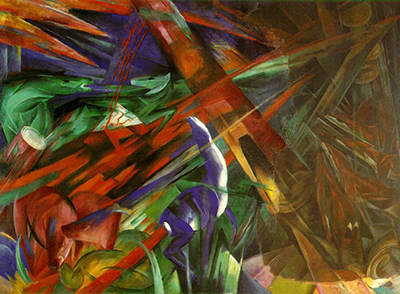
The same year brought works in which animals and surroundings were placed under far greater strain. The Fate of the Animals breaks a forest into crossing lines and gathers vulnerable creatures within it. The Foxes is quieter in subject, yet its joined forms show a related drive to make the living body part of a larger pictorial order. This comparison should not turn the foxes into an advance warning of war. Both pictures were made in 1913, before the conflict began, and each has its own mood and structure. [7] [1]
The Grawi family and the painting’s route
The work’s later history is unusually consequential. Christie’s provenance begins with Maria Marc after the artist’s death in 1916, then places the painting with Galerie Der Sturm in Berlin, Franz Kluxen, Max Leon Flemming and, from 1928, Kurt and Else Grawi. These were not just changes of owner on a list: they put the picture in the hands of a family whose circumstances were transformed by Nazi persecution. Kurt Grawi was arrested and imprisoned at Sachsenhausen in 1938. The family escaped Germany for Chile the next year. [1] [8]
The path by which The Foxes left the Grawis was not fully documented. A Kunstpalast research project summarized by Proveana found evidence that Kurt Grawi still possessed it in 1936, then traced the painting to New York by 1940, associated with Ernest Simon and dealer Karl Nierendorf. The project could not reconstruct every connection between those people or the circumstances of the Grawis’ loss. It reported evidence of the work’s presence outside Nazi Germany by 1940 and of William and Charlotte Dieterle acquiring it around that time. The gaps matter; a neat, confident story of a specific sale would say more than the surviving documentation supports. [8]
The Dieterles later offered the work for sale in 1961. Christie’s catalogue records Helmut Horten acquiring it by private treaty before that sale and gifting it to Düsseldorf’s municipal collection in 1962. It remained associated with the city for decades. In 2021 Düsseldorf restituted the painting to the heirs of Kurt and Else Grawi. Christie’s then sold it in London on 1 March 2022 for £42,654,500. That public sale is documented; the present private owner or current display location should not be inferred from the former Düsseldorf collection record or from an older online image caption. [1] [3] [9]
Restitution changes how a museum’s old label should be read. A digital reproduction may still carry “Kunstpalast” or “Düsseldorf” in inherited metadata because that was the painting’s location when the file was made. The work no longer belongs to that collection. The 2021 decision and 2022 sale are later, documented events. Accurate description has to follow the object’s history forward, especially where an outdated location could obscure the Grawi family’s claim. [3] [1]
Returning to the image
The ownership history deserves space, but it need not eclipse the painting. Look again for the fox high in the canvas, its ears rising through red planes, and for the lower fox whose eye and muzzle emerge from the overlapping forms. The shapes can make them seem joined without making them identical. Marc’s colours and diagonals slow the moment of recognition, then reward a second look. The Foxes remains a study of two creatures sharing one densely made world, and a painting whose documented twentieth-century and recent history asks for the same care with evidence as its visual details do. [1] [8]
Artwork Directory
This source-checked selection contains 192 identified works and print designs from the current Franz Marc research set. It is a curated selection, not a complete catalogue raisonné. Some works link to their article here; others link to a collection record. Unresolved identifications are omitted.
Discussion
Two foxes are difficult to separate from the fractured forest around them.
Reader Insights
Observation
Which line or colour first helps you find the second fox?
Comparison
How are these paired animals arranged differently from the three Large Red Horses?
Interpretation
How does the work’s later restitution history change the questions you bring to the image?
Join the Conversation
Which detail changed the way you saw this work? Share a close observation or a comparison with another Marc picture.
References
- Christie’s, The Foxes, 2022 sale catalogue. View source.
- Christie’s, 2022 painting account. View source.
- Christie’s restitution account. View source.
- Guggenheim, Yellow Cow. View source.
- Lenbachhaus, Tiger. View source.
- Franz Marc, Briefe, Aufzeichnungen und Aphorismen, notes on animal perception. View source.
- Kunstmuseum Basel, Animal Destinies dossier. View source.
- Proveana, Kunstpalast provenance research summary. View source.
- Christie’s sale result. View source.
- Related artwork image, Yellow Cow: Photograph by Dr. Alexey Yakovlev; resized without crop or colour change, CC BY-SA 2.0.
- Splash image: Franz Marc, The Foxes, 1913. Google Art Project file on Wikimedia Commons, public-domain faithful reproduction.