by Tom Gurney
Tom Gurney BSc (Hons) is an art history expert with over 20 years experience
Published on June 19, 2020 / Updated on November 4, 2026
Email: tomgurney1@gmail.com / Phone: +44 7429 011000
Flames rise around a mast while small figures climb through the rigging. Below them, a curved hull crosses the page, carrying people whose movements offer little suggestion of escape. A much larger hooded head emerges near its centre, and a broad clothed body extends beneath the vessel to two widely separated feet. The drawing combines a ship and a human form so closely that neither can be understood entirely on its own.
The Academy of Fine Arts Vienna holds this sheet as The Hell Ship, inventory HZ-2554. Its current record attributes it to Hieronymus Bosch and dates it to 1500–1520.[1] The Bosch Research and Conservation Project’s 2016 catalogue calls it Burning Ship and argues for Bosch’s own hand, against an attribution to an assistant.[2] The familiar image belongs to a real, identifiable drawing, but its title and authorship need more care than the older name Ship of Fools in Flames might suggest.
At a Glance
- Current museum titleThe Hell Ship / Das Höllenschiff
- Alternative titleBurning Ship
- Current museum attributionAttributed to Hieronymus Bosch
- Museum date1500–1520
- Current museum mediumPen and iron gall ink on paper
- Current museum dimensions17.7 × 15.4 cm
- CollectionAcademy of Fine Arts Vienna, Graphic Collection
- InventoryHZ-2554; numbered 2554 in the BRCP catalogue
- AcquisitionFranz Jäger bequest, 1839, in the current museum record
Compare these works across Bosch’s career
These date ranges are estimates, not a documented year-by-year sequence. These works provide context for the article; none is highlighted as the object discussed here.
Saint Jerome at Prayer
Circa 1485–1495 [3]Crucifixion with a Donor
Circa 1490–1500 (BRCP) [3]Hermit Saints Triptych
Circa 1495–1505 [3]Saint Liberata Triptych
Circa 1495–1505 [3]The Hearing Forest and the Seeing Field
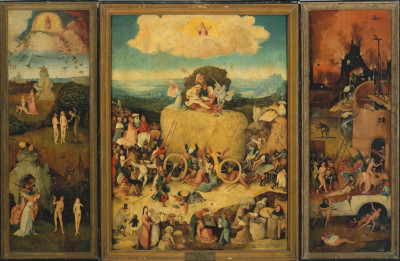
Circa 1500–1505 (Berlin exhibition) [4]The Haywain Triptych
1510–1516 (BRCP) [3]Contents
Annotated Details from The Burning Ship Drawing
The Vienna Academy drawing combines a crowded boat with a walking form below it. These details follow the two parts of the invention.
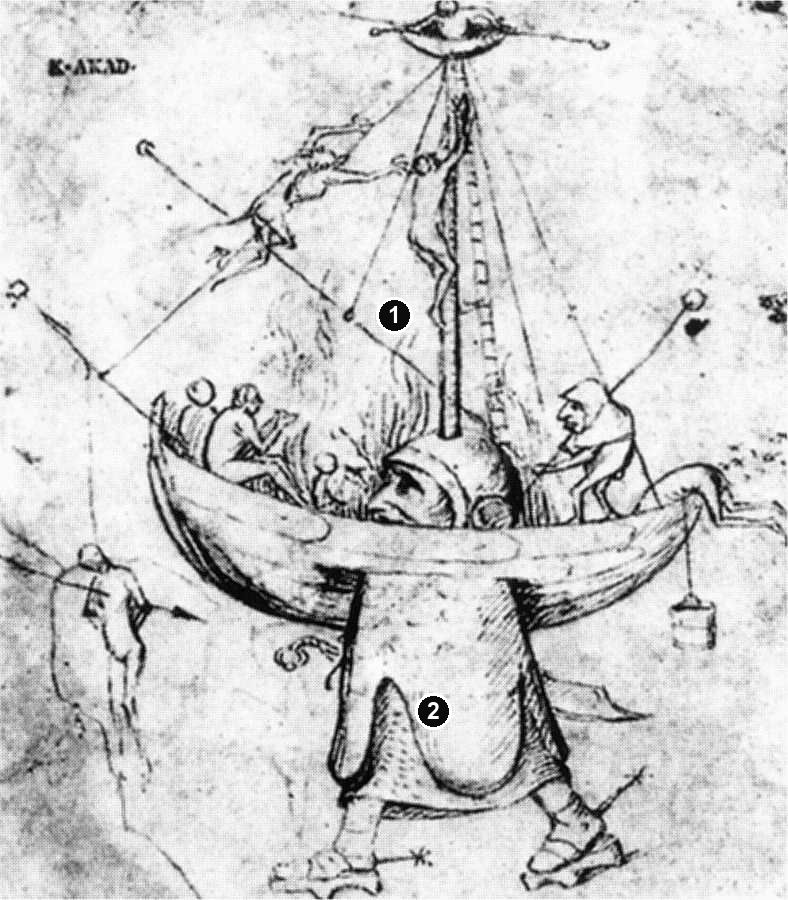
Details from THE BURNING SHIP DRAWING
The focused views retain the available native resolution.
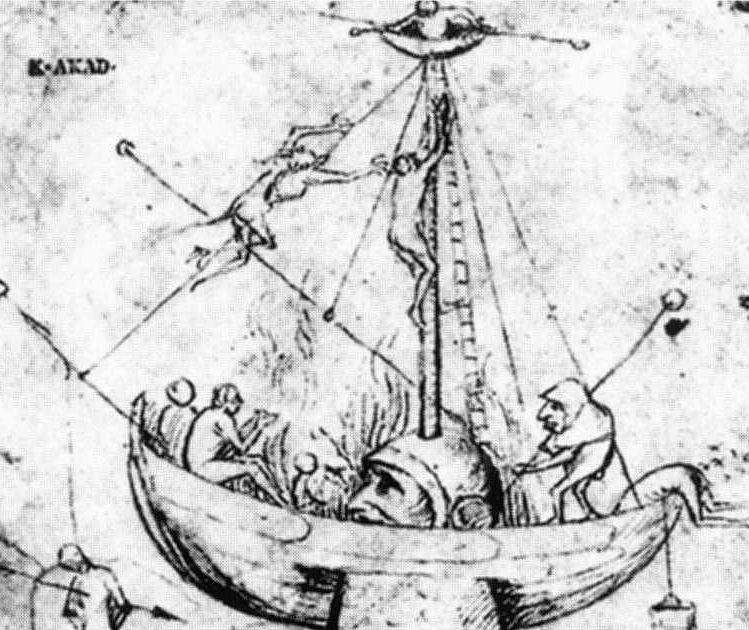
Passengers and the mast
Small figures gather around the tall mast. Thin lines cross between the passengers, the sides of the boat and the narrow structure above.
The walking form below
Beneath the hull, a long cloth-like form ends above two walking legs. The combination joins the boat to a body moving across the ground.
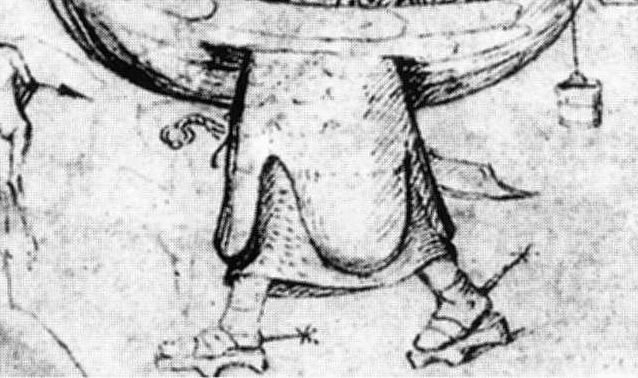
Image and detail crops: Wikimedia Commons source 1 (public domain reproductions).
A Vessel Joined to a Body
The hull makes the strongest horizontal shape. Its sides sweep upwards at both ends, enclosing a busy interior above a comparatively quiet band of planking. Short dark strokes gather along the lower curve. These marks make the vessel feel rounded and substantial, even though much of its upper structure consists of fine, lightly drawn lines.
Beneath that curve, the large garment hangs almost vertically before broadening around the knees. Its bottom edge is uneven, and the legs emerge at different angles. The right foot points outwards on a thick raised sole; the other turns across the lower part of the page. Long projecting spurs and the heavy footwear give these feet their own improbable equipment.
A narrow arm and small hand appear at the left side of the hanging clothing. The scale is unsettling: the hand is easily overlooked beside the boat, yet it belongs to a body large enough to support the whole arrangement. Above, the oversized face turns towards the left, its eye and nose described more firmly than many of the tiny passengers. The contrasts of scale make the ship seem both an enclosure and an extension of a person.
The figure does not occupy a convincingly described shore or seabed. There is no continuous landscape to settle how it stands in relation to the vessel or the water. That absence allows the hybrid to retain its visual instability. A plausible plank, boot or fold of cloth repeatedly leads into a combination that cannot be made physically coherent.
Fire, Mast and Rigging
The mast rises from close to the large head towards a small platform near the top edge. A ladder-like sequence of short marks runs beside it. Long diagonal ropes spread across the paper, connecting this central upright with the ends of the ship and with figures suspended above it. The resulting structure gives the upper half a delicate framework.
Bodies interrupt that framework. One figure stretches diagonally at the upper left, reaching towards the rigging while the legs extend behind. Another hangs close to the mast, where limbs and ropes almost become part of the same pattern. At the top, a small person occupies the platform with the arms spread along its rim. Each body finds a different, precarious relationship with the ship’s equipment.
Fire rises in uneven tongues around the mast and among the occupants. Some flames are little more than wavering lines; others are reinforced into darker passages. The open paper between them gives the effect air without describing a smoky sky. The fire is legible through its movement and placement rather than through colour or a large area of shading.
The rigging’s taut diagonals contrast with those wavering forms. One system suggests the means of controlling a vessel; the other suggests a force escaping control. The figures caught between them make the contrast active. Climbing, reaching and hanging become gestures of exposure rather than signs of a successfully managed voyage.
People at the Edges
At the left end of the hull, two seated figures turn towards the ship’s interior. One raises a hand near the face. Their rounded heads and compact bodies provide a moment of relative stillness beneath the figure stretching overhead. A much smaller person appears nearer the flames, where the scale makes the danger feel still more disproportionate.
On the right, a hooded figure leans forward with both arms extended. The inclined head and bent posture suggest effort, but do not explain what control the figure has over the vessel. A long shaft rises behind the body. The drawing supplies equipment and exertion without offering the reassurance of a clearly effective task.
A further person bends over the end of the ship, with the legs projecting beyond it. Small birds trail outwards behind this figure. A bucket hangs below on a separate thin line, introducing an ordinary object into the surrounding impossibility. Its simple cylindrical form is especially recognisable beside the more difficult combinations of limbs, hull and rigging.
At the far left, another body hangs outside the vessel. Its pale outline is much slighter than the large figure below the ship. Looking between the two makes scale itself part of the invention: the drawing contains human-sized passengers, tiny exposed bodies and an enormous clothed support, all joined within one compact image.
Birds in Another Vienna Drawing
The bird motif gives the sheet a specific connection with another drawing. In the Albertina’s Man in a Basket and Comic Figures, birds fly from the exposed backside of a man confined within a large basket. A more abbreviated version appears on that sheet’s reverse. The Albertina’s catalogue discusses both faces as developments of a related comic invention.[5]
The BRCP compares the birds in the Burning Ship particularly with those on the basket drawing’s reverse. It also identifies a related motif in the Hell wing of the Garden of Earthly Delights.[2] These connections reach across different settings: a basket, a monstrous vessel and a painted infernal world. Reuse changes the surrounding action while preserving a distinctive bodily absurdity.
The connection does not establish a fixed sequence. The Burning Ship need not be a preparatory study for either surviving work, and the repeated birds do not prove that every figure shares one precise meaning. The useful comparison concerns how a recognisable invention can be compressed, expanded and placed within another setting. It offers evidence of a visual repertoire without recovering an undocumented commission.
Bosch or an Assistant?
The BRCP’s attribution argument rests on more than the strange subject. Its entry compares the rendering of birds, tapered feet and arms with other drawings it accepts as Bosch’s. It also relates the shod feet, spurs and raised soles to those in the Infernal Landscape. The authors regard the energetic invention as consistent with Bosch, despite this sheet’s smaller ambition.[2]
That conclusion explicitly disagrees with Fritz Koreny’s assistant attribution. The Academy’s current wording, attributed to Bosch, preserves qualification rather than declaring an undisputed autograph.[1][2] The article’s artist name should be read in that light. Similar motifs can support a connection, while the judgement about the person who drew them remains a matter of comparison.
The museum’s date range also remains broad. It extends from Bosch’s final years into the period after his death in 1516. It cannot be read as proof that he personally made the drawing at its latest possible date. Nor does the lively appearance of the lines provide an independent year of execution. A rapid-looking image can still resist precise dating.
What the Material Records Tell Us
The current Academy record identifies pen and iron gall ink and measures the sheet at 177 × 154 mm. The BRCP describes brush and grey-brown ink, giving 175 × 154 mm.[1][2] Those descriptions should remain attached to their sources. The differences do not identify a second drawing, since the photographs show the same composition, stamp and physical marks.
The paper bears a crowned-star watermark. Both records compare it with Briquet 6116.[1][2] A watermark offers evidence about the support, but a comparison with a published type does not produce an exact date for the drawn image. Here it belongs beside the stylistic and collecting evidence, rather than replacing them.
Condition affects the visible surface too. The BRCP records stains, small dark spatters, a repaired branching tear at the lower left and white retouching on two stains towards the right.[2] Not every dark spot belongs to a monster or flame, and not every pale patch represents a deliberate highlight. The drawing’s changing physical surface must be distinguished from its invented forms.
A Hell Ship with a Collecting History
On the reverse, the museum records a pencil inscription naming Peter Breughel as draughtsman. It is an old attribution, rather than a signature proving Bruegel’s authorship. The collection stamp at the upper left records another stage of the object’s history.[1] Neither should be confused with a name supplied by the person who made the image.
The Academy now records the sheet as part of Franz Jäger’s bequest in 1839. The BRCP gives an earlier donation date of 1837.[1][2] The published records therefore differ on acquisition as well as on medium and height. Without further documentation, those dates should not be converted into a newly invented sequence of gift, transfer and registration.
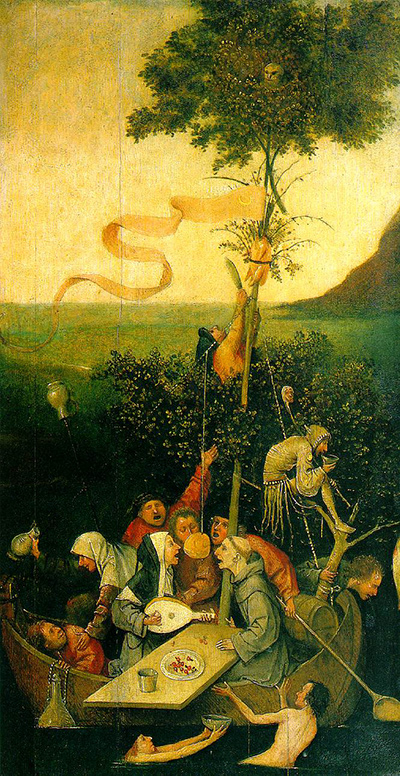
The Hell Ship also remains distinct from the Louvre’s Ship of Fools painting. A shared vessel does not make the drawing a sketch for that panel. Here the flames, exposed climbers and enormous hybrid body create a different structure. Its force lies in how quickly familiar things become unstable: a ship acquires legs, rigging catches bodies, and a suspended bucket remains calmly ordinary amid the disorder.
Artworks and related attributions
Browse paintings, drawings and related attributions. Records group triptychs, fragments and two-sided sheets where appropriate. Dates follow the cited museum records or catalogue headings and are generally estimates. Rows marked “2016 catalogue” report that publication’s attribution and collection information; these are dated opinions, rather than a claim that every work is an accepted autograph Bosch.
| Name | Date | Medium, attribution and collection |
|---|---|---|
| A Crossbowman | Second half of the sixteenth century | Oil on oak panel · Copy after Hieronymus Bosch · Museo Nacional del Prado, Madrid · P002695 Source 1. Source 2. |
| A Woman Spinning and an Old Woman | Museum estimates: about 1480–1490 for the women and 1500–1505 for the reverse; the precise chronology is disputed | Pen and brown and grey ink on the front; pen and brown ink on the reverse · Hieronymus Bosch · Museum Boijmans Van Beuningen, Rotterdam · N 190 recto and verso (PK) Source 1. Source 2. |
| Adoration of the Child in Cologne | Second half of the sixteenth century | Oil on oak panel · Imitator of Hieronymus Bosch, in the city collection record · Wallraf-Richartz-Museum & Fondation Corboud, Cologne · WRM 0474 Source 1. Source 2. |
| Adoration of the Magi in Philadelphia | Early sixteenth century in the museum record; around 1495–1520 in the BRCP catalogue | Oil on oak panel · Hieronymus Bosch in the museum record; workshop of Bosch in the 2016 BRCP catalogue · Philadelphia Museum of Art, John G. Johnson Collection, 1917 · 1321; museum object 103592 Source 1. Source 2. |
| Adoration of the Magi — New York | c.1470–1480 | 2016 catalogue: Bosch; oil on oak · Metropolitan Museum 13.26 2016 catalogue. |
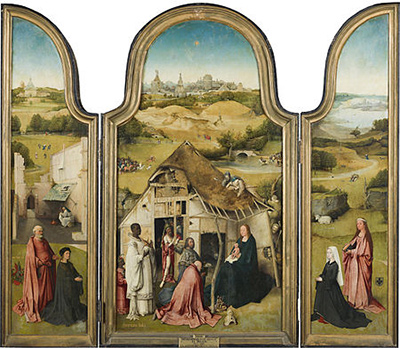
| Adoration of the Magi — Prado triptych | c.1494 | Oil on oak; grisaille exterior · Bosch · Prado P002048 Object source. |
| Adoration of the Magi — three associated fragments | c.1515–1535 | 2016 catalogue: Follower of Bosch · Two Shepherds / Retinue in Philadelphia; associated Adoration in private collection in 2016 2016 catalogue. |
| Ascent of the Blessed — Venice | c.1505–1515 | Oil on panel · Bosch · Gallerie dell’Accademia; Visions of the Hereafter Object source. |
| Battle of the Birds and Mammals | Not specified in catalogue heading | 2016 catalogue: Bosch; pen and brown ink · Berlin KdZ 14715 2016 catalogue. |
| Beggars and Musicians | Around 1530–1540 | Ink and wash on paper · Unknown follower of Hieronymus Bosch · Albertina, Vienna · 7798 Source 1. Source 2. |
| Christ Carrying the Cross Drawing | Around 1470 in the museum catalogue | Black chalk or charcoal, pen and brush in brown ink, white corrections · Anonymous, workshop of Rogier van der Weyden · Museum Boijmans Van Beuningen, Rotterdam · N 81 recto and verso (PK) Source 1. Source 2. |
| Christ Carrying the Cross in Vienna | Around 1490–1510 in the current KHM record and BRCP catalogue | Oil on oak, painted on both sides · Hieronymus Bosch; possible workshop involvement in the Passion side discussed by the BRCP · Kunsthistorisches Museum, Vienna · Gemäldegalerie, GG 6429 Source 1. Source 2. |
| Christ Carrying the Cross — El Escorial | c.1495–1505 | 2016 catalogue: Bosch; oil on oak · Patrimonio Nacional 10014739 2016 catalogue. |
| Christ Carrying the Cross — Ghent | c.1510–1516 (museum) | Oil on panel · Bosch in museum listing; authorship disputed · MSK Ghent 1902-H Object source. |
| Christ Mocked — London | c.1510 | Oil on wood · Bosch · National Gallery NG4744 Object source. |
| Concert in the Egg, After Hieronymus Bosch | Around 1561; third quarter of the sixteenth century | Oil on canvas · Anonymous, after Hieronymus Bosch · Palais des Beaux-Arts, Lille · P 816 Source 1. Source 2. |
| Conjurer / Comical Concert — Louvre drawing | Not specified in catalogue heading | 2016 catalogue: Bosch (recto), follower (concert verso) · Pen and brown ink · Louvre INV 19197 2016 catalogue. |
| Conjurer / Cross-bearing and beggars — Liège sheet | Not specified in catalogue heading | 2016 catalogue: Bosch (verso), follower (recto) · Pen and brown ink · Album d’Arenberg 534 2016 catalogue. |
| Crowning with Thorns — El Escorial | c.1530–1540 | 2016 catalogue: Follower of Bosch; oil on oak · Patrimonio Nacional 10014743 2016 catalogue. |
| Crucifixion with a Donor | Circa 1495–1505; Circa 1490–1500 | Oil on oak panel · Hieronymus Bosch · Royal Museums of Fine Arts of Belgium, Brussels · 6639 Source 1. Source 2. |
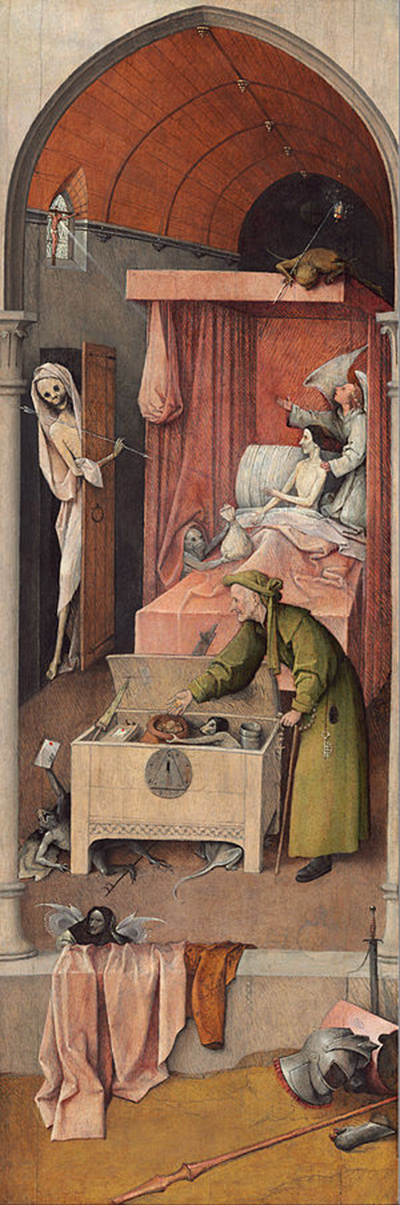
| Death and the Miser Drawing | Not securely established; probably made after the painting | Pen and brush, dark ink and white highlights on prepared paper · Workshop of Hieronymus Bosch in the BRCP catalogue; alternatives recorded by the Louvre · Musée du Louvre, Department of Prints and Drawings, Paris · RF 6947, Recto Source 1. Source 2. |
| Death and the Miser — Washington | c.1485/1490 (NGA) | Oil on panel · Bosch · National Gallery of Art 1952.5.33 Object source. |
| Ecce Homo Triptych — Boston | c.1495–1500; wings c.1500/1503 | 2016 catalogue: Workshop of Bosch; oil on oak · Museum of Fine Arts Boston; several production phases 2016 catalogue. |
| Ecce Homo — Frankfurt | c.1490 | Mixed technique on oak · Bosch · Städel 1577 Object source. |
| Fall of the Damned — Venice | c.1505–1515 | 2016 catalogue: Bosch; oil on panel · Visions of the Hereafter · Venice 2016 catalogue. |
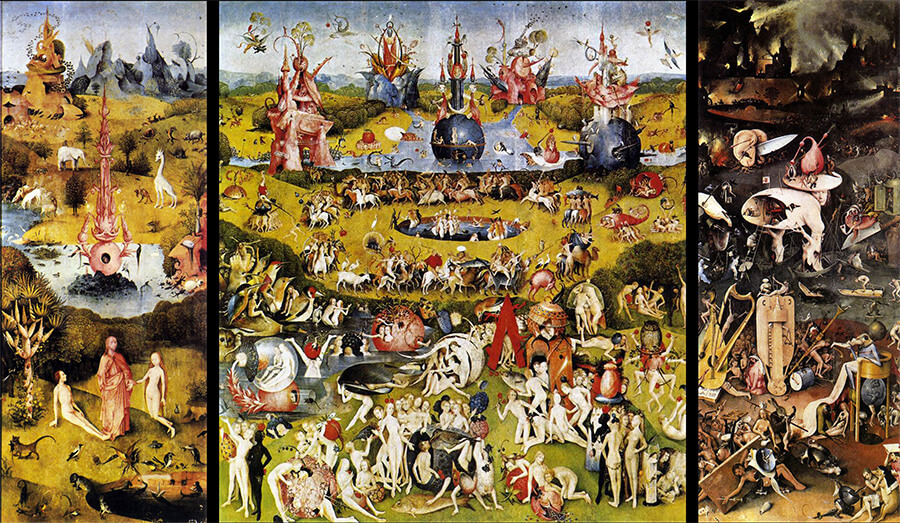
| Garden of Earthly Delights | 1490–1500 (Prado) | Oil on oak; grisaille exterior · Bosch · Prado; triptych Object source. |
| Gluttony and Lust / Allegory of Intemperance — Yale fragment | c.1500–1510 (group dating) | 2016 catalogue: Bosch; oil on oak · Yale 1959.15.22; fragment associated with Ship of Fools 2016 catalogue. |
| Group of Ten Spectators, a Follower of Bosch | Around 1510–1540 in the current museum record | Pen and two brown inks on paper, with a brown framing line · Follower of Hieronymus Bosch in the Morgan record; Bosch in the BRCP catalogue · Morgan Library & Museum, New York · I, 112 Source 1. Source 2. |
| Head of an Old Woman | About 1500 | Oil on panel · Attributed to Jacob Cornelisz. van Oostsanen · Museum Boijmans Van Beuningen, Rotterdam · 2439 (OK) Source 1. Source 2. |
| Hell and the Flood — Rotterdam panels | Around 1515 in the museum records; around 1510–1520 in the BRCP catalogue | Oil on oak panels · Jheronimus Bosch in the museum records; workshop of Bosch in the BRCP catalogue · Museum Boijmans Van Beuningen, Rotterdam Source 1. Source 2. |
| Hermit Saints Triptych | Circa 1495–1505 | Oil on oak panels · Hieronymus Bosch · Gallerie dell’Accademia, Venice · 2044 Source 1. Source 2. |
| Infernal Landscape | Not specified in catalogue heading | 2016 catalogue: Bosch; pen and brown ink, red accent · Private collection in 2016 2016 catalogue. |
| Infernal Scene with Anvil / Monster Studies | Not specified in catalogue heading | 2016 catalogue: Bosch; attribution debated in entry · Pen and brown ink · Berlin KdZ 548 2016 catalogue. |
| Infernal Scene with Tree-Man / Standing Man | Not specified in catalogue heading | 2016 catalogue: Workshop of Bosch; pen and brown ink · Dresden C 1875; historical reverse title includes a proposed prophet 2016 catalogue. |
| Job Triptych — Bruges | c.1510–1520 | 2016 catalogue: Workshop of Bosch; oil on oak · Groeningemuseum / Hoeke loan in 2016 2016 catalogue. |
| Last Judgement — Bruges triptych | c.1495–1505 | 2016 catalogue: Bosch; oil on oak · Groeningemuseum 2016 catalogue. |
| Last Judgement — Munich fragment | c.1530–1540 | 2016 catalogue: Follower of Bosch; oil on oak · Alte Pinakothek 5752 2016 catalogue. |
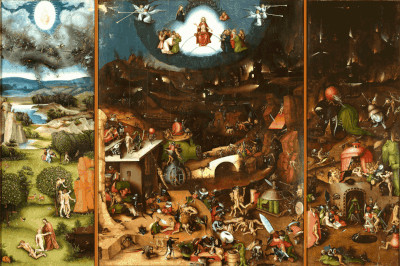
| Last Judgement — Vienna triptych | c.1500–1505 (BRCP 2016) | Oil on oak · Bosch and workshop (BRCP 2016) · Academy of Fine Arts Vienna 2016 catalogue. |
| Man in a Basket and Comic Figures | Around 1500–1515 in the museum record | Pen and brown ink on paper; the reverse is catalogued as iron-gall ink · Hieronymus Bosch in the current Albertina record; attribution has been debated · Albertina, Vienna · 7797 recto and verso Source 1. Source 2. |
| Man Seen from Behind | About 1550–1569; About 1565–1570 | Traces of black chalk, pen and brush in light brown ink · Anonymous, circle of Pieter Bruegel the Elder · Museum Boijmans Van Beuningen, Rotterdam Source 1. Source 2. |
| Mary and John at the Foot of the Cross | About 1440 | Brush in grey and black · Unknown, possibly Netherlandish · Kupferstich-Kabinett, Staatliche Kunstsammlungen Dresden · C 815 Source 1. Source 2. |
| Model Sheet with ‘Witches’ | Disputed; proposals depend on the attribution | Pen and brown ink; the BRCP also records underlying black chalk · Hieronymus Bosch; follower attributions also recorded · Musée du Louvre, Département des Arts graphiques, Paris · INV 19721 recto Source 1. Source 2. |
| Peasant and Three Bust-Length Figures | 1401–1500 | Brown pen over a black preliminary drawing · Attributed to the Master of the Drapery Studies; Bosch circle also recorded · Kupferstichkabinett, Staatliche Museen zu Berlin · KdZ 777 Source 1. Source 2. |
| River to Hell — Venice | c.1505–1515 | 2016 catalogue: Bosch; oil on panel · Visions of the Hereafter · Venice 2016 catalogue. |
| Saint Anthony and a Concert in an Egg | Around 1510–1525 in the museum’s 2016–17 exhibition texts | Pen in light and dark brown inks · Workshop of Hieronymus Bosch; underlying monsters: Bosch (BRCP), possibly Bosch (exhibition text) · Kupferstichkabinett, Staatliche Museen zu Berlin · KdZ 711 recto and verso Source 1. Source 2. |
| Saint Christopher Carrying the Christ Child | c.1500; 1490–1505 in restoration material | Oil on panel · Bosch · Boijmans St 26 Object source. |
| Saint James and Hermogenes | About 1551–1575 in the KIK-IRPA catalogue | Oil on wood, painted on both sides · Anonymous follower of Hieronymus Bosch · Musée des Beaux-Arts, Valenciennes · P.46.1.44; older number 176 Source 1. Source 2. |
| Saint Jerome at Prayer | Circa 1485–1495 | Oil on oak panel · Hieronymus Bosch · Museum of Fine Arts, Ghent · 1908-H Source 1. Source 2. |
| Saint John on Patmos / Passion Scenes | c.1495–1505; estimates vary | Oil on oak · Bosch · Gemäldegalerie Berlin 1647A Object source. |
| Saint John the Baptist in Meditation | Late 15th century; c.1485–1510 (Prado exhibition) | Oil on panel · Bosch · Lázaro Galdiano 8155 Object source. |
| Saint Liberata Triptych | Circa 1495–1505 | Oil on oak panels · Hieronymus Bosch · Gallerie dell’Accademia, Venice · 2045 Source 1. Source 2. |
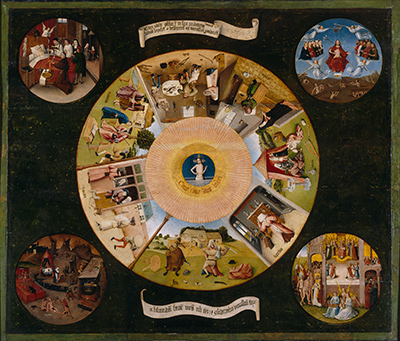
| Seven Deadly Sins and the Four Last Things | 1505–1510 (Prado) | Oil on poplar · Bosch (Prado); workshop/follower disputed · Prado Object source. |
| Ship of Fools — Louvre painting | 1475–1500 (record); c.1505–1515 (exhibition) | Oil on oak · Bosch · Louvre RF 2218; fragment Object source. |
| Ship of Fools — Louvre workshop drawing | Not specified in catalogue heading | 2016 catalogue: Workshop of Bosch · Pen, brush, grey-brown ink and white highlights on prepared paper · Louvre RF 3714 2016 catalogue. |
| Studies of Monsters | About 1530–1550, according to the current Ashmolean record | Pen and brown ink on laid paper, both faces · Anonymous follower of Hieronymus Bosch · Ashmolean Museum, University of Oxford · WA1863.155 Source 1. Source 2. |
| Studies of Saint Anthony and Monsters | No execution date specified in the current Louvre records | Pen and brown ink on paper · Bosch listed; reverse questioned by Louvre; BRCP accepts both faces · Musée du Louvre, Département des Arts graphiques, Paris · INV 20871 recto and verso Source 1. Source 2. |
| Temptation of Saint Anthony — Kansas City fragment | c.1500–1510 | 2016 catalogue: Bosch; oil on oak · Nelson-Atkins 35–22 2016 catalogue. |
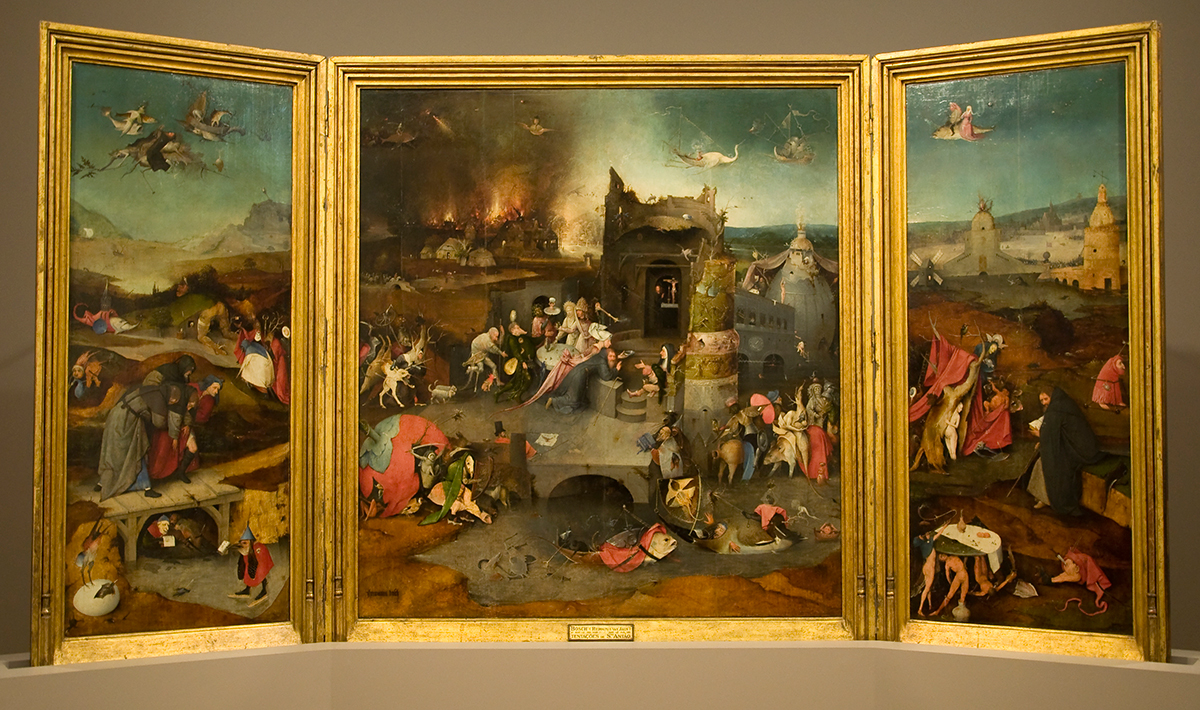
| Temptation of Saint Anthony — Lisbon triptych | c.1500 | Oil on oak · Bosch · Museu Nacional de Arte Antiga 1498 Pint Museum. |
| Temptation of Saint Anthony — Prado panel | c.1530–1540 | 2016 catalogue: Follower of Bosch (2016 opinion); oil on oak · Prado P002049 2016 catalogue. |
| Terrestrial Paradise | Approximately 1505–1515 | Oil on oak panel · Hieronymus Bosch · Gallerie dell'Accademia, Venice Source 1. Source 2. |
| The Burning Ship Drawing | 1500–1520 | Pen and iron gall ink on paper · Attributed to Hieronymus Bosch · Academy of Fine Arts Vienna, Graphic Collection · HZ-2554; numbered 2554 in the BRCP catalogue Source 1. Source 2. |
| The Comical Barber Scene | About 1550–1580, according to the British Museum | Pen and brown ink, grey and brown wash, over black chalk · Anonymous follower, after Hieronymus Bosch · British Museum, Department of Prints and Drawings, London · 1854,0628.46 Source 1. Source 2. |
| The Conjuror, After Hieronymus Bosch | Probably after 1525; around 1530–1540 in the BRCP technical report | Oil on oak panel · Anonymous follower of Hieronymus Bosch · Musée Ducastel-Vera, Saint-Germain-en-Laye · 872.1.87 Source 1. Source 2. |
| The Cure of Folly / Extraction of the Stone of Madness | 1501–1505 (Prado) | Oil on oak · Bosch (Prado); workshop/follower disputed · Prado P002056 Object source. |
| The Entombment Drawing | About 1505–1515, current museum record | Brush and black and grey ink, with grey wash, over black chalk · Workshop of Hieronymus Bosch; drawn by the Master of the Prado Haywain Triptych; Hieronymus Bosch, argued by the BRCP in 2016 · British Museum, Department of Prints and Drawings, London · 1952,0405.9 Source 1. Source 2. |
| The Gathering of the Birds | Not specified in catalogue heading | 2016 catalogue: Bosch; pen and brown ink · Berlin KdZ 13136 2016 catalogue. |
| The Haywain — Prado triptych | 1510–1516 (BRCP 2016) | Oil on oak · Bosch (BRCP 2016) · Prado; separate Escorial version exists 2016 catalogue. |
| The Hearing Forest and the Seeing Field | Circa 1500–1505 | Pen and brown ink on paper · Hieronymus Bosch; reverse: Bosch and workshop · Kupferstichkabinett, Staatliche Museen zu Berlin · KdZ 549, front and reverse Source 1. Source 2. |
| The Owl’s Nest — Rotterdam | Not specified in catalogue heading | 2016 catalogue: Bosch; pen and brown ink · Boijmans N 175 2016 catalogue. |
| The Passion Triptych in Valencia | Workshop of Bosch, about 1510–1520; Follower of Bosch; centre about 1530–1540, wings about 1540–1550 | Oil and gold on oak panels · Workshop of Bosch, about 1510–1520; Follower of Bosch; centre about 1530–1540, wings about 1540–1550 · Museu de Belles Arts de València Source 1. Source 2. |
| The Pedlar / Wayfarer — Rotterdam | c.1500 (museum) | Oil on panel · Bosch · Boijmans 1079 (OK); rejoined exterior Object source. |
| The Tree-Man — Vienna drawing | c.1505 | Pen and brown ink · Bosch · Albertina, Vienna Object source. |
| The Wedding at Cana, After Hieronymus Bosch | Approximately 1560 in the current museum record | Oil on panel, 93 cm high × 72 cm wide · Anonymous, after Hieronymus Bosch · Museum Boijmans Van Beuningen, Rotterdam, St 25 Source 1. Source 2. |
| Two Fantastical Creatures — Berlin KdZ 550 | Around 1505–1515 in the museum’s 2016 exhibition text | Pen in brown ink on reddish prepared laid paper · Hieronymus Bosch · Kupferstichkabinett, Staatliche Museen zu Berlin · KdZ 550, recto and verso Source 1. Source 2. |
| Two Figures Wearing Mitres | About 1480 | Oil on panel · Anonymous (Boijmans); Bosch circle (RKD) · Museum Boijmans Van Beuningen, Rotterdam · 1177 (OK) Source 1. Source 2. |
| Two Men and the Temptation of Eve | About 1505–1515 in the Prado’s 2016 exhibition guide | Pen and grey-brown ink on paper · Hieronymus Bosch in the 2016 catalogues discussed here · Private collection, as recorded in 2016 Source 1. Source 2. |
| Two Men Fighting | Not specified in the current Louvre record | Pen and brown ink · In the manner of Hieronymus Bosch · Musée du Louvre, Département des Arts graphiques, Paris · INV 20660 recto; formerly NIII 8896 and MA 8400 Source 1. Source 2. |
| Two Men — Berlin KdZ 5210 | Not specified in catalogue heading | 2016 catalogue: Bosch questioned · Pen, brush, ink, chalk and white highlights · Berlin KdZ 5210; historical title Two Oriental Men 2016 catalogue. |
| Two Monsters — Berlin KdZ 547 | Approximately 1500–1510 in Berlin's 2016 exhibition catalogue; an estimated range | Pen and brown ink on paper · Hieronymus Bosch · Kupferstichkabinett, Staatliche Museen zu Berlin · KdZ 547, drawn on both sides Source 1. Source 2. |
Frequently Asked Questions
The Academy of Fine Arts Vienna holds it as The Hell Ship, inventory HZ-2554.[1]
Its current record gives 1500–1520, pen and iron gall ink on paper, 17.7 × 15.4 cm. These are approximate catalogue dates and current object measurements.[1]
Discussion
Follow the shifting boundary between burning vessel and human body.
Reader Insights
Where does the ship’s hull begin to become a human body?
How do the tiny figures in the rigging change the scale of the hooded head?
Compare the flames’ upward movement with the widely separated feet below.
Join the Conversation
Share a detail, comparison or question about The Burning Ship Drawing: Vienna’s Hell Ship below.
References
- Academy of Fine Arts Vienna: The Hell Ship, HZ-2554, current collection record View source.
- Bosch Research and Conservation Project: Catalogue Raisonné, 2016, entry 45, pages 536–537, with related entry 46, pages 538–541 View source.
- BRCP Catalogue Raisonné (2016), object dates in catalogues 1, 2, 8, 15 and 20; catalogue 20 object metadata only for the Haywain comparison. View source
- Staatliche Museen zu Berlin, 2016 exhibition wall texts, p. 3: approximate date of KdZ 549. View source
- Albertina: Burlesque Scene with Hop Basket, 7797 verso, including the catalogue discussion of both faces View source.
- Splash image, Attributed to Hieronymus Bosch, The Hell Ship (Burning Ship), 1500–1520, pen and iron gall ink on paper, 17.7 × 15.4 cm, Graphic Collection, Academy of Fine Arts Vienna, HZ-2554. Date, medium and dimensions follow the current Academy record. View source.