by Tom Gurney
Tom Gurney BSc (Hons) is an art history expert with over 20 years experience
Published on June 19, 2020 / Updated on November 4, 2026
Email: tomgurney1@gmail.com / Phone: +44 7429 011000
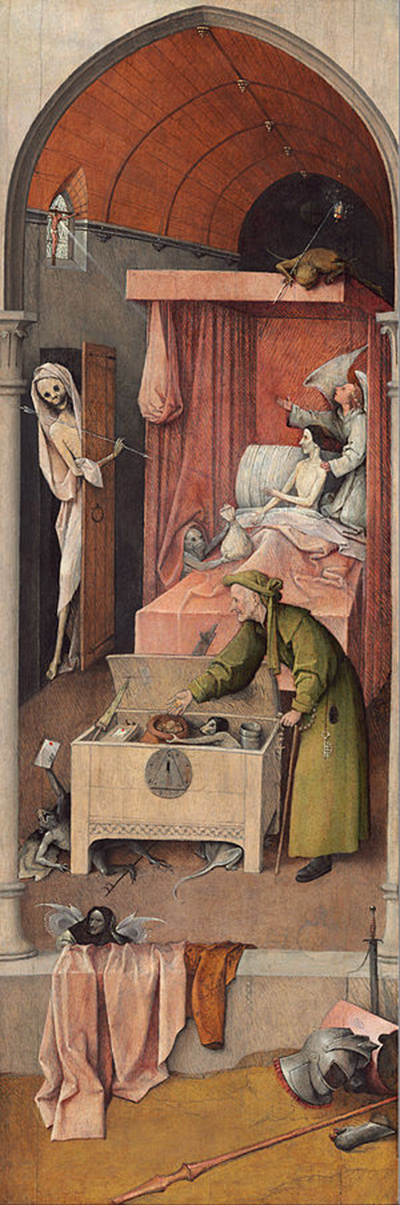
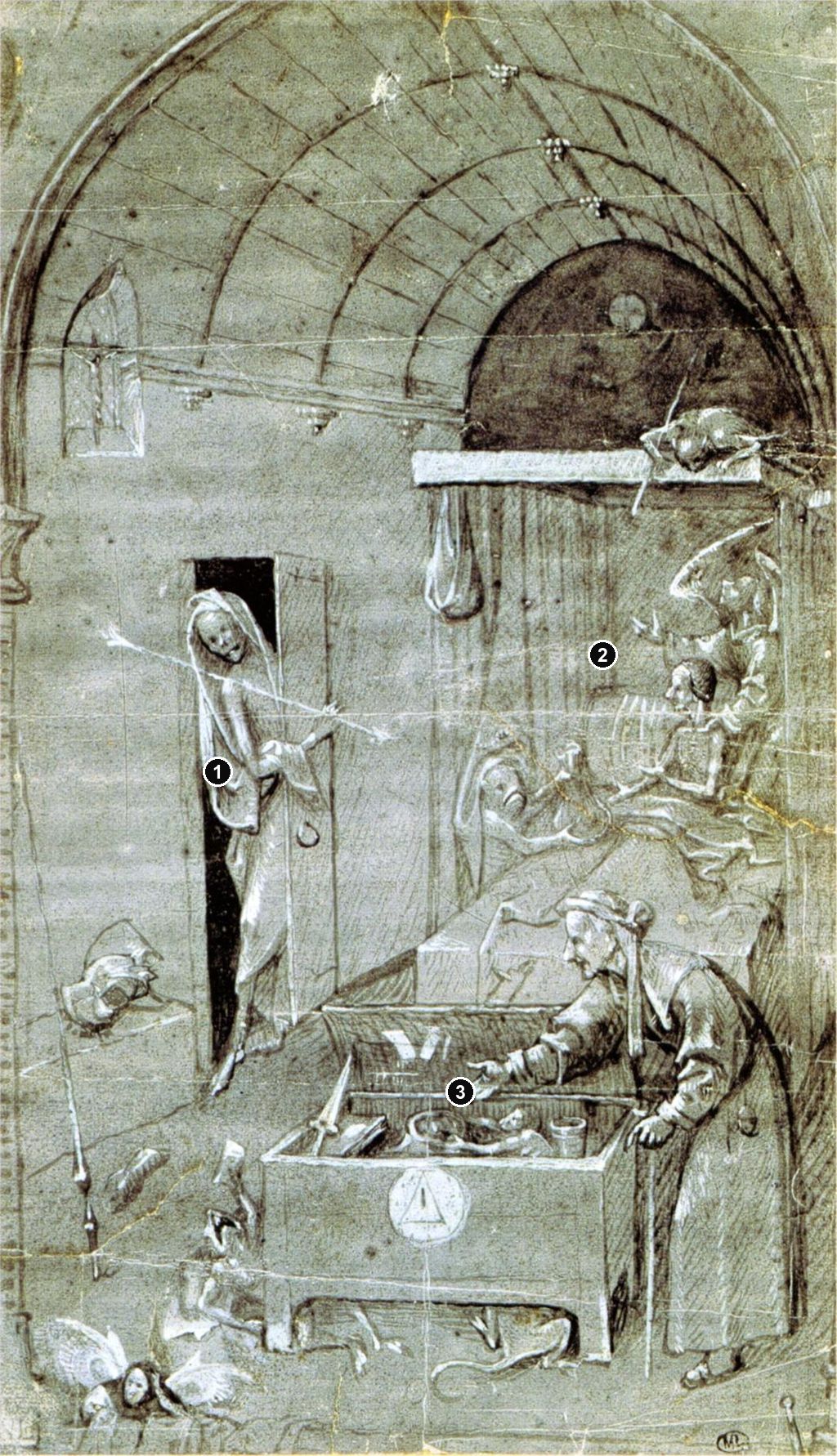
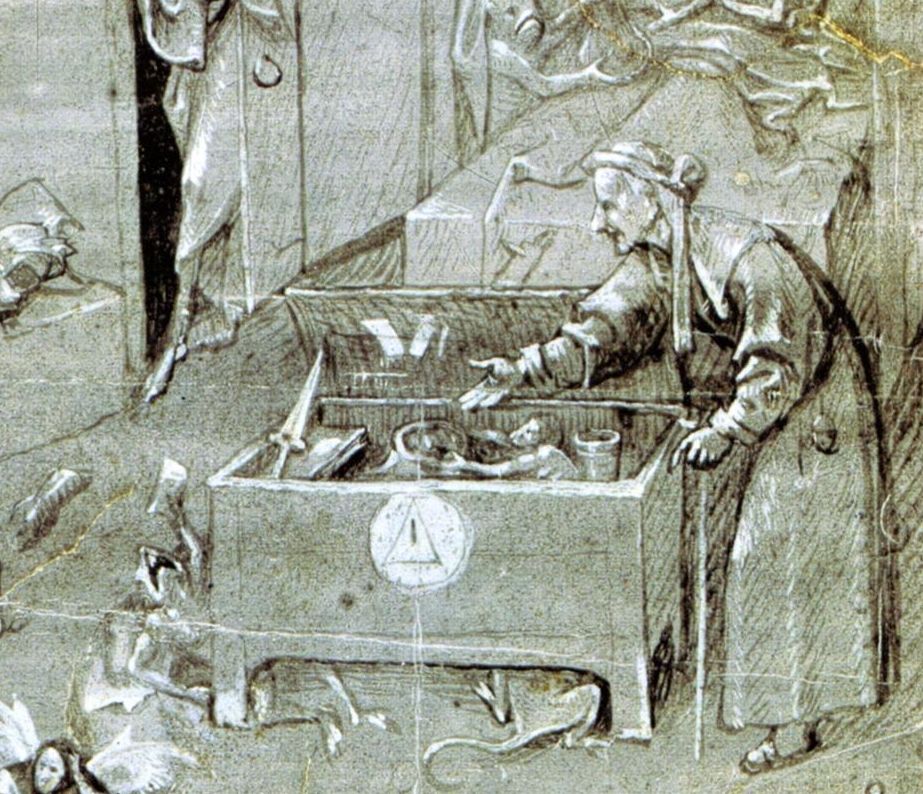
A skeleton enters a narrow room while a man sits upright in bed. An angel gestures towards a crucifix, a demon offers a money-bag, and another figure bends over an open chest. Pale highlights lift the faces, hands and folds from the darkened paper. The Louvre’s Ars Moriendi preserves the struggle represented in Bosch’s Death and the Miser, but changes its scale, medium and arrangement.
The sheet is RF 6947, Recto, in the Louvre’s Department of Prints and Drawings.[1] Often encountered under Bosch’s name, it is better approached with its attribution qualified. The Bosch Research and Conservation Project, or BRCP, assigns it to a workshop assistant and regards it as a record of the completed painting rather than a preparatory design.[3] The distinction changes what its lines can tell us about the painted composition.
At a Glance
- Museum titleArs Moriendi
- Familiar titleDeath and the Miser drawing
- AttributionWorkshop of Hieronymus Bosch in the BRCP catalogue; alternatives recorded by the Louvre
- DateNot securely established; probably made after the painting
- MediumPen and brush, dark ink and white highlights on prepared paper
- Dimensions25.5 × 15 cm in the Louvre record
- CollectionMusée du Louvre, Department of Prints and Drawings, Paris
- InventoryRF 6947, Recto
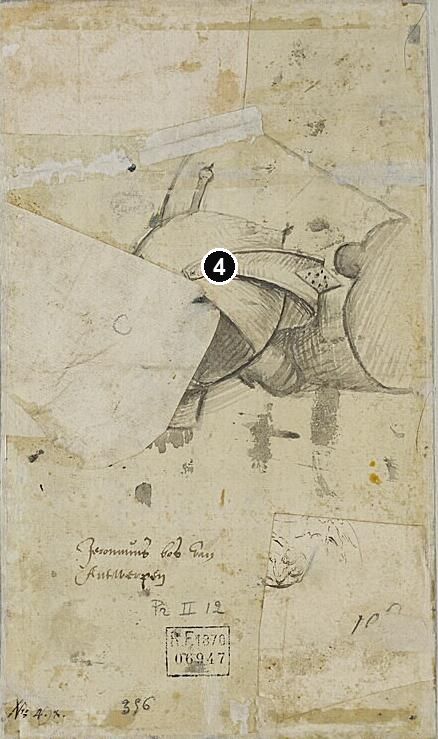
- ReverseStudies of a helmet and shield
- AcquisitionGift of A. W. M. Mensing, 1927
Compare these works across Bosch’s career
These date ranges are estimates, not a documented year-by-year sequence. These works provide context for the article; none is highlighted as the object discussed here.
Saint Jerome at Prayer
Circa 1485–1495 [2]Crucifixion with a Donor
Circa 1490–1500 (BRCP) [2]Hermit Saints Triptych
Circa 1495–1505 [2]Saint Liberata Triptych
Circa 1495–1505 [2]The Hearing Forest and the Seeing Field
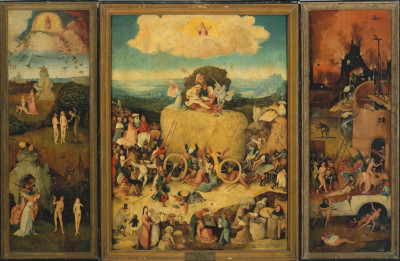
Circa 1500–1505 (Berlin exhibition) [4]The Haywain Triptych
1510–1516 (BRCP) [2]Contents
- Introduction
- Annotated Details
- A Deathbed beneath a Vaulted Ceiling
- The Meaning of Ars Moriendi
- The Chest and the Figure beside It
- White Highlights on Prepared Paper
- Why the Drawing Probably Follows the Painting
- Armour Moved to Fit the Sheet
- Attribution and the Workshop
- A Record That Later Helped Restoration
Annotated Details from Death and the Miser: The Louvre Drawing
The Louvre drawing shows the deathbed scene on its front and studies of armour on its reverse. These are the two faces of RF6947.
Louvre RF6947 Front
Louvre RF6947 Reverse
Details from DEATH AND THE MISER: THE LOUVRE DRAWING
Compare the room’s separate episodes and the armour drawn on the other side.
Louvre RF6947 Front
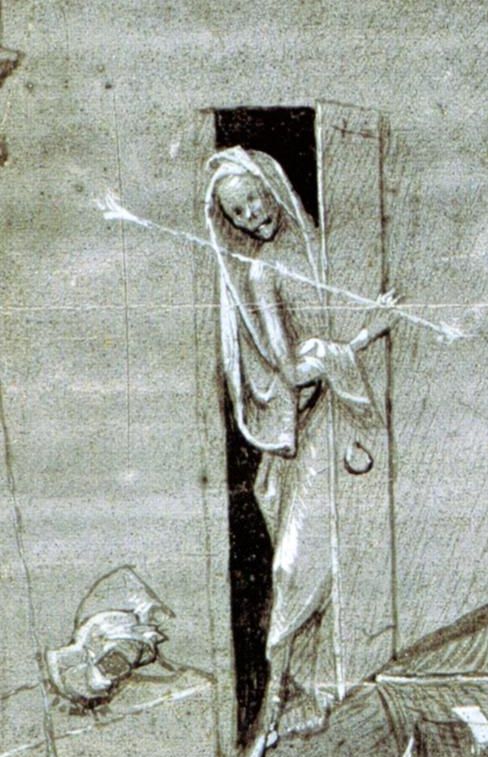
Death at the doorway
The skeletal figure enters through the narrow doorway on the left. A long shaft extends from its raised hand across the room.
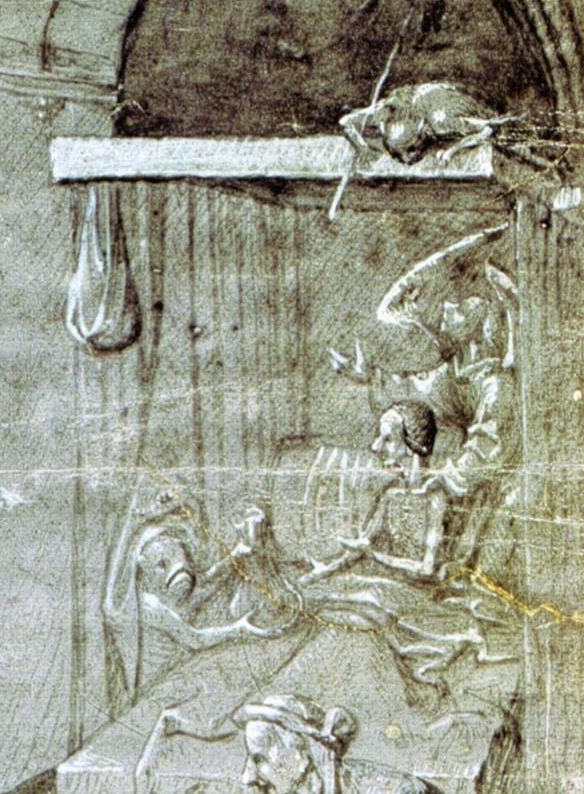
The bed and its attendants
The dying man raises his upper body beneath the canopy. Another figure bends beside him while small creatures interrupt the bedding and the space above it.
The open chest
A standing figure reaches into the open chest in the foreground. White highlights pick out the rim, the hands and the garments against the prepared paper.
Louvre RF6947 Reverse
Helmet and shield
The reverse carries a helmet and a broad shield. Shading follows the curved metal surfaces, while ruled lines establish an architectural edge above.
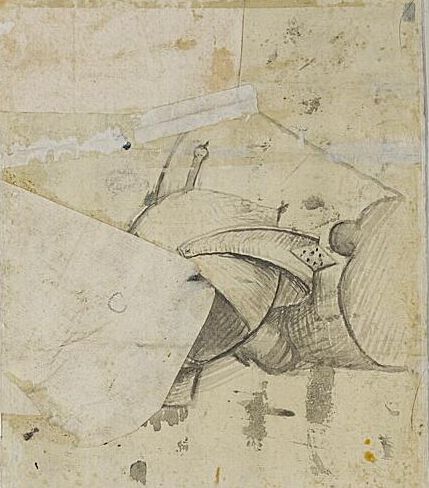
Image and detail crops: Wikimedia Commons source 1; Wikimedia Commons source 2 (public domain reproductions).
A Deathbed beneath a Vaulted Ceiling
The room rises in a sequence of curved ribs. These repeated arches draw attention upwards before the eye reaches the bed, whose canopy occupies the right side. Below them, the chamber narrows towards the dark doorway at the left. The drawing sets its confrontation within a carefully enclosed interior: there is little space through which the dying man could escape.
Death stands at that doorway in a loose shroud, one arm extending an arrow into the room. The arrow creates a long diagonal across the quieter space between the door and the bed. Its direction links the entering skeleton to the man’s lifted head, making the threat clear without showing a wound or a completed act of violence.
The bed’s curtain and canopy divide the chamber again. A creature sprawls above, while another appears close to the bedding with the money-bag. Their positions make temptation seem embedded in the furniture rather than arriving only through the door. The skeletal visitor has a distinct entrance; the smaller beings already inhabit the room.
The dying man turns towards Death, but his situation includes another possible direction. Behind him, the angel’s gesture leads towards the crucifix set high on the opposite wall. Faces, arms and the line of the arrow concentrate the action around the bed. The architecture gives those competing signals a larger space in which to unfold.
The Meaning of Ars Moriendi
Ars Moriendi means the art of dying. The title connects the scene with a late medieval tradition of texts and images about preparing for death and resisting temptation. The Louvre relates this drawing particularly to the temptations confronting the dying person.[1] The title describes a spiritual predicament, rather than identifying a particular historical man or the interior of his house.
In its discussion of the Washington painting, the National Gallery of Art’s systematic catalogue explains the tradition through opposing temptations and good inspirations. Avarice was one of the dangers presented to the dying person.[5] The money-bag in this scene makes that danger concrete: material possessions remain attractive at the very moment when their owner must relinquish them.
The angel and the demon offer different objects of attention. One points beyond the bed towards the crucifix; the other brings money within reach. Yet the man’s face turns towards the figure of Death. His attention does not follow either adviser in a simple, settled way. The image gains its tension from this divided moment, rather than depicting the soul’s final destination.
The title Death and the Miser gives greater prominence to a moral type, the person attached to wealth. Ars Moriendi places that attachment within the broader problem of dying well. Both titles help explain the work, but neither makes the outcome visible. No separate image of the man saved or damned appears on this sheet.
The Chest and the Figure beside It
The open chest forms a second centre of activity below the bed. Its broad front and raised lid introduce firmer angles among the curves of bedding and clothing. The standing figure bends towards its contents, carrying the action downward from the deathbed into a zone of stored possessions and small creatures.
That figure is often interpreted as the dying man at an earlier stage of life. The National Gallery catalogue discusses this possibility for the painting without treating the identification as certain.[5] It allows the composition to bring habitual behaviour and its final test into one room. The drawing preserves that juxtaposition, without requiring two separate scenes divided by a border.
The figure’s clothing falls in long folds, contrasting with the exposed upper body on the bed. One person is engaged in handling possessions while the other confronts their approaching loss. Repetition connects the two actions, but their different poses also make them readable independently. The chest can be examined as an episode within the chamber, not merely as background furniture.
Small papers and objects complicate its contents. Their presence suggests that the image concerns the organisation and keeping of wealth as well as the lure of a single bag. Their precise legal or financial purpose should remain open. A tiny rectangle in a moral scene cannot, by shape alone, be securely identified as a mortgage, an indulgence or a particular contract.
White Highlights on Prepared Paper
The drawing’s light depends on marks added to a toned surface. The Louvre describes black ink applied with pen and brush, grey prepared paper and white heightening. The BRCP describes grey-brown ink and a grey-green-brown preparation.[1][3] These accounts agree on the essential layered method, while describing the surviving colours differently.
Bright touches pick out the entering figure’s shroud, the dying man’s face and the hands of the figure at the chest. Broader pale passages describe cloth, while dark lines keep contours and folds distinct. The paper’s middle tone provides an atmosphere shared by the whole interior. Light and shadow develop around it, rather than beginning from an untouched white sheet.
This method gives the drawing a painterly character. It can translate contrasts from a painted scene into a restricted range of tones while still allowing individual pen strokes to remain visible. The effect is particularly noticeable where a pale edge separates a sleeve or face from the surrounding grey. A few light marks can establish a projecting form without filling it completely.
The sheet’s damaged surface also affects its appearance. The BRCP records cropping on every side, tears and cracks associated with folds.[3] Some conspicuous lines therefore belong to the object’s physical history. They must be distinguished from the artist’s hatchings, architectural ribs and highlights when following the chamber’s structure.
Why the Drawing Probably Follows the Painting
The crucial comparison involves three images: the Louvre drawing, the visible Washington painting, and the design beneath its paint. The last of these can be studied through infrared imaging. It records decisions made before the painted surface reached its present arrangement, providing a more specific test than a general resemblance between the two works.[3][5]
In the painting’s underdrawing, the dying man grasps the money-bag and holds a large goblet. Those actions were changed during painting. The Louvre sheet corresponds more closely to the completed version, where the man has not taken hold of the bag and the goblet is absent.[3] It therefore preserves the revised, less decisive gesture rather than the earlier one.
The BRCP argues that it would be an unlikely sequence for this sheet to precede the underdrawing: the painter would have departed from the supposed model and then returned to its arrangement while painting. A later record is the more plausible explanation.[3] The argument rests on the direction of changes, not simply on assuming that every copy must be less accomplished than its source.
The arrow provides another comparison. It extends farther towards the man in the underdrawing than in either the painting or the Louvre drawing.[3] Several details thus support the same sequence. The drawing is usually understood as a ricordo, a visual record of a finished work, rather than direct evidence of Bosch’s first planning on paper.
Armour Moved to Fit the Sheet
The drawing also reorganises the Death and the Miser painting. Armour and weapons that occupy its lower foreground appear along the left side of the drawn chamber. The copier retains these elements while changing their place within the composition.[3][5] A record of a painting need not reproduce every spatial relationship exactly.
This movement matters because it explains why the sheet can be recognisably faithful and visibly different at the same time. The room and its central action remain, but the lower foreground is compressed. The armour becomes an interior detail beside the wall, leaving the chest and standing figure to establish the bottom of the surviving scene.
On the reverse, a helmet and shield are drawn again at a larger scale. The BRCP suggests that their less resolved treatment on the front may explain this second attempt.[3] The reverse gives particular attention to forms that might otherwise seem incidental. It also shows why looking at both faces of the object contributes more than treating the front as a reduced reproduction.
The equipment’s precise symbolism remains disputed. It has been connected with worldly status, a former knightly life and possessions rendered useless by death.[5] Moving it within the image does not settle those interpretations. Nor does the presence of armour prove that the dying man is an identifiable soldier whose biography can be reconstructed.
Attribution and the Workshop
The Louvre retains Bosch as its principal artist heading but explicitly lists several possible attributions: a copy after him, the workshop of the Master of the Haywain according to Fritz Koreny, and Bosch’s workshop according to the BRCP.[1] Reading only the heading would conceal the qualifications that accompany the museum’s identification.
The BRCP considers the work skilled but finds too few close comparisons to assign it to Bosch himself. It compares the handling of hands and other forms with related drawings and with painted figures, while ultimately preferring an assistant.[3] That judgement distinguishes the invention behind the composition from the execution of this particular sheet.
Hatching has also entered the discussion. Its prevailing diagonal direction differs from much of the painting’s underdrawing, prompting arguments about the draughtsmen’s handedness.[3] Such observations contribute to comparison; they do not by themselves name an artist. The functions differ too: an underdrawing prepares a painted surface, whereas this sheet appears to preserve an already developed composition.
A Record That Later Helped Restoration
A related Louvre drawing repeats the Ship of Fools in a similar technique. The Louvre connects the two sheets, and the BRCP treats both as workshop records.[1][3] Their relationship offers a possible context for making painted inventions available on paper, without establishing a documented commission or an exact date for either drawing.
The chest gives this drawing an additional historical value. The BRCP reports that it helped guide reconstruction of the painted chest’s lock during restoration.[3] Here a record made after a painting could inform work on that painting centuries later. Its usefulness depended on preserving a legible detail, rather than on being an original preparatory study.
The Louvre records the sheet’s passage through the Esterházy and Robiano collections and its purchase by A. W. M. Mensing, who gave it to the museum in 1927.[1] Across that collecting history, the drawing has retained both its intimate drama and the evidence of its making: pale strokes on a prepared ground, relocated objects, repeated armour on the reverse, and gestures that preserve a crucial choice from the painted scene.
Artworks and related attributions
Browse paintings, drawings and related attributions. Records group triptychs, fragments and two-sided sheets where appropriate. Dates follow the cited museum records or catalogue headings and are generally estimates. Rows marked “2016 catalogue” report that publication’s attribution and collection information; these are dated opinions, rather than a claim that every work is an accepted autograph Bosch.
| Name | Date | Medium, attribution and collection |
|---|---|---|
| A Crossbowman | Second half of the sixteenth century | Oil on oak panel · Copy after Hieronymus Bosch · Museo Nacional del Prado, Madrid · P002695 Source 1. Source 2. |
| A Woman Spinning and an Old Woman | Museum estimates: about 1480–1490 for the women and 1500–1505 for the reverse; the precise chronology is disputed | Pen and brown and grey ink on the front; pen and brown ink on the reverse · Hieronymus Bosch · Museum Boijmans Van Beuningen, Rotterdam · N 190 recto and verso (PK) Source 1. Source 2. |
| Adoration of the Child in Cologne | Second half of the sixteenth century | Oil on oak panel · Imitator of Hieronymus Bosch, in the city collection record · Wallraf-Richartz-Museum & Fondation Corboud, Cologne · WRM 0474 Source 1. Source 2. |
| Adoration of the Magi in Philadelphia | Early sixteenth century in the museum record; around 1495–1520 in the BRCP catalogue | Oil on oak panel · Hieronymus Bosch in the museum record; workshop of Bosch in the 2016 BRCP catalogue · Philadelphia Museum of Art, John G. Johnson Collection, 1917 · 1321; museum object 103592 Source 1. Source 2. |
| Adoration of the Magi — New York | c.1470–1480 | 2016 catalogue: Bosch; oil on oak · Metropolitan Museum 13.26 2016 catalogue. |
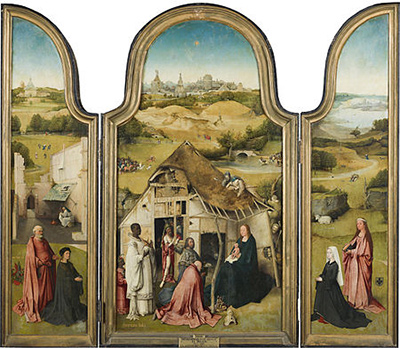
| Adoration of the Magi — Prado triptych | c.1494 | Oil on oak; grisaille exterior · Bosch · Prado P002048 Object source. |
| Adoration of the Magi — three associated fragments | c.1515–1535 | 2016 catalogue: Follower of Bosch · Two Shepherds / Retinue in Philadelphia; associated Adoration in private collection in 2016 2016 catalogue. |
| Ascent of the Blessed — Venice | c.1505–1515 | Oil on panel · Bosch · Gallerie dell’Accademia; Visions of the Hereafter Object source. |
| Battle of the Birds and Mammals | Not specified in catalogue heading | 2016 catalogue: Bosch; pen and brown ink · Berlin KdZ 14715 2016 catalogue. |
| Beggars and Musicians | Around 1530–1540 | Ink and wash on paper · Unknown follower of Hieronymus Bosch · Albertina, Vienna · 7798 Source 1. Source 2. |
| Christ Carrying the Cross Drawing | Around 1470 in the museum catalogue | Black chalk or charcoal, pen and brush in brown ink, white corrections · Anonymous, workshop of Rogier van der Weyden · Museum Boijmans Van Beuningen, Rotterdam · N 81 recto and verso (PK) Source 1. Source 2. |
| Christ Carrying the Cross in Vienna | Around 1490–1510 in the current KHM record and BRCP catalogue | Oil on oak, painted on both sides · Hieronymus Bosch; possible workshop involvement in the Passion side discussed by the BRCP · Kunsthistorisches Museum, Vienna · Gemäldegalerie, GG 6429 Source 1. Source 2. |
| Christ Carrying the Cross — El Escorial | c.1495–1505 | 2016 catalogue: Bosch; oil on oak · Patrimonio Nacional 10014739 2016 catalogue. |
| Christ Carrying the Cross — Ghent | c.1510–1516 (museum) | Oil on panel · Bosch in museum listing; authorship disputed · MSK Ghent 1902-H Object source. |
| Christ Mocked — London | c.1510 | Oil on wood · Bosch · National Gallery NG4744 Object source. |
| Concert in the Egg, After Hieronymus Bosch | Around 1561; third quarter of the sixteenth century | Oil on canvas · Anonymous, after Hieronymus Bosch · Palais des Beaux-Arts, Lille · P 816 Source 1. Source 2. |
| Conjurer / Comical Concert — Louvre drawing | Not specified in catalogue heading | 2016 catalogue: Bosch (recto), follower (concert verso) · Pen and brown ink · Louvre INV 19197 2016 catalogue. |
| Conjurer / Cross-bearing and beggars — Liège sheet | Not specified in catalogue heading | 2016 catalogue: Bosch (verso), follower (recto) · Pen and brown ink · Album d’Arenberg 534 2016 catalogue. |
| Crowning with Thorns — El Escorial | c.1530–1540 | 2016 catalogue: Follower of Bosch; oil on oak · Patrimonio Nacional 10014743 2016 catalogue. |
| Crucifixion with a Donor | Circa 1495–1505; Circa 1490–1500 | Oil on oak panel · Hieronymus Bosch · Royal Museums of Fine Arts of Belgium, Brussels · 6639 Source 1. Source 2. |
| Death and the Miser Drawing | Not securely established; probably made after the painting | Pen and brush, dark ink and white highlights on prepared paper · Workshop of Hieronymus Bosch in the BRCP catalogue; alternatives recorded by the Louvre · Musée du Louvre, Department of Prints and Drawings, Paris · RF 6947, Recto Source 1. Source 2. |
| Death and the Miser — Washington | c.1485/1490 (NGA) | Oil on panel · Bosch · National Gallery of Art 1952.5.33 Object source. |
| Ecce Homo Triptych — Boston | c.1495–1500; wings c.1500/1503 | 2016 catalogue: Workshop of Bosch; oil on oak · Museum of Fine Arts Boston; several production phases 2016 catalogue. |
| Ecce Homo — Frankfurt | c.1490 | Mixed technique on oak · Bosch · Städel 1577 Object source. |
| Fall of the Damned — Venice | c.1505–1515 | 2016 catalogue: Bosch; oil on panel · Visions of the Hereafter · Venice 2016 catalogue. |
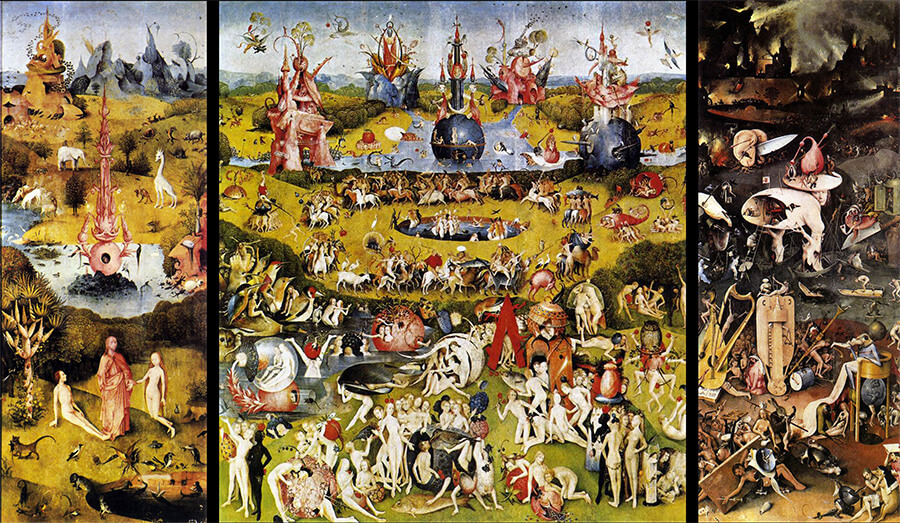
| Garden of Earthly Delights | 1490–1500 (Prado) | Oil on oak; grisaille exterior · Bosch · Prado; triptych Object source. |
| Gluttony and Lust / Allegory of Intemperance — Yale fragment | c.1500–1510 (group dating) | 2016 catalogue: Bosch; oil on oak · Yale 1959.15.22; fragment associated with Ship of Fools 2016 catalogue. |
| Group of Ten Spectators, a Follower of Bosch | Around 1510–1540 in the current museum record | Pen and two brown inks on paper, with a brown framing line · Follower of Hieronymus Bosch in the Morgan record; Bosch in the BRCP catalogue · Morgan Library & Museum, New York · I, 112 Source 1. Source 2. |
| Head of an Old Woman | About 1500 | Oil on panel · Attributed to Jacob Cornelisz. van Oostsanen · Museum Boijmans Van Beuningen, Rotterdam · 2439 (OK) Source 1. Source 2. |
| Hell and the Flood — Rotterdam panels | Around 1515 in the museum records; around 1510–1520 in the BRCP catalogue | Oil on oak panels · Jheronimus Bosch in the museum records; workshop of Bosch in the BRCP catalogue · Museum Boijmans Van Beuningen, Rotterdam Source 1. Source 2. |
| Hermit Saints Triptych | Circa 1495–1505 | Oil on oak panels · Hieronymus Bosch · Gallerie dell’Accademia, Venice · 2044 Source 1. Source 2. |
| Infernal Landscape | Not specified in catalogue heading | 2016 catalogue: Bosch; pen and brown ink, red accent · Private collection in 2016 2016 catalogue. |
| Infernal Scene with Anvil / Monster Studies | Not specified in catalogue heading | 2016 catalogue: Bosch; attribution debated in entry · Pen and brown ink · Berlin KdZ 548 2016 catalogue. |
| Infernal Scene with Tree-Man / Standing Man | Not specified in catalogue heading | 2016 catalogue: Workshop of Bosch; pen and brown ink · Dresden C 1875; historical reverse title includes a proposed prophet 2016 catalogue. |
| Job Triptych — Bruges | c.1510–1520 | 2016 catalogue: Workshop of Bosch; oil on oak · Groeningemuseum / Hoeke loan in 2016 2016 catalogue. |
| Last Judgement — Bruges triptych | c.1495–1505 | 2016 catalogue: Bosch; oil on oak · Groeningemuseum 2016 catalogue. |
| Last Judgement — Munich fragment | c.1530–1540 | 2016 catalogue: Follower of Bosch; oil on oak · Alte Pinakothek 5752 2016 catalogue. |
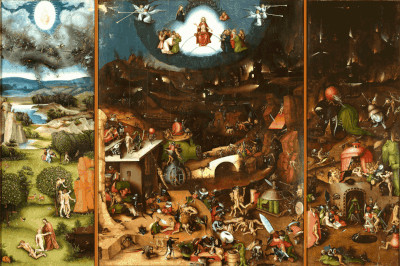
| Last Judgement — Vienna triptych | c.1500–1505 (BRCP 2016) | Oil on oak · Bosch and workshop (BRCP 2016) · Academy of Fine Arts Vienna 2016 catalogue. |
| Man in a Basket and Comic Figures | Around 1500–1515 in the museum record | Pen and brown ink on paper; the reverse is catalogued as iron-gall ink · Hieronymus Bosch in the current Albertina record; attribution has been debated · Albertina, Vienna · 7797 recto and verso Source 1. Source 2. |
| Man Seen from Behind | About 1550–1569; About 1565–1570 | Traces of black chalk, pen and brush in light brown ink · Anonymous, circle of Pieter Bruegel the Elder · Museum Boijmans Van Beuningen, Rotterdam Source 1. Source 2. |
| Mary and John at the Foot of the Cross | About 1440 | Brush in grey and black · Unknown, possibly Netherlandish · Kupferstich-Kabinett, Staatliche Kunstsammlungen Dresden · C 815 Source 1. Source 2. |
| Model Sheet with ‘Witches’ | Disputed; proposals depend on the attribution | Pen and brown ink; the BRCP also records underlying black chalk · Hieronymus Bosch; follower attributions also recorded · Musée du Louvre, Département des Arts graphiques, Paris · INV 19721 recto Source 1. Source 2. |
| Peasant and Three Bust-Length Figures | 1401–1500 | Brown pen over a black preliminary drawing · Attributed to the Master of the Drapery Studies; Bosch circle also recorded · Kupferstichkabinett, Staatliche Museen zu Berlin · KdZ 777 Source 1. Source 2. |
| River to Hell — Venice | c.1505–1515 | 2016 catalogue: Bosch; oil on panel · Visions of the Hereafter · Venice 2016 catalogue. |
| Saint Anthony and a Concert in an Egg | Around 1510–1525 in the museum’s 2016–17 exhibition texts | Pen in light and dark brown inks · Workshop of Hieronymus Bosch; underlying monsters: Bosch (BRCP), possibly Bosch (exhibition text) · Kupferstichkabinett, Staatliche Museen zu Berlin · KdZ 711 recto and verso Source 1. Source 2. |
| Saint Christopher Carrying the Christ Child | c.1500; 1490–1505 in restoration material | Oil on panel · Bosch · Boijmans St 26 Object source. |
| Saint James and Hermogenes | About 1551–1575 in the KIK-IRPA catalogue | Oil on wood, painted on both sides · Anonymous follower of Hieronymus Bosch · Musée des Beaux-Arts, Valenciennes · P.46.1.44; older number 176 Source 1. Source 2. |
| Saint Jerome at Prayer | Circa 1485–1495 | Oil on oak panel · Hieronymus Bosch · Museum of Fine Arts, Ghent · 1908-H Source 1. Source 2. |
| Saint John on Patmos / Passion Scenes | c.1495–1505; estimates vary | Oil on oak · Bosch · Gemäldegalerie Berlin 1647A Object source. |
| Saint John the Baptist in Meditation | Late 15th century; c.1485–1510 (Prado exhibition) | Oil on panel · Bosch · Lázaro Galdiano 8155 Object source. |
| Saint Liberata Triptych | Circa 1495–1505 | Oil on oak panels · Hieronymus Bosch · Gallerie dell’Accademia, Venice · 2045 Source 1. Source 2. |
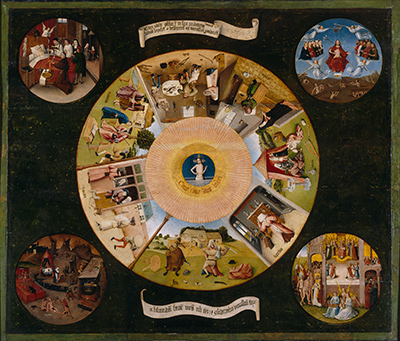
| Seven Deadly Sins and the Four Last Things | 1505–1510 (Prado) | Oil on poplar · Bosch (Prado); workshop/follower disputed · Prado Object source. |
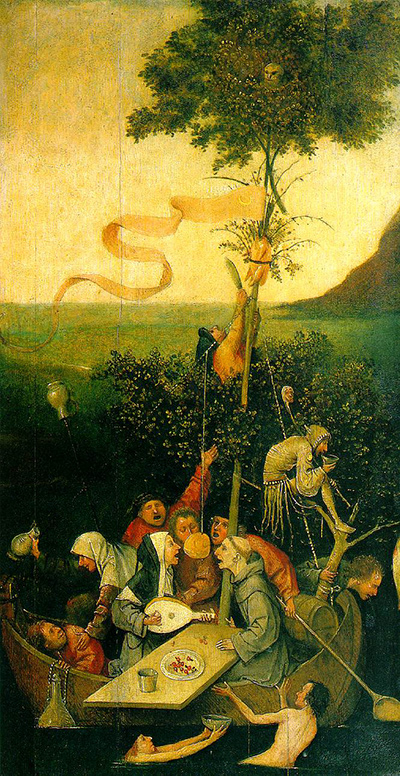
| Ship of Fools — Louvre painting | 1475–1500 (record); c.1505–1515 (exhibition) | Oil on oak · Bosch · Louvre RF 2218; fragment Object source. |
| Ship of Fools — Louvre workshop drawing | Not specified in catalogue heading | 2016 catalogue: Workshop of Bosch · Pen, brush, grey-brown ink and white highlights on prepared paper · Louvre RF 3714 2016 catalogue. |
| Studies of Monsters | About 1530–1550, according to the current Ashmolean record | Pen and brown ink on laid paper, both faces · Anonymous follower of Hieronymus Bosch · Ashmolean Museum, University of Oxford · WA1863.155 Source 1. Source 2. |
| Studies of Saint Anthony and Monsters | No execution date specified in the current Louvre records | Pen and brown ink on paper · Bosch listed; reverse questioned by Louvre; BRCP accepts both faces · Musée du Louvre, Département des Arts graphiques, Paris · INV 20871 recto and verso Source 1. Source 2. |
| Temptation of Saint Anthony — Kansas City fragment | c.1500–1510 | 2016 catalogue: Bosch; oil on oak · Nelson-Atkins 35–22 2016 catalogue. |
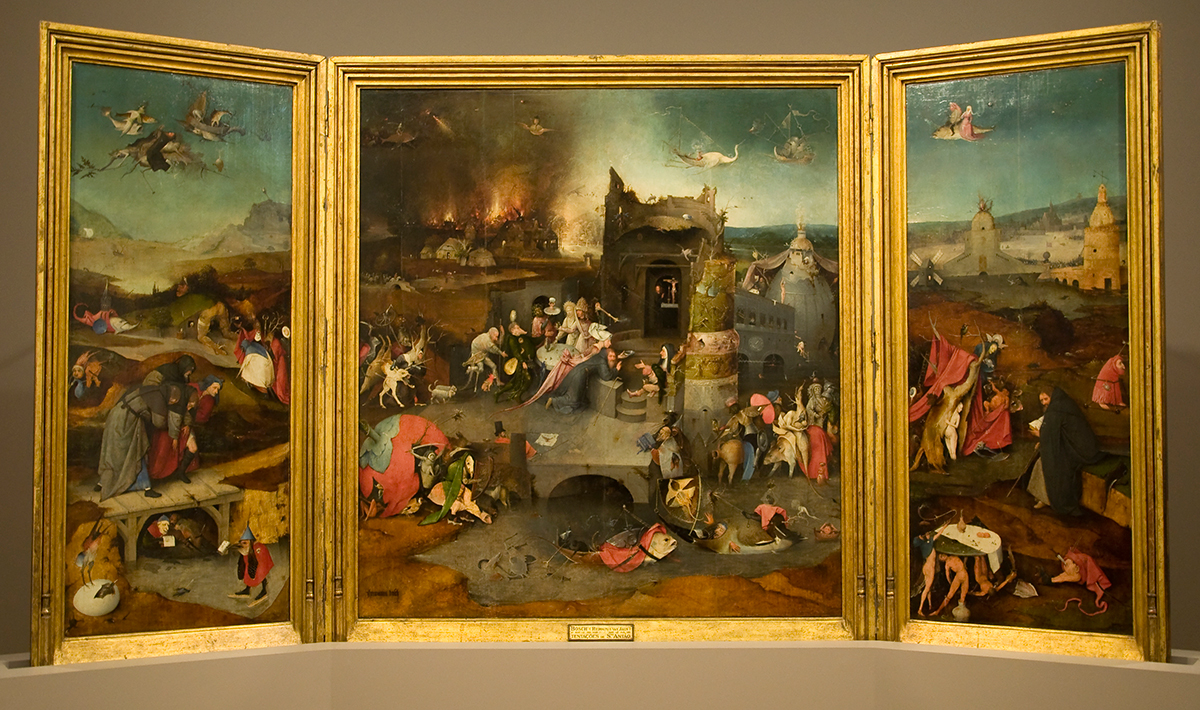
| Temptation of Saint Anthony — Lisbon triptych | c.1500 | Oil on oak · Bosch · Museu Nacional de Arte Antiga 1498 Pint Museum. |
| Temptation of Saint Anthony — Prado panel | c.1530–1540 | 2016 catalogue: Follower of Bosch (2016 opinion); oil on oak · Prado P002049 2016 catalogue. |
| Terrestrial Paradise | Approximately 1505–1515 | Oil on oak panel · Hieronymus Bosch · Gallerie dell'Accademia, Venice Source 1. Source 2. |
| The Burning Ship Drawing | 1500–1520 | Pen and iron gall ink on paper · Attributed to Hieronymus Bosch · Academy of Fine Arts Vienna, Graphic Collection · HZ-2554; numbered 2554 in the BRCP catalogue Source 1. Source 2. |
| The Comical Barber Scene | About 1550–1580, according to the British Museum | Pen and brown ink, grey and brown wash, over black chalk · Anonymous follower, after Hieronymus Bosch · British Museum, Department of Prints and Drawings, London · 1854,0628.46 Source 1. Source 2. |
| The Conjuror, After Hieronymus Bosch | Probably after 1525; around 1530–1540 in the BRCP technical report | Oil on oak panel · Anonymous follower of Hieronymus Bosch · Musée Ducastel-Vera, Saint-Germain-en-Laye · 872.1.87 Source 1. Source 2. |
| The Cure of Folly / Extraction of the Stone of Madness | 1501–1505 (Prado) | Oil on oak · Bosch (Prado); workshop/follower disputed · Prado P002056 Object source. |
| The Entombment Drawing | About 1505–1515, current museum record | Brush and black and grey ink, with grey wash, over black chalk · Workshop of Hieronymus Bosch; drawn by the Master of the Prado Haywain Triptych; Hieronymus Bosch, argued by the BRCP in 2016 · British Museum, Department of Prints and Drawings, London · 1952,0405.9 Source 1. Source 2. |
| The Gathering of the Birds | Not specified in catalogue heading | 2016 catalogue: Bosch; pen and brown ink · Berlin KdZ 13136 2016 catalogue. |
| The Haywain — Prado triptych | 1510–1516 (BRCP 2016) | Oil on oak · Bosch (BRCP 2016) · Prado; separate Escorial version exists 2016 catalogue. |
| The Hearing Forest and the Seeing Field | Circa 1500–1505 | Pen and brown ink on paper · Hieronymus Bosch; reverse: Bosch and workshop · Kupferstichkabinett, Staatliche Museen zu Berlin · KdZ 549, front and reverse Source 1. Source 2. |
| The Owl’s Nest — Rotterdam | Not specified in catalogue heading | 2016 catalogue: Bosch; pen and brown ink · Boijmans N 175 2016 catalogue. |
| The Passion Triptych in Valencia | Workshop of Bosch, about 1510–1520; Follower of Bosch; centre about 1530–1540, wings about 1540–1550 | Oil and gold on oak panels · Workshop of Bosch, about 1510–1520; Follower of Bosch; centre about 1530–1540, wings about 1540–1550 · Museu de Belles Arts de València Source 1. Source 2. |
| The Pedlar / Wayfarer — Rotterdam | c.1500 (museum) | Oil on panel · Bosch · Boijmans 1079 (OK); rejoined exterior Object source. |
| The Tree-Man — Vienna drawing | c.1505 | Pen and brown ink · Bosch · Albertina, Vienna Object source. |
| The Wedding at Cana, After Hieronymus Bosch | Approximately 1560 in the current museum record | Oil on panel, 93 cm high × 72 cm wide · Anonymous, after Hieronymus Bosch · Museum Boijmans Van Beuningen, Rotterdam, St 25 Source 1. Source 2. |
| Two Fantastical Creatures — Berlin KdZ 550 | Around 1505–1515 in the museum’s 2016 exhibition text | Pen in brown ink on reddish prepared laid paper · Hieronymus Bosch · Kupferstichkabinett, Staatliche Museen zu Berlin · KdZ 550, recto and verso Source 1. Source 2. |
| Two Figures Wearing Mitres | About 1480 | Oil on panel · Anonymous (Boijmans); Bosch circle (RKD) · Museum Boijmans Van Beuningen, Rotterdam · 1177 (OK) Source 1. Source 2. |
| Two Men and the Temptation of Eve | About 1505–1515 in the Prado’s 2016 exhibition guide | Pen and grey-brown ink on paper · Hieronymus Bosch in the 2016 catalogues discussed here · Private collection, as recorded in 2016 Source 1. Source 2. |
| Two Men Fighting | Not specified in the current Louvre record | Pen and brown ink · In the manner of Hieronymus Bosch · Musée du Louvre, Département des Arts graphiques, Paris · INV 20660 recto; formerly NIII 8896 and MA 8400 Source 1. Source 2. |
| Two Men — Berlin KdZ 5210 | Not specified in catalogue heading | 2016 catalogue: Bosch questioned · Pen, brush, ink, chalk and white highlights · Berlin KdZ 5210; historical title Two Oriental Men 2016 catalogue. |
| Two Monsters — Berlin KdZ 547 | Approximately 1500–1510 in Berlin's 2016 exhibition catalogue; an estimated range | Pen and brown ink on paper · Hieronymus Bosch · Kupferstichkabinett, Staatliche Museen zu Berlin · KdZ 547, drawn on both sides Source 1. Source 2. |
Frequently Asked Questions
The Louvre holds it as Ars Moriendi, RF 6947 recto. It entered the collection as a gift from A. W. M. Mensing in 1927.[1]
Discussion
Look at the competing directions of attention and the evidence that the drawing followed the painting.
Reader Insights
Follow the angel’s gesture and the demon’s offered bag. Which is easier to notice first?
How do the white highlights change the figures against the prepared paper?
What changes when this is read as a record of a painting rather than its first design?
Join the Conversation
Share a detail, comparison or question about Death and the Miser Drawing: The Louvre’s Ars Moriendi below.
References
- Musée du Louvre, Ars Moriendi, RF 6947, Recto, complete current collection entry, attribution alternatives, physical description and provenance. View source.
- BRCP Catalogue Raisonné (2016), object dates in catalogues 1, 2, 8, 15 and 20; catalogue 20 object metadata only for the Haywain comparison. View source
- Matthijs Ilsink and colleagues, Hieronymus Bosch, Painter and Draughtsman: Catalogue Raisonné (2016), catalogue 57, pp. 568–571, complete entry, notes and recto-verso comparison plates. View source.
- Staatliche Museen zu Berlin, 2016 exhibition wall texts, p. 3: approximate date of KdZ 549. View source
- John Oliver Hand and Martha Wolff, Early Netherlandish Painting, National Gallery of Art, Death and the Miser entry, pp. 17–22, including the drawing comparison and notes. View source.
- Splash image, Workshop of Hieronymus Bosch, attributed, Death and the Miser (Ars Moriendi), pen and brush with white highlights on prepared paper, Musée du Louvre, Paris, RF 6947, Recto. View source. View source.