by Tom Gurney
Tom Gurney BSc (Hons) is an art history expert with over 20 years experience
Published on June 19, 2020 / Updated on November 4, 2026
Email: tomgurney1@gmail.com / Phone: +44 7429 011000
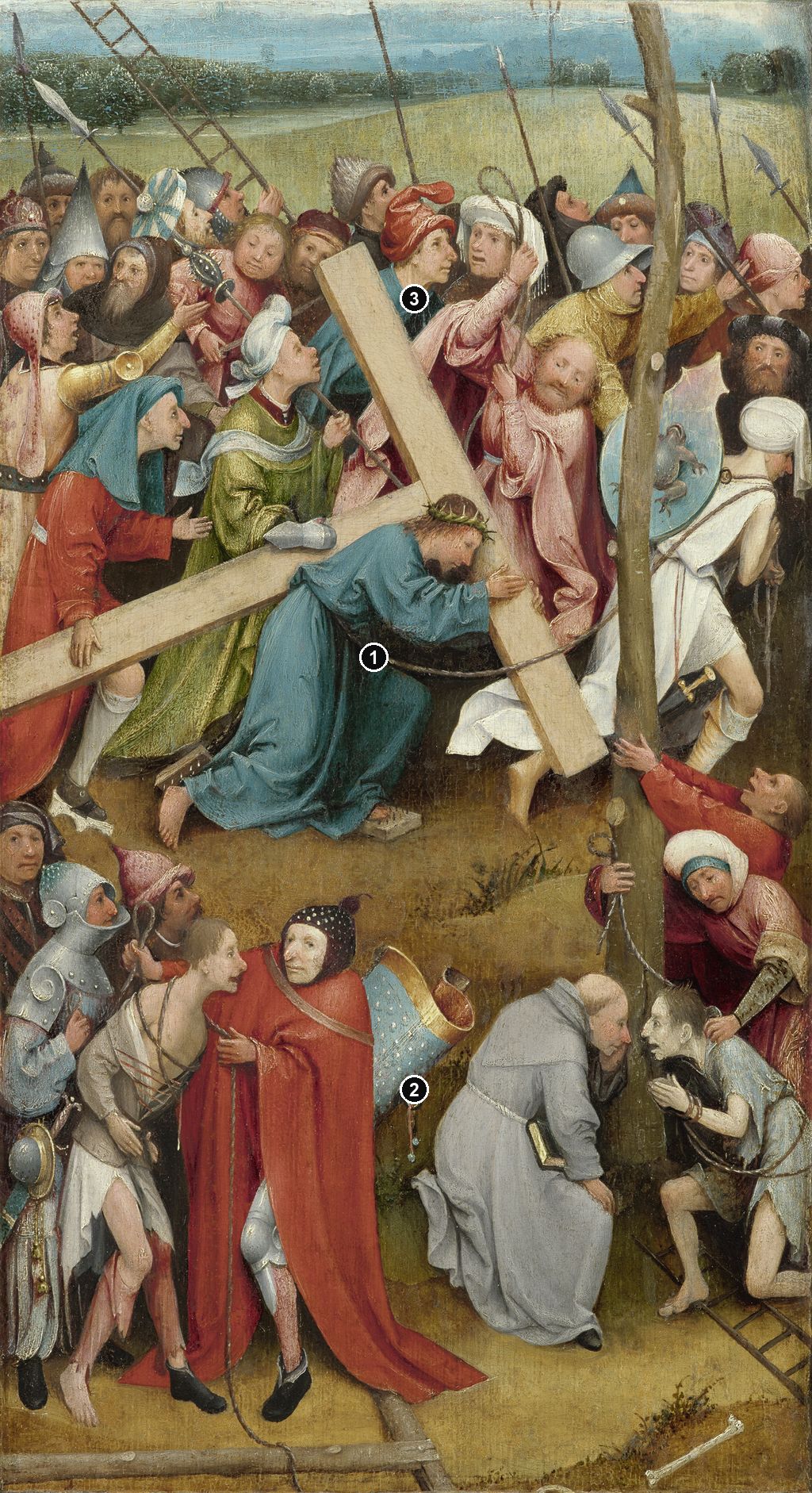
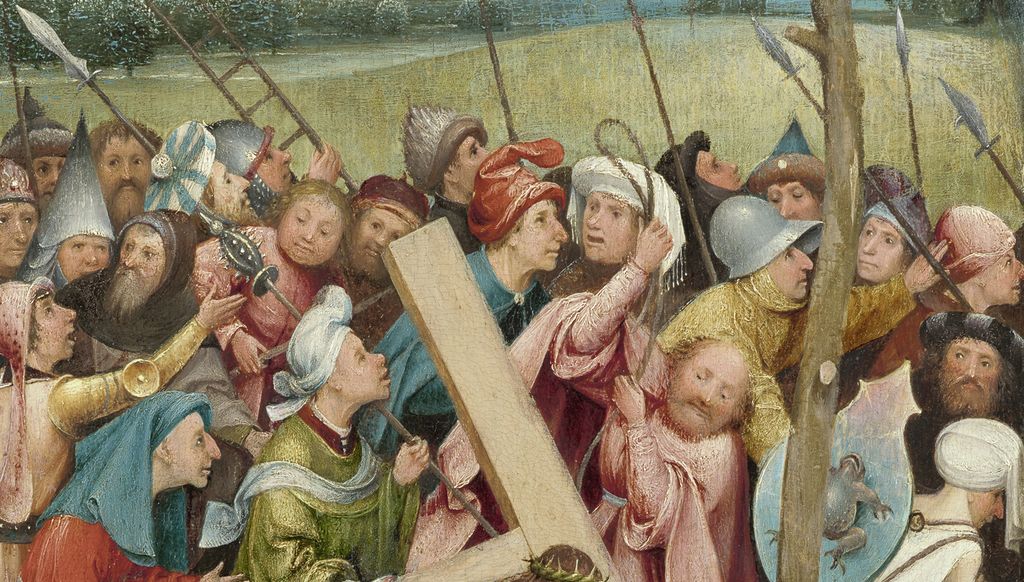
Christ bends beneath a pale wooden cross while an armed procession presses around him. Below, two other condemned figures approach execution with sharply contrasting gestures. The narrow Vienna Christ Carrying the Cross turns a crowded journey into a meditation on suffering, complicity and the possibility of repentance. Its small scale does not reduce the complexity of the choices it places before the viewer.
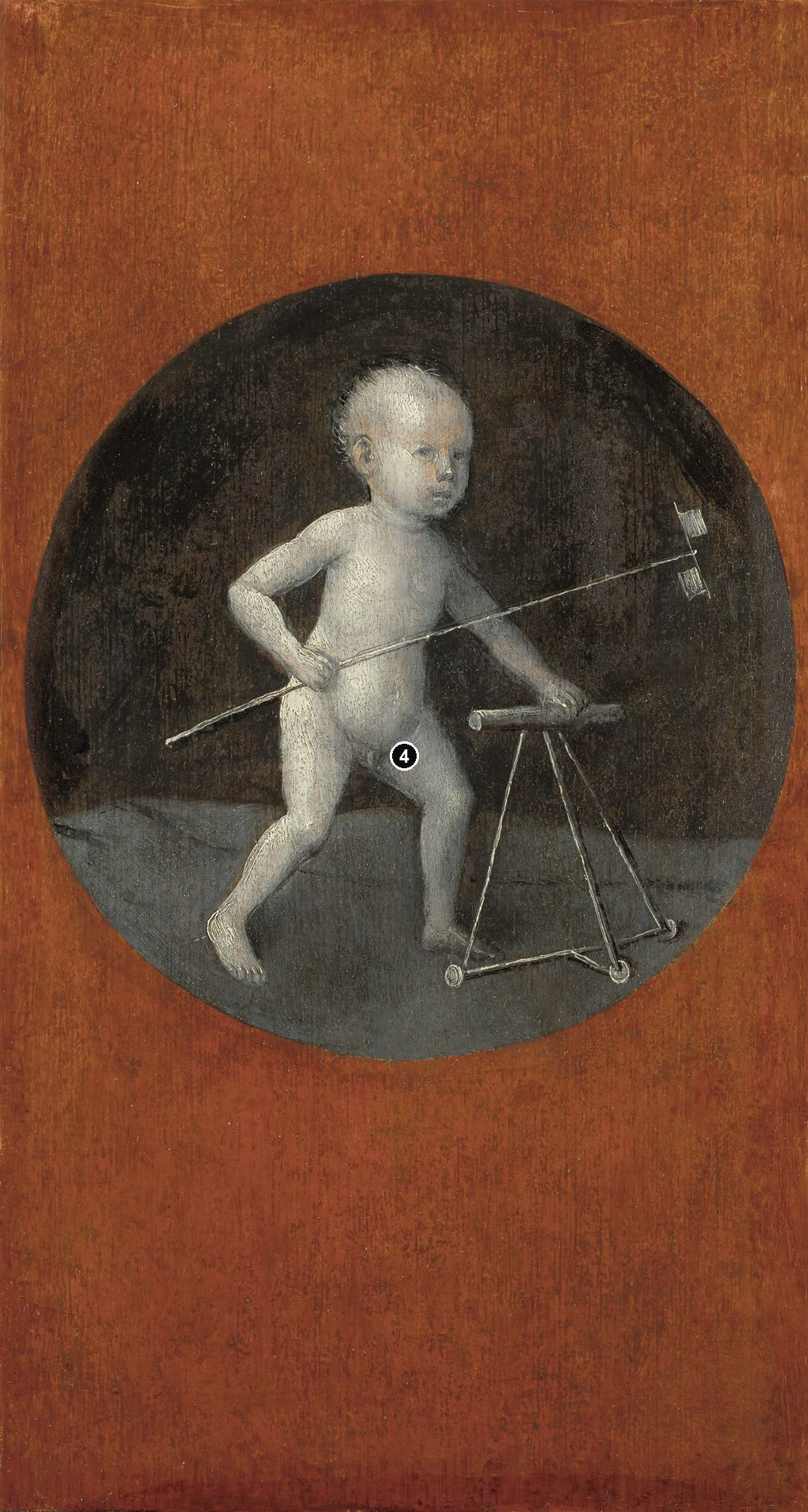
The painting is in the Kunsthistorisches Museum, Vienna, inventory GG 6429. It was originally the inside of a triptych’s left wing. On the other side, a child steadies himself with a walking frame and carries a toy windmill. These are two painted faces of one surviving oak panel, not separate pictures brought together in a modern interpretation. The museum dates the work around 1490–1510 and attributes it to Hieronymus Bosch.[1]
At a Glance
- ArtistHieronymus Bosch; possible workshop involvement in the Passion side discussed by the BRCP
- TitleChrist Carrying the Cross; Kreuztragung Christi
- DateAround 1490–1510 in the current KHM record and BRCP catalogue
- CollectionKunsthistorisches Museum, Vienna
- InventoryGemäldegalerie, GG 6429
- MediumOil on oak, painted on both sides
- DimensionsKHM: 57 × 32 cm; BRCP support measurement including added strips: 59.7 × 32 cm
- ReverseChild with a walking frame and toy windmill, generally identified as the Christ Child
- Original functionLeft wing of a dismantled triptych
Compare these works across Bosch’s career
These date ranges are estimates, not a documented year-by-year sequence. These works provide context for the article; none is highlighted as the object discussed here.
Saint Jerome at Prayer
Circa 1485–1495 [2]Crucifixion with a Donor
Circa 1490–1500 (BRCP) [2]Hermit Saints Triptych
Circa 1495–1505 [2]Saint Liberata Triptych
Circa 1495–1505 [2]The Hearing Forest and the Seeing Field
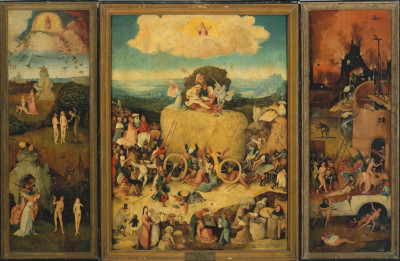
Circa 1500–1505 (Berlin exhibition) [3]The Haywain Triptych
1510–1516 (BRCP) [2]Contents
- Introduction
- Annotated Details
- Finding Christ in the Procession
- Ropes, Feet and the Weight of the Cross
- Is Anyone Helping?
- The Two Condemned Figures Below
- Figures Who Look Back at Us
- A Wing Cut Away from Its Altarpiece
- The Child on the Reverse
- Different Ways of Painting the Two Sides
- Date, Measurements and Conservation
Annotated Details from Christ Carrying the Cross: Vienna Panel
The crowded procession occupies the front of the Vienna panel. A small child with a walking frame appears on the reverse of the same support.
Vienna Procession
Vienna Child on Reverse
Details from CHRIST CARRYING THE CROSS: VIENNA PANEL
Explore the numbered details and compare the two faces.
Vienna Procession
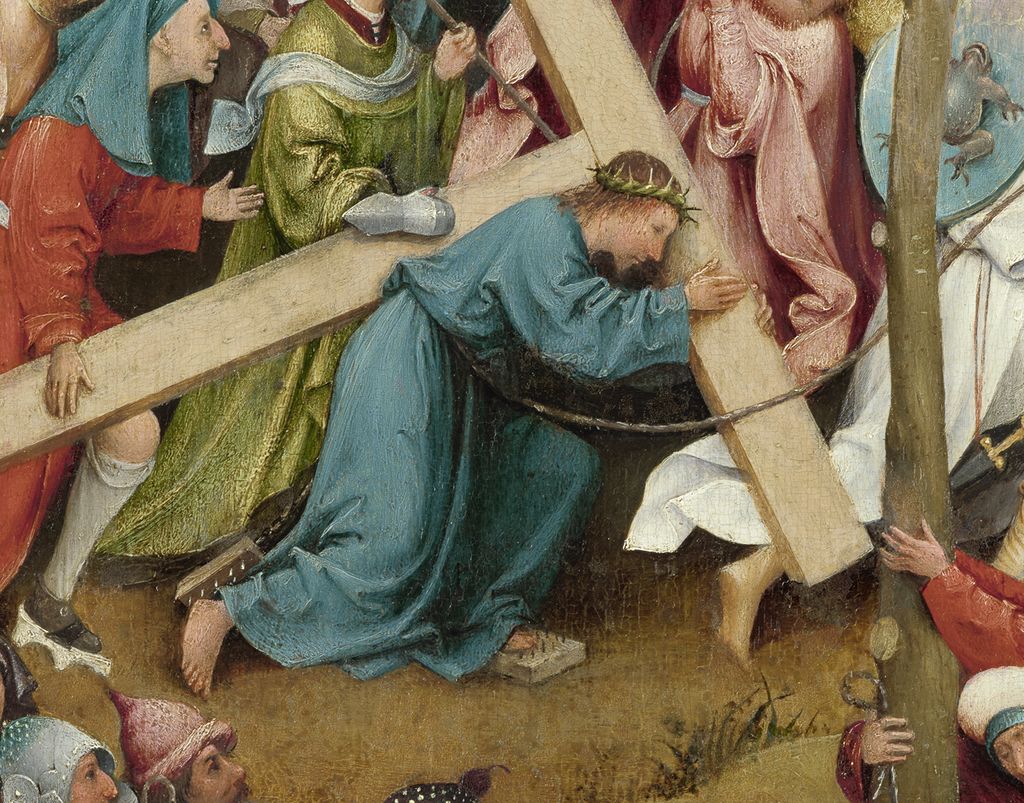
Christ beneath the cross
Christ bends beneath the large wooden cross. Its long diagonal beam cuts through the crowd and connects the upper procession with the open ground below.
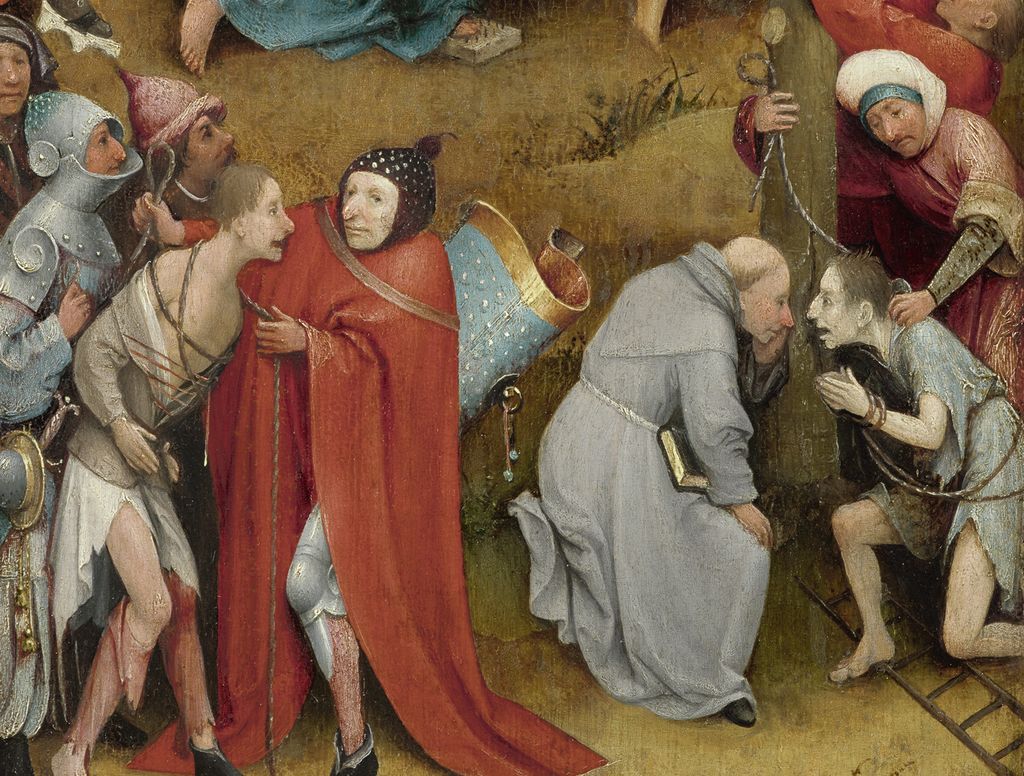
The two condemned men
The two nearly naked figures occupy opposite sides of the foreground. The grey-robed attendant bends towards the man on the right, while another figure stands close to the man on the left.
Faces in the procession
Helmets, caps, weapons and turned faces crowd the upper part of the panel. The variety of directions keeps the procession from forming a single uniform line.
Vienna Child on Reverse
Child and walking frame
The child steps inside a light wooden frame. One hand steadies the frame while the other holds a stick with a small windmill at its far end.
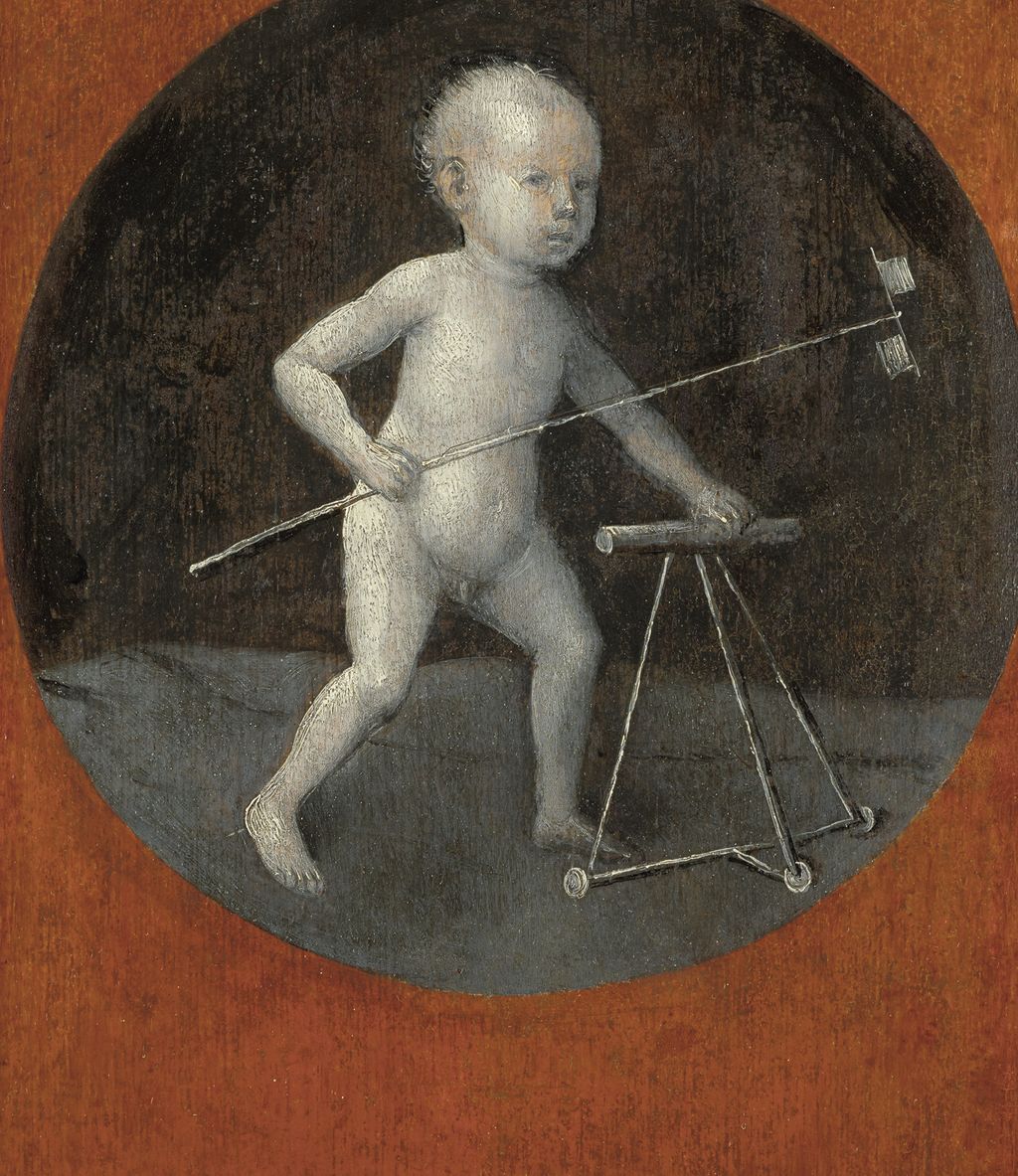
Image and detail crops: Wikimedia Commons source 1; Wikimedia Commons source 2 (public domain reproductions).
Finding Christ in the Procession
The cross establishes the strongest movement through the picture. Its long beam rises across Christ’s body, while the crosspiece stretches towards the left edge. The pale wood separates itself from the patterned helmets, coloured garments and overlapping faces behind it. We can trace its shape quickly, but finding a clear path for the person carrying it is much harder. Bodies and equipment fill almost every available gap.
Christ’s dark blue-green robe falls in folds around his lowered body. His head is bowed, and his hands gather against the timber. The contrast between his posture and the surrounding figures gives the burden its force. Others stand erect, turn their heads or raise an arm. He has little freedom to move. His bent position is both a physical response to weight and the compositional centre around which those other movements occur.
The landscape offers only a short release from this pressure. A strip of sky and distant greenery appears above the heads, but the procession occupies the foreground and middle distance. Spears, a ladder and an upright trunk carry the crowd’s activity into the narrow space overhead. The surviving format makes the journey seem compressed, although its present upper edge is the result of later cutting rather than a complete original boundary.
Ropes, Feet and the Weight of the Cross
The violence is communicated through small contacts as well as conspicuous gestures. A rope circles Christ’s waist and runs towards the figure in white ahead of him. Another figure raises a loop beside his head. The cross is therefore part of a larger system of restraint: Christ carries an object while other people control his direction and pace.
Near his feet are spiked wooden blocks suspended by cords. The BRCP catalogue identifies one beneath his stepping foot and another striking at his heel.[4] These devices add a particular cruelty to the act of walking. A bare foot has no safe place to land, and a movement that might carry him forwards also brings a new injury. The detail rewards looking below the large diagonal timber towards the body it bears down upon.
The figures around him are not all represented by the same action. One gestures, another touches the cross, others watch or push through the group. Their differentiated poses make the procession more disturbing than a simple wall of identical tormentors. An unusual face or elaborate headdress does not establish a person’s ethnicity or moral character. The picture’s clearest evidence of coercion lies in the ropes, raised loop, armed escort and restricted movement.
Is Anyone Helping?
A man behind Christ places a hand on the cross. That gesture might initially suggest Simon of Cyrene, the person compelled to carry it in the Gospel accounts of Matthew, Mark and Luke. Luke 23:26 specifically describes Simon carrying the cross behind Jesus. John 19:17, by contrast, describes Jesus going out bearing it himself.[5][6]
The BRCP authors question whether the man in Vienna is actually supporting the weight. They distinguish him from the clearly assisting Simon in Bosch’s larger El Escorial painting and note a change to his hand between underdrawing and paint.[4] His proximity therefore raises a question rather than supplying an uncomplicated example of compassion. Touching the cross and helping Christ carry it need not mean the same thing.
This ambiguity is effective because the viewer is free to notice it. The man’s hand, pointing gesture and clothed feet can be compared with Christ’s absorbed posture and exposed feet. We can look for assistance within the crowd and fail to find a fully reassuring answer. The painting invites that examination without providing a written identification for every person around the cross.
The Two Condemned Figures Below
The foreground forms a second episode within the same journey. At the left, a lightly clothed prisoner is held among an armoured figure and a man in a brilliant red cloak. At the right, another prisoner kneels close to a grey-robed cleric, with hands drawn together and head inclined. The difference between the two groups is immediately visible in their poses: restraint and agitation on one side, concentrated conversation on the other.
These figures are the two criminals executed beside Christ, traditionally called the Good and Bad Thieves. Luke’s account distinguishes the one who reviles Jesus from the one who acknowledges his own guilt and asks to be remembered. Jesus promises the latter a place in paradise. The Gospel places that exchange on the crosses; the painting anticipates the moral distinction before the executions.[5]
The cleric hearing the kneeling prisoner’s confession belongs to a devotional interpretation of the event rather than to a detail narrated by Luke. His presence makes repentance recognisable through a practice familiar to the painting’s Christian audience. The remaining cross timbers and execution equipment connect the intimate exchange to what is about to happen. There is still time for an act of acknowledgement within a scene whose physical outcome appears fixed.
Figures Who Look Back at Us
Several faces interrupt the procession’s general direction. At the lower left edge, a figure looks out towards the viewer. The red-cloaked man in the foreground also turns his face away from the prisoners’ immediate action. Their glances create a different relationship with the picture from that of the people who appear wholly occupied by the journey.
The effect is to make the viewer’s position less comfortable. We stand outside the scene, but these faces acknowledge a space beyond it. The lower groups then provide a route towards Christ: the eye can move from one prisoner to the other and upwards into the main procession. The picture offers more than a distant account of an event. It arranges different responses to suffering within a field that we must examine.
The catalogue raises the possibility that an outward-looking face might be a portrait, but no secure identity follows from that suggestion.[4] Naming Bosch himself or an unknown patron would give the glance a certainty it does not possess. Its role in directing attention remains visible even when the individual’s name is lost.
A Wing Cut Away from Its Altarpiece
The present rectangle does not preserve the original format. A remnant of curved paint edge shows that the wing once had a quarter-round top. It lost part of its upper section and some of its lower edge; later wooden additions helped give it a rectangular outline. The BRCP technical study reconstructs a loss of roughly 23–25 cm above, while museum descriptions have used somewhat smaller estimates.[7]
The missing centre and right wing leave the complete programme uncertain. A Crucifixion in the centre is a plausible proposal, with an Entombment or Resurrection suggested for the other wing. A young John the Baptist has been proposed as the companion to the child on the closed exterior. Those are reconstructions based on surviving structure, subject and comparisons, not a list of panels whose appearance or whereabouts is securely documented.[4]
Opening and closing the triptych would have changed its visual character. The crowded, strongly coloured procession belonged to the open state; the solitary child occupied the outside. The contrast was therefore built into a movable devotional object. A visitor looking only at a reproduction of the front loses both the reverse image and the physical act that once alternated between them.
The Child on the Reverse
Within a dark roundel against red, a naked child holds a long toy windmill and rests the other hand on a small wheeled walking frame. One leg reaches forwards while the other extends behind. The child is alone, without the crowd, weapons or execution equipment of the opposite side. Yet movement remains central: this body is also learning how to carry itself through space.
The frame’s thin bars are particularly economical. Pale and dark strokes establish its edges, while the grey behind contributes a middle tone. The child’s head and limbs likewise emerge from a limited range of lights and shadows. Instead of the front’s many competing colours, Bosch builds an image around a few carefully placed contrasts. The circular boundary gives the tentative step a self-contained setting.
The KHM’s description preserves two readings, the Christ Child and an allegory of unreason, while emphasising the contrast between the child’s innocence and the Passion scene’s cruelty.[1] The BRCP argues specifically for the young Christ, relating the toddler’s position to the suffering figure on the other face.[4] These accounts need not be flattened into one entirely settled label. The generally used title Christ Child is an interpretation with a strong devotional rationale.
Seen together, the two sides connect beginning and ending, unstable first steps and the struggle towards execution. That relationship does not require the toy to be called a miniature cross or every bar of the walking frame to carry a secret meaning. The strongest comparison is already embodied in the two figures’ movements and in their placement on opposite sides of one panel.
Different Ways of Painting the Two Sides
Technical examination found extensive preparation beneath the procession. Outlines, reinforced details and hatched shadows developed through more than one stage. The reverse contains much less detectable drawing and was largely painted while the colours were still wet. The report distinguishes these approaches without treating the mere absence of elaborate underdrawing as proof of a different artist.[7]
The front also preserves revisions. The kneeling prisoner’s legs and the cleric’s lower outline were adjusted, while the angle of a weapon and the shape of a headpiece changed. Such differences reveal decisions made as the composition developed. They are useful evidence of a working process, but they do not identify a named assistant or assign every garment to a particular hand.[7]
The BRCP accepts the panel within Bosch’s work while considering workshop participation possible in the less refined execution of the Passion scene. It praises the reverse’s handling particularly highly.[4][7] The attribution can therefore remain Bosch while the discussion acknowledges collaboration as a possibility. That is a more precise account than either declaring every stroke equally autograph or relabelling the whole object a follower’s copy.
Date, Measurements and Conservation
The current museum record gives a date around 1490–1510, also used in the BRCP’s headline dating. The range remains a scholarly estimate. The technical study explains that added strips obstructed the wood’s end grain and that an attempted tree-ring assessment did not produce a usable measurement; there is no precise dendrochronological painting date to quote.[1][7]
The measurements likewise need context. The museum lists 57 × 32 cm. The BRCP measured the support at 59.7 × 32 cm and explicitly included added top and bottom strips. These records should not be silently combined into one supposedly exact measurement of the untouched original. Neither describes the full height of the wing before it was cut down.[1][7]
The panel underwent treatment in 2014–2015, after the BRCP’s principal examination in 2011. The technical report records yellowed varnish, old retouching, landscape losses on the front and abrasion on the child’s side. Those observations largely describe the earlier examination, rather than the completed treatment’s result. The reverse had once been covered in brown paint; its recovery began with earlier twentieth-century treatment.[7] Present reproductions can therefore record different stages of cleaning and restoration.
Vienna, Ghent and El Escorial
Several Bosch-related paintings share the title Christ Carrying the Cross. Vienna GG 6429 is the narrow, double-sided wing with two prisoners in the foreground. The painting in Ghent, inventory 1902-H, is a separate, much wider composition that crowds faces tightly around Christ and includes Veronica’s cloth.[8] It should not be substituted for the Vienna panel or used to supply its dimensions.
The El Escorial work is another distinct object, inventory 10014739, measuring 142.8 × 104.3 cm in the BRCP catalogue. Its more monumental composition shows Simon’s assistance more clearly.[4] Similar subjects and repeated motifs permit comparison, but they do not make the three paintings interchangeable versions of one physical object. Their supports, formats and histories require separate accounts.
Vienna’s documented provenance becomes firm in the twentieth century: the English art trade, Frederik Muller & Cie in Amsterdam in January 1923, and the KHM’s purchase from Goudstikker that year.[1] The original commissioner remains unidentified. The museum’s ownership history anchors the surviving fragment without recovering the complete altarpiece from which it was separated.
The panel’s two faces finally bring attention back to the vulnerability of movement. On one side, a child tests a step with the help of a small frame. On the other, Christ must move under a burden while those around him complicate rather than ease the journey. The foreground prisoners add the possibility of a changed response before death. Material loss has reduced the original ensemble, but these relationships remain available within the surviving wing.
Artworks and related attributions
Browse paintings, drawings and related attributions. Records group triptychs, fragments and two-sided sheets where appropriate. Dates follow the cited museum records or catalogue headings and are generally estimates. Rows marked “2016 catalogue” report that publication’s attribution and collection information; these are dated opinions, rather than a claim that every work is an accepted autograph Bosch.
| Name | Date | Medium, attribution and collection |
|---|---|---|
| A Crossbowman | Second half of the sixteenth century | Oil on oak panel · Copy after Hieronymus Bosch · Museo Nacional del Prado, Madrid · P002695 Source 1. Source 2. |
| A Woman Spinning and an Old Woman | Museum estimates: about 1480–1490 for the women and 1500–1505 for the reverse; the precise chronology is disputed | Pen and brown and grey ink on the front; pen and brown ink on the reverse · Hieronymus Bosch · Museum Boijmans Van Beuningen, Rotterdam · N 190 recto and verso (PK) Source 1. Source 2. |
| Adoration of the Child in Cologne | Second half of the sixteenth century | Oil on oak panel · Imitator of Hieronymus Bosch, in the city collection record · Wallraf-Richartz-Museum & Fondation Corboud, Cologne · WRM 0474 Source 1. Source 2. |
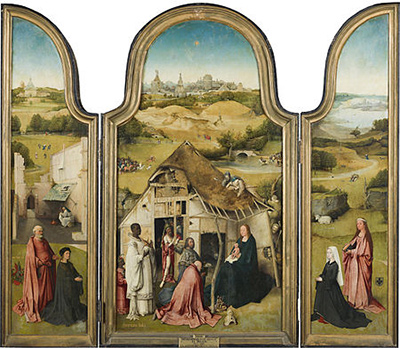
| Adoration of the Magi in Philadelphia | Early sixteenth century in the museum record; around 1495–1520 in the BRCP catalogue | Oil on oak panel · Hieronymus Bosch in the museum record; workshop of Bosch in the 2016 BRCP catalogue · Philadelphia Museum of Art, John G. Johnson Collection, 1917 · 1321; museum object 103592 Source 1. Source 2. |
| Adoration of the Magi — New York | c.1470–1480 | 2016 catalogue: Bosch; oil on oak · Metropolitan Museum 13.26 2016 catalogue. |
| Adoration of the Magi — Prado triptych | c.1494 | Oil on oak; grisaille exterior · Bosch · Prado P002048 Object source. |
| Adoration of the Magi — three associated fragments | c.1515–1535 | 2016 catalogue: Follower of Bosch · Two Shepherds / Retinue in Philadelphia; associated Adoration in private collection in 2016 2016 catalogue. |
| Ascent of the Blessed — Venice | c.1505–1515 | Oil on panel · Bosch · Gallerie dell’Accademia; Visions of the Hereafter Object source. |
| Battle of the Birds and Mammals | Not specified in catalogue heading | 2016 catalogue: Bosch; pen and brown ink · Berlin KdZ 14715 2016 catalogue. |
| Beggars and Musicians | Around 1530–1540 | Ink and wash on paper · Unknown follower of Hieronymus Bosch · Albertina, Vienna · 7798 Source 1. Source 2. |
| Christ Carrying the Cross Drawing | Around 1470 in the museum catalogue | Black chalk or charcoal, pen and brush in brown ink, white corrections · Anonymous, workshop of Rogier van der Weyden · Museum Boijmans Van Beuningen, Rotterdam · N 81 recto and verso (PK) Source 1. Source 2. |
| Christ Carrying the Cross in Vienna | Around 1490–1510 in the current KHM record and BRCP catalogue | Oil on oak, painted on both sides · Hieronymus Bosch; possible workshop involvement in the Passion side discussed by the BRCP · Kunsthistorisches Museum, Vienna · Gemäldegalerie, GG 6429 Source 1. Source 2. |
| Christ Carrying the Cross — El Escorial | c.1495–1505 | 2016 catalogue: Bosch; oil on oak · Patrimonio Nacional 10014739 2016 catalogue. |
| Christ Carrying the Cross — Ghent | c.1510–1516 (museum) | Oil on panel · Bosch in museum listing; authorship disputed · MSK Ghent 1902-H Object source. |
| Christ Mocked — London | c.1510 | Oil on wood · Bosch · National Gallery NG4744 Object source. |
| Concert in the Egg, After Hieronymus Bosch | Around 1561; third quarter of the sixteenth century | Oil on canvas · Anonymous, after Hieronymus Bosch · Palais des Beaux-Arts, Lille · P 816 Source 1. Source 2. |
| Conjurer / Comical Concert — Louvre drawing | Not specified in catalogue heading | 2016 catalogue: Bosch (recto), follower (concert verso) · Pen and brown ink · Louvre INV 19197 2016 catalogue. |
| Conjurer / Cross-bearing and beggars — Liège sheet | Not specified in catalogue heading | 2016 catalogue: Bosch (verso), follower (recto) · Pen and brown ink · Album d’Arenberg 534 2016 catalogue. |
| Crowning with Thorns — El Escorial | c.1530–1540 | 2016 catalogue: Follower of Bosch; oil on oak · Patrimonio Nacional 10014743 2016 catalogue. |
| Crucifixion with a Donor | Circa 1495–1505; Circa 1490–1500 | Oil on oak panel · Hieronymus Bosch · Royal Museums of Fine Arts of Belgium, Brussels · 6639 Source 1. Source 2. |
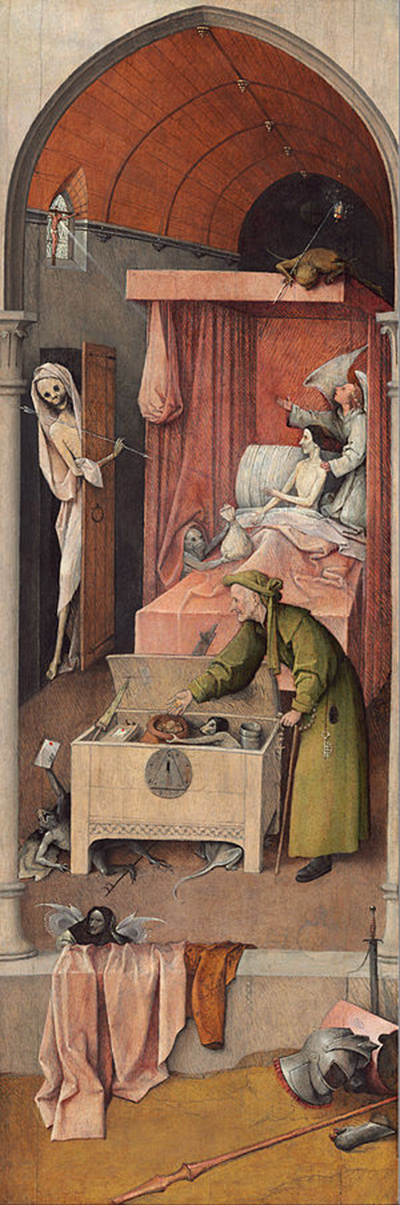
| Death and the Miser Drawing | Not securely established; probably made after the painting | Pen and brush, dark ink and white highlights on prepared paper · Workshop of Hieronymus Bosch in the BRCP catalogue; alternatives recorded by the Louvre · Musée du Louvre, Department of Prints and Drawings, Paris · RF 6947, Recto Source 1. Source 2. |
| Death and the Miser — Washington | c.1485/1490 (NGA) | Oil on panel · Bosch · National Gallery of Art 1952.5.33 Object source. |
| Ecce Homo Triptych — Boston | c.1495–1500; wings c.1500/1503 | 2016 catalogue: Workshop of Bosch; oil on oak · Museum of Fine Arts Boston; several production phases 2016 catalogue. |
| Ecce Homo — Frankfurt | c.1490 | Mixed technique on oak · Bosch · Städel 1577 Object source. |
| Fall of the Damned — Venice | c.1505–1515 | 2016 catalogue: Bosch; oil on panel · Visions of the Hereafter · Venice 2016 catalogue. |
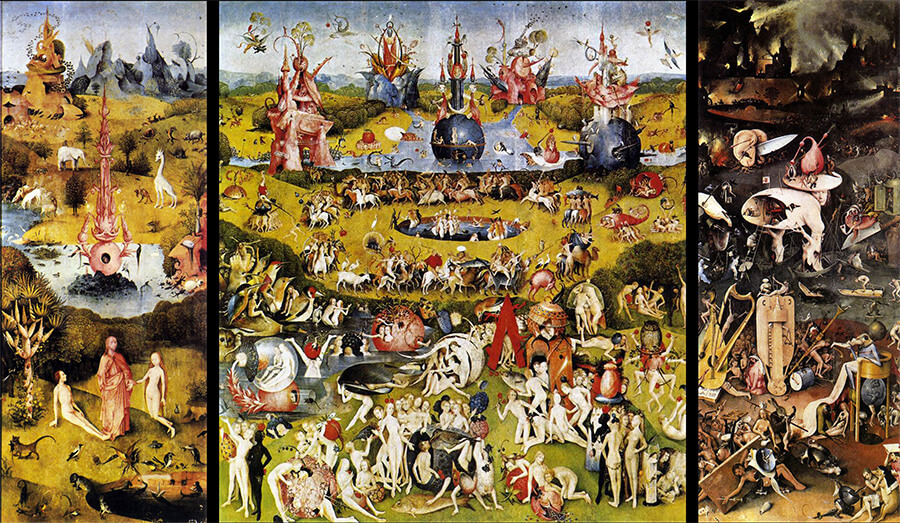
| Garden of Earthly Delights | 1490–1500 (Prado) | Oil on oak; grisaille exterior · Bosch · Prado; triptych Object source. |
| Gluttony and Lust / Allegory of Intemperance — Yale fragment | c.1500–1510 (group dating) | 2016 catalogue: Bosch; oil on oak · Yale 1959.15.22; fragment associated with Ship of Fools 2016 catalogue. |
| Group of Ten Spectators, a Follower of Bosch | Around 1510–1540 in the current museum record | Pen and two brown inks on paper, with a brown framing line · Follower of Hieronymus Bosch in the Morgan record; Bosch in the BRCP catalogue · Morgan Library & Museum, New York · I, 112 Source 1. Source 2. |
| Head of an Old Woman | About 1500 | Oil on panel · Attributed to Jacob Cornelisz. van Oostsanen · Museum Boijmans Van Beuningen, Rotterdam · 2439 (OK) Source 1. Source 2. |
| Hell and the Flood — Rotterdam panels | Around 1515 in the museum records; around 1510–1520 in the BRCP catalogue | Oil on oak panels · Jheronimus Bosch in the museum records; workshop of Bosch in the BRCP catalogue · Museum Boijmans Van Beuningen, Rotterdam Source 1. Source 2. |
| Hermit Saints Triptych | Circa 1495–1505 | Oil on oak panels · Hieronymus Bosch · Gallerie dell’Accademia, Venice · 2044 Source 1. Source 2. |
| Infernal Landscape | Not specified in catalogue heading | 2016 catalogue: Bosch; pen and brown ink, red accent · Private collection in 2016 2016 catalogue. |
| Infernal Scene with Anvil / Monster Studies | Not specified in catalogue heading | 2016 catalogue: Bosch; attribution debated in entry · Pen and brown ink · Berlin KdZ 548 2016 catalogue. |
| Infernal Scene with Tree-Man / Standing Man | Not specified in catalogue heading | 2016 catalogue: Workshop of Bosch; pen and brown ink · Dresden C 1875; historical reverse title includes a proposed prophet 2016 catalogue. |
| Job Triptych — Bruges | c.1510–1520 | 2016 catalogue: Workshop of Bosch; oil on oak · Groeningemuseum / Hoeke loan in 2016 2016 catalogue. |
| Last Judgement — Bruges triptych | c.1495–1505 | 2016 catalogue: Bosch; oil on oak · Groeningemuseum 2016 catalogue. |
| Last Judgement — Munich fragment | c.1530–1540 | 2016 catalogue: Follower of Bosch; oil on oak · Alte Pinakothek 5752 2016 catalogue. |
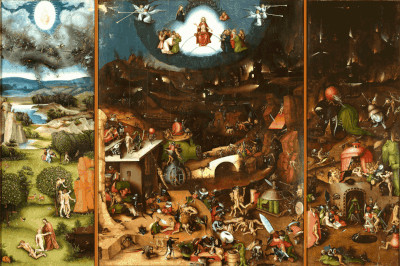
| Last Judgement — Vienna triptych | c.1500–1505 (BRCP 2016) | Oil on oak · Bosch and workshop (BRCP 2016) · Academy of Fine Arts Vienna 2016 catalogue. |
| Man in a Basket and Comic Figures | Around 1500–1515 in the museum record | Pen and brown ink on paper; the reverse is catalogued as iron-gall ink · Hieronymus Bosch in the current Albertina record; attribution has been debated · Albertina, Vienna · 7797 recto and verso Source 1. Source 2. |
| Man Seen from Behind | About 1550–1569; About 1565–1570 | Traces of black chalk, pen and brush in light brown ink · Anonymous, circle of Pieter Bruegel the Elder · Museum Boijmans Van Beuningen, Rotterdam Source 1. Source 2. |
| Mary and John at the Foot of the Cross | About 1440 | Brush in grey and black · Unknown, possibly Netherlandish · Kupferstich-Kabinett, Staatliche Kunstsammlungen Dresden · C 815 Source 1. Source 2. |
| Model Sheet with ‘Witches’ | Disputed; proposals depend on the attribution | Pen and brown ink; the BRCP also records underlying black chalk · Hieronymus Bosch; follower attributions also recorded · Musée du Louvre, Département des Arts graphiques, Paris · INV 19721 recto Source 1. Source 2. |
| Peasant and Three Bust-Length Figures | 1401–1500 | Brown pen over a black preliminary drawing · Attributed to the Master of the Drapery Studies; Bosch circle also recorded · Kupferstichkabinett, Staatliche Museen zu Berlin · KdZ 777 Source 1. Source 2. |
| River to Hell — Venice | c.1505–1515 | 2016 catalogue: Bosch; oil on panel · Visions of the Hereafter · Venice 2016 catalogue. |
| Saint Anthony and a Concert in an Egg | Around 1510–1525 in the museum’s 2016–17 exhibition texts | Pen in light and dark brown inks · Workshop of Hieronymus Bosch; underlying monsters: Bosch (BRCP), possibly Bosch (exhibition text) · Kupferstichkabinett, Staatliche Museen zu Berlin · KdZ 711 recto and verso Source 1. Source 2. |
| Saint Christopher Carrying the Christ Child | c.1500; 1490–1505 in restoration material | Oil on panel · Bosch · Boijmans St 26 Object source. |
| Saint James and Hermogenes | About 1551–1575 in the KIK-IRPA catalogue | Oil on wood, painted on both sides · Anonymous follower of Hieronymus Bosch · Musée des Beaux-Arts, Valenciennes · P.46.1.44; older number 176 Source 1. Source 2. |
| Saint Jerome at Prayer | Circa 1485–1495 | Oil on oak panel · Hieronymus Bosch · Museum of Fine Arts, Ghent · 1908-H Source 1. Source 2. |
| Saint John on Patmos / Passion Scenes | c.1495–1505; estimates vary | Oil on oak · Bosch · Gemäldegalerie Berlin 1647A Object source. |
| Saint John the Baptist in Meditation | Late 15th century; c.1485–1510 (Prado exhibition) | Oil on panel · Bosch · Lázaro Galdiano 8155 Object source. |
| Saint Liberata Triptych | Circa 1495–1505 | Oil on oak panels · Hieronymus Bosch · Gallerie dell’Accademia, Venice · 2045 Source 1. Source 2. |
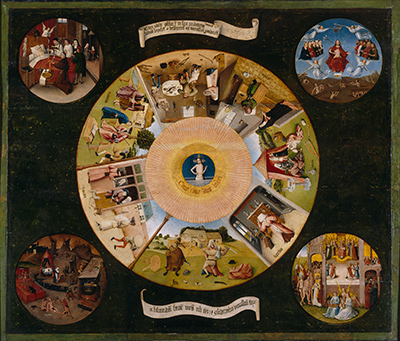
| Seven Deadly Sins and the Four Last Things | 1505–1510 (Prado) | Oil on poplar · Bosch (Prado); workshop/follower disputed · Prado Object source. |
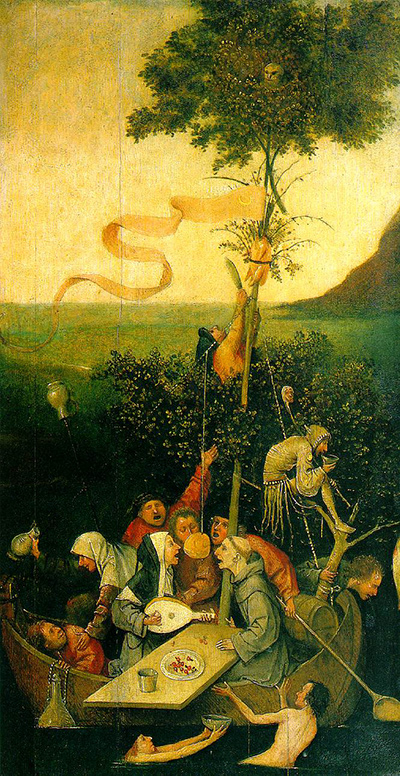
| Ship of Fools — Louvre painting | 1475–1500 (record); c.1505–1515 (exhibition) | Oil on oak · Bosch · Louvre RF 2218; fragment Object source. |
| Ship of Fools — Louvre workshop drawing | Not specified in catalogue heading | 2016 catalogue: Workshop of Bosch · Pen, brush, grey-brown ink and white highlights on prepared paper · Louvre RF 3714 2016 catalogue. |
| Studies of Monsters | About 1530–1550, according to the current Ashmolean record | Pen and brown ink on laid paper, both faces · Anonymous follower of Hieronymus Bosch · Ashmolean Museum, University of Oxford · WA1863.155 Source 1. Source 2. |
| Studies of Saint Anthony and Monsters | No execution date specified in the current Louvre records | Pen and brown ink on paper · Bosch listed; reverse questioned by Louvre; BRCP accepts both faces · Musée du Louvre, Département des Arts graphiques, Paris · INV 20871 recto and verso Source 1. Source 2. |
| Temptation of Saint Anthony — Kansas City fragment | c.1500–1510 | 2016 catalogue: Bosch; oil on oak · Nelson-Atkins 35–22 2016 catalogue. |
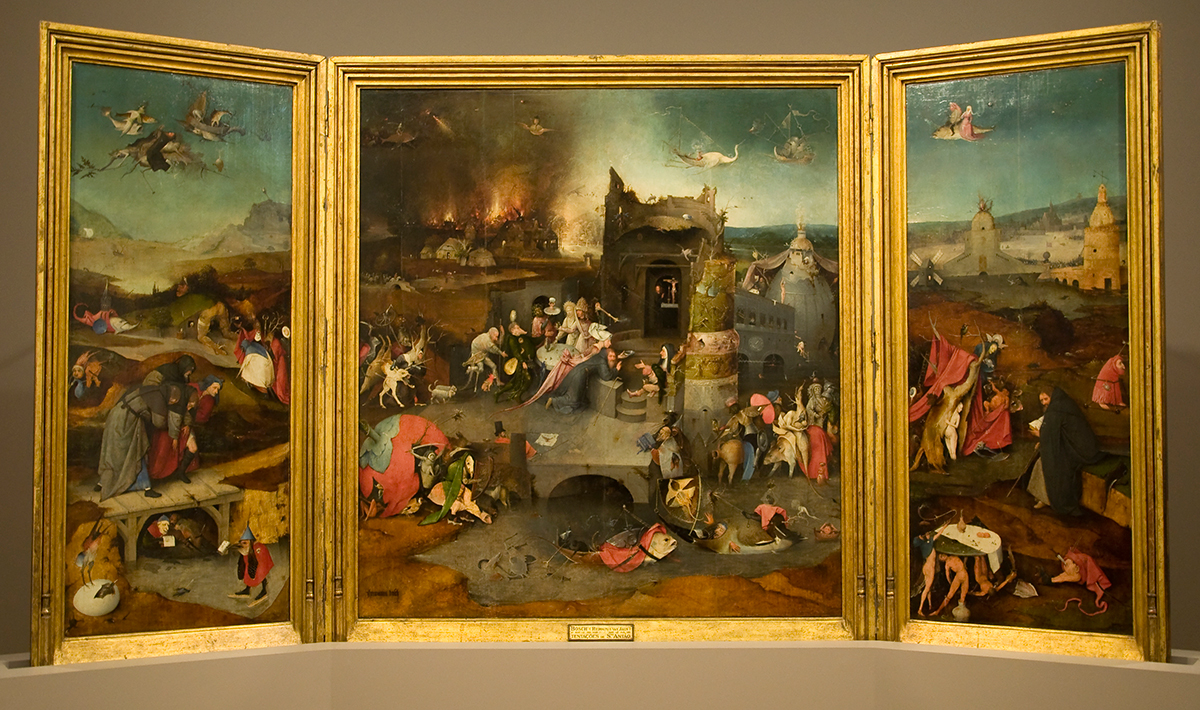
| Temptation of Saint Anthony — Lisbon triptych | c.1500 | Oil on oak · Bosch · Museu Nacional de Arte Antiga 1498 Pint Museum. |
| Temptation of Saint Anthony — Prado panel | c.1530–1540 | 2016 catalogue: Follower of Bosch (2016 opinion); oil on oak · Prado P002049 2016 catalogue. |
| Terrestrial Paradise | Approximately 1505–1515 | Oil on oak panel · Hieronymus Bosch · Gallerie dell'Accademia, Venice Source 1. Source 2. |
| The Burning Ship Drawing | 1500–1520 | Pen and iron gall ink on paper · Attributed to Hieronymus Bosch · Academy of Fine Arts Vienna, Graphic Collection · HZ-2554; numbered 2554 in the BRCP catalogue Source 1. Source 2. |
| The Comical Barber Scene | About 1550–1580, according to the British Museum | Pen and brown ink, grey and brown wash, over black chalk · Anonymous follower, after Hieronymus Bosch · British Museum, Department of Prints and Drawings, London · 1854,0628.46 Source 1. Source 2. |
| The Conjuror, After Hieronymus Bosch | Probably after 1525; around 1530–1540 in the BRCP technical report | Oil on oak panel · Anonymous follower of Hieronymus Bosch · Musée Ducastel-Vera, Saint-Germain-en-Laye · 872.1.87 Source 1. Source 2. |
| The Cure of Folly / Extraction of the Stone of Madness | 1501–1505 (Prado) | Oil on oak · Bosch (Prado); workshop/follower disputed · Prado P002056 Object source. |
| The Entombment Drawing | About 1505–1515, current museum record | Brush and black and grey ink, with grey wash, over black chalk · Workshop of Hieronymus Bosch; drawn by the Master of the Prado Haywain Triptych; Hieronymus Bosch, argued by the BRCP in 2016 · British Museum, Department of Prints and Drawings, London · 1952,0405.9 Source 1. Source 2. |
| The Gathering of the Birds | Not specified in catalogue heading | 2016 catalogue: Bosch; pen and brown ink · Berlin KdZ 13136 2016 catalogue. |
| The Haywain — Prado triptych | 1510–1516 (BRCP 2016) | Oil on oak · Bosch (BRCP 2016) · Prado; separate Escorial version exists 2016 catalogue. |
| The Hearing Forest and the Seeing Field | Circa 1500–1505 | Pen and brown ink on paper · Hieronymus Bosch; reverse: Bosch and workshop · Kupferstichkabinett, Staatliche Museen zu Berlin · KdZ 549, front and reverse Source 1. Source 2. |
| The Owl’s Nest — Rotterdam | Not specified in catalogue heading | 2016 catalogue: Bosch; pen and brown ink · Boijmans N 175 2016 catalogue. |
| The Passion Triptych in Valencia | Workshop of Bosch, about 1510–1520; Follower of Bosch; centre about 1530–1540, wings about 1540–1550 | Oil and gold on oak panels · Workshop of Bosch, about 1510–1520; Follower of Bosch; centre about 1530–1540, wings about 1540–1550 · Museu de Belles Arts de València Source 1. Source 2. |
| The Pedlar / Wayfarer — Rotterdam | c.1500 (museum) | Oil on panel · Bosch · Boijmans 1079 (OK); rejoined exterior Object source. |
| The Tree-Man — Vienna drawing | c.1505 | Pen and brown ink · Bosch · Albertina, Vienna Object source. |
| The Wedding at Cana, After Hieronymus Bosch | Approximately 1560 in the current museum record | Oil on panel, 93 cm high × 72 cm wide · Anonymous, after Hieronymus Bosch · Museum Boijmans Van Beuningen, Rotterdam, St 25 Source 1. Source 2. |
| Two Fantastical Creatures — Berlin KdZ 550 | Around 1505–1515 in the museum’s 2016 exhibition text | Pen in brown ink on reddish prepared laid paper · Hieronymus Bosch · Kupferstichkabinett, Staatliche Museen zu Berlin · KdZ 550, recto and verso Source 1. Source 2. |
| Two Figures Wearing Mitres | About 1480 | Oil on panel · Anonymous (Boijmans); Bosch circle (RKD) · Museum Boijmans Van Beuningen, Rotterdam · 1177 (OK) Source 1. Source 2. |
| Two Men and the Temptation of Eve | About 1505–1515 in the Prado’s 2016 exhibition guide | Pen and grey-brown ink on paper · Hieronymus Bosch in the 2016 catalogues discussed here · Private collection, as recorded in 2016 Source 1. Source 2. |
| Two Men Fighting | Not specified in the current Louvre record | Pen and brown ink · In the manner of Hieronymus Bosch · Musée du Louvre, Département des Arts graphiques, Paris · INV 20660 recto; formerly NIII 8896 and MA 8400 Source 1. Source 2. |
| Two Men — Berlin KdZ 5210 | Not specified in catalogue heading | 2016 catalogue: Bosch questioned · Pen, brush, ink, chalk and white highlights · Berlin KdZ 5210; historical title Two Oriental Men 2016 catalogue. |
| Two Monsters — Berlin KdZ 547 | Approximately 1500–1510 in Berlin's 2016 exhibition catalogue; an estimated range | Pen and brown ink on paper · Hieronymus Bosch · Kupferstichkabinett, Staatliche Museen zu Berlin · KdZ 547, drawn on both sides Source 1. Source 2. |
Frequently Asked Questions
Discussion
Look beneath the cross to the restraints and feet, then compare the child on the other side of the panel.
Reader Insights
How do the ropes and spiked blocks change your reading of the cross’s weight?
Does the man touching the cross appear to help? Which visible detail shapes your answer?
What changes when the suffering procession is compared with the child learning to walk on the reverse?
Join the Conversation
Share a detail, comparison or question about Christ Carrying the Cross in Vienna below.
References
- Kunsthistorisches Museum, Kreuztragung Christi, GG 6429, complete current object description, metadata and provenance; German text within the English site. View source.
- BRCP Catalogue Raisonné (2016), object dates in catalogues 1, 2, 8, 15 and 20; catalogue 20 object metadata only for the Haywain comparison. View source
- Staatliche Museen zu Berlin, 2016 exhibition wall texts, p. 3: approximate date of KdZ 549. View source
- Matthijs Ilsink and colleagues, Hieronymus Bosch, Painter and Draughtsman: Catalogue Raisonné (2016), catalogue 12, pp. 236–247, complete entry; catalogue 13, p. 248, bounded El Escorial object comparison. View source.
- Gospel of Luke 23:26–43, United States Conference of Catholic Bishops, the journey, two criminals and promise to the penitent prisoner. View source.
- Gospel of John 19:16–18, United States Conference of Catholic Bishops, Jesus bearing his cross. View source.
- Bosch Research and Conservation Project, Christ Carrying the Cross / Christ Child, technical study, catalogue 12, research reports 9–10, pp. 192–205, complete report. View source.
- Museum of Fine Arts Ghent, Christ Carrying the Cross, 1902-H, current object description and metadata for the separate Ghent painting. View source.
- Splash image, Hieronymus Bosch, Christ Carrying the Cross, around 1490–1510, Kunsthistorisches Museum, Vienna, GG 6429. View source.