by Tom Gurney
Tom Gurney BSc (Hons) is an art history expert with over 20 years experience
Published on June 19, 2020 / Updated on November 4, 2026
Email: tomgurney1@gmail.com / Phone: +44 7429 011000
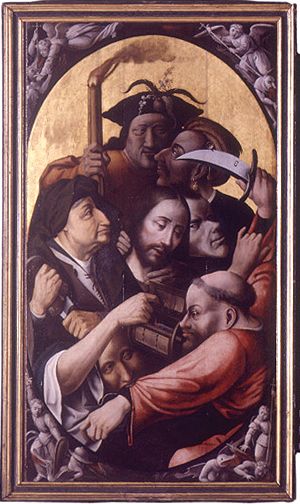
Christ appears three times in the Passion Triptych at the Museu de Belles Arts de València. On the left he is seized by an armed crowd; in the centre he is crowned with thorns; on the right he is beaten. Each episode brings large figures close to the picture surface, against gold and within a dark surround. The repeated face of Christ gives the three scenes a common focus amid sharply different gestures of violence.
The illustration here shows the Arrest, the left wing, inventory 265. It belongs with the central Crowning with Thorns, inventory 264, and the right-wing Flagellation, inventory 266.[3] Reading the panels together reveals a larger arrangement than any one of these crowded scenes can convey alone.
The museum currently attributes the ensemble to Bosch's workshop and dates it to about 1510–1520.[1] The Bosch Research and Conservation Project, or BRCP, instead classifies it as the work of a follower, with the centre painted about 1530–1540 and the wings about 1540–1550.[4] Its connection with Bosch is strong, but the date, degree of workshop involvement and relationship between the panels remain matters of scholarly disagreement.
At a Glance
- TitlePassion Triptych, also known as Triptych of the Improperios
- Left wingThe Arrest of Christ, inventory 265
- CentreThe Crowning with Thorns, inventory 264
- Right wingThe Flagellation, inventory 266
- Museum attribution and dateWorkshop of Bosch, about 1510–1520
- BRCP attribution and datesFollower of Bosch; centre about 1530–1540, wings about 1540–1550
- MediumOil and gold on oak panels
- Museum's published dimensions150.5 × 334.5 cm
- BRCP open dimensions, including framesAbout 164 × 385 cm
- CollectionMuseu de Belles Arts de València
- Earlier locationMencía de Mendoza's memorial chapel, Santo Domingo, Valencia
Compare these works across Bosch’s career
These date ranges are estimates, not a documented year-by-year sequence. These works provide context for the article; none is highlighted as the object discussed here.
Saint Jerome at Prayer
Circa 1485–1495 [2]Crucifixion with a Donor
Circa 1490–1500 (BRCP) [2]Hermit Saints Triptych
Circa 1495–1505 [2]Saint Liberata Triptych
Circa 1495–1505 [2]The Hearing Forest and the Seeing Field
Circa 1500–1505 (Berlin exhibition) [5]The Haywain Triptych
1510–1516 (BRCP) [2]Contents
- Introduction
- Annotated Details
- Three Scenes, One Repeated Centre
- The Arrest in the Left Wing
- The Crowning with Thorns
- The Flagellation in the Right Wing
- Angels and Demons at the Edges
- What the Technical Examination Shows
- Workshop, Follower and the Bosch Name
- Mencía de Mendoza and the Valencia Chapel
- Looking across the Whole Triptych
Annotated Details from The Passion Triptych in Valencia
The existing article photograph shows the left wing. This supplementary view places it beside the centre and right wing of the surviving Valencia triptych.
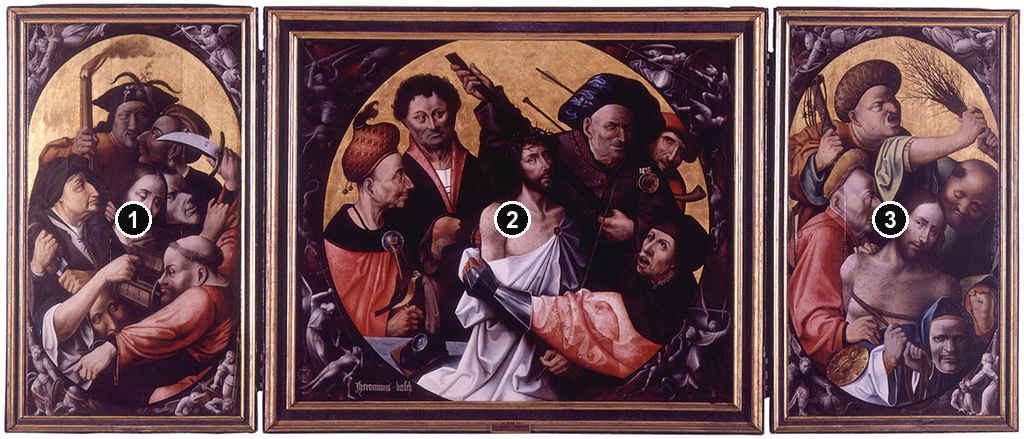
Details from THE PASSION TRIPTYCH IN VALENCIA
Each panel is isolated below at the source photograph’s native resolution. The article explains the different dates and attribution proposals.
The left wing
Faces press around Christ within the left wing’s gilded field. Hands, a raised arm and the curved outer boundary compress the group into the narrow panel.
The central panel
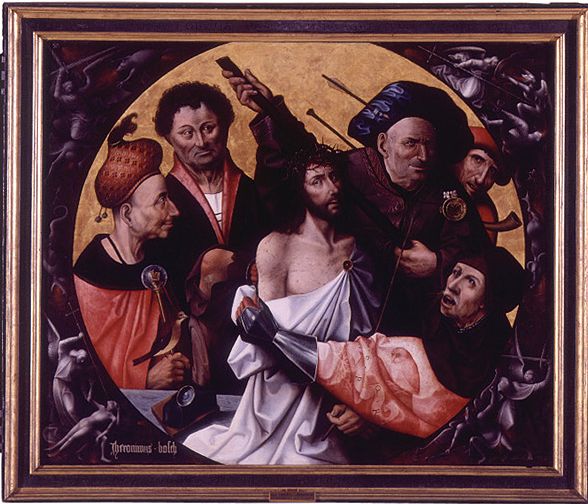
The centre shows Christ amid a larger crowd. A raised fist, pointed implements and turned faces surround the pale upper body.
The right wing
The right wing repeats the close arrangement of Christ and surrounding figures. The narrow format gathers heads, hands and objects into another compact group.
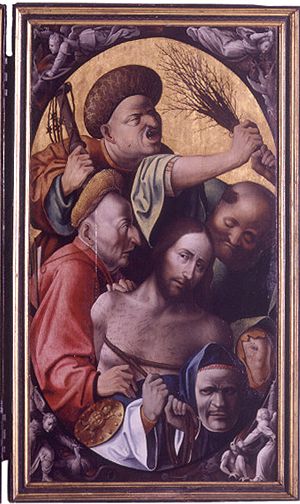
Image and detail crops: Wikimedia Commons source 1 (public domain reproductions).
Three Scenes, One Repeated Centre
The broad central panel gives the Crowning with Thorns greater prominence than either wing. Christ's pale robe opens across his chest and shoulder, making his body a bright interruption among dark garments and richly coloured sleeves. The surrounding men lean towards him, grip the cloth and raise implements above his head. A large gold circle gathers these movements into one compressed encounter.
The wings repeat the arrangement in narrower, upright ovals.[6] Christ remains the focus, but the available space squeezes the surrounding heads into taller stacks. Weapons, arms and clothing seem to have little room to unfold. The difference in format gives the side scenes a particularly insistent pressure.
The order is devotional rather than a continuous sequence read from left to right. The Arrest begins the events, but the Flagellation would precede the Crowning in the narrative sequence discussed by the BRCP.[4] Placing the Crowning at the centre gives that episode visual authority. The viewer is invited to return to Christ's suffering, rather than simply advance through an illustrated chronology.
The Arrest in the Left Wing
In the Arrest, Christ's head occupies the middle of a dense group. His eyes are lowered, his mouth is small and his dark hair falls towards his shoulders. Several faces crowd around him without sharing his expression. The contrast between his relative quietness and their activity establishes the scene before individual figures have been identified.
At the upper left, a man holds a torch whose rising shaft follows the tall format. Above Christ, another figure brings a broad curved blade across the gold background. The pale metal cuts horizontally through a composition dominated by heads arranged one above another. These weapons announce danger while also linking the upper corners of the narrow panel.
At the lower edge, a man twists beneath a raised arm. Beside him, a red-clad figure leans across the foreground, with his back and sleeve forming a large diagonal. The incident represents Peter's attack on one of the arresting party, identified in the BRCP catalogue as the moment before he cuts off the officer's ear.[4] It is a second act of violence within the larger seizure of Christ.
The foreground action is difficult to isolate from the crowd above. Arms overlap clothing, the lower head is tilted sharply, and a blade presses into the already cramped space. This makes the viewer work through the tangle of bodies. Christ's face, by contrast, remains comparatively easy to find.
The gold field does not provide a naturalistic garden or night sky. The torch and weapons carry the episode's immediate circumstances, while the background removes most of the setting. Without distant ground to absorb attention, the faces and gestures seem uncomfortably near.
The Crowning with Thorns
In the centre, Christ looks towards the viewer from beneath the thorny crown. His upper body turns slightly, and the white robe slips down from one shoulder. The exposed flesh, the thin reed and the light cloth make a vulnerable core around which the other figures arrange themselves.
A man behind him raises an implement towards the crown. Another face looks over his shoulder, while a large dark-clad man in a blue-black hat occupies the upper right. Below, a man in a red sleeve reaches across Christ's body and takes hold of the robe. The hands establish a pattern of intrusion: clothing is pulled, the head is approached from above, and the body is enclosed from both sides.
At the left, a figure wearing a decorated red headdress holds an elaborate staff-like object. His profile points towards Christ rather than out towards the viewer. A small bird stands on the pale ledge below him. Its scale is startling beside the large human figures, drawing attention to a detail that might otherwise disappear in the crowded scene.
The red sleeve is another passage that rewards close looking. Pale ornament, curved forms and small bright marks interrupt its warm colour. The BRCP relates its owl, banderole and thorn motifs to details in Bosch's Saint Wilgefortis Triptych.[4] This is evidence for familiarity with Bosch's imagery, though a borrowed motif does not settle who painted the whole panel.
The varied faces create an uneven ring around Christ. Some are frontal, others sharply turned, and several have emphatic noses, brows or mouths. Their distortions intensify the contrast with his comparatively restrained expression. They are constructed characters within a Passion image, not evidence for identifying real people or attaching moral qualities to a particular community.
The Flagellation in the Right Wing
The Flagellation returns to a narrower upright format. Christ's pale upper body is surrounded by men whose heads, hands and implements fill the remaining space. A figure at the top raises a bundle of rods, his arm stretching across the gold background. The broad gesture gives the threat a clear direction even before the lower figures are examined.
At the left, another man bends inwards towards Christ. His red clothing contrasts with the cooler passages around the exposed body. A large head behind Christ tilts downwards, while a hooded face occupies the bottom foreground. Their different angles create a sense of pressure from above, beside and below.
Christ's head inclines differently here from its position in the central panel. His body is again the lightest and most vulnerable part of the group, but the enclosing faces leave less open gold around him. The repetition therefore does not feel static. The three depictions use a related visual language while changing the balance between stillness, exposure and movement.
The raised rods also answer the weapons in the Arrest. Across the whole triptych, long implements rise into the upper part of each scene, while grasping hands and overlapping bodies occupy the lower sections. This repeated organisation makes the wings feel related even before questions of their production are considered.
Angels and Demons at the Edges
Around the gold circles and ovals, small pale figures struggle within dark corners. Angels confront infernal creatures, creating another scale of conflict outside the large human encounters. The museum describes these marginal scenes as grisaille battles between angels and demonic figures.[1]
Their placement prevents the dark surround from becoming an empty border. A viewer who follows the oval edge encounters limbs, wings and threatening creatures. The small conflicts echo the violence enacted against Christ, while placing it within a wider struggle between good and evil.
The contrast of colour is important. Gold and flesh tones dominate the principal scenes; greyish figures emerge from darkness at the margins. The eye moves between the large, immediate bodies and much smaller forms that initially resemble sculptural ornament. Looking closely makes the border active rather than merely decorative.
The outside faces of the wings carry imitation stone, rather than another complete figurative narrative.[4][7] Their appearance when closed would therefore have differed markedly from the gold and crowded bodies revealed inside. The triptych was an object that opened and shut, not simply three pictures permanently displayed in a row.
What the Technical Examination Shows
The BRCP's examination found different methods beneath the painted surfaces. The central panel has extensive dry underdrawing, probably in charcoal or black chalk, including hatching used to prepare modelling. In the wings, a small brush and liquid medium chiefly establish outlines.[7] These findings provide a physical basis for distinguishing the centre from the side panels.
The report also records incised lines in the central picture, including the circular boundary and passages in Christ's beard. The wings use a different handling, with dabbing near some flesh contours. Their frames and surviving hinge evidence show that they belonged to a closable ensemble.[7] Differences of technique are relevant to the authorship debate, but they do not reveal a named painter by themselves.
Dendrochronology dates the centre's youngest surviving growth ring to 1506. With the report's allowances for missing sapwood, drying and transport, its earliest possible production is 1517, or more probably 1519 onwards. The wings were not measured.[7] These calculated lower limits should be distinguished from a stylistically proposed painting date and from the date of assembling the triptych.
Workshop, Follower and the Bosch Name
The museum's current workshop attribution and early date should be kept visible beside the later BRCP assessment. The latter combines technical differences, stylistic comparisons and the possibility that an existing Crowning was expanded with wings.[4] It proposes production in stages, probably in Antwerp, rather than a single securely documented campaign under Bosch's supervision.
Marc Borrás Espinosa argued in 2015 for a closer connection between the central panel and Bosch. His study considers direct authorship, workshop completion and proximity to a lost original as alternatives. It also recognises that the wings were painted by a different hand from the centre.[8] That argument demonstrates why the painting cannot be reduced to an uncontested label of either autograph or late copy.
The central panel bears Bosch's name at the lower left. The BRCP regards the inscription as an imitation signature.[4] Its presence records an association with Bosch, but should not be treated as self-sufficient proof that he painted the picture. The relation to other Crowning compositions, including the version at El Escorial, likewise concerns both repeated designs and disputed directions of copying.
The published size figures also differ. The museum lists 150.5 × 334.5 cm, while the technical report gives approximately 164 × 385 cm for the open object including its frames.[1][7] These are the figures supplied by the respective sources; they should not be silently combined into a single measurement.
Mencía de Mendoza and the Valencia Chapel
The triptych's history is closely connected with Mencía de Mendoza, a collector whose life linked Spain and the Low Countries. The museum records her ownership and the work's transfer after her death in 1554 to the Royal Chapel of the Dominican convent of Santo Domingo in Valencia.[1] That association gives the ensemble a collecting history independent of the changing judgement of its painter.
The BRCP catalogue describes a more complicated installation than the familiar modern triptych. In the memorial chapel, the central painting and the two wings placed together served as separate altarpieces. The catalogue connects this arrangement with Mencía's testamentary provision for devotional panels to be used for additional altars.[4] The three parts could therefore retain related imagery while taking on a different physical arrangement.
Following the confiscation of monastic property in the nineteenth century, the panels entered the museum's predecessor collection.[1][4] Their present association brings the three Passion episodes together again, but their earlier use reminds us that an altarpiece's history can include separation, reuse and changing display.
Looking across the Whole Triptych
The Arrest is especially forceful when viewed alongside its companions. Its compressed weapons and twisting foreground bodies introduce the pressure that continues through the Crowning and Flagellation. The repeated gold fields link scenes that differ in width, handling and emphasis.
At the centre of each, Christ remains distinguishable from those surrounding him. The triptych achieves much of its emotional force through that persistent difference: a relatively quiet face and exposed body within a dense assembly of hostile gestures. Its disputed attribution does not diminish the precision with which these three encounters demand the viewer's attention.
Artworks and related attributions
Browse paintings, drawings and related attributions. Records group triptychs, fragments and two-sided sheets where appropriate. Dates follow the cited museum records or catalogue headings and are generally estimates. Rows marked “2016 catalogue” report that publication’s attribution and collection information; these are dated opinions, rather than a claim that every work is an accepted autograph Bosch.
| Name | Date | Medium, attribution and collection |
|---|---|---|
| A Crossbowman | Second half of the sixteenth century | Oil on oak panel · Copy after Hieronymus Bosch · Museo Nacional del Prado, Madrid · P002695 Source 1. Source 2. |
| A Woman Spinning and an Old Woman | Museum estimates: about 1480–1490 for the women and 1500–1505 for the reverse; the precise chronology is disputed | Pen and brown and grey ink on the front; pen and brown ink on the reverse · Hieronymus Bosch · Museum Boijmans Van Beuningen, Rotterdam · N 190 recto and verso (PK) Source 1. Source 2. |
| Adoration of the Child in Cologne | Second half of the sixteenth century | Oil on oak panel · Imitator of Hieronymus Bosch, in the city collection record · Wallraf-Richartz-Museum & Fondation Corboud, Cologne · WRM 0474 Source 1. Source 2. |
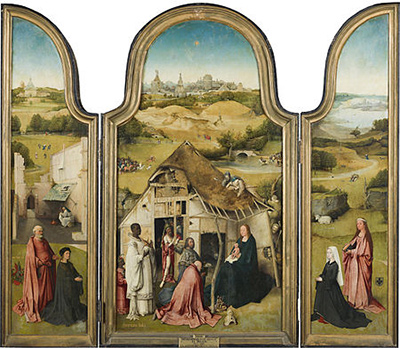
| Adoration of the Magi in Philadelphia | Early sixteenth century in the museum record; around 1495–1520 in the BRCP catalogue | Oil on oak panel · Hieronymus Bosch in the museum record; workshop of Bosch in the 2016 BRCP catalogue · Philadelphia Museum of Art, John G. Johnson Collection, 1917 · 1321; museum object 103592 Source 1. Source 2. |
| Adoration of the Magi — New York | c.1470–1480 | 2016 catalogue: Bosch; oil on oak · Metropolitan Museum 13.26 2016 catalogue. |
| Adoration of the Magi — Prado triptych | c.1494 | Oil on oak; grisaille exterior · Bosch · Prado P002048 Object source. |
| Adoration of the Magi — three associated fragments | c.1515–1535 | 2016 catalogue: Follower of Bosch · Two Shepherds / Retinue in Philadelphia; associated Adoration in private collection in 2016 2016 catalogue. |
| Ascent of the Blessed — Venice | c.1505–1515 | Oil on panel · Bosch · Gallerie dell’Accademia; Visions of the Hereafter Object source. |
| Battle of the Birds and Mammals | Not specified in catalogue heading | 2016 catalogue: Bosch; pen and brown ink · Berlin KdZ 14715 2016 catalogue. |
| Beggars and Musicians | Around 1530–1540 | Ink and wash on paper · Unknown follower of Hieronymus Bosch · Albertina, Vienna · 7798 Source 1. Source 2. |
| Christ Carrying the Cross Drawing | Around 1470 in the museum catalogue | Black chalk or charcoal, pen and brush in brown ink, white corrections · Anonymous, workshop of Rogier van der Weyden · Museum Boijmans Van Beuningen, Rotterdam · N 81 recto and verso (PK) Source 1. Source 2. |
| Christ Carrying the Cross in Vienna | Around 1490–1510 in the current KHM record and BRCP catalogue | Oil on oak, painted on both sides · Hieronymus Bosch; possible workshop involvement in the Passion side discussed by the BRCP · Kunsthistorisches Museum, Vienna · Gemäldegalerie, GG 6429 Source 1. Source 2. |
| Christ Carrying the Cross — El Escorial | c.1495–1505 | 2016 catalogue: Bosch; oil on oak · Patrimonio Nacional 10014739 2016 catalogue. |
| Christ Carrying the Cross — Ghent | c.1510–1516 (museum) | Oil on panel · Bosch in museum listing; authorship disputed · MSK Ghent 1902-H Object source. |
| Christ Mocked — London | c.1510 | Oil on wood · Bosch · National Gallery NG4744 Object source. |
| Concert in the Egg, After Hieronymus Bosch | Around 1561; third quarter of the sixteenth century | Oil on canvas · Anonymous, after Hieronymus Bosch · Palais des Beaux-Arts, Lille · P 816 Source 1. Source 2. |
| Conjurer / Comical Concert — Louvre drawing | Not specified in catalogue heading | 2016 catalogue: Bosch (recto), follower (concert verso) · Pen and brown ink · Louvre INV 19197 2016 catalogue. |
| Conjurer / Cross-bearing and beggars — Liège sheet | Not specified in catalogue heading | 2016 catalogue: Bosch (verso), follower (recto) · Pen and brown ink · Album d’Arenberg 534 2016 catalogue. |
| Crowning with Thorns — El Escorial | c.1530–1540 | 2016 catalogue: Follower of Bosch; oil on oak · Patrimonio Nacional 10014743 2016 catalogue. |
| Crucifixion with a Donor | Circa 1495–1505; Circa 1490–1500 | Oil on oak panel · Hieronymus Bosch · Royal Museums of Fine Arts of Belgium, Brussels · 6639 Source 1. Source 2. |
| Death and the Miser Drawing | Not securely established; probably made after the painting | Pen and brush, dark ink and white highlights on prepared paper · Workshop of Hieronymus Bosch in the BRCP catalogue; alternatives recorded by the Louvre · Musée du Louvre, Department of Prints and Drawings, Paris · RF 6947, Recto Source 1. Source 2. |
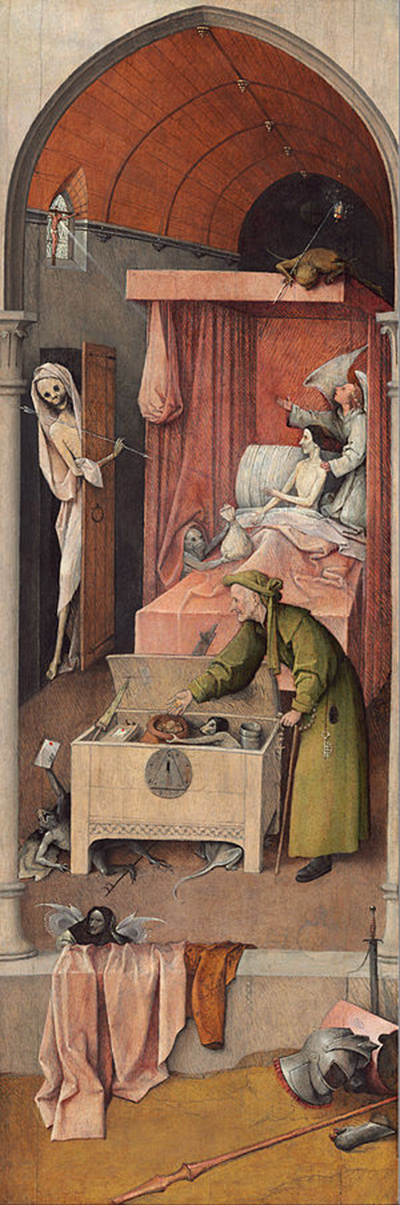
| Death and the Miser — Washington | c.1485/1490 (NGA) | Oil on panel · Bosch · National Gallery of Art 1952.5.33 Object source. |
| Ecce Homo Triptych — Boston | c.1495–1500; wings c.1500/1503 | 2016 catalogue: Workshop of Bosch; oil on oak · Museum of Fine Arts Boston; several production phases 2016 catalogue. |
| Ecce Homo — Frankfurt | c.1490 | Mixed technique on oak · Bosch · Städel 1577 Object source. |
| Fall of the Damned — Venice | c.1505–1515 | 2016 catalogue: Bosch; oil on panel · Visions of the Hereafter · Venice 2016 catalogue. |
| Garden of Earthly Delights | 1490–1500 (Prado) | Oil on oak; grisaille exterior · Bosch · Prado; triptych Object source. |
| Gluttony and Lust / Allegory of Intemperance — Yale fragment | c.1500–1510 (group dating) | 2016 catalogue: Bosch; oil on oak · Yale 1959.15.22; fragment associated with Ship of Fools 2016 catalogue. |
| Group of Ten Spectators, a Follower of Bosch | Around 1510–1540 in the current museum record | Pen and two brown inks on paper, with a brown framing line · Follower of Hieronymus Bosch in the Morgan record; Bosch in the BRCP catalogue · Morgan Library & Museum, New York · I, 112 Source 1. Source 2. |
| Head of an Old Woman | About 1500 | Oil on panel · Attributed to Jacob Cornelisz. van Oostsanen · Museum Boijmans Van Beuningen, Rotterdam · 2439 (OK) Source 1. Source 2. |
| Hell and the Flood — Rotterdam panels | Around 1515 in the museum records; around 1510–1520 in the BRCP catalogue | Oil on oak panels · Jheronimus Bosch in the museum records; workshop of Bosch in the BRCP catalogue · Museum Boijmans Van Beuningen, Rotterdam Source 1. Source 2. |
| Hermit Saints Triptych | Circa 1495–1505 | Oil on oak panels · Hieronymus Bosch · Gallerie dell’Accademia, Venice · 2044 Source 1. Source 2. |
| Infernal Landscape | Not specified in catalogue heading | 2016 catalogue: Bosch; pen and brown ink, red accent · Private collection in 2016 2016 catalogue. |
| Infernal Scene with Anvil / Monster Studies | Not specified in catalogue heading | 2016 catalogue: Bosch; attribution debated in entry · Pen and brown ink · Berlin KdZ 548 2016 catalogue. |
| Infernal Scene with Tree-Man / Standing Man | Not specified in catalogue heading | 2016 catalogue: Workshop of Bosch; pen and brown ink · Dresden C 1875; historical reverse title includes a proposed prophet 2016 catalogue. |
| Job Triptych — Bruges | c.1510–1520 | 2016 catalogue: Workshop of Bosch; oil on oak · Groeningemuseum / Hoeke loan in 2016 2016 catalogue. |
| Last Judgement — Bruges triptych | c.1495–1505 | 2016 catalogue: Bosch; oil on oak · Groeningemuseum 2016 catalogue. |
| Last Judgement — Munich fragment | c.1530–1540 | 2016 catalogue: Follower of Bosch; oil on oak · Alte Pinakothek 5752 2016 catalogue. |
| Last Judgement — Vienna triptych | c.1500–1505 (BRCP 2016) | Oil on oak · Bosch and workshop (BRCP 2016) · Academy of Fine Arts Vienna 2016 catalogue. |
| Man in a Basket and Comic Figures | Around 1500–1515 in the museum record | Pen and brown ink on paper; the reverse is catalogued as iron-gall ink · Hieronymus Bosch in the current Albertina record; attribution has been debated · Albertina, Vienna · 7797 recto and verso Source 1. Source 2. |
| Man Seen from Behind | About 1550–1569; About 1565–1570 | Traces of black chalk, pen and brush in light brown ink · Anonymous, circle of Pieter Bruegel the Elder · Museum Boijmans Van Beuningen, Rotterdam Source 1. Source 2. |
| Mary and John at the Foot of the Cross | About 1440 | Brush in grey and black · Unknown, possibly Netherlandish · Kupferstich-Kabinett, Staatliche Kunstsammlungen Dresden · C 815 Source 1. Source 2. |
| Model Sheet with ‘Witches’ | Disputed; proposals depend on the attribution | Pen and brown ink; the BRCP also records underlying black chalk · Hieronymus Bosch; follower attributions also recorded · Musée du Louvre, Département des Arts graphiques, Paris · INV 19721 recto Source 1. Source 2. |
| Peasant and Three Bust-Length Figures | 1401–1500 | Brown pen over a black preliminary drawing · Attributed to the Master of the Drapery Studies; Bosch circle also recorded · Kupferstichkabinett, Staatliche Museen zu Berlin · KdZ 777 Source 1. Source 2. |
| River to Hell — Venice | c.1505–1515 | 2016 catalogue: Bosch; oil on panel · Visions of the Hereafter · Venice 2016 catalogue. |
| Saint Anthony and a Concert in an Egg | Around 1510–1525 in the museum’s 2016–17 exhibition texts | Pen in light and dark brown inks · Workshop of Hieronymus Bosch; underlying monsters: Bosch (BRCP), possibly Bosch (exhibition text) · Kupferstichkabinett, Staatliche Museen zu Berlin · KdZ 711 recto and verso Source 1. Source 2. |
| Saint Christopher Carrying the Christ Child | c.1500; 1490–1505 in restoration material | Oil on panel · Bosch · Boijmans St 26 Object source. |
| Saint James and Hermogenes | About 1551–1575 in the KIK-IRPA catalogue | Oil on wood, painted on both sides · Anonymous follower of Hieronymus Bosch · Musée des Beaux-Arts, Valenciennes · P.46.1.44; older number 176 Source 1. Source 2. |
| Saint Jerome at Prayer | Circa 1485–1495 | Oil on oak panel · Hieronymus Bosch · Museum of Fine Arts, Ghent · 1908-H Source 1. Source 2. |
| Saint John on Patmos / Passion Scenes | c.1495–1505; estimates vary | Oil on oak · Bosch · Gemäldegalerie Berlin 1647A Object source. |
| Saint John the Baptist in Meditation | Late 15th century; c.1485–1510 (Prado exhibition) | Oil on panel · Bosch · Lázaro Galdiano 8155 Object source. |
| Saint Liberata Triptych | Circa 1495–1505 | Oil on oak panels · Hieronymus Bosch · Gallerie dell’Accademia, Venice · 2045 Source 1. Source 2. |
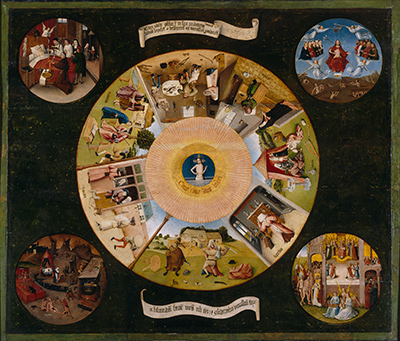
| Seven Deadly Sins and the Four Last Things | 1505–1510 (Prado) | Oil on poplar · Bosch (Prado); workshop/follower disputed · Prado Object source. |
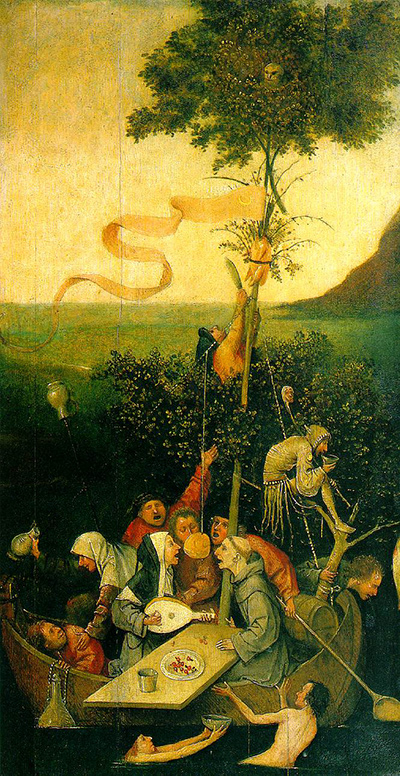
| Ship of Fools — Louvre painting | 1475–1500 (record); c.1505–1515 (exhibition) | Oil on oak · Bosch · Louvre RF 2218; fragment Object source. |
| Ship of Fools — Louvre workshop drawing | Not specified in catalogue heading | 2016 catalogue: Workshop of Bosch · Pen, brush, grey-brown ink and white highlights on prepared paper · Louvre RF 3714 2016 catalogue. |
| Studies of Monsters | About 1530–1550, according to the current Ashmolean record | Pen and brown ink on laid paper, both faces · Anonymous follower of Hieronymus Bosch · Ashmolean Museum, University of Oxford · WA1863.155 Source 1. Source 2. |
| Studies of Saint Anthony and Monsters | No execution date specified in the current Louvre records | Pen and brown ink on paper · Bosch listed; reverse questioned by Louvre; BRCP accepts both faces · Musée du Louvre, Département des Arts graphiques, Paris · INV 20871 recto and verso Source 1. Source 2. |
| Temptation of Saint Anthony — Kansas City fragment | c.1500–1510 | 2016 catalogue: Bosch; oil on oak · Nelson-Atkins 35–22 2016 catalogue. |
| Temptation of Saint Anthony — Lisbon triptych | c.1500 | Oil on oak · Bosch · Museu Nacional de Arte Antiga 1498 Pint Museum. |
| Temptation of Saint Anthony — Prado panel | c.1530–1540 | 2016 catalogue: Follower of Bosch (2016 opinion); oil on oak · Prado P002049 2016 catalogue. |
| Terrestrial Paradise | Approximately 1505–1515 | Oil on oak panel · Hieronymus Bosch · Gallerie dell'Accademia, Venice Source 1. Source 2. |
| The Burning Ship Drawing | 1500–1520 | Pen and iron gall ink on paper · Attributed to Hieronymus Bosch · Academy of Fine Arts Vienna, Graphic Collection · HZ-2554; numbered 2554 in the BRCP catalogue Source 1. Source 2. |
| The Comical Barber Scene | About 1550–1580, according to the British Museum | Pen and brown ink, grey and brown wash, over black chalk · Anonymous follower, after Hieronymus Bosch · British Museum, Department of Prints and Drawings, London · 1854,0628.46 Source 1. Source 2. |
| The Conjuror, After Hieronymus Bosch | Probably after 1525; around 1530–1540 in the BRCP technical report | Oil on oak panel · Anonymous follower of Hieronymus Bosch · Musée Ducastel-Vera, Saint-Germain-en-Laye · 872.1.87 Source 1. Source 2. |
| The Cure of Folly / Extraction of the Stone of Madness | 1501–1505 (Prado) | Oil on oak · Bosch (Prado); workshop/follower disputed · Prado P002056 Object source. |
| The Entombment Drawing | About 1505–1515, current museum record | Brush and black and grey ink, with grey wash, over black chalk · Workshop of Hieronymus Bosch; drawn by the Master of the Prado Haywain Triptych; Hieronymus Bosch, argued by the BRCP in 2016 · British Museum, Department of Prints and Drawings, London · 1952,0405.9 Source 1. Source 2. |
| The Gathering of the Birds | Not specified in catalogue heading | 2016 catalogue: Bosch; pen and brown ink · Berlin KdZ 13136 2016 catalogue. |
| The Haywain — Prado triptych | 1510–1516 (BRCP 2016) | Oil on oak · Bosch (BRCP 2016) · Prado; separate Escorial version exists 2016 catalogue. |
| The Hearing Forest and the Seeing Field | Circa 1500–1505 | Pen and brown ink on paper · Hieronymus Bosch; reverse: Bosch and workshop · Kupferstichkabinett, Staatliche Museen zu Berlin · KdZ 549, front and reverse Source 1. Source 2. |
| The Owl’s Nest — Rotterdam | Not specified in catalogue heading | 2016 catalogue: Bosch; pen and brown ink · Boijmans N 175 2016 catalogue. |
| The Passion Triptych in Valencia | Workshop of Bosch, about 1510–1520; Follower of Bosch; centre about 1530–1540, wings about 1540–1550 | Oil and gold on oak panels · Workshop of Bosch, about 1510–1520; Follower of Bosch; centre about 1530–1540, wings about 1540–1550 · Museu de Belles Arts de València Source 1. Source 2. |
| The Pedlar / Wayfarer — Rotterdam | c.1500 (museum) | Oil on panel · Bosch · Boijmans 1079 (OK); rejoined exterior Object source. |
| The Tree-Man — Vienna drawing | c.1505 | Pen and brown ink · Bosch · Albertina, Vienna Object source. |
| The Wedding at Cana, After Hieronymus Bosch | Approximately 1560 in the current museum record | Oil on panel, 93 cm high × 72 cm wide · Anonymous, after Hieronymus Bosch · Museum Boijmans Van Beuningen, Rotterdam, St 25 Source 1. Source 2. |
| Two Fantastical Creatures — Berlin KdZ 550 | Around 1505–1515 in the museum’s 2016 exhibition text | Pen in brown ink on reddish prepared laid paper · Hieronymus Bosch · Kupferstichkabinett, Staatliche Museen zu Berlin · KdZ 550, recto and verso Source 1. Source 2. |
| Two Figures Wearing Mitres | About 1480 | Oil on panel · Anonymous (Boijmans); Bosch circle (RKD) · Museum Boijmans Van Beuningen, Rotterdam · 1177 (OK) Source 1. Source 2. |
| Two Men and the Temptation of Eve | About 1505–1515 in the Prado’s 2016 exhibition guide | Pen and grey-brown ink on paper · Hieronymus Bosch in the 2016 catalogues discussed here · Private collection, as recorded in 2016 Source 1. Source 2. |
| Two Men Fighting | Not specified in the current Louvre record | Pen and brown ink · In the manner of Hieronymus Bosch · Musée du Louvre, Département des Arts graphiques, Paris · INV 20660 recto; formerly NIII 8896 and MA 8400 Source 1. Source 2. |
| Two Men — Berlin KdZ 5210 | Not specified in catalogue heading | 2016 catalogue: Bosch questioned · Pen, brush, ink, chalk and white highlights · Berlin KdZ 5210; historical title Two Oriental Men 2016 catalogue. |
| Two Monsters — Berlin KdZ 547 | Approximately 1500–1510 in Berlin's 2016 exhibition catalogue; an estimated range | Pen and brown ink on paper · Hieronymus Bosch · Kupferstichkabinett, Staatliche Museen zu Berlin · KdZ 547, drawn on both sides Source 1. Source 2. |
Frequently Asked Questions
It shows the Arrest of Christ, the left wing, inventory 265. The centre is the Crowning with Thorns, 264, and the right wing is the Flagellation, 266.[3]
No. The BRCP treats the centre’s name as an imitation signature. The differing attribution assessments need to be considered separately from that inscription.[4]
The technical report provides a tree-ring limit for the centre; the wings were not measured. Its conditional production limits are not an exact painting date for the entire ensemble.[7]
Discussion
Compare all three Passion scenes while keeping the illustrated left wing and the disputed dates distinct.
Reader Insights
How does the repeated face of Christ connect the three different acts of violence?
Compare the gestures around the Arrest with those in the Crowning and Flagellation.
What changes when the left-wing illustration is understood as one part of the whole triptych?
Join the Conversation
Share a detail, comparison or question about The Passion Triptych in Valencia: Arrest, Crowning and Flagellation below.
References
- Museu de Belles Arts de València: Passion Triptych, current museum catalogue, inventories 264–266 View source.
- BRCP Catalogue Raisonné (2016), object dates in catalogues 1, 2, 8, 15 and 20; catalogue 20 object metadata only for the Haywain comparison. View source
- Boletín Oficial del Estado, 2016 Prado exhibition loan list, entries 16–18: centre 264, left 265 and right 266 View source.
- Bosch Research and Conservation Project, Catalogue Raisonné (2016), catalogue 28, pp. 436–441 View source.
- Staatliche Museen zu Berlin, 2016 exhibition wall texts, p. 3: approximate date of KdZ 549. View source
- Matthijs Ilsink and Jos Koldeweij, Hieronymus Bosch: Visions of Genius (2016), catalogue 13, pp. 64–65 and work list 54 View source.
- Bosch Research and Conservation Project, Technical Studies (2016), catalogue 28, research reports 91–96, pp. 384–393, available through SRAL View source.
- Marc Borrás Espinosa, Sobre la posible autoría del Bosco de la tabla central del tríptico de Los Improperios, Archivo de Arte Valenciano 96 (2015), pp. 27–28 and 35–40 View source.
- Splash image, The Arrest of Christ, left wing of the Passion Triptych, Museu de Belles Arts de València, inventory 265. The museum attributes the ensemble to Bosch’s workshop, about 1510–1520; the BRCP dates the wings to about 1540–1550 and classifies the work as a follower’s production. View source. View source. View source.