by Tom Gurney
Tom Gurney BSc (Hons) is an art history expert with over 20 years experience
Published on June 19, 2020 / Updated on November 4, 2026
Email: tomgurney1@gmail.com / Phone: +44 7429 011000
Three saints have withdrawn from society, but their surroundings offer little peace. A fire burns behind Anthony. Broken masonry and a falling idol surround Jerome. Giles stands at the entrance to a dark shelter, an arrow piercing his chest. Hieronymus Bosch gives each man somewhere to pray while making the world beyond his prayer difficult to ignore. Seen together, the panels turn solitude into an active, sometimes painful encounter with distraction.
The Hermit Saints Triptych, painted in oil on oak around 1495–1505, belongs to the Gallerie dell’Accademia in Venice. Anthony occupies the left wing, Jerome the larger centre panel and Giles the right. The central panel bears Bosch’s signature. Although the three saints share a distant landscape, their immediate surroundings differ sharply: one sits among temptations, another kneels in a ruin, and the third shelters beside a small table. Those differences make the painting worth exploring a panel at a time.[1][2]
Its appearance also contains a complicated history of changes. Bosch revised the saints as he worked; later owners and restorers altered the panels themselves. Technical investigation has helped separate those two histories, revealing both a composition in motion and a physical object that has been cut, reinforced and conserved.[3]
At a Glance
- ArtistHieronymus Bosch
- TitleHermit Saints Triptych; Trittico degli Eremiti
- DateCirca 1495–1505
- MediumOil on oak panels
- Left wing85.4 × 29.2 cm
- Central panel85.7 × 60 cm
- Right wing85.7 × 28.9 cm
- CollectionGallerie dell’Accademia, Venice
- Museum catalogue number2044
- SaintsAnthony, Jerome and Giles, from left to right
Compare these works across Bosch’s career
These date ranges are estimates, not a documented year-by-year sequence. The highlighted row is the work discussed here.
Saint Jerome at Prayer
Circa 1485–1495 [4]Crucifixion with a Donor
Circa 1490–1500 (BRCP) [4]Hermit Saints Triptych
Circa 1495–1505 [4]Saint Liberata Triptych
Circa 1495–1505 [4]The Hearing Forest and the Seeing Field
Circa 1500–1505 (Berlin exhibition) [5]The Haywain Triptych
1510–1516 (BRCP) [4]Contents
Annotated Details from Hermit Saints Triptych
The numbered areas move from the three saints to two smaller features around Jerome. Explore each numbered area in the detail views below.
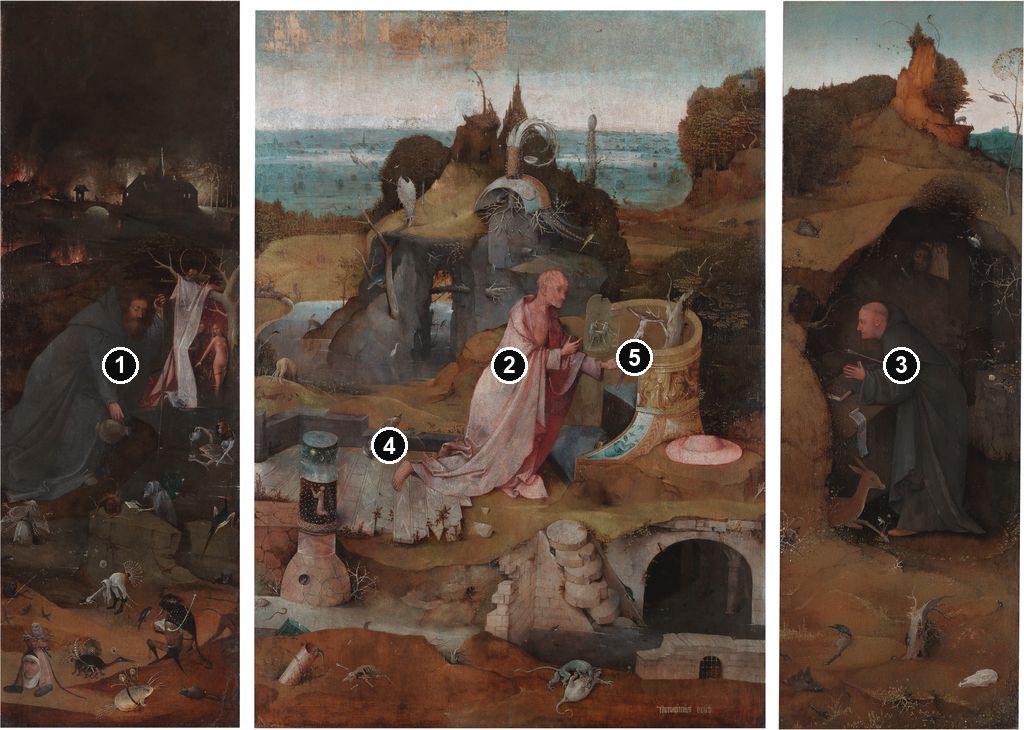
Details from HERMIT SAINTS TRIPTYCH
Compare the separate retreats, then look more closely at the centre panel.
Anthony in the left wing
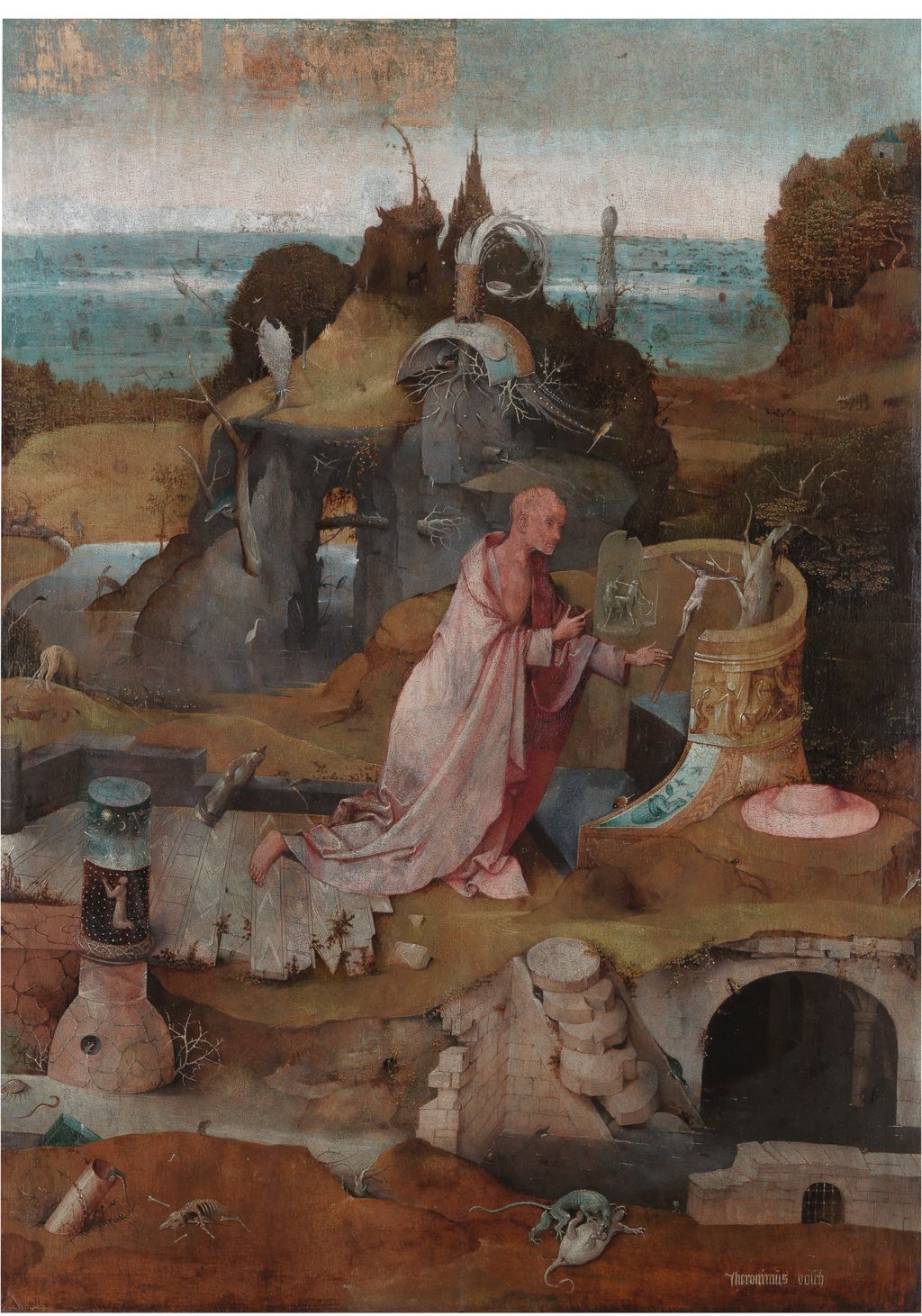
Anthony sits beneath a dark tree while a settlement burns behind him. The narrow wing draws the surrounding disturbances close to his seated figure.
Jerome in the centre panel
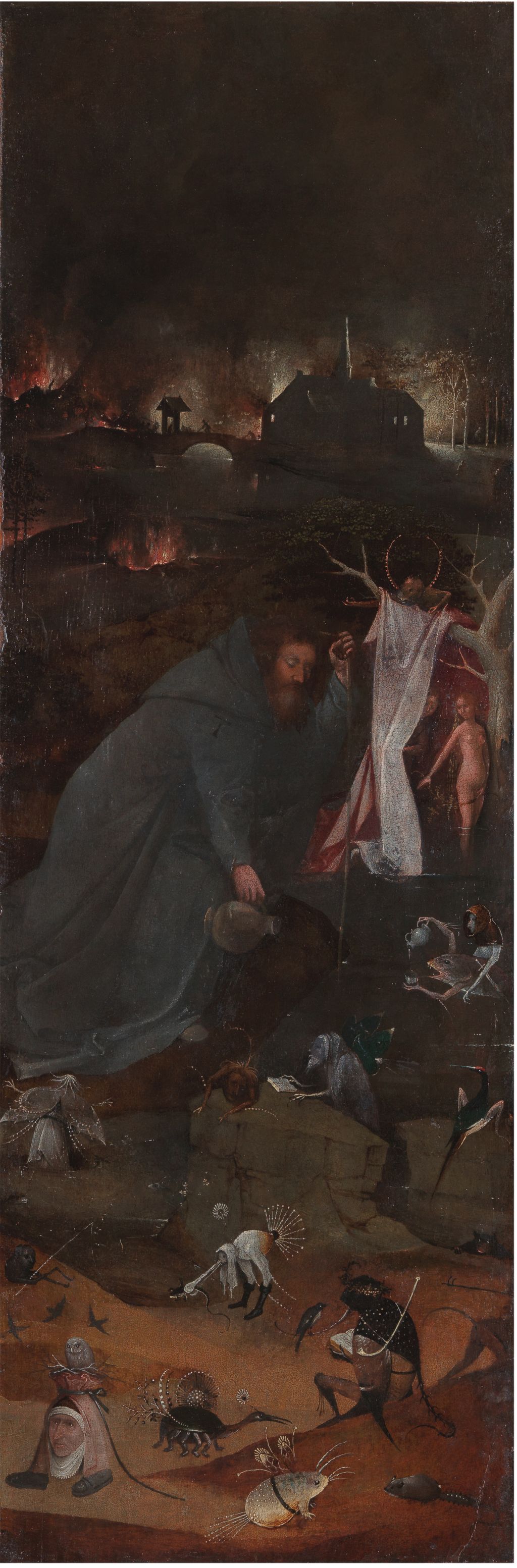
Jerome kneels in an exposed ruin. His pale robe and the broad space around him make this the most immediately prominent of the three retreats.
Giles in the right wing
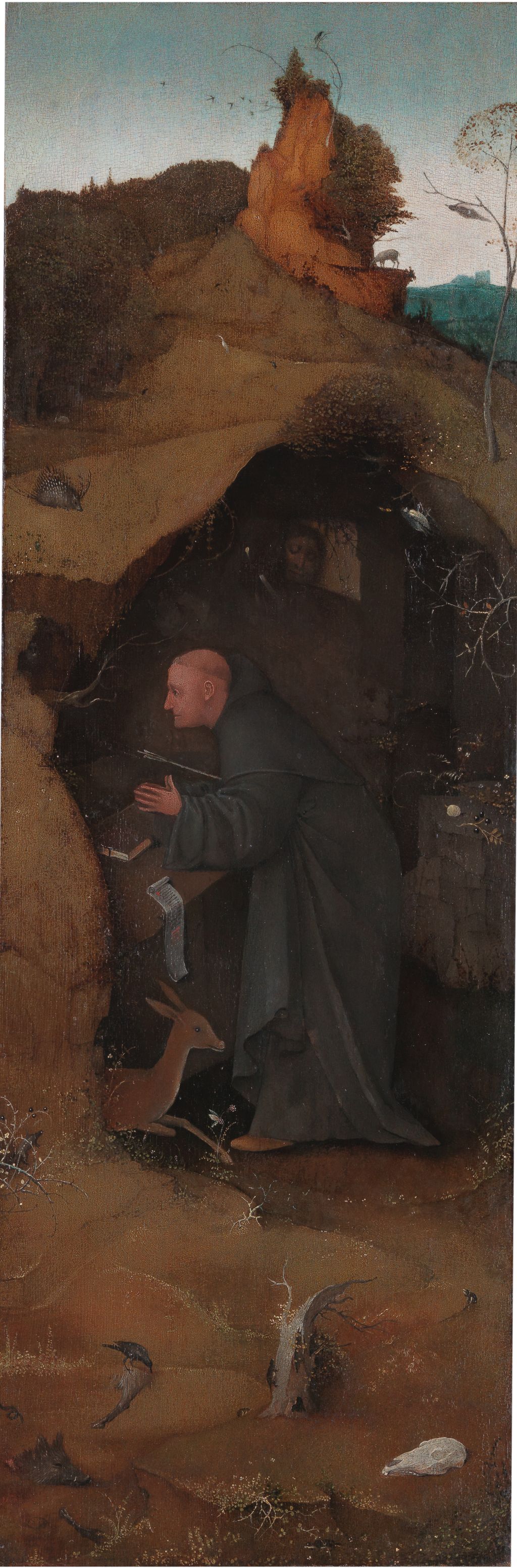
Giles stands in the dark opening of his shelter. Look for the hind beside him and the arrow against his clothing, the principal attributes discussed in the article.
The falling idol
The damaged figure tips from a short column behind Jerome’s kneeling body. Its unstable pose contrasts with the saint’s concentrated movement towards the crucifix.
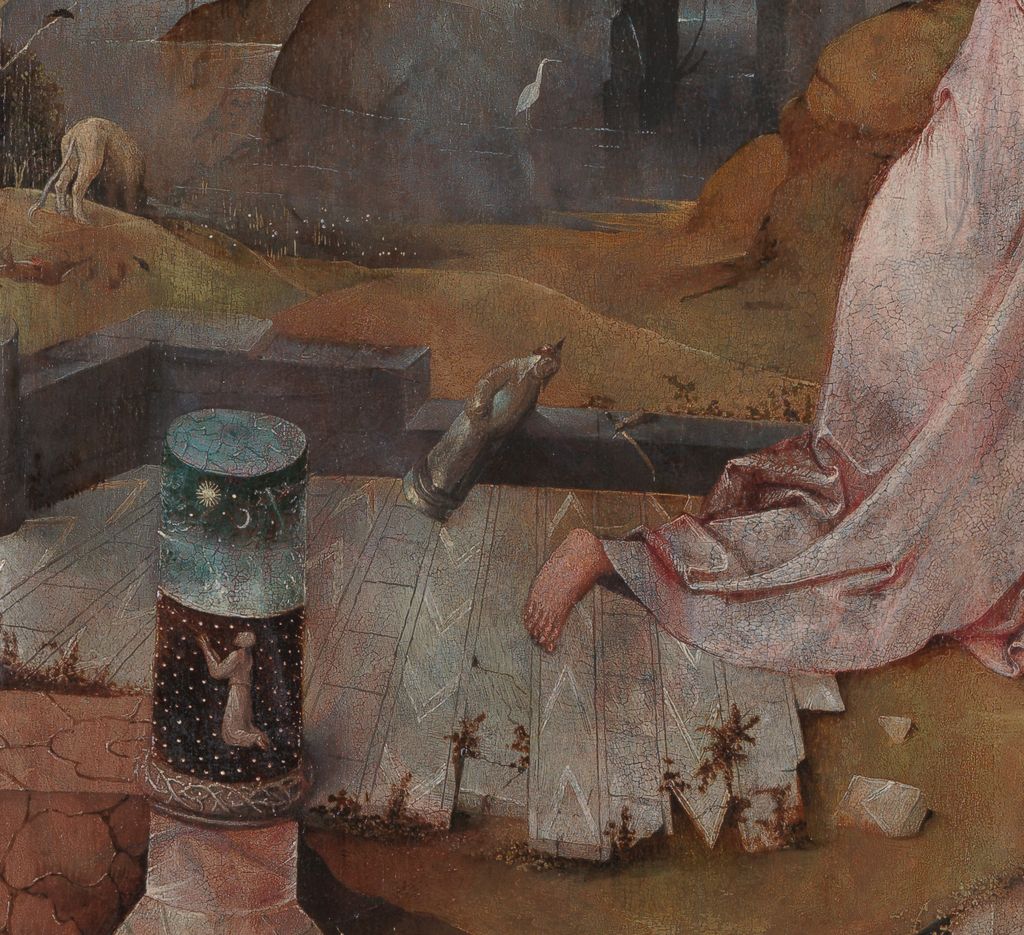
The carved structure
Small figures decorate the structure beside Jerome. Their miniature scale changes the pace of looking after the larger saint has been recognised. The BRCP interpretation of the reliefs is discussed in the main text.
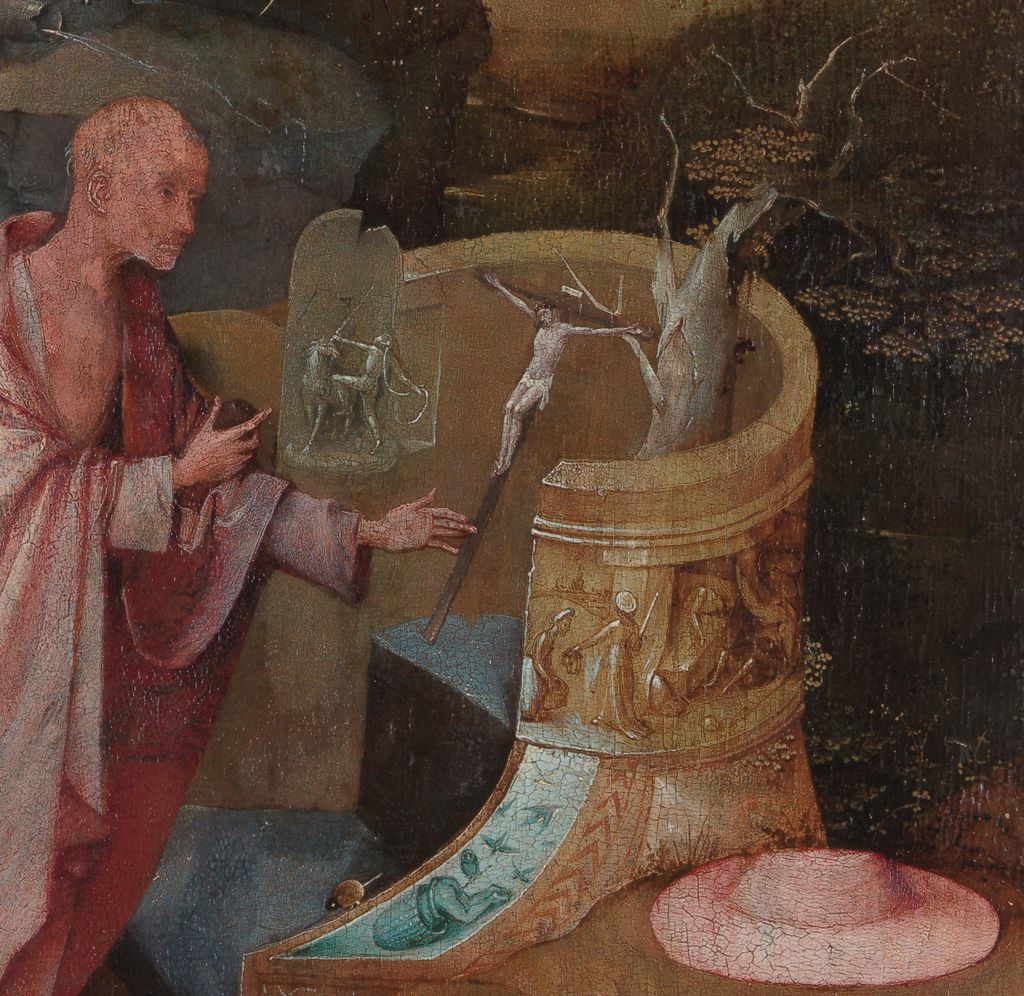
Image and detail crops: Wikimedia Commons source file (public domain reproduction).
Jerome in the Ruins
Jerome’s central position gives his act of prayer the greatest space. His pale, reddish robe spreads across the ground as he kneels before a crucifix. The body bends towards this small object, bringing the saint’s face and hands into a close relationship with it. Around him, the setting opens in several directions: towards distant water and buildings, into a dark space beneath the foreground masonry, and upwards through a broken, irregular structure. His attention has a definite focus within a place whose boundaries are hard to grasp.
The discarded cardinal’s hat identifies Jerome, while the stone in his hand belongs to the tradition of his penitence. His familiar lion is present too, though tucked away near the water rather than placed prominently at his feet. In the Bosch Research and Conservation Project’s interpretation, the ruin’s pagan imagery sharpens the encounter between Jerome’s faith and the culture he has renounced. A damaged idol topples behind him, giving instability a visible form.[2]
That falling figure also affects the composition. Jerome’s body curves inward towards the cross; the idol tilts away from its support. One movement gathers itself, while the other loses its balance. The broken column and patches of pavement give the scene enough architectural detail to suggest an earlier order, but there is no intact room to enclose the saint. He prays amid its remains.
Small painted scenes decorate the structure before him. The BRCP catalogue identifies Judith with the severed head of Holofernes and a figure approaching a unicorn, reading these in relation to chastity and the conquest of desire. Their miniature scale invites a second, closer look after the larger figure has been understood. They belong to an intricate devotional setting; their presence does not make every nearby creature part of a single decipherable code.[2]
Bosch’s independent Saint Jerome at Prayer in Ghent offers a useful comparison. Both compositions bring the saint close to a crucifix within an extensive landscape. Here, the broken structures make the act of concentration more visibly precarious. The centre panel places prayer among fragments: a hat set aside, architecture in pieces and figures reduced to images on stone.
Anthony and the Persistence of Temptation
Anthony’s wing is darker and more compressed. His figure sits low in the panel beneath a tree, while a distant blaze interrupts the night. Nearby creatures gather around the ground and water. Their odd shapes become apparent gradually, as the eye adjusts to the dimness. This slower encounter suits a subject in which danger can emerge through the apparently familiar.
The bathing woman belongs to Anthony’s temptations, while the saint’s absorbed posture offers little response to the activity around him. The landscape establishes two different kinds of disturbance: the public catastrophe of a burning settlement and the intimate pressure of desire. Bosch can suggest both within the narrow space of a wing.[2]
An early Christian account gives some sense of the difficulty associated with such withdrawal. In his Letter 22 to Eustochium, Jerome recalls how memories of pleasure persisted during his harsh life in the desert. The passage describes solitude as a place where unwanted thoughts could become especially vivid. It helps explain the spiritual problem represented by the temptations of hermit saints, although it does not establish that Bosch used a particular edition of the letter.[6]
Anthony’s stillness consequently requires something of the viewer. The monsters and the fire attract attention; the saint holds his position within their activity. Looking repeatedly between him and his surroundings makes the difference in their rhythms more apparent. A birdlike shape or a small moving creature can lead the gaze away, but the seated figure remains the wing’s quiet centre.
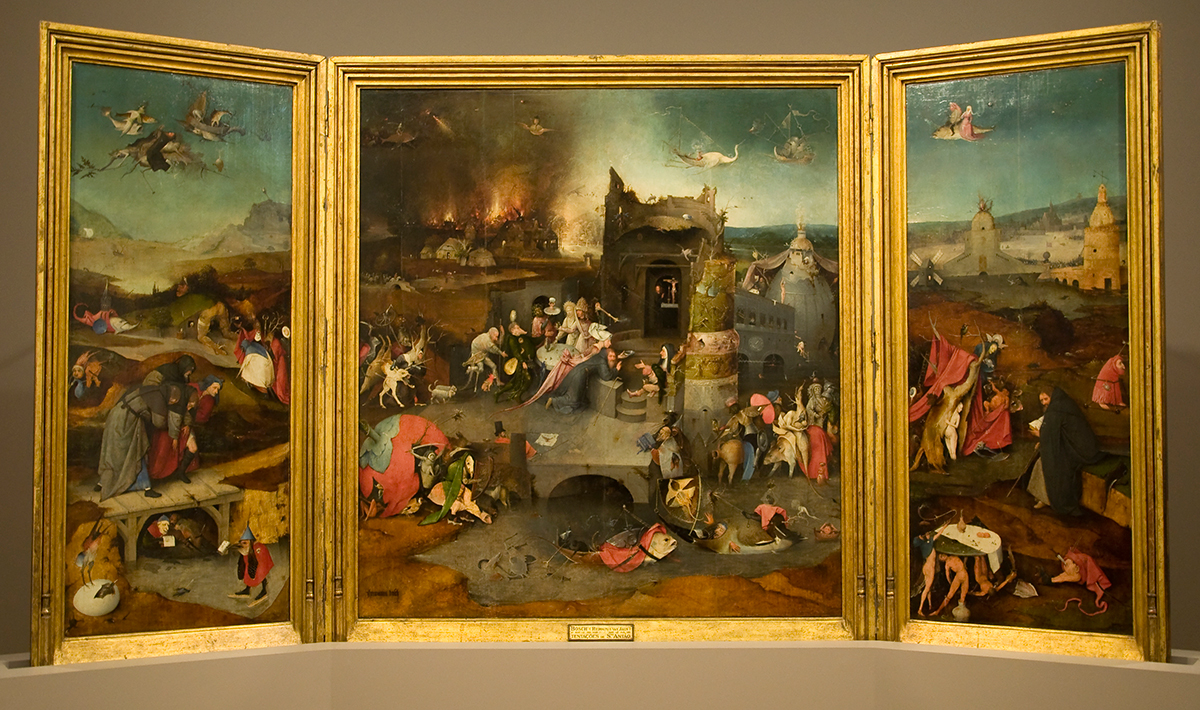
The same relationship becomes far more expansive in the Lisbon Temptation of Saint Anthony. In this smaller panel, the limited width draws disturbance close to the saint. There is little empty space separating retreat from temptation.
Giles, the Hind and the Arrow
The right wing offers another kind of shelter. Giles stands within a hollow, dark opening, close to a surface bearing a book and scroll. His heavy clothing almost merges with the surrounding shadows. The hind beside him and the arrow in his chest identify an episode from his legend: the hermit was wounded by an arrow intended for the animal that sustained him.[2]
Bosch makes the consequences of that encounter visible without showing the action of a hunt. The deer has settled beside the saint, while his body remains upright. The arrow interrupts the dark mass of his clothing. Attention moves between a vulnerable animal and the wounded man who shares its shelter.
The opening around Giles also gives the wing a different sense of depth from Jerome’s exposed ruin. Its darkness draws the figure back into the hill, while the lighter ground below carries small creatures towards the viewer. A distant building on the ridge offers another possible dwelling, separated from the saint by a steep rise. The landscape seems to contain several degrees of withdrawal.
Some details remain less secure than the principal attributes. The BRCP catalogue proposes a relationship between the watching visitor, the scroll and the later events of Giles’s legend. Such suggestions help connect the small objects with a larger narrative, but the visible lettering cannot simply be treated as a complete, legible message. The hind and arrow give the clearest entry into the subject.[2]
How the Landscape Holds the Panels Together
The landscape encourages the eye to travel across the divisions in the wood. Distant water, low horizons and changing stretches of land create a broader world beyond the saints’ separate retreats. In the foreground, however, each panel has its own obstacles. Anthony’s tree and dark ground, Jerome’s broken architecture and Giles’s hollow shelter interrupt any easy passage from one figure to the next.
The centre panel has the greatest breadth, allowing the surrounding country to spread out beside Jerome. The narrow wings offer steeper, more concentrated encounters. Looking from the whole ensemble to its individual parts changes the experience of space: first there is a wide setting inhabited by three saints, then three small places with markedly different pressures.
The saints’ gestures bring another kind of continuity. Their hands remain occupied by prayer, devotional objects or books, while their bodies turn away from the more restless activity around them. The painting establishes its subject through those repeated acts of attention. The differences in setting prevent the repetition from becoming mechanical.
Colour contributes to that movement too. Jerome’s light robe is conspicuous against the broken ground, while Anthony and Giles sit more deeply within the dark tones of their wings. The centre therefore draws the eye readily, but the quieter sides reward a longer search. The painting’s scale allows intimate inspection without requiring every small form to yield a firm symbolic explanation.
Bosch Changed the Saints While Painting
Technical examination revealed that the present Jerome covers a substantially larger figure. The earlier version had been drawn and carried into paint before Bosch reduced it. His larger hands occupied a lower position, and a long, beamlike form may have belonged to an initially planned cross. The background was altered around the revised saint as well.[3]
This discovery matters when looking at the space he now inhabits. Jerome was not simply placed inside a finished landscape. Figure and setting developed together. Reducing him increased the room available around his body, making the surviving masonry, water and distant country more prominent in the final composition. Technical evidence shows the change; the visible painting lets us consider its effect.
Giles also became smaller. His earlier dwelling included more substantial architectural features, subsequently changed into the shelter seen today. Anthony appears to have moved upwards from an earlier position. The findings show work proceeding through revisions across the ensemble, rather than a design transferred unchanged onto each panel.[3]
An Altered Triptych
Later changes affected the work’s physical form. The BRCP technical investigation reconstructs an arched central panel with corresponding curved tops on the wings. Cropping and wooden additions produced the rectangular outlines familiar today. The wings were also lowered relative to the centre. Their present alignment therefore cannot be used as an untouched record of the original arrangement.[3]
The current museum interpretation is cautious about whether the three panels were intended as a triptych from the outset, noting the greater independence of Anthony’s composition. The structural investigation provides a different emphasis, supporting a folding ensemble with engaged frames. Together, these approaches direct attention to the relationship between the panels’ construction and their differing pictorial spaces.[1][3]
The reverses suffered particularly from later thinning and reinforcement. Surviving traces indicate that the wing backs were painted black; a dark grisaille has been proposed, but its subject cannot be recovered from that evidence. During the conservation campaign of 2013–16, restrictive cradles and a metal mounting framework were removed, allowing the ensemble to function again as a folding triptych.[3]
Conservation also helps explain differences between reproductions. Abrasion, discoloured coatings, faded red pigments and changes in the transparency of paint had affected the image before treatment. An older photograph may show a duller or browner surface than a later one. Those differences belong to the object’s history and should not automatically be treated as Bosch’s intended colour relationships.[3]
From Venice to Vienna and Back
The triptych’s early ownership remains a question. The Gallerie dell’Accademia associates it with Cardinal Domenico Grimani’s collection, but the BRCP catalogue identifies a 1733 description in the Doge’s Palace as the first firm reference to this particular work. A proposed earlier connection and a securely identifiable record are different kinds of evidence.[1][2]
The distinction has remained important in recent scholarship. Reviewing the 2017 exhibition Jheronimus Bosch e Venezia, Tom Nichols questioned whether descriptions of paintings in Grimani’s collection could confidently be matched to the surviving Venetian panels. He also challenged expansive claims about Bosch’s influence on Venetian painting. The presence of these works in Venice offers a rich history of collecting, but it does not by itself demonstrate that Bosch visited the city or transformed its artistic tradition.[7]
The later movements are clearer. The triptych was transferred from Venice to Vienna in 1838 and returned in 1919. It subsequently moved from the Doge’s Palace to the Gallerie dell’Accademia. Its Venetian history connects it with the Saint Liberata Triptych, another Bosch ensemble whose appearance was profoundly affected by later interventions.[2]
The recent conservation campaign brought Italian and Dutch specialists together with international researchers and conservators in training. CODART’s 2013 announcement describes that collaboration and its connection with the approaching Bosch anniversary. The project made the work’s material history part of its renewed public presence.[8]
After those journeys and alterations, the relationship among the saints remains compellingly close. Jerome’s open ruin, Anthony’s dark patch of ground and Giles’s shelter offer three different places to linger. The small figures and broken objects invite attention away from the saints; their concentrated gestures draw it back. Looking across the panels becomes an experience of the very difficulty the painting represents: keeping one’s attention steady within a restless world.
Artworks and related attributions
Browse paintings, drawings and related attributions. Records group triptychs, fragments and two-sided sheets where appropriate. Dates follow the cited museum records or catalogue headings and are generally estimates. Rows marked “2016 catalogue” report that publication’s attribution and collection information; these are dated opinions, rather than a claim that every work is an accepted autograph Bosch.
| Name | Date | Medium, attribution and collection |
|---|---|---|
| A Crossbowman | Second half of the sixteenth century | Oil on oak panel · Copy after Hieronymus Bosch · Museo Nacional del Prado, Madrid · P002695 Source 1. Source 2. |
| A Woman Spinning and an Old Woman | Museum estimates: about 1480–1490 for the women and 1500–1505 for the reverse; the precise chronology is disputed | Pen and brown and grey ink on the front; pen and brown ink on the reverse · Hieronymus Bosch · Museum Boijmans Van Beuningen, Rotterdam · N 190 recto and verso (PK) Source 1. Source 2. |
| Adoration of the Child in Cologne | Second half of the sixteenth century | Oil on oak panel · Imitator of Hieronymus Bosch, in the city collection record · Wallraf-Richartz-Museum & Fondation Corboud, Cologne · WRM 0474 Source 1. Source 2. |
| Adoration of the Magi in Philadelphia | Early sixteenth century in the museum record; around 1495–1520 in the BRCP catalogue | Oil on oak panel · Hieronymus Bosch in the museum record; workshop of Bosch in the 2016 BRCP catalogue · Philadelphia Museum of Art, John G. Johnson Collection, 1917 · 1321; museum object 103592 Source 1. Source 2. |
| Adoration of the Magi — New York | c.1470–1480 | 2016 catalogue: Bosch; oil on oak · Metropolitan Museum 13.26 2016 catalogue. |
| Adoration of the Magi — Prado triptych | c.1494 | Oil on oak; grisaille exterior · Bosch · Prado P002048 Object source. |
| Adoration of the Magi — three associated fragments | c.1515–1535 | 2016 catalogue: Follower of Bosch · Two Shepherds / Retinue in Philadelphia; associated Adoration in private collection in 2016 2016 catalogue. |
| Ascent of the Blessed — Venice | c.1505–1515 | Oil on panel · Bosch · Gallerie dell’Accademia; Visions of the Hereafter Object source. |
| Battle of the Birds and Mammals | Not specified in catalogue heading | 2016 catalogue: Bosch; pen and brown ink · Berlin KdZ 14715 2016 catalogue. |
| Beggars and Musicians | Around 1530–1540 | Ink and wash on paper · Unknown follower of Hieronymus Bosch · Albertina, Vienna · 7798 Source 1. Source 2. |
| Christ Carrying the Cross Drawing | Around 1470 in the museum catalogue | Black chalk or charcoal, pen and brush in brown ink, white corrections · Anonymous, workshop of Rogier van der Weyden · Museum Boijmans Van Beuningen, Rotterdam · N 81 recto and verso (PK) Source 1. Source 2. |
| Christ Carrying the Cross in Vienna | Around 1490–1510 in the current KHM record and BRCP catalogue | Oil on oak, painted on both sides · Hieronymus Bosch; possible workshop involvement in the Passion side discussed by the BRCP · Kunsthistorisches Museum, Vienna · Gemäldegalerie, GG 6429 Source 1. Source 2. |
| Christ Carrying the Cross — El Escorial | c.1495–1505 | 2016 catalogue: Bosch; oil on oak · Patrimonio Nacional 10014739 2016 catalogue. |
| Christ Carrying the Cross — Ghent | c.1510–1516 (museum) | Oil on panel · Bosch in museum listing; authorship disputed · MSK Ghent 1902-H Object source. |
| Christ Mocked — London | c.1510 | Oil on wood · Bosch · National Gallery NG4744 Object source. |
| Concert in the Egg, After Hieronymus Bosch | Around 1561; third quarter of the sixteenth century | Oil on canvas · Anonymous, after Hieronymus Bosch · Palais des Beaux-Arts, Lille · P 816 Source 1. Source 2. |
| Conjurer / Comical Concert — Louvre drawing | Not specified in catalogue heading | 2016 catalogue: Bosch (recto), follower (concert verso) · Pen and brown ink · Louvre INV 19197 2016 catalogue. |
| Conjurer / Cross-bearing and beggars — Liège sheet | Not specified in catalogue heading | 2016 catalogue: Bosch (verso), follower (recto) · Pen and brown ink · Album d’Arenberg 534 2016 catalogue. |
| Crowning with Thorns — El Escorial | c.1530–1540 | 2016 catalogue: Follower of Bosch; oil on oak · Patrimonio Nacional 10014743 2016 catalogue. |
| Crucifixion with a Donor | Circa 1495–1505; Circa 1490–1500 | Oil on oak panel · Hieronymus Bosch · Royal Museums of Fine Arts of Belgium, Brussels · 6639 Source 1. Source 2. |
| Death and the Miser Drawing | Not securely established; probably made after the painting | Pen and brush, dark ink and white highlights on prepared paper · Workshop of Hieronymus Bosch in the BRCP catalogue; alternatives recorded by the Louvre · Musée du Louvre, Department of Prints and Drawings, Paris · RF 6947, Recto Source 1. Source 2. |
| Death and the Miser — Washington | c.1485/1490 (NGA) | Oil on panel · Bosch · National Gallery of Art 1952.5.33 Object source. |
| Ecce Homo Triptych — Boston | c.1495–1500; wings c.1500/1503 | 2016 catalogue: Workshop of Bosch; oil on oak · Museum of Fine Arts Boston; several production phases 2016 catalogue. |
| Ecce Homo — Frankfurt | c.1490 | Mixed technique on oak · Bosch · Städel 1577 Object source. |
| Fall of the Damned — Venice | c.1505–1515 | 2016 catalogue: Bosch; oil on panel · Visions of the Hereafter · Venice 2016 catalogue. |
| Garden of Earthly Delights | 1490–1500 (Prado) | Oil on oak; grisaille exterior · Bosch · Prado; triptych Object source. |
| Gluttony and Lust / Allegory of Intemperance — Yale fragment | c.1500–1510 (group dating) | 2016 catalogue: Bosch; oil on oak · Yale 1959.15.22; fragment associated with Ship of Fools 2016 catalogue. |
| Group of Ten Spectators, a Follower of Bosch | Around 1510–1540 in the current museum record | Pen and two brown inks on paper, with a brown framing line · Follower of Hieronymus Bosch in the Morgan record; Bosch in the BRCP catalogue · Morgan Library & Museum, New York · I, 112 Source 1. Source 2. |
| Head of an Old Woman | About 1500 | Oil on panel · Attributed to Jacob Cornelisz. van Oostsanen · Museum Boijmans Van Beuningen, Rotterdam · 2439 (OK) Source 1. Source 2. |
| Hell and the Flood — Rotterdam panels | Around 1515 in the museum records; around 1510–1520 in the BRCP catalogue | Oil on oak panels · Jheronimus Bosch in the museum records; workshop of Bosch in the BRCP catalogue · Museum Boijmans Van Beuningen, Rotterdam Source 1. Source 2. |
| Hermit Saints Triptych | Circa 1495–1505 | Oil on oak panels · Hieronymus Bosch · Gallerie dell’Accademia, Venice · 2044 Source 1. Source 2. |
| Infernal Landscape | Not specified in catalogue heading | 2016 catalogue: Bosch; pen and brown ink, red accent · Private collection in 2016 2016 catalogue. |
| Infernal Scene with Anvil / Monster Studies | Not specified in catalogue heading | 2016 catalogue: Bosch; attribution debated in entry · Pen and brown ink · Berlin KdZ 548 2016 catalogue. |
| Infernal Scene with Tree-Man / Standing Man | Not specified in catalogue heading | 2016 catalogue: Workshop of Bosch; pen and brown ink · Dresden C 1875; historical reverse title includes a proposed prophet 2016 catalogue. |
| Job Triptych — Bruges | c.1510–1520 | 2016 catalogue: Workshop of Bosch; oil on oak · Groeningemuseum / Hoeke loan in 2016 2016 catalogue. |
| Last Judgement — Bruges triptych | c.1495–1505 | 2016 catalogue: Bosch; oil on oak · Groeningemuseum 2016 catalogue. |
| Last Judgement — Munich fragment | c.1530–1540 | 2016 catalogue: Follower of Bosch; oil on oak · Alte Pinakothek 5752 2016 catalogue. |
| Last Judgement — Vienna triptych | c.1500–1505 (BRCP 2016) | Oil on oak · Bosch and workshop (BRCP 2016) · Academy of Fine Arts Vienna 2016 catalogue. |
| Man in a Basket and Comic Figures | Around 1500–1515 in the museum record | Pen and brown ink on paper; the reverse is catalogued as iron-gall ink · Hieronymus Bosch in the current Albertina record; attribution has been debated · Albertina, Vienna · 7797 recto and verso Source 1. Source 2. |
| Man Seen from Behind | About 1550–1569; About 1565–1570 | Traces of black chalk, pen and brush in light brown ink · Anonymous, circle of Pieter Bruegel the Elder · Museum Boijmans Van Beuningen, Rotterdam Source 1. Source 2. |
| Mary and John at the Foot of the Cross | About 1440 | Brush in grey and black · Unknown, possibly Netherlandish · Kupferstich-Kabinett, Staatliche Kunstsammlungen Dresden · C 815 Source 1. Source 2. |
| Model Sheet with ‘Witches’ | Disputed; proposals depend on the attribution | Pen and brown ink; the BRCP also records underlying black chalk · Hieronymus Bosch; follower attributions also recorded · Musée du Louvre, Département des Arts graphiques, Paris · INV 19721 recto Source 1. Source 2. |
| Peasant and Three Bust-Length Figures | 1401–1500 | Brown pen over a black preliminary drawing · Attributed to the Master of the Drapery Studies; Bosch circle also recorded · Kupferstichkabinett, Staatliche Museen zu Berlin · KdZ 777 Source 1. Source 2. |
| River to Hell — Venice | c.1505–1515 | 2016 catalogue: Bosch; oil on panel · Visions of the Hereafter · Venice 2016 catalogue. |
| Saint Anthony and a Concert in an Egg | Around 1510–1525 in the museum’s 2016–17 exhibition texts | Pen in light and dark brown inks · Workshop of Hieronymus Bosch; underlying monsters: Bosch (BRCP), possibly Bosch (exhibition text) · Kupferstichkabinett, Staatliche Museen zu Berlin · KdZ 711 recto and verso Source 1. Source 2. |
| Saint Christopher Carrying the Christ Child | c.1500; 1490–1505 in restoration material | Oil on panel · Bosch · Boijmans St 26 Object source. |
| Saint James and Hermogenes | About 1551–1575 in the KIK-IRPA catalogue | Oil on wood, painted on both sides · Anonymous follower of Hieronymus Bosch · Musée des Beaux-Arts, Valenciennes · P.46.1.44; older number 176 Source 1. Source 2. |
| Saint Jerome at Prayer | Circa 1485–1495 | Oil on oak panel · Hieronymus Bosch · Museum of Fine Arts, Ghent · 1908-H Source 1. Source 2. |
| Saint John on Patmos / Passion Scenes | c.1495–1505; estimates vary | Oil on oak · Bosch · Gemäldegalerie Berlin 1647A Object source. |
| Saint John the Baptist in Meditation | Late 15th century; c.1485–1510 (Prado exhibition) | Oil on panel · Bosch · Lázaro Galdiano 8155 Object source. |
| Saint Liberata Triptych | Circa 1495–1505 | Oil on oak panels · Hieronymus Bosch · Gallerie dell’Accademia, Venice · 2045 Source 1. Source 2. |
| Seven Deadly Sins and the Four Last Things | 1505–1510 (Prado) | Oil on poplar · Bosch (Prado); workshop/follower disputed · Prado Object source. |
| Ship of Fools — Louvre painting | 1475–1500 (record); c.1505–1515 (exhibition) | Oil on oak · Bosch · Louvre RF 2218; fragment Object source. |
| Ship of Fools — Louvre workshop drawing | Not specified in catalogue heading | 2016 catalogue: Workshop of Bosch · Pen, brush, grey-brown ink and white highlights on prepared paper · Louvre RF 3714 2016 catalogue. |
| Studies of Monsters | About 1530–1550, according to the current Ashmolean record | Pen and brown ink on laid paper, both faces · Anonymous follower of Hieronymus Bosch · Ashmolean Museum, University of Oxford · WA1863.155 Source 1. Source 2. |
| Studies of Saint Anthony and Monsters | No execution date specified in the current Louvre records | Pen and brown ink on paper · Bosch listed; reverse questioned by Louvre; BRCP accepts both faces · Musée du Louvre, Département des Arts graphiques, Paris · INV 20871 recto and verso Source 1. Source 2. |
| Temptation of Saint Anthony — Kansas City fragment | c.1500–1510 | 2016 catalogue: Bosch; oil on oak · Nelson-Atkins 35–22 2016 catalogue. |
| Temptation of Saint Anthony — Lisbon triptych | c.1500 | Oil on oak · Bosch · Museu Nacional de Arte Antiga 1498 Pint Museum. |
| Temptation of Saint Anthony — Prado panel | c.1530–1540 | 2016 catalogue: Follower of Bosch (2016 opinion); oil on oak · Prado P002049 2016 catalogue. |
| Terrestrial Paradise | Approximately 1505–1515 | Oil on oak panel · Hieronymus Bosch · Gallerie dell'Accademia, Venice Source 1. Source 2. |
| The Burning Ship Drawing | 1500–1520 | Pen and iron gall ink on paper · Attributed to Hieronymus Bosch · Academy of Fine Arts Vienna, Graphic Collection · HZ-2554; numbered 2554 in the BRCP catalogue Source 1. Source 2. |
| The Comical Barber Scene | About 1550–1580, according to the British Museum | Pen and brown ink, grey and brown wash, over black chalk · Anonymous follower, after Hieronymus Bosch · British Museum, Department of Prints and Drawings, London · 1854,0628.46 Source 1. Source 2. |
| The Conjuror, After Hieronymus Bosch | Probably after 1525; around 1530–1540 in the BRCP technical report | Oil on oak panel · Anonymous follower of Hieronymus Bosch · Musée Ducastel-Vera, Saint-Germain-en-Laye · 872.1.87 Source 1. Source 2. |
| The Cure of Folly / Extraction of the Stone of Madness | 1501–1505 (Prado) | Oil on oak · Bosch (Prado); workshop/follower disputed · Prado P002056 Object source. |
| The Entombment Drawing | About 1505–1515, current museum record | Brush and black and grey ink, with grey wash, over black chalk · Workshop of Hieronymus Bosch; drawn by the Master of the Prado Haywain Triptych; Hieronymus Bosch, argued by the BRCP in 2016 · British Museum, Department of Prints and Drawings, London · 1952,0405.9 Source 1. Source 2. |
| The Gathering of the Birds | Not specified in catalogue heading | 2016 catalogue: Bosch; pen and brown ink · Berlin KdZ 13136 2016 catalogue. |
| The Haywain — Prado triptych | 1510–1516 (BRCP 2016) | Oil on oak · Bosch (BRCP 2016) · Prado; separate Escorial version exists 2016 catalogue. |
| The Hearing Forest and the Seeing Field | Circa 1500–1505 | Pen and brown ink on paper · Hieronymus Bosch; reverse: Bosch and workshop · Kupferstichkabinett, Staatliche Museen zu Berlin · KdZ 549, front and reverse Source 1. Source 2. |
| The Owl’s Nest — Rotterdam | Not specified in catalogue heading | 2016 catalogue: Bosch; pen and brown ink · Boijmans N 175 2016 catalogue. |
| The Passion Triptych in Valencia | Workshop of Bosch, about 1510–1520; Follower of Bosch; centre about 1530–1540, wings about 1540–1550 | Oil and gold on oak panels · Workshop of Bosch, about 1510–1520; Follower of Bosch; centre about 1530–1540, wings about 1540–1550 · Museu de Belles Arts de València Source 1. Source 2. |
| The Pedlar / Wayfarer — Rotterdam | c.1500 (museum) | Oil on panel · Bosch · Boijmans 1079 (OK); rejoined exterior Object source. |
| The Tree-Man — Vienna drawing | c.1505 | Pen and brown ink · Bosch · Albertina, Vienna Object source. |
| The Wedding at Cana, After Hieronymus Bosch | Approximately 1560 in the current museum record | Oil on panel, 93 cm high × 72 cm wide · Anonymous, after Hieronymus Bosch · Museum Boijmans Van Beuningen, Rotterdam, St 25 Source 1. Source 2. |
| Two Fantastical Creatures — Berlin KdZ 550 | Around 1505–1515 in the museum’s 2016 exhibition text | Pen in brown ink on reddish prepared laid paper · Hieronymus Bosch · Kupferstichkabinett, Staatliche Museen zu Berlin · KdZ 550, recto and verso Source 1. Source 2. |
| Two Figures Wearing Mitres | About 1480 | Oil on panel · Anonymous (Boijmans); Bosch circle (RKD) · Museum Boijmans Van Beuningen, Rotterdam · 1177 (OK) Source 1. Source 2. |
| Two Men and the Temptation of Eve | About 1505–1515 in the Prado’s 2016 exhibition guide | Pen and grey-brown ink on paper · Hieronymus Bosch in the 2016 catalogues discussed here · Private collection, as recorded in 2016 Source 1. Source 2. |
| Two Men Fighting | Not specified in the current Louvre record | Pen and brown ink · In the manner of Hieronymus Bosch · Musée du Louvre, Département des Arts graphiques, Paris · INV 20660 recto; formerly NIII 8896 and MA 8400 Source 1. Source 2. |
| Two Men — Berlin KdZ 5210 | Not specified in catalogue heading | 2016 catalogue: Bosch questioned · Pen, brush, ink, chalk and white highlights · Berlin KdZ 5210; historical title Two Oriental Men 2016 catalogue. |
| Two Monsters — Berlin KdZ 547 | Approximately 1500–1510 in Berlin's 2016 exhibition catalogue; an estimated range | Pen and brown ink on paper · Hieronymus Bosch · Kupferstichkabinett, Staatliche Museen zu Berlin · KdZ 547, drawn on both sides Source 1. Source 2. |
Frequently Asked Questions
Anthony is on the left, Jerome in the centre and Giles on the right. Their attributes and different settings connect three examples of withdrawal and devotion.[2]
The BRCP technical study reconstructs an earlier arched format. Later cropping and wooden additions changed the outlines and alignment of the panels.[3]
Discussion
Look across the three retreats, then compare the small gestures and objects that hold each saint’s attention.
Reader Insights
Compare Jerome’s exposed ruin with Giles’s dark shelter. Which setting draws you closer to its saint?
How does reducing Jerome’s figure change the amount of landscape around him?
What changes when the three panels are viewed together rather than separately?
Join the Conversation
Share a detail, comparison or question about Hermit Saints Triptych below.
References
- Gallerie dell’Accademia di Venezia, Trittico degli Eremiti, catalogue 2044. View source.
- Matthijs Ilsink and colleagues, Bosch Research and Conservation Project, Hermit Saints Triptych, catalogue 2, in Hieronymus Bosch, Painter and Draughtsman: Catalogue Raisonné (2016), pp. 122–131. View source.
- Luuk Hoogstede and colleagues, Bosch Research and Conservation Project, Hermit Saints Triptych, in Hieronymus Bosch, Painter and Draughtsman: Technical Studies (2016), research reports 27–31 and 40, pp. 66–81. View source.
- BRCP Catalogue Raisonné (2016), object dates in catalogues 1, 2, 8, 15 and 20; catalogue 20 object metadata only for the Haywain comparison. View source
- Staatliche Museen zu Berlin, 2016 exhibition wall texts, p. 3: approximate date of KdZ 549. View source
- Jerome, Letter 22 to Eustochium, section 7, English translation in Nicene and Post-Nicene Fathers, second series, vol. 6. View source.
- Tom Nichols, review of Jheronimus Bosch e Venezia, Renaissance Studies 32, no. 3 (2018), pp. 489–497, accepted manuscript; DOI: 10.1111/rest.12363. View source.
- CODART, “Venetian Bosch works to return to artist’s city of birth, Bosch Research and Conservation Project website launched”, 28 May 2013. View source.