by Tom Gurney
Tom Gurney BSc (Hons) is an art history expert with over 20 years experience
Published on June 19, 2020 / Updated on November 4, 2026
Email: tomgurney1@gmail.com / Phone: +44 7429 011000
The cross rises above a quiet gathering. Mary bows her head beside the young Saint John; on the other side, Saint Peter stands behind a kneeling man dressed in black. Only the man’s red and black striped legs break sharply from the measured arrangement of robes. In this restrained scene, Hieronymus Bosch gives an unknown worshipper a place close to Christ’s body, making personal prayer part of the Crucifixion itself.
The painting belongs to the Royal Museums of Fine Arts of Belgium in Brussels. Often called Calvary with Donor, it is an unsigned oil painting on oak, generally accepted as Bosch’s work. The museum currently dates it to about 1495–1505, while the Bosch Research and Conservation Project places it about 1490–1500. Both ranges locate it around the end of the fifteenth century; neither is a date inscribed on the panel.[1][2]
Its apparent simplicity rewards close attention. The figures’ gestures, the donor’s uncertain identity and the small signs of death in the landscape give the scene a purpose beyond recording an execution. Technical investigation also reveals a complicated afterlife: another figure once overlapped the donor, and changes to the wooden support and paint surface affect the image seen today.[2][3]
At a Glance
- ArtistHieronymus Bosch
- TitleCrucifixion with a Donor; Calvary with Donor
- Museum dateCirca 1495–1505
- BRCP catalogue dateCirca 1490–1500
- MediumOil on oak panel
- Museum dimensions74.7 × 61 cm
- CollectionRoyal Museums of Fine Arts of Belgium, Brussels
- Inventory number6639
- SignatureUnsigned
- DonorUnidentified
Compare these works across Bosch’s career
These date ranges are estimates, not a documented year-by-year sequence. The highlighted row is the work discussed here.
Saint Jerome at Prayer
Circa 1485–1495 [4]Crucifixion with a Donor
Circa 1490–1500 (BRCP) [4]Hermit Saints Triptych
Circa 1495–1505 [4]Saint Liberata Triptych
Circa 1495–1505 [4]The Hearing Forest and the Seeing Field
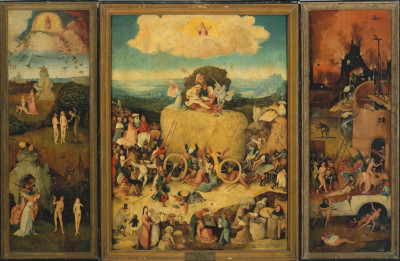
Circa 1500–1505 (Berlin exhibition) [5]The Haywain Triptych
1510–1516 (BRCP) [4]Contents
Annotated Details from Crucifixion with a Donor
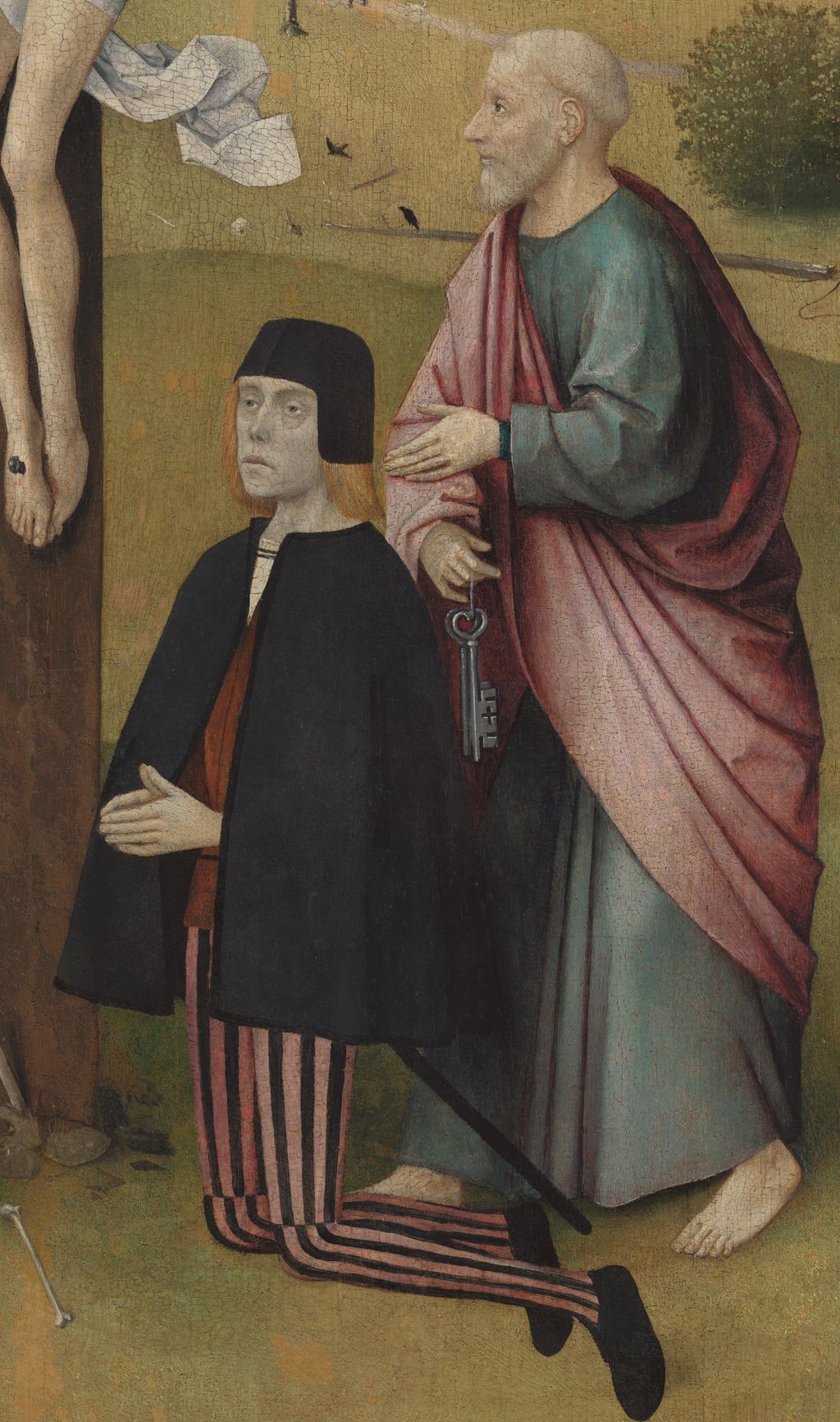
The donor’s place among the sacred figures and the distant landscape become clearer at a larger scale. Explore each numbered area in the detail views below.
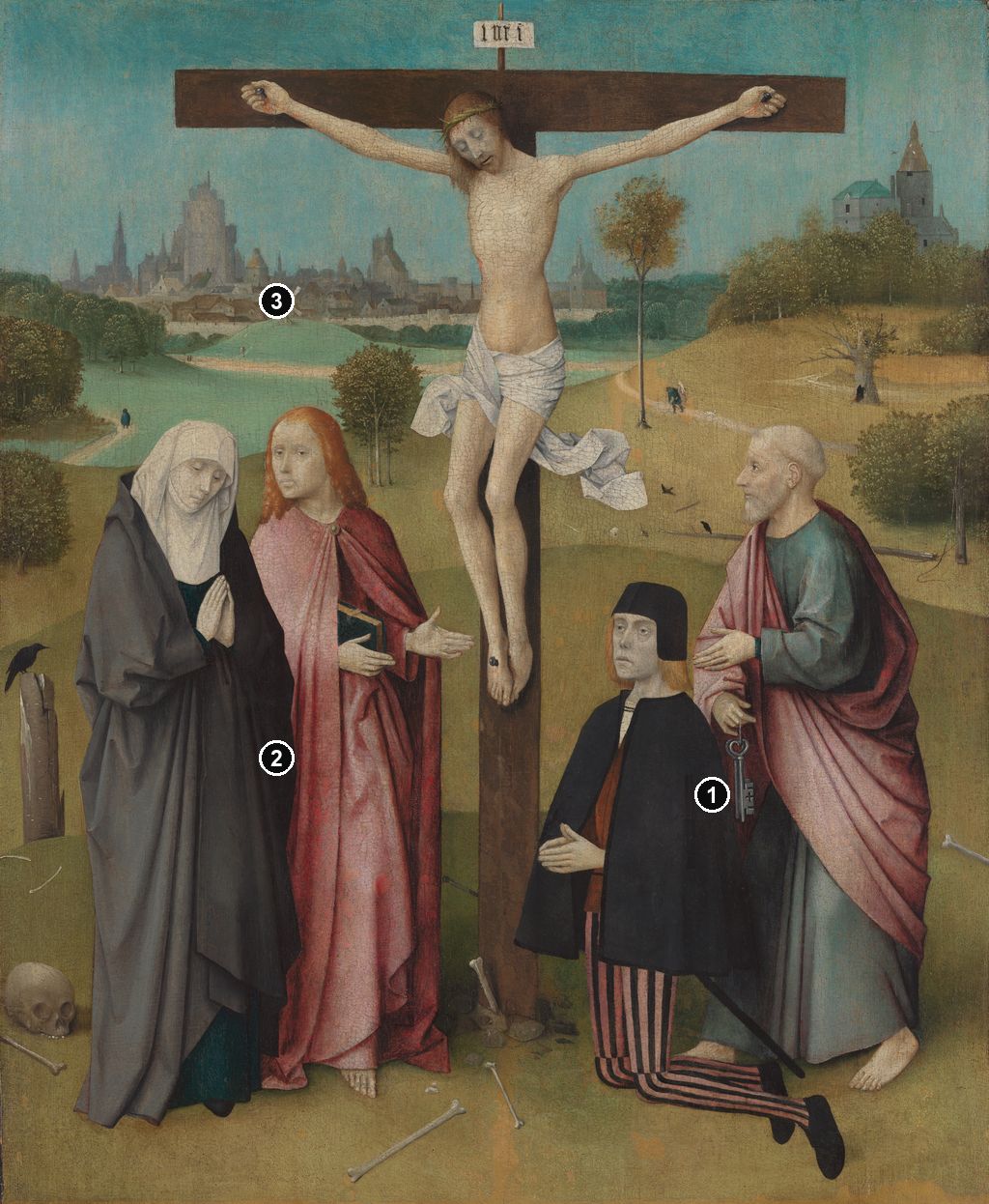
Details from CRUCIFIXION WITH A DONOR
Compare the foreground relationships with the smaller forms beyond the cross.
The kneeling donor and Peter
The donor kneels beside Peter, whose keys are visible against his robe. The saint’s open hand directs attention towards the cross; the donor’s hands are joined in prayer.
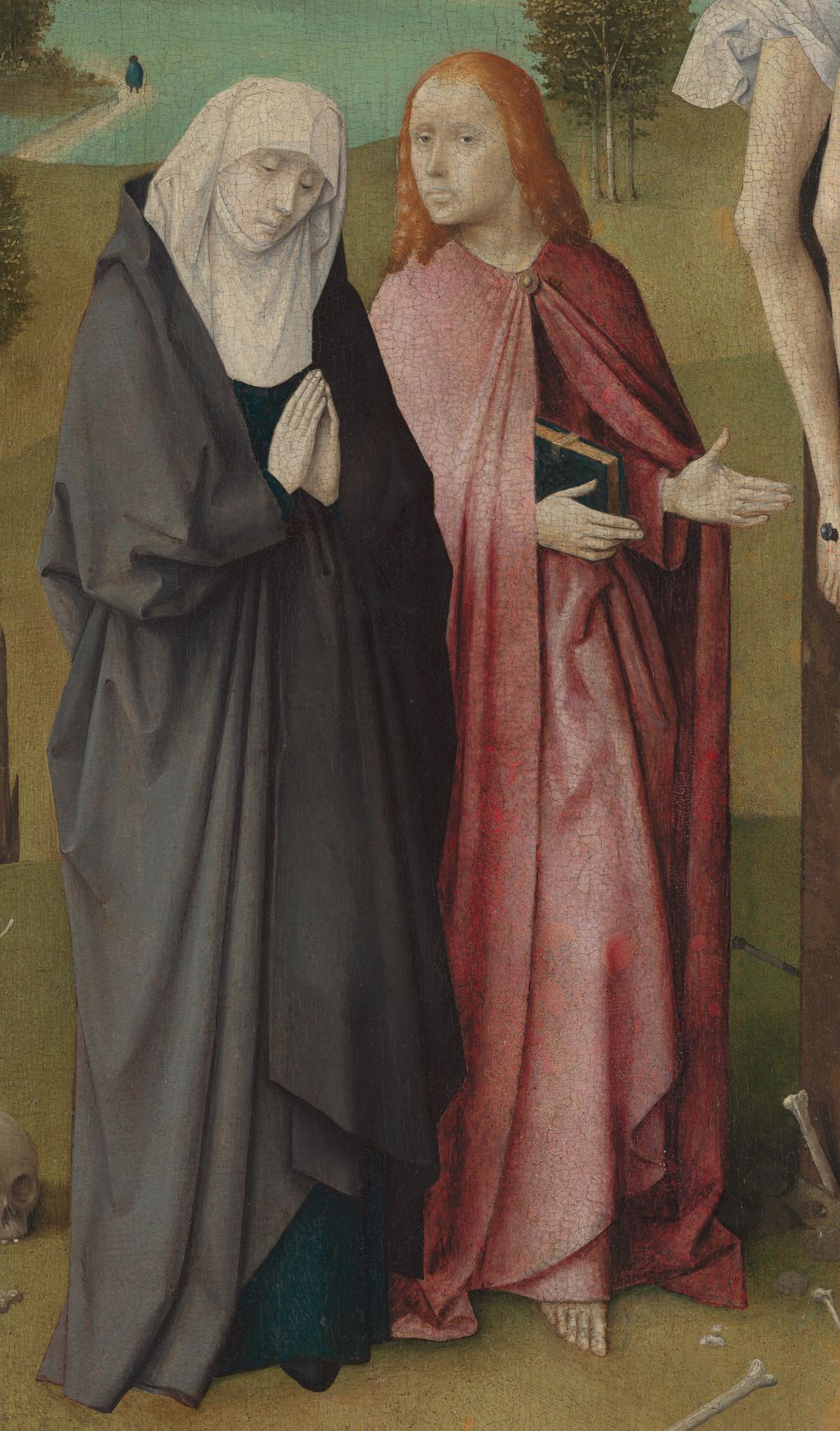
Mary and John
Mary clasps her hands while John turns beside her. Their close grouping gives the left foreground a different rhythm from the kneeling donor and Peter opposite.
City and distant landscape
A distant city stands beyond water and rising ground. Its small vertical buildings echo the upright cross while remaining far behind the foreground figures.
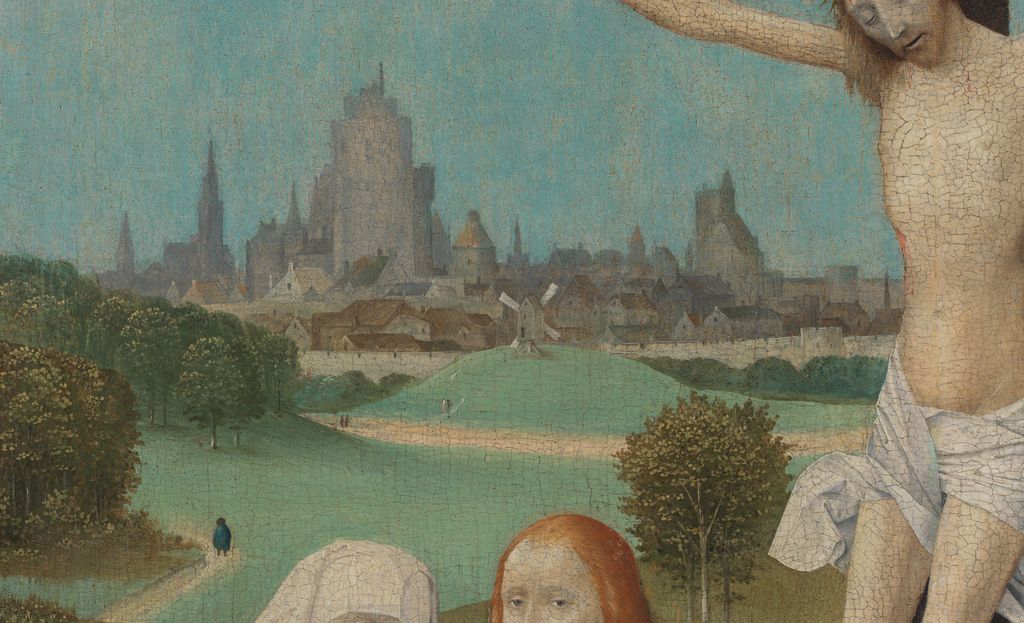
Image and detail crops: Wikimedia Commons source file (public domain reproduction).
Four Figures beneath the Cross
Christ’s pale body occupies the upper centre, with the horizontal crossbeam extending almost the width of the painting. The white loincloth gathers into folds and projects to the right, introducing a small movement against the dark timber. Beneath it, the cross descends to the ground between two pairs of figures. The arrangement is immediately legible, but the people do not stand like equivalent figures in a balanced diagram.
Mary and John occupy the viewer’s left, which is Christ’s right. Her light headdress encloses a lowered face; the dark outer cloak gives her a compact, inward shape. John’s reddish garment and uncovered head distinguish him beside her. His book, youthful features and long hair identify him as the Evangelist. His hands extend across the space towards the donor’s side, making a connection that the broad vertical cross might otherwise interrupt.[2]
Peter stands at the far right. Older and bearded, he holds the keys that serve as his familiar attribute. The kneeling donor is placed immediately in front of him, closer to the foot of the cross. Peter’s presence frames the man’s prayer within a relationship of patronage and protection: the saint introduces a particular worshipper into the company of Mary and John.[2]
The man is smaller in height because he kneels, rather than because Bosch has reduced him to a tiny emblem. His head and hands remain large enough to command attention. His dark cloak forms a substantial shape against Peter’s lighter, reddish drapery, while the stripes lead the eye down towards his bent knees and extended lower legs. The costume makes this unnamed person visually specific even where the historical record fails to name him.
None of these figures dramatically throws back the head towards Christ. Mary’s grief is contained, and the donor’s face does not simply demonstrate an upward gaze. The scene consequently asks more of the viewer than recognition of a familiar biblical event. The cross is visible above everyone, but the human relationships below it become an equally important part of looking.
Prayer through Intercession
The BRCP catalogue reads the figures as a sequence of intercession. Peter presents the donor to John, and John recommends him to Mary, who can plead with Christ. The saints connect the living worshipper with the central promise of redemption. This explains why a man in contemporary clothing appears beside people from the biblical past: his presence represents devotion across time, rather than a claim that he physically witnessed the execution.[2]
The donor’s hands are joined, and his body remains still. For the historical owner, viewing the panel could mean looking at an image of himself already engaged in ideal prayer. The painted figure models an attitude that the person standing before the picture might seek to adopt. The catalogue proposes that his unfocused or inward-looking gaze belongs to this meditative purpose, though the precise content of a painted person’s thoughts cannot be recovered as a fact.
Stillness does not remove movement from the composition. In a 1954 museum essay, Gaston Van Camp described the gestures and relationships as an active progression of prayer. His account is useful beside the modern emphasis on contemplation: John’s turn and Peter’s presentation allow an exchange to unfold even though no crowd presses around the cross. The painting’s emotional restraint leaves room for a different kind of action.[6]
Nor does restrained emotion necessarily keep a viewer at a distance. Elena Zabrodina, discussing tragic emotion in northern European religious painting, points to the nearness of Bosch’s cross to the front of the picture as another way of involving the spectator. One can see the force of that observation here. There is little intervening foreground before the figures, so the viewer approaches the event without having to look past a procession, soldiers or a dense assembly.[7]
The work does not explain exactly where it originally hung or how its owner used it. A memorial function is plausible, but a particular church, burial place or documented devotional routine cannot be supplied. Its surviving arrangement establishes the importance of personal prayer more securely than it establishes the circumstances of the commission.
Who Was the Donor?
Saint Peter provides the clearest clue to the donor’s name. A patron saint frequently shared a worshipper’s first name, making Peter or Pieter a reasonable possibility. It remains a possibility: neither the keys nor the saint’s presence identify a particular historical individual. The BRCP catalogue rejects confident identification of the man with a municipal official or guild member in the absence of supporting evidence.[2]
His clothing seems to promise greater precision. A sword emerges beneath the black cloak, and the red and black stripes are carefully arranged across his legs. They could have related to his occupation, household affiliation or status, but the surviving comparisons have not settled the question. A sword does not by itself prove that he was a knight, and striped clothing cannot be assigned one fixed meaning across every period and social setting.
That uncertainty is part of what makes the portrait compelling. A generalised worshipper might have worn an undifferentiated robe; this man appears in a combination of garments that someone once recognised as appropriate to him. Bosch preserves the shape of a social identity without giving modern viewers the information needed to translate it into a name. The title with a Donor acknowledges that imbalance between visual presence and historical knowledge.
It is also worth separating a devotional portrait from a modern record of appearance. The man’s face has suffered damage and later alteration. The technical report notes that an added moustache visible in old photographs was subsequently removed because it belonged to a later intervention. A historic reproduction can therefore preserve a past state of the painting without preserving the donor’s original features accurately.[3]
A Landscape near Home
Beyond the figures, the ground falls away towards a town. Towers and roofs gather against the sky, a windmill stands outside the built-up area, and roads cross the open land. The setting feels closer to the Low Countries than to an archaeological reconstruction of Jerusalem. The BRCP catalogue describes its Brabantine character, but that observation does not establish the town as an exact portrait of ’s-Hertogenbosch.[2]
The distance matters. The town is far enough away to leave the foreground gathering isolated, yet close enough to suggest an ordinary inhabited world beyond the execution. Small walkers move along the paths without turning the Crucifixion into a public spectacle. Their scale separates everyday movement in the landscape from the still, monumental figures nearest the viewer.
Bones scattered on the ground interrupt the green surface. Behind Peter, a bare tree contributes another exposed, lifeless form, while birds make dark accents in the middle distance. These details prevent the open country from becoming merely pleasant scenery. They locate prayer within a place marked by death, without filling that place with the fantastic creatures familiar from some of Bosch’s other paintings.
The contrast becomes clearer beside Gerard David’s Crucifixion in the Metropolitan Museum of Art, painted around 1495. The Met describes David’s darkened sky and prominent Jerusalem setting, including the Church of the Holy Sepulchre. It also interprets Saint Jerome there as visualising the event through scripture. David and Bosch thus offer different arrangements for devotional looking; the comparison does not demonstrate that one picture served as the other’s direct source.[2][8]
Why the Date Remains Approximate
The painting’s orderly design long encouraged an early position in Bosch’s career. Yet a conventional subject does not have to be an apprentice’s work. Simplicity can answer a particular commission and devotional purpose. The BRCP catalogue instead stresses affinities with paintings usually placed later, including the figures and foliage of The Garden of Earthly Delights and the small Crucifixion on the closed wings of the Prado Adoration of the Magi.[2]
Wood analysis supplies a different kind of evidence. The youngest preserved growth ring dates to 1466. Allowing for missing outer rings, preparation and transport, the technical report gives 1477 as an earliest possible production date, with a date after 1479 statistically more probable. Those are constraints on when the panel could have been used, rather than evidence that Bosch painted it in either year.[3]
The museum’s current range of 1495–1505 and the BRCP range of 1490–1500 therefore remain distinct estimates. Their overlap is useful, but averaging them would manufacture a precision that neither source claims. The evidence supports an approximate place in the artist’s career more comfortably than an exact sequence against every related panel.
Authorship is a firmer matter in the sources reviewed here. The work is unsigned, but the BRCP technical study places its painting and underdrawing within Bosch’s core production. It finds a controlled process with relatively few changes between the preparatory design and the finished paint. Confidence in attribution does not require confidence about the donor’s identity or the painting’s exact year.[2][3]
How Bosch Built the Image
Infrared examination shows a carefully developed drawing beneath the paint. Outlines established the principal forms, including the landscape, while parallel strokes prepared shadow and volume. Darker areas received denser, broader marks. The donor was included in this preparation, although his black cloak and damaged face make parts of his underdrawing harder to distinguish. He was integral to the original composition.[2][3]
The painting did change as Bosch worked. The heads of Mary, John and Peter became slightly smaller, and some hands, folds and contours were adjusted. These revisions refine an already organised design. They differ from a wholesale replacement of the central idea, and from changes made by people who handled the picture after it left the workshop.[3]
Thin and thicker applications work together across the surface. The landscape’s trees begin with dark green, followed by lighter touches that give the foliage shape. Red glazes help establish the garments, with pale modelling beneath them in important passages. In the donor’s hose, black stripes were worked into paint that was still wet. Such small practical decisions produce the contrast between soft fabric folds and sharply legible costume that survives in the overall view.[3]
The Figure That Covered the Donor
At some later stage, a new figure was painted partly over the donor near the foot of the cross. Its remnants suggest Mary Magdalene, probably with an arm reaching towards or around the timber. The added paint lay over the existing background, and X-radiography reveals surviving traces of a hand and arm. The technical report treats this as a later intervention, rather than an alternative composition devised by Bosch.[3]
Most of that figure had already been removed before the museum acquired the panel in 1952. The 1966–67 conservation campaign investigated its remains and carried out further treatment. Keeping those stages separate avoids a misleading story in which the original donor first emerged intact during that later campaign. Removal itself damaged parts of the underlying paint, so the present portrait carries the consequences of both concealment and recovery.[3]
The support also needed substantial repair. Two oak boards form the panel, whose original thickness is largely retained. Severe old woodworm damage weakened the wood, especially at the lower edge, where replacement strips were fitted during the 1966–67 treatment. Other repairs reinforce the join and damaged areas on the reverse. The original frame, within which the panel was prepared and painted, has been lost.[3]
The BRCP examination in 2011 documented widespread tiny losses associated with metal-soap aggregates in the paint structure, alongside abrasion and restored damage. These findings describe the condition observed during that investigation; they are not a new diagnosis of the painting today. They help explain why a face or robe can look granular or interrupted even where the composition remains readable.[3]
An Unknown Man in a Recorded Collection
The documented ownership history begins much later than the commission. The panel was in the Fétis collection in Brussels by 1886, appeared at auction in 1909 and subsequently belonged to the Franchomme–Van Halteren collection. The museum purchased it in 1952. These records secure part of its modern history while leaving the original patron and destination unknown.[1][2]
That missing beginning does not erase the donor from the picture. He remains insistently present, his striped legs and clasped hands placed beside the cross while Peter stands behind him. Bosch gives the viewer enough space to study the relationship: a single person among saints, an event recalled through prayer, and an inhabited landscape continuing beyond them. The quietness is the means through which those connections become visible.
Artworks and related attributions
Browse paintings, drawings and related attributions. Records group triptychs, fragments and two-sided sheets where appropriate. Dates follow the cited museum records or catalogue headings and are generally estimates. Rows marked “2016 catalogue” report that publication’s attribution and collection information; these are dated opinions, rather than a claim that every work is an accepted autograph Bosch.
| Name | Date | Medium, attribution and collection |
|---|---|---|
| A Crossbowman | Second half of the sixteenth century | Oil on oak panel · Copy after Hieronymus Bosch · Museo Nacional del Prado, Madrid · P002695 Source 1. Source 2. |
| A Woman Spinning and an Old Woman | Museum estimates: about 1480–1490 for the women and 1500–1505 for the reverse; the precise chronology is disputed | Pen and brown and grey ink on the front; pen and brown ink on the reverse · Hieronymus Bosch · Museum Boijmans Van Beuningen, Rotterdam · N 190 recto and verso (PK) Source 1. Source 2. |
| Adoration of the Child in Cologne | Second half of the sixteenth century | Oil on oak panel · Imitator of Hieronymus Bosch, in the city collection record · Wallraf-Richartz-Museum & Fondation Corboud, Cologne · WRM 0474 Source 1. Source 2. |
| Adoration of the Magi in Philadelphia | Early sixteenth century in the museum record; around 1495–1520 in the BRCP catalogue | Oil on oak panel · Hieronymus Bosch in the museum record; workshop of Bosch in the 2016 BRCP catalogue · Philadelphia Museum of Art, John G. Johnson Collection, 1917 · 1321; museum object 103592 Source 1. Source 2. |
| Adoration of the Magi — New York | c.1470–1480 | 2016 catalogue: Bosch; oil on oak · Metropolitan Museum 13.26 2016 catalogue. |
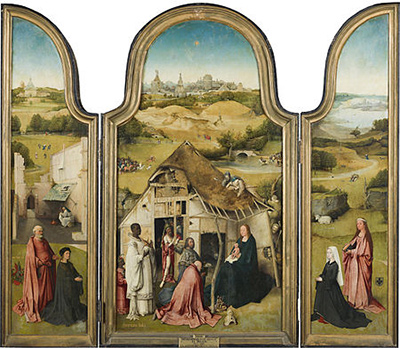
| Adoration of the Magi — Prado triptych | c.1494 | Oil on oak; grisaille exterior · Bosch · Prado P002048 Object source. |
| Adoration of the Magi — three associated fragments | c.1515–1535 | 2016 catalogue: Follower of Bosch · Two Shepherds / Retinue in Philadelphia; associated Adoration in private collection in 2016 2016 catalogue. |
| Ascent of the Blessed — Venice | c.1505–1515 | Oil on panel · Bosch · Gallerie dell’Accademia; Visions of the Hereafter Object source. |
| Battle of the Birds and Mammals | Not specified in catalogue heading | 2016 catalogue: Bosch; pen and brown ink · Berlin KdZ 14715 2016 catalogue. |
| Beggars and Musicians | Around 1530–1540 | Ink and wash on paper · Unknown follower of Hieronymus Bosch · Albertina, Vienna · 7798 Source 1. Source 2. |
| Christ Carrying the Cross Drawing | Around 1470 in the museum catalogue | Black chalk or charcoal, pen and brush in brown ink, white corrections · Anonymous, workshop of Rogier van der Weyden · Museum Boijmans Van Beuningen, Rotterdam · N 81 recto and verso (PK) Source 1. Source 2. |
| Christ Carrying the Cross in Vienna | Around 1490–1510 in the current KHM record and BRCP catalogue | Oil on oak, painted on both sides · Hieronymus Bosch; possible workshop involvement in the Passion side discussed by the BRCP · Kunsthistorisches Museum, Vienna · Gemäldegalerie, GG 6429 Source 1. Source 2. |
| Christ Carrying the Cross — El Escorial | c.1495–1505 | 2016 catalogue: Bosch; oil on oak · Patrimonio Nacional 10014739 2016 catalogue. |
| Christ Carrying the Cross — Ghent | c.1510–1516 (museum) | Oil on panel · Bosch in museum listing; authorship disputed · MSK Ghent 1902-H Object source. |
| Christ Mocked — London | c.1510 | Oil on wood · Bosch · National Gallery NG4744 Object source. |
| Concert in the Egg, After Hieronymus Bosch | Around 1561; third quarter of the sixteenth century | Oil on canvas · Anonymous, after Hieronymus Bosch · Palais des Beaux-Arts, Lille · P 816 Source 1. Source 2. |
| Conjurer / Comical Concert — Louvre drawing | Not specified in catalogue heading | 2016 catalogue: Bosch (recto), follower (concert verso) · Pen and brown ink · Louvre INV 19197 2016 catalogue. |
| Conjurer / Cross-bearing and beggars — Liège sheet | Not specified in catalogue heading | 2016 catalogue: Bosch (verso), follower (recto) · Pen and brown ink · Album d’Arenberg 534 2016 catalogue. |
| Crowning with Thorns — El Escorial | c.1530–1540 | 2016 catalogue: Follower of Bosch; oil on oak · Patrimonio Nacional 10014743 2016 catalogue. |
| Crucifixion with a Donor | Circa 1495–1505; Circa 1490–1500 | Oil on oak panel · Hieronymus Bosch · Royal Museums of Fine Arts of Belgium, Brussels · 6639 Source 1. Source 2. |
| Death and the Miser Drawing | Not securely established; probably made after the painting | Pen and brush, dark ink and white highlights on prepared paper · Workshop of Hieronymus Bosch in the BRCP catalogue; alternatives recorded by the Louvre · Musée du Louvre, Department of Prints and Drawings, Paris · RF 6947, Recto Source 1. Source 2. |
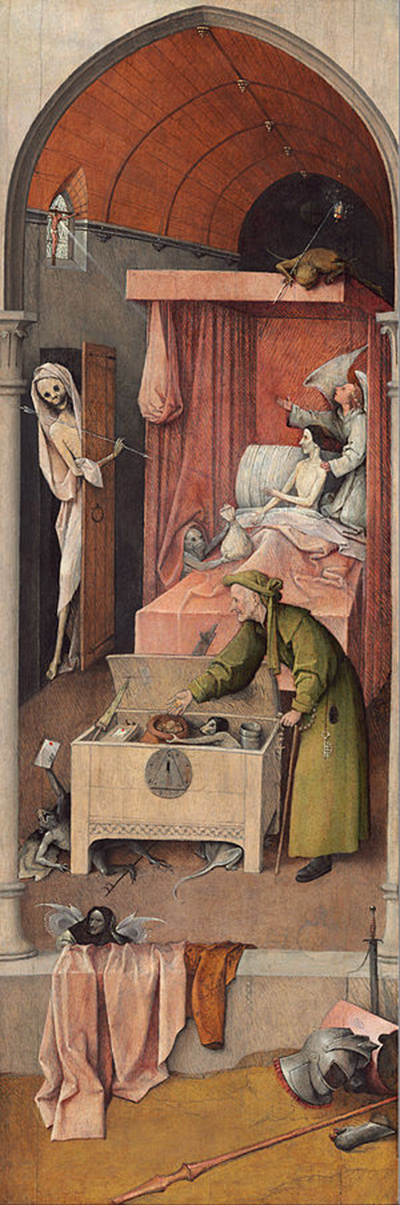
| Death and the Miser — Washington | c.1485/1490 (NGA) | Oil on panel · Bosch · National Gallery of Art 1952.5.33 Object source. |
| Ecce Homo Triptych — Boston | c.1495–1500; wings c.1500/1503 | 2016 catalogue: Workshop of Bosch; oil on oak · Museum of Fine Arts Boston; several production phases 2016 catalogue. |
| Ecce Homo — Frankfurt | c.1490 | Mixed technique on oak · Bosch · Städel 1577 Object source. |
| Fall of the Damned — Venice | c.1505–1515 | 2016 catalogue: Bosch; oil on panel · Visions of the Hereafter · Venice 2016 catalogue. |
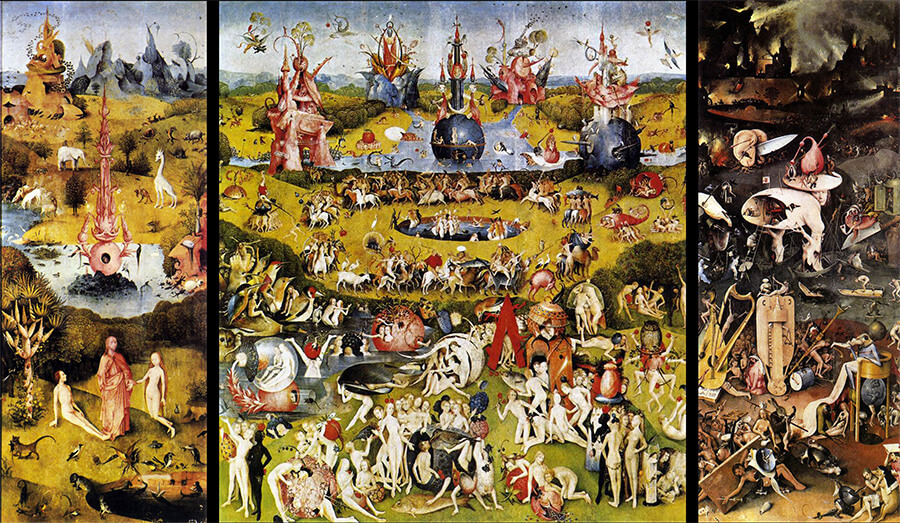
| Garden of Earthly Delights | 1490–1500 (Prado) | Oil on oak; grisaille exterior · Bosch · Prado; triptych Object source. |
| Gluttony and Lust / Allegory of Intemperance — Yale fragment | c.1500–1510 (group dating) | 2016 catalogue: Bosch; oil on oak · Yale 1959.15.22; fragment associated with Ship of Fools 2016 catalogue. |
| Group of Ten Spectators, a Follower of Bosch | Around 1510–1540 in the current museum record | Pen and two brown inks on paper, with a brown framing line · Follower of Hieronymus Bosch in the Morgan record; Bosch in the BRCP catalogue · Morgan Library & Museum, New York · I, 112 Source 1. Source 2. |
| Head of an Old Woman | About 1500 | Oil on panel · Attributed to Jacob Cornelisz. van Oostsanen · Museum Boijmans Van Beuningen, Rotterdam · 2439 (OK) Source 1. Source 2. |
| Hell and the Flood — Rotterdam panels | Around 1515 in the museum records; around 1510–1520 in the BRCP catalogue | Oil on oak panels · Jheronimus Bosch in the museum records; workshop of Bosch in the BRCP catalogue · Museum Boijmans Van Beuningen, Rotterdam Source 1. Source 2. |
| Hermit Saints Triptych | Circa 1495–1505 | Oil on oak panels · Hieronymus Bosch · Gallerie dell’Accademia, Venice · 2044 Source 1. Source 2. |
| Infernal Landscape | Not specified in catalogue heading | 2016 catalogue: Bosch; pen and brown ink, red accent · Private collection in 2016 2016 catalogue. |
| Infernal Scene with Anvil / Monster Studies | Not specified in catalogue heading | 2016 catalogue: Bosch; attribution debated in entry · Pen and brown ink · Berlin KdZ 548 2016 catalogue. |
| Infernal Scene with Tree-Man / Standing Man | Not specified in catalogue heading | 2016 catalogue: Workshop of Bosch; pen and brown ink · Dresden C 1875; historical reverse title includes a proposed prophet 2016 catalogue. |
| Job Triptych — Bruges | c.1510–1520 | 2016 catalogue: Workshop of Bosch; oil on oak · Groeningemuseum / Hoeke loan in 2016 2016 catalogue. |
| Last Judgement — Bruges triptych | c.1495–1505 | 2016 catalogue: Bosch; oil on oak · Groeningemuseum 2016 catalogue. |
| Last Judgement — Munich fragment | c.1530–1540 | 2016 catalogue: Follower of Bosch; oil on oak · Alte Pinakothek 5752 2016 catalogue. |
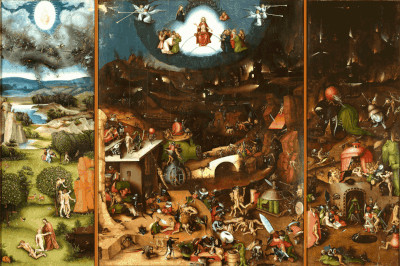
| Last Judgement — Vienna triptych | c.1500–1505 (BRCP 2016) | Oil on oak · Bosch and workshop (BRCP 2016) · Academy of Fine Arts Vienna 2016 catalogue. |
| Man in a Basket and Comic Figures | Around 1500–1515 in the museum record | Pen and brown ink on paper; the reverse is catalogued as iron-gall ink · Hieronymus Bosch in the current Albertina record; attribution has been debated · Albertina, Vienna · 7797 recto and verso Source 1. Source 2. |
| Man Seen from Behind | About 1550–1569; About 1565–1570 | Traces of black chalk, pen and brush in light brown ink · Anonymous, circle of Pieter Bruegel the Elder · Museum Boijmans Van Beuningen, Rotterdam Source 1. Source 2. |
| Mary and John at the Foot of the Cross | About 1440 | Brush in grey and black · Unknown, possibly Netherlandish · Kupferstich-Kabinett, Staatliche Kunstsammlungen Dresden · C 815 Source 1. Source 2. |
| Model Sheet with ‘Witches’ | Disputed; proposals depend on the attribution | Pen and brown ink; the BRCP also records underlying black chalk · Hieronymus Bosch; follower attributions also recorded · Musée du Louvre, Département des Arts graphiques, Paris · INV 19721 recto Source 1. Source 2. |
| Peasant and Three Bust-Length Figures | 1401–1500 | Brown pen over a black preliminary drawing · Attributed to the Master of the Drapery Studies; Bosch circle also recorded · Kupferstichkabinett, Staatliche Museen zu Berlin · KdZ 777 Source 1. Source 2. |
| River to Hell — Venice | c.1505–1515 | 2016 catalogue: Bosch; oil on panel · Visions of the Hereafter · Venice 2016 catalogue. |
| Saint Anthony and a Concert in an Egg | Around 1510–1525 in the museum’s 2016–17 exhibition texts | Pen in light and dark brown inks · Workshop of Hieronymus Bosch; underlying monsters: Bosch (BRCP), possibly Bosch (exhibition text) · Kupferstichkabinett, Staatliche Museen zu Berlin · KdZ 711 recto and verso Source 1. Source 2. |
| Saint Christopher Carrying the Christ Child | c.1500; 1490–1505 in restoration material | Oil on panel · Bosch · Boijmans St 26 Object source. |
| Saint James and Hermogenes | About 1551–1575 in the KIK-IRPA catalogue | Oil on wood, painted on both sides · Anonymous follower of Hieronymus Bosch · Musée des Beaux-Arts, Valenciennes · P.46.1.44; older number 176 Source 1. Source 2. |
| Saint Jerome at Prayer | Circa 1485–1495 | Oil on oak panel · Hieronymus Bosch · Museum of Fine Arts, Ghent · 1908-H Source 1. Source 2. |
| Saint John on Patmos / Passion Scenes | c.1495–1505; estimates vary | Oil on oak · Bosch · Gemäldegalerie Berlin 1647A Object source. |
| Saint John the Baptist in Meditation | Late 15th century; c.1485–1510 (Prado exhibition) | Oil on panel · Bosch · Lázaro Galdiano 8155 Object source. |
| Saint Liberata Triptych | Circa 1495–1505 | Oil on oak panels · Hieronymus Bosch · Gallerie dell’Accademia, Venice · 2045 Source 1. Source 2. |
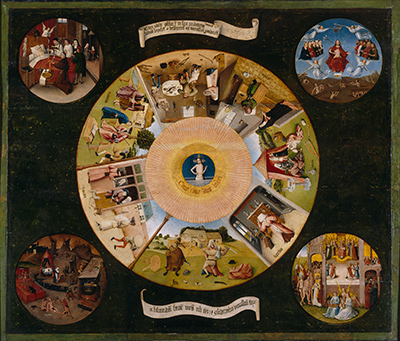
| Seven Deadly Sins and the Four Last Things | 1505–1510 (Prado) | Oil on poplar · Bosch (Prado); workshop/follower disputed · Prado Object source. |
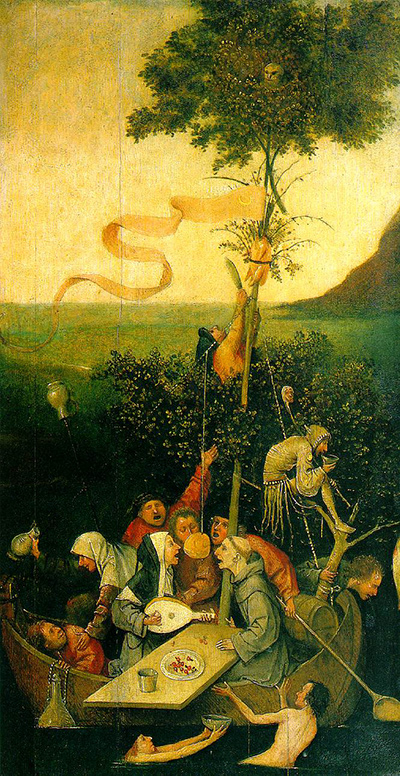
| Ship of Fools — Louvre painting | 1475–1500 (record); c.1505–1515 (exhibition) | Oil on oak · Bosch · Louvre RF 2218; fragment Object source. |
| Ship of Fools — Louvre workshop drawing | Not specified in catalogue heading | 2016 catalogue: Workshop of Bosch · Pen, brush, grey-brown ink and white highlights on prepared paper · Louvre RF 3714 2016 catalogue. |
| Studies of Monsters | About 1530–1550, according to the current Ashmolean record | Pen and brown ink on laid paper, both faces · Anonymous follower of Hieronymus Bosch · Ashmolean Museum, University of Oxford · WA1863.155 Source 1. Source 2. |
| Studies of Saint Anthony and Monsters | No execution date specified in the current Louvre records | Pen and brown ink on paper · Bosch listed; reverse questioned by Louvre; BRCP accepts both faces · Musée du Louvre, Département des Arts graphiques, Paris · INV 20871 recto and verso Source 1. Source 2. |
| Temptation of Saint Anthony — Kansas City fragment | c.1500–1510 | 2016 catalogue: Bosch; oil on oak · Nelson-Atkins 35–22 2016 catalogue. |
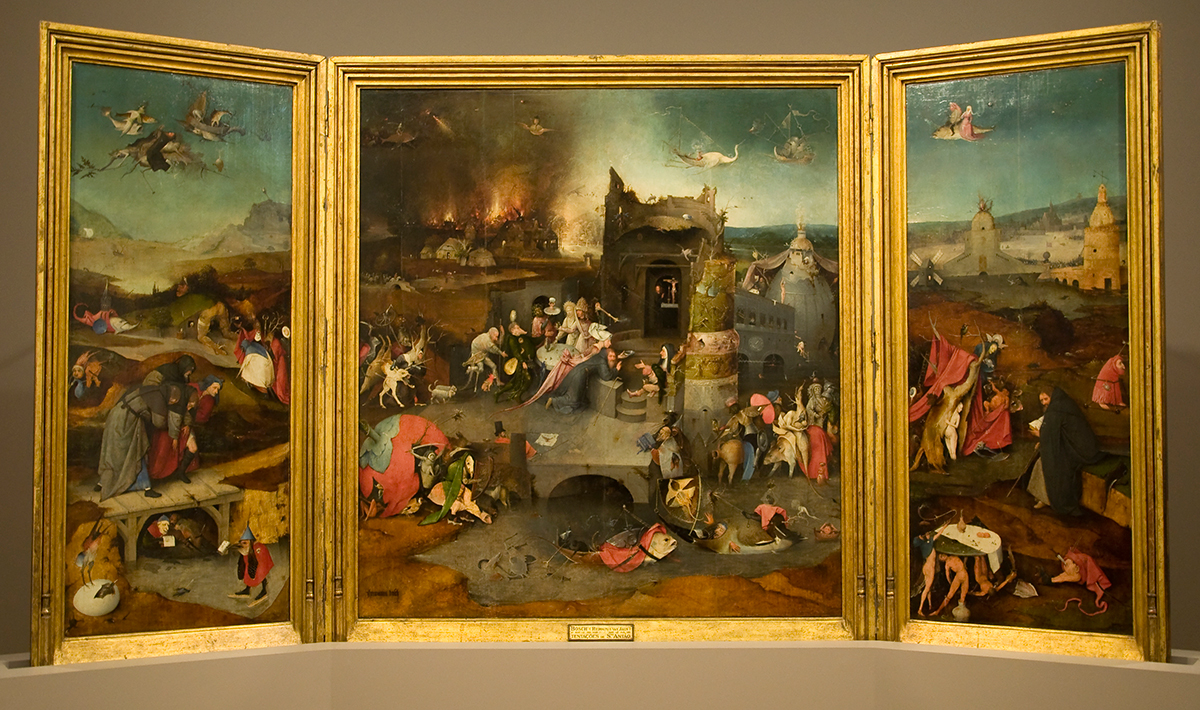
| Temptation of Saint Anthony — Lisbon triptych | c.1500 | Oil on oak · Bosch · Museu Nacional de Arte Antiga 1498 Pint Museum. |
| Temptation of Saint Anthony — Prado panel | c.1530–1540 | 2016 catalogue: Follower of Bosch (2016 opinion); oil on oak · Prado P002049 2016 catalogue. |
| Terrestrial Paradise | Approximately 1505–1515 | Oil on oak panel · Hieronymus Bosch · Gallerie dell'Accademia, Venice Source 1. Source 2. |
| The Burning Ship Drawing | 1500–1520 | Pen and iron gall ink on paper · Attributed to Hieronymus Bosch · Academy of Fine Arts Vienna, Graphic Collection · HZ-2554; numbered 2554 in the BRCP catalogue Source 1. Source 2. |
| The Comical Barber Scene | About 1550–1580, according to the British Museum | Pen and brown ink, grey and brown wash, over black chalk · Anonymous follower, after Hieronymus Bosch · British Museum, Department of Prints and Drawings, London · 1854,0628.46 Source 1. Source 2. |
| The Conjuror, After Hieronymus Bosch | Probably after 1525; around 1530–1540 in the BRCP technical report | Oil on oak panel · Anonymous follower of Hieronymus Bosch · Musée Ducastel-Vera, Saint-Germain-en-Laye · 872.1.87 Source 1. Source 2. |
| The Cure of Folly / Extraction of the Stone of Madness | 1501–1505 (Prado) | Oil on oak · Bosch (Prado); workshop/follower disputed · Prado P002056 Object source. |
| The Entombment Drawing | About 1505–1515, current museum record | Brush and black and grey ink, with grey wash, over black chalk · Workshop of Hieronymus Bosch; drawn by the Master of the Prado Haywain Triptych; Hieronymus Bosch, argued by the BRCP in 2016 · British Museum, Department of Prints and Drawings, London · 1952,0405.9 Source 1. Source 2. |
| The Gathering of the Birds | Not specified in catalogue heading | 2016 catalogue: Bosch; pen and brown ink · Berlin KdZ 13136 2016 catalogue. |
| The Haywain — Prado triptych | 1510–1516 (BRCP 2016) | Oil on oak · Bosch (BRCP 2016) · Prado; separate Escorial version exists 2016 catalogue. |
| The Hearing Forest and the Seeing Field | Circa 1500–1505 | Pen and brown ink on paper · Hieronymus Bosch; reverse: Bosch and workshop · Kupferstichkabinett, Staatliche Museen zu Berlin · KdZ 549, front and reverse Source 1. Source 2. |
| The Owl’s Nest — Rotterdam | Not specified in catalogue heading | 2016 catalogue: Bosch; pen and brown ink · Boijmans N 175 2016 catalogue. |
| The Passion Triptych in Valencia | Workshop of Bosch, about 1510–1520; Follower of Bosch; centre about 1530–1540, wings about 1540–1550 | Oil and gold on oak panels · Workshop of Bosch, about 1510–1520; Follower of Bosch; centre about 1530–1540, wings about 1540–1550 · Museu de Belles Arts de València Source 1. Source 2. |
| The Pedlar / Wayfarer — Rotterdam | c.1500 (museum) | Oil on panel · Bosch · Boijmans 1079 (OK); rejoined exterior Object source. |
| The Tree-Man — Vienna drawing | c.1505 | Pen and brown ink · Bosch · Albertina, Vienna Object source. |
| The Wedding at Cana, After Hieronymus Bosch | Approximately 1560 in the current museum record | Oil on panel, 93 cm high × 72 cm wide · Anonymous, after Hieronymus Bosch · Museum Boijmans Van Beuningen, Rotterdam, St 25 Source 1. Source 2. |
| Two Fantastical Creatures — Berlin KdZ 550 | Around 1505–1515 in the museum’s 2016 exhibition text | Pen in brown ink on reddish prepared laid paper · Hieronymus Bosch · Kupferstichkabinett, Staatliche Museen zu Berlin · KdZ 550, recto and verso Source 1. Source 2. |
| Two Figures Wearing Mitres | About 1480 | Oil on panel · Anonymous (Boijmans); Bosch circle (RKD) · Museum Boijmans Van Beuningen, Rotterdam · 1177 (OK) Source 1. Source 2. |
| Two Men and the Temptation of Eve | About 1505–1515 in the Prado’s 2016 exhibition guide | Pen and grey-brown ink on paper · Hieronymus Bosch in the 2016 catalogues discussed here · Private collection, as recorded in 2016 Source 1. Source 2. |
| Two Men Fighting | Not specified in the current Louvre record | Pen and brown ink · In the manner of Hieronymus Bosch · Musée du Louvre, Département des Arts graphiques, Paris · INV 20660 recto; formerly NIII 8896 and MA 8400 Source 1. Source 2. |
| Two Men — Berlin KdZ 5210 | Not specified in catalogue heading | 2016 catalogue: Bosch questioned · Pen, brush, ink, chalk and white highlights · Berlin KdZ 5210; historical title Two Oriental Men 2016 catalogue. |
| Two Monsters — Berlin KdZ 547 | Approximately 1500–1510 in Berlin's 2016 exhibition catalogue; an estimated range | Pen and brown ink on paper · Hieronymus Bosch · Kupferstichkabinett, Staatliche Museen zu Berlin · KdZ 547, drawn on both sides Source 1. Source 2. |
Frequently Asked Questions
The donor remains unidentified. Saint Peter suggests a possible first name such as Peter or Pieter, but neither his clothing nor his sword establishes a particular person or office.[2]
The BRCP catalogue reads Peter as the donor’s patron saint, presenting him to John and Mary within a sequence of intercession.[2]
A later figure, probably Mary Magdalene, partly overlapped him. It had largely been removed before the museum acquired the painting in 1952; the 1966–67 treatment examined surviving traces.[3]
Discussion
Look at the relationships beneath the cross and the clues that make the unknown donor visually distinctive.
Reader Insights
Follow John’s and Peter’s gestures. How do they connect the donor to the other figures?
Which landscape detail most changes the apparent calm of the scene?
What does the donor’s striped clothing tell you visually, even though his name remains unknown?
Join the Conversation
Share a detail, comparison or question about Crucifixion with a Donor below.
References
- Royal Museums of Fine Arts of Belgium, Calvarie met schenker, inventory 6639. View source.
- Bosch Research and Conservation Project, catalogue 15: Calvary with Donor. View source.
- Bosch Research and Conservation Project, Technical Studies, catalogue 15, pp. 222–229. View source.
- BRCP Catalogue Raisonné (2016), object dates in catalogues 1, 2, 8, 15 and 20; catalogue 20 object metadata only for the Haywain comparison. View source
- Staatliche Museen zu Berlin, 2016 exhibition wall texts, p. 3: approximate date of KdZ 549. View source
- Gaston Van Camp, “Autonomie de Jérôme Bosch et récentes interprétations de ses œuvres,” museum bulletin (1954), relevant discussion pp. 131–135. View source.
- Elena Zabrodina, study of tragic emotions in Netherlandish and German altarpieces (2020), relevant discussion p. 69. View source.
- The Metropolitan Museum of Art, Gerard David, The Crucifixion, 09.157. View source.