



 by Tom Gurney
Tom Gurney BSc (Hons) is an art history expert with over 20 years experience
Published on June 19, 2020 / Updated on October 30, 2026
Email: tomgurney1@gmail.com / Phone: +44 7429 011000
Alabama and Kearsarge by Édouard Manet: Introduction
A sailing boat pushes into a great expanse of green-blue water. Beyond it, men cling to wreckage while two warships disappear into smoke. The battle occupies the upper part of the canvas, but the sea reaches almost to the spectator's feet. Its dark troughs and pale crests make the distance to the ships feel both immense and dangerously open.
Édouard Manet painted The Battle of the USS “Kearsarge” and the CSS “Alabama” in response to a naval engagement fought off the French coast in June 1864. Now in the Philadelphia Museum of Art, it is his first known seascape.[1] He had not witnessed the encounter. He made the picture from reported information, giving a recent event a strikingly unsettled arrangement of water, ships and human figures.[2]
At a Glance
- ArtistÉdouard Manet
- TitleThe Battle of the USS “Kearsarge” and the CSS “Alabama”
- Date1864
- MediumOil on canvas
- Dimensions137.8 × 128.9 cm, height × width
- CollectionPhiladelphia Museum of Art
- Collection numberCat. 1027
- CreditJohn G. Johnson Collection, 1917.[1]
This work across Édouard Manet’s career
Contents
- The Battle off Cherbourg
- An Extraordinary View over the Water
- Waves Built from Visible Paint
- The Pilot Boat and the Men in the Sea
- Smoke, Sails and Partly Hidden Ships
- Making a Picture from the News
- What Examination Reveals about the Composition
- A Letter from Boulogne
- The Kearsarge at Boulogne
- Marine: The Subject in Print
The Battle off Cherbourg
On 19 June 1864, the United States warship Kearsarge, commanded by John A. Winslow, fought the Confederate commerce raider Alabama, commanded by Raphael Semmes, off Cherbourg. The American Civil War had brought its naval conflict into waters close to the French coast. The ships engaged beyond French territorial waters, circling as they exchanged fire. Alabama was fatally damaged and sank.[3]
The commanders' reports describe that broad sequence from opposing sides. Winslow's first account was dated the day of the battle; Semmes wrote from Southampton two days later. Their explanations of particular actions and responsibilities differ, but both describe the circling engagement and the loss of Alabama.[3] These were already events being reported, argued over and retold before they became a subject for Manet.
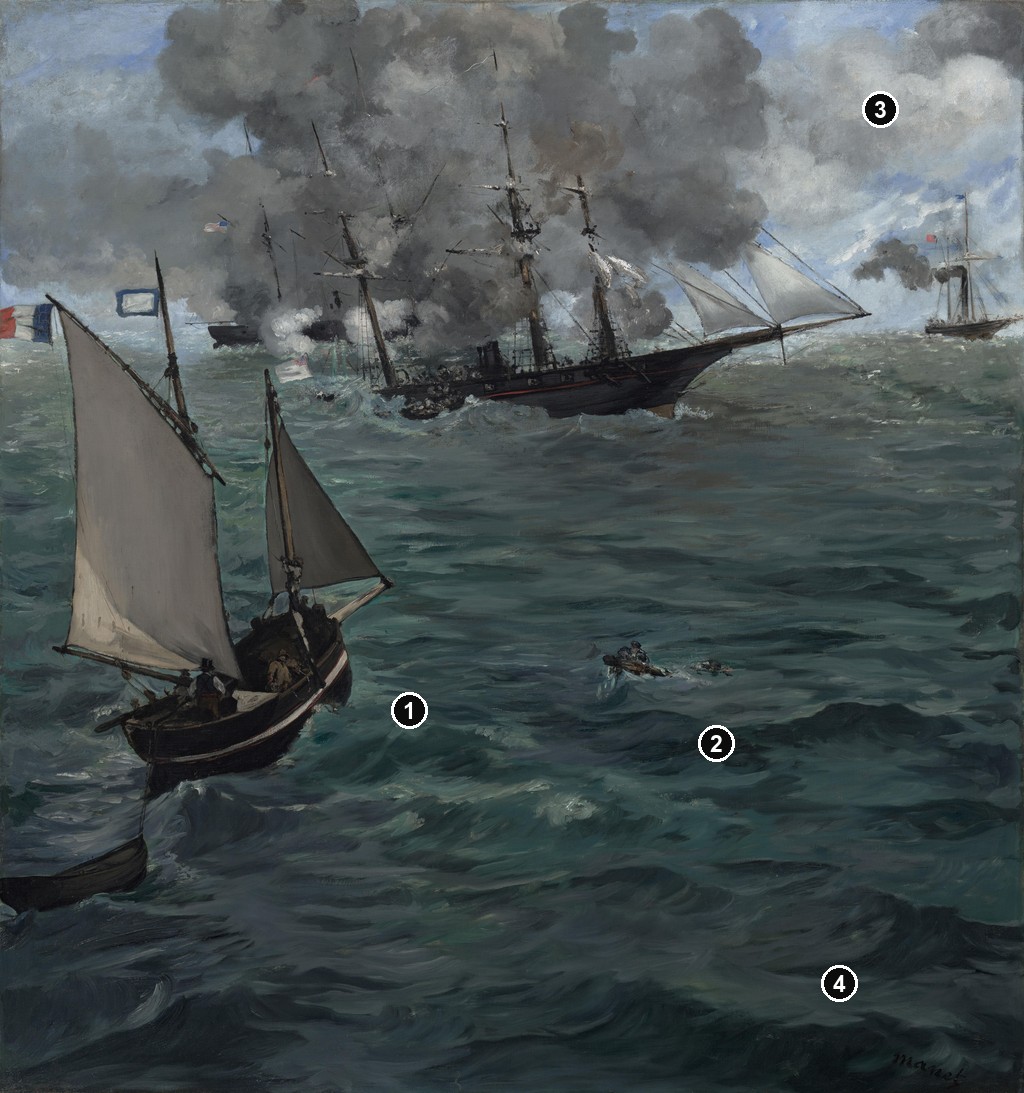
The painting concentrates on the sinking and rescue. Alabama lies nearer to us, her stern settling low in the water. Kearsarge is partly concealed behind her and the surrounding smoke. At the far right is the British steam yacht Deerhound, which helped rescue survivors; a French pilot boat approaches from the foreground.[2]
An Extraordinary View over the Water
The high viewpoint is one of the first things to notice. We look down on the near boat and the small dinghy trailing behind it, yet the distant ships stand almost against the horizon. The eye has to travel a long way across the painted sea before reaching them.
That journey is uneven. The pilot boat provides a substantial dark shape at the lower left, with pale sails rising above its hull. Near the centre, a much smaller group of marks resolves into people clinging to wreckage. Farther away, the masts and hulls gather beneath the broad cloud of smoke. Each of these passages asks us to look at a different scale.
There is little stable ground for the spectator. No stretch of shore gives us a comfortable position from which to watch. The water continues to the lower edge, where large curved strokes suggest waves passing beneath our viewpoint. We seem to hover over a surface that keeps changing.
The shape of the canvas intensifies this effect. Slightly taller than it is wide, it gives the foreground sea considerable depth. The warships could almost fit within a narrow horizontal picture near the top; Manet makes their distance from us a major part of the subject.
Look along the pilot boat's course. Its wake bends back into the foreground, while its bows lead towards the action. The craft offers a route into the picture, but the open water around it prevents that route from feeling secure. The viewer can follow the rescue attempt without being allowed to forget the sea it must cross.
Waves Built from Visible Paint
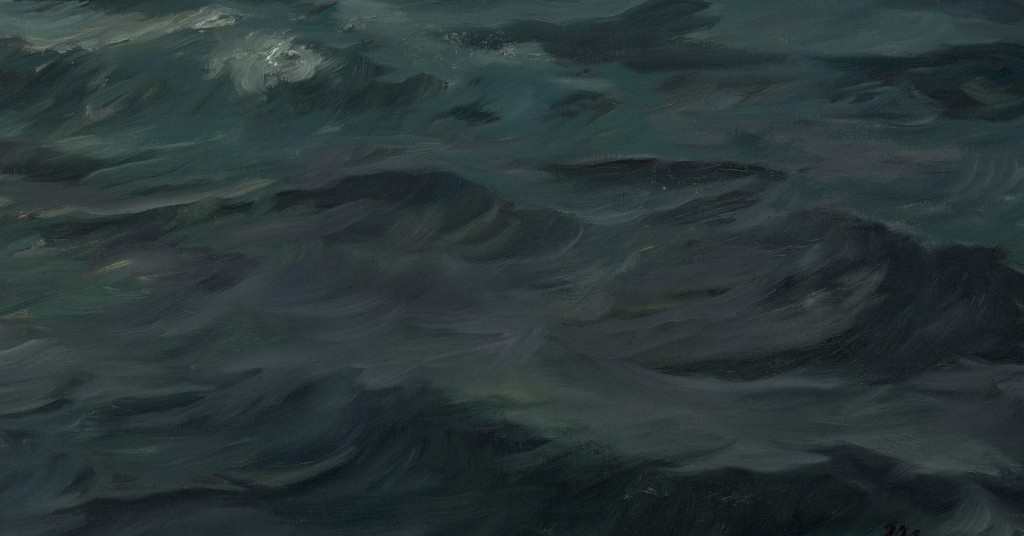
The sea contains many changes within a restricted range of colours. Deep blue-green passages form the hollows between waves. Grey and paler green rise across them, with short whitish marks catching the crests. Towards the ships, the surface grows lighter and the individual strokes become smaller.
Near the bottom, broad sweeps of paint remain easy to follow. Some curve upwards, others slide across them at a shallower angle. They create a succession of ridges and depressions without giving each wave a carefully enclosed outline. The movement depends on neighbouring marks pulling in different directions.
The water beside the pilot boat is especially varied. Pale touches break against its dark hull, while a lighter trail opens behind it. Farther to the right, darker swells spread across a larger, less interrupted area. The boat's passage and the wider motion of the sea occupy the same surface.
Distance changes the handling. Around the sinking ship, foam and small craft are compressed into brief strokes. A mark that would be a small accent in the foreground can become an entire boat or a group of people higher up. Manet uses those differences to make a broad painted field carry several scales of activity.
The result rewards looking from more than one distance. From farther away, the sea reads as a continuous space through which the vessels move. Closer to the canvas, its separate strokes become more insistent, and the scene seems to gather itself out of coloured paint.
The Pilot Boat and the Men in the Sea
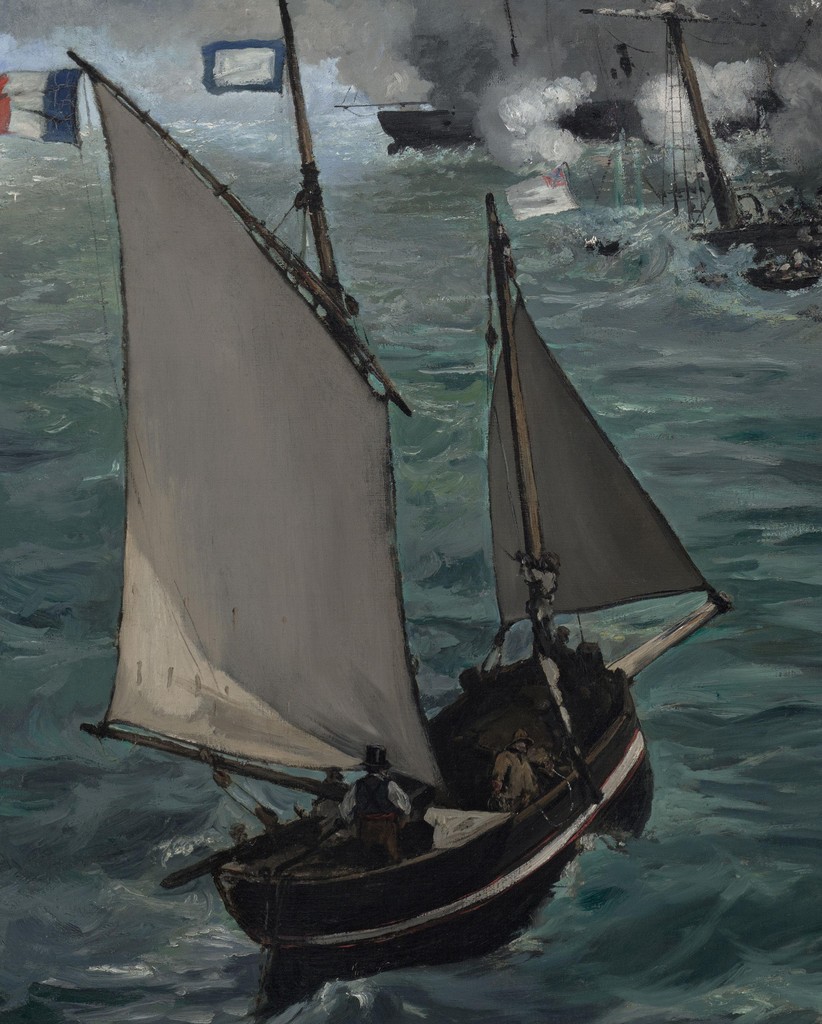
The near boat gives the rescue a visible human presence. A man stands at the tiller in a dark top hat and waistcoat over a light shirt. Other figures appear among the sails and rigging. Their bodies are small, but the contrasts between pale clothing, dark hull and bright flags help us find them.
Juliet Wilson-Bareau and David C. Degener identify the craft as a French pilot boat. They caution against confidently naming its helmsman as Antoine François Mauger, a real pilot who took part in saving Alabama's crew.[2] The painting gives its boatman a particular appearance while leaving his identity open.
That distinction allows us to attend to his place in the composition. His upright figure stands within a vessel tilted across the waves. The pale shirt makes a compact light patch below the much larger sail. Beyond him, the eye moves towards the low forms near the middle of the water.
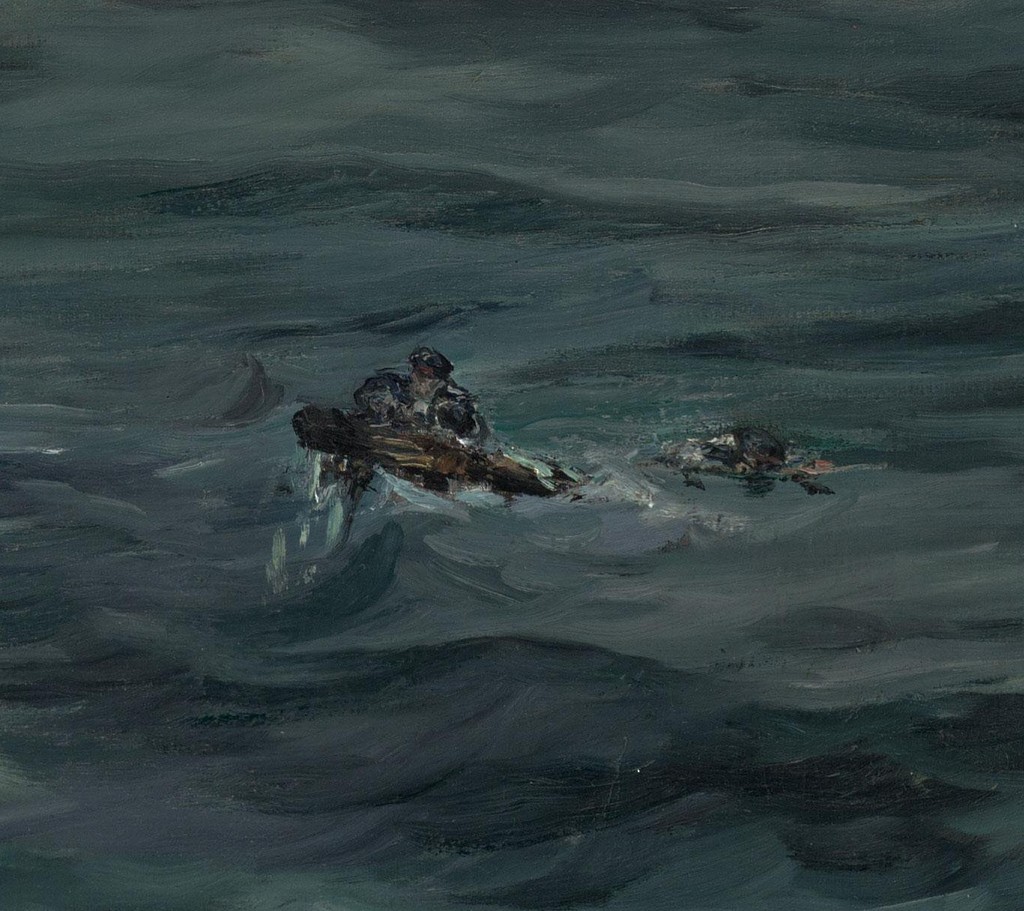
Those forms are easily missed on a first look. Heads and arms rise around a narrow piece of wreckage; white touches break against the surrounding green. The people occupy far less space than a single foreground wave, yet recognising them changes the apparent emptiness of the sea.
The pilot boat supplies a possible connection between these vulnerable bodies and safety. Its course gives the open water a human purpose.
Smoke, Sails and Partly Hidden Ships
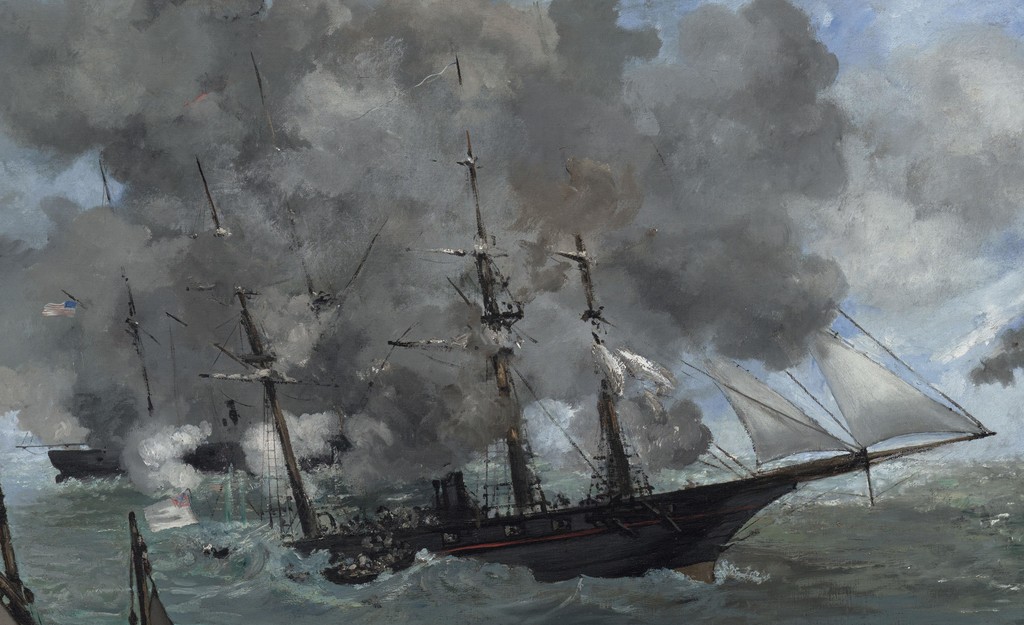
Above the water, the smoke spreads across much of the upper canvas. Dense dark passages gather near the vessels, opening into softer grey shapes as they rise. At the right, lighter cloud and glimpses of blue sky interrupt the mass.
The masts repeatedly disappear and return. A thin dark line may remain clear for a short distance, then dissolve into a grey passage before appearing again above it. Rigging, smoke and cloud make the ships harder to separate, especially where Kearsarge lies behind Alabama.
The sinking vessel is more immediately legible. Its dark hull cuts diagonally across a lighter area of water, and the pale sails towards its bows catch the light. Small boats and figures cluster near the lower, troubled stern. The position of the hull gives the scene a downward pull that counters the rising masts.
At far right, Deerhound stands apart from that confusion. Its darker hull and smokestack are set against a pale band near the horizon. Tiny coloured flags echo the red, white and blue accents on the pilot boat, connecting two widely separated parts of the picture.[2]
These fragments of bright colour matter because so much else belongs to the green-grey range. Flags, pale sails and white foam provide points of recognition within a scene where forms are repeatedly obscured. The eye keeps moving between what can be identified quickly and what requires a longer search.
Making a Picture from the News
The engagement attracted rapid attention in the illustrated press. In their study of Manet's paintings, Wilson-Bareau and Degener compare several images published in late June and early July 1864. Those illustrations varied in their placement of the vessels, the moment represented and the information they supplied.[2]
Such images could help an artist imagine a battle without providing one unquestionable view of it. A depiction might be based on a participant's sketch, then redrawn and engraved for publication. Flags, ship profiles and the relationship between smoke and action could change as information passed through several hands.
The marine painter Henri Durand-Brager also produced a picture of the encounter, displayed in Paris early in July. Whether Manet saw that oil before it left for New York is uncertain. The authors discuss it among the contemporary visual resources surrounding the event, while leaving the precise stimulus for Manet's own painting unresolved.[2]
In Manet's arrangement, the sea takes on unusual importance. The named combatants occupy the distance, partly hidden; the foreground is given to the approaching pilot boat and a wide reach of waves. The viewer's experience depends on crossing that space with the eye.
What Examination Reveals about the Composition
The picture also preserves evidence of changes made during its development. Wilson-Bareau and Degener describe diagonal forms visible in raking light and underlying boats revealed by X-radiography, particularly towards the right and near the centre. Some earlier shapes were covered as Manet reconsidered the arrangement.[2]
The pilot boat had a more settled place. According to their account of the X-radiograph, its main outline was established early and remained largely consistent, although Manet adjusted details including the stern and a rope.[2] The large foreground craft and the smaller vessels did not all undergo the same degree of alteration.
The authors relate aspects of the earlier arrangement to Dutch marine painting, particularly a work by Ludolf Backhuysen in the Louvre. That comparison offers a possible older pictorial resource alongside the recent newspaper images. It helps place Manet's work between the immediate demands of the news and an existing tradition of arranging ships on water.[2]
The sequence of revisions remains less certain than their presence. The authors propose that stronger turquoise greens may have followed Manet's experience of the sea at Boulogne later that summer. They also leave open possible returns to the canvas before its exhibitions in 1867 or 1872.[2]
A Letter from Boulogne
A short letter to the critic Philippe Burty brings Manet's own response into the story. Written from Boulogne and usually placed around 18 July 1864, it thanks Burty for his notice of the battle painting in La Presse. Manet also says that he had gone to visit Kearsarge on the preceding Sunday.[2]
He remarks, in the French phrase “Je l'avais assez bien deviné,” that he had guessed its appearance fairly well. The letter goes on to mention his painting of the ship's appearance at sea.[2] It links an imagined battle with a later opportunity to encounter the surviving vessel.
The letter itself is undated. Establishing precisely which Sunday Manet meant has involved comparison with publication schedules and the ship's movements; July 1864 is a safer setting than a certain day of boarding.[2]
The Kearsarge at Boulogne
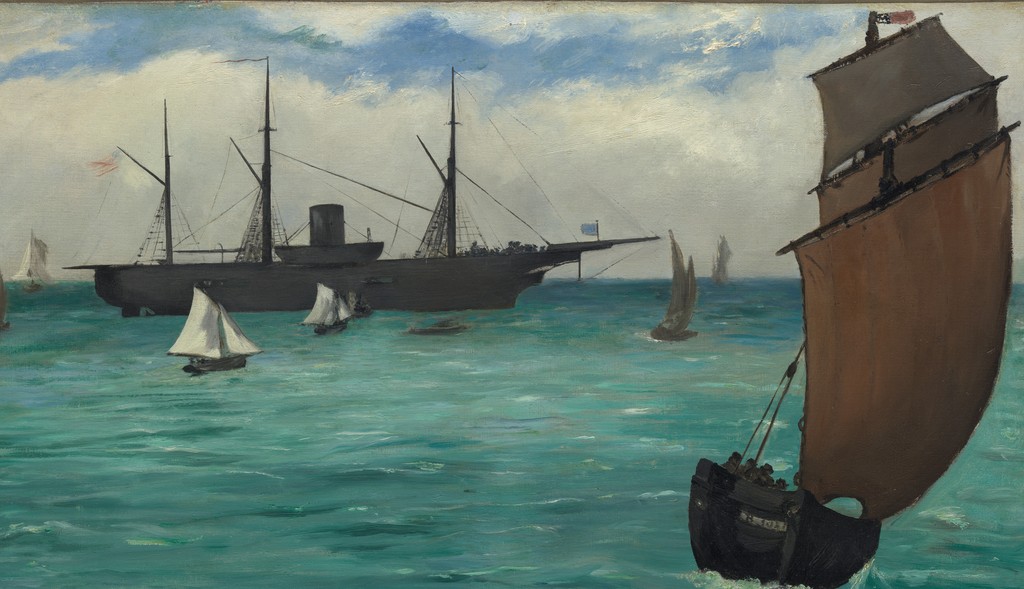
In The Kearsarge at Boulogne, also dated 1864, the warship becomes a broad dark profile against a pale sky. This separate canvas, now in the Metropolitan Museum of Art, measures 81.6 × 100 cm.[4]
The comparison is revealing. The ship's hull, smokestack and masts can be followed much more readily than in the battle painting. Little white sails gather around it, while a large fishing boat with brown sails advances through the right foreground. The water is still expansive, but the great cloud of gun smoke has gone.
Both pictures put a smaller craft close to us and a large vessel farther away. In the battle, the pilot boat enters from the left and leads towards danger. In the Boulogne scene, the brown sails on the right give the quieter arrangement a strong vertical weight beside the horizontal warship.
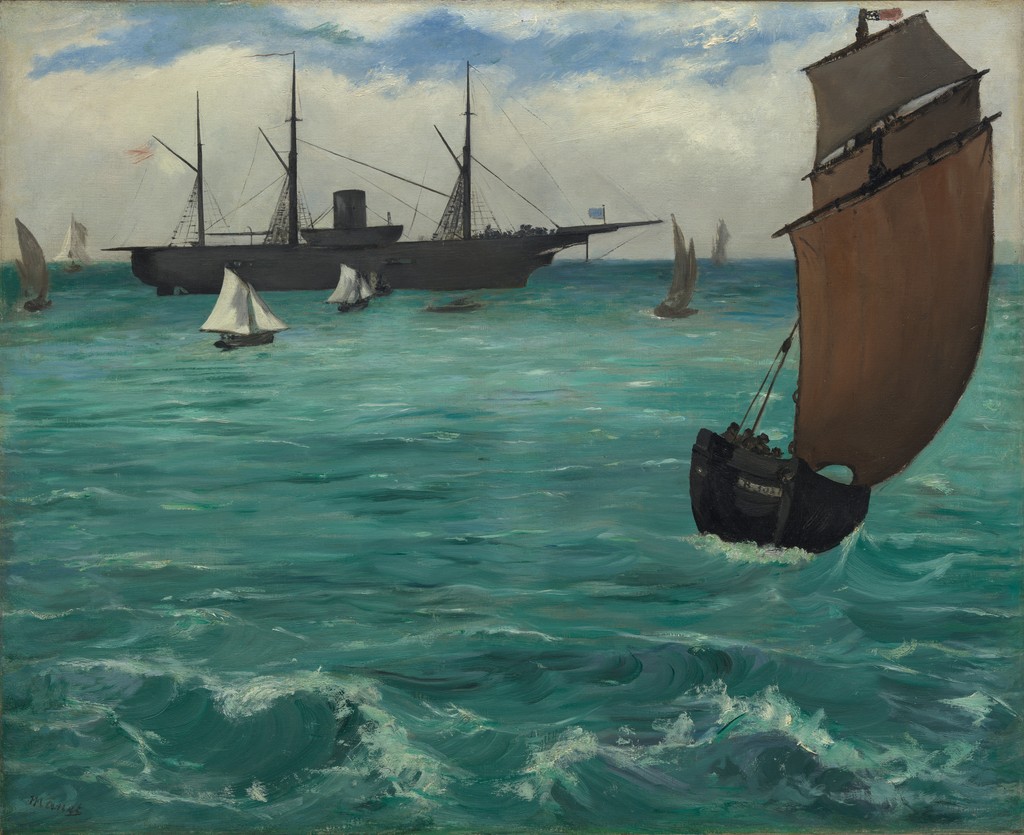
Édouard Manet, The “Kearsarge” at Boulogne, 1864. The Metropolitan Museum of Art, New York, 1999.442. Image source. CC0 / Public domain. Trim black photographic surround and narrow unpainted support lip; retain all vessels, sails, signature and painted foreground.
Marine: The Subject in Print
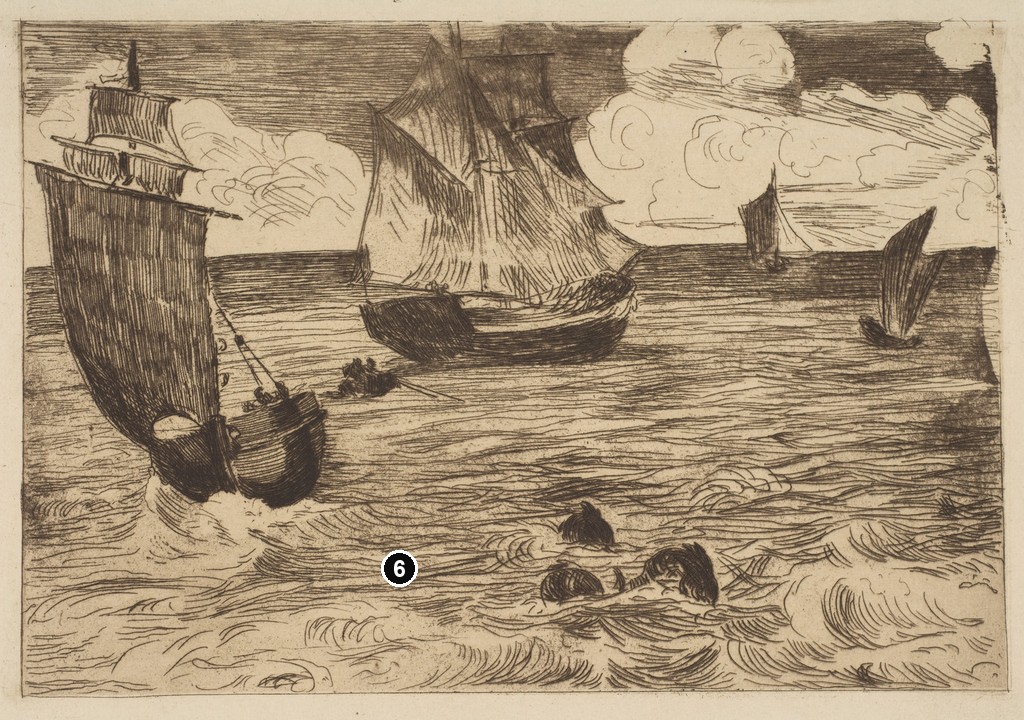
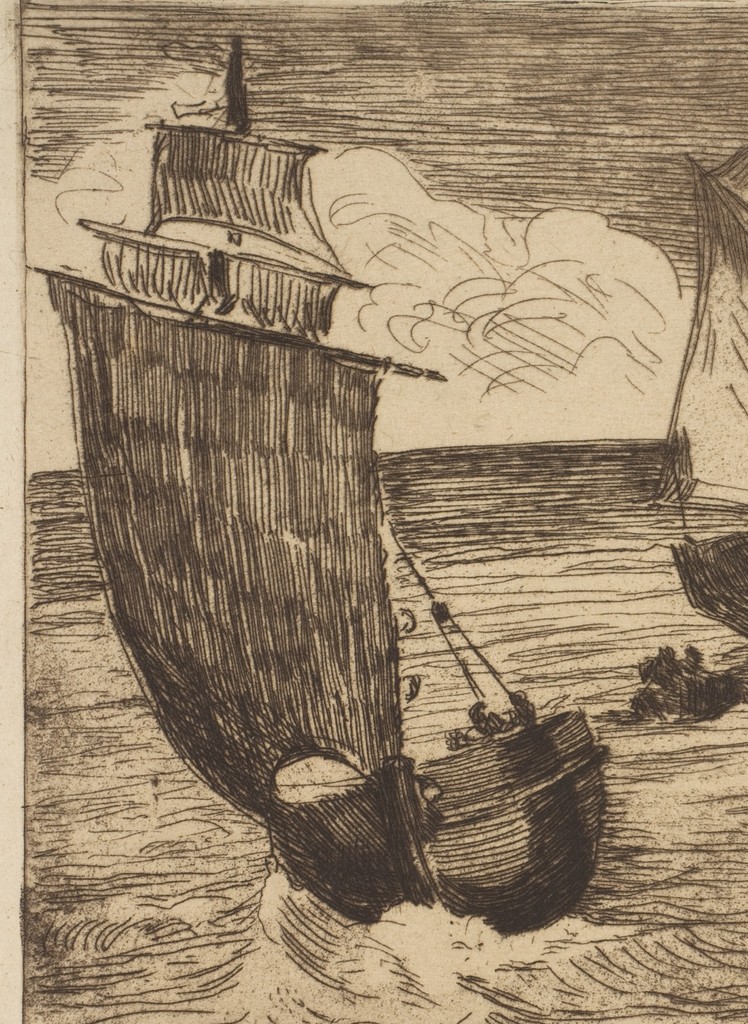
Manet returned to related motifs in Marine. The Metropolitan Museum's impression is dated 1865–66 and combines etching, aquatint, roulette and bitten tone in brown ink. Its plate measures 14 × 20 cm.[5] The small print changes the balance between boats, water and people once again.
Here a dark sailboat occupies the left, while a much brighter expanse of sails rises near the upper centre. Smaller craft lie to the right. In the foreground, heads appear among curved lines that turn the water into a dense succession of ridges.
Colour has given way to different concentrations of marks. Close hatching makes the left sail almost solid, while open paper allows the central sails to brighten. Clouds are described through loose, rounded contours. Across the lower half, repeated curves give the waves an energy quite different from the broad strokes of the oil.
The relationship to the paintings is a combination of motifs. The Bibliothèque nationale de France's record quotes Marcel Guérin's observation that the sailboat on the left is borrowed from the Boulogne painting, where it appears on the right.[6] This relocation helps explain why the print rewards comparison with both canvases.
The change of medium also brings the people in the water closer to us. Their heads interrupt the foreground pattern, and the surrounding lines make their exposure to the waves particularly immediate. An idea developed across large canvases could be recast on a much smaller plate, with the pressure of dark marks and pale paper carrying the scene.
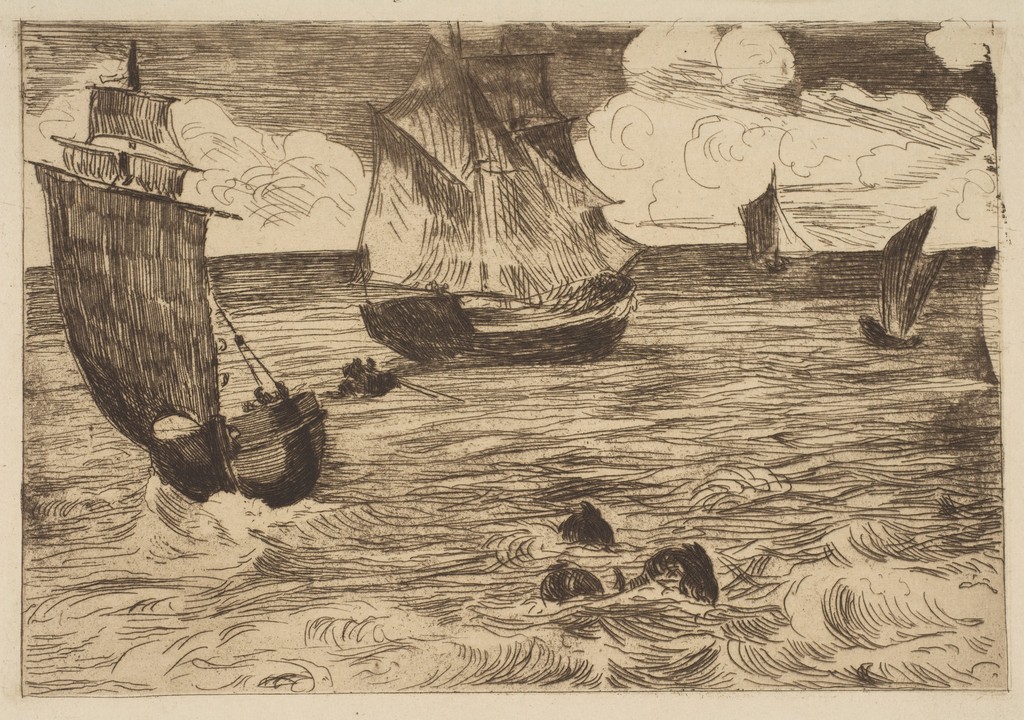
Édouard Manet, Marine, 1865–66. Etching, aquatint, roulette and bitten tone in brown ink. The Metropolitan Museum of Art, New York, 32.109.2. Supplied image view; not a verified whole-sheet reproduction. Image source. CC0 / Public domain. Whole supplied reproduction resized within native dimensions; no enlargement, retouching or colour alteration.
Annotated Details from Alabama and Kearsarge: Boats, Smoke and Open Water
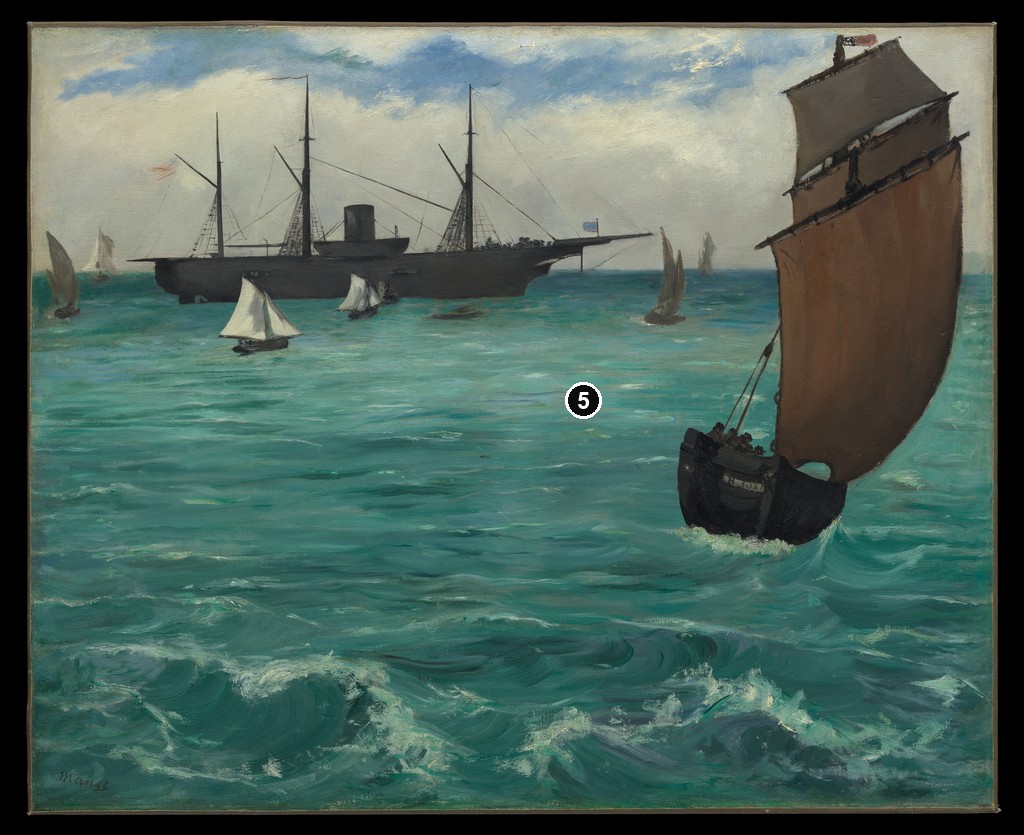
The numbered points identify visible features discussed in this article. Return from each detail to the whole composition. Each caption identifies the work shown.
The Battle of the Kearsarge and Alabama
Édouard Manet, The Battle of the USS “Kearsarge” and the CSS “Alabama”, 1864. Philadelphia Museum of Art, John G. Johnson Collection, 1917, Cat. 1027. Philadelphia Museum of Art; public-domain reproduction. Image source. Public domain. Numbers added to a separate resized whole provided overview. Detail crops from the immutable original; no enlargement, retouching or colour alteration.
The Kearsarge at Boulogne
Édouard Manet, The “Kearsarge” at Boulogne, 1864. The Metropolitan Museum of Art, New York, 1999.442. Image source. CC0 / Public domain. Numbers added to a separate resized whole provided overview retaining the black photographic surround and narrow support lip. Ordinary illustration uses a separately recorded inner-painting crop. Detail crops from the immutable original; no enlargement or retouching.
Marine — Supplied Print View
Édouard Manet, Marine, 1865–66. Etching, aquatint, roulette and bitten tone in brown ink. The Metropolitan Museum of Art, New York, 32.109.2. Supplied image view; not a verified whole-sheet reproduction. Image source. CC0 / Public domain. Number added to a separate resized overview of the supplied print image; this is not a verified whole-sheet reproduction. One detail crop from the immutable original; paper tone/marks retained, no enlargement, whitening or retouching.
Details from ALABAMA AND KEARSARGE: BOATS, SMOKE AND OPEN WATER
Look from the nearby pilot boat and figures in the water to the partly hidden ships and smoke. Compare those shapes with Boulogne’s long hull and the fishing boat in the print.
The Battle of the Kearsarge and Alabama
Pilot Boat and Pale Sails
The nearby boat rises across the waves with pale sails and small figures gathered inside the dark hull.
Figures in the Open Water
Small dark figures break the green-grey water in the gap between the foreground boat and the distant ships.
Smoke around the Warships
Masts and dark hulls appear through overlapping grey smoke, leaving the distant vessels partly concealed.
Dark Troughs and Pale Wave Crests
Dark curved bands alternate with shorter pale marks across the broad foreground water.
The Kearsarge at Boulogne
Warship beyond the Foreground Sails
The long dark warship sits beyond small pale sails, while the large brown foreground sail changes the scale.
Marine — Supplied Print View
Printed Fishing Boat and Curving Waves
Dense lines darken the fishing boat and sail while lighter curling marks turn around the bow.
From a Paris Window to Philadelphia
Manet's painting reached the public quickly. It was displayed in Alfred Cadart's Paris shop window in July 1864; Wilson-Bareau and Degener establish that it was on view by 16 July. A battle fought less than a month earlier had become a picture that passers-by could stop to examine.[1][2]
The work continued to have a public life after that immediate response. Manet included it in his own exhibition on the avenue de l'Alma in 1867, and it appeared at the Salon in 1872.[2] Those later appearances also form part of the setting for the authors' questions about when he might have returned to its surface.
Paul Durand-Ruel bought the painting from Manet's studio in January 1872. Its later owners included the singer Jean-Baptiste Faure, Georges Charpentier and Théodore Duret. John G. Johnson acquired it through Durand-Ruel in October 1888, and it passed by bequest to the City of Philadelphia in 1917.[1]
Its journey into Johnson's collection carried a French painter's response to an American naval battle back across the Atlantic. The event remains identifiable through the ships and their fate, while the rescue boat, the swimmers and the tremendous reach of water continue to make its human distances felt.
Artworks directory
Explore selected paintings, drawings and prints by Édouard Manet. Search by title or another recorded name.
Frequently Asked Questions
He did not witness the engagement. He developed the painting from reported information, then encountered Kearsarge later at Boulogne.[2]
It belongs to the Philadelphia Museum of Art, John G. Johnson Collection, 1917, Cat. 1027.[1]
Discussion
Look again at the images and ideas explored in Alabama and Kearsarge by Édouard Manet. These editorial prompts invite your observations.
Reader Insights
Look from the broad foreground waves to the small ships near the top. Notice how the scale of the marks changes as your eye crosses the sea.
Follow the pilot boat towards the people in the water. How do its hull, sails and wake give a direction to the wide painted space?
Compare the painted sea with Marine. Look at how curved strokes, hatching and open paper carry water and light in the print.
Join the Conversation
Share a detail, comparison or question about Alabama and Kearsarge by Édouard Manet below.
References
- Philadelphia Museum of Art, The Battle of the USS “Kearsarge” and the CSS “Alabama”, 1864, Cat. 1027, object 101707; collection details and provenance. View source.
- Juliet Wilson-Bareau, with David C. Degener, Manet and the American Civil War: The Battle of U.S.S. Kearsarge and C.S.S. Alabama, Metropolitan Museum of Art, 2003, pp.41–60, including Manet's undated letter to Philippe Burty, reproduced on p.53. View source.
- Naval History and Heritage Command, “Sinking of C.S.S. Alabama by U.S.S. Kearsarge, 19 June 1864,” transcriptions of reports by John A. Winslow, 19 June and 30 July 1864, and Raphael Semmes, 21 June 1864, from Official Records of the Union and Confederate Navies in the War of the Rebellion. View source.
- The Metropolitan Museum of Art, The “Kearsarge” at Boulogne, 1864, object 1999.442. View source.
- The Metropolitan Museum of Art, Marine, 1865–66, object 32.109.2. View source.
- Bibliothèque nationale de France, Marine, about 1865, bibliographic record FRBNF47017953, including a quotation from Marcel Guérin's L'Œuvre gravé de Manet, 1944 (in French). View source.
- Splash image, Édouard Manet, The Battle of the USS “Kearsarge” and the CSS “Alabama”, 1864. Philadelphia Museum of Art, John G. Johnson Collection, 1917, Cat. 1027. Philadelphia Museum of Art; public-domain reproduction. Image source. Public domain. Whole supplied reproduction resized within native dimensions; no enlargement, retouching or colour alteration.


