


 by Tom Gurney
Tom Gurney BSc (Hons) is an art history expert with over 20 years experience
Published on June 19, 2020 / Updated on October 30, 2026
Email: tomgurney1@gmail.com / Phone: +44 7429 011000
Woman with a Parrot: Manet and Courbet: Introduction
In one painting, a parrot spreads its wings above a reclining nude. In the other, a grey bird leans on a perch beside a woman in a pink dressing gown. Both canvases date to 1866, and both have been called Woman with a Parrot. Their shared subject makes their differences especially revealing.
The standing woman is Édouard Manet’s Young Lady in 1866, modelled by Victorine Meurent.[1] The reclining figure belongs to Gustave Courbet’s Woman with a Parrot.[2] Both paintings are in the Metropolitan Museum of Art, New York. Looking between them opens a discussion about the body, contemporary intimacy and the place of a viewer before a painted scene.
At a Glance
- PaintingManet: Young Lady in 1866, also called Woman with a Parrot; Courbet: Woman with a Parrot
- DateManet: 1866; Courbet: 1866
- MediumManet: Oil on canvas; Courbet: Oil on canvas
- DimensionsManet: 185.1 × 128.6 cm; Courbet: 129.5 × 195.6 cm
- Met object numberManet: 89.21.3; Courbet: 29.100.57
- AcquisitionManet: Gift of Erwin Davis, 1889; Courbet: H. O. Havemeyer Collection, bequest of Mrs. H. O. Havemeyer, 1929
Object details follow the Metropolitan Museum’s collection records.[1][2]
Contents
- A Body across the Canvas, a Figure Standing Before Us
- Where the Bird Meets the Hand
- Flesh, Fabric and the Work of Colour
- Intimacy and the Viewer
- The Same Painting Year, Different Salon Dates
- Was Manet Answering Courbet?
- How a Title Changes the Picture
- Annotated details
A Body across the Canvas, a Figure Standing Before Us
Courbet’s picture spreads out horizontally. The woman’s head lies towards the lower left, with her legs extending to the right. Pale flesh occupies a broad band across the centre, supported by crumpled white linen. Her raised arm returns attention upwards towards the bird, making a loop within the long movement of the body.
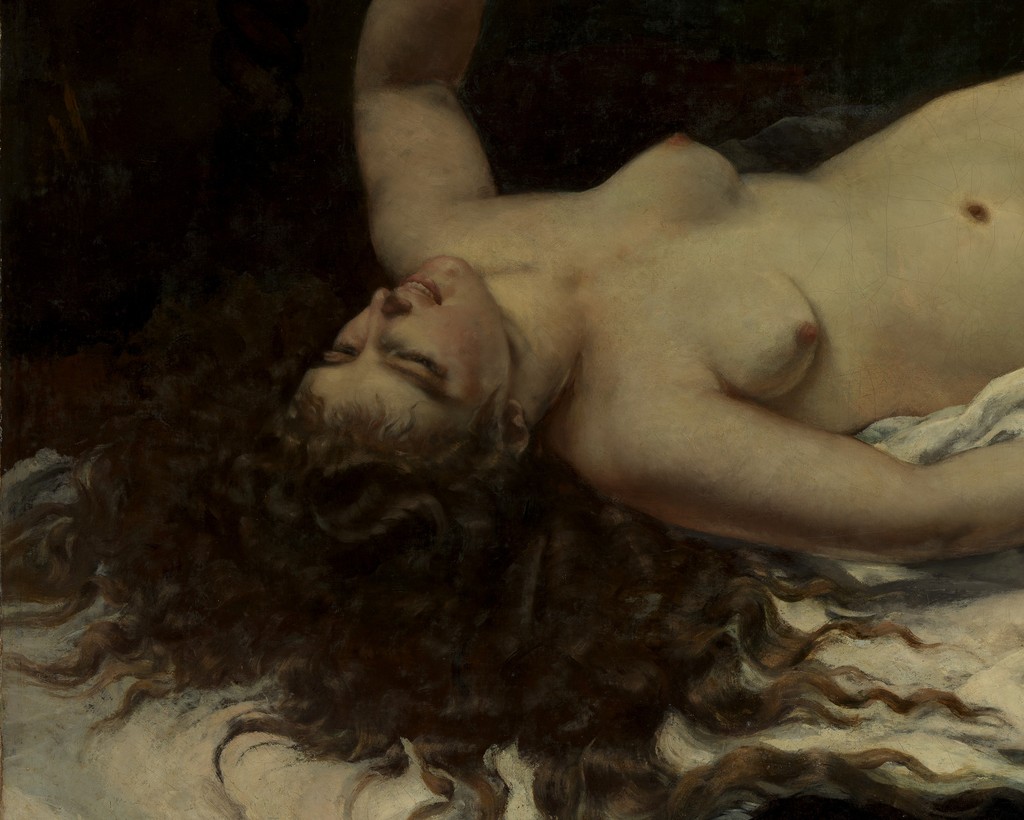
The head’s low position gives the hair exceptional room. Reddish-brown waves spread over the bedding and approach the foreground. Their irregular edges meet the sharper creases of the sheet, joining the figure to the materials around her. The eye can travel through body, hair and linen without finding a single straight boundary that contains them all.
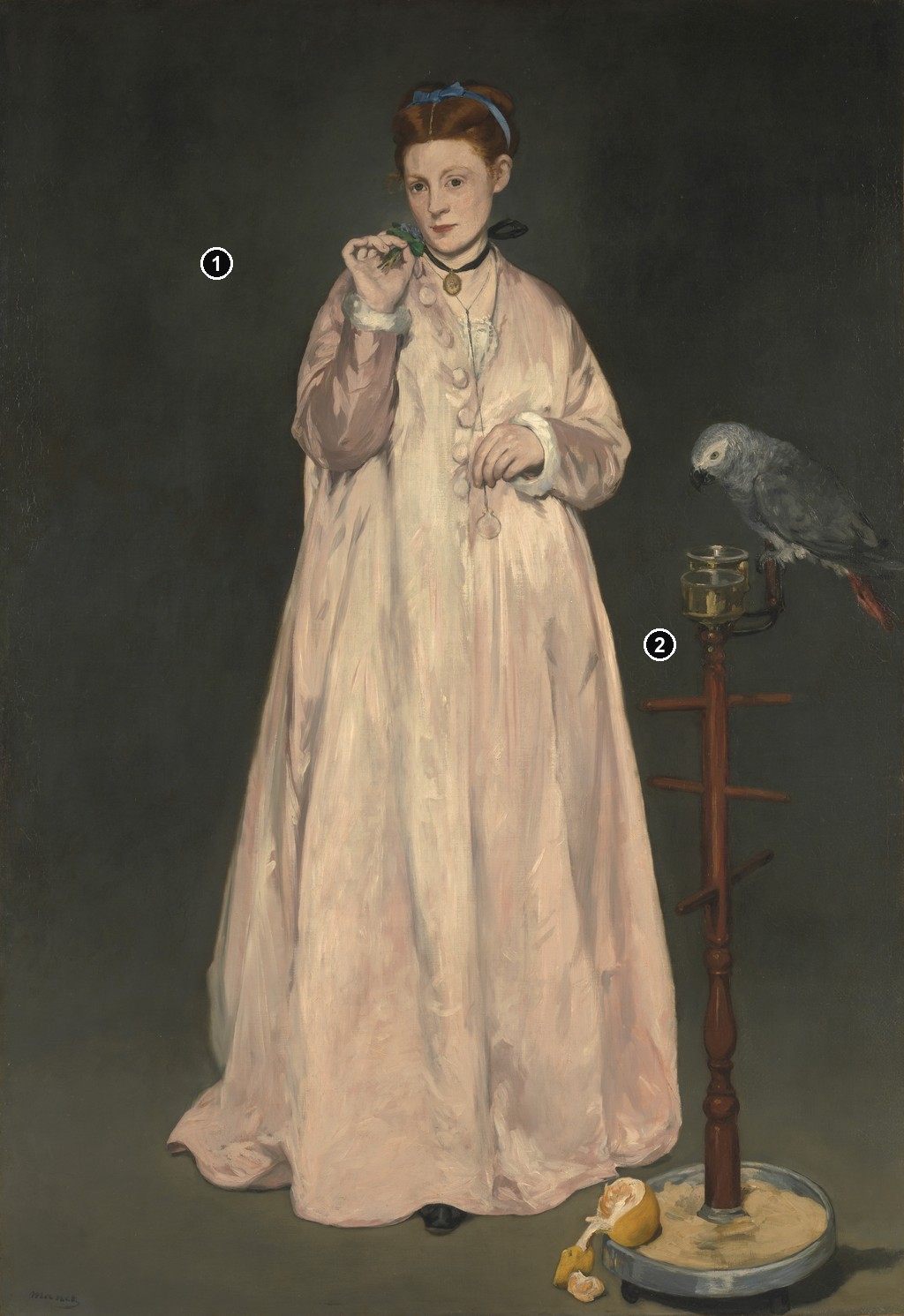
Manet turns the arrangement upright. Victorine’s head is near the top of the canvas, while her long gown widens as it descends. The bird stands to one side at a lower level, with its tall perch running almost parallel to her body. The composition allows us to take in the woman from head to foot before examining the smaller objects beside her.
These orientations create different kinds of encounter. Courbet invites a long, lateral exploration of a reclining figure. Manet places a standing person before us, with a direct outward gaze that repeatedly brings our looking back to her face.
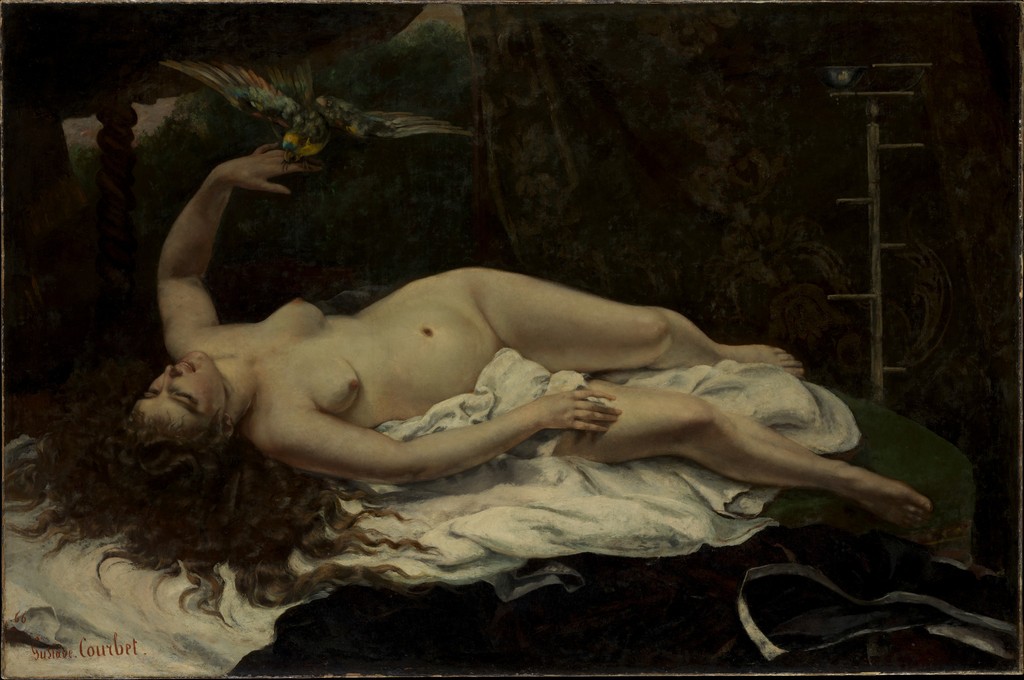
Gustave Courbet, Woman with a Parrot, 1866. The Metropolitan Museum of Art, New York, 29.100.57. H. O. Havemeyer Collection, bequest of Mrs. H. O. Havemeyer, 1929. Image source. CC0 / Public domain. Remove black photographic surround directly from the unchanged original before resize; retain the provided painting edge, lower-left inscription and principal composition. No colour correction or claim to every physical canvas edge.
Where the Bird Meets the Hand
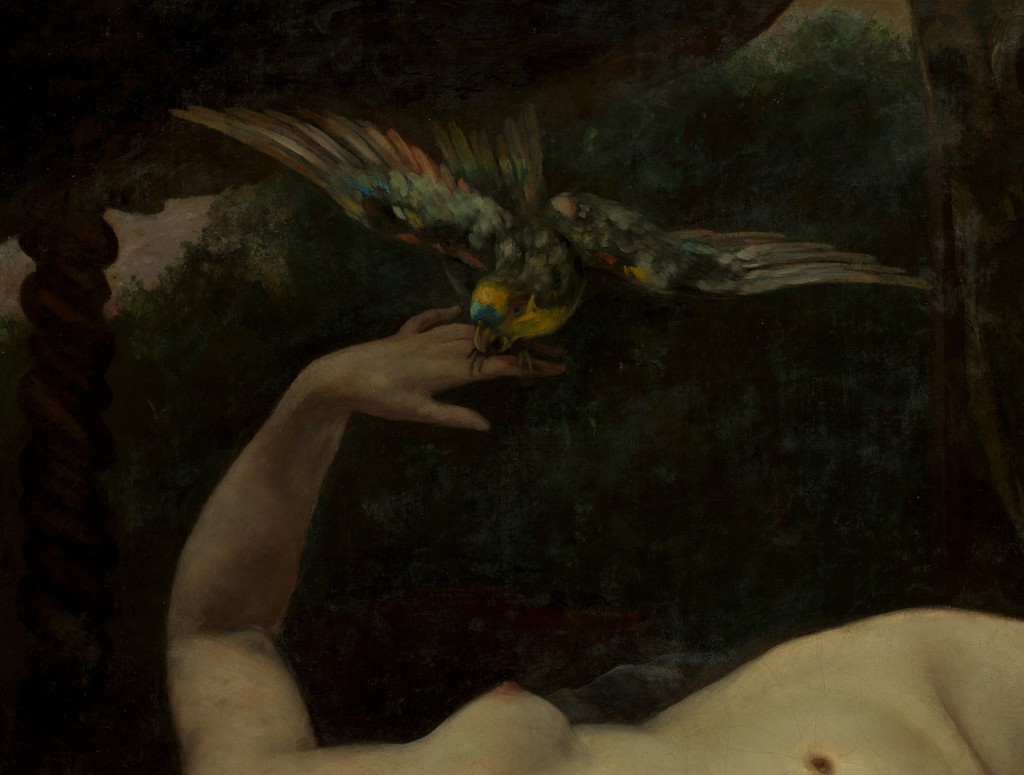
Courbet concentrates the relationship between woman and bird at the raised fingers. The parrot’s feet meet her hand while its wings extend into the dark space above. Blue, yellow and green enliven its body, with longer feathers spreading outwards. Its open wings give this small area an activity quite different from the reclining pose below.
The arm lifts from the shoulder, bends at the elbow and carries the hand towards the bird. It forms a pale, articulated shape against the darker setting. The woman’s upturned head follows that direction, linking her face with the encounter above her. The bird becomes the point around which the pose gathers its most evident movement.
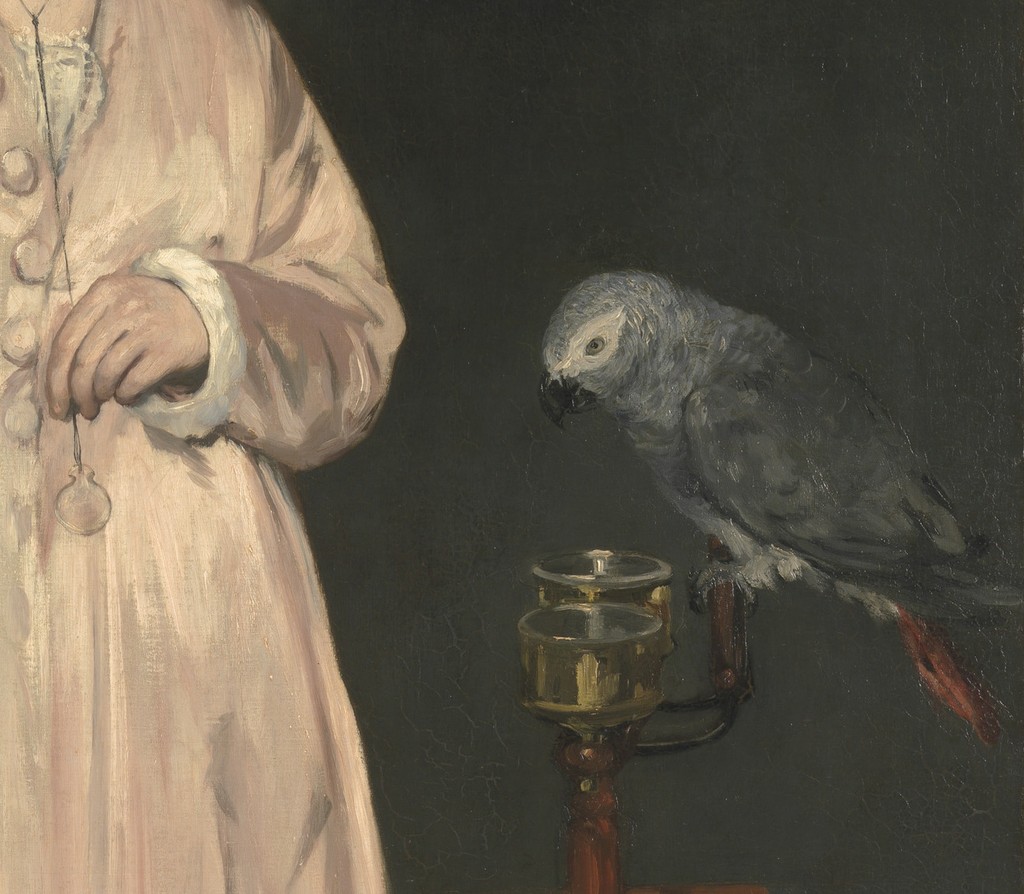
In Manet, the woman’s hands have other occupations. One raises violets beside her face; the other attends to a cord and suspended monocle. The parrot remains on its stand, separated from both gestures. Its curved neck and downward-tilting head supply a small answering movement beside the much larger figure.
The difference is more specific than a contrast between a lively bird and a quiet one. Courbet establishes physical contact: fingers become a temporary perch. Manet creates proximity without touch. Woman and bird occupy neighbouring positions, leaving the viewer to consider what kind of companionship their shared space might imply.
The two birds also direct our attention differently. Courbet’s spread wings occupy the area above the woman’s head, where we follow her raised arm. Manet’s grey parrot pulls the eye sideways from the pink robe towards the wooden stand, metal vessels and fruit below. Each bird helps organise how we explore the painting around it.

Édouard Manet, Young Lady in 1866, also called Woman with a Parrot, 1866. The Metropolitan Museum of Art, New York, 89.21.3. Gift of Erwin Davis, 1889. Image source. CC0 / Public domain. Whole supplied reproduction resized within native dimensions; no enlargement, retouching or colour alteration.
Annotated Details from Woman with a Parrot: Gestures in Manet and Courbet
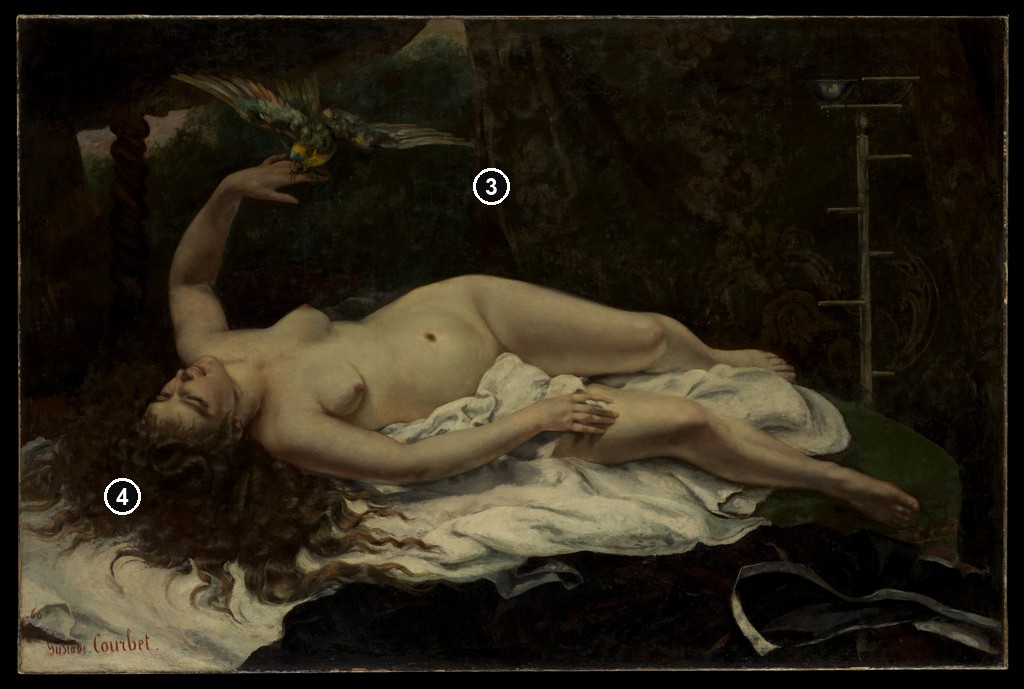
The numbered points identify visible features discussed in this article. Return from each detail to the whole composition. Each caption identifies the work shown.
Manet — Young Lady in 1866
Édouard Manet, Young Lady in 1866, also called Woman with a Parrot, 1866. The Metropolitan Museum of Art, New York, 89.21.3. Gift of Erwin Davis, 1889. Image source. CC0 / Public domain. Numbers added to a separate resized whole provided overview. Detail crops from the immutable original; no enlargement, retouching or colour alteration.
Courbet — Woman with a Parrot
Gustave Courbet, Woman with a Parrot, 1866. The Metropolitan Museum of Art, New York, 29.100.57. H. O. Havemeyer Collection, bequest of Mrs. H. O. Havemeyer, 1929. Image source. CC0 / Public domain. Numbers added to a separate resized whole provided overview retaining the photographic surround and supplied painting edges. The ordinary illustration uses a separately recorded inner crop. Detail crops from the immutable original; no enlargement, retouching or colour alteration.
Details from WOMAN WITH A PARROT: GESTURES IN MANET AND COURBET
Compare Manet’s separate hand and bird with Courbet’s raised fingers beneath spread wings. Each caption identifies the artist and canvas shown.
Manet — Young Lady in 1866
Outward Face and Two Separate Gestures
The face looks outward while one hand raises flowers and the other holds the cord of a monocle.
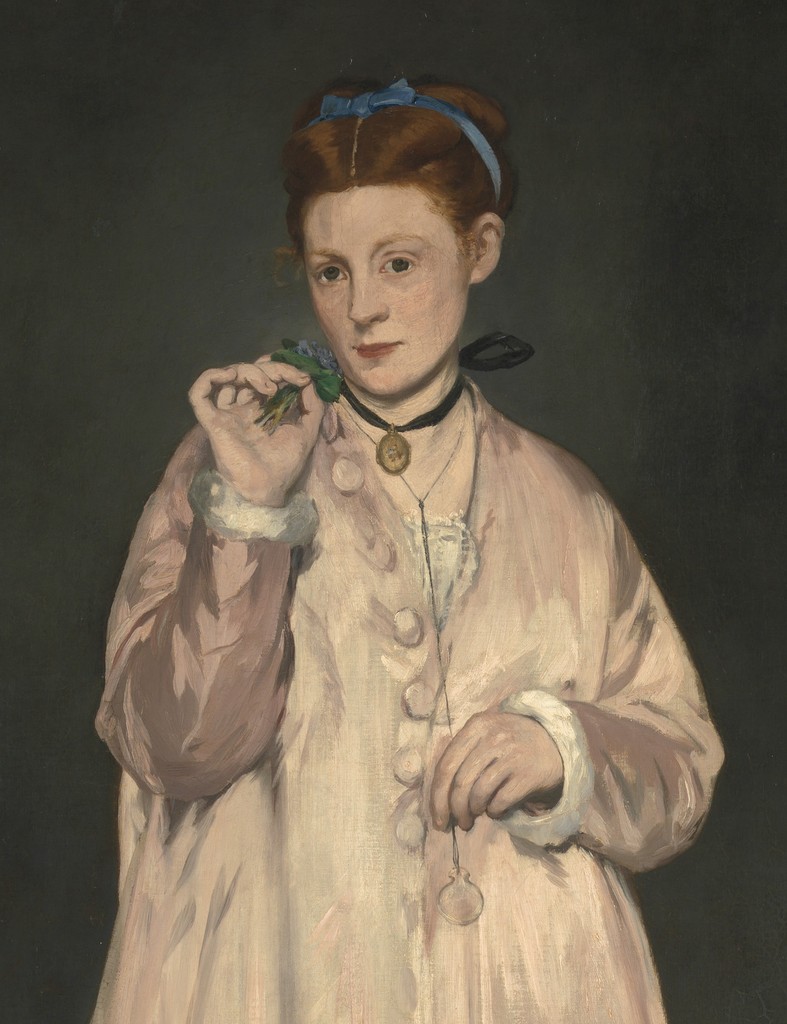
Parrot beside the Lower Hand
A gap separates the woman’s lower hand from the grey bird and the feeding cups on its stand.
Courbet — Woman with a Parrot
Spread Wings above the Raised Hand
Courbet brings the bird’s spread wings directly above the woman’s raised fingers.
Reclining Head and Flowing Hair
The tilted face and long dark hair lie against pale fabric beneath the raised arm.
Flesh, Fabric and the Work of Colour
The largest light area in Courbet’s painting is the body itself. Changes of tone follow the stomach, thighs and shoulders, giving flesh a rounded continuity. Alongside it, the linen breaks into folds with sharper changes between pale surfaces and grey recesses. The distinction lets skin and cloth remain recognisably different even where their light colours approach one another.
Manet gives the equivalent expanse of light to the dressing gown. Cream, rose and mauve move across its sleeves and long skirt. Broad marks describe folds without making every part equally explicit. Buttons and cuffs interrupt the larger movement, offering firmer details within the flowing surface.
The contrast changes how much of the body we can reconstruct. Courbet articulates limbs and torso through their exposed contours. In Manet, shoulders and hands supply points from which we imagine a body beneath the gown. Fabric controls most of the silhouette, spreading over the floor before a small black slipper appears under the hem.
Both painters set pale forms against dark surroundings, but the surroundings behave differently. Courbet’s greens and browns deepen the enclosed setting around the bed. Manet’s simpler grey-green field leaves the figure more isolated. His robe and the narrow bird stand remain distinct against it, with few surrounding objects to explain the room.
Colour also connects figure and bird within each work. Courbet’s brown hair belongs comfortably among the warm shadows, while the parrot introduces concentrated brighter accents above. In Manet, grey passes from background to feathers and into the folds of the pink cloth. The bird participates in the painting’s colour relationships as well as its possible story.
Intimacy and the Viewer
Courbet gives us the signs of an inhabited place. Bedding gathers beneath the figure; dark fabric hangs behind; a perch rises at the right. Discarded clothing lies low on that side. These things extend the scene beyond the woman’s body, suggesting the immediate surroundings of a person who has undressed.
Manet’s dressing gown offers intimacy through clothing. Its loose, enveloping form belongs to private attire, yet the figure’s presentation is formal and sustained. The bare background reveals little about her circumstances. She meets our eyes while retaining a situation we cannot fully explain.
That gaze makes the viewer’s position especially noticeable. In Courbet, attention travels towards the woman’s encounter with the bird. In Manet, our interest in the flowers, glass and robe takes place under the steady presence of a face directed outwards. We look into one relationship and find ourselves addressed by the other.
Clothing therefore changes the encounter without settling its meaning. The gown can suggest privacy, and the nude can appear absorbed in a small activity. Each painter develops intimacy through pose, setting and attention, with different degrees of access offered to the person represented.
The Same Painting Year, Different Salon Dates
Courbet exhibited his Woman with a Parrot at the Salon of 1866. The Met describes a mixed response: some critics objected to the pose and loose hair, while the French state briefly considered purchasing the canvas.[2] Its public history includes criticism, recognition and the prospect of official interest at the same moment.
Manet’s painting followed a different exhibition path. It appeared in his independent exhibition of 1867 as Jeune dame en 1866. At the Salon of 1868 it was listed as Une jeune femme, alongside his portrait of Émile Zola.[3] The two-year difference between the Salon appearances can obscure the fact that both paintings bear the date 1866.
Acceptance by a jury also tells only part of the reception story. In his 1906 history, Théodore Duret recalled comparatively restrained opposition to Manet’s portrait of Zola, followed by harsher treatment of the standing woman. He associated that response with the face, pink peignoir and conspicuous parrot, reporting the public’s use of the title Femme au perroquet.[4]
Duret wrote as a sympathetic historian looking back over Manet’s career. His account emphasises the resistance the painter faced. A different voice appears in Zola’s essay, published in 1867 after a studio visit in December 1866. Zola praised the standing woman’s elegance and the ample pink gown, while finding that Manet’s austerity kept the picture from becoming excessively pretty.[5]
Those responses prevent either canvas from settling into a simple story of approval or scandal. The Salon supplied an important public setting, but critics and supporters could disagree about what they encountered there. Courbet’s nude and Manet’s clothed figure each tested expectations through more than the amount of skin they showed.
Was Manet Answering Courbet?
The similarity of subject encouraged comparison early on. In her study of Manet’s painting, Mona Hadler reports Chaumelin’s remark in La Presse that Manet had borrowed Courbet’s parrot and placed it beside a woman in a pink dressing gown. She quotes the comment through an earlier history by Adolphe Tabarant.[6]
The remark jokes about the transfer of a pictorial subject. It recognises a shared motif and an obvious transformation: the reclining nude becomes an upright clothed figure, and the bird moves from hand to stand.
Hadler also questioned a neatly ordered exchange of replies. Manet’s painting was already being shown privately while Courbet’s was on exhibition, making the chronology less straightforward than the later Salon dates suggest.[6] The possibility of a response remains useful, but the paintings cannot be arranged into a certain sequence solely by their first Salon appearances.
Looking at them as a conversation allows their differences to remain active. They share a woman, a bird and a setting with intimate associations. Within those elements, Courbet gives unusual prominence to the meeting of hand and wings; Manet gives it to the outward face and the objects suspended around the hands. The comparison can illuminate both works without supplying a final explanation of either painter’s intention.
How a Title Changes the Picture
Young Lady in 1866 identifies a contemporary figure through a moment in time. Woman with a Parrot identifies her through a companion. For Manet’s canvas, the two titles offer different entrances into the same arrangement: one begins with the woman’s place in the present, the other with the relationship beside her.
The coexistence of the names appears in a photographic record at the Musée d’Orsay. A mounted reproduction associated with Nicolas Godet and/or Anatole Louis Godet is catalogued as La Femme au perroquet d’Edouard Manet, with Jeune dame en 1866 d’Edouard Manet as an alternative title. The record dates the photograph around 1866, meaning the painting’s date or later.[7]
That object is a photograph of Manet’s canvas, distinct from the oil painting in New York. Its titles show how an image can circulate under more than one description. The bird’s memorable presence makes it a natural point of recognition, even when the picture offers much else to examine.
Courbet and Manet give that shared motif different work to do. One bird brings wings and fingers into contact above a reclining body. The other stands beside an upright figure whose eyes meet ours. Returning to those small, visible relationships makes the title useful again: it asks how a woman and a parrot can occupy a painting together, and how much can change within that apparently simple subject.
Artworks directory
Explore selected paintings, drawings and prints by Édouard Manet. Search by title or another recorded name.
Frequently Asked Questions
Victorine Meurent, who also modelled for Olympia and Le Déjeuner sur l’herbe.[1]
Discussion
Look again at the images and ideas explored in Woman with a Parrot: Manet and Courbet. These editorial prompts invite your observations.
Reader Insights
Follow the route from shoulder to hand to bird in Courbet, then try the same movement in Manet.
Notice where physical contact ends and where a gap remains.
Compare the large pale shape of exposed flesh with the large pale shape of the gown, and consider how each controls your approach to the face.
Join the Conversation
Share a detail, comparison or question about Woman with a Parrot: Manet and Courbet below.
References
- The Metropolitan Museum of Art. “Young Lady in 1866,” 1866, 89.21.3. Object details, model and alternative subject description. View source.
- The Metropolitan Museum of Art. “Woman with a Parrot,” Gustave Courbet, 1866, 29.100.57. Current collection record and English audio transcript; French curatorial commentary on the nude and its setting. View source.
- Juliet Wilson-Bareau. Manet, Monet, and the Gare Saint-Lazare. National Gallery of Art, 1998, checklist no.15, p.194. Manet’s exhibition titles and dates. View source.
- Théodore Duret. Histoire d’Édouard Manet et de son œuvre. 1906, pp.92–93. Retrospective account of Manet’s reception at the Salon of 1868. View source. (in French).
- Émile Zola. Édouard Manet: étude biographique et critique. 1867. Discussion of Jeune dame en 1866 and note dating the essay’s writing to December 1866. View source. (in French).
- Mona Hadler. “Manet’s Woman with a Parrot of 1866.” Metropolitan Museum Journal 7 (1973), especially pp.120–121. Critical comparison with Courbet and qualifications concerning chronology. View source.
- Musée d’Orsay. “La Femme au perroquet d’Edouard Manet,” Nicolas Godet and/or Anatole Louis Godet, around 1866 or later, RF MO ODO 2023 1 19. Mounted photographic reproduction and alternative title. View source. (in French).
- Splash image, Édouard Manet, Young Lady in 1866, also called Woman with a Parrot, 1866. The Metropolitan Museum of Art, New York, 89.21.3. Gift of Erwin Davis, 1889. Image source. CC0 / Public domain. Whole supplied reproduction resized within native dimensions; no enlargement, retouching or colour alteration.


