by Tom Gurney
Tom Gurney BSc (Hons) is an art history expert with over 20 years experience
Published on June 19, 2020 / Updated on October 14, 2026
Email: tomgurney1@gmail.com / Phone: +44 7429 011000
A whole Crucifixion in a small sketch
Christ hangs at the centre of the cross, his body bright against a stormy sky. Below him a woman in blue and another in red stand together on the left. A kneeling woman reaches upward at the foot of the cross, while figures and a horse press in from the right. Rubens has arranged a large religious drama inside a compact painted panel. The figures are clear enough to carry the story, yet their edges and faces have the freedom of a design still being worked out.
The Snijders&Rockox House visitor guide[1] identifies this work as Peter Paul Rubens's Christ on the Cross, oil on panel, 1628, collection number 77.124. It calls the work a modello: a small-scale painted design for a larger work. The intended commission was an altarpiece for St Michael's Church in Ghent. Rubens did not execute that final canvas. According to the museum, a diplomatic mission intervened and Anthony van Dyck was asked to paint the altarpiece instead.
Those facts change how the page should present the image. It is not a reduced photograph of a finished Rubens altarpiece, nor a Van Dyck painting wrongly filed under Rubens. It is Rubens's own preliminary oil painting for a project whose final execution passed to another artist. The visible composition can be admired as a complete image, but its original purpose was to test and communicate a larger design.
At a Glance
- ArtistPeter Paul Rubens [1]
- Date1628 [1]
- MediumOil on panel [1]
- PurposeModello for a Ghent altarpiece [1]
- Final commissionCompleted by Anthony van Dyck [1]
- CollectionSnijders&Rockox House, 77.124 [1]
Where this work sits in Rubens's career
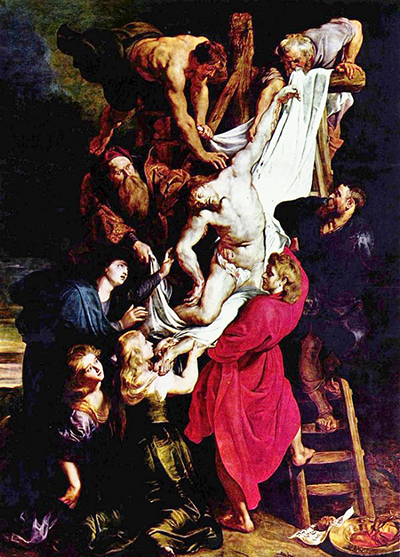
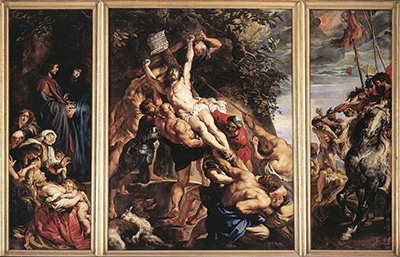
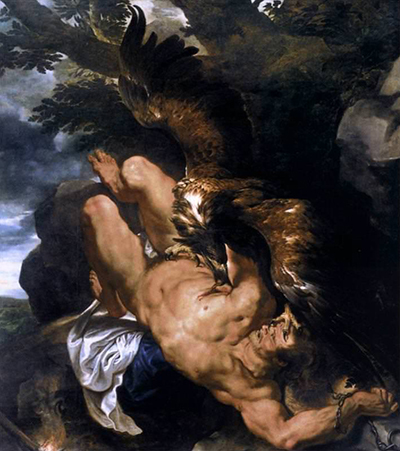
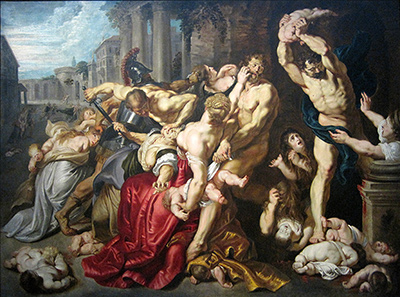
The Elevation of the Cross
1609–10The Descent from the Cross
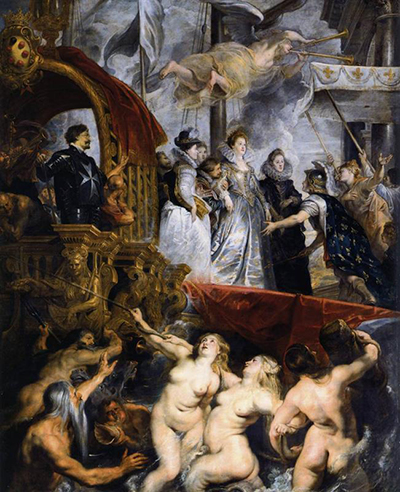
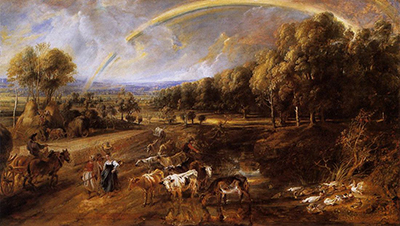
1611–14The Garden of Love
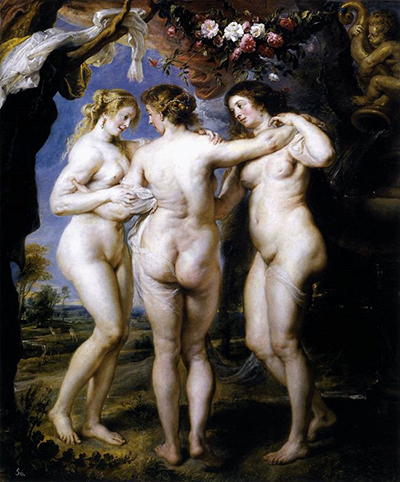
1630–35The Three Graces
1630–35Contents
- What is a modello?
- The body above and the mourners below
- Weather, light and the sketch's pace
- A commission that changed hands
- Rubens and Van Dyck: design and completion
- Why the small painting still holds attention
- Identifying the exact panel
- Looking again at the central cross
What is a modello?
An oil modello makes a proposed composition visible before a large painting is made. Its painter can decide where the main figures stand, how the eye moves among them and where light will fall. The object can also let patrons or collaborators understand a design that would be hard to convey through words alone. The Rockox House uses precisely this term for its panel.
The word does not mean the sketch is careless. Rubens had to solve the central relationships: Christ above, mourners below, additional witnesses around them, sky behind. The painted panel shows how these parts could hold together. A larger altarpiece would need more sustained finish and perhaps changes in details, but the sketch already gives the dramatic structure.
The museum guide draws attention to Rubens's rapid brushwork, roughly suggested clouds and economical faces for Mary and John. In the retained image, forms seem to appear through broad movement rather than tight outlining. The white cloth around Christ, the warmer flesh and the darkened sky each do a different job. The painting asks us to see the event before we examine every fold or feature.
Because this is a preparatory work, visible speed belongs to its purpose. Rubens did not need to describe every stone on the ground to decide whether the composition would work on an altar. He needed the height of the cross, the emotional pull of the figures and the contrast of light and dark. The sketch shows these decisions in a form that remains lively centuries later.
The body above and the mourners below
The cross dominates the upper middle. Christ's arms extend along its beam while his torso bends and the head drops. A pale cloth circles the waist. Against the dark background, the body is the clearest large form. This placement establishes where a viewer should look first, even from a distance.
At the lower left, the two standing mourners are identified by the museum guide as Mary and John. Their faces are swiftly painted but turned toward the death above them. Their joined presence gives the scene a human point of entry. The kneeling woman at the base of the cross brings the emotional movement closer still: her body rises toward Christ from the ground. She is commonly recognizable as Mary Magdalene in Crucifixion imagery, although the Rockox House passage specifically names only Mary and John.
The figures at the right add another pressure. A horse's pale head catches the light, and armed or mounted people crowd behind it. They give the Crucifixion a public setting beyond the private grief of the mourners. The horse and surrounding bodies also keep the right side active, balancing the grouped figures on the left. The eye can move from their movement back to Christ's still, exposed form.
This arrangement makes the sketch work in several registers at once. We see a religious subject, a group of people responding differently and a strong visual structure of vertical cross and lower clusters. Rubens uses a few decisive shapes to keep these levels connected. The painting feels full even though it is only a preliminary design.
Weather, light and the sketch's pace
The clouded sky is not a carefully mapped landscape. The Rockox House describes it as a rough suggestion. Dark and lighter passages swirl behind the cross, providing contrast for Christ's torso and a sense of disturbance around the event. The weather belongs to the painting's mood, while the painted marks remain plainly visible as marks.
The centre is brighter than much of the outer scene. Pale flesh and cloth lift Christ away from the dark arch of cloud. Lower down, small accents of light catch faces, hands and the horse. This selective illumination helps the viewer read a busy subject quickly. A complete altarpiece might have carried the same hierarchy at a much larger scale; the modello lets us see that hierarchy being proposed.
Rubens's brushwork is economical rather than uniform. Christ's body has enough modelling to feel weighty, while the surroundings are looser. The contrast is not simply a measure of what he cared about. It is also a practical way to test a composition: sharpen the forms that must carry the picture and leave other passages open to adjustment.
The small reproduction can conceal the physical difference between a quick painted sketch and a fully finished picture. The museum's description is therefore useful, but it does not supply exact dimensions in the cited guide. This page should not borrow a size from another Crucifixion, or from a secondary listing, and present it as a museum-certified measurement. The secure object facts here are oil on panel, 1628, inventory 77.124.
A commission that changed hands
The Rockox House says Rubens made the sketch for an altarpiece in St Michael's Church, Ghent. It also says a diplomatic mission prevented him from completing the assignment. The guide does not identify the precise mission, date of departure or every negotiation with the church. Naming one from Rubens's broader biography would turn a general museum statement into an unsupported commission narrative.
What can be said is clear: Rubens proposed a design, and Van Dyck executed the final altarpiece. The handover is not a minor footnote. Without it, a visitor might assume the sketch was the direct miniature of a large Rubens painting. Instead, the surviving small panel records one artist's conception at an earlier stage, while the church's finished work belongs to another artist's practice.
A Van Dyck Crucifixion drawing at Museum Boijmans Van Beuningen[2] is a separate piece of evidence for the next phase. The museum catalogues the drawing to Van Dyck, about 1627–30, and says it prepared a painting for the Brotherhood of the Holy Cross's chapel altar in St Michael's Church. Its record says the commission was first offered to Rubens and ultimately went to Van Dyck. That independent institutional account supports the outline of the transfer, while the Van Dyck sheet must not be confused with Rubens's painted panel in Antwerp.
Boijmans also mentions a Van Dyck preparatory oil sketch. Thus at least three kinds of object must be kept distinct: Rubens's modello at the Rockox House, Van Dyck's drawing in Rotterdam, and the final altarpiece associated with Ghent. The museum's reference to another oil sketch points to a fourth stage or object. A shared Crucifixion subject does not erase differences of artist, medium or collection.
Rubens and Van Dyck: design and completion
Van Dyck had worked in Rubens's orbit, but this commission should not be described as merely an assistant finishing the master's abandoned panel. The Rockox House identifies Van Dyck as the painter asked to make the large altarpiece. Boijmans identifies a Van Dyck preparatory drawing for it. These records show another artist developing the project after Rubens's initial design.
The surviving Rubens sketch remains important because it shows the starting arrangement of the story. Yet the final work is not thereby reduced to a mechanical enlargement. A painter translating a design to an altar could change scale, spacing, gesture, colour and emphasis. The public records cited here do not itemize every change between Rubens's panel and Van Dyck's completed work. A careful article can compare their documented roles without inventing a line-by-line reconstruction of the transfer.
This distinction also helps us understand attribution. The rockox panel can be captioned as Rubens because that is how the holding museum identifies it. The Rotterdam drawing is Van Dyck according to Boijmans. The Ghent altar work is Van Dyck in the Rockox account. One commission can leave multiple related objects by more than one artist, and each object needs its own label.
The relationship is therefore richer than a simple story of replacement. Rubens's idea continued to matter, but Van Dyck's authorship mattered too. The modello is evidence of Rubens thinking in paint; the finished church image belongs to the painter who carried the public commission through. Both stages deserve accurate descriptions.
Why the small painting still holds attention
A preparatory sketch can be treated as merely a step toward an absent “real” work. This panel resists that view. Its clustered figures, uneasy sky and strong contrast create an encounter in their own right. The viewer sees the necessary design decisions and the traces of making at the same time. The work's relative openness gives it an energy a smooth finish might not have.
The painting is also unusually instructive about scale. Its purpose was an altarpiece, where viewers would have seen the cross from a church interior. In the modello, that intended vertical emphasis is already visible. Christ occupies the centre and rises above people who look or move below. Rubens could test whether the visual weight would carry before a large canvas was made.
The women's and John's grief anchors the theological subject in human response. Their expressions are abbreviated but legible. The scene does not need individually finished portraits to move a viewer. A bowed head, a raised hand and the direction of a gaze can do the work. The museum guide values this economy, and the retained image lets us see how little may be needed to establish an emotional relationship.
At the right, the horse and crowd prevent the scene from becoming a private lament alone. Christ's execution takes place before witnesses with different positions and responses. Rubens makes those surrounding people part of the design rather than filling empty space. The small sketch thus proposes both the public event and the close grief around the cross.
Identifying the exact panel
There are many works called Christ on the Cross, including other paintings by Rubens and Van Dyck. This page is about the Snijders&Rockox House panel in Antwerp, inventory 77.124, dated 1628 by its own visitor guide. Its key feature is its role as Rubens's oil modello for the Ghent commission later completed by Van Dyck.
The approved inherited JPEG visually matches that small panel. It should remain attached to this route and captioned with the museum identifier. A caption saying only “Rubens, Crucifixion” would lose the object's purpose and risk confusion with a finished church painting. Conversely, a caption calling it Van Dyck because he made the eventual altarpiece would misattribute this particular sketch.
The guide is the primary source for date, medium, collection and commission narrative. Boijmans is the primary source for its own related Van Dyck drawing and corroborates that the church commission passed from an initial Rubens offer to Van Dyck. Neither institution's record makes the other museum's object interchangeable with its own. This separation is the core of responsible documentation for the page.
Looking again at the central cross
Begin with Christ's pale body and follow the beam outward to the turbulent sky. Then descend to Mary and John on the left, the kneeling woman below and the horse and other witnesses at the right. The composition gathers grief, public spectacle and religious focus into a small painted space. Its marks reveal how swiftly Rubens could establish those relationships.
The exact work is Rubens's Christ on the Cross, 1628, oil on panel, Snijders&Rockox House 77.124. The museum calls it a modello for a St Michael's Church altarpiece in Ghent. A diplomatic assignment prevented Rubens from finishing the larger work; Van Dyck took on the final commission. Boijmans's separate drawing records Van Dyck's own preparation for that altar project.
The painting therefore has two identities that belong together. It is a striking Crucifixion image now, and it is a proposal for a larger painting Rubens never executed. Its quick sky, concentrated body and responsive faces are not defects to be filled in by a later artist. They are the visible means by which Rubens made a design persuasive enough to carry the story toward an altar—even though another painter ultimately completed that public work.
Rubens artworks directory
Frequently Asked Questions
No. The Rockox House calls it an oil modello, a small painted design for an altarpiece intended for St Michael's Church in Ghent.
The holding museum identifies Peter Paul Rubens as its painter and dates it 1628. It is oil on panel, inventory 77.124.
The Rockox House says Anthony van Dyck took the commission after a diplomatic mission prevented Rubens from completing it. Museum Boijmans holds a separate Van Dyck preparatory drawing for the church project.
No. Rubens's oil panel is in Antwerp; Van Dyck's drawing is in Rotterdam. The church altarpiece is another object again.
The cited museum guide does not give dimensions. This page therefore does not present a number borrowed from another source as a museum-certified size.
The Rockox House guide identifies Mary and John among the mourners. A kneeling woman at the base is consistent with the customary depiction of Mary Magdalene, though the cited passage does not name her directly.
Discussion
Look at Christ's body, then the groups of mourners and witnesses below.
Share an observation about the oil sketch or a reliable source that adds to its history.
Reader Insights
Which marks make the small composition legible despite its rapid handling?
What changes when a modello's final commission passes to another painter?
How does the separate Van Dyck drawing help keep the objects distinct?
Join the Conversation
Add your reading below, keeping observations specific and evidence clear.
References
- Snijders&Rockox House, visitor guide, p. 56: Rubens, Christ on the Cross , inventory 77.124. View source
- Museum Boijmans Van Beuningen, Van Dyck, The Crucifixion , preparatory drawing MB 1958/T 25 (PK). View source