by Tom Gurney
Tom Gurney BSc (Hons) is an art history expert with over 20 years experience
Published on June 19, 2020 / Updated on October 14, 2026
Email: tomgurney1@gmail.com / Phone: +44 7429 011000
A human story almost swallowed by weather
Clouds break over a valley. Water tears through the ground, carrying people and animals into a swollen stream. Trees bend and rock faces darken under the storm. Only after scanning this violent setting do we find the small figures of Philemon and Baucis at the right, pleading as the flood spreads below them. Peter Paul Rubens makes the catastrophe the picture's dominant event and the spared couple a discovery within it.
The Kunsthistorisches Museum (KHM) catalogues Gemäldegalerie 690[1] as Rubens's Landscape with Philemon and Baucis, about 1625, on oak panel, with overall dimensions 147.1 × 209.6 × 2.5 centimetres. The older route calls it a “Stormy Landscape,” which describes what first strikes the eye. The current museum title keeps the two human figures and their myth in view.
The object was not necessarily completed in one short campaign around 1625. The KHM's broader album places it from about 1620/25 to about 1636, and the Wallace Collection's account of Rubens's great landscapes[4] describes its enlargement and later transformation. These different date labels reflect a developing work. A concise object card can use the KHM's “about 1625,” but the full account needs the longer, qualified history.
At a Glance
- ArtistPeter Paul Rubens [1]
- DateAbout 1625; later development proposed to about 1636 [1][3][4]
- SupportOak panel [1]
- Overall size147.1 × 209.6 × 2.5 cm [1]
- CollectionKunsthistorisches Museum, Vienna, GG 690 [1]
- SubjectPhilemon and Baucis spared from a catastrophic flood [1][2]
Where this work sits in Rubens's career
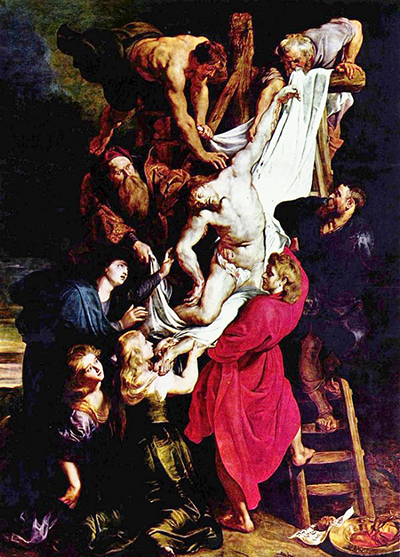
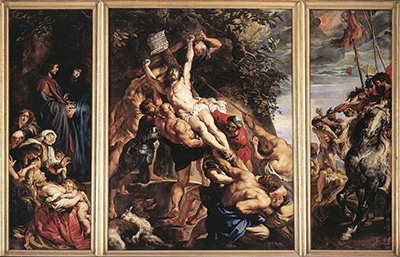
The Elevation of the Cross
1609–10The Descent from the Cross
1611–14Landscape with Philemon and Baucis
c. 1625–36The Garden of Love
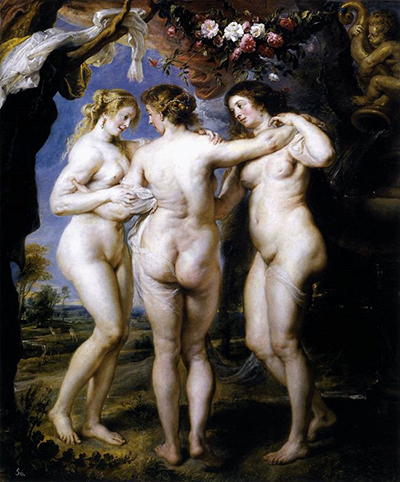
1630–35The Three Graces
1630–35Contents
- Finding Philemon and Baucis
- Water, trees and a broken sky
- A landscape enlarged and transformed
- A different mood from the Het Steen paintings
- Another Philemon and Baucis painting in Vienna
- From Rubens's estate to the KHM
- Looking once more at the flood
Finding Philemon and Baucis
The story comes from Ovid's Metamorphoses. The KHM explains[2] that the poor couple offered hospitality to Jupiter and Mercury, who travelled in human disguise and had been refused shelter by others. The gods punished the inhospitable world with a flood but spared their hosts. Rubens does not choose the humble meal as the main scene. He chooses the moment when punishment overwhelms the land.
The couple appear at the right in the middle distance, in a supplicatory posture, according to the museum. They are not large foreground heroes. Their small scale changes the viewing experience: the eye meets cloud, torrent and drowning bodies first, then finds the reason these two people have escaped. The contrast between their survival and the surrounding destruction gives the landscape its narrative tension.
The KHM's description explicitly says the natural catastrophe is the main subject. That curatorial judgement fits the composition. The figures at the right are necessary to identify the myth, but the storm occupies most of the surface. Rubens seems interested in what a flood does to an entire world of trees, rock, water, bodies and sky, not solely in the moral clarity of two virtuous hosts.
The story does carry a moral contrast: hospitality is rewarded and rejection punished. Yet the painting complicates any easy satisfaction in the punishment. The KHM's own summary[2] notes the drowning and already drowned. Their bodies make the cost of divine judgement visible. A viewer can understand the myth's logic while still feeling the severity of what Rubens has painted.
Water, trees and a broken sky
The storm is built from different directions of force. Dark clouds press across the upper half. Rain and water descend into ravines. Trees rise against those movements, some surviving, others caught in the flood. A bright opening beyond the cliffs gives the eye a momentary route into depth, but the foreground torrent pulls it back. The picture keeps the viewer moving between distant weather and immediate danger.
At lower left, water surges over a ledge, turning the foreground into a place of sudden drop. Fallen forms and debris gather near it. The eye can follow the stream from the higher ground through the middle and down toward that edge. The painting's large width makes this movement feel continuous: catastrophe is not confined to one isolated pool. It takes in the valley and runs out toward the viewer.
The trees have several roles. They set scale against the high clouds, divide the landscape into passages, and make the storm's violence legible when trunks and branches meet water or wind. On the right, dark vertical trees partly frame the small group of spared figures. The structure helps a viewer locate them without letting them dominate the picture. Rubens uses landscape forms as guides to the story.
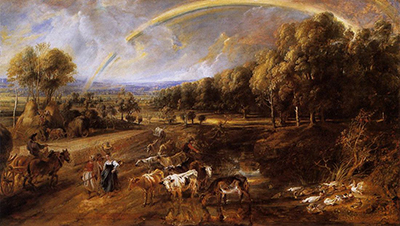
The Wallace essay[4] points out a small rainbow near the bottom of the scene, arising from spray around the torrent. It is an unexpected counterpart to the immense bow in Rubens's Rainbow Landscape. In the Vienna flood, the rainbow is marginal and close to danger. The Wallace notes that an inscription accompanying a print after the work identified it with Iris, messenger of the gods. That identification belongs to the later print's accompanying text; it should not be treated as Rubens's own written explanation of every painted colour.
A landscape enlarged and transformed
Conservation research has altered how the painting's making is understood. The Wallace's account of the work[4] says it began as a smaller landscape and was enlarged in two stages. The central earlier scene appears to have been a mountainous view without the full mythological narrative. Rubens then developed it with figures and ultimately made the ambitious flood picture now in Vienna.
The museum phrases the sequence cautiously: Rubens seems to have returned to a composition painted about a decade earlier. This is an interpretation based on technical and visual evidence, not a dated diary of each painting session. It explains why a current object record may give about 1625 while a broader exhibition label reaches to about 1636. The initial landscape and the final narrative do not have to share a single date.
Enlargement also changes the role of the human story. A relatively self-contained mountain view could become a wider stage for flood, figures and divine intervention. The finished panel's scale — over two metres wide — lets weather and water surround the small protagonists. The transformation is part of its meaning: a landscape with dramatic atmosphere became a mythological disaster in which atmosphere itself drives the action.
This physical history should not be confused with a simple claim that Rubens “finished” every part in 1636. The cited Wallace source says the final iteration is thought to have been painted in the years when he worked on the Het Steen and Rainbow pictures. It does not supply a signed completion date. Presenting the sequence as stages preserves the evidence without hiding the uncertainty.
A different mood from the Het Steen paintings
The Vienna scene belongs in a conversation with Rubens's great landscapes, but it is not a companion to the two views of his own estate. The Wallace compares[4] its wild, mythical terrain and violent weather with the cultivated Brabant countryside in An Autumn Landscape with a View of Het Steen in the Early Morning and The Rainbow Landscape. Those London paintings emphasize productive work, changing daylight and a more peaceful mood.
The comparison makes Rubens's range clearer. In the Het Steen pictures, a panoramic viewpoint can invite calm exploration of fields, roads and farm activity. In the Vienna painting, the same broad ambition compresses danger into a torrent and a breaking sky. Nature is no longer the backdrop to a settled rural day. It is the force that overwhelms almost every figure in the story.
The rainbow motif also behaves differently. In the Wallace picture it spans the sky and helps hold the whole scene together. Here the small bow near the flood's edge is easy to miss. Its reduced size is a visual fact before it becomes a symbol. The Wallace interprets it in relation to Iris and an inverted natural order; that is a scholarly reading attached to a specific print inscription and to the painting's extreme weather, rather than a universal code for every Rubens rainbow.
The final flood picture may have been completed around the same late period as the two estate views. The KHM's current shorter date still deserves to be visible. Rather than declaring one institution wrong, the article distinguishes the beginning of a composition from its expanded later form and attributes the resulting chronology to the museums that discuss it.
Another Philemon and Baucis painting in Vienna
The KHM owns a separate work called Jupiter and Mercury with Philemon and Baucis. Its Point of View publication[5] describes it as a Rubens workshop painting and sets it in the couple's modest interior. Baucis pursues a goose while the disguised gods and Philemon sit near a table. That picture tells an earlier part of Ovid's episode, before the punitive flood.
The distinction is not merely one of title. The workshop interior is a different object, material and composition from Gemäldegalerie 690, the large Rubens landscape on this page. The KHM's publication explicitly says Rubens depicted two different moments from the narrative. A reader searching for “Philemon and Baucis by Rubens” may encounter either, so the museum number and the flood scene are useful identifiers.
The interior painting's own attribution history should not be carried over to the flood landscape. The KHM's current object record attributes the large landscape to Rubens. The workshop credit belongs to the separate indoor scene. Conversely, dimensions and date ranges for GG 690 should not be transferred to that smaller canvas. Keeping the objects apart preserves their different artistic questions: hospitality at a table versus nature's catastrophic response.
From Rubens's estate to the KHM
The KHM records the landscape in the 1640 inventory of Rubens's estate and later in the collection of Archduke Leopold Wilhelm. These are strong points in the painting's early ownership history. The inventory connection also shows that the picture remained with Rubens at his death, consistent with the idea that he worked on it over time rather than simply delivering it at once to a known buyer.
The cited record does not name an original commissioner. It would be possible to imagine such a work displayed in a grand room or made for a collector, but that possibility is not proof. Its estate presence is the established fact. The KHM catalogues it as Gemäldegalerie 690 in Vienna, a stable identifier more useful to a researcher than a room number, which can change.
One practical complication remains in the published measurements. The current KHM object entry gives 147.1 × 209.6 × 2.5 centimetres overall. Earlier KHM exhibition material reported 146 × 208.5 centimetres and a broader date. The difference may reflect measurement practice or catalogue revision; the public materials checked here do not explain it. This page uses the current object entry's labelled overall size and records the variant rather than combining figures.
Looking once more at the flood
Start at the clouds, then follow water down through the valley into the broken foreground. Look for people and animals in the current before locating Philemon and Baucis at the right. Only then trace the small rainbow near the lower edge. That path through the picture mirrors its design: overwhelming nature first, a moral story discovered within it.
The story has a clear cause in Ovid's account, but Rubens does not make its result comfortable. A hospitable couple survives while the landscape around them collapses. The painting's long development, from smaller mountain scene to expanded flood, helps explain why weather feels like the true protagonist. It also places the work beside Rubens's late landscapes without turning all three into one series or giving them the same mood.
Rubens artworks directory
Frequently Asked Questions
The Kunsthistorisches Museum calls GG 690 Landscape with Philemon and Baucis. “Stormy Landscape” is a descriptive inherited route label.
The KHM identifies them pleading in the right middle distance. The flood, clouds and drowning figures dominate the composition, so the pair can take time to find.
The current KHM object page says about 1625. Its broader album and the Wallace's discussion of two enlargements indicate development extending toward about 1636. These labels refer to a work made in stages, not one securely dated sitting.
It is on oak panel. The current KHM entry gives an overall size of 147.1 × 209.6 × 2.5 centimetres; older exhibition material gives a slightly different face measurement.
No. That separate KHM work shows the poor couple hosting the disguised gods indoors. GG 690 is the large Rubens flood landscape showing their rescue.
It is Gemäldegalerie 690 at the Kunsthistorisches Museum, Vienna. The museum's live record is the place to check current display location.
Discussion
Follow the torrent from the clouds to the foreground drop.
Share an observation about the painting or a reliable source that adds to its history.
Reader Insights
How long did it take you to find Philemon and Baucis at the right?
What changes when the storm, rather than the couple, is the first thing you see?
How does this flood differ from Rubens's landscapes of Het Steen?
Join the Conversation
Add your reading below, keeping observations specific and evidence clear.
References
- Kunsthistorisches Museum, Landscape with Philemon and Baucis , Gemäldegalerie 690. View source
- Kunsthistorisches Museum, English summary of the flood scene and the couple. View source
- Kunsthistorisches Museum, Flemish Baroque album with the broader date range. View source
- The Wallace Collection, Rubens's Great Landscapes , conservation and comparison. View source
- Kunsthistorisches Museum, Point of View 28, the distinct workshop interior. View source