by Tom Gurney
Tom Gurney BSc (Hons) is an art history expert with over 20 years experience
Published on June 19, 2020 / Updated on October 14, 2026
Email: tomgurney1@gmail.com / Phone: +44 7429 011000
A royal meeting above a city
Henri IV and Marie de Médicis meet above clouds as if they were gods. He sits powerfully at the centre with a red cloak over his body; she approaches from the left in blue and pale drapery. Below them, a woman rides a chariot drawn by lions while small winged figures play around the animals. A rainbow and a shining star complete a scene far removed from an ordinary account of a monarch arriving in a French city.
The Louvre[1] titles the painting L’Arrivée de la reine à Lyon, The Arrival of the Queen at Lyon. It gives an alternate title, The Meeting of the King and Queen, 9 December 1600. The canvas is oil on canvas, 394 × 295 centimetres, inventory INV 1775 / MR 966. Rubens painted it in 1622–25 as one of the twenty-four works in the Marie de Médicis cycle. The date 1600 names the represented meeting; it is not the date at which Rubens painted the canvas.
The inherited route Meeting at Lyon is understandable, but the museum's fuller title helps identify the queen as the subject of a larger biography. This picture belongs to a series commissioned by Marie herself for her Luxembourg Palace in Paris. Rubens was not illustrating an independent love story detached from politics. He was turning an event in a royal marriage into a heroic chapter of the queen's public life.
At a Glance
- ArtistPeter Paul Rubens [1]
- EventMeeting of Henri IV and Marie de Médicis at Lyon, 9 December 1600 [1]
- Painted1622–25 for the Marie de Médicis cycle [1]
- MediumOil on canvas [1]
- Dimensions394 × 295 cm [1]
- CollectionMusée du Louvre, Paris, INV 1775 / MR 966 [1]
Where this work sits in Rubens's career
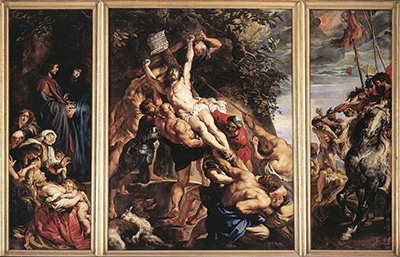
The Elevation of the Cross
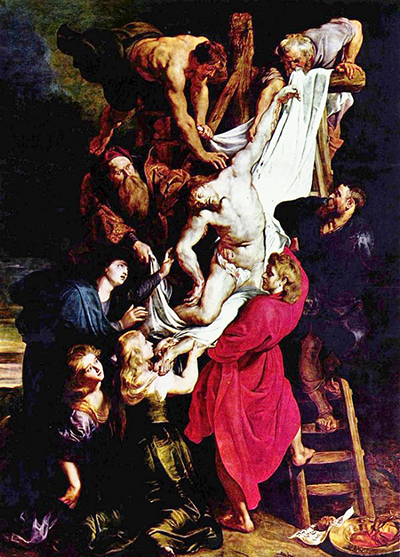
1609–10The Descent from the Cross
1611–14The Garden of Love
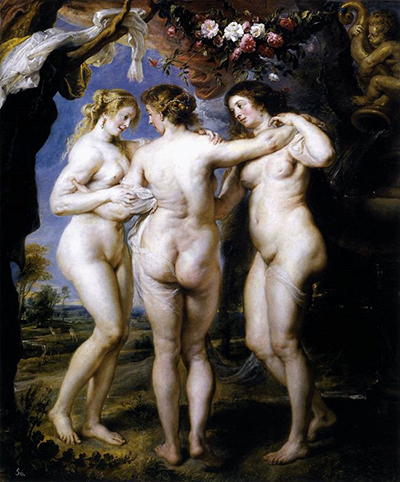
1630–35The Three Graces
1630–35Contents
- Who is shown as Jupiter and Juno?
- Who is in the chariot below?
- Why are there a star and rainbow?
- What did the royal meeting mean?
- Where did the painting first hang?
- Did Rubens paint it alone?
- How should the picture be read now?
Who is shown as Jupiter and Juno?
The Louvre identifies Henri IV as Jupiter and Marie de Médicis as Juno. The king's broad bare torso, red drapery and commanding placement make his divine role legible. Marie moves towards him with the visual dignity of Jupiter's queen. Their human identities remain necessary to the story, but the mythological guises elevate the dynastic meeting beyond a literal encounter at Lyon.
The Louvre also identifies Hymen, the figure carrying a torch, as an attendant of the marriage. In classical imagery, Hymen is associated with weddings; here the torch makes the union visually explicit. The characters occupy a floating upper realm, held up by clouds rather than a palace interior or a city street. Rubens can therefore combine a specific historical date with a timeless language of gods and marriage.
The royal pair do not simply stand side by side like conventional sitters in a double portrait. Their bodies and gestures converge. Henri's arm and turned head answer Marie's approach; her lowered face and open pose draw the eye towards him. This arrangement makes the meeting an event unfolding in front of the viewer, even though its setting is deliberately impossible.
Jupiter's eagle is also visible near the right of the upper group. Its dark wing forms a strong shape against the clouds and the king's pale body. The animal belongs to the god's attributes and deepens the identification of Henri with Jupiter. A viewer can find the iconography in layers: first the embracing pair, then the torch, then the eagle and sky.
This transformation flatters both people. Marie becomes Juno, not simply a bride arriving after a journey; Henri becomes ruler of a divine realm, not merely a husband awaiting her. The Louvre's catalogue describes the cycle as a heroic account of the queen's life. The picture's mythological language supports that project while still relying on the recognisable event of a royal reunion.
Who is in the chariot below?
The woman seated at lower right personifies Lyon, according to the Louvre. Older readings identified her as Cybele, but the museum explicitly rejects that identification for this canvas. The distinction is easy to miss because the figure is a grand female presence in a lion-drawn chariot. Here her job is to stand for the city where the couple met.
The lions produce a visual pun: Lyon sounds like the French word lions. The city is also shown as a real place in the distant background. Rubens thus gives the viewer two forms of Lyon at once, a personified figure near the foreground and an urban setting beyond. Neither is merely decorative. Both anchor the celestial meeting to a named location.
Small winged cupids ride the lions. The Louvre interprets them as saying that love overcomes force. The animals embody strength, while the putti are light and playful. They do not hold the lions by violence; they sit on them as though love can govern even powerful creatures. This symbolic point is part of the museum's reading of the composition, not a quotation from Rubens written on the canvas.
The chariot's movement gives the lower half of the painting its own energy. The lions advance across the foreground, their fur and bodies contrasting with the smooth cloud forms above. Lyon turns up towards the royal pair, so the city seems to witness or welcome the union. The eye moves along the animals, up through the personification and into the meeting among the gods.
The two registers, earthly and heavenly, depend on each other. Without the lower city and chariot, the upper figures might appear to be a generic Jupiter-and-Juno scene. Without the celestial couple, the lower group would be an elaborate civic emblem. Rubens ties them together to make a political event seem fated and celebrated by more than the people actually present.
Why are there a star and rainbow?
The Louvre notes a bright star above Jupiter and discusses more than one possible reading. Its catalogue refers to a Baluze memorandum identifying the star as Hesperus, associated with Venus, a flattering sign for the queen. It also says a planetary star in the world of the gods could be read in relation to Jupiter and the royal couple's children. A single fixed label would flatten the museum's own caution.
The rainbow across the sky is less ambiguous in the Louvre's account. It signals a radiant future under heavenly favour. Its broad arc visually links the upper figures to the edge of the picture and makes the clouds feel like an opened realm. Rubens could use such a sign to move the viewer from the historical fact of a meeting to an imagined future of dynastic promise.
The painting was made more than twenty years after the represented event. That hindsight matters. The rainbow is not a weather report for Lyon on 9 December 1600. It is an image of how Marie's commissioned cycle wanted the moment to be understood. The star likewise belongs to the picture's allegorical argument, not to a documented astronomical observation on the day of the meeting.
Such details show how the cycle blends chronology with praise. An actual date, a real city and identifiable rulers form the base. Mythological figures and celestial signs enlarge their meaning. The Louvre's object essay gives readers a way to see both levels without mistaking the invented vision for a literal record of the event.
What did the royal meeting mean?
The Louvre's alternate title dates the reunion to 9 December 1600. Its essay says Henri reached Marie at Lyon six days after her arrival. This makes the picture a meeting rather than the instant of the queen first stepping into the city. The title Arrival of the Queen at Lyon refers to the larger episode in her journey and marriage; the alternate title specifies the encounter shown.
Marie de Médicis became the wife of Henri IV and queen of France. The Louvre's cycle describes her life in a deliberately heroic mode. A union between king and queen was both personal and dynastic; it shaped the succession and the court's political future. Rubens's choice of Jupiter and Juno makes that public importance visible through a classical language of rulership.
The canvas does not reproduce a witnessed ceremony word for word. No contemporary observer could have seen the couple on clouds, a city-personification beneath them or cupids riding lions. These are acts of visual interpretation. They turn a political marriage into a story of cosmic harmony and civic welcome. Readers who know that difference can appreciate the painting's invention without using it as a factual diagram of what happened in Lyon.
The queen commissioned the cycle for her own palace. That context explains why the story is told with emphasis on her dignity and destiny. It is a public self-presentation, not an independent historian's neutral account. The page should therefore identify the historical event while recognising the patron's stake in the image.
Where did the painting first hang?
The Louvre says the twenty-four canvases were made in 1622–25 for the western gallery of Marie's Luxembourg Palace, built in Paris between 1615 and 1622. Large paintings filled the wall spaces between windows. The series was arranged so that visitors moved through a narrative of the queen's life. The Lyon canvas was one part of that architectural and political experience, not originally a stand-alone museum picture.
Its scale—almost four metres high—makes sense in such a gallery. A viewer standing in front of it would see life-sized or larger bodies, with the lion chariot and the floating royal pair occupying different heights. The small website image is useful for identifying figures but cannot reproduce that spatial force. The painting was designed to meet viewers as they walked through a room lined with related scenes.
The Louvre's object entry traces the cycle's later movement with the Luxembourg Palace and royal collections. It records transfer of the paintings to the Louvre in 1790, a return to the Luxembourg for display from 1802 to 1815, a definitive move to the Louvre in 1816, and installation together in the Richelieu wing in 1993. This is the history of a series repeatedly reframed by new rooms and audiences.
The Louvre's current public guide says the Galerie Médicis is temporarily closed while a major restoration programme proceeds. That current status may change; it should not be frozen into the timeless artwork caption. What remains stable for this page is the collection identity: the painting belongs to the Louvre's Marie de Médicis cycle, INV 1775 / MR 966.
Did Rubens paint it alone?
The Louvre's older object prose calls the series wholly autograph and says that contrary claims are often made. The museum's more recent public discussion of Rubens's large workshop gives wider production context, while its current object field simply credits Rubens. These sources do not justify assigning specific hands to the Lyon canvas from a small reproduction. The public page follows the Louvre's Rubens credit and avoids a stroke-by-stroke authorship claim.
The sheer scale of the commission is relevant. Twenty-four monumental paintings were delivered within a few years. A viewer can understand why studio practice and planning matter to the cycle without needing an unsupported formula about who painted every lion, cloud or face. The Louvre also cites a grisaille sketch in the Hermitage for this scene. That separate sketch indicates a design stage, but the image on this page is the large finished canvas in Paris.
The distinction between sketch and final painting parallels the distinction between event and image. The 1600 meeting, the 1622–25 planning and execution, and later museum display are separate stages. Keeping them straight gives the painting a real chronology beneath its deliberately timeless allegory.
How should the picture be read now?
Start with the royal pair in the clouds. Find the torch-bearing Hymen and Jupiter's eagle. Then follow the rainbow across the upper sky. Drop your gaze to the woman in the chariot, identified by the Louvre as Lyon, and to the putti riding the lions. Finally, look for the actual city in the background. Each step moves between history and allegory.
The painting is a carefully constructed claim about Marie de Médicis's life. It treats a meeting at Lyon as an event welcomed by a city, blessed by gods and projected into a radiant future. It is visually persuasive because the symbols work through bodies and movement rather than sitting as a list of labels. Henri and Marie meet; Hymen illuminates them; Lyon and the lions carry the place and its pun below.
The most reliable short caption gives both kinds of date: The Arrival of the Queen at Lyon, representing the meeting of 9 December 1600, painted 1622–25 by Rubens for the Marie de Médicis cycle. The Louvre inventory INV 1775 / MR 966, medium oil on canvas and dimensions 394 × 295 centimetres distinguish the work from other cycle paintings that share similar size, ambition and royal figures.
Rubens artworks directory
Frequently Asked Questions
The Louvre identifies Henri IV as Jupiter and Marie de Médicis as Juno, with Hymen carrying a torch.
The Louvre explicitly identifies her as the personification of Lyon, not Cybele. The lions make a play on the city's name.
The museum's alternate title gives 9 December 1600. Rubens painted the canvas for the cycle in 1622–25.
It is oil on canvas, 394 × 295 centimetres, in the Musée du Louvre, inventory INV 1775 / MR 966.
No. It was one of twenty-four paintings Marie de Médicis commissioned for the western gallery of her Luxembourg Palace.
Discussion
Find Henri and Marie in the clouds, then Lyon in the chariot.
Share a close observation or a reliable source about Louvre INV 1775.
Reader Insights
How do Jupiter, Juno and Hymen change the royal meeting?
What does the lion-drawn chariot say about Lyon?
Why must the 1600 event and 1622–25 painting dates stay separate?
Join the Conversation
Add your reading below, using the Louvre's figure identifications.
References
- Musée du Louvre, L’Arrivée de la reine à Lyon , INV 1775 / MR 966. View source
- Musée du Louvre, “To the glory of a queen of France — The Galerie Médicis”. View source