by Tom Gurney
Tom Gurney BSc (Hons) is an art history expert with over 20 years experience
Published on June 19, 2020 / Updated on October 14, 2026
Email: tomgurney1@gmail.com / Phone: +44 7429 011000
The day’s work moving home
A cart, sheep and people move through a broad landscape as light spreads low across the fields. The figures are relatively small within a large stretch of land and sky. They give the painting its subject without taking it over. Peter Paul Rubens’s Return from the Fields asks us to look at ordinary rural movement and the open country together: the route home passes through a world that has its own light, weather and distance.
The Italian national cultural-heritage catalogue[1] identifies the painting as oil on panel, 121 × 194 centimetres, in the Galleria Palatina at Palazzo Pitti, Florence. Its inventory number is Palatina 14, national record 0900129513. These object details are more dependable than a generic description of Rubens’s landscapes. They also correct a frequent assumption that a painting of this width must be on canvas. The catalogue’s structured period “1600–1699” is an indexing range, not a usable date for the picture.
The broad panel allows the eye to travel. On one side, the cart and animals carry the weight of field work. On the other, figures and trees pull the scene toward a darker foreground. Between them a road opens into the landscape. Clouds and late light give the horizon a changing atmosphere. This view reveals the overall arrangement; the holding catalogue supplies the material facts that a reproduction cannot establish.
At a Glance
- ArtistPeter Paul Rubens [1]
- Date1630s; published estimates differ [1]
- MediumOil on panel [1]
- Dimensions121 × 194 cm [1]
- CollectionGalleria Palatina, Palazzo Pitti, Palatina 14 [1]
Where this work sits in Rubens's career
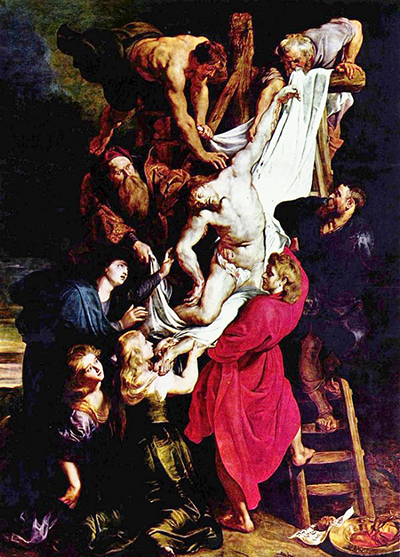
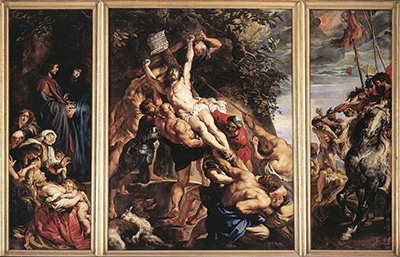
The Elevation of the Cross
1609–10The Descent from the Cross
1611–14The Garden of Love
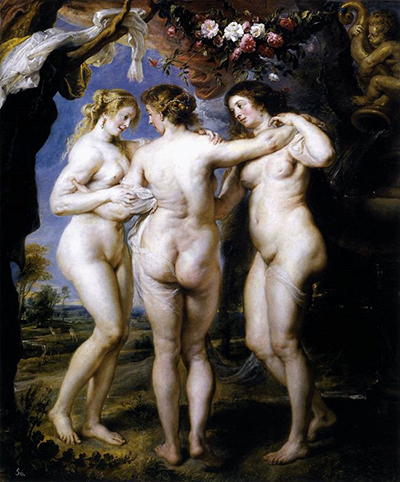
1630–35The Three Graces
1630–35Contents
- A landscape with people at work
- When was it painted?
- What can drawings tell us?
- A visible change in the panel
- Florence, older names and newer readings
- Four drawing comparisons, four different claims
- How the date affects the painting's story
A landscape with people at work
Rubens places workers within the land rather than treating them as an afterthought. Two women carry hay, while a cart and other figures make the return from agricultural labour visible. The picture’s title names a transition: the work in the fields is done or drawing to a close, and people and animals are moving away. It does not identify a single farmer, village or dated harvest. The painting builds a recognisable pattern of rural life rather than a documented portrait of a particular day.
The position of the figures keeps the landscape large. A viewer can follow the road and the distant fields before returning to the people in the foreground. That movement creates an interplay between human effort and the countryside that makes such effort possible. The trees are not mere scenery behind a human drama; they form the passage of light and shade through which the workers travel. Rubens’s interest in bodies, animals and weather all meet in one picture.
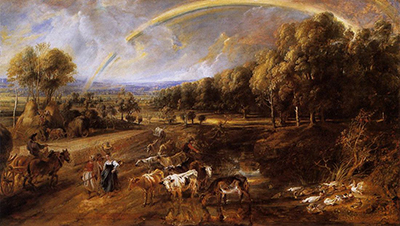
This is not a biblical or mythological subject, and its rural workers do not need allegorical names. Its cart, field workers, animals and lowering light distinguish it from Rubens’s other landscapes. His View of Het Steen and Rainbow Landscape have their own histories and objects. They provide a broader career context for the Florence panel.
When was it painted?
The older Italian catalogue note[1], compiled in 1979 and updated in 2006, places Return from the Fields around 1632–34. It also says the landscape was perhaps made in collaboration with Lucas van Uden. Neither point is a dated signature or a documented division of labour. The date is a specialist estimate; the named collaboration is explicitly conditional.
A newer study points to a somewhat later span. In the publisher’s 2023 Oud Holland summary[2], Corina Kleinert identifies the Pitti painting and dates it about 1635–38. That summary calls the work important but comparatively neglected and makes it central to her discussion of Rubens’s evolving landscape art. The older state record and newer scholarship differ; “1630s” is therefore a cautious general date.
The disagreement is instructive because the painting sits in a period of sustained landscape invention. A date a few years earlier or later affects how closely it is placed beside Rubens’s late estate landscapes, but it does not alter the painting’s present identity, support or location. Nor does the later dating by itself settle van Uden’s role. A reader should be given the range of published estimates and the qualification around collaboration, instead of a precise year presented as if the panel carried one.
What can drawings tell us?
The Italian catalogue commentary[1] links the cart in this painting to two earlier drawings: one in the Devonshire collection at Chatsworth, and another in the Berlin Kupferstichkabinett. It relates a peasant figure to a drawing in the Uffizi. These comparisons describe a painter returning to figure and vehicle ideas across different sheets. They do not mean that every feature of the landscape was planned on those sheets or that any one of the drawings is a full composition study for the finished panel.
The catalogue also discusses an ALBERTINA drawing with five people at the right and records disagreement over its Rubens attribution. That disagreement shows that links between sheets and the Pitti painting require more than visual resemblance. A drawing can be relevant to how a composition developed while its maker remains contested. The landscape was shaped through choices and comparisons rather than imagined in one fixed moment.
The painter’s reuse of a cart motif is not the same as mechanically copying it. A drawing can preserve a posture or arrangement that is then adjusted to a different scale, light and setting. In the Pitti panel, the cart belongs to a specific route through the fields. Its meaning emerges from the surrounding workers, sheep, ground and sky. The related drawings offer evidence of Rubens’s visual storehouse; the Florence picture remains its own completed landscape.
A visible change in the panel
The holding catalogue reports a visible pentimento between the two women carrying hay and the rams. Pentimento means a change from an earlier painted arrangement that can be seen or detected in the finished work. The record does not specify enough to reconstruct the first form of that area. It would be misleading to draw a precise earlier grouping in words or to claim an X-ray finding that the source does not supply. What can be said is that the artist adjusted this active passage of field workers and animals.
That evidence matters for how we look at the wide scene. The everyday subject might appear casual, as though Rubens had merely observed people crossing a familiar track. A visible revision tells us that the placement of figures was worked over. The painter could shift the relationship between women, sheep and road to make the movement through the composition clearer. The object itself thus resists a simple story of an unplanned rural snapshot.
The record’s “perhaps” about van Uden is another boundary. In seventeenth-century Antwerp, landscape specialists and figure painters could work together, but that general practice cannot prove who painted which passages on this panel. The older catalogue proposes possible collaboration without allocating particular passages. Rubens is the named artist in the holding record; the proposed second hand remains a question for specialist assessment.
Florence, older names and newer readings
The Italian national catalogue[1] notes that the seventeenth-century writer Roger de Piles described the work under a name referring to a view of Mechelen. That historical title is part of the painting’s reception. It is not proof that every field, tree or building in the image can be mapped to Mechelen. The current catalogue title, Return from the Fields, instead foregrounds what people and animals are doing.
Kleinert’s publisher summary[2] approaches Rubens’s landscapes through otium, a period term for fruitful leisure, including contemplation in the countryside. Her account proposes that this lens helps explain the growth and reworking of his landscapes and gives the Pitti picture an important role. This is a modern scholarly interpretation, not a surviving statement by Rubens that he painted these workers to illustrate a named philosophical idea. It can enrich a reader’s view after the object’s visible evidence has been made clear.
There is a productive tension here. The represented people work, carry and travel; the later scholar asks how looking at a countryside image could also offer space for reflection. The painting can hold both experiences. A viewer may take pleasure in the late light and broad prospect while still seeing the effort of labour that gives the scene its title. No symbolic code is needed to make that relation worth noticing.
The Florence location matters too. The Galleria Palatina[1] holds this particular panel, while many of Rubens’s better-known late landscapes are in British collections. Research on the British landscapes may provide career context, but the Pitti panel has its own inventory, material and scholarship.
Four drawing comparisons, four different claims
The Italian catalogue does more than say “Rubens made studies.” It identifies two earlier cart drawings, one in the Devonshire collection at Chatsworth with a reaper and a wagon at the right, and another in the Berlin Kupferstichkabinett, numbered 3237, with two wagons. Their common subject explains why they are brought into discussion of the cart in Return from the Fields. It does not establish that Rubens drew either while planning this exact panel. An artist could return to a useful vehicle type after years of looking and drawing. The comparison is about a motif that appears again in a new composition.
For one peasant figure, the same catalogue cites an Uffizi drawing numbered 8439s. This is a narrower claim than treating that sheet as a complete model for the Florence landscape. A figure moving in one direction can be adapted to a broader scene of workers and animals; the panel's road, light and changing sky remain separate compositional problems. If the figure correspondence is accepted, it shows Rubens drawing on a store of human poses alongside his studies of carts. It does not identify any individual farm worker who posed for the final painting.
The ALBERTINA sheet 17469, showing five figures at the right, has a more contested place in this chain. The Italian catalogue records that Burchard and d'Hulst considered it autograph Rubens, while J. Müller Hofstede rejected that attribution. A visual relationship to the Pitti picture is therefore not enough to settle the sheet's author or function. It might be related without being a secure preparatory drawing in Rubens's own hand. The public page gives that dispute because calling all four sheets “Rubens studies for Return from the Fields” would convert different levels of evidence into one overconfident label.
How the date affects the painting's story
The national catalogue's 1632–34 estimate and Kleinert's 1635–38 dating place the panel in different parts of Rubens's late career. The later range would bring it closer to the great panoramic landscapes associated with Het Steen; the earlier range would make it a more distant predecessor. The difference does not change the title or the physical panel, but it changes the story an author might tell about why Rubens returned to countryside subjects. This is why a current overview should keep the disagreement visible and use “1630s” for a compact label.
Kleinert's published summary also warns against making otium into a fixed programme imposed on every Rubens landscape. It defines the idea as fruitful, contemplative leisure and says Rubens did not follow it programmatically. Applied to this painting, it suggests a way to think about the painter or viewer contemplating a scene of rural work; it does not turn the workers into allegorical personifications of leisure. The cart, hay carriers and sheep remain what the object presents. The interpretation belongs to a modern research question, and the catalogue's visible pentimento remains separate material evidence about making the scene.
That distinction between depicted labour, painterly revision and later contemplation gives the Florence panel its depth. Its everyday action is neither a mere excuse for scenery nor proof of a detailed social record. The visible correction between hay carriers and rams suggests deliberate adjustment of movement. The wide panel creates room for the eye to pause in fields and sky. A viewer can respond to both the effort of the people returning home and the freedom of looking across the countryside, without assuming Rubens left a written explanation of that response.
Rubens artworks directory
Frequently Asked Questions
It belongs to the Galleria Palatina at Palazzo Pitti, Florence, inventory Palatina 14.
The Italian national catalogue records oil on panel, 121 × 194 centimetres.
The older holding catalogue estimates 1632–34; a 2023 scholarly summary dates it about 1635–38. “In the 1630s” preserves both published positions in a short label.
The older catalogue says perhaps. The sources reviewed here do not document a definite division of work.
The catalogue reports a visible revision between the women carrying hay and the rams. It does not describe the prior arrangement closely enough to reconstruct it.
Discussion
Look closely at the workers, animals and road.
Share an observation grounded in the painting or its sources.
Reader Insights
How does the broad landscape affect the story of returning home?
What does the recorded pentimento tell us about the composition?
How should the different published dates be explained?
Join the Conversation
Add your reading below, keeping observations specific and evidence clear.
References
- Italian national cultural-heritage catalogue, Rubens, Ritorno dai campi , record 0900129513. View source
- Oud Holland / RKD, 2023 issue summary of Corina Kleinert’s study of Rubens’s landscapes and the Pitti painting. View source