by Tom Gurney
Tom Gurney BSc (Hons) is an art history expert with over 20 years experience
Published on June 19, 2020 / Updated on October 14, 2026
Email: tomgurney1@gmail.com / Phone: +44 7429 011000
Rubens looks out from a circle
Several men gather tightly around a table. Most turn towards one another, but the man in the foreground near the right looks directly at us. The Wallraf-Richartz-Museum[1] identifies that figure as Peter Paul Rubens. His gaze makes the viewer feel drawn into a conversation already underway. The painting is both a group portrait and a deliberate introduction to the artist's chosen social world.
The museum calls the work Self-Portrait in the Circle of Mantuan Friends and dates it about 1602–05. It is oil on canvas, 77.5 × 101 centimetres, and is shown in Cologne as a loan from the Federal Republic of Germany, WRM Dep. 248. That loan designation matters: the Wallraf is the displaying museum, but the source does not describe the painting as owned by it. The broad canvas and clustered heads distinguish this picture from Rubens's later individual self-portraits.
The title can sound like a photograph of a meeting in Mantua. The museum instead suggests that these people probably never assembled there in precisely this configuration. Rubens may have brought together individuals and identities that mattered to him in a single constructed image. The painting can therefore be read as a statement about friendship, learning and status rather than as evidence that one actual evening unfolded exactly as painted.
At a Glance
- ArtistPeter Paul Rubens [1]
- SubjectRubens among proposed Mantuan companions [1]
- DateAbout 1602–05 (Wallraf) [1]
- MediumOil on canvas [1]
- Dimensions77.5 × 101 cm [1]
- Display/loanWallraf-Richartz-Museum; German federal loan WRM Dep. 248 [1]
Where this work sits in Rubens's career
Mantuan Friends Self-Portrait
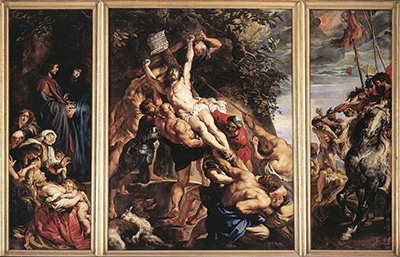
c. 1602–05The Elevation of the Cross
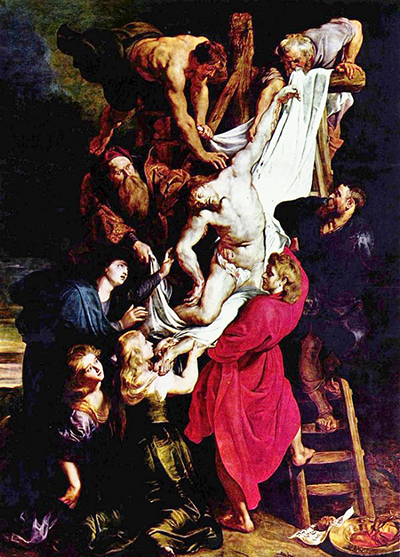
1609–10The Descent from the Cross
1611–14The Garden of Love
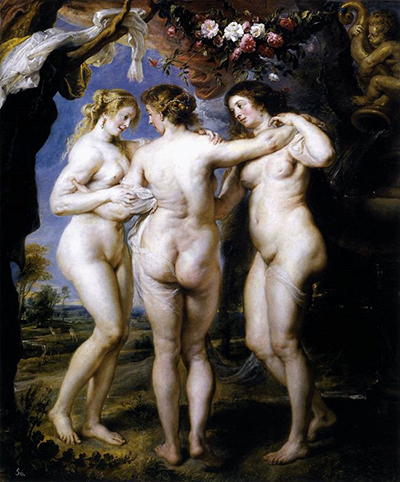
1630–35The Three Graces
1630–35Contents
- Why is Mantua in the title?
- Which figure is Rubens?
- Can the companions be named?
- Why does the scene feel conversational?
- Was this a real meeting?
- How is this different from The Four Philosophers?
- What is known about the painting's collection status?
- How should a viewer read it today?
Why is Mantua in the title?
Rubens travelled to Italy as a young man and worked for the Duke of Mantua. The Wallraf's account places the painting within that early Italian experience, when a Flemish painter could encounter a court, its collections and a network of influential people. The date about 1602–05 falls within those years, before Rubens returned permanently to Antwerp. The setting helped form the artist who later became a major court painter and diplomat.
Mantua is also a social frame. A circle of men close together in a picture can imply access to conversation and learned company. The Wallraf interprets Rubens's self-image as a kind of public introduction: he shows the sort of people with whom he wished to be associated. The title does not establish that every sitter lived in Mantua or that all sat for Rubens at the same time. It connects the composition to his Italian period and to the idea of a cultivated circle.
The close viewpoint reinforces that idea. There is little open space between the men. Faces form a chain across the canvas, and the nearest shoulders make the group seem to occupy our side of the picture. The gathering has no grand architectural setting or formal rank of standing figures. It appears intimate, yet Rubens's direct look means the painter remains the one person who consciously addresses an outside viewer.
An older scholarly catalogue of Rubens's portraits[4] warns that the secure points are Rubens's own likeness, a Mantuan view and the broad Italian-period context; the precise date and several sitter identities have long been debated. The Wallraf gives a useful working date, but that scholarly caution explains why the canvas should not be turned into a fully labelled group photograph.
Which figure is Rubens?
Rubens is the man nearest the foreground on the right side of the central group, looking directly outward. His bright face and shining grey garment stand against darker clothing around him. While his body participates in the circle, his eyes leave it. That turn makes him both one of the companions and the painter who mediates our encounter with them.
The gaze is a practical way to make a self-portrait within a group. A viewer first notices the exchange among the men, then the one face that interrupts it. Rubens can announce his presence without placing himself alone in the centre or holding the tools of his trade. The painting says he belongs to this company, and the eyes say he is also presenting that company to us.
His place among the others is not simply a matter of vanity. Group portraits allow artists to show relationships. A single self-portrait tells us how Rubens wished his own face and clothing to be seen; this one also offers a social claim about who surrounds him. The claim can be considered even if scholars cannot securely name every sitter. The visual structure itself puts the artist in the midst of discussion.
The painting's relatively modest size makes that conversation feel close. At 77.5 × 101 cm, it is much smaller than Rubens's great public altarpieces. The figures are nevertheless large enough to carry distinct expressions and turnings. The viewer reads glances, distances and alignments rather than a distant ceremonial arrangement.
Can the companions be named?
The Wallraf identifies Rubens's brother Philippe near him and the philosopher Justus Lipsius behind him. It says that many of the heads can be recognised. At the same time, the museum qualifies another proposed identification: a figure facing Rubens has been suggested by some scholars as Galileo Galilei. The museum does not present Galileo as an established sitter. A public caption should not silently remove that uncertainty.
The names matter because they would make the group more than a cluster of fashionable men. Philippe connects Rubens to family and shared learning; Lipsius was a prominent thinker; Galileo would connect the circle with early modern science. But different historical interpretations have proposed different names for some faces. The older Rubens catalogue explicitly notes disagreements over figure identifications. The painting's intellectual character should therefore not rest on the unqualified certainty of every suggested sitter.
The issue is clearest with Galileo. If the identification is correct, the gathering gains a powerful association with scientific inquiry. If it is wrong, the picture can still speak about friendship and cultivated identity, because those qualities are built into the group arrangement and the museum's broader reading. A viewer should be able to understand the work without being required to accept a disputed face as a famous astronomer.
Even the proposed family and philosopher identities should be phrased as the Wallraf's account rather than as labels somehow written into the paint. Rubens's own likeness is secure in the museum's treatment. Beyond that, the evidence is art-historical comparison of faces, relationships and context. A careful page preserves the museum's useful identifications while leaving room for specialist reassessment.
Why does the scene feel conversational?
The heads are close, but they do not all face one direction. A man at the left turns inward, a figure near the centre looks across the table, and Rubens breaks the circuit by looking out. This pattern creates a sense of exchange without showing a specific spoken sentence. The viewer feels that ideas might be passing between people, yet the picture does not tell us exactly what they are saying.
Dark clothing makes faces and collars carry much of the action. Changes in expression become more noticeable when the surroundings are restrained. The picture has a compact range of light and shadow: bright skin and fabric sit against deep browns and blacks. That contrast helps us read individual heads within the crowd, while the shared dark ground keeps the companions together.
Rubens gives himself a particularly strong position through light and angle. His face is turned far enough towards us to form an immediate connection, and his garment catches a broad sheen. This does not erase the other men. It lets the artist function as an entry point into the group. Our glance can start with him and travel around the circle to consider the relationships implied there.
The composition feels intimate partly because so much is cropped. We are not shown whole bodies, chairs, or a room that explains every person's place. The limited view concentrates on faces and upper bodies. This economy suits a portrait about company: identity and interaction matter more than furniture or a descriptive account of the location.
Was this a real meeting?
The Wallraf says the friends probably did not meet in Mantua in this exact arrangement. That is a curatorial interpretation, but it fits the way group portraits can gather people conceptually rather than report a single event. Rubens could use likenesses to construct an image of intellectual belonging across time and place. The painting's apparent immediacy need not make it documentary.
This distinction protects the people in the picture from false biography. The image alone cannot prove that Galileo, if correctly identified, sat beside Philippe Rubens on one day; nor can it establish the words exchanged with Lipsius. It shows a painter's arrangement of figures. The historical relationships can be investigated through letters and scholarship, but the canvas is not a verbatim record of a gathering.
Calling it a friendship portrait describes its subject more accurately than calling it a snapshot. The men occupy a shared pictorial space and Rubens includes himself among them. The work proposes company, affinity and standing. Its effect depends on believing the social relation is meaningful, not on proving that every participant stood in one room for a single sitting.
This crafted quality also explains the direct gaze. Rubens makes himself the link between the group and a viewer who was not present. In life, friends might turn inward and shut us out. Here, the painter opens the circle just enough for a new audience. The image's social claim is performed through that turn of the head.
How is this different from The Four Philosophers?
Rubens later painted another group that includes himself, his brother Philippe and Justus Lipsius. The Italian national catalogue identifies that work, The Four Philosophers, as a large panel in the Uffizi, with Jan Woverius also present. It is associated with about 1611–12, years after the Mantuan friends canvas. The same names and a similar concern with learned company can make the two paintings easy to conflate.
Their objects and visual structures differ. The Mantuan picture is a 77.5 × 101 cm canvas shown at the Wallraf on German federal loan. The Uffizi picture is a substantially larger panel with its own collection identity and commemorative context. Details such as the Uffizi's tulips or so-called Seneca bust should not be copied into a description of the Mantuan canvas merely because Lipsius and Rubens appear in discussions of both.
The later work is useful as a comparison because it shows that Rubens returned to the idea of placing his image among thinkers and intimates. Yet each group has to be read on its own terms. In the Mantuan painting, the tight gathering and outward glance carry the first impression. In the Uffizi panel, the figures and objects form a different statement, shaped by later circumstances. Treating the two as separate gives Rubens's changes in purpose room to emerge.
The distinction is also practical for an art reader. If a source says “Rubens with his brother and Lipsius,” ask which painting it means. Check the support, size, collection and other named companions. The broad description could fit more than one work, but the Wallraf loan number WRM Dep. 248 belongs to this early Mantuan image.
What is known about the painting's collection status?
The Wallraf presents the painting as WRM Dep. 248, a loan from the Federal Republic of Germany. It is available through the museum's account and has been central to a Wallraf project exploring friendship. The loan status is not a trivial cataloguing suffix. It prevents a statement that the Wallraf owns the canvas outright when the cited record says otherwise.
The number also makes the object traceable. Titles in different languages vary slightly: Self-Portrait in a Circle of Friends from Mantua, Self-Portrait in the Circle of Mantuan Friends, and the German Selbstbildnis im Kreise der Mantuaner Freunde all point to the same painting in this context. The support, dimensions and loan designation connect those labels to a particular canvas.
The Wallraf source does not provide a complete chain of ownership from Rubens's lifetime. It gives present display, loan status and an interpretive account. A fuller provenance would require dedicated collection records. Leaving that gap visible is preferable to turning a modern museum setting into an invented uninterrupted history.
The painting has also attracted repeated debate about date and sitters. That debate is part of its reception, not an obstacle to viewing it. We can say securely that Rubens depicts himself in a close group during his Italian years, and we can describe the museum's proposed companions while acknowledging what remains unsettled.
How should a viewer read it today?
Start with Rubens's eyes. They bring you into the picture and make his self-portrait immediately legible. Then follow the other faces and their different directions of attention. The dense composition makes the gathering feel warm and active even though no dramatic gesture announces a specific event.
Keep the object facts close at hand: about 1602–05 in the Wallraf's dating, oil on canvas, 77.5 × 101 cm, WRM Dep. 248, a German federal loan. Those details identify this work. The proposed Philippe, Lipsius and Galileo names should be read with the degree of certainty the museum gives them, and with the older scholarship's warning that several identities have been disputed.
What remains clear is the painting's achievement as an image of belonging. Rubens has placed himself within a cultivated circle and chosen to face outward. The group can suggest intellectual friendship without proving that all of its members met in one place. The portrait shows how a young artist used likeness, proximity and gaze to present a social identity that would matter throughout his career.
Rubens artworks directory
Frequently Asked Questions
He is the foreground figure looking directly at the viewer, according to the Wallraf-Richartz-Museum.
No. The Wallraf says some scholars have suggested a figure is Galileo, but treats the identification as a possibility.
The Wallraf thinks the pictured people probably did not gather there in precisely this arrangement. The painting can be read as a constructed statement of friendship and learned company.
The Wallraf shows it as WRM Dep. 248, a loan from the Federal Republic of Germany. The museum is the displaying institution.
No. The Four Philosophers is a later, larger Uffizi panel with a different arrangement and collection history. The Mantuan friends work is an early canvas shown in Cologne.
Discussion
Start with Rubens's gaze and follow the other faces around the group.
Share a close observation or a reliable source for WRM Dep. 248.
Reader Insights
How does the painting present Rubens's social identity?
Which proposed sitter names need qualification?
Why is the group better read as a constructed portrait than a documented meeting?
Join the Conversation
Add your reading below, keeping this canvas distinct from The Four Philosophers.
References
- Wallraf-Richartz-Museum, Selbstbildnis im Kreise der Mantuaner Freunde , WRM Dep. 248. View source
- Wallraf-Richartz-Museum, Rubens, You and I exhibition information. View source
- Italian national cultural catalogue, Rubens's separate Four Philosophers panel. View source
- Corpus Rubenianum portrait catalogue excerpt discussing the Mantuan work's disputed date and sitters. View source